‘Many may die’ warns UN after end of Black Sea grain deal
The spike in grain prices in the days since Russia quit a deal allowing the safe Black Sea export of Ukraine grain “potentially threatens hunger and worse for millions of people,” the United Nations aid chief has told the Security Council.
Russia quit the Black Sea grain deal on Monday, saying that demands to improve its own food and fertiliser exports had not been met and complaining that not enough Ukrainian grain had reached poor countries.
US wheat futures in Chicago rose more than 6 percent this week and had their biggest daily gain on Wednesday since Russia invaded Ukraine, but pared some of those gains on Friday in part due to hopes Russia may resume talks on the deal.
“Higher prices will be most acutely felt by families in developing countries,” Martin Griffiths told the 15-member body, adding that, currently, some 362 million people in 69 countries were in need of humanitarian aid.
“Some will go hungry, some will starve, many may die as a result of these decisions,” he said.
Bulgaria to send armoured vehicles to Ukraine in U-turn
Bulgaria has decided to send about 100 armoured personnel carriers to Ukraine in the Balkan country’s first shipment of heavy equipment to Kyiv.
Parliament approved – with 148 votes in favour and 52 against – a proposal of the new pro-European government to send the vehicles along with armaments and spare parts.
The government bought various models of Soviet-made BTR carriers in the 1980s but they were never used.
“This equipment is no longer necessary for the needs of Bulgaria, and it can be of serious support to Ukraine in its battle to preserve the country’s independence and territorial integrity after the unjustified and unprovoked Russian aggression,” parliament said in its decision.
Russia accuses Ukraine of using grain corridor for ‘terrorism’
Russian Deputy Foreign Minister Sergey Vershinin accuses Ukraine of using a grain export corridor to launch “terrorist attacks” against Russian interests, including on the Crimean Bridge.
Addressing Russia’s decision to pull out of the grain deal, Vershinin said, “It was used – as we know, and we have also talked about it – to organise terrorist attacks.”
“It was the Crimean Bridge, twice already. It was Sevastopol. Remember last October.”
A bridge that links Russia to Crimea was hit on Monday killing two people.
Russian attacks on Black Sea ports could have a ‘far-reaching impact’ on food supplies: UN
The UN political affairs chief has told the Security Council that Russia’s attacks on Black Sea ports risk “having far-reaching impacts on global food security, in particular, in developing countries”.
Rosemary DiCarlo added that threats by Russia and Ukraine to potentially target civilian vessels were unacceptable.
“Any risk of conflict spillover as a result of a military incident in the Black Sea – whether intentional or by accident – must be avoided at all costs as this could result in potentially catastrophic consequences to us all,” she said.
Russia says it will protect Africa from grain deal fallout
Moscow will do “all it can” to protect Africa from the consequences of withdrawing from the Black Sea grain export deal, Russian Deputy Foreign Minister Sergei Vershinin said.
Vershinin added that Russia is working on new grain export routes following its exit from the deal when it expired on Monday.
The deal, which the UN and Turkey had brokered, aimed to prevent a global food crisis by allowing grain blocked by the war in Ukraine to be safely exported from Black Sea ports.
Putin says Ukraine’s counteroffensive is failing
President Vladimir Putin says Kyiv’s counteroffensive was failing despite military and financial support from Western countries.
During a televised meeting of the Kremlin’s Security Council, Putin said, “Neither the colossal resources that have been pumped into the Kyiv regime nor the supplies of Western weapons, tanks, artillery, armoured vehicles and missiles are helping.”
According to the Russian state-owned TASS news agency, Putin said Ukrainian forces were also suffering from colossal losses.
“Most importantly, as a result of suicidal attacks, the formations of the Armed Forces of Ukraine suffered huge losses. These are tens of thousands, exactly tens of thousands of people,” he added.
Russian warships conduct drills in Black Sea
Russia’s Black Sea Fleet has conducted an exercise in enforcing a naval blockade, the Defense Ministry reported on Friday. The drills come after Russia and Ukraine declared that they would presume all civilian ships traveling to each other’s ports to be carrying military cargo.
According to the Russian ministry’s statement, warships and naval aviation “trained in isolating an area that was temporarily suspended for traffic” and “conducted measures to detain a [simulated] trespassing vessel.”
During the same exercise, a Russian patrol boat fired cruise missiles at a target ship placed on a training range. It was successfully hit and destroyed, the ministry reported.
On Monday, Russia declined to extend the Black Sea Initiative, a UN and Turkey-mediated arrangement with Ukraine, which allowed Kiev to export grain via its seaports. Moscow said the UN had failed to deliver on its part of the bargain and convince Western nations to lift sanctions hampering Russian exports of food and fertilizers.
The Russian Defense Ministry further announced that starting on Thursday it would revoke security guarantees under the deal. It now considers all ships moving to Ukrainian ports in the Black Sea as “potential carriers of military cargoes” and their flag nations as “involved in the Ukrainian conflict on the side of the Kiev regime”.
The Ukrainian military issued a similar warning on Thursday, which it claimed to be a response to the Russian policy. The statement declared the Black Sea a “danger zone” for Russian and Russia-bound ships.
Kiev also brought up the sinking of the Russian fleet’s former flagship, the Moskva, destroyed in April 2022 in what is widely believed to have been a Ukrainian missile attack. The Russian military said the warship was heavily damaged by a fire and explosions of munitions on board.
China’s position on Ukraine is ‘unchanging’ and ‘clear’
China says its position on the war in Ukraine remains “unchanging” and “clear”, the Russian news agency TASS reported.
“We will make efforts and continue to play a constructive role in order to advance the political process to resolve the crisis,” Chinese Foreign Ministry spokesperson Mao Ning said at a press briefing.
Ning added that China will closely monitor the situation in Ukraine.
On Thursday, explosions hit near the building of the Chinese Consulate General in Odesa.
None of the employees of the diplomatic mission were injured but minor damage to the building was reported.
Russia hits grain terminals in southern Ukraine: Governor
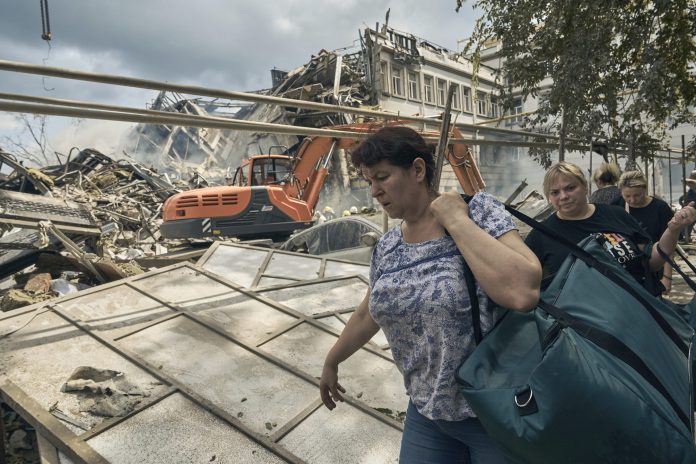
Russian missiles hit grain terminals at an agricultural enterprise in the Odesa region in a fourth successive night of air strikes on southern Ukraine, the regional governor has said.
“Unfortunately, the grain terminals of an agricultural enterprise in Odesa region were hit. The enemy destroyed 100 tons of peas and 20 tons of barley,” Odesa’s regional governor Oleh Kiper stated, adding that two people had been hurt in the attack.
Kiper said Russia had attacked with Kalibr cruise missiles that were fired from the Black Sea at low altitudes to bypass air defence systems.
Photographs from the scene showed a fire burning among crumpled metal buildings that appeared to be storehouses and a badly damaged fire-fighting vehicle.
Moscow says it has been carrying out “retaliatory strikes” this week after quitting the Black Sea grain export deal and accusing Ukraine of being behind blasts on Monday on a bridge that is used to transport Russian military supplies.
Russia used almost 70 missiles and nearly 90 drones in just 4 days: Zelensky
Russia has used almost 70 missiles of various types and almost 90 combat drones over just four days during attacks on the Ukrainian cities of Odesa, Mykolaiv and other southern communities, according to Ukrainian President Volodymyr Zelensky.
“Of course, our soldiers managed to shoot down some of the enemy missiles and drones, and I thank each of our sky defenders for this,” he said Thursday in his nightly address.
“Unfortunately, the Ukrainian air defense capabilities are not yet sufficient to protect the entire Ukrainian sky,” he added.
Ukraine is working with partners “as extensively as possible” for additional air defense systems that can provide security to Odesa and other cities across the country, Zelensky continued.
Speaking about the Black Sea grain deal, Zelensky said that work “to mobilize the world to protect food security and normal life” continues. He added he spoke earlier Thursday for the first time with the Ethiopian Prime Minister Abiy Ahmed Ali, whose country is experiencing “one of the most critical situations in the world.”
“I am confident that this year we can do it all together, the whole world,” Zelensky continued, stating, “No one in the world is interested in Russia’s success in destroying the global food market.”
The Ukrainian president also thanked countries that have extended sanctions on Russia over its war in Ukraine.
“Russia and everyone in this world who dares to help terrorists must feel the ever-increasing sanctions pressure, whether they are individuals, companies or countries,” Zelensky stated.
Russian envoy denies plot to attack civilian ships and to blame Ukraine
Russia has no intention of targeting civilian vessels in the Black Sea and to blame Ukraine, Anatoly Antonov, Russia’s ambassador to the US, said Thursday.
He was responding to a media question about comments made by National Security Council spokesman Adam Hodge on Wednesday. Hodge also claimed Russia has laid additional sea mines in the approach to Ukrainian ports.
“Attempts to attribute to Russia the preparation of some sort of attacks on civilian vessels are pure fabrication. It is no secret that the [US] administration does not shy away from the basest anti-Russian information provocations,” Antonov said in a statement posted on the embassy’s Facebook page.
“We regard the statements by the United States of America as an effort by any means to disguise its own destructive activities aimed at actually sabotaging the implementation of the mutually agreed Istanbul agreements. To discourage representatives of the Global South from cooperating with Russia. To undermine confidence in our country, which not in words but in deeds helps developing countries by supplying food and fertilizers, including on a gratuitous basis,” Antonov stated.
It is “especially indicative that the administration intensifies with such insinuations on the eve of major international forums,” Antonov said, adding that “a new round of false propaganda” is being used ahead of the second Russia-Africa summit scheduled for the end of July in St. Petersburg and the upcoming BRICS heads of state meeting in August
Some Western weaponry sent to Ukraine was stolen last year before being reclaimed: Pentagon watchdog
Criminals, volunteer fighters and arms traffickers in Ukraine stole some Western-provided weapons and equipment intended for Ukrainian troops last year before being recovered, according to a Defense Department Inspector General report obtained by CNN.
Ukraine’s intelligence services disrupted plots to steal the weaponry and equipment, and they were ultimately recovered, according to the report. CNN obtained the report, titled “DoD’s Accountability of Equipment Provided to Ukraine,” via a Freedom of Information Act request. Military.com first reported the news.
But the inspector general report noted that after Russia’s invasion of Ukraine last year, the Defense Department’s ability to track and monitor all of the US equipment pouring into Ukraine, as required by law under the Arms Export Control Act, faced “challenges” because of the limited US presence in the country.
The report, dated October 6, 2022, examined the period from February to September 2022. The Office of Defense Cooperation in Kyiv “was unable to conduct required (end-use monitoring) of military equipment that the United States provided to Ukraine in FY 2022,” it said.
“The inability of DoD personnel to visit areas where equipment provided to Ukraine was being used or stored significantly hampered ODC-Kyiv’s ability to execute” the monitoring, the report added.
In late October, the US resumed on-site inspections of Ukrainian weapons depots as a way to better track where the equipment was going. The department has also provided the Ukrainians with tracking systems, including scanners and software, the Pentagon’s former undersecretary of defense for policy, Colin Kahl, told lawmakers in February.
But the report underscores how difficult it was in the early days of the war for the US to track the billions of dollars worth of weapons and equipment it was sending to Ukraine.
Ukraine is using US-provided cluster munitions effectively in combat: White House official
Ukrainian forces are using US-provided cluster munitions against Russia “appropriately” and “effectively” in combat, National Security Council coordinator for strategic communications John Kirby said Thursday, confirming that Ukraine has started using the munitions in combat.
“They are using them appropriately. They’re using them effectively and they are actually having an impact on Russia’s defensive formations and Russia’s defensive maneuvering. I think I can leave it at that,” Kirby told reporters.
Asked when Ukrainians began using the cluster munitions, Kirby said he would “guess” in the last week or so.
The US announced on July 8 that it would be sending the controversial munitions, and they were delivered to Ukrainian forces about a week later. Cluster munitions scatter “bomblets” across large areas, which would allow Ukrainian forces to target larger concentrations of Russian forces and equipment with fewer rounds of ammunition. But the bomblets can also fail to explode on impact and can pose a long-term risk to anyone who encounters them, similar to landmines.
Kirby also discussed the additional sanctions on Russia that US President Joe Biden’s administration announced Thursday, saying that they are and will continue to be an effective tool going forward.
“I have every expectation that in coming days you’re gonna be another round of support provided to Ukraine because we are really trying to keep a fingertip on what’s going on in the battlefield and what they need,” Kirby added.
Kirby also reiterated the warning from the National Security Council suggesting Russia could be preparing to stage a false-flag operation in the Black Sea to try to justify its attacks on ships.
Chief: EU to create dedicated 20 billion euro section for Ukraine defence
The European Union will provide up to five billion euros ($5.57bn) a year for the next four years for Ukraine’s defence needs via the means of a “dedicated section” under the European Peace facility, the EU’s foreign policy chief, Josep Borrell, has said.
“It’s still the same tool, the European Peace facility, which has been working very well and we will continue using it but with a dedicated chapter inside it, with a specific funding which can be estimated on the figures I mentioned,” Borrell told reporters during a news conference after convening with EU member states’ foreign ministers.
UN chief condemns Russian attacks on Ukraine Black Sea ports
United Nations Secretary-General Antonio Guterres has slammed Russian attacks on military infrastructure in southern Ukraine.
“These attacks are … having an impact well beyond Ukraine. We are already seeing the negative effect on global wheat and corn prices which hurts everyone, but especially vulnerable people in the global south,” Guterres said in a statement from his spokesman, Stephane Dujarric.