
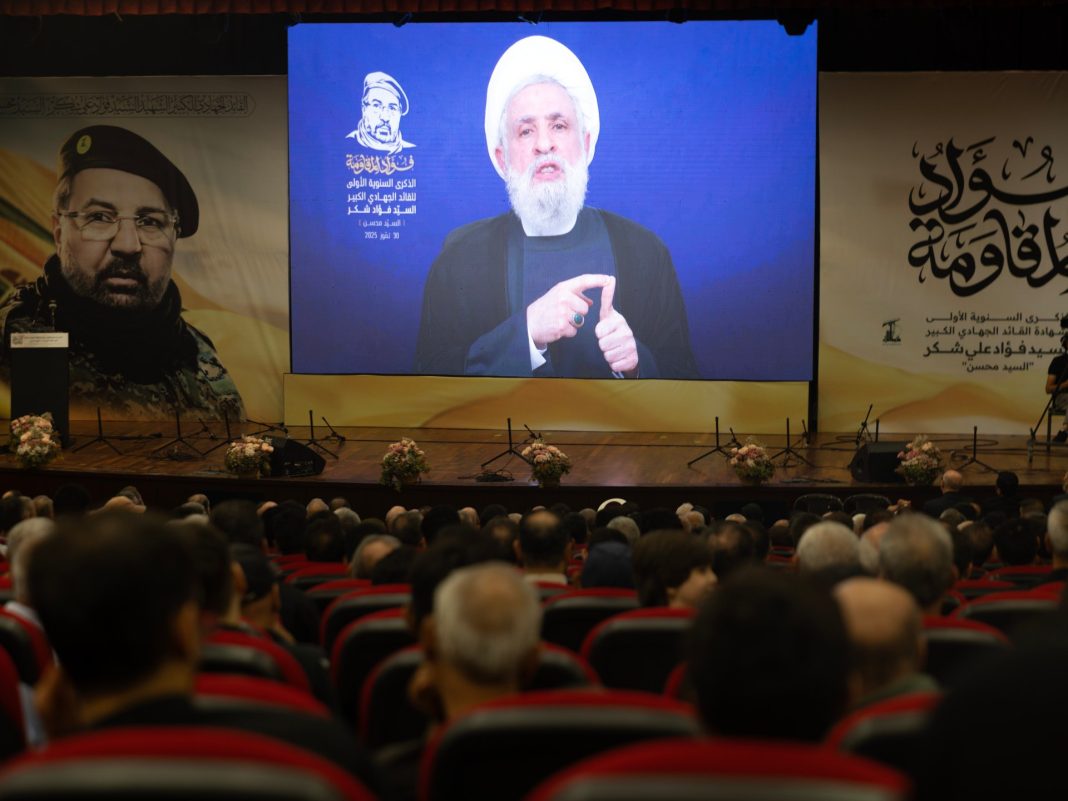
The comments marked Qassem’s first public reaction after Israel announced Sunday that it had killed Tabtabai, Hezbollah’s chief of staff, in an airstrike that targeted Beirut’s southern suburb.
Speaking at a memorial event for the slain commander, Qassem reiterated that “what happened is a blatant attack and a deliberate crime, and we have the right to respond –we will determine the timing ourselves.”
Sunday’s strike on the southern suburb left five people dead and 25 wounded. Hezbollah confirmed Tabtabai’s death in the attack.
He added that the ceasefire agreement reached Nov. 27, 2024, “represents a new phase in which the state has decided to assume responsibility for expelling the occupation and deploying the Lebanese army.”
Qassem attacked those he described as “servants of Israel” in Lebanon, saying that although they are few, they create problems by attempting to destabilize the country and following American orders.
He noted that the party is ready “to discuss the defensive strategy, but not under pressure, not in pursuit of a new agreement, not to give up our strength as part of any other arrangement, and not to evade the current agreement.”
He accused Israel of wanting Lebanon to be its backyard.
“We will not accept that the enemy decides how we live. We, our people, our allies, and our army will not accept being subservient to Israel,” he stated.
Qassem also commented on Israel’s Friday attack on Syria, stressing that the Beit Jinn attack “proves that the Syrian people will not accept surrendering to Israel.”
A ceasefire was reached between Tel Aviv and Beirut on Nov. 27, 2024, after more than a year of attacks against the backdrop of the war in the Gaza Strip. More than 4,000 people were killed and 17,000 injured.
The Israeli army was supposed to withdraw from southern Lebanon this January, under the ceasefire, but instead only partially pulled out and continues to maintain a military presence at five border outposts.
