
Former Prime Ministers Yair Lapid and Ehud Olmert levelled the criticism on Sunday as Israeli forces continued to bombard Gaza.
Lapid, the leader of Israel’s biggest opposition party, told Israeli Army Radio that “nothing good” would come out of the plans to establish the “humanitarian city” on the ruins of the city of Rafah.
“It’s a bad idea from every possible perspective – security, political, economic, logistical,” he said.
“I don’t prefer to describe a humanitarian city as a concentration camp, but if exiting it is prohibited, then it is a concentration camp,” he added.
Lapid served as Israel’s prime minister for six months in 2022.
According to the Israeli government, the “humanitarian city” will initially house 600,000 displaced Palestinians currently living in tents in the overcrowded area of al-Mawasi along Gaza’s southern coast. But eventually, the enclave’s entire population of more than two million people is to be moved there.
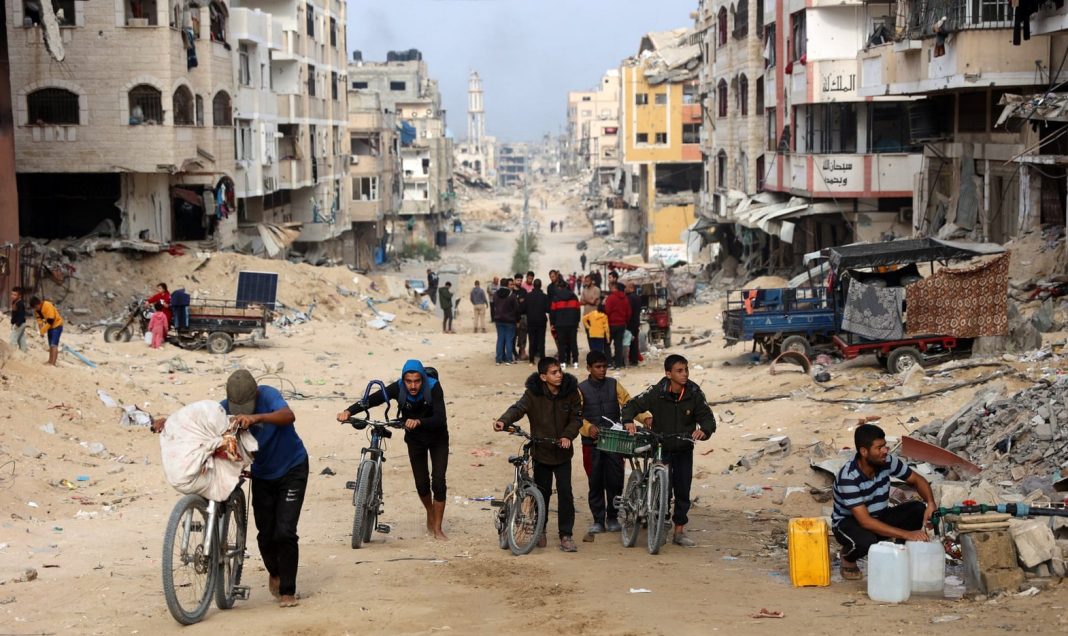
Satellite images have shown Israeli troops have stepped up demolition operations in Rafah in recent months. On April 4, the number of destroyed buildings stood at about 15,800. By July 4, the number had gone up to 28,600.
Olmert, who served as Israel’s prime minister from 2006 to 2009, also slammed the Israeli plan.
“It is a concentration camp. I am sorry,” he told the United Kingdom’s Guardian daily newspaper.
“If they [Palestinians] will be deported into the new ‘humanitarian city’, then you can say that this is part of an ethnic cleansing,” he stated.
“When they build a camp where they [plan to] ‘clean’ more than half of Gaza, then the inevitable understanding of the strategy of this [is that] it is not to save [Palestinians]. It is to deport them, to push them and to throw them away. There is no other understanding that I have at least.”
Humanitarian officials also have announced the plan for the internment camp in Rafah would lay the groundwork for the ethnic cleansing of Palestinians from Gaza.
The Israeli government insisted the transfer of Palestinians to the internment camp in Rafah would be “voluntary” while Netanyahu and United States President Donald Trump have continued to tout their proposal to forcibly transfer all of the Palestinians in Gaza out of the enclave.
Netanyahu said during a dinner with Trump last week that Israel was working with the US “very closely about finding countries that will seek to realise what they always say, that they want to give the Palestinians a better future”.
For his part, the US president added “we’ve had great cooperation from [countries] surrounding Israel” and “something good will happen” soon.
Israel’s neighbours and other Arab states, however, have roundly rejected any plans to displace Palestinians from Gaza, and so have the war-weary Palestinians of the coastal enclave.
