Monday, December 22, 2025
Home Blog Page 921

Interior minister: Iran set to hold runoff parliamentary elections

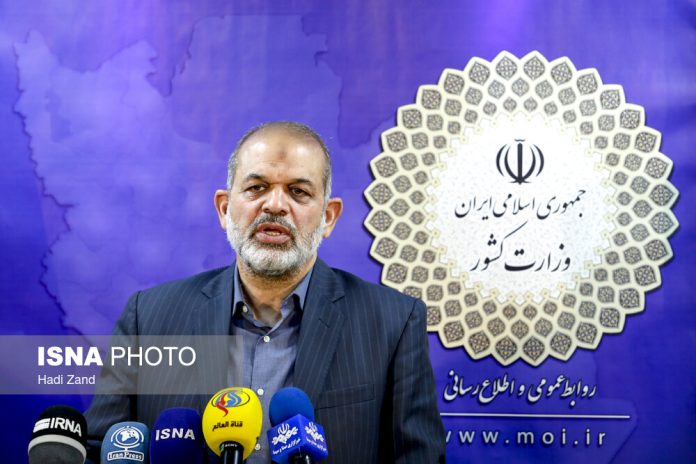
Iran’s Interior Minister Ahmad Vahidi

This round of the elections will be held in 22 constituencies across the country on April 10, and the votes will be cast electronically in 8 constituencies, the interior minister said.

The campaign for the vote will start on May 2.

The first round of the polls was held on March 1 to choose lawmakers from among over 15,000 candidates for the 290-seat legislative body for a four-year term.

Over 61 million people from the country’s 85 million-strong population were eligible to vote in the polls.

According to the official sources, the participation rate for the first round was at around 40 percent.

Iran deputy FM talks Islamic Republic’s strong response to Zionist aggression

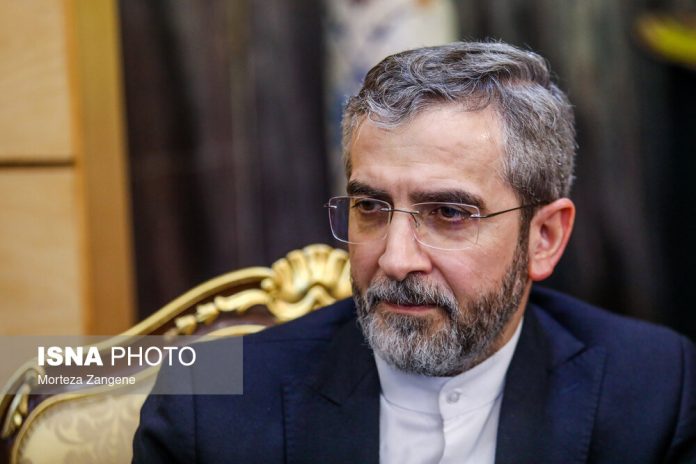
Ali Bagheri Kani

Bagheri, who traveled to Moscow to participate in a meeting of deputy foreign ministers and special representatives of countries in the Middle East and North Africa, added that the BRICS meeting classified the Israeli aggression as consistent with the aggressive nature of the Zionists.

Bagheri noted: “We also emphasized in this meeting that responding to the Zionist regime’s crime in the Syrian capital city of Damascus was the legal right of the Islamic Republic of Iran as a form of countermeasure.”

He stressed: “The Islamic Republic of Iran will respond seriously, quickly, and very harshly to any violation of its territory, interests, or citizens.”

The Iranian deputy foreign minister for political affairs went on to say that Tehran’s response to the crime and aggression of the Zionists demonstrated that the key to protecting regional stability is holding the aggressor accountable.

He said: “As long as the aggressor is rewarded or appeased for their aggression, we cannot hope for stability in the region.”

Younger Americans less likely to support military aid to Israel: Report

Gaza War

About 30% of US adults over the age of 65 strongly favor providing military aid, while about 9% strongly oppose it, according to Pew Research Center.

According to Pew Research Center, there is no big age difference among US adults regarding whether the country should provide aid to Gaza, with 25-33% strongly in favor of doing so.

President Joe Biden on Wednesday signed into law an aid package worth $95 billion that includes $26 billion for Israel.

Student-led protests against Israel’s war on Gaza have intensified across the United States, as House Speaker Mike Johnson suggested the National Guard be brought in and police in riot gear arrested dozens of young people at the University of Texas at Austin (UT Austin) and the University of Southern California (USC).

The arrests on Wednesday in cities of Austin and Los Angeles came as students at Harvard University and Brown University on the east coast also defied threats of action and set up encampments in solidarity with Palestinians in Gaza.

The movement, which began at Columbia University in New York last week, is calling on universities cut financial ties to Israel and divest from companies they say are enabling its brutal war in Gaza. At least 34,300 Palestinians have been killed in Israeli attacks on the besieged enclave since October 7, when fighters from Hamas attacked southern Israel, killing 1,200 people and taking dozens of people captive.

The student protests against the war have been peaceful and largely respectful, but have been met by heavy-handed action from many universities amid allegations of anti-Semitism.

Palestinians retrieve hundreds of bodies from 3 mass graves in Gaza’s Khan Younis

Gaza War

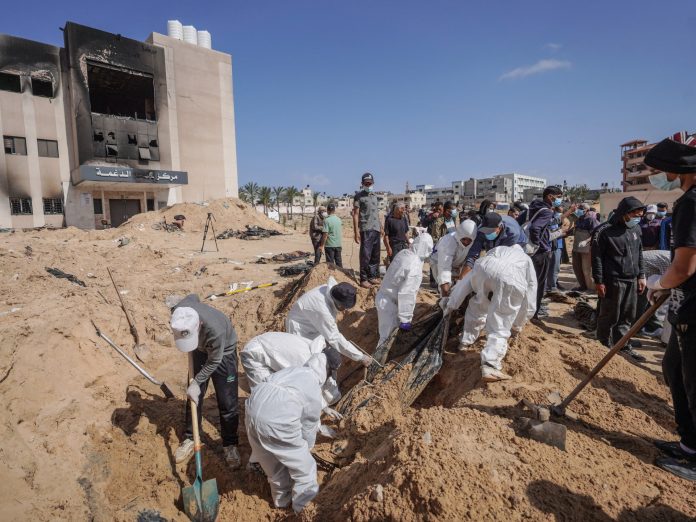
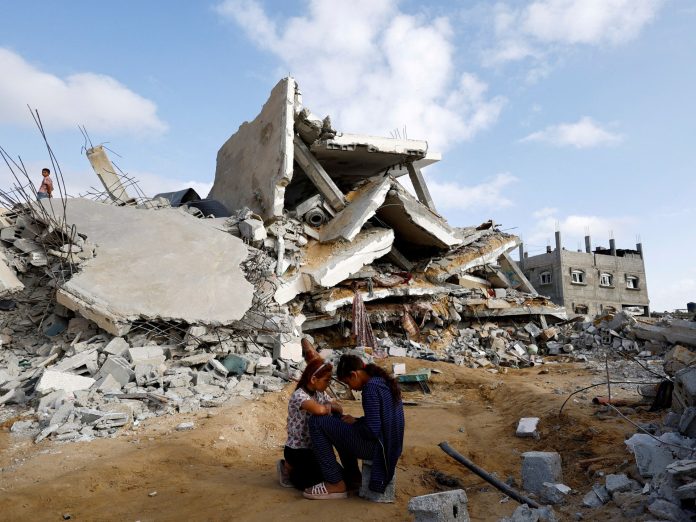
“Civil defense teams have dug up 392 bodies from the mass graves,” the agency said during a press conference in the southern city of Rafah.

Bodies of children were found among the victims.

“We don’t know the reason for the presence of children’s bodies in mass graves at the hospital,” the agency added.

According to the agency, signs of torture were found on the bodies of the victims.

“There are indications of carrying out field executions against some of the victims, while the bodies of other victims carried signs of torture and others were buried alive,” it said.

“Several victims were buried in plastic bags and placed at a depth of three meters, which accelerated their decomposition,” it added.

The bodies were discovered after the Israeli army withdrew from Khan Younis on April 7 following a 4-month ground offensive in the city.

Israel has waged a brutal offensive on the Gaza Strip since a cross-border attack by the Palestinian group Hamas on Oct. 7 last year, which Tel Aviv says killed nearly 1,200 people.

More than 34,300 Palestinians have since been killed, mostly women and children, and 77,300 others injured, according to local health authorities.

More than six months into the Israeli war, vast swathes of Gaza lay in ruins, pushing 85% of the enclave’s population into internal displacement amid a crippling blockade of food, clean water and medicine, according to the UN.

Israel stands accused of genocide at the International Court of Justice. An interim ruling in January ordered Tel Aviv to stop genocidal acts and take measures to guarantee that humanitarian assistance is provided to civilians in Gaza.

The Euro-Mediterranean Human Rights Monitor has also joined numerous rights groups and nations in calling for an independent investigation into the discovery of dozens of mass graves in Gaza.

It said its team members on the ground had witnessed the exhumation of hundreds of bodies found in the vicinity of Gaza City’s al-Shifa Hospital and saw victims “handcuffed … who were executed”.

In a statement, Euro-Med announced the high number of bodies that have been recovered is “alarming, and requires urgent international action, including the formation of an independent international investigation committee”.

Many of those who lost their lives were subjected to “premeditated murder as well as arbitrary and extrajudicial executions while they were detained and handcuffed”, it added.

Israeli officials admit campaign to kill UNRWA funding has failed: Report

UNRWA

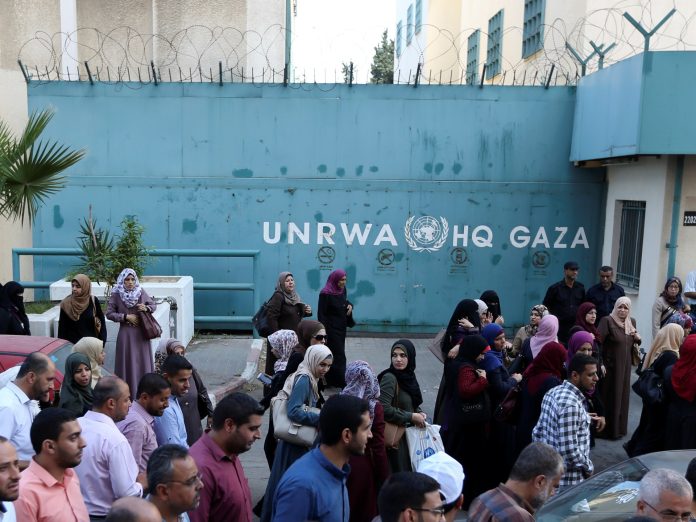
This news comes after Germany announced today that it would restore its funding to the agency, which it froze in January amid allegations by Israel that UNRWA staff had participated in the October 7 attacks on Israel. This week, a report from Catherine Colonna, former French foreign minister, discredited the Israeli allegations.

“Political sources in Israel have acknowledged in talks with foreign diplomats in recent days that Jerusalem had not succeeded in influencing the report in the way it had hoped,” Haaretz daily reported.

“An Israeli source involved in the diplomatic effort to halt funding to UNRWA told Haaretz that the failure was not in the field of public relations and communications, but rather stemmed from the lack of a convincing alternative to UNRWA,” it added.

Philippe Lazzarini, head of UNRWA, has told Al Jazeera that Israel’s campaign to discredit and defund the organisation had led to it facing an “unprecedented” crisis.

UNRWA plays a vital role in distributing desperately needed aid inside Gaza, where thousands are facing famine.

UNRWA has been hindered from doing its job since January, when Israel accused a handful of its thousands of employees of being involved in the Hamas attacks on Israel.

Amid a probe of the claims, several countries have cut off funding to the agency, and its aid work for Gaza’s famine-stricken population has suffered.

At least 18 countries initially suspended funding to the agency amid the allegations.

UNRWA was created by the UN General Assembly more than 70 years ago to assist Palestinians who were forcibly displaced from their land.

The agency provides crucial support to millions of Palestinian refugees in the Gaza Strip, West Bank, Jordan, Lebanon, Syria and other areas where large numbers of registered Palestinians live.

US secretly shipped long-range ATACMS missiles to Ukraine: Report

Long-range ATACMS missiles

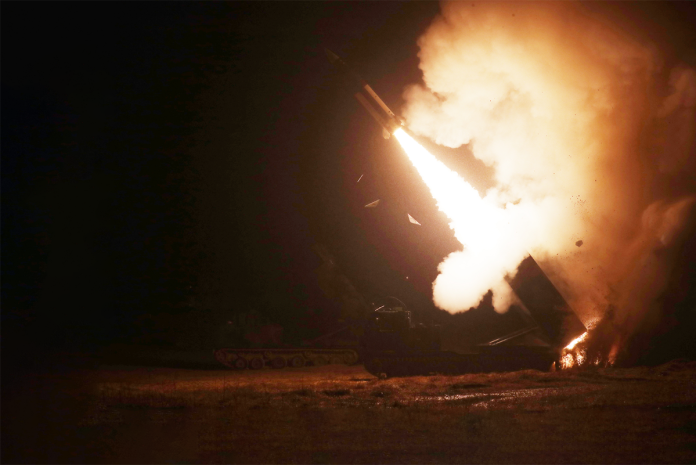
The Army Tactical Missile Systems (ATACMS), with a range up to 300 kilometers, were included in the $300-million package of military aid approved by President Joe Biden on March 12, according to the official, who spoke with Reuters.

Speaking on condition of anonymity, the source said that Ukraine used the missiles for the first time last Wednesday, targeting a Russian airfield about 165 kilometers (103 miles) from the front line.

On the morning of April 17, Ukrainian President Volodymyr Zelensky said his forces had attacked the airbase in Dzhankoy, Crimea. The Russian Defense Ministry has not commented on that claim.

Zelensky has long clamored for longer-range missiles. According to the anonymous official cited in Reuters’ report, the Pentagon was initially opposed, but changed its mind after Russia used ballistic missiles allegedly supplied by North Korea and began targeting Ukraine’s energy infrastructure.

“We warned Russia about those things,” the official said.

“They renewed their targeting.”

Biden was advised to send the longer-range missiles by National Security Advisor Jake Sullivan, Defense Secretary Lloyd Austin, Secretary of State Antony Blinken and Joint Chiefs of Staff Chairman Charles Q Brown, the official added.

The ATACMS were acquired from Lockheed Martin, rather than from the Pentagon stockpiles, and paid for by the “savings” discovered in March, when several military contracts were reportedly delivered for less than the original bid value.

According to the official, Biden instructed his aides to include the ATACMS in the package but to keep it secret, so as to preserve Ukraine’s “operational security and the element of surprise.”

Ukraine first received mid-range ATACMS last September. The Russian military quickly began shooting them down, however, thwarting Zelensky’s plan to damage or destroy the Crimean Bridge.

“This is yet another mistake on the part of the United States,” Russian President Vladimir Putin said last October, explaining that, had Washington refrained from sending the missiles, it could have later positioned itself as the “good guy” for its attempts to prevent needless casualties.

With Russia upgrading its air defenses to intercept the ATACMS, their arrival will not have a major impact on combat operations, and will only “prolong the agony” of Ukraine, Putin explained, adding, “That’s why it’s a mistake.”

Reacting to Washington’s secret delivery of ATACMS missiles to Kiev, Russian ambassador to Washington Anatoly Antonov said the long-range missiles that the US has supplied to Ukraine are “extremely dangerous weapons”, but they will not help Kiev turn the tide of the conflict against Moscow.

The delivery of long-range missiles to Kiev is “impossible to justify”, Antonov wrote in a post on Telegram on Thursday.

The move by Washington “increases the threat to the security of Crimea, including Sevastopol, the new Russian regions [the People’s Republics of Donetsk and Lugansk, and the Kherson and Zaporozhye Regions] and other Russian cities”, he added.

The assurances by the US officials that the long-range missiles will not be used against Russian territory are “particularly cynical,” the ambassador stressed.

“How can we ignore the numerous terrorist attacks by Kiev’s criminals? Deadly strikes on hospitals, schools, kindergartens, bridges and even their own servicemen?”

Antonov reminded that the Russian forces have already shot down mid-range ATACMS missiles, which Ukraine had received last September. The same will happen with their long-range counterparts, he assured, adding that “neither these missiles nor other weapons can help defeat Russia”.

“Aren’t local politicians [in the US] afraid of drowning in the quagmire of conflict? Washington will not be able to get out of the horrible swamp that has absorbed the blood of ordinary soldiers,” the envoy warned.

Russian Foreign Ministry spokeswoman Maria Zakharova pointed to the fact that Washington’s acknowledgement of the delivery of long-range ATACMS to Ukraine comes amid attempts by Kiev and its Western backers to “deceive the international community into some kind of conference on the ‘Zelensky formula’”.

“Washington’s plan is sickeningly simple: drag everyone into a pointless meeting under the pretext of ‘peaceful intentions’, while at the same time boosting Zelensky’s terrorist potential,” she wrote on Telegram.

Israel violating international and humanitarian law with US arms: Report

Gaza War

The report, viewed by Middle East Eye, was submitted to the US government on 19 April.

The authors found “a clear pattern of violations of international law, failures to apply civilian harm mitigation best practices, and restrictions of humanitarian assistance, by the Government of Israel and the IDF, often utilizing US provided arms”.

The report was filed as the State Department prepares an official assessment for Congress on Israel’s compliance with National Security Memorandum/NSM-20, signed by Biden in February, which calls for assurances from countries receiving US arms that those weapons are not being used in contravention of international law or international humanitarian law.

Israel submitted a written assurance to the US in March saying that it was using American-supplied weapons per international humanitarian law.

But that letter was not made available to the public and has raised eyebrows among some progressive members of Congress who have called on the Biden administration to restrict weapons transfers to Israel amid concerns over the civilian death toll in Gaza.

“In the face of mounting credible and deeply troubling reports and allegations that Israel has used US arms in ways that violate US and international law … we believe a failure to question, at minimum, the Benjamin Netanyahu government’s assurances, violates the very spirit of the NSM-20 process,” More than two dozen House Democrats said in a letter to Biden in April.

The independent task force has no official US government mandate and is co-chaired by former US official Josh Paul, former director in the State Department’s Bureau of Political-Military Affairs, and Noura Erakat, a human rights attorney and associate professor at Rutgers University.

The task force also includes Charles Blaha, a former director in the State Department’s Bureau of Democracy, Human Rights, and Labor; Adil Haque, a professor and expert on international armed conflict; Wes J Bryant, a retired master sergeant in the US Air Force, and other experts and researchers,

The panel said their objective was to inform the US Departments of State and Defence as they prepare a final assessment for Congress slated for 8 May.

The panel noted it reviewed thousands of reports of Israeli violations of international law. It noted an Israeli strike on 9 October on Jabalia refugee camp that destroyed several multi-story buildings and killed at least 39 people which the UN said appeared to have no specific military objective.

It also cited several cases where Israeli soldiers have attacked humanitarian aid workers.

In February, an Israeli naval vessel attacked a UN Relief and Works Agency for Palestine Refugees convoy. The following month, Israeli soldiers killed at least 23 Palestinians waiting for the distribution of food in Gaza City. And in April, Israel conducted three separate strikes that killed seven members of World Central Kitchen.

“The Task Force concludes that the incidents…are just the most easily identifiable among a clear pattern of violations of international law, failures to apply civilian harm mitigation best practices, and restrictions of humanitarian assistance, by the Government of Israel,” the report added.

The authors added that their findings raise “grave concerns” about the Biden administration’s compliance with both US and international law by providing Israel with arms transfers.

Despite mounting criticism of Israel’s offensive on Gaza, the Biden administration has continued to provide its ally with a steady stream of weapons. The Wall Street Journal reported in April that the White House was eyeing an additional $1bn weapons deal with Israel.

On Wednesday, the US Senate joined the House of Representatives in passing an aid bill that will provide $26bn in aid for Israel and Palestine, with $4bn set to replenish Israel’s missile defence system and roughly $9bn slated for humanitarian assistance to Palestinians in Gaza.

Tehran, Moscow ink MoU to strengthen security cooperation

Iran Russia Security Chief

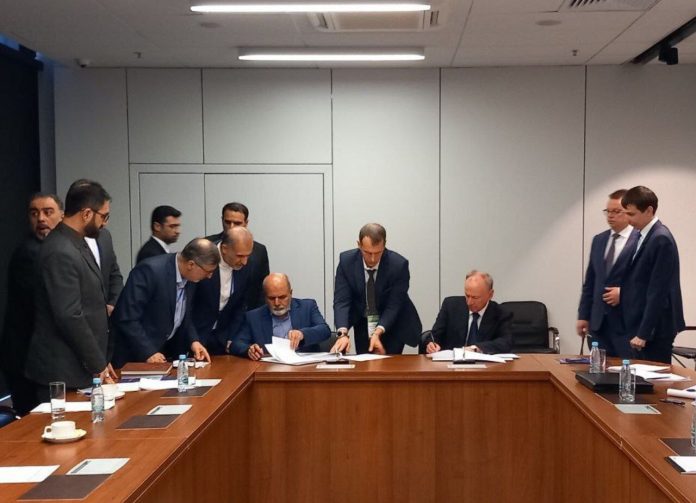
Secretary of Iran’s Supreme National Security Council (SNSC) Ali Akbar Ahmadian and his Russian counterpart, Nikolai Patrushev, put their signatures on the document, during a meeting on the sidelines of the 12th International Meeting of High Representatives for Security Issues in St. Petersburg on Wednesday.

Under the MoU, Tehran and Moscow will work towards boosting their cooperation in various strategic areas.

Iran and Russia, as two close and strategic allies, have over the past years deepened their ties in different fields, including security and defense, despite being under heavy Western sanctions.

The 12th International Meeting of High Representatives for Security Issues is being held in St. Petersburg on April 23-25, with the participation of delegates from 106 countries.

In a video address to the event, Russian President Vladimir Putin expressed his county’s readiness to forge close cooperation with all interested partners in ensuring global and regional security.

Undoubtedly, international terrorism remains one of the gravest threats of the 21st century, he said, warning that radical groups and intelligence agencies of certain countries perpetrate terrorist attacks in a bid to destabilize sovereign states and fuel interethnic and interreligious discord.

Iranian inventor awarded in Geneva inventions exhibition

Hamzeh Najafi Mehr

Hamzeh Najafi Mehr presented virtual reality smart glasses and a platform that provides new tools and solutions for personal brand development.

By using advanced artificial intelligence algorithms, the unique platform can analyze data and recognize conditions and create a unique experience for each user to improve their performance in work and professional, social and even emotional life.

The smart platform can also help people directly interact with artificial intelligence on their mobile phones and have a unique experience of having a coach and guide in different situations and in virtual environments.

Furthermore, the glasses and platform can provide facilities for users to attend lectures in virtual reality, group meetings and classes, personalize exercises in personal development, interact with artificial intelligence in areas related to people and businesses.

Najafi Mehr won a silver medal from the Inventions Exhibition in South Korea last year.

Iranian president hails achievements in two-nation South Asia trip

Ebrahim Raisi

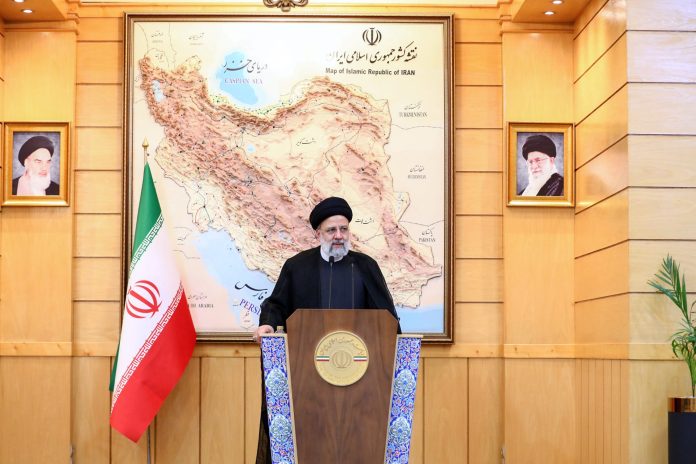
Summing up the achievements of the tour upon his arrival at Tehran, Ebrahim Raisi said the landmark deal in Pakistan was an agreement to increase the commercial bilateral ties to $10 billion annually.

In Sri Lanka, he said, the inauguration of a major hydropower multipurpose project is expected to set the stage for greater cooperation between the two countries.

Preside Raisi stressed, “The tour at the current stage can be a positive step towards the development of political, cultural, economic, commercial, scientific and technological relations with neighboring and independent countries.”

He reiterated that Ian’s policy is to advance its ties with Asian countries and boost its bilateral, regional, and international cooperation, including with Pakistan and Sri Lanka.

The Iranian president, accompanied by a delegation of ministers, embarked on a three-day official visit to Islamabad on April 22, followed by a visit to Sri Lanka, in order to forge stronger ties with both countries.