Monday, January 12, 2026
Home Blog Page 838

Kremlin fires back at Biden over Putin comments at NATO summit

Kremlin

“We continue to consider it absolutely unacceptable and impermissible behavior for a head of state to make such disrespectful remarks about other heads of state,” Kremlin spokesperson Dmitry Peskov said, according to Reuters.

“I am referring to his remarks about President Putin.”

In his first solo press conference of the year, Biden said Putin instilled fear in Europe. The president had just concluded days of meetings with international leaders, including allies of Ukraine.

“For those who thought NATO’s time had passed, they got a rude awakening when Putin invaded Ukraine,” Biden stated Thursday, adding, “Some of the oldest and deepest fears in Europe roared back to life because, once again, a murderous madman was on the march.”

Peskov stressed the remark does not make Biden look good.

“This is something that we pay direct attention to and something that is absolutely unacceptable to us,” he added.

During his speech, Biden also slammed former President Donald Trump for the relationship he has with Putin.

Shortly before beginning his press conference, Biden mistakenly referred to Ukrainian President Volodymyr Zelensky as “President Putin”, when introducing him at a NATO event. He quickly corrected himself.

Later in his remarks, he accidentally said his second-in-command was “Vice President Trump”.

Peskov stressed the “whole world paid attention” to his gaffes.

Both the NATO summit and the press conference were seen as critical moments for Biden, who faces a growing number of calls for him to step aside and let someone else take on former President Trump in the election this fall.

Peskov told reporters that it wasn’t Russia’s place to have an official comment.

“It is understandable that they probably received such a wide resonance given the context of the internal political discussions that we are now witnessing in the U.S.,” he said of Biden’s gaffes, “but it’s not our topic, it’s an internal U.S. topic.”

Russian Foreign Ministry Spokeswoman Maria Zakharova also said the NATO summit promised Ukraine an “irreversible path” into the abyss, but not to the alliance.

“The Kiev regime was eventually promised an ‘irreversible path’ to the alliance [at the summit]. Frankly speaking, I do not know what this irreversible path to the alliance looks like, but I guess that the only emerging association is ‘the path to the edge of a cliff’,” the diplomat stated during a briefing.

According to Zakharova, Ukraine “is still kind of welcome in the alliance, however it is obvious that all this looks more like a game not with Ukraine, but in the remains of Ukraine”. The summit’s decision on Ukraine’s membership is designed to consolidate the Ukrainians to go on fighting, the Russian Foreign Ministry spokeswoman added.
Iran president-elect outlines foreign policy, seeks de-escalation with West, praises Russia, China

Massoud Pezeshkian

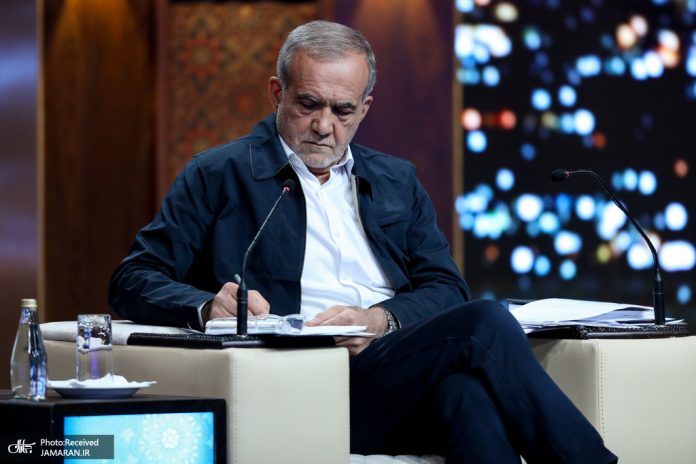
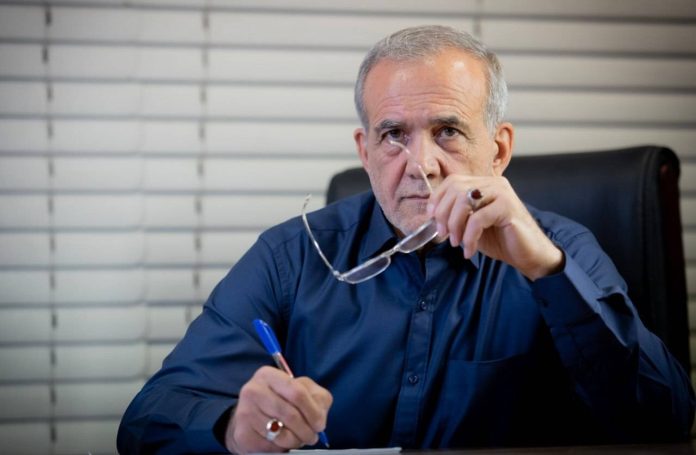
In an open letter tiled “My Message to the New World”, Pezeshkian revealed that he would continue to strengthen the country’s cordial ties with the Eastern bloc and would make efforts to de-escalate with the West.

The letter reads, “China and Russia have consistently stood by us during tough times. We deeply appreciate the friendship.”

He noted that Iran’s 25-year roadmap with China and the “comprehensive strategic partnership” would continue and highlighted Beijing’s constructive role in helping restore Iran’s ties with Saudi Arabia.

Iran will also continue to foster its well-established relations with Latin America and build on significantly more potential for cooperation than what is currently being realized, Pezeshkian clarified.

He, however, bemoaned the conflicts in Ukraine and Gaza and said his administration would take steps to establish peace in both conflict zones.

“As a first measure, my administration will urge our neighboring Arab countries to collaborate and utilize all political and diplomatic leverages to prioritize achieving a permanent ceasefire in Gaza aiming to stop the massacre and prevent the broadening of the conflict,” the letter adds.

The newly-elected Iranian president reiterated Iran’s principled policy of castigating “the apartheid Israeli regime” for its policies.

Regarding the Western bloc, Pezeshkian censured European countries for reneging on all their commitments stipulated in a 2015 nuclear agreement, known as the Joint Comprehensive Plan of Action (JCPOA), while expecting Iran to unilaterally fulfill all its obligations under the deal.

He, however, noted, “Despite these missteps, I look forward to engaging in a constructive dialogue with European countries to set our relations on the right path, based on principles of mutual respect and equal footing.”

The incoming Iranian chief executive concluded the letter, calling on the US “to learn from the past miscalculations and adjust its policy accordingly.”

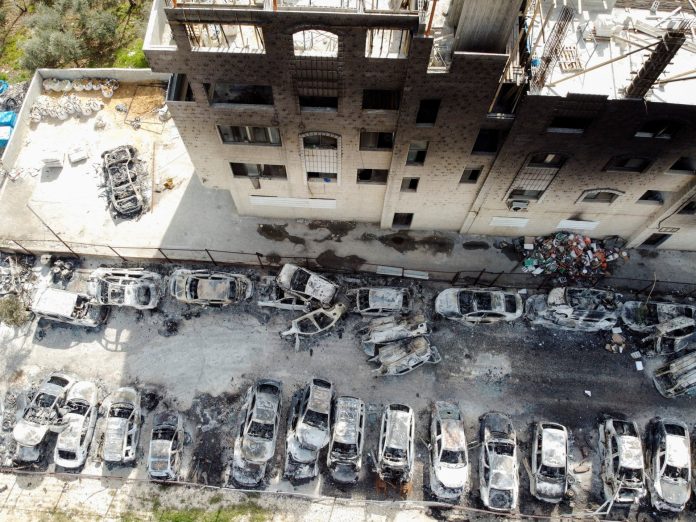
US imposes sanctions on Israeli settlers over West Bank violence

Israel Palestine West Bank

The sanctions announced by the US Department of State and the Department of the Treasury target Israeli individuals Isachar Manne, Reut Ben Haim, and Aviad Shlomo Sarid, and four illegal Israeli settlement outposts; Manne Farm, Meitarim Farm, Hamahoch Farm, and Neriya’s Farm.

The US also blacklisted Lehava, an umbrella group for Israeli settlers, which it described as the “largest violent extremist organization in Israel” with more than 10,000 members.

“The United States remains deeply concerned about extremist violence and instability in the West Bank, which undermines Israel’s own security,” State Department spokesperson Matthew Miller stated in a statement.

“We strongly encourage the Government of Israel to take immediate steps to hold these individuals and entities accountable. In the absence of such steps, we will continue to impose our own accountability measures.”

The sanctions freeze any assets held by those targeted in US jurisdictions and block Americans from doing business with them.

Lehava swiftly criticised the US designation and President Joe Biden, saying the group will not stop its actions.

“Biden’s measures won’t deter us – we’ll continue to act fearlessly to save Israel’s daughters, much to the dismay of Biden and Israel’s other enemies,” it added.

The EU had already placed Lehava on its asset freeze and visa ban blacklist for their attacks on Palestinians earlier this year.

The West Bank, which Israel has occupied since 1967, has seen a surge in violence in the past year, particularly since Israel’s war on Gaza erupted in October.

Since then, at least 553 Palestinians have been killed by Israeli forces and settlers in the territory, and 9,510 have been detained, according to Palestinian officials.

About 3 million Palestinians live in the Israeli-occupied West Bank, and more than 500,000 Israelis reside in more than 100 settlements across the territory.

In early July, Israeli NGO Peace Now reported that Israel’s government had approved 5,295 new housing units in a host of illegal settlements across the occupied West Bank and had recognised three new settlement outposts.

The expansion of settlements in the occupied West Bank, deemed illegal under international law, is often cited as the main barrier to any lasting peace agreement with Palestinians under a two-state solution.

Israeli army acknowledges failure to protect settlement during Hamas attack

Hamas October 7 Attack

In a statement, the army announced an investigation revealed the military was “not prepared for the extensive infiltration scenario” that unfolded on the day.

During the attack on the kibbutz, 31 security personnel were killed, including soldiers, members of the civilian rapid force, and police, and many others were injured, the report said. The attack also resulted in the death of 101 individuals, and capture of 32 others.

The probe showed that approximately 340 Palestinian fighters infiltrated the settlement, including around 100 members of the Hamas elite forces. Nearly 100 of them were killed during the attack.

Israel has killed more than 38,000 Palestinians in Gaza since the Hamas incursion last year that claimed 1,200 lives and took around 250 as hostages. The onslaught has triggered a humanitarian disaster and reduced the territory to rubble. Efforts for a permanent cease-fire since a brief November truce have not succeeded yet.

News organisations call on Israel to allow open access to Gaza

Gaza War

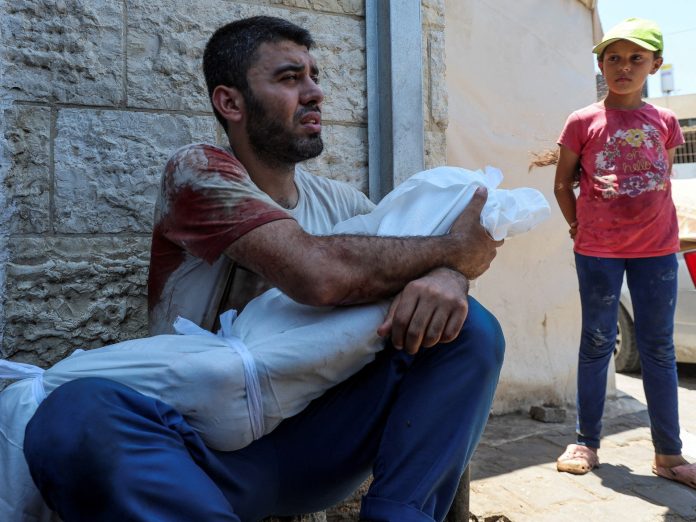
“We…request that Israeli authorities end immediately the restrictions on foreign media entering Gaza and grant independent access to international news organizations seeking to access the territory,” the letter said.

The companies and organisations said that Israel’s tight control of who enters Gaza has restricted reporting to those who achieve “rare and escorted trips arranged by the Israeli military”, adding that “this effective ban on foreign reporting has placed an impossible and unreasonable burden on local reporters to document a war through which they are living”.

Middle East Eye, whose reporters are on the ground in Gaza, is a signatory to the letter. Other prominent media companies like ABC; Bloomberg; NBC; NPR; CBS; The Financial Times; The New York Times; and The Washington Post also signed the letter.

The petition comes days after Israel allowed a select number of journalists to enter and film in Rafah, the southern Gaza border city that Israel has hammered with strikes and air raids for months.

The visit was tightly conducted under the scrutiny of Israel’s military, with journalists travelling in Israeli open-air vehicles. One report produced by The Wall Street Journal from the tour includes comments from Israeli military officials, but no Palestinian civilians from Rafah. The Wall Street Journal has not signed the letter.

“We ask that Israel uphold its commitments to press freedom by providing foreign media with immediate, independent access to Gaza, and that Israel abides by its international obligations to protect journalists as civilians,” the signatories added.

Last week, the Gaza government’s media office announced that five Palestinian journalists were killed in one day alone, bringing the total number of killed to 158 since 7 October when the war broke out.

Media analysts and rights groups have slammed the one-sided coverage of the war in the blockaded territory. In April, a leaked New York Times memo was revealed, instructing reporters to avoid using words like “slaughter” and “massacre” when describing Israeli-perpetrated violence against Palestinians.

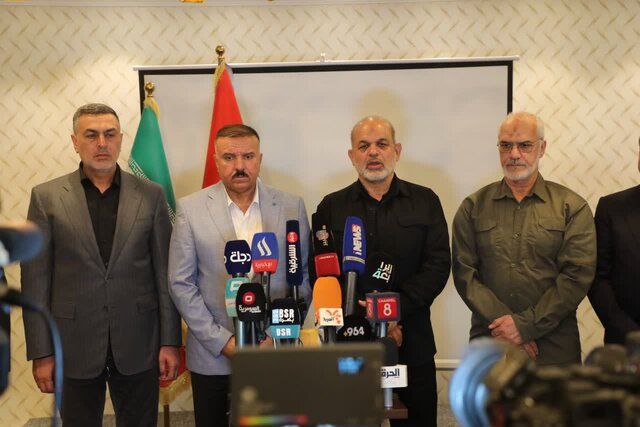
Iran and Iraq to launch the Khorramshahr-Basra sea line 

He made the announcement during a visit to Iraq’s al-Seeba port in Basra Governorate for the necessary arrangements in order to holding the Arbaeen march.

Vahidi noted that the details will be discussed in the next executive meetings with the Iraqi officials.

On the Iraqi side of the border, Vahidi met with his Iraqi counterpart Abdul Amir Al-Shammariand and held talks with him about  strengthening public transportation from Iran’s Shalamcheh to the Iraqi cities of Najaf and Karbala.

The Iraqi side agreed to the propossl, saying if there are suitable buses, it will help facilitate transportation.

Millions of people will take part in the Arbaeen march, marking the 40th day after the martyrdom anniversary of Imam Hussein, the third Shia Imam.

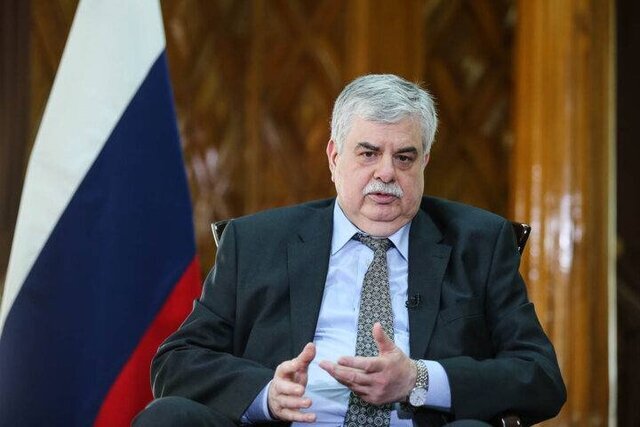
Russian ambassador to Tehran: Work on Strategic Partnership Treaty with Iran almost complete 

Dedov further spoke about the Ukraine war, saying if Iran announces its readiness to mediate to end the conflict, Russia is ready to consider such a proposal.

Earlier, Russian Deputy Foreign Minister Andrei Rudenko also said that Moscow accepts Tehran as a mediator in the peace talks to end the Ukrainian war, and if such a proposal is made, Moscow will consider it.

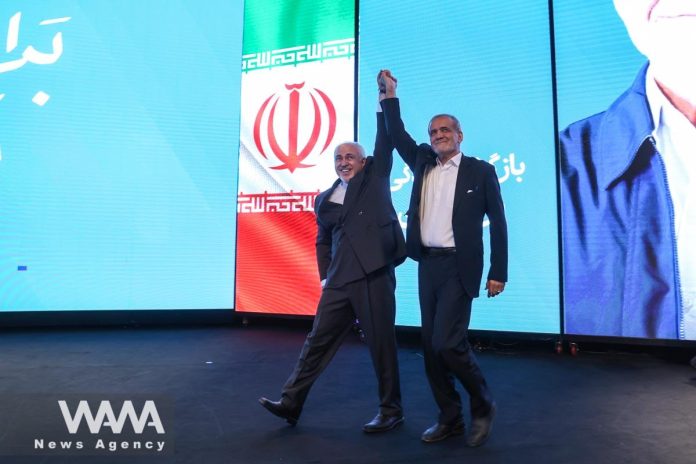
Iran president-elect appoints former FM Zarif as head of transitional council

Pezeshkian and Zarif

In his capacity as the head of the council, Zarif posted a message on X social media on Friday, dismissing reports that the new president has picked the final candidate for the vice presidential and some ministerial posts.

The former top diplomat also ‘categorically rejected’ claims that former reformist president Mohammad Khatami is putting pressure on Pezeshkian on certain members of the cabinet.

“So far, no candidate for any position, including first vice president, has even been considered. The review process will start after receiving the proposals of the NGOs, scientific associations, trade associations, and the private sector,” Zarif clarified.

The president-elect’s office issued a call on Thursday on a wide range of social groups and political parties in Iran to have their say on members of the incoming cabinet.

Several committees have also been formed to study the nominees for the top posts in meetings with the former foreign minister on Saturday and the new executive head next week, according to Zarif.

The council is assigned with cushioning the bumpy effects of the transition period through a careful study of the candidates for the posts based on a checklist of qualifications highlighted by the president-elect.

Iran, Russia preparing several documents to boost cooperation between provinces

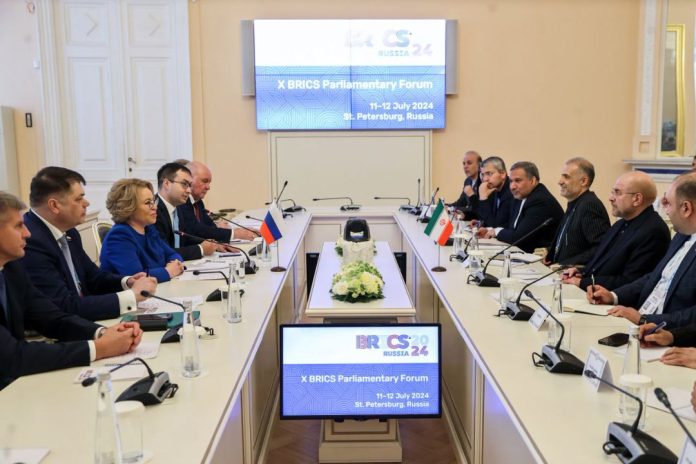
Valentina Matviyenko made the remarks in a meeting with Iran’s visiting Parliament Speaker Mohammad Baqer Qalibaf and his accompanying delegation on the sidelines of the 10th BRICS Parliamentary Forum in St. Petersburg.

Qalibaf said, “Without a doubt, BRICS has regional and international effects on both countries, along with the bilateral relations between Iran and Russia.”

Underlining the ‘great capacities’ between Iran and Russia, he added Russia’s chairmanship of BRICS is a good opportunity to enhance ties, especially in economic, security, social, and cultural areas as well as transit, energy, and trade opportunities.

For her part, Matviyenko announced that about 15 cooperation documents between the Iranian and Russian provinces are in the coordination stage and asked officials in both countries to facilitate the plan.

She also expressed Russia’s satisfaction and support for Iran’s accession to the BRICS geopolitical bloc, which was formed as a counterweight for Western alliances.

Qalibaf had earlier met with ranking Russian officials, including President Vladimir Putin and President of the Russian State Duma Viacheslav Valodin.

Iran president-elect issues general plea for consultation on cabinet members 

Massoud Pezeshkian

The statement issued on Thursday reads, “Dr. Massoud Pezeshkian believes in and needs the opinion and participation of scientific and specialized associations and institutions, NGOs and political parties to pick the most qualified members in the 14th administration, including ministers, vice presidents and heads of large government organizations.”

Abiding by the Constitution, having a good track record and reputation, honesty, and courage, having a nationalistic view, avoiding extremist, factional, and ethnic tendencies, being the voice of the voiceless, fulfilling the demands of women, youth and ethnic groups are some of the characteristics the statement has highlighted for the prospective candidates.

Meanwhile, a former member of Iran’s Expediency Council and a reformist political activist revealed that the president-elect, in an unprecedented move, has formed five working groups and has asked each group to make a shortlist of three candidates for each ministry.

Mohammad Hashemi explained that Pezeshkian is weighing in on the issues and has put the sanctions-hit economy and people’s livelihood high on the agenda of his priorities.

Pezeshkian, a cardiac surgeon by profession and a reformist politician, won the snap presidential election in Iran in a runoff on July 5.

The spokesperson for the Iranian Parliament’s Presiding Board has earlier stated that the inauguration ceremony of Iran’s President-Elect will be held in the Parliament on July 30.