Sunday, December 21, 2025
Home Blog Page 7

Iran says no message sent to U.S. for resumption of talks

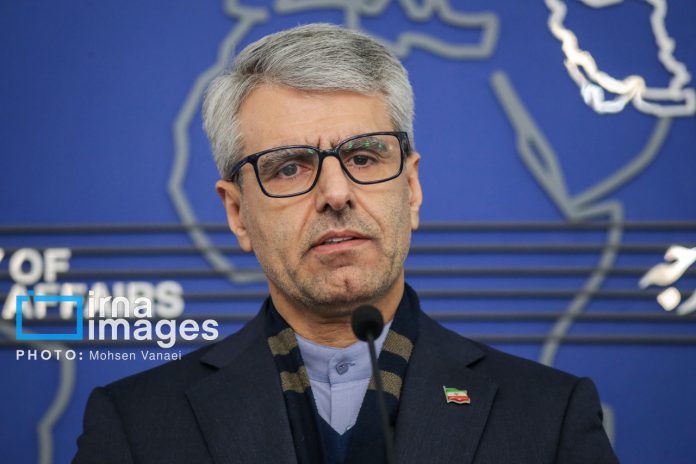
Mohajerani stressed that Iran has never rejected talks in principle, but insists they must be conducted with respect and on an equal footing.

Speaking in response to a question about negotiations with the United States, she said that if Iran were not interested in dialogue, it would not have initiated a diplomatic path before the 12-day war.

Mohajerani noted that Iran will continue to pursue its positions openly and discreetly where necessary, but emphasized that the Islamic Republic has not sent any message to the other side.

At the same time, she said Iran is a nation that believes in dialogue, provided it is dignified, honorable, and free from imposed conditions.

According to the spokesperson, the other side cannot present a pre-written agreement and then call for talks, as this contradicts the very meaning of dialogue.

She stressed that negotiations will only take place when Iran’s position is respected and the dignity of the Iranian people is preserved.

Asked whether Iran would engage in direct talks if conditions were met, she said the form of dialogue is secondary to its substance.

She explained that the main problem is that the other side seeks to start discussions based on a predetermined text, which is incompatible with genuine negotiations.

She added that the only viable path to dialogue with Iran is through mutual respect and recognition of the dignity of the Iranian people.

Armed attack in Southeast Iran kills four

Iran Police

According to a statement by the Public Relations Office of the Quds Base of the Islamic Revolution Guard Corps (IRGC) Ground Force, the incident occurred on Monday night when armed elements attacked law enforcement personnel at the checkpoint located at the entrance to the city of Fahraj on the Zahedan–Fahraj road.

The statement said the law enforcement forces stationed at the checkpoint were carrying out routine missions to ensure security along the region’s main transit route when they came under attack by the armed assailants.

The incident is currently being followed up with seriousness by security and law enforcement authorities.


US seeking to investigate Israel’s assassination of Hamas official: Washington

Gaza War

Raad Saad was killed alongside three others on Saturday when his car was targeted near al-Nabulsi square in western Gaza City, according to Israeli media reports.

Saad was a senior member of al-Qassam Brigades, Hamas’s armed wing. He was said to be second in rank only to the group’s latest military chief, Izz al-Din al-Haddad, according to Reuters.

Israel has repeatedly violated a ceasefire that was signed on 10 October and guaranteed by Egypt, Qatar and the US.

Over 350 Palestinians have been killed by Israel, according to what Gaza’s Government Media Office says are at least 738 violations.

Israel has drastically restricted the amount of aid and medical supplies that can enter Gaza and has prevented the reopening of the enclave’s Rafah border crossing to Egypt.

The Trump administration has been generally quiet on these violations in public. The assassination of Saad, however, could complicate the Trump administration’s plans to move the ceasefire forward.

Middle East Eye reported in October that US envoy Steve Witkoff and Trump’s son-in-law, Jared Kushner, met senior Hamas officials, including Khalil al-Hayya, in Egypt’s Sharm el-Sheikh resort and personally guaranteed an end to the war as an assurance to Hamas’s senior leaders.

When given the opportunity to address his relationship with Israeli Prime Minister Benjamin Netanyahu, Trump downplayed reports in Israeli media that he was angry with his counterpart.

“Israel and I have gotten along very well. My relationship with Bibi Netanyahu has been obviously a very good one,” Trump told reporters in the White House.

The Trump administration has dispatched allies of Kushner to Tel Aviv to work on a plan that would cement Gaza’s division in half, by building so-called “Alternate Safe Communities” in the Israeli-occupied portion of Gaza. Israel has imposed a full blockade of the enclave, while its troops physically occupy around 50 percent of Gaza’s landmass.

The plans to divide Gaza have unnerved states like Qatar, Saudi Arabia, Indonesia, Egypt, and Turkey. Trump needs their political, economic, and manpower support to deploy an international stabilisation force to Gaza. The United Nations Security Council approved a mandate for the force in November, but it has yet to deploy.

US officials have stated that they expect it to be ready in 2026, but Trump said the force was already operating. MEE spoke with three western and Arab officials on Monday, along with analysts. No one was aware of the force operating.

“I think that, in a form, it’s already running,” Trump continued, adding, ”More and more countries are coming into it. They’re already in, but they’ll send any number of troops that I ask them to send.”


Authorities struggling to recover bodies from Gaza rubble amid winter storms

Authorities sounded the alarm on Monday, three days after two buildings collapsed in Gaza, killing at least 12 people, during winter rains that have also washed away and flooded the tents of displaced Palestinians and led to deaths from exposure.

A ceasefire has been in effect since October 10 after two years of Israel’s genocidal war against the Palestinian people in Gaza, but humanitarian agencies said Israel is letting very little aid into the enclave, where nearly the entire population has been displaced.

According to Al Jazeera, despite a shortage of equipment and fuel and the weather conditions in the enclave, Palestinian Civil Defence teams retrieved the bodies of 20 people on Monday.

The bodies were recovered from a multistorey building bombed in December 2023 where about 60 people, including 30 children, were believed to be sheltering.

Gaza Civil Defence spokesman Mahmoud Basal called on the international community to provide mobile homes and caravans for displaced Palestinians rather than tents.

“If people are not protected today, we will witness more victims, more killing of people, children, women, entire families inside these buildings,” he added.

The head of the United Nations agency for Palestinian refugees warned on Monday that more aid must be allowed into Gaza without delay to prevent putting more displaced families at serious risk.

“With heavy rain and cold brought in by Storm Byron [late last week], people in the Gaza Strip are freezing to death,” UNRWA Commissioner General Philippe Lazzarini posted on X.

“The waterlogged ruins where they are sheltering are collapsing, causing even more exposure to cold,” he added.

Lazzarini said UNRWA has supplies that have waited for months to enter Gaza that he said would cover the needs of hundreds of thousands of Gaza’s more than two million people.

UN and Palestinian officials said at least 300,000 new tents are urgently needed for the roughly 1.5 million people still displaced. Most existing shelters are worn out or made of thin plastic and cloth sheeting.

Gaza authorities, meanwhile, were still digging to recover about 9,000 bodies they estimated remain buried in rubble from Israeli bombing during the war, but the lack of machinery is slowing down the process, spokesman Ismail al-Thawabta said.

Israel’s continuing ban on the entry of heavy machinery into the Gaza Strip is a violation of the ceasefire, he added.

Earlier on Sunday, Hamas announced Israel’s continuing violations of the ceasefire risk jeopardising the agreement and progress towards the next stage of United States President Donald Trump’s plan to end the war.

Since the ceasefire began, Israel has continued to strike Gaza on a daily basis, carrying out nearly 800 attacks and killing nearly 400 people, according to authorities in Gaza, while blocking the free flow of humanitarian aid.


Iranian spokesperson: US bombed negotiation table

Iran US Flags

If Iran were not seeking dialogue, it would not have initiated the negotiation path before the 12-day war, Mohajerani stated in response to a question regarding negotiations with the US.

Saying Iran has not sent any message to the other party, she added the Iranian nation seeks dialogue and will cooperate on the condition that the dialogue is honorable and without dictation.

Iran will negotiate on an equal footing and under conditions that preserve the dignity of the Iranian people, she continued.

Earlier on December 2, 2025, Foreign Minister Abbas Araghchi emphasized that if the American side shows its readiness for a fair and balanced agreement based on mutual interests, Iran will definitely consider the issue.

Araghchi reiterated that the door to negotiations and mediations is always open and this possibility exists at any time, provided that the rules are followed.

He said that the first principle of diplomacy and negotiation is that two parties come to the negotiating table with the real intention of a fair and equal exchange, adding that but if the goal of one of the parties is to impose its demands, such negotiations will not take place and will be fruitless.

He pointed out that the main cause of the problem in Iran-US relations, which is preventing the start of negotiations at the moment, is the US approach based on imposing its demands and excessive demands, saying that unfortunately, Iran has seen this behavior many times in its interactions with the US.


Iran says 1.6 million undocumented Afghans have returned home

Afghan Refugee Iran

Nader Yarahmadi, head of Iran’s Bureau for Aliens and Foreign Immigrants Affairs, said that after the removals, approximately 4.5 million Afghan nationals remain in Iran. This figure includes a floating population of around 400,000 to 500,000 people who enter or leave the country irregularly.

He acknowledged that some Afghans who were deported have later re-entered Iran illegally.

According to Yarahmadi, irregular crossings, mainly through Iran’s eastern borders, rose after September, despite being relatively limited earlier in the year.

He said that while illegal migration cannot be fully eliminated, authorities are working to reduce it to a level that does not create security or social challenges.

He noted that between 2,500 and 3,000 undocumented Afghans are leaving Iran each day, describing this year’s returns as unprecedented. Yarahmadi emphasized that government services are prioritized for legally residing foreign nationals.

He also said Iran currently hosts about 60,000 foreign students, including nearly 20,000 Afghan nationals.

Iran Judiciary: Verdict on Israeli spy to be issued soon

Iran Court

Asghar Jahangir said the defendant was a dual national who obtained Swedish citizenship in 2020 and had been residing in Sweden.

According to Jahangir, the suspect was recruited by the Israeli regime’s intelligence services in 2023 and, after undergoing training in six European countries, had most recently traveled to the occupied territories (Israel) two weeks before entering Iran.

He added that the suspect entered Iran one month before the outbreak of the recent 12-day war and was staying in a villa on the outskirts of Karaj, the capital of Alborz Province.

Jahangir said the suspect was carrying electronic espionage equipment, which was identified by judicial authorities, and was arrested during the 12-day war.

The judiciary spokesperson said the case demonstrates that Iran’s judicial system acts swiftly and decisively wherever reports of espionage are received.

Jahangir emphasized that pursuing espionage cases has been on the judiciary’s agenda since the very beginning of the 12-day war, and that prosecutors across the country have been instructed—under an order from the head of the judiciary—to handle such cases promptly.

Ayatollah Khamenei’s aide: Iran opposes Trump’s corridor plan for Caucasus

Ali-Akbar Velayati

Ali Akbar Velayati made the remarks during a meeting with Armenia’s Ambassador to Iran Grigor Hakobyan in Tehran on Monday.

He said the so-called Trump Route for International Peace and Prosperity (TRIPP) is no different from the Zangezur Corridor.

The route connects Azerbaijan to its Nakhchivan exclave through Armenian territory along its entire border with Iran. On a 99-year land lease, the US will operate the 43-kilometer route, which will include railways, communication networks, and pipelines for oil and gas.

Velayati stated that past experience shows the United States often enters sensitive regions under the guise of economic projects, only to gradually expand its presence into military and security spheres.

“Allowing the US any foothold near Iran’s borders under any schemes carries clear security implications,” he warned.

The senior Iranian official also noted that Iran stood against the Zangezur Corridor plan from its very beginning and rejected any alteration of borders or developments undermining the country’s security.

“When the Zangezur Corridor was proposed, the Islamic Republic of Iran firmly declared its opposition and prevented the implementation of the plan without the support of Russia, which was heavily engaged in the Ukraine war.”

“This was because the corridor could have paved the way for NATO’s presence in northern Iran, posing a serious threat to the security of northern Iran and southern Russia. The Trump route is essentially the same project, only with a different name, and is now being pursued in the form of American companies entering Armenia,” he added.

The creation of Trump’s transit corridor was agreed as part of the US-brokered peace agreement that Azerbaijan and Armenia signed at the White House on August 8, 2025.

The two South Caucasus states had been locked in conflict for nearly four decades as they fought for control of the Karabakh region, recaptured militarily by Baku in 2023.

At that time, Iran welcomed the end of the conflict between Armenia and Azerbaijan as a step towards regional stability, while simultaneously expressing concern over the negative consequences of foreign meddling in the Caucasus region.

Additionally, in his remarks, Velayati expressed Iran’s keenness to expand its historical and deep-rooted relations with Armenia.

Hakobyan, for his part, described Tehran-Yerevan cooperation as highly significant and strategic, noting that the development of ties with Iran is among the main priorities of his country’s foreign policy.

Meanwhile, both sides underscored the need for strengthening bilateral relations and keeping up consultations on regional issues.


European NATO countries push plan to send troops to Ukraine

Following talks in Berlin on Monday with US President Donald Trump’s peace envoys Steve Witkoff and Jared Kushner, as well as a Ukrainian delegation, the leaders of Germany, Denmark, Finland, France, Italy, Lithuania, the Netherlands, Norway, Poland, Sweden and the UK, along with officials from Brussels, issued a joint statement proposing “robust security guarantees” for Kiev.

“This would include commitments to… a European-led ‘Multinational Force Ukraine’ made up of contributions from willing nations within the framework of the Coalition of the Willing and supported by the US. It will assist in the regeneration of Ukraine’s forces, in securing Ukraine’s skies, and in supporting safer seas, including through operating inside Ukraine,” the document states.

The UK and France have long pushed the idea of sending European troops to Ukraine once a ceasefire is agreed, although it remains unclear which nations are actually ready to contribute forces.

Polish Prime Minister Donald Tusk immediately rejected the plan, saying his country needs all its troops at home to “defend the eastern flank of NATO.” Italy has also consistently rejected sending Italian forces to Ukraine.

Moscow has rejected the idea of NATO forces in Ukraine under any pretext, and has insisted that Kiev would use any pause in fighting to rearm and regroup. Russia continues to push for a permanent peace that addresses the conflict’s root causes.

Another provision in the European plan calls for a “US-led ceasefire monitoring and verification mechanism.” The signatories also seek a “legally binding commitment, subject to national procedures,” to support Kiev with “armed force, intelligence and logistical assistance, economic and diplomatic actions.”

The Trump administration has not confirmed the extent of its support for the European plan. Recent media reports suggest the US leader is prepared to offer Kiev NATO-style, Congressionally-approved security guarantees if it agrees to territorial concessions to Russia.

Ukraine’s President Volodymyr Zelensky, however, reiterated on Monday that Kiev will not recognize Donbass as Russian “neither de jure nor de facto.”

Other European proposals include “significant support to Ukraine to build its armed forces,” backing Ukraine’s accession to the European Union, and efforts to “invest in the future prosperity of Ukraine” by using frozen Russian sovereign assets. Moscow has warned that any attempt to seize its funds would amount to theft, and has initiated legal proceedings against Euroclear.


Newspaper chides Taliban for shunning Tehran meeting, calls on Iran for policy shift

The conference, attended by representatives from Pakistan, Tajikistan, Uzbekistan, Turkmenistan, China, and Russia, was held under the title “Efforts to Reduce Tensions.”

According to the newspaper, the choice of title itself highlights that Taliban-controlled Afghanistan remains a major source of regional instability.

Citing UN reports, the newspaper noted that Afghanistan under Taliban rule has been described as a hub for terrorism, with more than 20 extremist groups operating in the country with Taliban support, posing risks to regional security.

The Taliban’s decision to boycott the Tehran meeting follows a similar refusal last year, which the paper interprets as a sign that the group neither values Iran’s diplomatic outreach nor acknowledges its own destabilizing role.
The editorial argued that the Taliban views tension as central to its political identity and pointed to its alleged support for the Pakistani Taliban as evidence.

The newspaper warned Iranian policymakers against further concessions to the Taliban, stressing that such engagement risks undermining Iran’s standing among the Afghan people.