Sunday, December 21, 2025
Home Blog Page 6

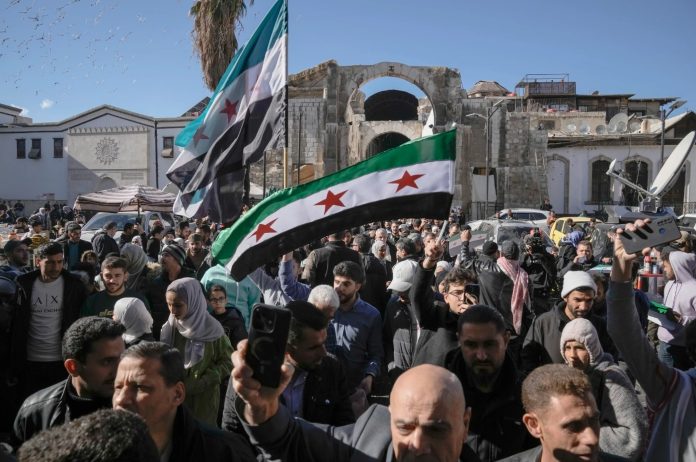
Mass grave discovered in former security building in Syria’s Idlib

The grim discovery was reportedly made during renovation work inside the facility, which had previously served as State Security headquarters in Maaret al-Numan before the Assad government lost control of the city in 2019. Workers reportedly found human remains buried within the structure, leading to an immediate halt in the renovation process.

According to the reports, security forces have sealed off the area and prevented access to the location, pending further procedures. No official details were provided regarding the number of bodies found or their identities.

After a coalition led by militant group Hayat Tahrir al-Sham (HTS), a regional offshoot of Al-Qaeda, captured Damascus and displaced former Syrian President Bashar Assad late last year, at least 66 mass graves were discovered throughout the country. Each could hold answers about the fates of some of the more than 170,000 people who remain missing.

Last December, a mass grave containing at least 100,000 bodies was found outside Damascus.


Trump expands travel ban, targets Syria, Palestine

The proclamation adds “full restrictions and entry limitations” on those attempting to come to the United States from Burkina Faso, Mali, Niger, South Sudan and Syria, as well as those with travel documents issued by the Palestinian Authority.

The administration is also imposing partial entry limits on individuals from 15 countries that were not previously part of a travel ban. Those countries include Angola, Antigua and Barbuda, Benin, Dominica, Gabon, Gambia, Ivory Coast, Malawi, Mauritania, Nigeria, Senegal, Tanzania, Tonga, Zambia and Zimbabwe.

The administration is also increasing restrictions on Laos and Sierra Leone, which previously were subject to partial restrictions under an existing travel ban policy.

The travel restrictions exclude lawful permanent residents, existing visa holders and certain visa categories that apply to athletes and diplomats.

Trump in June signed an initial travel ban targeting 12 countries: Afghanistan, Chad, Republic of the Congo, Equatorial Guinea, Eritrea, Haiti, Iran, Libya, Myanmar, Somalia, Sudan and Yemen. The entry restrictions on those countries remain in effect, the White House said.

Immigration groups blasted Tuesday’s move, noting it comes on the heels of a series of actions from Trump further restricting immigration and barring migrants from moving forward with their cases.

The administration has announced that the travel restrictions are a matter of national security, arguing that countries can get off the list if they improve vetting procedures or work with the U.S. For example, Tuesday’s proclamation lifts a ban on nonimmigrant visas for those from Turkmenistan, citing “significant progress” since the last iteration of a travel ban.

Homeland Security Secretary Kristi Noem earlier this month previewed that the administration intended to expand the scope of the travel ban to cover more than 30 countries.

Her remarks came in the wake of a shooting in Washington of two National Guard members. The accused shooter is an Afghan native, and the incident sparked calls from Trump and other Republicans who pushed to further restrict the entry of foreign nationals into the U.S.

Trump has sought to drastically reduce the number of immigrants and refugees who can enter the U.S. since taking office.

The administration has already paused all pending asylum applications for those from across the globe seeking refuge in the U.S. Trump last month set the refugee cap to its lowest level in history, allowing the U.S. to admit just 7,500 refugees — down from the 125,000 cap set under Biden.


Brits must be ready to sacrifice ‘sons and daughters’: Military official

UK Army

Russia has consistently rejected claims that it plans to attack European NATO countries, describing them as warmongering tactics used by Western politicians to justify inflated military budgets.

Moscow insists it is defending its citizens in the Ukraine conflict and has accused NATO of provoking hostilities and derailing US-backed peace efforts.

During a lecture at the Royal United Services Institute on Monday, Knighton acknowledged that the probability of a direct conflict with Russia is “remote” but claimed that this “does not mean the chances are zero.”

“More people being ready to fight for their country” is essential, Knighton said, adding that the response to modern threats “must go beyond simply strengthening our armed forces” and involve every part of British society.

“Sons and daughters. Colleagues. Veterans… will all have a part to play. To build. To serve. And if necessary, to fight. And more families will know what sacrifice for our nation means.”

Knighton’s remarks echoed those made last month by his “good friend” Fabien Mandon, the French chief of defense, who also warned that citizens must be prepared to “lose children” in a potential war with Russia.

The speech comes as a handful of European NATO states once again floated the controversial idea of sending a multinational force into Ukraine in the event of a ceasefire.

Moscow has strongly rejected any such deployment, warning that any NATO country which sends troops to Ukraine would be treated as direct participation in the conflict. Russian officials have described the idea as a reckless escalation that undermines peace efforts and risks drawing the entire bloc into open confrontation.

Russian Foreign Minister Sergey Lavrov said earlier this year that Western European leaders were “trying to prepare Europe for war – not some hybrid war, but a real war against Russia.” He accused the EU of sliding into what he described as a “Fourth Reich,” marked by a surge in Russophobia and aggressive militarization.


UN warns millions facing acute food insecurity in Afghanistan

The number at risk is some 3 million more than a year ago.

Economic woes, recurrent drought, shrinking international aid and and influx of Afghans returning home from countries like neighboring Iran and Pakistan have strained resources and added to the pressures on food security, reports the Integrated Food Security Phase Classification, known as IPC, which tracks hunger crises.

“What the IPC tells us is that more than 17 million people in Afghanistan are facing acute food insecurity. That is 3 million more than last year,” stated Jean-Martin Bauer, director of food security at the U.N.’s World Food Program, told reporters in Geneva.

“There are almost 4 million children in a situation of acute malnutrition,” he said by video from Rome.

“About 1 million are severely acutely malnourished, and those are children who actually require hospital treatment.”

Food assistance in Afghanistan is reaching only 2.7% of the population, the IPC report says — exacerbated by a weak economy, high unemployment and lower inflows of remittances from abroad — as more than 2.5 million people returned from Iran and Pakistan this year.

More than 17 million people, or more than one-third of the population, are set to face crisis levels of food insecurity in the four-month period through to March 2026, the report said. Of those, 4.7 million could face emergency levels of food insecurity.

An improvement is expected by the spring harvest season starting in April, IPC projected.

The U.N. last week warned of a “severe” and “precarious” crisis in the country as Afghanistan enters its first winter in years without U.S. foreign assistance and almost no international food distribution.

Tom Fletcher, the U.N. humanitarian chief, told the Security Council on Wednesday that the situation has been exacerbated by “overlapping shocks,” including recent deadly earthquakes, and the growing restrictions on humanitarian aid access and staff.

While Fletcher stressed that nearly 22 million Afghans will need U.N. assistance in 2026, his organization will focus on 3.9 million facing the most urgent need of lifesaving help in light of the reduced donor contributions.

US issues ultimatum to Ukraine over Russia war: Telegraph

On Monday, Ukraine’s Vladimir Zelensky met with US envoys Steve Witkoff and Jared Kushner in Berlin to discuss US President Donald Trump’s peace proposal. While the details have not been made public, American officials cited by the newspaper have described the proposed security guarantees as “platinum standard.”

However, the negotiators reportedly warned Zelensky that the offer “will not be on the table forever,” urging him to accept Washington’s terms. The guarantees are said to be modeled on NATO’s Article 5 collective defense clause, which states that an attack on one member is an attack on all and justifies retaliation by the entire bloc.

American officials told The Telegraph that around 90% of the broader peace deal has already been agreed upon by both Moscow and Kiev. However, there has reportedly been no progress on the territorial issue or on a proposed “50-50” split of the Zaporozhye nuclear power plant.

Washington has reportedly been pressing Kiev to withdraw its forces from the Donbass region as a condition for peace. According to the Wall Street Journal, US negotiators have been “unwilling to compromise” on this point. The Donbass joined Russia following a referendum in 2022.

Trump pointed out on Monday that Ukraine has “already lost the territory” and that his guarantee proposal is meant to prevent the conflict from restarting. He noted that he wants a deal reached before the end of the year.

Zelensky recently indicated he could abandon Kiev’s NATO ambitions in exchange for binding security guarantees, but has continued to rule out recognizing Russia’s borders or holding a long-delayed presidential election beforehand. However, he has suggested that after receiving the assurances, Kiev could organize a referendum on territorial concessions and possibly a new vote.

Moscow has rejected Zelensky’s proposal as a ploy to prolong the conflict, insisting on Kiev’s withdrawal from all Russian territories and pledging to push Ukrainian troops out one way or another.

South Korean court issues verdict in case involving Iranian track and field team members

Iran Prison

The individuals were detained in June 2025 on charges related to sexual assault against a South Korean woman and appeared in several court hearings.

According to the ruling, two of the defendants were acquitted of all charges, while the other two were sentenced to short prison terms ranging from two to four years.

The verdict was issued at the first-instance level, and the convicted individuals have the right to appeal the decision.

Back in mid-June, South Korea’s media had reported that three members of the Iranian delegation, including two athletes and one coach, were arrested during the 2025 Asian Athletics Championships in the city of Gumi on charges of assaulting a 20-year-old woman.

About a week later, a fourth team member was added to the list of suspects.

According to the reports, out of Iran’s 19-member delegation to the championships, 14 individuals returned to the country following the incident.

Iran says no message sent to U.S. for resumption of talks

Mohajerani stressed that Iran has never rejected talks in principle, but insists they must be conducted with respect and on an equal footing.

Speaking in response to a question about negotiations with the United States, she said that if Iran were not interested in dialogue, it would not have initiated a diplomatic path before the 12-day war.

Mohajerani noted that Iran will continue to pursue its positions openly and discreetly where necessary, but emphasized that the Islamic Republic has not sent any message to the other side.

At the same time, she said Iran is a nation that believes in dialogue, provided it is dignified, honorable, and free from imposed conditions.

According to the spokesperson, the other side cannot present a pre-written agreement and then call for talks, as this contradicts the very meaning of dialogue.

She stressed that negotiations will only take place when Iran’s position is respected and the dignity of the Iranian people is preserved.

Asked whether Iran would engage in direct talks if conditions were met, she said the form of dialogue is secondary to its substance.

She explained that the main problem is that the other side seeks to start discussions based on a predetermined text, which is incompatible with genuine negotiations.

She added that the only viable path to dialogue with Iran is through mutual respect and recognition of the dignity of the Iranian people.

Armed attack in Southeast Iran kills four

Iran Police

According to a statement by the Public Relations Office of the Quds Base of the Islamic Revolution Guard Corps (IRGC) Ground Force, the incident occurred on Monday night when armed elements attacked law enforcement personnel at the checkpoint located at the entrance to the city of Fahraj on the Zahedan–Fahraj road.

The statement said the law enforcement forces stationed at the checkpoint were carrying out routine missions to ensure security along the region’s main transit route when they came under attack by the armed assailants.

The incident is currently being followed up with seriousness by security and law enforcement authorities.


US seeking to investigate Israel’s assassination of Hamas official: Washington

Gaza War

Raad Saad was killed alongside three others on Saturday when his car was targeted near al-Nabulsi square in western Gaza City, according to Israeli media reports.

Saad was a senior member of al-Qassam Brigades, Hamas’s armed wing. He was said to be second in rank only to the group’s latest military chief, Izz al-Din al-Haddad, according to Reuters.

Israel has repeatedly violated a ceasefire that was signed on 10 October and guaranteed by Egypt, Qatar and the US.

Over 350 Palestinians have been killed by Israel, according to what Gaza’s Government Media Office says are at least 738 violations.

Israel has drastically restricted the amount of aid and medical supplies that can enter Gaza and has prevented the reopening of the enclave’s Rafah border crossing to Egypt.

The Trump administration has been generally quiet on these violations in public. The assassination of Saad, however, could complicate the Trump administration’s plans to move the ceasefire forward.

Middle East Eye reported in October that US envoy Steve Witkoff and Trump’s son-in-law, Jared Kushner, met senior Hamas officials, including Khalil al-Hayya, in Egypt’s Sharm el-Sheikh resort and personally guaranteed an end to the war as an assurance to Hamas’s senior leaders.

When given the opportunity to address his relationship with Israeli Prime Minister Benjamin Netanyahu, Trump downplayed reports in Israeli media that he was angry with his counterpart.

“Israel and I have gotten along very well. My relationship with Bibi Netanyahu has been obviously a very good one,” Trump told reporters in the White House.

The Trump administration has dispatched allies of Kushner to Tel Aviv to work on a plan that would cement Gaza’s division in half, by building so-called “Alternate Safe Communities” in the Israeli-occupied portion of Gaza. Israel has imposed a full blockade of the enclave, while its troops physically occupy around 50 percent of Gaza’s landmass.

The plans to divide Gaza have unnerved states like Qatar, Saudi Arabia, Indonesia, Egypt, and Turkey. Trump needs their political, economic, and manpower support to deploy an international stabilisation force to Gaza. The United Nations Security Council approved a mandate for the force in November, but it has yet to deploy.

US officials have stated that they expect it to be ready in 2026, but Trump said the force was already operating. MEE spoke with three western and Arab officials on Monday, along with analysts. No one was aware of the force operating.

“I think that, in a form, it’s already running,” Trump continued, adding, ”More and more countries are coming into it. They’re already in, but they’ll send any number of troops that I ask them to send.”


Authorities struggling to recover bodies from Gaza rubble amid winter storms

Authorities sounded the alarm on Monday, three days after two buildings collapsed in Gaza, killing at least 12 people, during winter rains that have also washed away and flooded the tents of displaced Palestinians and led to deaths from exposure.

A ceasefire has been in effect since October 10 after two years of Israel’s genocidal war against the Palestinian people in Gaza, but humanitarian agencies said Israel is letting very little aid into the enclave, where nearly the entire population has been displaced.

According to Al Jazeera, despite a shortage of equipment and fuel and the weather conditions in the enclave, Palestinian Civil Defence teams retrieved the bodies of 20 people on Monday.

The bodies were recovered from a multistorey building bombed in December 2023 where about 60 people, including 30 children, were believed to be sheltering.

Gaza Civil Defence spokesman Mahmoud Basal called on the international community to provide mobile homes and caravans for displaced Palestinians rather than tents.

“If people are not protected today, we will witness more victims, more killing of people, children, women, entire families inside these buildings,” he added.

The head of the United Nations agency for Palestinian refugees warned on Monday that more aid must be allowed into Gaza without delay to prevent putting more displaced families at serious risk.

“With heavy rain and cold brought in by Storm Byron [late last week], people in the Gaza Strip are freezing to death,” UNRWA Commissioner General Philippe Lazzarini posted on X.

“The waterlogged ruins where they are sheltering are collapsing, causing even more exposure to cold,” he added.

Lazzarini said UNRWA has supplies that have waited for months to enter Gaza that he said would cover the needs of hundreds of thousands of Gaza’s more than two million people.

UN and Palestinian officials said at least 300,000 new tents are urgently needed for the roughly 1.5 million people still displaced. Most existing shelters are worn out or made of thin plastic and cloth sheeting.

Gaza authorities, meanwhile, were still digging to recover about 9,000 bodies they estimated remain buried in rubble from Israeli bombing during the war, but the lack of machinery is slowing down the process, spokesman Ismail al-Thawabta said.

Israel’s continuing ban on the entry of heavy machinery into the Gaza Strip is a violation of the ceasefire, he added.

Earlier on Sunday, Hamas announced Israel’s continuing violations of the ceasefire risk jeopardising the agreement and progress towards the next stage of United States President Donald Trump’s plan to end the war.

Since the ceasefire began, Israel has continued to strike Gaza on a daily basis, carrying out nearly 800 attacks and killing nearly 400 people, according to authorities in Gaza, while blocking the free flow of humanitarian aid.