Tuesday, December 30, 2025
Home Blog Page 688

At least 4 killed, several injured in attack on aerospace firm in Turkey

Two of the “terrorists” who attacked a defense company near Ankara on Wednesday have been “neutralized”, and security forces are searching for a third gunman, Turkish Interior Minister Ali Yerlikaya has said

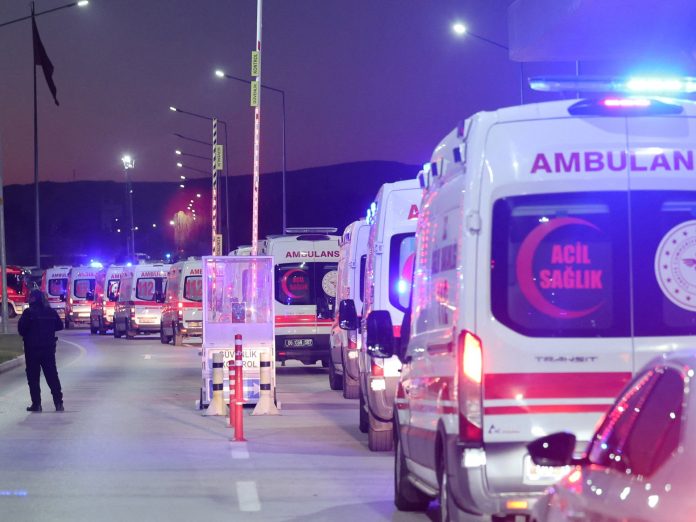
Three assailants stormed the Turkish Aerospace Industries (TUSAS) headquarters in a suburb of Ankara, killing four people and injuring 14 others, according to Turkish President Recep Tayyip Erdogan.

While the Turkish government has banned reporting from the scene of the incident, unverified videos posted on social media purportedly showed heavily armed special forces personnel storming the TUSAS facility less than an hour after the attack began.

Shortly afterwards, Yerlikaya announced that “two terrorists were neutralized”, and that “our struggle will continue with determination and resolve until the last terrorist is neutralized”.

One of the attackers was a woman, Yerlikaya told reporters, adding that she and a male accomplice had been killed. Unconfirmed reports suggest that the third attacker may have blown himself up.

“As soon as their identities are determined, we will share with you which terrorist organization it is,” the minister stated.

Terror attacks in Turkey are often the work of the Kurdistan Workers’ Party (PKK), a Kurdish militant group that has been involved in a low-intensity conflict with the Turkish state since the 1980s.

It is also unclear whether the assailants took any hostages. Turkish media outlets reported that some TUSAS employees had been taken captive, and an unconfirmed photo posted on social media showed around a dozen people purportedly detained inside the facility. However, neither Erdogan nor Yerlikaya has confirmed this.
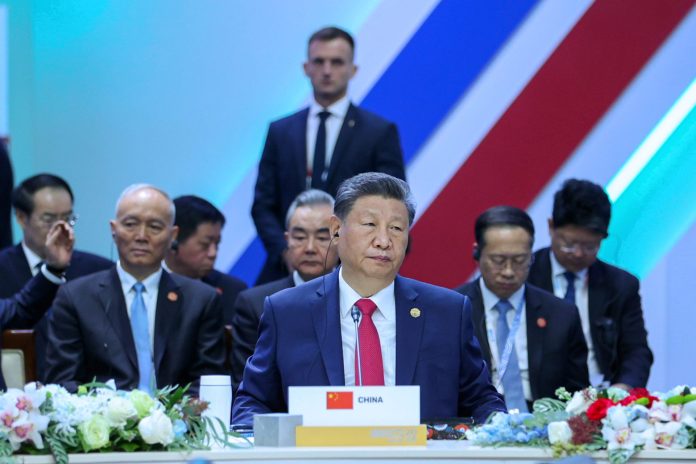
Xi advocates high quality development of greater BRICS collaboration

In a speech addressing the 16th BRICS Summit on Wednesday, Xi said the ongoing BRICS summit has decided to invite a number of nations to become partner countries. He hailed the decision as another important development in the course of BRICS development.

Xi urged BRICS members to build the multilateral mechanism into a major venue of solidarity and cooperation for the Global South and a vanguard force for global governance reform.

He called on the BRICS members to build BRICS for peace and act as guardians of common security, urging the BRICS countries to uphold the three principles of no expansion of the battlefield, no escalation of fighting and no provocation by any party, to work for de-escalation of the Ukraine crisis as soon as possible.

Xi urged the BRICS members to build BRICS for innovation and act as pioneers for high-quality development.

He called on BRICS members to build green BRICS and be practitioners of sustainable development, noting that China is willing to leverage its own advantages to expand cooperation with BRICS countries in green industries, clean energy and green minerals.

The president also called for building a BRICS for justice and leading the reform of the global governance system, calling on BRICS members to conform to the general trend of the rise of the Global South, and actively respond to the call of countries to join the BRICS cooperation mechanism.

The group should advance the process of expanding membership and establishing partner countries, and enhance the representation and voice of developing countries in global governance, added Xi.

Xi stated the urgency of reforming the international financial architecture is becoming increasingly prominent in the current situation.

He also called for strengthening the New Development Bank and urged BRICS countries to take the lead in promoting a better alignment of the international financial system with the changing dynamics of the global economy.

Xi urged BRICS countries to advocate peaceful coexistence and harmony between civilizations.

China will establish 10 overseas learning centers in BRICS countries in the next five years to provide training opportunities for 1,000 education administrators, teachers and students, he continued.

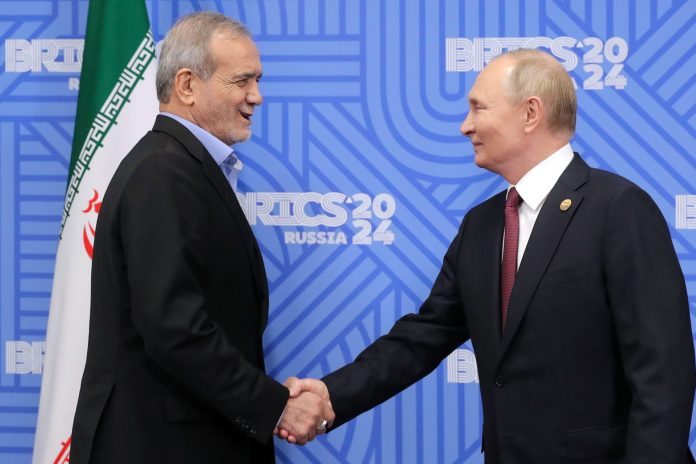
Iranian presiden meets Putin, urges deeper Tehran-Moscow cooperation

Pezeshkian also expressed hope that such cooperation helps weaken the “US authoritarianism”.

The Iranian president added that he thinks the Iran Russia ties are strategic and unavoidable.

Addressing Putin, Pezeshkian noted, “After meeting you in Turkmenistan, I pursued the agreements [the two sides] concluded so we can sign them as soon as possible”.

Putin for his part said, “We are also pushing for the creation of a multi-polar fair international order”.

The Russian president then spoke about bilateral ties with Iran, saying the development of the north-south railway infrastructure and the construction of the second and third Bushehr power plants are on Moscow’s agenda, and “we will sign new contracts regarding our bilateral strategic partnership”.

Putin added that Iran and Russia also signed a bilateral agreement on building cultural centers and cancelling visas for the exchange of tourists last year.

The Russian president then asked Pezeshkain to extend his warm greetings to the leader of Iran’s Islamic Revolution.

Ayatollah Khamenei says struggles of Hezbollah, Hamas leaders changed fate of region

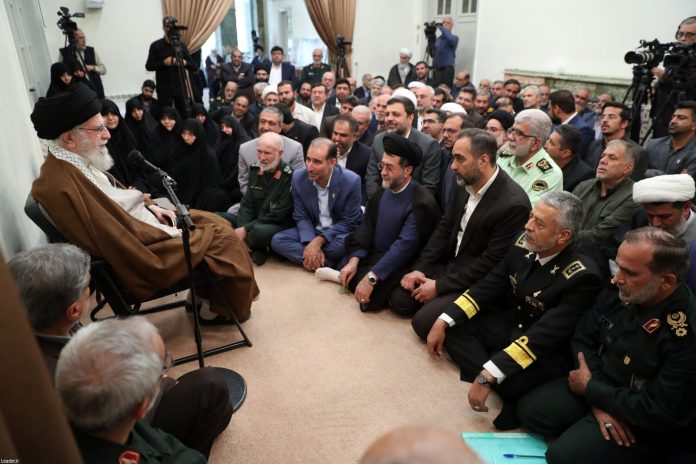
Ayatollah Khamenei made the remarks in a meeting with organizers of the Congress of 15,000 Martyrs of the southern Iranian Fars Province on Wednesday.

The Leader described the events in the region and the steadfastness and efforts of the resistance as factors that have changed the fate and history of the region.

He noted that the Israeli regime had clearly failed to destroy the resistance despite the massacre of more than 50,000 innocent people, describing this as a “great defeat for the Zionist regime”.

Yet, Ayatollah Khamenei stressed that the greater defeat lies in the disgrace of Western culture, civilization, and politicians.

“In the confrontation between the resistance front and the front of evil, victory belongs to the resistance,” he emphasized.

The Leader described the current developments in the region and the events in the besieged Gaza Strip, Lebanon, and the occupied West Bank as historic.

“If figures like the martyr Sinwar had not emerged to fight until the last moment, or if great leaders like the martyr Sayyed Hassan Nasrallah had not combined jihad, wisdom, courage, and sacrifice and brought them to the field, the fate of the region would have been entirely different.”

The Israeli regime assassinated Hamas’ chief Ismail Haniyeh in the Iranian capital Tehran back in July and Nasrallah in southern Lebanon last month. Furthermore, the occupying entity assassinated Haniyeh’s successor, Sinwar, in Gaza earlier this month.

“The Zionists thought they could easily eliminate the resistance groups. However, despite the martyrdom of more than 50,000 defenseless civilians and several prominent resistance leaders, and despite the enormous costs and US support…. the resistance front and the young fighters in Hamas, Islamic Jihad, Hezbollah, and other resistance groups continue to fight with the same resolve and strength,” he stated.

“This is a significant defeat for the Zionist regime,” Ayatollah Khamenei added.

The Leader described the outcome of the Zionist region’s ongoing aggression in the region as a major defeat not only for the Zionist regime but also for Western civilization and culture.

“The massacre of 10,000 innocent children with two-ton bombs and various weapons, while Western politicians remained unmoved, has disgraced the hypocritical Western politicians and self-proclaimed advocates of human rights,” he continued.

“It has exposed the lack of credibility of Western civilization to the entire world, and this is their greatest defeat,” he noted. “Western politicians have been disgraced. Western politics has been disgraced and defeated—this is a major defeat.”

Condemning the West’s disregard for human life and suffering, Ayatollah Khamenei said the Western governments are sending taxpayers’ money to fund “the destruction of families, the martyrdom of 10,000 children, and the orphaning of thousands more.”

Since October 2023, the US-Israeli genocide across the besieged Gaza Strip has killed over 42,700 Palestinians and injured more than 100,000 others.

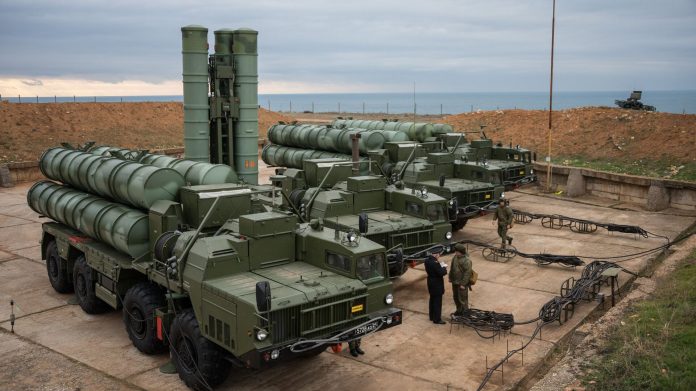
Iranian MP demands Russia deliver missile shields under mutual agreement 

Manouchehr Mottaki, a member of the Iranian Parliament’s National Security and Foreign Policy Commission, urged the Russian government to abide by its commitments under the agreements.

Iran has already paid for the missile shields but have yet to deliver them.

The Iranian lawmaker’s comment comes as Iran is being threatened with military action by the Israeli regime on a daily basis. Iran has said it will give a firm response to any aggression on its soil.

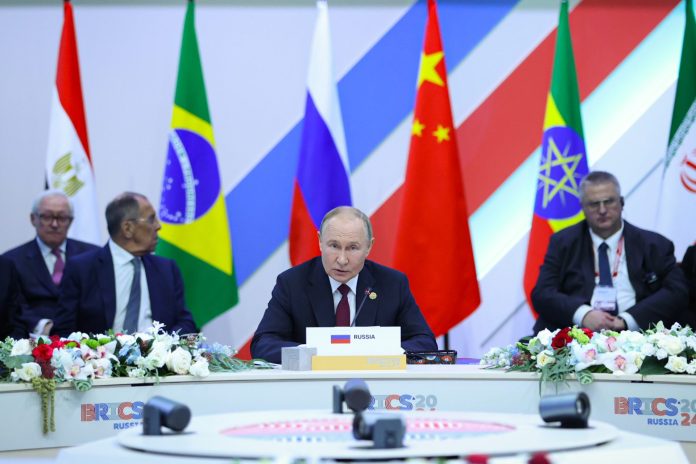
Putin says share of BRICS member states in global economy to total 36.7% in 2024

“Priority growth rates are expected in most states of the association in the medium term,” he said.

The president cited statistics, according to which the average growth of BRICS economies in 2024-2025 will amount to 3.8% with global GDP growth to equal 3.2-3.3% according to preliminary estimates.

“The share of BRICS states on a purchasing-power basis will total 36.7% in 2024, which is stably higher than the share of G7 countries whose share will stand at 30%,” Putin added.

The Russian president has repeatedly noted the dynamics demonstrated by economies of the integrations compared. In particular, speaking at the BRICS business forum, Putin cited statistics, according to which the share of G7 countries in global GDP accounted for 45.5% in 1992, while BRICS states accounted for 16.7% in the same year, adding that three decades later, by 2023, the ratio had drastically changed. He has also noted that particularly BRICS member states are drivers of global economic growth, which will generate the main global GDP growth in the foreseeable future.

There are more than 2,500 special economic zones operating within the BRICS nations, and their collaboration should be intensified, Putin stated at the BRICS Summit.

“More than two thousand five hundred special economic zones are currently functioning across BRICS,” the Russian leader noted.

“We believe it is essential to establish direct connections between the management teams of these zones, which offer preferential and beneficial conditions,” Putin emphasized.

“This will enable them to share best practices in developing logistical hubs, localizing industrial production, and creating favorable global and competitive conditions for investors,” he continued.

Searching for alternatives to the dollar is not fighting against this currency, Putin said.

The dollar is used as the weapon to attain political goals, the Russian leader added.

“But this is not what we are doing; the others are doing that. We do not reject, do not fight against the dollar but if we are prevented from working with it, what we have to do? We then have to search for alternatives, and this is what is happening,” Putin noted.

Dollar weaponization is a big mistake, the head of state stressed.

President of the New Development Bank Dilma Rousseff said at the BRICS Summit that the dollar is used as a weapon.

“Yes, indeed so, we see, so it is,” Putin stated.

“I believe in actual fact this is a great mistake of those making it because the use of the dollar, and it remains thus far the most important instrument in global finance, as means of achieving political goals undermines confidence in this currency and reduces its abilities,” the Russian leader stressed.

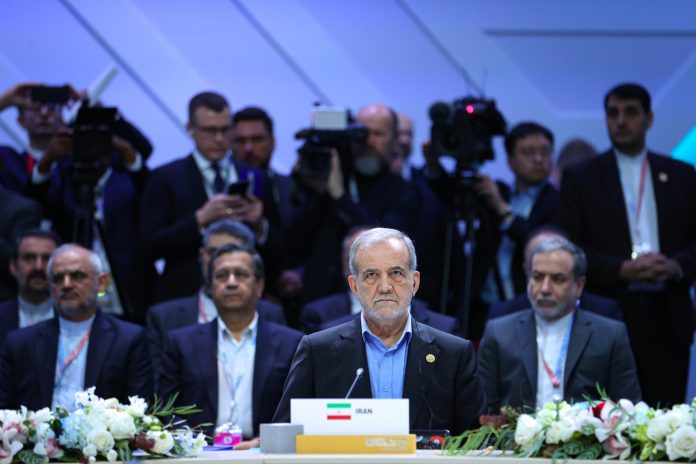
President Pezeshkian urges BRICS economic synergy, resistance against dominance of US dollar

In his speech at the BRICS summit in Kazan, Russia, on Wednesday, Pezeshkian highlighted the need for collective efforts among BRICS countries to confront illegal and anti-human rights sanctions.

He noted that millions of people in dozens of countries worldwide are subjected to sanctions, and combating these sanctions requires group action and the creation of joint mechanisms within BRICS.

The Iranian president also advocated for trade and economic exchanges between BRICS members using national currencies, viewing this as an effective way to counter the US dollar, which Washington uses as a weapon and a tool of control over other countries.

President Pezeshkian pointed out that BRICS members are the largest producers and consumers of energy, food, and other goods, emphasizing that launching and using digital currencies, and creating a foundation for new financial technologies, align with BRICS’ primary goals.

He further stressed the importance of joint efforts by BRICS members, including through information exchange and joint investments, to help Global South countries gain access to modern technologies.

Iran’s president also called for strengthening the New Development Bank, a key institution born out of BRICS, and reiterated Tehran’s readiness for close cooperation with the bank.

Highlighting Iran’s strategic position in the region, Pezeshkian said that the Islamic Republic serves as a transit hub for several international transportation corridors, including the North-South and East-West corridors.

He emphasized that through constructive cooperation, BRICS could establish a new network of transit relations for the transfer of energy and trade goods.

Elsewhere, Pezeshkian called for an immediate and permanent ceasefire, the complete withdrawal of Zionist regime forces from occupied territories, and urgent humanitarian aid to the people of Gaza and Lebanon.

BRICS is an intergovernmental organization initially comprising Brazil, Russia, India, China and South Africa. Iran, Egypt, Ethiopia, the United Arab Emirates and Saudi Arabia have also joined BRICS, with Türkiye, Azerbaijan Republic and Malaysia having formally applied to become members.

WHO says Israeli bombardment stopped Gaza polio vaccinations

Gaza War

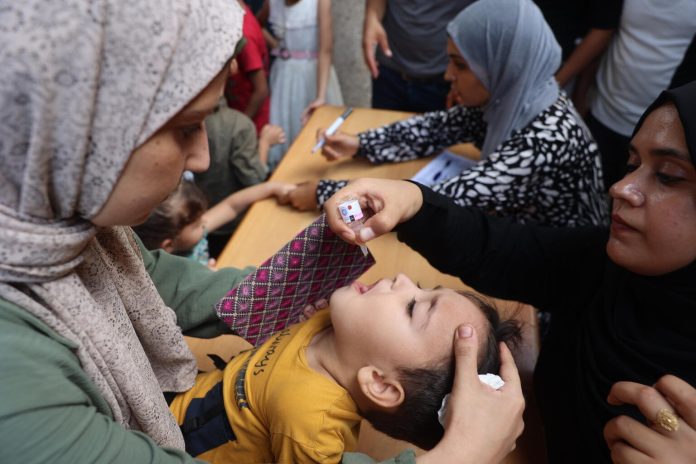
The necessary second round of vaccinations has been completed in central and southern Gaza, and was to begin on Wednesday in the north.

But the WHO said it had been “compelled to postpone” the bid to give 119,279 children in northern Gaza a second vaccine dose.

Israel launched a major air and ground assault in northern Gaza this month, vowing to stop Hamas militants from regrouping in the area.

The vaccination campaign was called off “due to the escalating violence, intense bombardment, mass displacement orders, and lack of assured humanitarian pauses across most of northern Gaza”, the UN health agency announced.

“The current conditions, including ongoing attacks on civilian infrastructure, continue to jeopardise people’s safety and movement in northern Gaza, making it impossible for families to safely bring their children for vaccination,” and for health workers to operate, it added.

The vaccination drive began after the Gaza Strip confirmed its first case of polio in 25 years.

The war has left most medical facilities and Gaza’s sewage system in ruins.

Typically spread through sewage and contaminated water, poliovirus is highly infectious.

It can cause deformities and paralysis, and is potentially fatal, mainly affecting children under the age of five.

The WHO says a minimum of two separate doses of oral vaccine are needed to interrupt poliovirus transmission, requiring 90 percent of all children aged under 10 to be vaccinated in a given community.

As in the initial round of vaccinations last month, the second round was divided into three phases, helped by localised “humanitarian pauses” in the fighting: first in central Gaza, then in the south and finally the north.

Each phase was to take up to four days.

The WHO warns that immunity levels are lower if the second dose is given more than six weeks after the first.

The UN agency said the approved area for humanitarian pauses in the north had been cut down to Gaza City alone, meaning many children would have missed the second dose.

This would “seriously jeopardise efforts to stop the transmission of poliovirus in Gaza”, it noted.

Since the second round of the campaign began on October 14, some 442,855 children under 10 have been vaccinated in central and southern Gaza, with coverage at 94 percent.

“It is imperative to stop the polio outbreak as soon as possible, before more children are paralysed and poliovirus spreads further,” the UN health agency said, adding, “It is crucial therefore that the vaccination campaign in northern Gaza is facilitated through the implementation of the humanitarian pauses.”

More than 560,000 children below the age of 10 in Gaza received their first doses of the vaccine in September, according to the WHO.

The war in Gaza began with Hamas’s October 7, 2023 attack on Israel, which resulted in the deaths of 1,200 people, mostly civilians.

Israel’s retaliatory offensive has killed more than 42,700 people in Gaza, also mostly civilians, according to figures from the Hamas-run territory’s health ministry which the UN considers reliable.

Turkey quietly curbs military goods exports to Russia following US warning: Report

In recent weeks, Ankara updated its customs systems to stop the export of over 40 categories of US-made items deemed critical to Russia’s war in Ukraine, according to FT sources.

The new restrictions target goods such as microchips, processors, and control systems, believed to be used in weapons.

According to the report, Turkish banks have also reduced dealings with Russian entities over the past year, following US threats of sanctions.

The updated policy regarding Russian exports was not publicly announced due to political sensitivities.

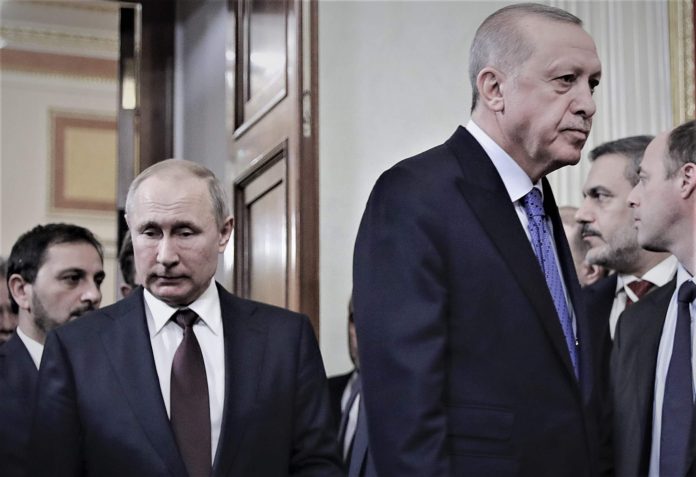
While Turkey is a NATO member, Turkish President Recep Tayyip Erdogan has aimed to maintain positive relations with both Russia and Ukraine.

Turkey has also facilitated the flow of Russian oil to the European Union since Russia’s full-scale invasion of Ukraine, enabling the Kremlin to circumvent the bloc’s sanctions.

In 2023, Turkey became the world’s biggest buyer of Russian fossil fuels, importing around 42.2 billion euros ($45.9 billion) in oil, natural gas, and coal from the country – a fivefold increase over the past decade.

At the same time, Erdogan has publicly supported Ukrainian sovereignty, and his administration has given significant aid to Ukraine since the start of Russia’s full-scale invasion.

“We support Ukraine’s territorial integrity, together with Ukrainian Crimea,” Erdogan said in early February.

Turkey also brokered a grain deal in 2022, along with the UN, that was essential in mitigating a global surge in food prices partially caused by the war. It allowed Ukraine to export its agricultural products via the Black Sea, despite the ongoing invasion.

President Pezeshkian warns Israel of firm response to any attack against Iran

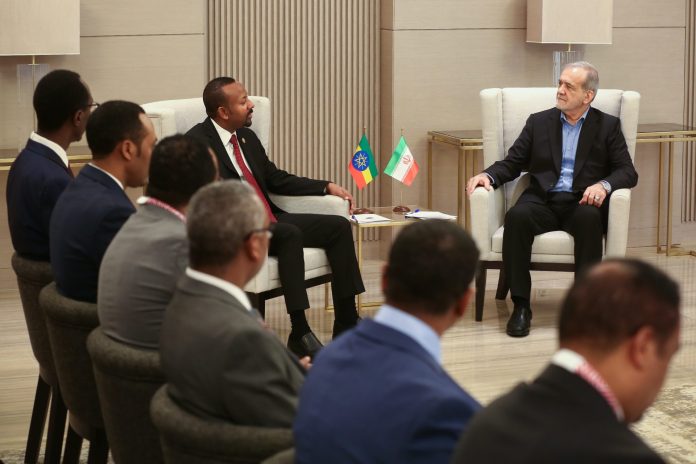
President Pezeshkian made these remarks during a meeting with Ethiopian Prime Minister Abiy Mohamed on the sidelines of the BRICS summit in the Russian city of Kazan.

The Iranian president referred to the Israeli regime’s assassination of former Hamas political leader Ismail Haniyeh in Tehran, which took place during Pezeshkian’s inauguration ceremony.

He stated that Iran had shown restraint in response to the Israeli regime’s crime, hoping for a ceasefire in Gaza. However, the continuation of the Zionist regime’s crimes in Gaza and their expansion into Lebanon prompted the Islamic Republic to respond.

President Pezeshkian also emphasized that the West’s support for the Israeli regime has significantly contributed to its ongoing crimes.

The Iranian president stressed that Tehran does not seek an escalation of tensions and conflicts, adding that Iran welcomes any effort aimed at peace and stability.

During the meeting, the Ethiopian prime minister described Iran as a powerful and independent country, stating that current global and regional systems need to change as they are unequal.