Friday, December 26, 2025
Home Blog Page 5042

Russia’s navy warships berth in northern Iran

Iran-Russia-Anzali
Iran-Russia-Anzali

A detachment of Russian fleet of warships has berthed at the Caspian port city of Bandar Anzali in northern Iran.

The flotilla, which docked in Bandar Anzali on Monday, carries the message of peace and friendship in the Caspian Sea and was welcomed by Iranian naval officials.

This is the second time a Russian fleet of warships has traveled to Iran, Russian Ambassador to Tehran Levan Dzhagaryan said on Monday.

He also stressed the importance of strengthening cooperation between the two countries.

A group of Russian Navy warships, comprised of Admiral Panteleyev anti-submarine destroyer and the logistic battleships Peresvet and Admiral Nevelskoy with a crew of 712, docked at the southern Iranian port city of Bandar Abbas on April 21, 2013, after a long journey from the Pacific Ocean.

The Russian consul general in the northern Iranian city of Rasht, Maxim Baranov, said on Monday that the visit by the fleet aims to boost relations in various economic, political and military fields.

Russia believes that all issues pertaining to the Caspian Sea should be settled by its five littoral states, without the interference of other countries.

The Russian flotilla is scheduled to leave Iran for Azerbaijan on Wednesday.

Iranian Culture Week to be held in Tunisia

Iran cultural week-Tunisia

Iran is to hold a Culture Week in Tunisia to introduce the Persian culture and various arts to the nation.

Minister of Culture Ali Jannati and several other officials are slated to attend the event.

A 30-member delegation bringing together experts in various arts will also participate in the festival that will be held in several Tunisian cities.

Screening Iranian cinematic productions, exhibiting Persian works of art such as paintings, calligraphy, illumination, traditional and regional Persian costumes and performing traditional music are among the programs of the event.

Different cultural panels will be also held on the sidelines of the event.

The first Iranian film week was held in the capital city of Tunis in 2011, while the first Tunisian Culture Week was celebrated in Tehran in 2012.

Iran’s second Culture Week is to kick off on October 14 and will continue until October 19, 2014.

Shia Muslims celebrate Eid Al-Ghadeer

Eid al-Ghadeer-Muslims-celebrate

Iranians along with many Muslims of other parts of the world are celebrating Eid al-Ghadeer, one of the most important religious feasts.

The auspicious occasion is annually celebrated with various ceremonies and rituals in different cities, on the 18th of Dhu al-Hijjah in the Islamic calendar.

Prophet Mohammd received a revelation from God, ordering him to halt the pilgrims at a pond called Khum, a place near Mecca, and to designate Imam Ali (PBUH) as his successor in guiding and ruling Muslims.

Eid al-Ghadeer is also known as Eid al-Akbar (the greatest Eid) in Islamic narrations, since Muslims believe that the mission of all the previous messengers of Allah became accomplished on this day.

The event dates back to March 10, 632 CE, in the tenth year of Hijra, when Prophet Mohammad (PBUH) made his last Hajj pilgrimage known as the ‘Hajjat-
ul-Wida’ or the Farewell Pilgrimage a few months before his demise.

Three Iranian scholars weigh in on ways of promoting global peace

damad va bojnurdi
damad va bojnurdi

September 21st has been designated by the United Nations as the International Day of Peace. Coincidentally, on the same day 34 years ago, Iran was dragged into a devastating war when Saddam’s Iraq attacked the country. Each year the UN and its offices in different countries host ceremonies to mark the occasion. In Iran, the Center for the Great Islamic Encyclopedia organized a gathering in cooperation with the United Nations on sustainable global peace.

On September 29th, Shahrvand newspaper featured the transcript of the speeches of a number of participants in the gathering. Accompanying the detailed transcripts were the images of world-renowned individuals such as Mahatma Gandhi, Nelson Mandela, Aung San Suu Kyi, and Malala Yousafzai, who have contributed greatly to global peace. The following is the translation of two speeches in their entirety and the excerpt of a third one:


Ten vital principles to secure sustainable peace

Mohammad Mojtahed Shabestari: A few years ago, at the invitation of an Austrian university, a number of Muslim and Christian jurists, economists and theologians, me included, got together in Austria to look into national and international necessities to secure peace. The meeting produced a 10-point resolution in both English and German. Let’s review those 10 principles here.

1. Sustainable global peace is not achievable in the absence of justice. Similarly, justice remains elusive when sustainable global peace is non-existent. In other words, justice and peace are inseparable. You can’t ask a community or a nation to observe peace while denying its members justice. Likewise you can’t ask a group to advance the cause of justice without providing them with peace. Back then [when the meeting took place] Palestinians were a good example for this. They were being asked to commit themselves to the cause of peace, without enjoying the benefits of justice.

2. In a world fraught with social inequality, hunger and poverty, sustainable global peace remains elusive. You can’t expect members of a society to be exposed to enormous financial and economic disparity and at the same time live in peace with each other. You can’t have very rich countries and very poor nations on the world stage and ask them to coexist peacefully. Social inequalities and poverty should be eliminated to pave the way for closer cooperation between humans and for international cooperation to bridge the gaps.
When a nation enjoys welfare and is more powerful than others, and another is impoverished, the poor develop an instinctive negative attitude toward the rich and the powerful. […] The use of soothing words won’t do much. A negative attitude is bound to take shape. When that happens, peaceful coexistence between the rich and poor would become impossible.

Social inequalities are not just financial. Political inequalities are at play too. Instinctively, humans develop a negative attitude toward those who have political power and enjoy the right to self-determination. […] A while ago I read a book on democracy. It featured the viewpoints of a philosopher who believed humans are jealous. They can’t stand others having control over their political future, enjoying enormous powers and showing off their power all the time. They can’t step back and live in peace with such powerful figures.

3. Sustainable global peace would be unachievable unless violence is utterly rejected. Violence should be condemned in all forms, without any distinction between legal and illegal violence. Violence is defined as use of force to secure political goals which are achievable without recourse to force. Violence is in contrast with peace. The worst type of violence is the kind of violence which is committed in the name of religion and God. Of course, enforcement of laws and punitive measures such as imprisonment is not violence. […]

4. Sustainable global peace would not be a non-starter, if the dignity of humans is not respected and if there is no legal system to uphold human rights. […]

5. Sustainable global peace would not be achievable unless pillars of social pluralism are recognized. […] Pluralism should be upheld on all fronts, including in religion, customs, cultures, etc. No one should ever try to reject [the cultures and customs of] others and stick to what they find interesting. […]

Religious pluralism is often misunderstood. Some might assume that their freedom to choose religion amounts to pluralism. That is not true. Religious pluralism is to give individuals the right to be part of the political process and at the same time stick to their faith. Giving individuals the right to practice whatever faith they opt for, but taking away their right to political determination is not religious freedom. […]

6. Dialog is vital. Dialog should be aimed at pressing home the responsibility of all those involved in talks in settling the problems of humanity. […] The sixth principle is all about promoting dialog at the expense of monolog, bossiness, etc.

7. In the absence of willingness to peacefully settle disputes and prevent clashes in the future, sustainable global peace would be unachievable. In other words, those who sit at the negotiating table to settle disputes should be ready to settle their problems in a way that serves the interests of all. […]

8. Sustainable global peace would not be achievable unless education is based on lofty human and religious values not blind imitation and customs. […]

In bringing up their children, parents, particularly in our society, think they should cement the foundation of customs, beliefs and respect for authority in their children. One-sided upbringing as such chips away at the foundation of peace and gives rise to differences. Upbringing should be aimed at the future; children should be raised to be able to tackle future problems rather than simply comply with the past. […]

9. Unless women enjoy the same rights as men on all fronts of human life, sustainable global peace would remain elusive. Male superiority which fans the flames of the battle of sexes is still in place in various fields including in religion. […] The principle of equality should be upheld and anything that stands in the way of parity should be disposed of. Whatever remains of male superiority should be eliminated.
10. Sustainable global peace would not be achievable unless the rights of minorities, particularly religious minorities are respected. […] Recognition of minority rights means that, among other things, they should be allowed to evolve culturally, and form political parties to take on a more active role in society. […]

These rules are not carved in stone; one can add principles to the list or take some off it. Participants in the gathering in Austria were urged to promote these principles upon returning home. Now you decide how much importance Iranian society attaches to these principles, what people and authorities think about them, and how much focus is placed on them in general.
 

Pressing for global peace is mandatory from a Shiite perspective

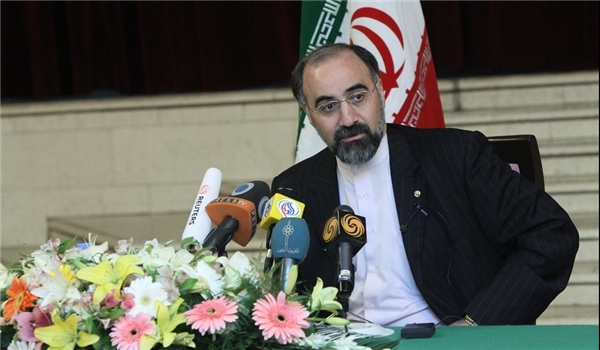
Seyyed Mohammad Mousavi Bojnourdi: The true and pure Islam is a harbinger of mercy, so one has to weep bitter and painful tears for the crimes which are committed against humanity in the name of religion.

Islam describes peace as a blessing, characterizing it as a core principle. The Muslim Prophet (Peace Be upon Him) too openly invited the followers of Moses, Jesus and Abraham (Peace Be upon Them) to talk about their common ground and form a united front.

Peace, by nature, cannot be an indecent issue. Conflict is always an ugly phenomenon unless it is in self-defense. In other words, people resort to conflict only to defend their territorial integrity and independence.

Peace is what all divine faiths unanimously call for. The issue which I am raising today with a sunken heart is this: today some are playing the religion card to commit most heinous crimes against humanity.

In the name of the Muslim faith and under the fake name of the Islamic State, the Islamic State of Iraq and the Levant (ISIL) is acting against Muslims and Christians, killing both, whereas Islam steers clear of such acts.

When the Prophet Muhammad (PBUH) entered Mecca triumphantly 13 years after he emigrated from his homeland, he announced that the day was one of mercy, and those who embraced Islam would see their lives and property remain protected and untouched.

The true, pure Islam offers mercy wherever it goes. Muslims do not nurse grudges against or animosity toward Jews and Christians. Judaism shouldn’t be confused with Zionism and Israel.

[UN Secretary General] Ban Ki-Moon is pressing for the establishment of peace, but he should know that we are not at odds with Christianity or Judaism, since we view them as Abrahamic and monotheistic religions.

Unfortunately, certain Islamic nations use their petrodollars to lend support to the ISIL militants, a group which has done the gravest injustice to the Muslim faith just like al-Qaida.

We are ardent advocates of global peace and friendship with nations. We are among the followers of a prophet whose mindset heralded global peace. It is incumbent on Shiite people to do all they can to help establish global peace, because Sharia stresses anything wisdom deems obligatory.

We are opposed to war unless it is solely for the purpose of standing up to aggressors. Iran has not launched any attack on any nation. In the course of the Sacred Defense too, the Islamic Republic defended itself against the aggressions of Saddam’s Iraq. Without doubt, the Iraqis, back then, were not supporting Saddam.

If Iran has issues with Israel, it is because the Islamic Republic regards the regime as an invader. That’s why Iran cannot be on friendly terms with the occupying regime [of Israel].


To boost global peace, we should start from family

Mostafa Mohaghegh Damad: Immanuel Kant, the German philosopher who lived in the 18th century, is the father of global peace. He owes this title to his [1795] essay, Perpetual Peace, which he penned six years prior to his death.

He says in his book that he was inspired by “The land of eternal calm”, a phrase he saw years earlier in a Dutch inn under a photo of a graveyard.

As Kant puts it, “Whether this satirical inscription on a Dutch innkeeper’s sign upon which a burial ground was painted had for its object mankind in general, or the rulers of states in particular, who are insatiable of war, or merely the philosophers who dream this sweet dream, it is not for us to decide.”

Some are of the opinion that the perpetual peace or calm – the book’s title – is a sign of deep dismay Kant felt as a philosopher over establishment of peace and sought to ask if sustainable peace was just for the dead; an indirect suggestion that humans are after war as long as they are alive.

Although before Kant many philosophers and lawyers raised the issue of peace, why is that their works have failed to be given as much attention as Kant’s?

Perhaps the reason lies in the fact that none of them tried to foretell a system or mechanism for bringing about peace and maintaining it, whereas Kant suggested that a league of nations be formed so that it could prevent governments from waging war.

It is worth mentioning that the concept of forming such institutions as the community of nations and the United Nations was outlined by Kant. Nobody can deny what the United Nations has gone through to bring under control many wars and conflicts. But a question arises here: Has the UN been able to bring all aggressions and wars to an end and offer calm to humans?

As an Iranian scholar, I urge the UN envoy to convey our message to the UN secretary general and ask him to do what it takes to help peace take hold. You’d better know that education lies at the center of efforts to spread a mentality of peace and promote peace-seeking efforts.

Global peace and such institutions cannot get things down just through military power. We need to try our best to contribute to efforts to promote the culture of peace and this should be done within the family and inside the education system.

A geek motivated by his parents

Khashkhashi moghadam

“He is a nerd.” That may sound familiar when we are told about a very studious person wearing thick framed glasses, one who leafs through a thick pile of books, habitually studying much. What you are to go through proves otherwise. A young Iranian man, Mohammad-Amin Khashkhashi Moghaddam, is an Olympiad medal winner, but he defies the definition of a bookish guy, or – if you will – a “computer geek”, “bookworm” or “studyholic”.

Mohammad-Amin was the Iranian high schooler who grabbed one of the two gold medals the Iranian computer team collected at the 26th International Olympiad in Informatics (IOI) in Taipei, Taiwan, (July 13-20, 2014). In aggregate, Iran received two gold and two silver medals to rank sixth in the event. Standing behind such a successful young man is a student mom who seeks to make a leap toward higher academic levels.

Hamshahri Javan dedicated a few pages of its 474th issue on September 27 to interviews with Mohammad-Amin and his mother, taking a brief look at the life of a young man in a house where studying comes first. IFP has picked and translated part of what the weekly published:

[…]

Our presuppositions seemed to be true: a smart student with specs and of course diligent, but with a playful tone of voice, something he insists is a noticeable feature of all computer students. He says Olympiad students, for whom being glued to the computer screen is normal, are not into studying much!

The gold medal you received in a national Olympiad spared you the university entrance exam. What about a gold from an international contest?

It allows you to choose whatever university program you wish. […] It has no other benefits; that’s why students don’t take a shot at it after they win a gold medal in a national Olympiad.

But you did it, didn’t you?

It helps me work on my lessons and remain prepared for the Collegiate Programming Contest. I’m thinking about international competitions.

[…]

What do you do for fun? Just studying?

[…] I mostly do my computer-related works. I develop websites, build weblogs, etc. I also play ping pong.

What are your plans for the academic year?

[…] I want to get prepared for the Collegiate Programming Contest. With my friends, we will form a three-man team to attend a regional qualifying contest later this year. The top team will make it to the International Olympiad in Informatics in Morocco.

[…]

Do you have a job?

It is almost a month since I started to work for Café Bazaar Co., [the Iranian version of Android App Market]. A teacher of mine who worked for the company asked me to join up. The idea that working for the firm will teach me many new things prompted me to take up my teacher on his offer. I am now a member of a software-developing team in the company.

Are your siblings as studious as you are?

I have two elder sisters. My eldest sister has been admitted to an Industrial Engineering Ph.D. program. The other one has been admitted to a master’s program on animations at University of Tehran. We are all programmers. My mom has recently completed a master’s program and my father has a bachelor’s degree.

Is there anything you are at odds with your parents over?

No. Everything is ok, really! At times they ask about my job to see if it’s good or not. They have full trust in me.

How much money do you want to make?

I’m not after an office job. I’m trying to work on an idea of my own to make a big wad of money.

What about marriage?

I am not thinking about it yet.

*** The weekly leads off its interview with Mohammad-Amin’s mother by saying:

Mohammad-Amin, his two sisters and mom have each targeted higher levels of university studies, trying to take the bull by the horns. […] Zahra Mohammad-Nia, the mom, who is thinking about a Ph.D. these days, has an insatiable taste for studying.

[…]

Would you agree if Mohammad-Amin decided to go to work instead of studying?

Well, my husband and I have tried to let our children decide freely. […] When he bagged a gold medal and people learnt that he could pick any program in university he wished, they told us to ask him to choose medicine, but we said the choice is all his. As for their jobs, we always tell them to continue their lessons in order to land a decent job down the line.

You are studying at a postgraduate level. Is that right?

I got my degree back in 1989. I couldn’t continue my studies because I had to juggle my parenting responsibilities and the demands of my job. […] Two years ago I was admitted to University of Tehran to major in Psychology and Education of Exceptional Children.

[…]

Lessons and university entrance exam are always the main topics in your family, I suppose.

Exactly!

Your kids were encouraged by you or it was you who were inspired by the example of your children?

I think they followed my example. My eagerness motivated them.

Aren’t they tired of constant studying?

No! […] When I said a while ago that I wanted to study for a doctoral degree […] all of them, their dad included, encouraged me, saying I needed to study even harder.

[…]

Symbolic polo match to prompt UNESCO to register the game in Iran’s name

Iran-Polo match
Iran-Polo match

Ettela’at newspaper ran a short report in its October 12th issue on a polo match in Isfahan, central Iran, to urge the United Nations Educational, Scientific and Cultural Organization to register the age-old game in Iran’s name. The following is the translation of the report:

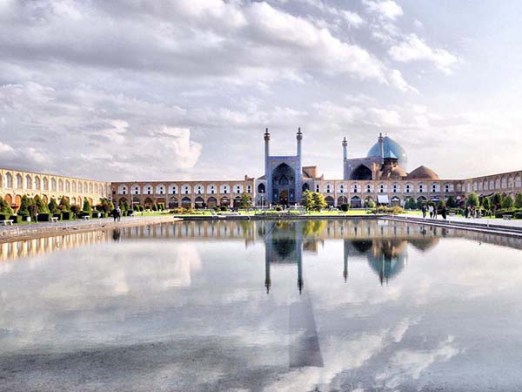
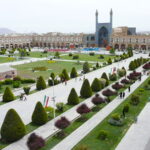
Iran-poloA polo match was held in the world’s oldest polo field in Isfahan on the sidelines of the 2014 Inter-City Intangible Cultural Cooperation Network (ICCN) International Festival, General Assembly and Women’s Forum.

Chairman of the Iranian Polo Federation Hamzeh Ilkhanizadeh said that the match, which was held symbolically in cooperation with the provincial Cultural Heritage, Tourism and Handicrafts Organization, was meant to document Iran’s bid to have the team sport (which is played on horseback) registered as an Iranian heritage at UNESCO.

He also said that Imam [Naqsh-e Jahan] Square in Isfahan is a standard venue for a polo match, adding that polo used to be played in the square up until 90 years ago.


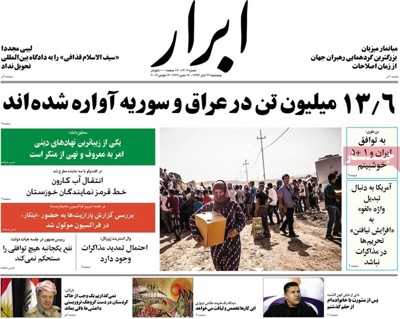
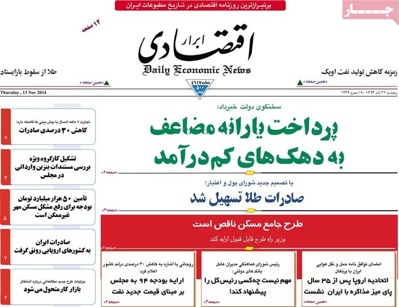
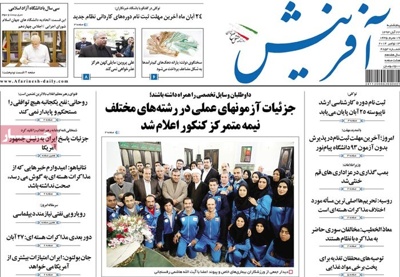
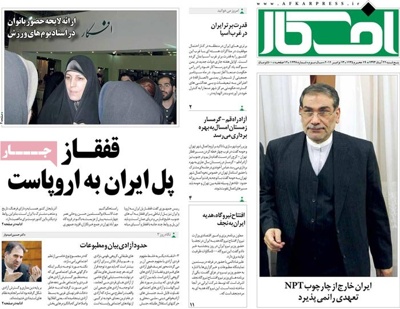
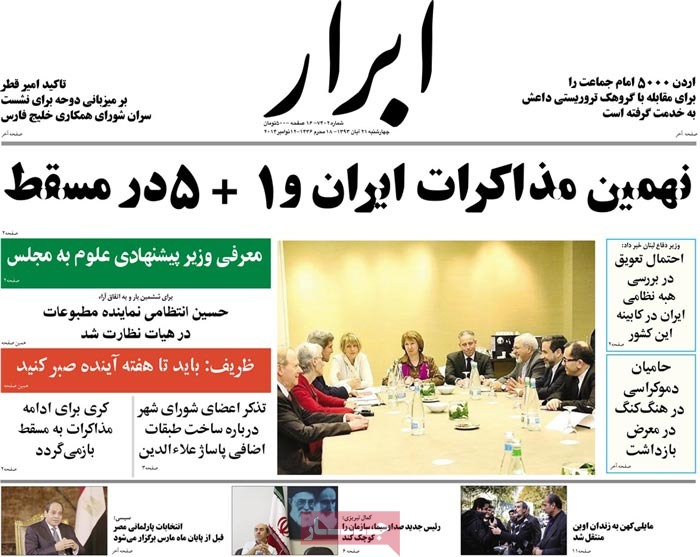
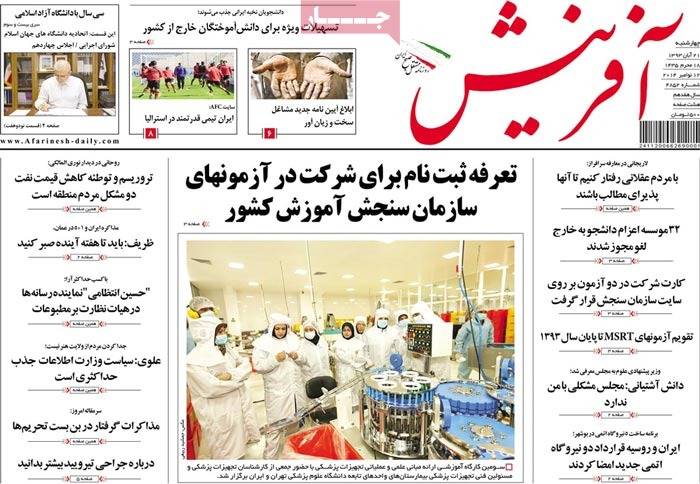
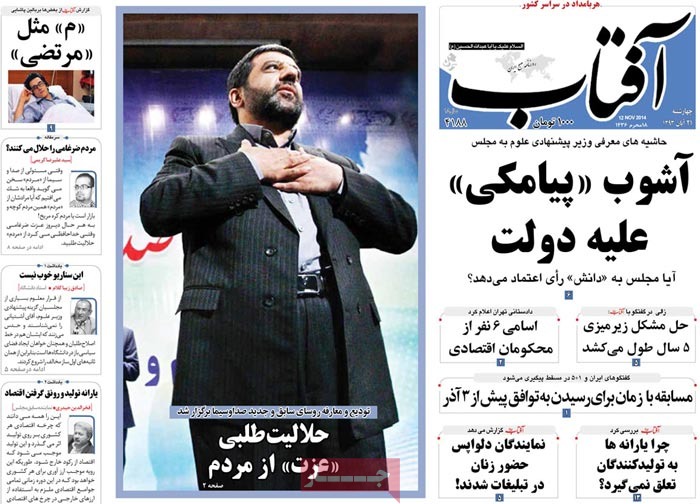
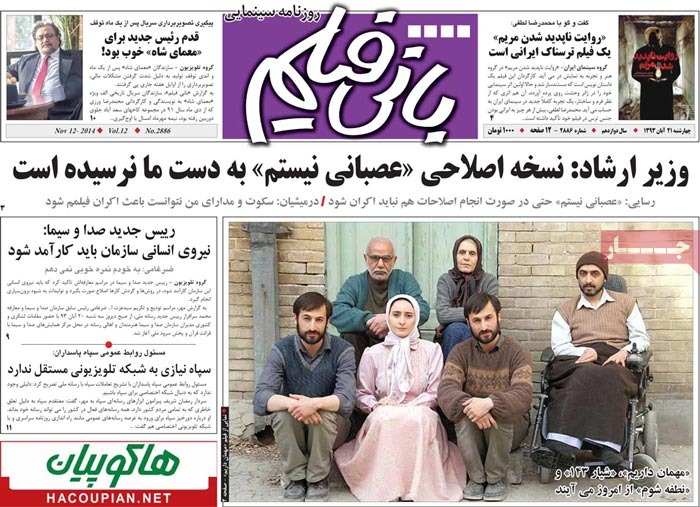
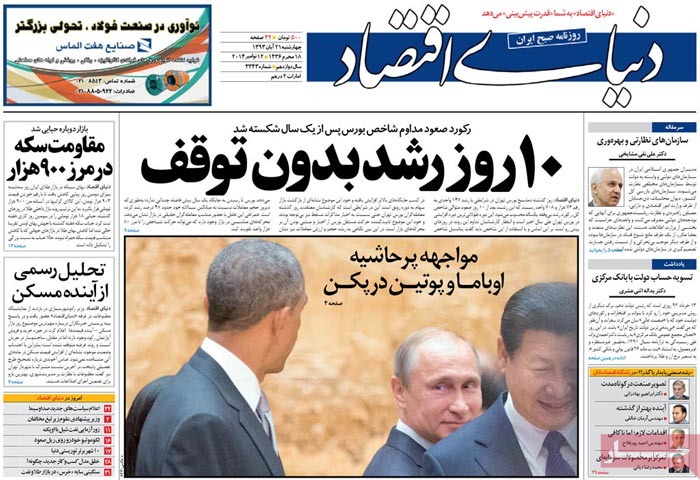
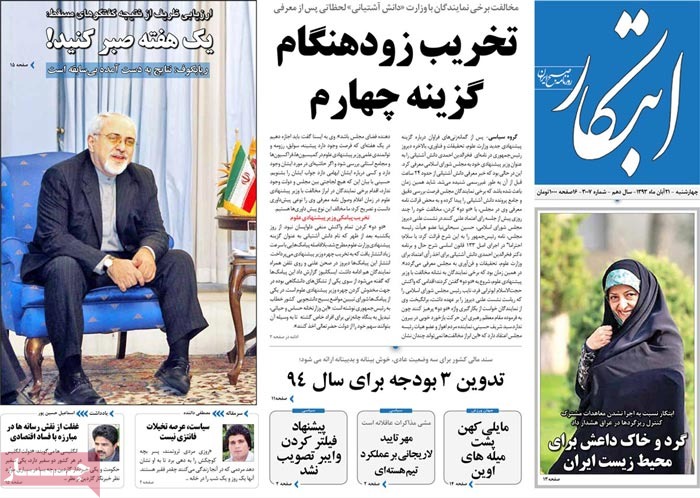
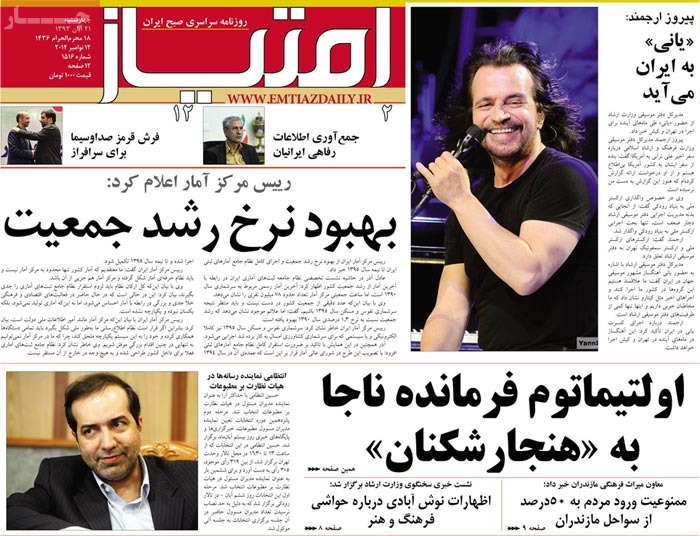
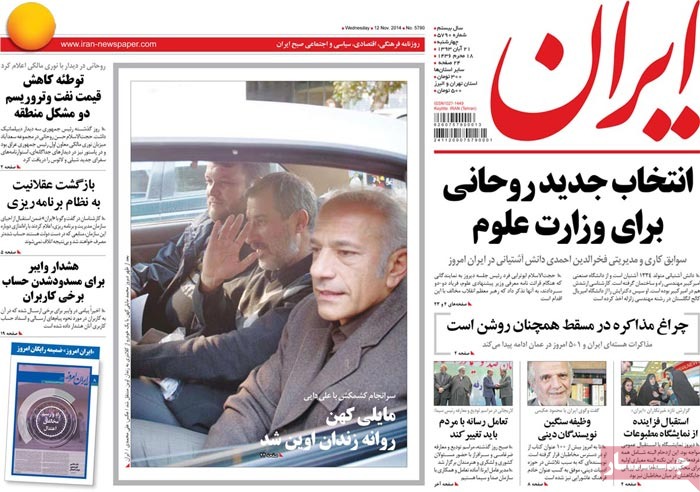
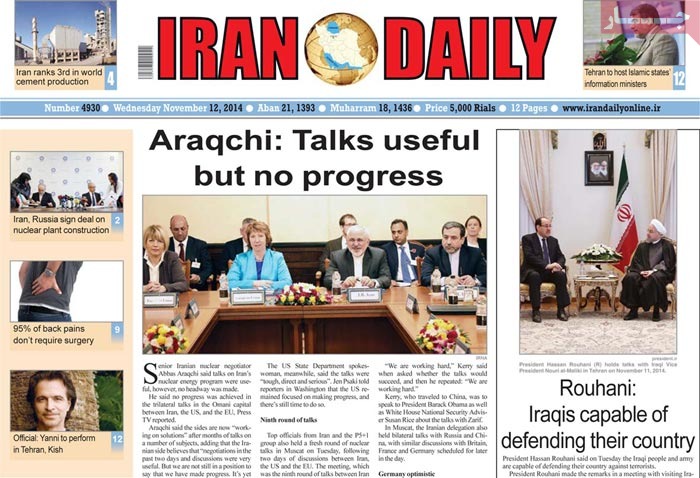
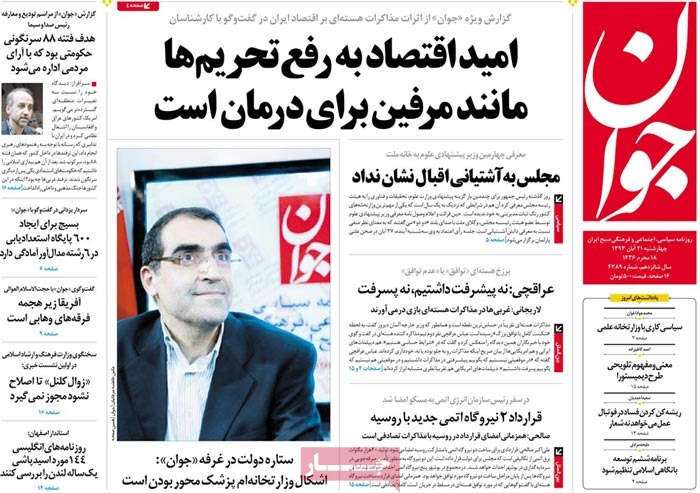
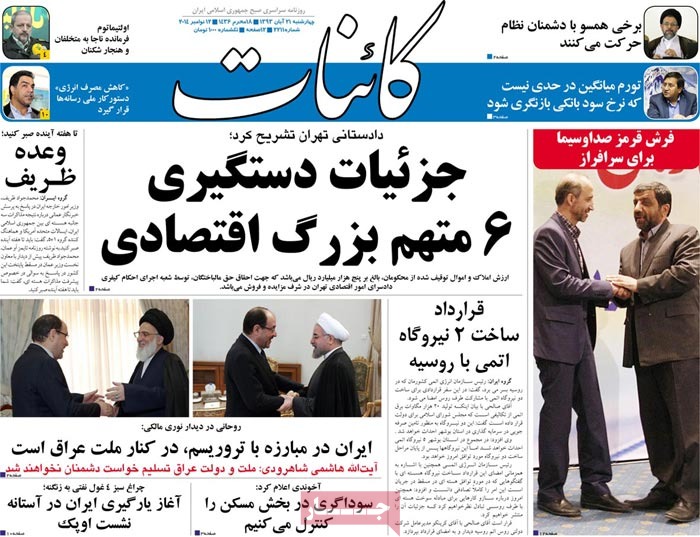
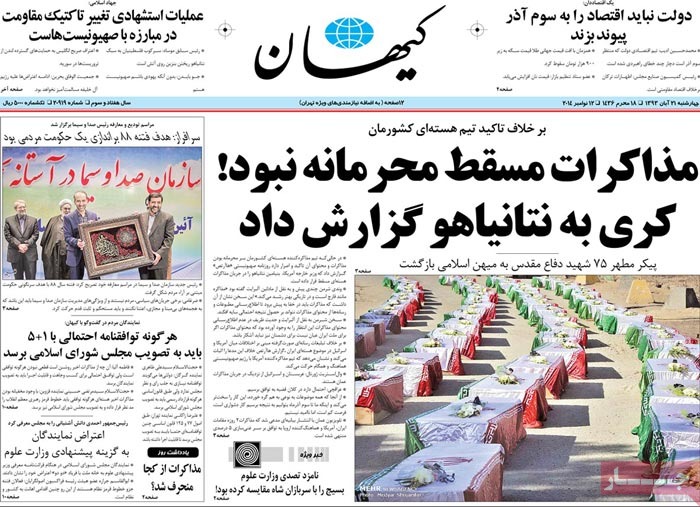
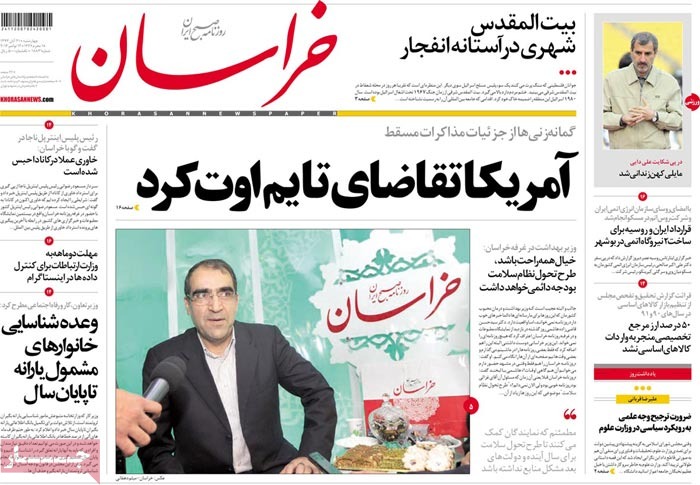
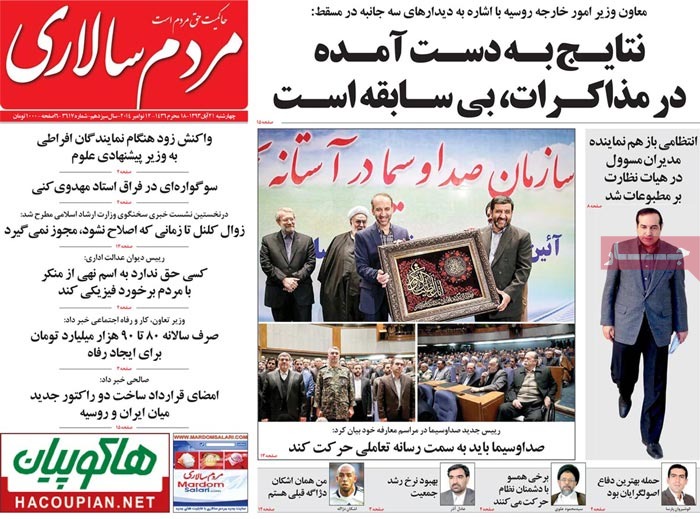
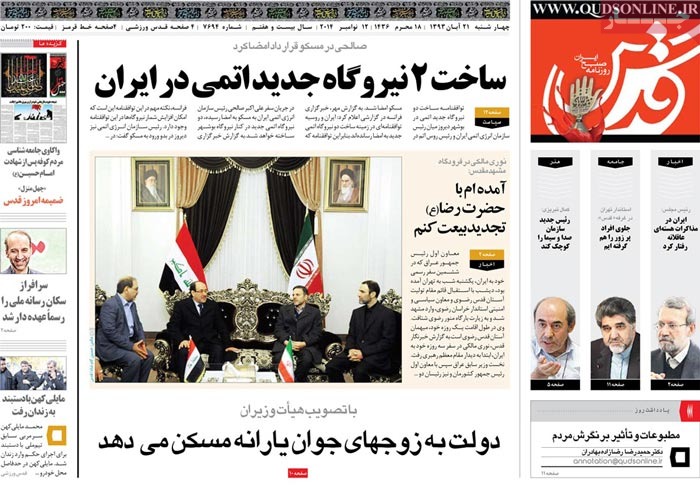
A look at Iranian newspaper front pages on Oct. 12

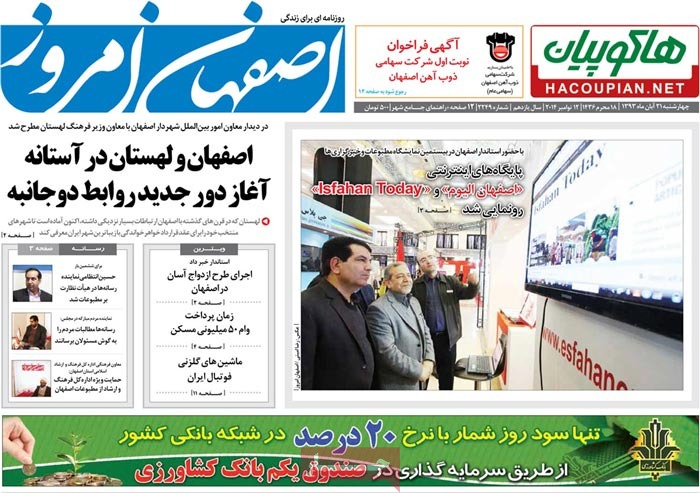
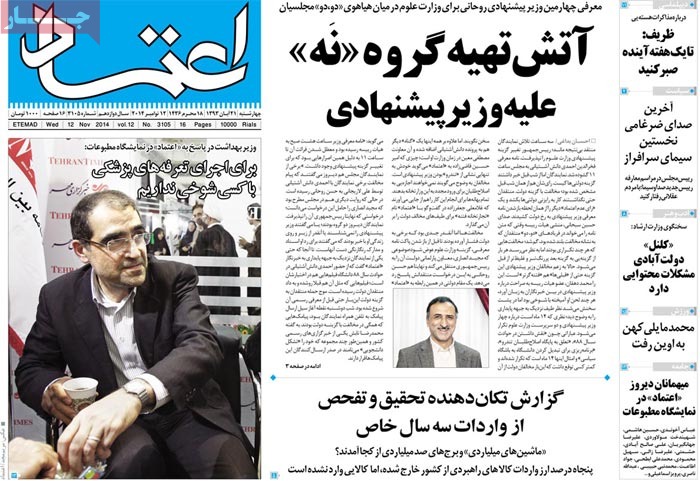
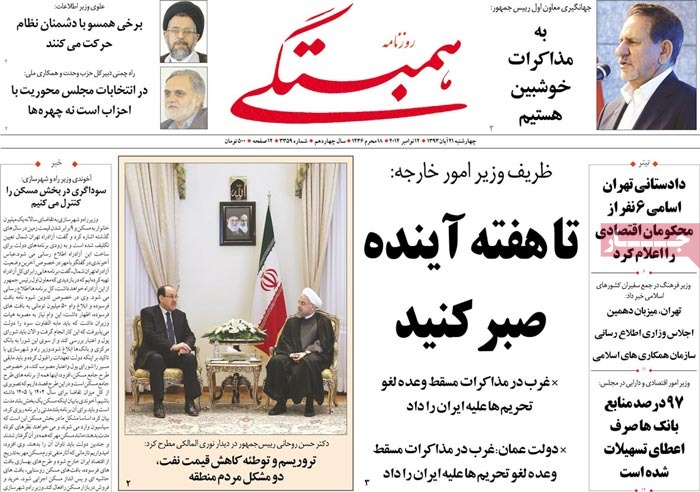
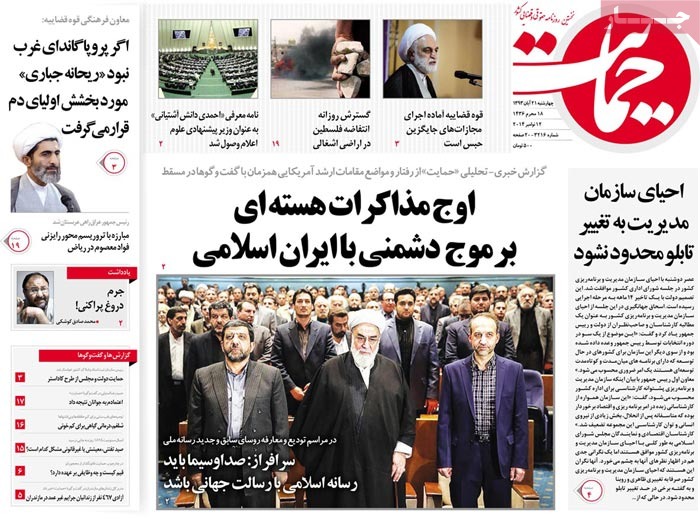
Iranian Newspapers Headlines

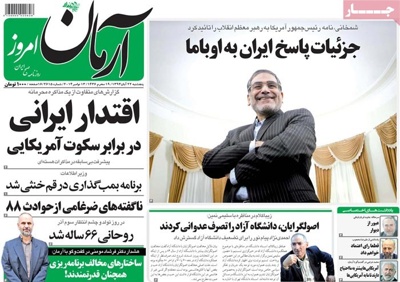
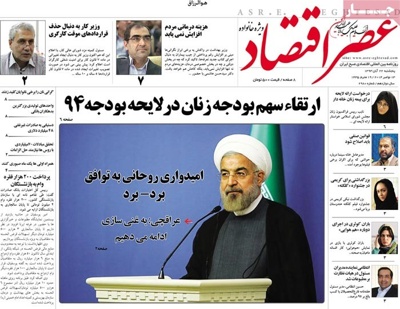
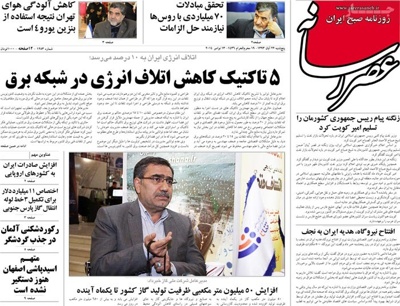
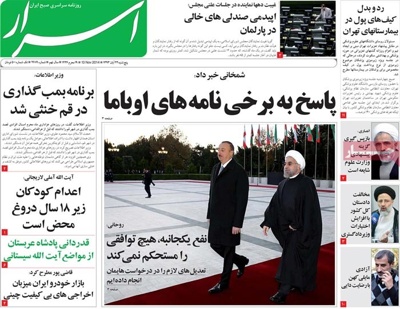
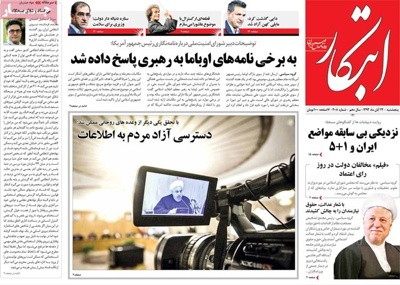
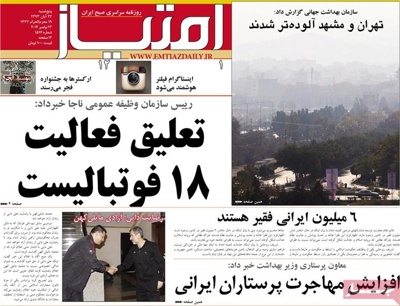
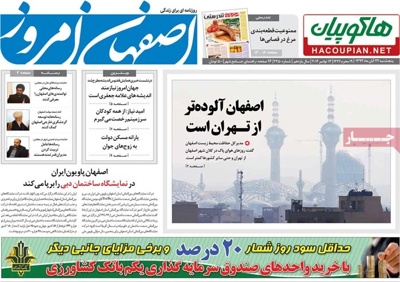
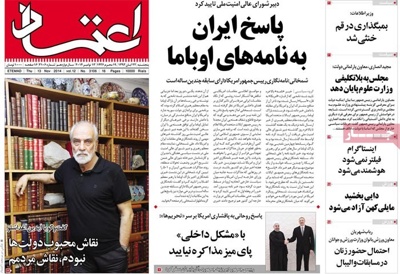
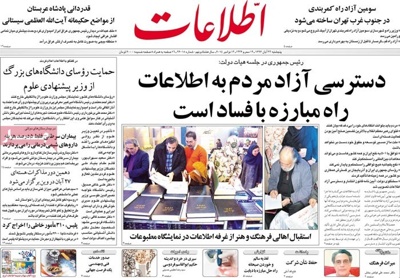
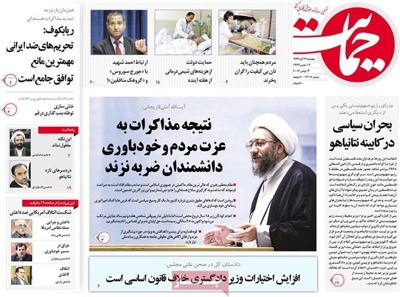
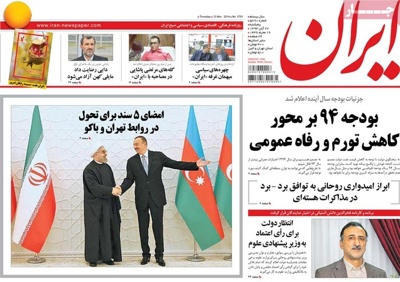
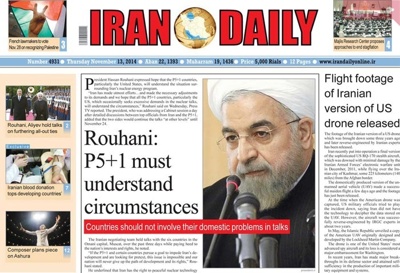
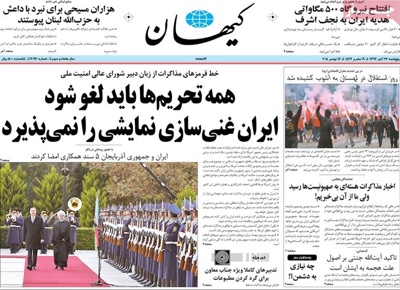
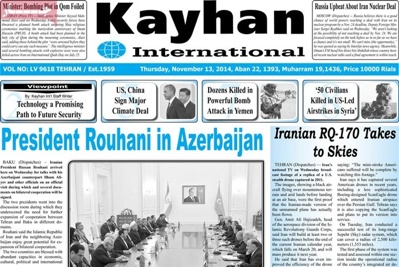
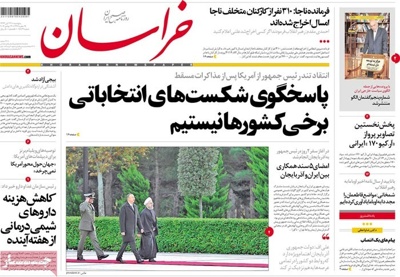
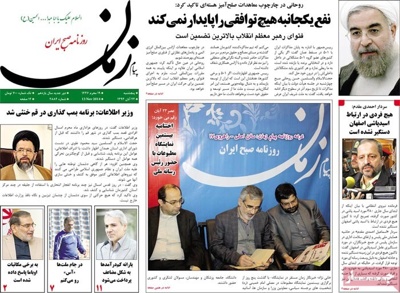
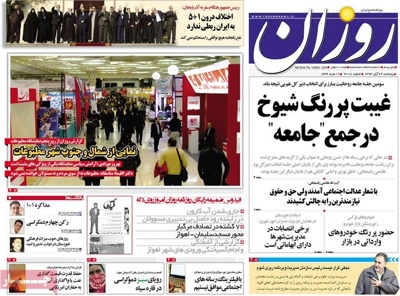
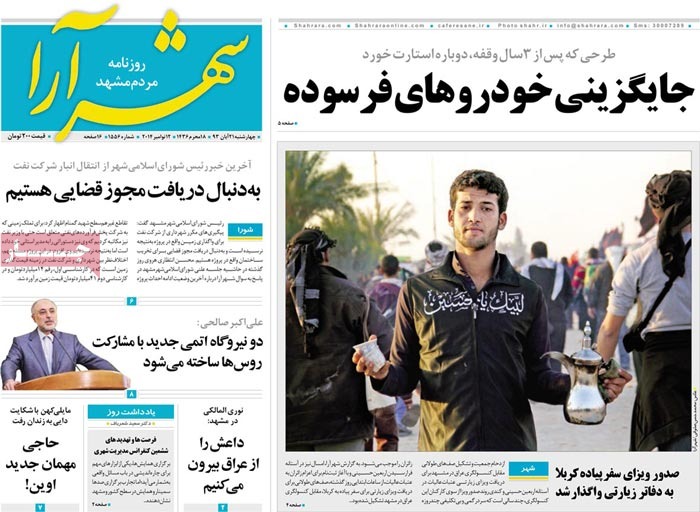
The Supreme Leader’s decision to offer amnesty to or commute the sentences of as many as 1,256 Iranian prisoners convicted in various courts and the 2014 Golden Neuron Award which was given to Iran’s renowned scientist Professor Majid Samiias the world’s top neurosurgeon grabbed front-page headlines in several Iranian newspapers on Sunday. A gathering by Principlists “to unite” also appeared on the front pages of some dailies.

Abrar:“The Ministry of Culture and Islamic Guidance should not give in to illogical pressures by the Worriers [a group of Ahmadinejed supporters who have expressed concern about the state of affairs since the rise to power of President Rouhani’s government in 2013]”, appealed a statement by the artistic arm of reformist Mardomsalari (Democracy) Party.


Abrar newspaper 10 - 12


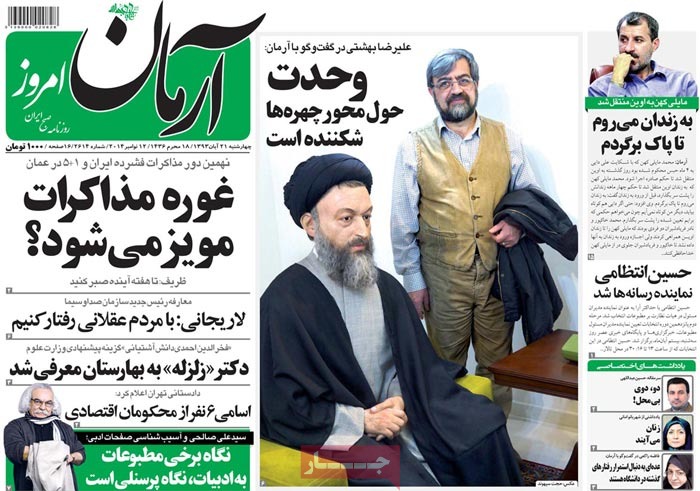
Arman-e Emrooz: “Pressures are being cranked up on Reformists to block the movements of the Moderation Camp,” writes the daily on hardline media attacks on former President Mohammad Khatami to interfere with efforts to promote moderation by President Rouhani’s administration.

Arman-e Emrooz: “Recent efforts by Ansar [Hezbollah to enforce morality laws] are politically motivated,” said Abdullah Nasseri, a member of BARAN Foundation (the Foundation for Freedom, Growth and Development of Iran), and a close ally of former President Mohammad Khatami.


Armane emruz newspaper 10 - 12


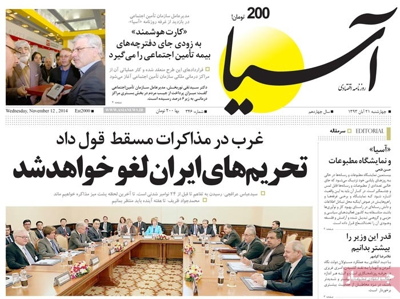
Asia: “Iran and the West have no other choice but to arrive at a nuclear agreement,” said Ali Khorram, an advisor to the Iranian foreign minister.

Asia: “A Europe-Iran economic forum [which meets in London on Wednesday October 15] has been given added weight by the presence of the US, ostensibly for supervision.”


Asia newspaper 10 -12


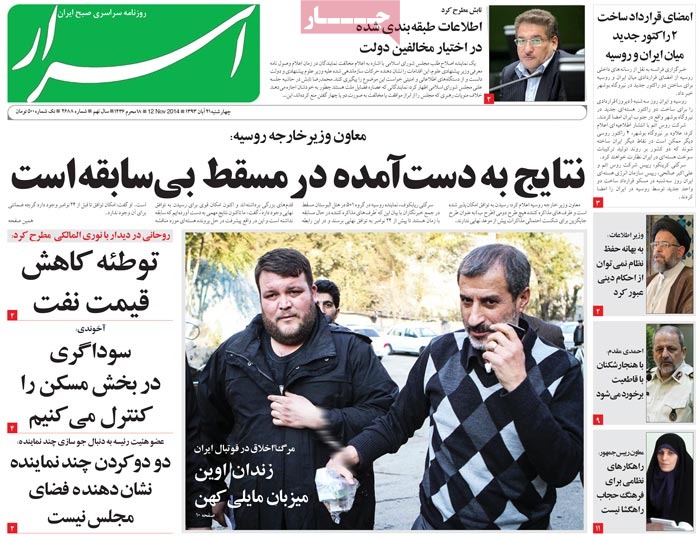
Asrar: “Iran holds Pakistan accountable for the recent terrorist attacks in Saravan [in the southeastern province of Sistan-Baluchestan],” said Deputy Interior Minister Hossein-Ali Amiri.

Asrar: “Iran’s efforts to bring down the inflation rate and improve economic growth are exemplary,” said the International Monetary Fund (IMF).

Asrar: “Iran plans to jointly make movies with European countries,” saidHojjatollah Ayyoubi, the director of Iran’s Cinema Organization.

Asrar: “Iran is ready to step up efforts to settle [outstanding] issues between Tehran and the International Atomic Energy Agency (IAEA),” said Abbas Araghchi, a senior Iranian nuclear negotiator.


Asrar newspaper 10 - 12


Ebtekar: “Professor Majid Samii was named the world’s top neurosurgeon,” is the daily’s pick for its front page. The World Academy of Neurological Surgery conferred the 2014 Golden Neuron Award upon the renowned Iranian scientist at its biannual meeting in Vienna on October 11.

Ebtekar: “Policies adopted by [President] Rouhani are praiseworthy,” said Mahathir Mohammad, the former Malaysian prime minister.


Ebtekar newspaper 10 - 12


Etemad: “A political maneuver by the Principlists 15 months ahead of parliamentary elections,” appeared on the daily’s front page, saying that the absence of some heavyweights from Saturday’sgathering has raised concerns within the conservative camp.


Etemad newspaper 10 - 12


Hadaf va Eghtesad: “Iran is the key regional power,” said Intelligence Minister Seyyed Mahmoud Alawi.


Hadafo eghtesad newspaper 10 - 12


Hambastegi: “The question of unity would not have been brought up if there had been no differences,” said Gholam-Ali Haddad Adel, a former Iranian parliament speaker and a top Principlist figure.


Hambastegi newspaper 10 - 12


Iran: “A nuclear deal would pull the rug from under the hard-liners’ feet,” said Sadegh Zibakalam, a university professor and a political analyst.

Iran: “President Rouhani will have a direct talk with people on Monday night”. The President will go live on TV to give a progress report of his Cabinet’s performance.


Iran newspaper 10 - 12


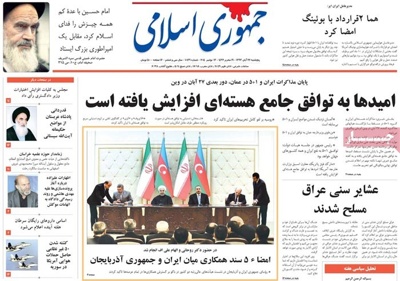
Jomhouri Islami: “Exporters would be given new incentives,” said the deputy minister of trade, industry and mines.

Jomhouri Islami: “Line One of Shiraz Metro was inaugurated in a ceremony attended by First Vice-President Eshagh Jahangiri.”

Jomhouri Islami reports that shortage of water supplies has prompted officials to issue a drought alert in three Iranian provinces.


Jomhorie eslami newspaper 10 - 12


Qods: “The World Bank is not expected to adopt a politically motivated stance [against Tehran],” said Ali Tayyebnia, the Iranian economy minister, in the annual meetings of the World Bank and the International Monetary Fund in Washington.


Ghods newspaper 10 - 12


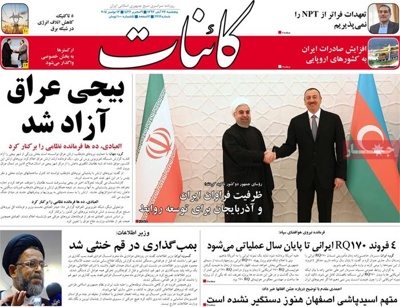
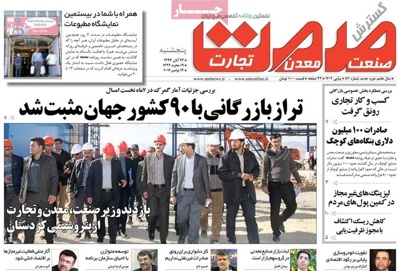
Resalat quoted Iraqi Foreign Minister Ibrahim al-Jaafari as saying that the deployment of foreign ground troops in Iraq is out of the question.


Resalat newspaper 10 - 12


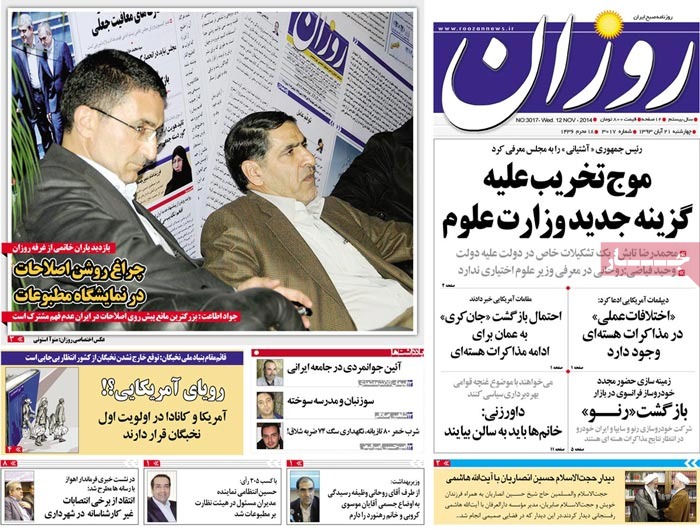
Roozan: “Those who have kept distance from moderation are to blame for the emergence of ISIL,” said Seyyed Hassan Khomeini, the grandson of the late founder of the Islamic Republic.

Roozan: “Former President Mohammad Khatami places emphasis on efforts to recognize the rights of and show respect for universities.”


Ruzan newspaper 10 - 12


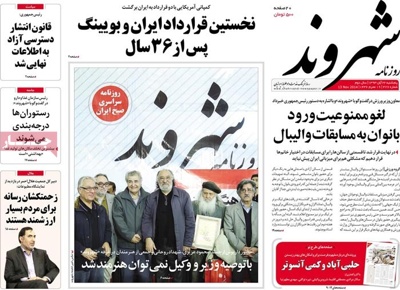
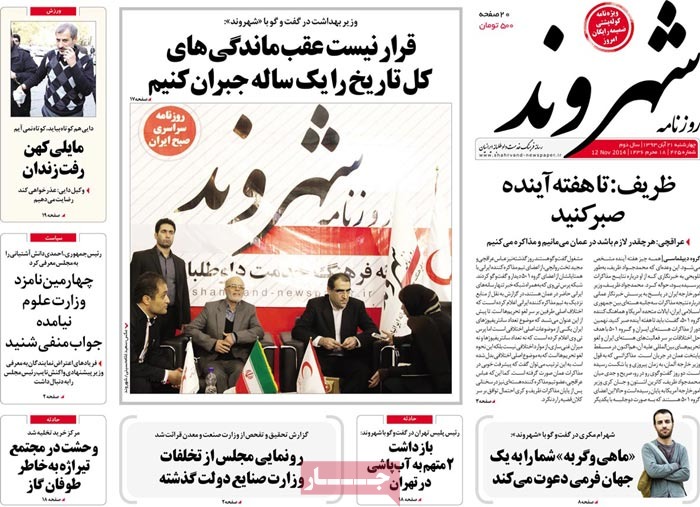
Shahrvand: “As much as 40 tons of humanitarian aid is en route to Iraq,” said the deputy director of the Iranian Red Crescent Society.


Shahrvand newspaper 10 - 12


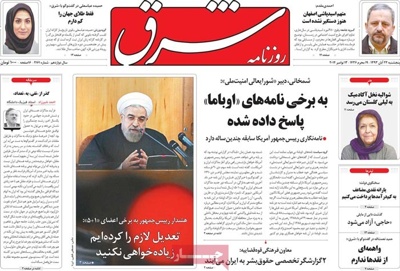
Sharq reports on “Untold stories about the university scholarship case”, saying that the names of the children of certain office holders under former President Ahmadinejad and those of MPs are on the list of students who have been favored with illegal scholarships.


Shargh newspaper 10 - 12


Hafez Day commemorated in Shiraz

Hafez-Shiraz
Hafez-Shiraz

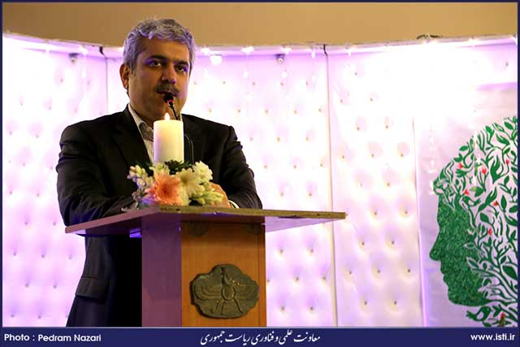
Commemoration Day of Iran’s internationally renowned poet, Hafez, was held by his tomb in his hometown, Shiraz, in the presence of 1st Vice President Eshaq Jahangiri, Vice President and head of Cultural Heritage, Handicrafts and Tourism Organization Masoud Soltanifar.

Prominent Iranian and foreign poets as well as literary figures and experts in Hafez studies attended the commemoration service that received broad mass media coverage.

The National Library of Fars Province, too, will in its Documentaries Department hold a scientific conference on Hafez on Sunday.

October 12th marks “Hafez Day” in the Iranian National calendar.

Khaje Shams-ud-Deen Muhammad Hafez-e Shirazi (1325/26–1389/90), was a Persian poet.

His collected works are regarded as a pinnacle of Persian literature and are to be found in the homes of most people in Iran and Afghanistan, who learn his poems by heart and use them as proverbs and sayings.

His life and poems have been the subject of much analysis, commentary and interpretation, influencing post-fourteenth century Persian writing more than any other author.

Themes of his qhazals are the beloved, faith, and exposing hypocrisy. His influence in the lives of Farsi speakers can be found in ‘Hafez readings’ (faal-e Hafez ‎) and the frequent use of his poems in Persian traditional music, visual art, and Persian calligraphy.

His tomb is visited often. Adaptations, imitations and translations of Hafez’ poems exist in all major languages.

Airstrikes on Kobani plot for foreign presence in Syria: Iran commander

Kobani-strike
Kobani-strike

A high-ranking Iranian military commander says the US-led airstrikes against ISIL targets in Syria are part of a “show” aimed at paving the way for foreign military presence in the Arab country.

“There is premonition of conspiracy to victimize the people of [Syria’s Kurdish town of] Kobani in order to create a bridgehead for the military presence of the coalition in Syria,” Iranian Armed Forces’ Chief of Staff Major General Hassan Firouzabadi said on Saturday.

He expressed deep concern over a possible massacre in Kobani, saying such a thing would amount to a “criminal tragedy.”

The Iranian commander also lashed out at the US for its “selective” airstrikes against ISIL terrorists, saying the raids have contributed to the militants’ advances in Iraq and Syria.

The Iranian commander underlined the need to help the people of Kobani in their fight against ISIL, implicitly criticizing the Turkish government for refusing to let Kurdish fighters cross the border into Syria to join the anti-ISIL battle.

He also called on the international community, particularly Muslim countries, to condemn the ISIL attacks in Kobani.

The Iranian commander’s remarks come as Kurdish militants continue defending the town of Kobani against ISIL militants.

On Friday, the United Nations’ envoy to Syria, Staffan de Mistura, warned that thousands of people “will most likely be massacred” if Kobani falls into the hands of ISIL militants. He also urged Turkey to allow Kurdish volunteers to cross border into Syria to defend Kobani against the ISIL terrorists.

Turkey has called for the creation of a no-fly zone over its border with Syria as the United States and its allies continue airstrikes against the ISIL terrorist group in Syria.

Iran has cast doubt on the sincerity of the US-led attacks against ISIL targets, saying Washington has an ax to grind in the so-called anti-terror battle.

President Rouhani to talk to people live on TV program

Iranian-President-Rouhani

Deputy head of the Presidential Office for communications and publicity affairs said that President Rouhani will present a report on his administration’s performance in various fields in a televised speech.
[…]
Parviz Esmaeili noted that Rouhani has so far held four news conferences with Iranian and foreign media in Iran, eight news conferences in the provinces and eight news conferences abroad.

The numerous contacts with reporters reveal the government’s attention to the special status of media, and create harmony between the nation and government in line with aspirations of the nation.

In the upcoming TV interview, President Rouhani will deal with the country’s major issues in the fields of economy, foreign policy and culture, Esmaeili said.