Sunday, December 28, 2025
Home Blog Page 5011

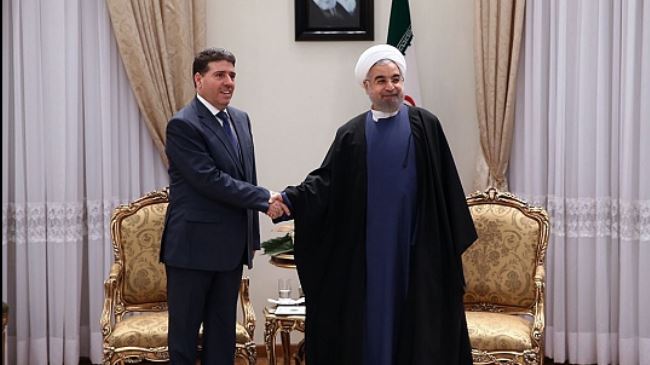
Farhadi receives vote of confidence

Farhadi

In an open session Wednesday Majlis (parliament) endorsed President Hassan Rouhani’s fifth nominee to head the Ministry of Science, Research and Technology.

The parliamentary session was held in the presence of President Rouhani during which he urged the lawmakers to support his nominee. It was attended by 235 lawmakers and chaired by Speaker Ali Larijani.

The chamber approved Mohammad Farhadi as the minister of science, research and technology with 197 votes in favor, 28 against, and 10 abstentions.
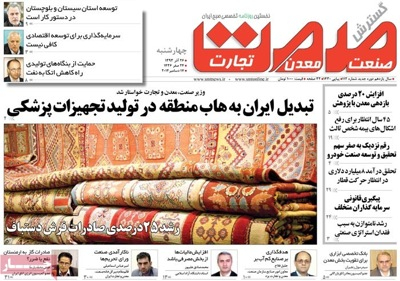
Farhadi needed 50 percent plus one of the votes to become minister.

Last Tuesday, Majlis turned down Rouhani’s fourth nominee Fakhreddin Ahmadi Danesh-Ashtiani.

Danesh-Ashtiani failed to obtain a vote of confidence when 171 lawmakers voted against him, 70 in favor, and 13 abstained.

Iran strongly supports Iraq in fight against terrorism: Deputy FM

Hassan Qashqavi
Hassan Qashqavi

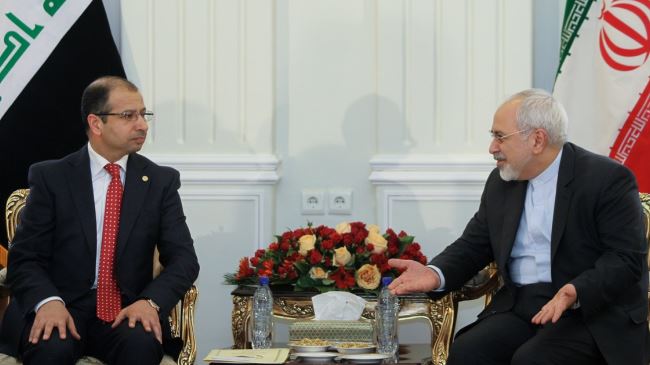
Hassan Qashghavi, a high-ranking Iranian diplomat who is in Baghdad, in a meeting with chairman of the Islamic Supreme Council of Iraq underlined Iran’s strong support for Iraqi government and people in the fight against terrorism.

Deputy Foreign Minister for Consular and Parliamentary Affairs Hassan Qashghavi, in a meeting with Ammar al-Hakim, offered congratulations on recent victories of the Iraqi military and people in the fight against terrorists and expressed hope for continuation of such victories.

Ammar al-Hakim, for his part, called Iran’s role in helping Iraqi government in fight against terrorist groups valuable and appreciated Iran’s support for Iraq.

He also underlined the necessity of promoting ties between the two countries in all fields.

[…]

Iran, Turkey will solve Syrian crisis politically: Official

Hossein-Amir-Abdollahian

Iran’s Deputy Foreign Minister for Arab and African Affairs Hossein Amir-Abdollahian says the Islamic Republic and Turkey will succeed in finding a political solution to the Syrian crisis.

In a meeting Tuesday with Umit Yalcın, Director General for Bilateral Political Affairs at Turkey’s Foreign Ministry, the Iranian official said Tehran and Ankara play a strategic role in the Middle East and should stay in touch about regional developments.

“Given the [present] circumstances in the region, Tehran and Ankara can play a leading political role in settling the crises and we are ready to turn consultation in this regard into practical cooperation,” Amir-Abdollahian said.

Reiterating that the Syrian conflict should be solved through democratic ways without any military intervention, he said Iran backs “broad-based national dialog” and opposes foreign governments’ arming of the Syrian opposition.

The Iranian diplomat noted that any solution to the ongoing problems in the Middle East, particularly in Syria and Iraq, would not bear fruit without Iran’s involvement.

Amir-Abdollahian further expressed Iran’s determination to cooperate with Iraq in the fight against terrorism, saying, “We respect Iraq’s national unity, sovereignty, independence and territorial integrity and explicitly oppose measures by certain parties to disintegrate Iraq.”

The Turkish official, for his part, said Iran and Turkey share views on the importance of restoration of peace and stability to the region, maintenance of territorial integrity and security of Iraq and Syria and eradication of terrorism in the region.

Yalcın added that settlement of the ongoing problems in the Muslim world is a top priority in Tehran-Ankara cooperation.

[…]

Iran, China agree to broaden cooperation in fight against terrorism, money laundering

Nasser Seraj

Iranian and Chinese officials in a meeting in Tehran Tuesday agreed to increase cooperation in several areas, including in the campaign against money laundering and extradition of financial offenders.

The agreement was reached between Head of Iran’s General Inspectorate Nasser Seraj and Chinese Deputy Prosecutor General Jiang Xian Chu.

“We are willing to increase our cooperation in the campaign against financial and political corruption, terrorism and money laundering,” Seraj said during the meeting.

The senior Chinese official, for his part, pointed to the age-old relations between the two nations, and expressed hope that mutual cooperation would further expand in the fight against terrorism and financial corruption.

[…]

Trade between Iran and China last year was estimated at $45 billion.

Iran is currently China’s third largest supplier of crude, providing Beijing with roughly 12 percent of its total oil consumption annually.

Iran condemns raid on prominent Bahraini Shiite cleric’s house

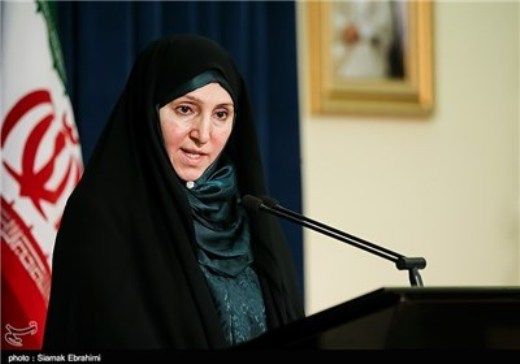
Iranian Foreign Ministry Spokeswoman Marziyeh Afkham

The Iranian Foreign Ministry on Tuesday strongly condemned Bahraini forces’ raid on the house of prominent Shiite cleric Ayatollah Sheikh Issa Ahmed Qassem a day earlier.

“Desecration of religious symbols and insulting popular religious leaders and scholars signify the Bahraini government’s failed security and ethnic approaches to dealing with peaceful protests by the people of the country,” Foreign Ministry Spokeswoman Marziyeh Afkham said.

Bahraini security forces raided the house of Ayatollah Sheikh Issa Qassem on Monday. Witnesses say regime forces even took photos of the ID cards of everyone who was inside the house in Diraz, west of the capital Manama.

The Iranian spokeswoman called on Bahraini authorities to show respect for the highly respected position of Muslim scholars and religious leadership in the country and punish those who committed this “unacceptable measure” [raid on Sheikh Issa’s house].

The raid on the home of the spiritual leader of the opposition al-Wefaq group came just a few days after people voted in an alternative election held by the main opposition parties of Bahrain.

The opposition had boycotted the parliamentary elections which were held with a low turnout on the same day across the tiny kingdom.

Why the nuclear talks failed? What is the takeaway? Daily answers

iran_nuclear_talks

A comprehensive deal has once again eluded the representatives of Iran and P5+1who met almost for a week in the Austrian capital, Vienna to put the dispute over Iran’s nuclear program to rest, once and for all.

On Tuesday, Resalat, a principlist daily, published an opinion piece by Hanif Qaffari on the reasons why the parties to the talks failed to clinch a deal and on what the likely lesson of such failure is: in the US, Republicans and Democrats are cut from the same cloth and the showdown between Tehran and Washington will carry on. The following is a partial translation of the piece:

November 24, 2014 came and passed and a comprehensive nuclear deal between Iran and world powers remained elusive. Over the past four months, thanks to the West’s throw-a-wrench-into-the-works approach several opportunities have slipped away. In the talks held in New York, Vienna (round 7) and Muscat, Washington upstaged fellow P5+1 members and turned them into passive onlookers as the diplomatic marathon between Iran and the United States played itself out.

After four months, talks are practically back where they were at the close of Vienna 6: on the border between agreement and failure. In other words, we have to admit we are in a nuclear limbo which is only a little bit better framed than that of Vienna 6. There are six things worth remembering about the negotiators in Vienna:

1. The most important reason why parties to the talks failed to nail down a deal was the inability of the US and the European Troika to make a definite decision on Iranian rights which are enshrined in the charter of the International Atomic Energy Agency.

If such a decision had been made a day after the Geneva Interim Agreement was signed or even before the conclusion of that deal, the parties to the negotiations could have clinched an accord last year. But the US administration and other members of P5+1 pushed ahead with their excessive demands when it came to “supply of basic needs” and “removal of sanctions”. That trend continued into the most recent round of talks in Vienna. The ups and downs in the talks showed that the West has not made a final decision to sign a comprehensive deal.

2. A second factor that prevented the conclusion of a deal was the destructive role foreign players had in the talks. Meetings between American and Zionist officials on the one hand and the hasty arrival of Saudi Foreign Minister Saud al-Feisal in Vienna for a meeting with Secretary of State John Kerry showed that the seemingly behind-the-closed-doors talks were not confined to the conference rooms of Coburg Hotel in Vienna.

On the other hand, there were some mediators such as Omani Foreign Minister Youssef bin Alawi bin Abdullah, who tried to act as a catalyst, narrow the gap between the two sides and turn the static nuclear equation into a dynamic one. Former EU Foreign policy chief Javier Solana and former UN Secretary General Kofi Annan tried to inject momentum into the talks. But these mediators turned out to be not as powerful as behind-the-scene players such as David Albright and other people with links to America’s Zionist lobby.

3. That Chinese Foreign Minister Wang Yi arrived in Vienna just for the final day of the talks and Russia acted passively in the final round contributed to the failure of the talks too. Containing Western rebelliousness was a test these two countries spectacularly failed on. One can even say on some fronts they even joined Western rebelliousness. The negative role France played should not be overlooked either. The influence the Zionist regime has over the French Socialist party was partly to blame for the failure of the talks.

4. One of the things that stood out about the talks in Vienna was the leading role Western media played in the campaign against Iran. Since day one of the talks, the BBC openly talked about the likely failure of the parties to clinch a deal and described the extension of the deadline as inevitable. Other Western media such as Reuters, The New York Times and The Washington Post acted as if Iran’s acquisitiveness were to blame for the inconclusiveness of the talks.

That means we need to bolster our hand as far as public diplomacy goes. To that end, we need to monitor their game plan in a smarter way.

After Vienna 6, this marks the second time that the let-the-game-go-down-to-the-wire approach fails. That our negotiating team stuck to our principles and did not cross the red lines is praiseworthy. Still the fact that the other party did not change its game plan showed that recognition of Iran’s obvious nuclear rights is not on the agenda of the West.

In other words, the latest round of talks showed that lack of confidence in the West in the court of public opinion should go beyond being an assumption and turn into an undisputed belief. It is in light of such belief that Iran’s resistance against the West takes on meaning.

5. At this point in time transparency about what really happened in the talks is necessary more than ever before. The shelf life of the what-happens-in-the-talks-stays-in-the-conference-room tactic has run out and the public want to know about the behavior of every single party to the nuclear talks. They should be let in on the destructive and passive role of some of the players. Naturally, the country’s foreign policy machine should change tack, of course in a calculated way, in dealing with individual members of P5+1.

6. Except for insistence on excessive demands, a recent power shift on Capitol Hill did nothing to bring any change to the negotiating table on the American side. That means American hawks and doves are united in being anti-Iranian.

Some in the court of public opinion, and even some analysts did not know about such unity. Recent talks in Vienna provided a perfect opportunity to develop a better understanding of the fixtures and variables of America’s foreign policy. The former prevented American negotiators from acting logically at the negotiating table. The latter, as displayed by Kerry and Obama, was not weighty enough to lead to a final comprehensive deal.

The most important lesson one can draw from the talks is that in the court of public opinion in Iran, America’s two main parties are cut from the same cloth. So, the showdown between the Islamic Republic of Iran and the White House (where a Democratic president resides) and Capitol Hill (where Republicans are in control) will continue. A showdown that should not be allowed to drift into oblivion.

Nuclear deal and its impact on Iran’s relations with Arab nations

arabs

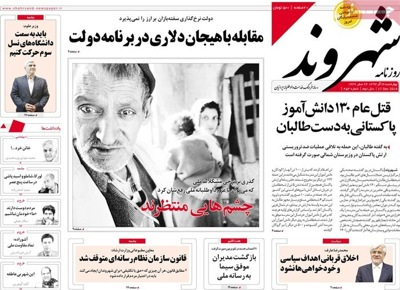
Shahrvand, a daily affiliated with Iran’s Red Crescent Society, carried an analytical piece – on November 25 – on concerns among some Arab countries about a yet-to-be-signed nuclear deal between Iran and P5+1. The following is a partial translation of the piece by Matin Moslem, an international relations expert:

That the Arab image of the Middle East and the Persian Gulf region will definitely undergo change – what kind of change remains to be seen – in the aftermath of a nuclear deal with world powers has turned into a paramount, worrisome question which weighs heavily on the minds of the Arab countries.

In an interview with Bret Baier of Fox News, UAE Foreign Minister Shaikh Abdullah bin Zayed Al Nahyan on Sunday said, “We wake up on Tuesday morning and everyone, and I mean most of us, will ask the question, ‘what is Iran going to get out of it, not on the nuclear front but on the regional front?’”

Saudi Foreign Minister Saud al-Faisal has also made similar remarks of late, saying that the matter concerning Iran does not only concern America, rather it is more of a regional question which concerns Iran’s neighbors, and Washington should not bow to a deal that disregards Arab concerns.

Such stance might not reflect the viewpoint shared by all Arab regional nations, particularly the Arab states on the southern edge of the Persian Gulf. However, undoubtedly, it reveals the attitude of the most important of these countries, especially members of the Persian Gulf Cooperation Council.

[…]

Whether true or false, US allies in the region are under the impression that any agreement over quality, and not even quantity, between Iran and Washington either on a small or large scale will by itself deal a blow to their regional edge, especially in terms of their ties with America. Whether it’s true or not does not make much difference. They have their own interpretation of the developments and do not mull over whether such interpretations are true or not.

[…]

A Persian Gulf Arab diplomat living in Beirut whose government has very close and friendly relations with Tehran has stressed, “[…] We have told our fellow brothers in Riyadh and Sharjah that perhaps what is going on is not to our liking, but what could we possibly do? Are we going to bring about insecurity to the region simply because America has decided to shift only its policies, and not necessarily its strategy, toward Iran and the region? Such moves will bring forward our concerns faster than we expect and prompt America to change its strategy.”

[…]

November 24, regardless of the outcome of nuclear talks and their continuation in the future which is now definite [the talks have been extended for another 7 months], could be of great significance as far as Iran’s regional relations in the future are concerned.

[…]

As Emil Khoury, a political analyst of Beirut’s influential An-Nahar [an Arabic-language daily], pointed out, Iranian officials will deal with their neighbors from a more powerful position.

West cannot bring Iran to knees over N-issue: Leader

Leader-meeting
Leader-meeting

Ayatollah Khamenei made the statements in a Tuesday meeting with participants in the World Congress on Extremist and Takfiri Movements in the Islamic Scholars’ View, held in the Iranian holy city of Qom on November 23-24.

“In the nuclear issue, the United States and colonial European countries got together and did their utmost to bring the Islamic Republic to its knees, but they failed, and will continue to fail,” Ayatollah Khamenei noted.

Iran and the P5+1 states – Russia, China, Britain, France, the US and Germany – wrapped up a week of closed-door nuclear negotiations in Vienna, Austria, on Monday.

The two sides decided to extend their discussions for seven more months in the search for a comprehensive agreement that would end a 12-year dispute on Iran’s peaceful nuclear work.

The Leader further referred to the violence by Takfiri ISIL extremists operating in the Middle East, stressing that such a Takfiri current serves the objectives of the hegemonic powers.

Ayatollah Khamenei said the aim of the so-called coalition, led by the United States to fight the ISIL is a “mere lie,” adding that Washington actually “seeks to keep this scourge alive, which of course it won’t be able to.”

Elsewhere in his remarks, Ayatollah Khamenei reaffirmed Iran’s support for the Palestinians in Gaza and the Israeli-occupied territories, adding the Palestinians in the occupied West Bank should be armed to defend their land, just like the Gazans.

“We are not entangled in religious divisions, and we will provide Hamas and Islamic Jihad in Palestine with the same assistance we offered to Shia Hezbollah in Lebanon,” the Leader noted.

Ayatollah Khamenei also called on Muslim scholars to help uproot the Takfiri current, which has diverted the Islamic world’s attention from the Israeli regime’s atrocities against the holy al-Aqsa Mosque in East Jerusalem al-Quds.


Rafsanjani warns Islamic countries against impact of discord

hashemi-Qatar
hashemi-Qatar

Chairman of Iran’s Expediency Council Ayatollah Akbar Hashemi Rafsanjani on Monday warned the Islamic countries about the weakening impact of discord, calling for religious solidarity.

At a meeting in Tehran with visiting Qatari Judiciary Chief Ali Bin Fatis al-Marri, Ayatollah Rafsanjani said Iran has always attached special significance to expansion of relations with the neighboring and Muslim Qatar.

‘With a population of 1.7 billion and enormous resources, nearly 60 Islamic countries could turn into the top decision-maker in regional and international arenas,’ the Ayatollah said.

Ayatollah Rafsanjani, who has also served as Iran’s president for two terms, recalled his administration’s policies for promotion of cooperation with Persian Gulf Arab states and Central Asian countries and said, ‘Cooperation with Persian Gulf states, particularly Qatar, on drinking water supplies was one of our plans.’

Rafsanjani said in addition to personal efforts, he endeavors, as part of the official policy of the Islamic establishment, to ensure Islamic solidarity.

He went on to say Islamic scholars are duty-bound to prevent ignorance from spreading to Islamic communities.

The Qatari judiciary chief, for his part, said that the Qatari Emir favors enhanced relations between the two countries, adding, ‘We know that our common ground outweighs what divides us.’

Recalling to the role of Ayatollah Rafsanjani in the Muslim world, al-Marri called on the Iranian veteran politician to step in and help narrow the gap among the Muslims.

A look at Iranian newspaper front pages on Nov. 25

Iranian Newspapers Headlines

After days of speculations about the outcome of nuclear talks between Iran and world powers, which finally came to an end on November 24, all Iranian dailies, without exception, gave extensive coverage to the Vienna negotiations. The two sides have agreed to extend the negotiations for another seven months; every month, $700 million in Iran’s frozen assets will be released, they reported.
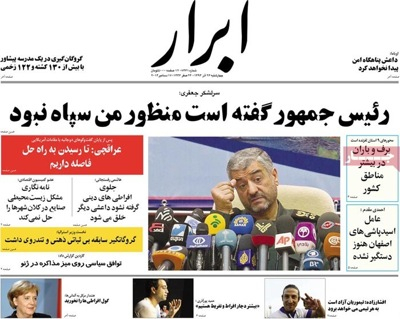
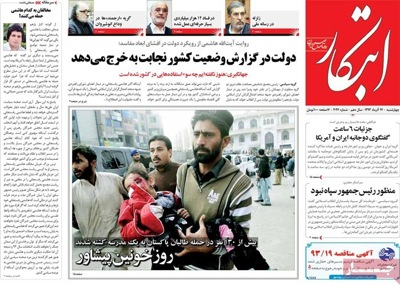
Abrar: “Mohammad Farhadi [President Rouhani’s fifth choice for the Ministry of Science, Research and Technology] will run the ministry with new faces in managerial positions.”


Abrar newspaper 11 - 25


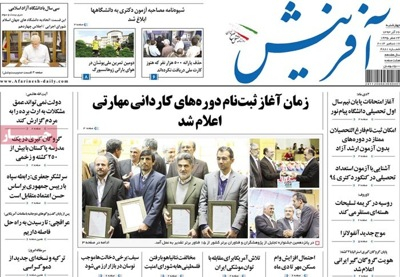
Afarinesh: “Disagreements have undermined Islamic countries,” said Chairman of the Expediency Council Akbar Hashemi Rafsanjani in a meeting with Chairman of the Supreme Judiciary Council (SJC) of Qatar.


Afarinesh newspaper 11 - 25


Afkar: “We still look at the process of nuclear talks positively,” said Vice-Speaker of the Iranian Parliament Mohammad Hassan Abutorabi.


Afkar newspaper 11 - 25


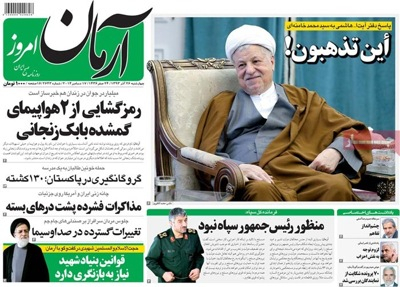
Arman-e Emrooz: “Seven-day negotiations have been extended for seven months.”

Arman-e Emrooz: “We are victors; the world has no choice but hold talks with Iran,” said President Rouhani.


Armane emruz newspaper 11 - 25


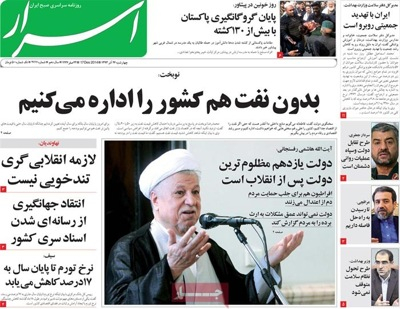
Asrar: “I am opposed to the hardline approach of the Islamic Revolution Stability Front [an ultra-principlist party],” said Ali Motahari, a principlist MP representing Tehran in parliament.

Asrar: “Cash subsidies by the government will continue next year [starting on March 21, 2015],” said Government Spokesman Mohammad Bagher Nobakht.


Asrar newspaper 11 - 25


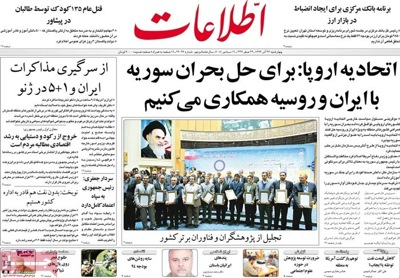
Ettela’at: “Winners of Jalal Al-e-Ahmad Literary Awards [given to the best Iranian authors each year] have been named.”

Ettela’at: “Some economic sanctions slapped against Iran have been lifted,” said the economy minister.


Ettelaat newspaper 11 - 25


Hambastegi: “The performance of Iran’s negotiating team reflected the decisions of the establishment,” said the Iranian defense minister.


Hambastegi newspaper 11 - 25


Hamshahri: “The Chinese are reigning on Iran’s car market.”


Hamshahri newspaper 11 - 25


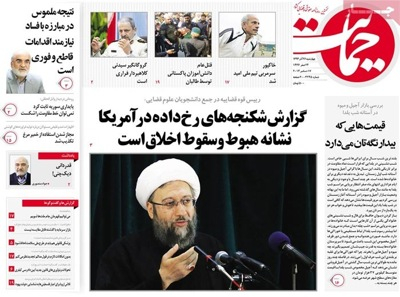
Hemayat: “Tehran and Doha have cut judicial deals.”


Hemayat newspaper 11 - 25


Iran Daily: “[Gov’t Spokesman]: Development budget to rise by 20%”


Iran daily newspaper 11 - 25


Jahan-e Sanat: “Release of $700 million in Iran’s frozen assets on a monthly basis has marked the finish line of Vienna marathon nuclear talks.”


Jahane sanaat newspaper 11 - 25


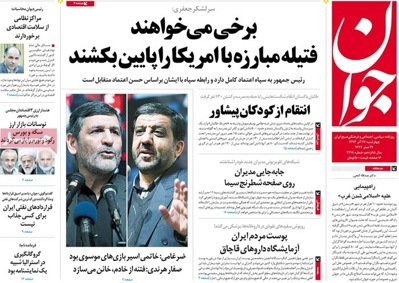
Javan: “On the closing day of a global conference in Qom, in central Iran, Muslim scholars, who gathered to discuss Takfiri and extremist groups, have laid emphasis on consensus among Sunnis and Shiites to confront extremist groups.”

Javan: “Seven-month artificial respiration is given to nuclear diplomacy.”


Javan newspaper 11 - 25


Kayhan: “We should not turn to foreigners in our quest for dignity and authority,” said Commander of the Islamic Revolution Guard Corps Major General Mohammad Ali Jafari.

Kayhan: “The village chief [a reference to America] proved untrustworthy; sanctions have been extended;” read the banner headline of the daily.


Kayhan newspaper 11 - 25


Khorasan: “Mobile data tariffs have dropped by 80 percent.”


Khorasan newspaper 11 - 25


Mardomsalari: “The Islamic Republic of Iran is looking for peaceful relations in the future,” said Chairman of the Expediency Council Akbar Hashemi Rafsanjani.


Mardom salari newspaper 11 - 25


Rah-e Mardom: “Mohammad Farhadi [President Rouhani’s fifth pick to lead the Ministry of Science, Research and Technology] will get confirmation from parliament,” said a number of MPs.
 

Rahe mardom newspaper 11 - 25


Resalat: “The International Atomic Energy Agency (IAEA) has realized that the information offered by the terrorist Mojahedin-e Khalq Organization was unreliable.”


Resalat newspaper 11 - 25


Roozan: “Disrupting the economic system of the country is the new charge facing Saeed Mortazavi, a former Tehran prosecutor.”

Roozan: “Commanders of the Islamic Revolution Guard Corps (IRGC) and Basij (volunteer force) have taken a harsh stance against America in a series of anti-US conferences.”


Ruzan newspaper 11 - 25


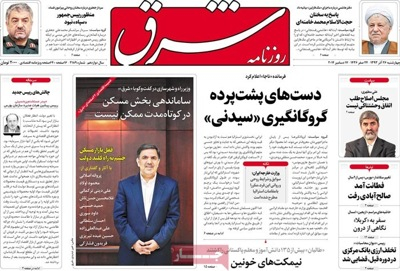
Sharq has described extension of nuclear talks as “renewal of hope”.

 

Shargh newspaper 11 - 25


Tehran Times: “Oil advances for a third day as Iran seeks OPEC production cut.”

Tehran Times: “Iran accounts for about 40% of Islamic banking assets: IMF, WB.”


Tehran times newspaper 11 - 25


Vatan-e Emrooz: “US Secretary of Defense Chuck Hagel has been forced to resign.”

Vatan-e Emrooz: “The Geneva Interim Agreement has been extended for another seven months; one year into the Geneva deal, the achievement amounts to nothing.”


Vatane emruz newspaper 11 - 25