A film by an Iranian director has been initially shortlisted for the best Live Action Short Film at the 87th Academy Awards.
Parvaneh, the 25-minute short film by Talkhon Hamzavi, is one of the 10 motion pictures selected from a 141 qualified short films in this Oscar Awards category.
Parvaneh narrates the story of an Afghan girl who has entered a refugee camp in Switzerland, but when she comes to know about her father’s poor health condition in Afghanistan, she decides to send the whole money she had illegally earned in the foreign land to her family.
She is forced to go to the city of Zurich, but due to not possessing a valid passport, she finds herself unable to follow her initial aim. Meanwhile, she meets a girl named Emily, and the rest of the story is determined by their friendship.
Hamzavi, who is currently living in Switzerland, has produced her film in German language. She had formerly participated in various foreign film festivals with Parvaneh, and in 2013, won the silver medal for the best foreign film at Student Academy Awards.
Her film was forwarded to the Oscars from the country of her residence. She was born in 1979 in Tehran, and migrated to Switzerland when she was 7. She obtained her Master of Arts in film-making from the University of Zurich.
All the 10 qualified short movies were viewed for the first round of voting by the Academy’s Short Films and Feature Animation Branch Reviewing Committee at Los Angeles screens. Based on the regulations, three to five movies will ultimately be opted as the major finalists at the upcoming Academy Awards. Four cities of Los Angeles, London, New York, and San Francisco will host the branch screenings in December.
Nominees in all 24 categories of the 87th Annual Academy Awards will be announced on January 15, 2015, in Samuel Goldwyn Theater, and the Oscars Ceremony will be held on February 22, 2015, at the Dolby Theater in Hollywood.
Iran has officially addressed Reza Mirkarimi’s Today to represent the country this year. A Few Cubic Meters of Love, the Iranian-Afghan film directed by Jamshid Mahmoudi, is also nominated by Afghanistan to compete at the upcoming Academy Awards.
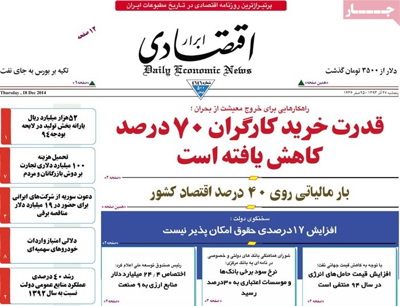
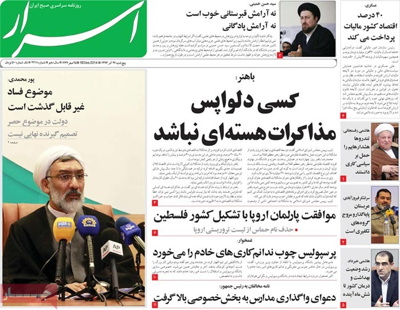
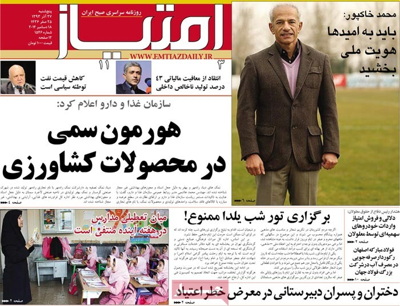
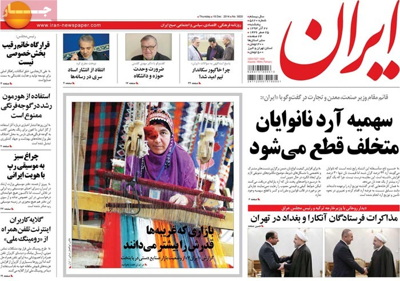
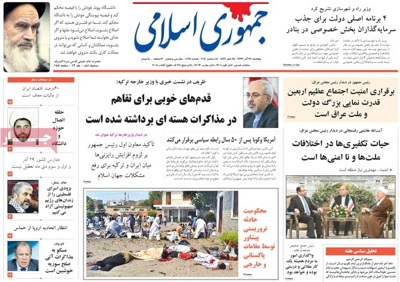
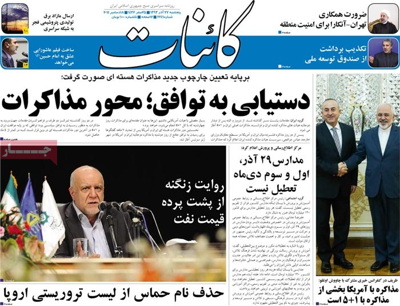
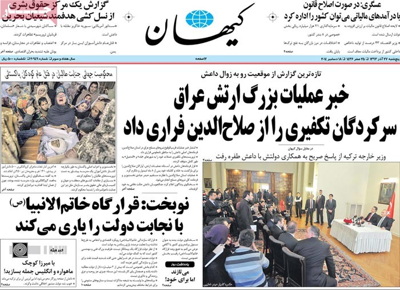
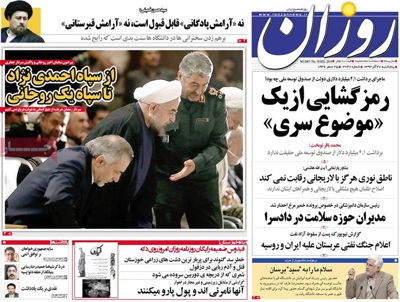
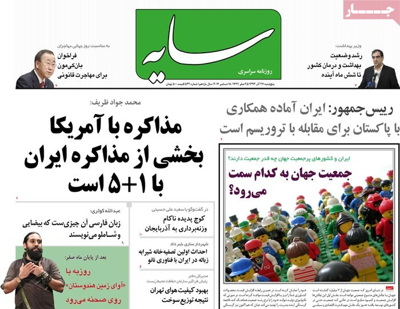
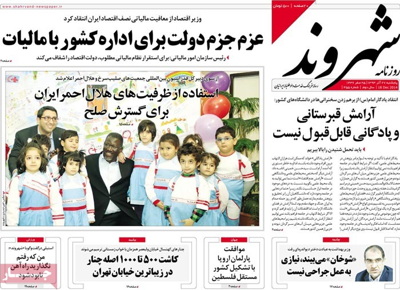
Parliament’s vote of confidence to Mohammad Farhadi as science minister dominated the front pages of Iranian newspapers on Thursday. Also among front-page headlines was the spillover of protests to other American cities following the decision of a grand jury in Ferguson, Missouri not to indict a white police officer for fatally shooting an unarmed black teenager in August.
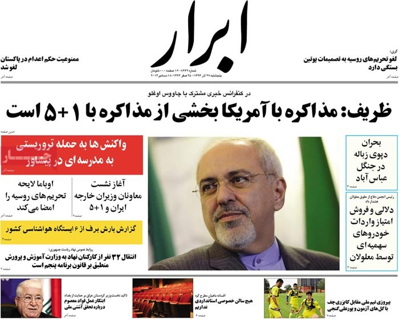
Abrar: America has extended the suspension of its sanctions against Iran.
Abrar: “Those who have illegally received scholarships should be dealt with,” an MP said during the confirmation hearing of Mohammad Farhadi, the new science minister.
Afarinesh: South Korea paid $500 million it owed Iran [for crude imports].
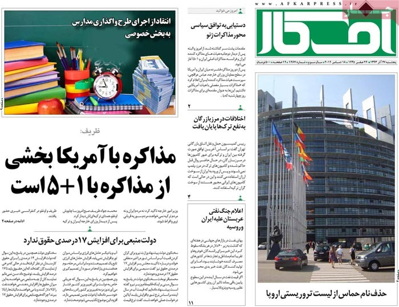
Afkar: President Obama has urged Saudi King Abdullah’s son to help normalize relations between Tehran and Riyadh.
Afkar: President Rouhani has hailed the performance of the Iranian nuclear negotiating team.
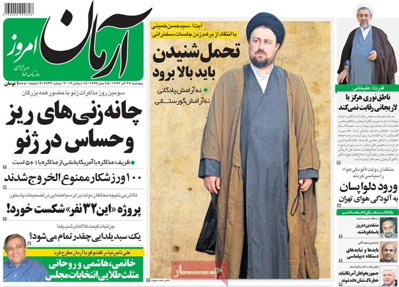
Arman-e Emrooz: Mohammad Farhadi, President Rouhani’s pick for science minister, won 197 nods from MPs to take charge of the Ministry of Science, Research and Technology.
Arman-e Emrooz: Ali Motahari, [a principlist MP who supported President Rouhani’s nominees for science minister] has come under a barrage of attacks by fellow principlists in the chamber.
Asrar: “We all have to turn out for [upcoming parliamentary] elections,” said former President Mohammad Khatami.
Ebtekar: Former President Mohammad Khatami has described the performance of President Rouhani as “good”.
Ebtekar: “Using Basij [the Volunteer Force] to advance partisan agenda is sinful,” said Chairman of the Expediency Council Akbar Hashemi Rafsanjani.
Emtiaz: Sami Yusuf, an Iranian-born British singer-songwriter, is to perform onstage in Iran.
Emtiaz: “The value of smuggled items in Iran stands at $20 billion annually,” said the director of the Headquarters to Fight Smuggling in Goods and Currency.
Esfahan Emrooz has described the confirmation of President Rouhani’s pick for science minister as “reconciliation between government and parliament”.
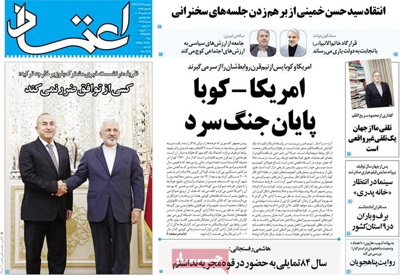
Etemad: As many as 70 French automotive managers will soon pay a visit to Iran.
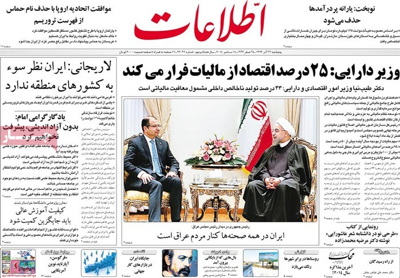
Ettela’at: The government spokesman said the pay rise of civil servants will be proportionate to inflation next year.
Ettela’at: European giants are in line to make it to the Iranian stock market.
Farhikhtegan: “Some want to tell Rouhani that they are still powerful,” said reformist former President Mohammad Khatami.
Hamshahri: Mayors of Asian cities have welcomed a proposal by Tehran Mayor Mohammad Bagher Ghalibaf to establish a joint development fund.
Hemayat: “The bullying attitude of the United States is to blame for the failure [of Iranian and P5+1 negotiators] to strike a nuclear deal,” said Judiciary Chief Ayatollah Sadegh Amoli Larijani.
Iran: As many as 15 million people who live on the edges of major cities will benefit from the Healthcare Transformation Plan.
Iran Daily: Musician Khorshidifar passes away.
Javan: “Recent talks proved that the United States is not trustworthy,” said the commander of the Islamic Revolution Guard Corps.
Jomhouri Islami: “Iran has no plans to cut its crude oil production,” said Oil Minister Bijan Namdar Zanganeh.
Kaenat: Three policemen on the beat have been killed in a terrorist attack in Zahak, a small town in the southeastern province of Sistan and Baluchestan.
Kayhan: The Russian ambassador to Tehran has said in an exclusive, “Just like Iran, we view economic self-sufficiency as the way to counter sanctions.”
Resalat: American people are protesting against racial discrimination from coast to coast.
Roozan: [With the confirmation of Farhadi as science chief] Mohammad Ali Najafi, who served as acting minister since the impeachment of Faraji-Dana, released a memo to bid farewell to the staff at the Ministry of Science, Research and Technology.
Shahrara: Sami Yusuf [an Iranian-born British singer-songwriter] says he will soon pay a pilgrimage visit to Mashhad [home to the shrine of Imam Reza (PBUH)].
Shahrvand: A number of MPs have signed a motion that calls for the death penalty for those convicted of staging acid attacks.
A senior Iranian legislator has said that nuclear talks between the Islamic Republic and the six major world powers revealed that the United States is not a reliable country.
Chairman of Iranian Parliament’s National Security and Foreign Policy Committee Alaeddin Boroujerdi said on Wednesday that Iran’s negotiating partners – Britain, China, France, Russia, the United States, and Germany – must live up to their commitments based on the Joint Plan of Action, signed between the two sides in the Swiss city of Geneva last November.
“The Islamic Republic of Iran displayed its sincerity with respect to this accord, but America is trying to weaken the pillars of this agreement by announcing new sanctions [against Iran],” Boroujerdi said during a meeting with chair of the European Parliament’s delegation for relations with Iran, Tarja Cronberg, in Tehran.
The Iranian lawmaker further noted that Washington does not respect the rights of the Iranian nation and tries to influence Iran’s position and the result of the talks through sanctions.
Boroujerdi also underscored that such sanctions have helped Iran base its economy on domestic capabilities.
Cronberg, for her part, expressed hope that the Geneva nuclear deal is respected in its entirety.
The latest round of nuclear talks between Iran and P5+1 ended in the Austria capital, Vienna, on November 24, with the two sides agreeing to extend the Joint Plan of Action to July 1, 2015.
Under the Joint Plan of Action reached between the two sides in November 2013, a final comprehensive deal aims to give assurances that Tehran’s nuclear program is exclusively peaceful and, at the same time, lift all sanctions imposed against the Iranian nation over the country’s nuclear program.
Iran has repeatedly said its nuclear program is for peaceful purposes, including generating electricity and making radioisotopes for its cancer patients.
Iran has called on countries which are non-members of the Organization of the Petroleum Exporting Countries (OPEC) to participate in cutting oil output.
Oil Minister Bijan Namdar Zanganeh told reporters on Wednesday that it was not only up to the organization to deal with growing market oversupplies, saying non-OPEC producers needed to cooperate as well in limiting oil production.
“To deal with this situation we need to have a contribution from non-OPEC producers for managing the market,” Zanganeh told reporters upon arrival in the Austrian city of Vienna for the OPEC meeting.
His remarks come as the 166th ministerial meeting of OPEC is scheduled to be held in Vienna on Thursday, November 27, to discuss sharp reduction in oil prices.
Meanwhile, non-members Russia and Mexico along with two OPEC countries Saudi Arabia and Venezuela met on Thursday to address a growing oil glut.
Oil prices have plunged this year, with analysts putting the blame on the rise in the value of the US dollar and the unlikely chance that the intergovernmental OPEC body might cut crude output.
OPEC is a Vienna-based intergovernmental organization of 12 oil-producing countries, which groups Algeria, Angola, Ecuador, Iran, Iraq, Libya, Kuwait, Nigeria, Qatar, Saudi Arabia, the United Arab Emirates, and Venezuela.
OPEC members pump about 40 percent of the world’s oil with Iran being currently the organization’s third-largest oil producer.
On Tuesday, US benchmark West Texas Intermediate for January delivery rose nine cents at USD 75.87, while Brent crude for January fell eight cents to USD 79.60 in afternoon trade.
The untimely death of Morteza Pashaei, an Iranian pop singer, and the hearty farewell Iranians bid to him in his funeral became a topical theme for Arman-e Emrooz newspaper on its November 22 issue which featured an interview with Taghi Azad Armaki, a sociologist and a Tehran University professor.
The death of the young singer and the subsequent hearty, spontaneous outpouring of grief grabbed headlines in the country. Those active in social networking sites were quick to react to his passing; artists, athletes and even famous politicians cabled condolence messages, and many attended his funeral.
Although official media, especially Islamic Republic of Iran Broadcasting, talked about this issue belatedly, the spontaneity of people’s reaction helped stage one of the most glorious commemorative ceremonies in a society which is at times blamed for its insufficient attention to artists. It is not all that happened. Since Pashaei was not viewed as an A-lister, many talked, among other things, about a shift in the artistic taste of people, the influence of modern communication tools, veneration of the dead.
Some even went further to claim that Pashaei was merely an excuse, talking about the dawn of a new era in which the reference groups of Iranian youth have changed.
In the interview, Azad Armaki talked about his take on the events that followed Pashaei’s death. IFP has translated a summary of the interview, and changed its format without damaging its content.
[…]
What is going on? Are the Iranian people waiting for events such as a funeral procession of a key figure, a victory in a football match or political and cultural success on global scenes to take to the streets and express their feelings? Do the Iranians seek to give vent to their pent-up excitements which they fail to let out in normal conditions? Or is it another story? Do these events show the emergence of a new social and cultural atmosphere or we are still entrapped in a dual society? […]
What is the secret behind this? First, society has undergone fundamental metamorphoses; second, reference groups have changed dramatically; third, social and cultural issues have taken on importance; and fourth, borders have been drawn between politics on the one hand and social and cultural issues on the other.
The current situation which is bound to be repeated in different forms down the line should be viewed as the beginning of a social and cultural transformation leading to political change in which new forces will emerge with new forms, new wishes and new demands.
It would be better to concentrate more on new social forces in Iran. By and large, I should say that alongside intellectuals, politicians, bureaucrats and women, new forces have been formed, chief among them, artists, athletes and ethnic groups. In the shadows of intellectuals and politicians, these three forces would be given fewer opportunities to make their presence felt in the past. That’s why they have turned into independent actors and found new voices, trying to enter the race independently. […]
To develop a better understanding of this, it’s better to take a serious look at what has happened in art, music, cinema, theater, literature, football, wrestling and ethnic groupings. […] Each has established new traditions for themselves. They do not wait for politicians and intellectuals to do the job for them. They have introduced new mechanisms for production, presentation, consumption, judgment, and utilization of what they have to offer. This means Iranian society has undergone major changes which I think are very effective.
[…] Those who care for and are concerned about culture and society and have grown familiar with social and cultural changes will certainly hear the voice of constant change in Iranian life. The problem is that some who claim to know society are unable to fathom what is happening, because they lack the required tools to do that. They try to impose their own policies and wishes on society rather than getting familiar with or studying the events and circumstances. […]
According to one of the main findings of young Iranian sociologists, the reference groups have changed and more importance is being attached to athletes and artists along with women and the youth.
Sociologists who focus on values say values and mindsets have changed and new lifestyles have emerged in Iran. Therefore, we cannot say people are taken aback by such developments. When it comes to Iranian sociologists, they are not surprised at all. […]
As far as the lack of understanding of social event goes, multiple factors are to blame. That political players have replaced researchers familiar with social life is one factor.
Efforts in media by two rival groups to create excitement in society account for the second factor. One group claims it favors modernity and views these events as the result of the failure of tradition; the other blames malfunctioning of culture and science for what has happened. Such political dualism has turned an excited atmosphere in society into a grey area which is no longer in focus. […]
Hyperbole plays an important role as well. As I said earlier we are not facing an odd event in society. On various grounds, society has seen – and is still seeing –small and big incidents on different fronts. This incident [Pashaei’s funeral] is just one of them. Why are hyperboles so common?
A young society in which new social groups have surfaced witnesses new incidents. Aren’t women seeking to attend sporting events? Isn’t it common these days for people to leave cities, especially Tehran, en masse during public holidays? Isn’t it common for people to tend to consume luxury items? Aren’t people in Tehran and other cities spending too much time watching and listening to foreign media via satellite TV channels? Isn’t it important for women to enter new social and cultural areas? Isn’t it surprising that Iranians are more willing to emigrate? And many more.
These events have not happened overnight. They have happened over time and become persistent. The question here is “Why do we blow an incident out of proportion when it takes place?” I think these incidents will repeat themselves, and the reoccurrence of one event indicates that Iranian society is going through fundamental social and cultural change.
The occurrence of these incidents should be studied from different angles: first, they are exclusive to special areas and they are less likely to find their way into other areas at a national level. Second, they are less political and solely focus on social and cultural issues. Third, they have been formed over time and will stay in society. Fourth, each one is based on a special logic, and ignoring them will do nothing to make them disappear. Fifth, they are persistent and effective; their ideals, lifestyles and traditions fail to bring about their ephemerality. And finally, their main concern is “life in the modern world” which is the standout feature of such phenomena.
To develop a better understanding, we need to refer to the works of Morteza Pashaei. He has talked, among other things, about love, loneliness, the need for togetherness, compassion, faith and life. That’s why he has pulled in a broader audience. All those who talk about life in the modern era will attract the audience, and their works will be durable.
[…]
Those political groups which are seeking to link these social events with their policies are suffering from hallucination. People like Pashaei are unwittingly walking down the path of modernity, inviting their followers to understand and behave in a non-ideological and not anti-ideological fashion. They are not after inflaming political bickering. Rather, they get out of their way to instigate cultural and social order through collective efforts.
November 25 was the International Day for the Elimination of Violence against Women. Sharq, a daily, carried two separate items on its front page Wednesday to mark the occasion. The first piece by Poorya Alami was satirical, and the second one was a concise analysis by Minoo Mortazi Langaroodi, a women’s rights activist.
In this analytical piece, Ms. Mortazi tries to describe a new type of violence inflicted by women on themselves. She blames the newly-emerged ‘self-inflicted’ violence on the inferior light some women see themselves in. What comes next is a partial translation of her views:
Nowadays, different shades of violence against women, ranging from simple to complicated, have been identified. Ways to prevent or fight such violence are being promoted in media thanks to endeavors by equal rights activists, social workers and researchers focusing on social ills.
However, there is a newly-emerged type of violence against women which hasn’t drawn much attention. As you know the first step to cure ills is to diagnose them. So attention should be paid to this newly-emerged, self-inflicted type of violence some women have been subjected to.
One of the most extreme forms of self-inflicted violence some Iranian women are subjected to is that they sell themselves short. In other words, they view their personality and identity to sustain a family and social relations as weak.
Although Iranian women today are way more educated and knowledgeable than their mothers and grandmothers, they are grappling with an identity crisis less known to the older generation whose feminine identity was defined by values and beliefs.
In this day and age, by embracing consumerism, people are turning their appearance and bodies into tools at the disposal of markets which are merely in quest of profits. In clinging to mentality women have to make sure their bodies measure up to global standards in order to gain approval in society.
The pervasiveness of cosmetic surgery, including face-lifting, and constant change of hair color by some women are a reflection of the fact that some women in Iran feel deeply insecure and thus need endless approval and praise at home and in society.
Instead of correcting a defect in appearance, cosmetic surgery here is mostly intended to address the need for feminine security in women who seek approval and acceptance from a consumerist society.
One of the extreme forms of violence that women in developing countries inflict on themselves is that by unquestioningly following imported aesthetic clichés, they instill a feeling of inferiority and insufficiency within themselves.
By adding Europeanized qualities to their appearance and mimicking European body language, accent, mannerisms and culture and thus making themselves distinct, these women fully recognize the fact that the culture of consumerism is superior to theirs.
Sitting aside and witnessing such violence play out does not befit any fair individual, man or woman. We need to work out a solution. The International Day for the Elimination of Violence against Women offers a perfect opportunity to ponder and produce a solution.
On November 25, one day after the closing of nuclear talks between Iran and world powers, Donyay-e Eghtesad, a daily, carried a piece on what the extension of Vienna talks translates into, economically. The following is the translation of how the paper’s Ali Farahbakhsh assessed the outcome of the talks through an economic prism:
Political negotiations, in particular those with a geopolitical background which have dragged on for quite a few years thanks to distrust, require a long time to produce results.
A look at Ping-Pong Diplomacy pursued by Henry Kissinger, which was aimed at normalizing relations between America and China, as well as at the talks over ballistic missiles during the Cold War between the US and the Soviet Union clearly highlights the fact that in the most ideal of conditions, diplomatic negotiations over strategic issues either fail, or need quite a while to produce an agreement. Even more time is required to see such a deal come to fruition.
The outcome of the recent talks between Iran and P5+1 and the agreement over extension of the negotiations into the months ahead one more time showed that in spite of positive results coming out of the talks, we need to exercise more patience to witness a profound impact on the economy.
Although over the past few months, politicians and those active on the economic front have outlined the probable scenarios for the talks and sized up the likely impact of each on the economy, the important question is: “Now that the scenario of extension has been played out, based on what assumptions, should macroeconomic policies, by the government, and microeconomic policies, by economic institutions, be formulated?”
Although a nuclear deal could play an effective role in turning the economy around, policies at home seem to determine where the economy is heading for.
In fact, external factors resulting from diplomatic developments could have more effects on the pace of developments rather than giving directions to the economy.
As a matter of fact, the positive effects of the removal of sanctions should not be blown out of proportion, nor should it be assumed that all economic woes, several of which have cropped up on the back of dysfunctional structures, would be addressed overnight as soon as sanctions are lifted.
Actually, sanctions have exposed many of our internal flaws. When the previous government [Ahmadinejad’s] was in office, a lot of mismanagement was kept hidden behind sanctions without drawing a distinction between the ramifications of wrong macroeconomic policies and those of sanctions.
If our politicians are under the impression that the removal of sanctions will see an inflow of foreign currency which could act as a panacea for our economic problems, they are making a strategic miscalculation.
As it was mentioned, for one thing, there is no silver bullet for strategic disputes. For another, in the highly unlikely event of easy access to all foreign currency revenues of the country, history suggests that substantial amounts of petrodollars not only may fail to address the economic woes of the country, but they may give rise to a more deepening crisis.
For instance, the 1973 oil shock [which began in October when members of the Organization of Arab Petroleum Exporting Countries (OAPEC), consisting of the Arab members of the OPEC, plus Egypt, Syria and Tunisia, proclaimed an oil embargo which saw oil prices rise from $3 per barrel to nearly $12 by the end of the embargo in March 1974] which swelled the coffers of the previous regime did nothing to prevent the collapse of the Pahlavi Regime in 1979.
Nor did the petrodollars of the previous government – nearly $120 billion in annual revenues – lead to a pretty pass, and the baton was passed on to Rouhani in conditions that the country’s economic growth was languishing in negative territory while Iran’s economy was fighting a losing battle against an unprecedented recession which had spiraled out of control.
Which direction the economy at home takes is more influenced by our politicians rather than by uncontrollable external factors. Among other things, the mounting growth of liquidity, unbalanced interest rates, a big and dysfunctional state sector, an unsuited atmosphere for business, and implementation of privatization at a snail’s pace are key factors at play which can be streamlined by our politicians rather than by nuclear talks.
Above all, the process of economic policymaking in Iran reveals that the driving force behind the economy has usually gathered more momentum and turned out to be more functional in the face of uphill challenges. That has added more weight to implementation of economic reforms.
However, whenever Iran’s economy rakes in petrodollars, it simply invests its focus in how such additional revenues must be allocated, and it suddenly gets forgetful of transforming the economic structure of the country.
Although, to arrive at a multilateral deal, there is a bumpy road ahead, returning to the point where we were before the start of the talks is impossible.
Even if a minimum agreement is reached in the upcoming months, a new raft of sanctions is unlikely to be implemented. Besides, under the new accord in Vienna, in the next seven months, nearly $5 billion of Iran’s foreign currency revenues will return to government coffers.
The bottom line is that our policymakers should not attach the fate of the economy to the outcome of the negotiations. Rather, they should make efforts to put forth a coherent economic overhaul plan to lay the groundwork for economic growth. As an old saying goes, “Bad luck often brings good luck”, we can turn curses into blessings.
On November 25, the front page of Haft-e Sobh newspaper featured the translation of a piece on how American Monica Byrne has described Iran in her fantastic words. The simple, still very beautiful and emotion-filled, wording of this American novelist and playwright was good-enough reason for IFP to surf the net for the original piece. We eventually found it at http://www.lobelog.com/iran-reconciliation/. IFP decided to put the entire piece on its website, although the Persian-language paper had only parts of it translated:
Before I traveled to Iran, I didn’t want to read anything about Iran. Certainly nothing written by mainstream American news media, which often draws an absurdist caricature of the country. I wanted to arrive with an open heart.
But I knew that having an open heart wasn’t the same thing as an ignorant mind. I didn’t pretend to have more than a superficial knowledge of Iranian-American relations. I didn’t wish to gloss over the misdeeds of either country, including human rights abuses. I was just a writer, with three motivations:
Travel is essential to my writing;
I have Iranian friends in America who are passionate about their homeland, which made me curious; and
for their sake and mine, I want reconciliation between our countries.
No small task, of course. Not when people from both countries have been working toward that goal ever since the 1979 revolution ousted a pro-American monarch and replaced it with an Islamic Republic.
The revolution has impacted a whole generation of people in both Iran and America. But a new generation – including my friends and I – born after 1979, don’t have a memory of the revolution, or the occupation of the US Embassy in Tehran. There’s no case to be made for ignorance, but there is a case to be made for innocence: To us, the estrangement of Iran and America makes neither political nor intuitive sense. America’s simultaneous fidelity to Saudi Arabia and Israel feels odd and hypocritical. While I was in Iran, I asked my guide to explain the reason behind the sanctions. He couldn’t really explain it. I researched the sanctions. I couldn’t even explain them to myself. They just seemed pointless and arbitrary.
An older generation resigns itself to everything being the way it is. A younger generation questions why any of it has to be.
So where do we begin? And by “we,” I don’t mean the nation states; I mean “we” as individual citizens. Do we seek common ground? I’m not going to insult everyone’s intelligence by saying Iranians are just like Americans. That not only implies that Iranian lives only have value insofar as they resemble American ones; it also obscures our differences, including the religious orientations of our current governments, and the effects those orientations have on the public and private behavior of individual citizens. Those differences are real and important.
Yet those differences are not a real barrier to reconciliation. And as an American, I see the primary responsibility for reconciliation in America’s court. We are far more ignorant about, and hostile toward Iranians than Iranians are toward us. That is our shame. Are there people in Iran who chant “Death to America”? Sure, I guess, somewhere. I didn’t meet any of them. Are there people in America who can’t even locate Iran on a map? Yes. I meet them every day.
The good news is that both countries have made small acts of good faith over time, which then led to acts of good faith among individual citizens; my homeland became a home for people of Iranian origin and descent. They grew up in (or came to) America and made friends, including me. Those friendships then inspired me to travel to Iran.
While staying near the historical city of Pasargad, the final resting place of Cyrus the Great, I had a wonderful experience playing the part of an American tourist in a documentary that happened to be shooting near my guesthouse. The producers gave me a verse of Hafez, the great Persian poet, to say in Farsi:
The Tomb of Hafez, Shiraz, Iran. Credit: Monica Byrne
Derakhte doosti benshan,
ke kame del be bar arad.
Which means:
Plant the tree of friendship,
and it will give the fruit of the heart’s desire.
Even now, two weeks after leaving Iran, the line still resonates with me. I’m not a politician. I don’t have the ear of anyone in power. The negotiations over Iran’s nuclear program are not accessible to me. But travel and friendship: these are tools that are available to me. They’re also available to millions of Americans, especially after Hassan Rouhani – known inside Iran as a moderate cleric with reformist ambitions – was elected president last year. By travel I don’t mean joining a mindless mega-tour group, whose members don’t interact with anyone except through the viewfinder of their cameras. I mean travel as a mindful and radical act: to seek one-on-one consensual reconciliation of Other and Self, of mutual transformation that leaves both parties more perfectly themselves than they were before.
The state will act at the level of the state, in Vienna or wherever. But individuals can act at the level of individuals, on American and Iranian soil: seeing and being seen, hearing and being heard, knowing and being known.
My last night in Iran, I went back to the Tomb of Hafez. The first time I’d gone was daytime, when tourists go; evening is when Iranians go.
The air was cool and electric. In the northeast corner of the courtyard, a square of rugs was set down for evening prayer. Up and down the steps of the tomb came students, artists, professors, pairs of women, pairs of men, parents with teenagers, parents with toddlers. A young couple – the girl wearing a scarf fashionably high on her head, the boy wearing all black, with a gold chain – walked up to the tomb and fidgeted there, unsure of how to behave. Some placed their fingers on the tomb, their lips moving. Others checked their smartphones, or took selfies. A man in a grey suit hovered by one of the columns, reciting Hafez to whoever would listen.
As per an Iranian tradition I’d read about, I circled the tomb seven times and then sat down, legs crossed, with my back to one of the pillars, and asked the question in my mind: How do Iran and America reconcile?
And then I opened my English translation of The Divan of Hafez, which my guide Mohamad had bought me as a gift. This was the first verse my eyes fell upon:
Joyous that day from when this desolate abode, I go:
The ease of soul, I seek: and for the sake of the Beloved I go.
The answer gave me chills.
But I didn’t have time to think more about it, because just then, the men who’d finished praying came to take a group picture on the steps of the tomb. They asked me where I was from, and like everyone who heard I was from America, were delighted and extremely welcoming. We could communicate very little, but they managed to tell me they were from nearby Estahban, a city famous for figs.
Our conversation drew onlookers. Soon it was a crowd of twenty or more. Someone asked if I spoke any Farsi. I got really excited because I remembered my line from the vineyard documentary, so I started:
Derakhte doosti benshan—
And the entire crowd finished it with me as if it were a song we’d long rehearsed.
—ke kame del be bar arad!
The man in the grey suit who’d been reciting Hafez behind us called “Yes! Yes! Thank you!” and rushed forward to pour peanuts and raisins into my hand.
A translator materialized; the crowd was now asking me why I’d come to Iran. “I want Iran and America to reconcile,” I said. Immediately applause broke out. “Tell your government!” someone called out. “I’m trying!” I said, waving my Moleskin. It felt like such a paltry gesture. But I have to believe that it was something. That these gestures of good faith would also come to bear fruit, like the gestures of good faith that had sent me there in the first place.
American news outlets often portray Iran as something like Mordor, the strange and unknown wasteland from J. R. R. Tolkien’s Middle Earth. The average American mostly follows suit. Now that I’ve been there, what can I say to that? Where can I even begin?
What I saw was a vast, gorgeous, brilliant country at the crossroads of the world, with an ancient culture seasoned by peoples from the north, south, east, and west who’d broken over Persia like waves for three thousand years. I fell in love with Hafez and the reverence of artists that his veneration represents. I fell in love with Iranian food (I’m rationing my remaining saffron sugar sticks like bars of gold). I fell in love with Iranian landscapes—Alamut, Abyaneh, Persepolis, Garmeh. I fell in love with Iranian places—the Zurkhaneh in Yazd, the homestay in Farahzad, the garden in Kashan. And Iranians themselves were unfailingly kind to me. How is it even possible that our peoples are still estranged? It makes no sense.
I spent my last night in Iran on the steps of Hafez’s tomb, talking. Men, women, mothers, fathers, teenagers, girls, boys, children—all eager to talk. A daughter translated, and a father filmed the impromptu interview. A son translated, and told me the meanings of all his family’s names. I ripped pages out of my Moleskin and wrote down my contact information for five, ten, twenty people; and got theirs in return. Blog, Gmail, Twitter, Facebook, Viber, Whatsapp, Instagram—we would find each other there (even if some of those applications are illegal in Iran). The men from Estahban returned with a handful of figs and poured them into my hand on top of the peanuts and raisins. My heart overflowed. I didn’t want to leave. In just thirty days, Iran had become beloved to me.
I’ll be back soon, inshallah. In the meantime, to every single American who is able, I echo Hafez:
For the sake of the Beloved, go.
Monica Byrne is a novelist, playwright, and traveler based in Durham, NC. Her first novel The Girl in the Road was published by Penguin Random House in May. She writes from home and abroad on her blog.
Comments by the Supreme Leader at a meeting with Muslim scholars from around the world in Iran for a conference on extremism dominated the front pages of Iranian dailies on Wednesday. In the meeting Ayatollah Khamenei said that extremists serve the interests of hegemonic powers and that the coalition formed to take on IS was a sham. Also on front pages was the news of unrest in Ferguson, Missouri following the decision of a grand jury not to indict Officer Darren Wilson, a white police officer who killed unarmed black teenager Michael Brown in August.
Abrar: “The venue and exact timing of the next round of talks with P5+1 have yet to be determined,” said Iranian Deputy Foreign Minister Seyyed Abbas Araghchi.
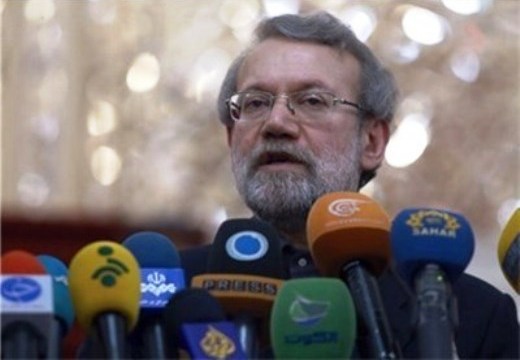
Afarinesh: “Extension of nuclear talks was the rational thing to do,” said Speaker of the Islamic Consultative Assembly Ali Larijani.
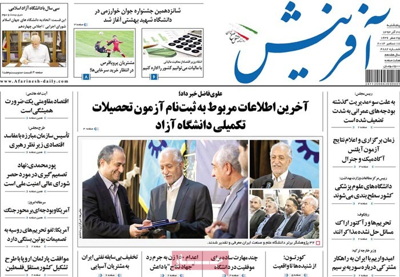
Afarinesh: Following the decision of Iran and P5+1 to extend their nuclear talks, EU sanctions against Tehran were suspended until July 2015.
Afkar: “Members of a terrorist cell that staged an attack on a border guard station in Saravan [in southeastern Iran earlier this year] have been arrested,” said the deputy commander of the Islamic Revolution Guard Corps’ Ground Forces.
Arman-e Emrooz: “President Rouhani does not have to answer to every single critic of his performance,” said Ali Motahari, a principlist MP.
Asrar: The chairman of the Expediency Council has called for a ban on imports of low-quality products from abroad.
Ebtekar: “The enemy has failed to bring Iran to its knees over the nuclear issue,” the Supreme Leader told a host of Muslim scholars in Iran to attend a world conference on Takfirism and Extremism.
Emtiaz: “Iran stands ready to export natural gas to Pakistan,” said Oil Minister Bijan Namdar Zanganeh.
Etemad: “Extension of talks has kept hopes and anticipation alive; support for the nuclear negotiators is evident in the stands officials are adopting,” said the paper in a story headlined “Post-Vienna Iran”.
Etemad: Rage and flames in Ferguson, Missouri after a grand jury did not find probable cause to indict a white police officer who killed an unarmed black teenager in August.
Ettela’at: “We’re determined to reach a deal with P5+1 soon,” said Foreign Minister Mohammad Javad Zarif.
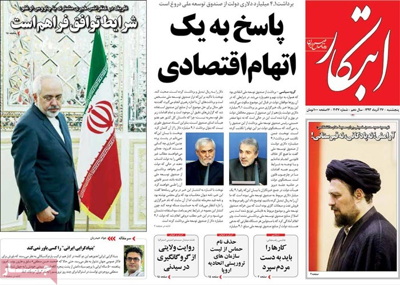
Hadaf va Eghtesad: The minister of communications has denied reports that Regin malware has found its way into the Iranian network.
Haft-e Sobh: In unexpected comments the governor of the Central Bank of Iran has said that the official price of the US dollar is likely to rise by 2,000 rials next year [starting March 21, 2015].
Hemayat: Parliament has yellow-carded the minister of labor, cooperatives and social welfare, a first step toward the impeachment of Ali Rabiei.
Iran: A number of parliamentary caucuses have thrown their weight behind Mohammad Farhadi, President Rouhani’s pick to lead the Ministry of Science, Research and Technology.
Javan: “Islamic Republic of Iran Broadcasting has decided to reduce the number of commercials it airs.”
Jomhouri Islami: Well-informed sources at OPEC say Iran and two other petroleum-exporting countries are likely to be exempt from a possible output cut of the organization.
Kaenat: “Inflation in the 30 days to November 20 stood at 17.8 percent,” reported the Statistical Center of Iran.
Kayhan: “No doubt, Iranian nuclear facilities will remain operational,” said President Rouhani.
Resalat: “Next year’s budget will be sent to parliament based on assumptions that sanctions will remain in place,” said the minister of economy and finance.
Roozan: “Women are the biggest victims of extremist acts committed in the name of religion,” said Iranian vice-president for women’s affairs.
Shahrvand: Parliament is predicted to confirm Mohammad Farhadi as science minister with a wide margin.
Tafahom: Tehran Stock Exchange shed 1,200 points in reaction to failure of Iran and P5+1 to clinch a comprehensive deal.
Iranian short animation Scale has scooped a prestigious award at the 2014 edition of Munich International Festival of Film Schools in Germany.
Directed by Amin Rahbar, the animation garnered the high-profile Climate Award of this year’s edition of the film event.
“Scale is a two-minute film which was produced by cutout animation technique,” the director said.
Some 42 screen productions from 22 countries, displaying various themes, took part in the festival.
Scale has been screened and awarded at several international festivals including Hamburg Festival in Germany, Con i minuti contati Festival in Italy, and SHNIT Festival in Switzerland.
The jury congratulated Amin Rahbar on the successful artistic and technical realization of his film, saying, “In just one and a half minutes, the clip illustrates how drastically our environment has changed, the severe damage that has been done to it and the current consequences such as climate change.”
The Munich International Festival of Film Schools is held annually (November 16-22).