Sunday, December 28, 2025
Home Blog Page 5009

Iran indigenizes flight simulator technology

Manouchehr Manteqi
Manouchehr Manteqi

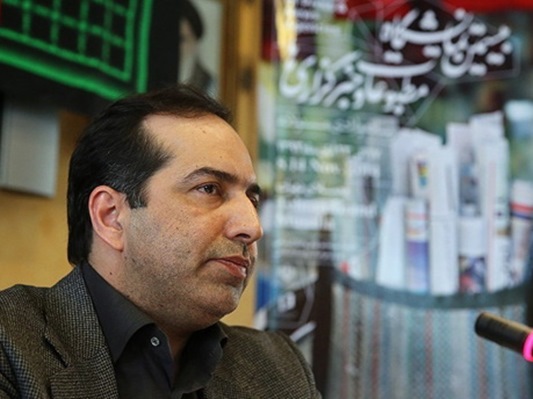
Managing Director of the Iranian Aviation Industries Organization Manouchehr Manteqi said Iranian experts have managed to indigenize flight simulator technology.

“From now on, before building any kind of drone, its simulator will be designed to reduce training costs and boost the capabilities of Iranian pilots,” Manouchehr Manteqi said on Saturday.

Iranian aviation experts have also gained the knowledge to build unmanned helicopters, Manteqi added.

Earlier this month, a home-made flight simulator system, compatible with different types of Unmanned Aerial Vehicles (UAVs), was unveiled at an international aviation exhibition in southern Iran.

The homegrown device was put on display at the 7th edition of Iran’s International Exhibition of Aviation and Aerospace Industries held on the Persian Gulf island of Kish.

Four of such simulators have been manufactured by Iran’s Aviation Industries Organization, an official said.

The new product is specifically helpful in training students in pilot courses.

The one unveiled in the exhibition has been configured to simulate flight conditions of the indigenous Ababil 3 drone.

Ababil 3 is a pilotless aircraft which can be used for military, research, environmental and trade purposes.

The drone can reach altitudes as high as 15,000 feet and has a flight endurance of 8 hours. It was first used in a military aerial exercise back in December 2013.

The Islamic Republic is now in possession of a broad range of UAVs which can be used for both civilian and military purposes.

Iran reaffirms sovereignty on three Persian Gulf islands

iran-islands
iran-islands

Iran has dismissed as “baseless” a statement by Persian Gulf Arab states supporting United Arab Emirates’ alleged ownership of three Iranian islands, saying the Persian Gulf islands are integral part of the country.

Foreign Ministry spokeswoman, Marzieh Afkham, said on Saturday that repetition of baseless claims to the three Iranian islands would not change historical facts.

Noting that “friendly ties with neighbors based on non-interference policy and mutual respect” top the Islamic Republic’s agenda, she said Iran does not put any limit on the expansion of friendly ties with neighboring countries.

On Tuesday, the six-nation [Persian] Gulf Cooperation Council issued a statement at the end of its 133rd foreign ministerial meeting in the Qatari capital, Doha, reiterating support for the UAE’s claimed ownership to the three islands of Greater and Lesser Tunbs and Abu Musa.

The three islands have been historically part of Iran, the proof of which can be found in and corroborated by countless historical, legal and geographical documents in Iran and other parts of the world.

The United Arab Emirates has, however, repeatedly laid claim to the islands.

A sense of esprit de corps with Palestinians on November 29

Reza Najafi
Reza Najafi

Ceremonies to mark the International Day of Solidarity with the Palestinian People gained added importance this year thanks to UN designation of 2014 as the International Year of Solidarity with the Palestinians.

The Islamic Republic News Agency (IRNA) on November 29 reported that at one such ceremony at the UN headquarters in the Austrian capital government representatives as well as key political and cultural figures delivered speeches on the need to demonstrate solidarity with the Palestinians.

The ceremony opened with a message by UN Secretary General Ban Ki-Moon which was read out by Director-General of the United Nations Office in Vienna (UNOV), Yury Fedotov.

Reza Najafi, the ambassador and permanent representative of the Islamic Republic of Iran to the United Nations and other International Organizations in Vienna, was one of the speakers there. The following is a partial translation of his address:

Over the past 65 years, the question of Palestine has not been a mere Islamic-Arabic issue; rather it has – over time – turned into one of the most complicated political and legal concerns around the world.

For years, the Palestinian people bore the brunt of injustice, displacement, massacre and occupation. They have been constantly deprived of their rights mainly due to the destructive, colonial policies of the Zionist regime, and their homeland has consequently shrunk by the day.

Iran’s democratic proposal for settling the Palestinian crisis helps achieve the broader goal of sustainable peace [in the occupied territories]. To make that goal attainable, these conditions should be met: administration of justice, an end to discrimination as well as to occupation of all Palestinian lands, resort to democracy to help the entire Palestine decide the fate of their homeland and see their dreams come true, and formation of an independent and sovereign Palestinian state with Quds as its capital.

In 1977, the General Assembly called for the annual observance of November 29 as the International Day of Solidarity with the Palestinian People.

What Zarif told MPs in a closed-door meeting of parliament

Zarif-Parliament
Zarif-Parliament

Mehr News Agency posted a report on November 29 about the remarks of a number of parliamentarians after Foreign Minister Mohammad Javad Zarif appeared on parliament floor to brief MPs on the most recent round of nuclear talks in Vienna. The following is a partial translation of the piece:

“A majority of questions posed to the foreign minister by MPs revolved around what the Islamic Republic of Iran offered to the West and what it got in return in Vienna,” said Vahid Ahmadi, a member of parliament’s National Security and Foreign Policy Committee.

“In response to expressions of concern about concessions, Mr. Zarif underlined what he and his fellow negotiators did was in line with the Interim Geneva Agreement,” he added.

Another member of the committee who spoke with the agency on condition of anonymity stated, “During the briefing, Zarif explicitly said that if the other party to nuclear talks did not keep its side of the bargain, Iran would resume 20-percent uranium enrichment.”

“The foreign minister said that Iran will honor its commitments step by step in tandem with fulfillment of the commitments by the West,” the MP added.

He pointed out, “Parliament Vice-Speaker Mohammad Reza Bahonar, who presided over the hearing, told Zarif that parliament will only approve a good deal and on no account will it give the go-ahead to a bad agreement. A good deal should entail the lifting of all sanctions.”

Hassan Sobhaninia, an MP representing Neishabur and a member of the chamber’s Presiding Board said, “The foreign minister briefed MPs for 45 minutes on the disagreement between Iran and the West over Fordow, Arak heavy water plant, the number of centrifuges and the timetable for removal of sanctions.”

“The Islamic Consultative Assembly has lent support to the process of nuclear talks and if Iran’s negotiating team does not cross the red lines and resists the excessive demands of the West, parliament will continue to support the process,” concluded Sobhaninia.

An MP on parliament’s Cultural Committee who did not want his name to be revealed said, “At this briefing, Zarif did not offer any explanation beyond what the media have reported; he only said that no deal has been cut with the West over the number of centrifuges or nuclear facilities in Arak and Fordow.”

“In line with the Supreme Leader’s support for the talks and Iran’s negotiating team, we approve the process of negotiations. We are mostly concerned about likely mischief on the part of the West,” the parliamentarian stated.

“I am not optimistic about nuclear talks and believe that over the past year, Iran has gained little from the negotiations,” he concluded.

“Zarif was of the opinion that over the time left, the prospects of reaching a comprehensive agreement are as strong as the likelihood of failure to strike a deal. That a deal is cut or not depends on how committed both sides stay to what has been agreed, said an MP with a seat on parliament’s Planning and Budget Committee who also spoke on condition of anonymity.

“At this briefing the measures taken by Iran’s negotiating team were elaborated on and MPs appreciated the efforts of the negotiating team by warmly seeing off the foreign minister after the hearing,” the representative concluded.

Iran to host Islamic Countries’ Health Tourism Conference

Iran-Health Tourism Conference

Northeastern Iranian city of Mashhad is slated to host the 2015 Islamic Countries’ Health Tourism Conference.

The program was announced after Iranian Economy Minister Ali Tayyebnia’s proposal for hosting the event was accepted by the Standing Committee for Economic and Commercial Cooperation of the Organization of the Islamic Conference (COMCEC) during a summit held in Turkey.

“Various issues have been discussed in the meeting, including trade and investment, but the issue of the tourism was at the core of the discussions,” Tayyebnia explained.

“I proposed our country’s hosting of the Health Tourism Conference, which was fortunately accepted,” he also added.

Iran had earlier hosted the First International ECO Health Tourism Seminar states in northern Mazandaran Province.

Iran is becoming a destination for Islamic and regional medical tourists. An increasing number of hospitals in Iranian cities offer very advanced medical and healthcare services to foreign medical tourists.

Iran museum displays Latin American dolls

Iran museum-Latin American dolls

Iran’s Nations’ Dolls Museum has showcased a number of Latin American dolls to introduce the region’s beliefs and traditions.

The exhibition held on November 27-28 also featured Mexican culture as well as Latin American handicrafts.

The museum displayed 540 culturally diverse dolls from 53 countries such as the UK, Germany, the US, Canada, Norway, Italy, France and Bulgaria.

The showcased dolls included a range of shadow puppets, theatre puppets, and dolls representing different ethnicities.

The visitors were provided with the opportunity to get acquainted with diverse cultures in Iran and other countries.

The Nations’ Dolls Museum was inaugurated in Tehran on the International Day of Peace, September 21, 2014.

Iran’s female vice president has been awarded Italy’s Minerva Award

Iran-Ebtekar-Minerva

On November 29, the Islamic Republic News Agency (IRNA) reported that Italy’s Minerva Foundation has honored Vice President Masoumeh Ebtekar for her outstanding organizational role, and commitment and integrity in her duties. What appears below is a partial translation of the report:

At a ceremony in the City Hall of Rome the 2014 Minerva Award was handed out to Director of Iran’s Environment Protection Organization Masoumeh Ebtekar in recognition of her scientific achievements and the role she has played as an accomplished woman on the political front.

The Minerva Awards, named after Minerva Anna Maria Mammoliti, an Italian journalist and social activist, come in different categories such as art, information, innovation and political management and are given to women. The Minerva non-governmental foundation is run under the patronage of the Italian president.

After receiving the non-cash award – a plaque, [the Minerva Award is symbolized with a brooch in silver, gold and precious stones, depicting the goddess Minerva] – Iranian Vice President Masoumeh Ebtekar said, “I have received this award on behalf of all Iranian women whose endeavors and sacrifices have ushered in monumental achievements for my country.”

Touching upon the progress that Iranian women have made in science, art, sport, as well as in executive and parliamentary undertakings, she stated, “Winning this award is immensely important, because Iran has a government which has been working at home and abroad in line with a policy of moderation.”

Describing the prize as an indication of a deep bond between the Iranians and Italians, she said, “In spite of differences and diversity in our cultures, getting the Minerva Award shows there is affinity and even unity between the two nations when it comes to principles such as the quest for justice, perfection along with selflessness and the love for the environment.”

She expressed hope that Iran and Italy could join hands to promote peace and security and protect the environment.

At the ceremony, along with Ebtekar, a Tunisian woman who has founded a big charity in her country to educate people to take on violence against women was also awarded.

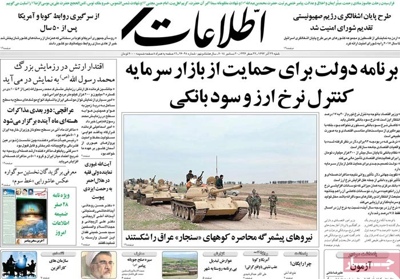
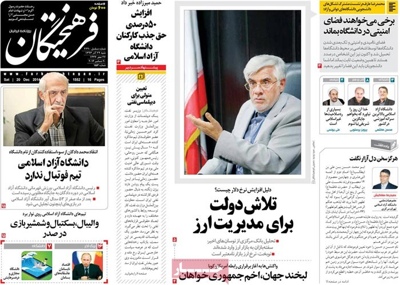
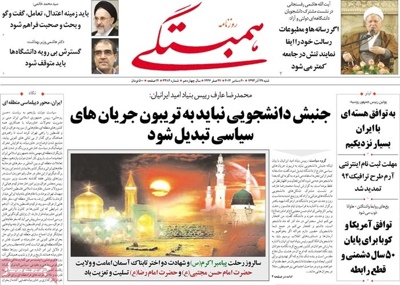
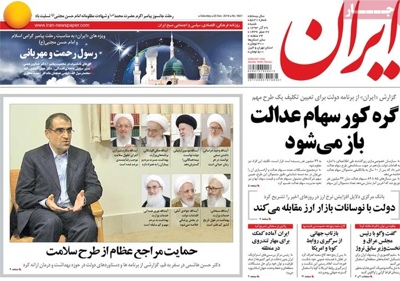
A look at Iranian newspaper front pages on Nov. 29

Iranian Newspapers Headlines

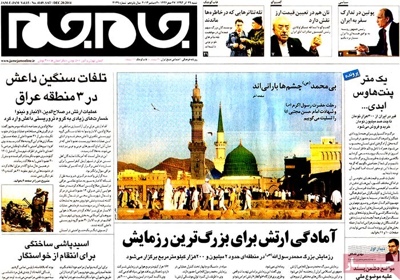
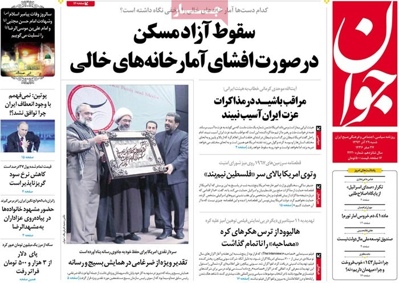
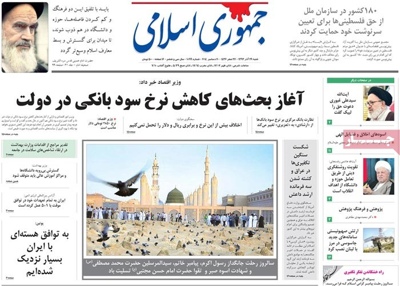
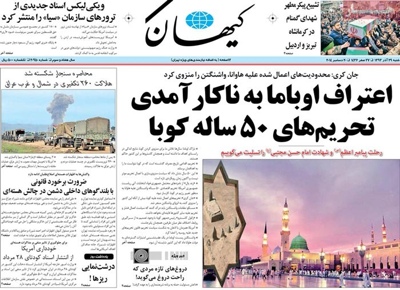
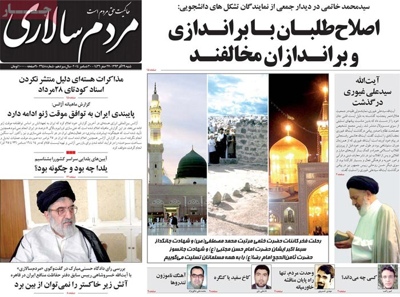
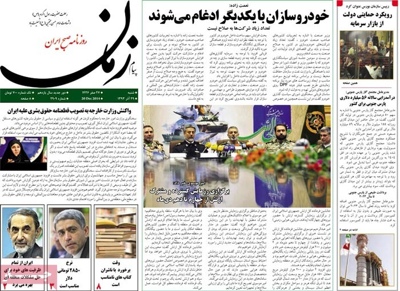
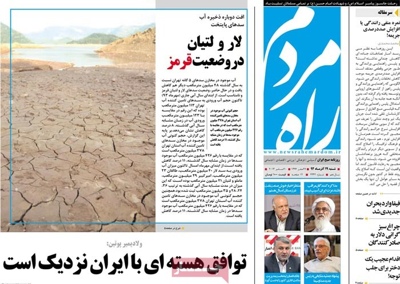
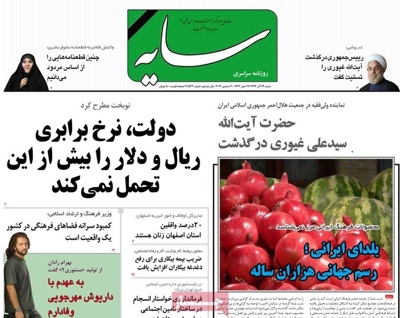
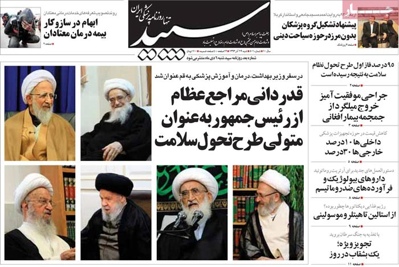
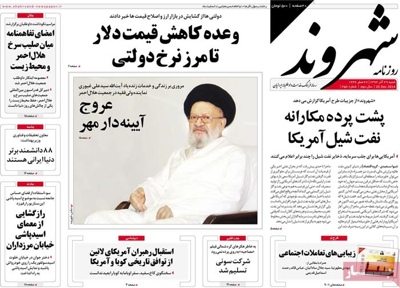
Iranian newspapers on Saturday were dominated by the Supreme Leader’s speech at a meeting with Basij volunteers on nuclear talks in which he supported the country’s negotiating team, and the decision to extend the talks for seven months. Newsweek’s cover story on Major General Ghasem Soleimani, the commander of the Islamic Revolution Guard Corps’ Quds Force, and his role in crushing ISIS in Iraq appeared on the front pages of several dailies too. Also in the news were the 166th session of OPEC in Vienna and its decision to maintain the current output ceiling, something which sent crude prices tumbling on world markets.

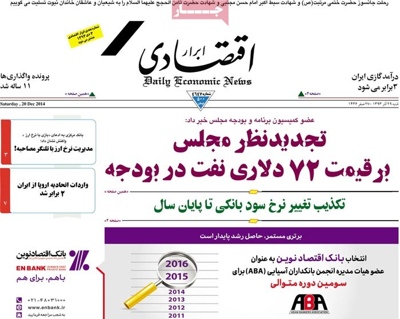
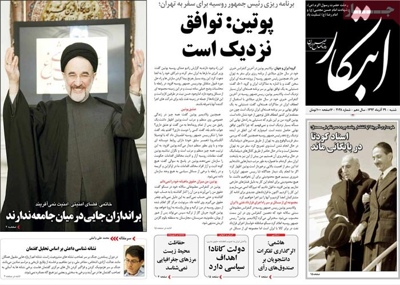
Abrar: “We will cross all passes and emerge victorious,” said President Rouhani.


Abrar newspaper 11 - 29


Abrar-e Eghtesadi: Lukoil, Russia’s second largest oil company, seeks to return to Iranian market.


Abrare eghtesadi newspaper 11 - 29


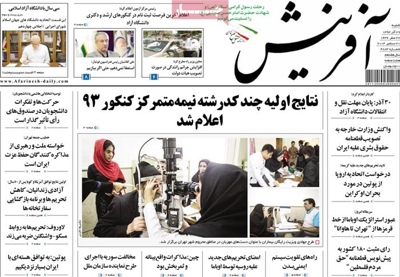
Afarinesh: President Rouhani has invited his Turkish counterpart Recep Tayyip Erdogan to pay a visit to Iran.

Afarinesh: “Nuclear talks will move into positive territory,” said Speaker of the Islamic Consultative Assembly Ali Larijani.


Afarinesh newspaper 11 - 29


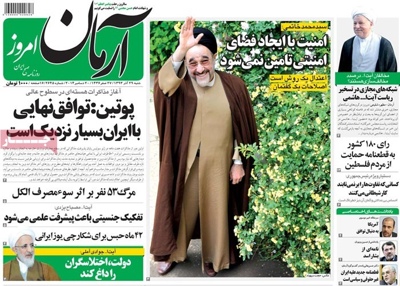
Arman-e Emrooz: “The responsibility to promote virtue cannot be delegated to a certain group. University students are duty-bound to correct deviations,” said Seyyed Hassan Khomeini, the grandson of the late Imam Khomeini.


Armane emruz newspaper 11 - 29


Asrar reports that parliament continues to stand its ground as far as calls for raising the powers of the justice minister go.


Asrar newspaper 11 - 29


Ebtekar: “For the first time in history, all Iranians have been given healthcare insurance coverage,” said Health Minister Seyyed Hassan Hashemi.

Ebtekar: “A trip by [Ayatollah] Hashemi Rafsanjani to Saudi Arabia holds the key to a breakthrough in [nuclear] talks and will help solve regional problems,” said Ayatollah Vahid Khorasani, a senior Shiite cleric.

Ebtekar: Value added tax (VAT) will not be raised next year [starting March 21, 2015].


Ebtekar newspaper 11 - 29


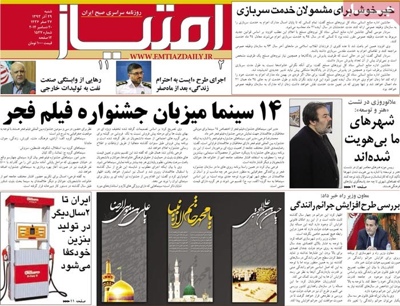
Emtiaz quoted a Tehran deputy mayor as saying that free Wi-Fi Internet will be made available on board public buses in the capital.

Emtiaz:“Four new police stations will be set up in the capital by the end of this year [ending March 2015],” said Tehran’s Police Chief Hossein Sajedinia.


Emtiaz newspaper 11 - 29


Ettela’at: “All hospitals across the country will be given a facelift by yearend [March 20, 2015],” said the health minister.


Ettelaat newspaper 11 - 29


Hemayat: Bime Razi, Iran’s representative in the World Wrestling Clubs Cup –held in the northern Iranian city of Jouybar (Nov. 26-28) – beat the US to claim the title in freestyle discipline.


Hemayat newspaper 11 - 29


Iran: “The [Iranian] negotiating team is hardworking, sympathetic, steadfast and logical. The inconclusiveness of the talks will be to the detriment of the US. I do not disapprove of the extension of the talks,” said Supreme Leader Ayatollah Seyyed Ali Khamenei.


Iran newspaper 11 - 29


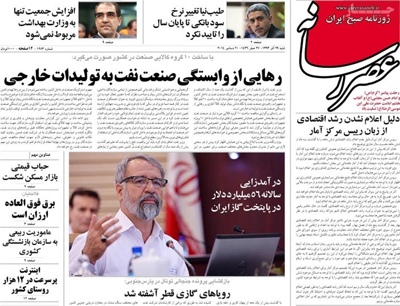
Jahan-e Sanat: “Iran will accept rational and fair words,” said the Supreme Leader.


Jahane sanaat newspaper 11 - 29


Kaenat put the cover story of Newsweek: “Nemesis: First He Fought America. Now He’s Crushing ISIS” on its front-page and underlined the praise the American weekly news magazine heaped on Commander of the Quds Force, Major General Ghasem Soleimani [for his role in tackling ISIS in Iraq].


Kaenat newspaper 11 - 29


Khorasan: “Iran will soon build its own fuel rods for the Bushehr Nuclear Power Plant,” said Director of the Atomic Energy Organization of Iran Ali Akbar Salehi.


Khorasan newspaper 11 - 29


Roozan: Iran and Total S.A., a French multinational integrated oil and gas company, have opened talks on oil trade.

Roozan: A 32-volume report on forms of domestic violence, which had been compiled when reformists were in power in Iran, went missing during the presidency of Mahmoud Ahmadinejad.


Ruzan newspaper 11 - 29


Sepid: “That [life-saving] medical supplies and medicines were exempted from sanctions [against Iran] was a sheer lie,” said the health minister.


Sepid newspaper 11 - 29


Shahrvand: Plummeting oil prices and a rise in gold prices came in the immediate aftermath of a decision by the Organization of the Petroleum Exporting Countries (OPEC) not to reduce production.


Sahrvand newspaper 11 - 29


UNHCR praises Iran for supporting foreign refugees

unhcr
unhcr

Representative of the United Nations High Commissioner for Refugees (UNHCR) Office in Iran Sivanka Dhanapala praised Iran’s performance in hosting and aiding foreign refugees, especially the Afghans.

“Iran’s services to refugees have set an example for other countries,” Dhanapala said, addressing a conference on cultural and social issues of Afghan refugees in Qom province, Central Iran, on Thursday.

“In Iranian schools, we are witnessing the friendly treatment of refugees by Iranian students,” he added.

Iran has been a generous host to more than 2 million Afghan refugees for two decades with little help from the international community.

Tehran has called on the international community to strengthen support for Iran to help it host the Afghan refugees and provide repatriation support for them.

Voluntary repatriation of Afghan refugees from Iran has slowed in recent years in the face of poor security and economic conditions in Afghanistan, which Tehran blames on the US-led invasion of the country in 2001.

The office of the UNHCR was established by the UN General Assembly in 1950.

According to the 1951 Convention on the Status of Refugees and its 1967 Protocol, the agency is mandated to lead and coordinate international action to protect refugees and resolve refugee problems worldwide. Its primary purpose is to safeguard the rights and well-being of refugees.

UNHCR first opened an office in Iran in 1984 and expanded its presence with the massive influx of Iraqi refugees following the Persian Gulf War in 1991 and the start of Afghans’ mass return movement to Afghanistan in 1992.

Today UNHCR has its Central office representation in Tehran, plus three suboffices in Mashhad, Kerman and Ahwaz.

A village chief or just a steward?

Kerry and Zarif
Kerry and Zarif

On November 25, one day after the conclusion of Vienna nuclear talks between Iran and six world powers, Haft-e Sobh, a daily, featured a front-page column by Arash Khoshkhoo on the negotiations. What comes below is the translation of the piece in its entirety:

It seems we have encountered an enormous change in the concept of American hegemony. Halfway through the second decade of the third millennium, America, a superpower which abandoned its glorious yet infamous imperialistic position after the collapse of the Soviet Union, is gripped by complicated economic and political woes, calls by multinational corporations for greater shares, and above all jitters about riding out a crippling economic crisis. Such entanglement has seen the US plunge from the position of the global village chief into a steward.

That spells trouble for the theory that prescribes talks with the global village chief rather than others in order to have the issue of sanctions settled. What village chief? The one who is unable to make a decision even when the opportunity presents itself in the form of one-on-one talks? The chief who is hastily summoned by a wealthy Saudi prince so that no measure is taken against the wishes of the rich in Saudi Arabia?

What makes John Kerry, who serves as the secretary of state of the village chief, fit in an unplanned 30-minute meeting on board the private jet of Saudi Foreign Minister Prince Saud al-Faisal? What is the nature of economic relations between Saudi Arabia and American political circles? Why was US Vice President Joe Biden forced to call and implicitly apologize to the UAE and Qatari emirs and the Turkish president one day after he made comments critical of the role of the UAE, Qatar, Turkey in supporting ISIL? [a reference to Joe Biden’s speech at Harvard University on Oct. 2 where he said, “Our allies poured hundreds of millions of dollars and tens of thousands of tons of weapons into anyone who would fight against al-Assad.”]

What kind of a village chief America is that at the beginning of each round of negotiation it tasks one of its top diplomats to launch a charm offensive to appease Benjamin Netanyahu and [Israeli Justice Minister] Tzipi Livni? Who is America? Why has the scary giant been so degraded that for every symbolic air strike against ISIL, it has to make public a bill of costs?

Let’s forget that 14 months of talks, always embellished with promising projections at sensitive times only to let down hopeful watchers with the final statement, has once more come to an end. A journalist with The Guardian tweeted that for some unknown reasons nuclear talks have been deadlocked since Sunday. Maybe the answer lies in the meeting between John Kerry and Saud al-Faisal.

Now we should believe in a new concept of America which no longer appears as a superpower running a one-man show, rather it is a corporation whose shares have been bought by Arab sheikhs, Israel and other investors during its transition from an economic crisis. Even Turkey and France now view themselves as entitled to buying its shares and see their viewpoints have an impact. What all these shareholders have in common is that they are afraid of a powerful Iran.

It’s time to thank Dr. Zarif and his team. On the back of their 14-month efforts, many economic knots have been untied and a different image of Iran has been presented to the world. Presence of hundreds of thousands of American and European tourists in Iran which gets $5 billion in revenues from tourism industry is the fruit of such endeavors.

However, it is high time we believed that bilateral meetings with America won’t go anywhere. This America is just a member of the board, not a CEO, not the chairman, and not a village chief. It is a junior manager, just a steward.