Friday, April 10, 2026
Home Blog Page 5005

Iran has rejected illegitimate demands in nuclear talks: Zarif

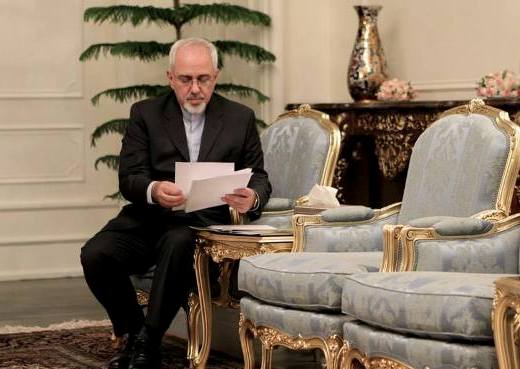
Zarif letter

In a letter to his counterparts, Iranian Foreign Minister Mohammad Javad Zarif briefed them on the latest developments in the negotiations between the Islamic Republic of Iran and the P5+1 Group on Iran`s peaceful nuclear program.

The Iranian Foreign Minister said, “My delegation has engaged in these talks with the firm mandate and strong political will to reach a comprehensive agreement. We have clearly demonstrated that we are prepared to accept a rational and fair agreement based on mutual respect and interest, in the same manner as we resist and reject arbitrary, degrading and unlawful demands. We have tried to be creative and innovative and have offered solutions.”

He added, “In our Joint Plan of Action, we envisaged a common goal for these negotiations: To reach a mutually-agreed long term comprehensive solution that would ensure Iran’s nuclear program will be “exclusively peaceful” and “would produce the comprehensive lifting of all UN Security Council sanctions, as well as multilateral and national sanctions related to Iran’s nuclear program.”

Zarif said, “Achieving the first objective is not difficult, because Iran does not want or need nuclear weapons. In our view, nuclear weapons are obsolete tools of the past, incapable of providing external security or internal stability. This is especially the case for Iran, which is content with its size, geography, natural resources and human capital, and has not started a single war in the past three centuries. A sober strategic assessment will show that nuclear weapons are detrimental to Iran’s security.

He added, “Iran also has a solid track record of opposing all WMDs on religious grounds. Ayatollah Khamenei, like his predecessor Imam Khomeini, declared that all WMDs are strictly forbidden by Islam. For this reason, Iran did not use chemical weapons even in retaliation when Saddam Hussein gassed our troops and civilians on a scale not seen since the First World War.”

Part of the letter said, “Moreover, “practical limits” envisaged by JPOA preclude arbitrary limits, which seek to shrink Iran’s enrichment to a token program. Such is neither practical nor realistic.”

The Iranian Foreign Minister pointed out, “The second objective envisaged by JPOA, namely the lifting of all sanctions, is an essential component of any agreement. But some members of P5+1 have become increasingly reluctant to abandon this counterproductive, illegal and inhuman instrument of coercion even at the expense of putting in jeopardy the entire process that provides certainty and assures transparency. Obsession with sanctions has not only obstructed a comprehensive long-term agreement, but also prevented the West from regaining the confidence of the Iranian people even after the adoption of JPOA. While Iran has shown its good faith by completely fulfilling its part of the bargain under the deal, the US and EU have adopted more measures to maintain and strengthen the sanctions regime than to live up to their sanction-easing commitments.”

The Iranian Foreign Minister concluded, “I am confident that a comprehensive agreement is imminently within reach. It requires foresight, political will and recognition of realities by our negotiating partners as well as the audacity to make the right choice benefitting the entire global community rather than succumbing to the whims of vocal, but increasingly unpopular, pressure groups and special interests.”
By 2040 countries lacking nuclear-generated electricity will fall apart

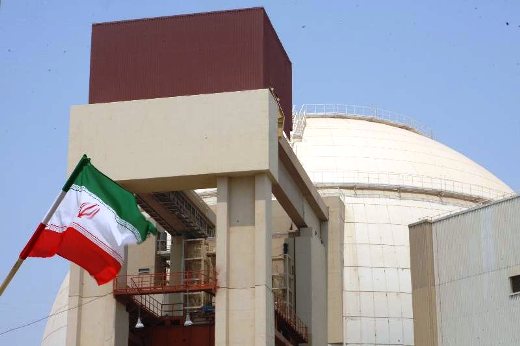
Bousher power plant

Nuclear scientists have stressed that uranium resources will meet energy needs of humans for 5 million years.

Tasnim News Agency ran a report on December 22 on the advantages of nuclear energy and enrichment, taking a look at the history and prospect of nuclear energy. What appears below is the translation of the report:

The world first learned about nuclear energy on August 6, 1945 when the US dropped an atomic bomb on Hiroshima, Japan. Nuclear energy has multiple functions. The World Nuclear Association (WNA) predicts that in 2015, a nuclear power plant will go up and running in the world every five days, on average.

Why will the world opt for nuclear energy? Power generation through nuclear energy is more cost-effective than through fossil fuels. On the other hand, non-renewable energy sources – coal, oil and natural gas – are running out. Those countries which remain dependent by 2040 on the sale or consumption of non-renewable energies will be on the verge of collapse.

Uranium sources can meet humans’ energy demands for 5 million years; that’s why the US which possesses one of the world’s largest oil reserves has the maximum number of nuclear power plants. France taps into nuclear energy to supply 80 percent of its electricity. Production of nuclear energy is cheaper than wind and solar energies and is not tied to any specific climatic conditions. Nuclear energy has more advantages.

3.5 – 5 percent enrichment

Electricity generation through nuclear energy will save $5 billion annually. It also helps diagnose and treat cattle diseases, ensure the safety of livestock products, desalinate seawater and overcome water shortages.

However, when it comes to the employment of nuclear energy for medical purposes, higher levels of enrichment are needed. To diagnose cardiovascular diseases and treat different types of cancers, brain tumors and the like, nuclear medicine should utilize 20%-enriched uranium.

What are the other functions of 20%-enriched uranium? It helps determine toxic elements in foodstuffs, discover rare [earth] deposits, spot environmental pollutants, improve the quality and quantity of agricultural products, and make desert farming an achievable possibility.

Submarines need the uranium enriched to 45-50 percent as their fuel. A nuclear-run submarine can move underwater for several months without any need to refuel. Currently, only a few countries can tap into commercial-grade uranium, and Iran is trying to break that monopoly.

Tehran University, a hangout of the opponents of nuclear program

Mohammad Esmaili

Iran’s nuclear case has been unquestionably a staple of Iranian news over the past 18 months. The spin different media circles have put on the news differs though, with some trying to deal with the question logically and justly, and others looking at the case one-sidedly.

Mohammad Esmaili, a member of parliament’s National Security and Foreign Policy Committee, has reacted to remarks by some university figures he calls “Revisionists”, calling on President Rouhani’s government to take a transparent stance on the Western-oriented approaches of Revisionists and discourage speculations that his Cabinet is like-minded with them.

Javan, a principlist newspaper, on December 17, ran an opinion piece by Esmaili who has analytically reviewed the performance of the Revisionists, saying perhaps this group aims to “downplay the [high] value the nuclear program has among people”. The following is a partial translation of what else he has written:


Denunciation of nuclear progress

Over the past year prominent figures and media affiliated to Revisionists have pushed hard to fuel suspicions among people [about nuclear achievements] through psychological-media operations and raising demagoguery questions such as “What’s the use of nuclear energy for the nation? … The nuclear achievements pale into insignificance when compared with [growing] economic and political pressures … We need to halt the development of nuclear energy to let people breathe easily”.

To theorize what they say, four people with links to Revisionists – on December 16 – took coordinated positions which clearly show their comments are “purposeful”.

Ahmad Shirzad, a member of the [Islamic Iran] Participation Party in the sixth parliament [which was reformist-majority and rife with tensions including mass resignations of some MPs] made comments in University of Tehran which deserve to be contemplated:

“No water can be taken out of the well (of nuclear industry), but it can provide some people with bread [something to live on] …. From 2003 on, we have taken no single glass of water [from this well]”.

He said, “Nobody in Iran knows why we have stepped onto the nuclear path. This is like the continuation of war after the liberation of Khorramshahr [back in 1982] when certain people were shouting slogans such as: ‘To reach the holy Quds, we need to pass through Karbala.’

“Since 2003 when the nuclear case was first raised, we have achieved nothing. The country was supposed to march toward scientific growth because of its nuclear program, but no research or document proves such growth”.

Davoud Hermidas-Bavand [a political scientist] implied that nuclear progress is costly, saying, “Our problems remain unresolved as long as we fail to patch up our differences with the US.”

Sadegh Zibakalam, a political analyst, said for his part, “Iran has made no scientific progress or innovation as far as the nuclear issue goes”.


What are the objectives of downplaying nuclear values?

In a separate piece of writing, we will study why nuclear gains matter for Iran, but the reasons Revisionists seek “to downplay nuclear values” are as follows:

1. “People don’t regret the loss of something which is useless, valueless and costly for them.” Through such mindset, the pro-Liberalist camp is trying to show that nuclear gains are worthless, costly and risky. The move is meant to weaken public support for such achievements. They seek to make people believe that the march toward nuclear development will earn the country no distinct, objective achievement, thus people should not pin their hopes on nuclear development, rather be content with not having nuclear technology.

2. Since the months leading up to the 2013 [presidential] elections the Revisionist theoreticians have tried to resort to reason No. 1 [above] to make people believe that “nuclear progress translates into economic and pocketbook problems for them”. If institutionalized, such mentality will kill people’s enthusiasm about nuclear progress and make them defy it.

3. Based on the reasons one and two, public disillusionment with nuclear progress paves the way for making concessions to the West.

4. The Revisionist decision makers hold that downplaying nuclear values justifies the theory of “compromise”, “capitulation” and “passivity” which prevailed during and after reformist years, and confirms the continuation of such a trend as expedient for the country.

5. The main reason is “to pit the public against the establishment”. “To be against the establishment” is an integral part and base of the strategy adopted by the proponents of liberalism in Iran. It doesn’t seem far-fetched if we think that they make use of the nuclear case to provoke confrontation between people and the establishment.


What does the government is expected to do?

Finally, it is worth mentioning that the officials of the eleventh government – although they have on several occasions stressed the need for nuclear progress – are expected to show appropriate reaction to pre-planned and targeted stances of Revisionists to eliminate speculations that some office holders see eye to eye with pro-West Revisionists inside the country.

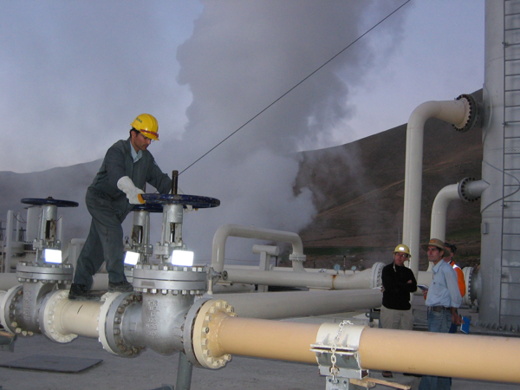
Iran becomes the ninth member of an exclusive club of nations tapping geothermal energy

Iran -Earth Enegry

On December 22, the Islamic Republic News Agency (IRNA) reported that an almost four-decades-long project to develop the technology to harness geothermal energy has produced the intended result and Iran has finally become the 9th nation in possession of the technology to tap into geothermal resources to generate energy. What comes next is a partial translation of the report:

[…]

Iran has become the 9th country which has the technology to exploit geothermal energy. The project which got underway before the Islamic revolution and has seen 14 different governments take and leave office finally came to fruition after 39 years.

[…]

Over the years, the project went through lots of ups and downs for different reasons including sanctions. It was shelved for a while before being taken up again.

[…]

Yousef Armodeli, the managing director of the Renewable Energy Organization of Iran says, “Fifteen wells have already been drilled, and seven have run into geothermal reserves; with temperatures at 240˚C, they are highly efficient. Feasibility studies suggest the potential of electricity production in the region under study [that is to say Meshkinshahr] stands at about 250 MW.

In Phase One of the project to develop the geothermal field, a pilot 5MW geothermal power plant is expected to be set up. First though, we need to build a plant to turn thermal energy into electricity. An Iranian contractor which has won the tender to build the plant and its turbines is already working on it. The power station will be operational in two years to generate 5MW of electricity.”

[…]

Studies presented in 2008 by the Renewable Energy Organization of Iran suggest that almost a dozen areas across Iran are suitable for generation of geothermal energy.

[…]

Court orders 7th floor of the cell phone hub of the capital removed

Iran-Alaeddin mobile store

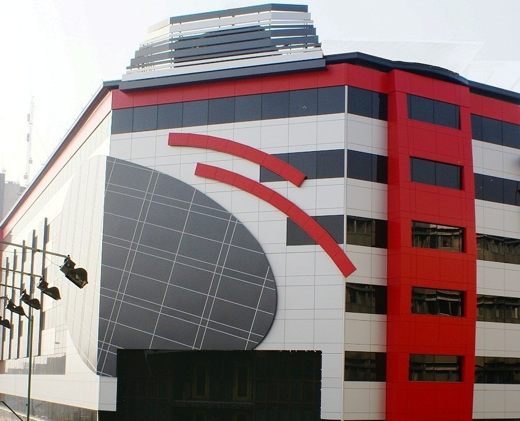
Arman-e Emrooz newspaper on December 22 quoted an official with the Court of Administrative Justice as saying that the court has ordered the seventh floor of Alaeddin Shopping Center in Tehran to be destroyed. The following is a partial translation of the report:

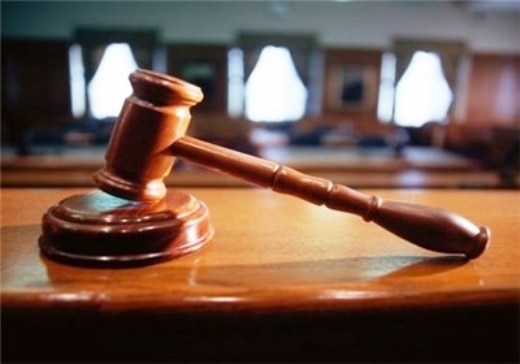
Musa Ghorbani, the deputy chairman of the Court of Administrative Justice for judicial affairs, said the owner of the [cell phone] shopping center had illegally constructed the additional floor, but the court has now ordered it removed.

He said the owner will naturally appeal the court’s verdict, adding due to the compelling evidence the ruling is unlikely to be overturned.

The owner – plaintiff – had filed complaints against a decision by the Article 100 Commission of Tehran Municipality to destroy the building’s seventh floor, he said, adding his complaint was overturned in the court of first instance.

According to a report by the Fire Department, Center for Justice Department Experts and Tehran Construction Engineering Organization, the construction in the shopping center is both illegal and untechnical, he said.

The official further said the building is a threat to its occupants, adding it should be pulled down in order to avoid any further damage to the structure.

The verdict of the court of first instance was released more than 20 days ago and the owner has 20 days, since the verdict is officially announced, to appeal.

Belgian Court Orders Return of Smuggled Antiquities to Iran

law

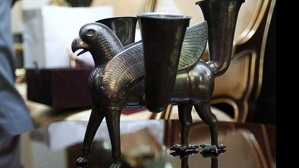
Shir Dal-drinking-cupA regional Belgian appeals court ruled that a consignment of antiquities, including more than 300 historical objects discovered in Iran some 50 years ago, must be returned to the Islamic Republic, overturning previous verdicts that were challenged by Iran’s diplomatic channels.

The appeals court of Belgium’s Liege ordered that the historical objects, which have been kept at a museum in the European country for decades, be given back to Iran, Mohsen Mohebbi, an official at Iran’s presidential office said on Tuesday.

The invaluable antiquities had been discovered in Khurvin, a rural area at Iran’s northern province of Alborz, about 50 years ago.

The historical objects, dating back to 2000 B.C., had been discovered by a French woman and were later smuggled out of Iran by a Belgian diplomat, according to the Iranian officials.

“The items are scheduled to be transferred to Iran soon,” Mohebbi said.

Iran felicitates Tunisians on successful presidential elections

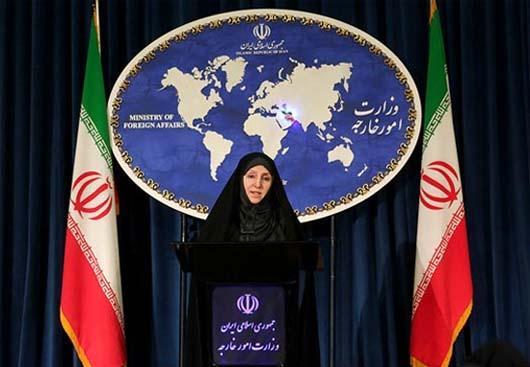
Iranian Foreign Ministry Spokeswoman Marziyeh Afkham

Iranian Foreign Ministry Spokeswoman Marzieh Afkham congratulated the Tunisian nation and government on holding the recent presidential election successfully.

Afkham congratulated the Tunisian nation and government on successful holding of the presidential election and described it as a stabilizer of the democratic process in that country and an important achievement of the Tunisian Revolution.

Veteran politician Beji Caid Essebsi won Tunisia’s first free presidential election, beating rival and incumbent Moncef Marzouki with 55.68 percent of the vote against 44.32 percent, official results showed on Monday.

The ballot marked the final step in Tunisia’s transition to democracy after an uprising that ousted autocrat Zine El-Abidine Ben Ali in 2011 and inspired the Arab Spring revolts across North Africa and the Middle East.

Essebsi, a former official in Ben Ali’s one-party administration, recast himself as a technocrat.

A look at Iranian newspaper front pages on Dec. 24

Iranian Newspapers Headlines

The comments of the secretary of the Supreme National Security Council about nuclear talks and ties with the United States dominated the front pages of many Iranian newspapers on Wednesday. The three-leg regional tour of the speaker of the Islamic Consultative Assembly that has taken him to Syria, Lebanon and Iraq where he took up regional questions as well as issues of mutual interests with senior officials also appeared on the front pages of dailies. Also in the news was the ruling by a Belgian court that will eventually see the return to Iran of historical items dating back 4,000 years.

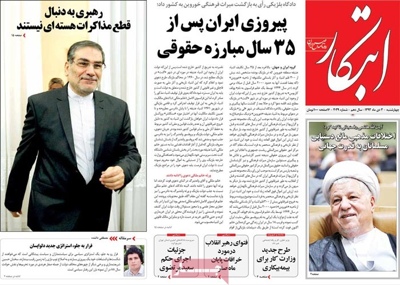
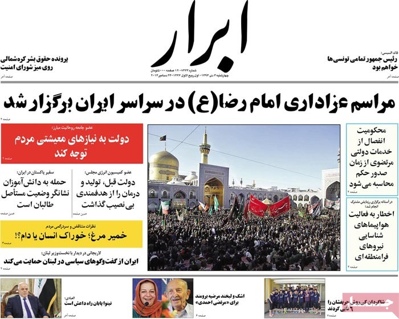
Abrar: “Tehran supports political dialogue in Lebanon,” Iranian Parliament Speaker Ali Larijani said at a meeting with the Lebanese prime minister in Beirut.


Abrar newspaper 12 - 24


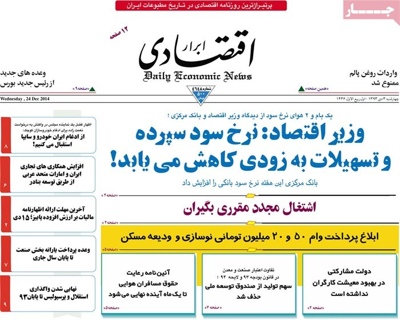
Abrar-e Eghtesadi: A ban has been imposed on imports of palm oil. [It came after the use of palm oil in a number of dairy plants caused quite a stir in the country earlier this year.]

Abrar-e Eghtesadi: The economy minister has said interest rates will be cut next year. His comments came less than a week after the Central Bank decided to raise interest rates on 6- and 9-month accounts.


Abrare eghtesadi newspaper 12 - 24


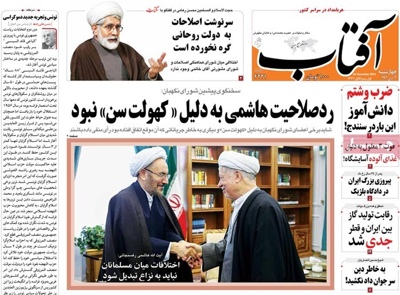
Aftab-e Yazd: “Old age was not the only determining factor in the Guardian Council’s decision to disqualify Hashemi Rafsanjani [when he wanted to run for president in 2013],” said former spokesman of the council Abbasali Kadkhodaei.


Aftabe yazd newspaper 12 - 24


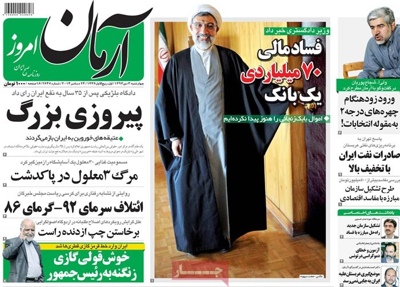
Arman-e Emrooz: A great victory for Iran. Following a Belgium court order, 4,000-year-old Iranian antiques will return home.

Arman-e Emrooz: The justice minister has reported corruption to the tune of 700 billion rials (almost $23 million) in a bank. “So far we have been unable to discover all the assets of Babak Zanjani [who stands accused of massive corruption],” Mostafa Pourmohammadi said.


Armane emruz newspaper 12 - 24


Ebtekar: “The Supreme Leader does not seek to bring nuclear talks to a halt,” said Ali Shamkhani, the secretary of the Supreme National Security Council.


Ebtekar newspaper 12 - 24


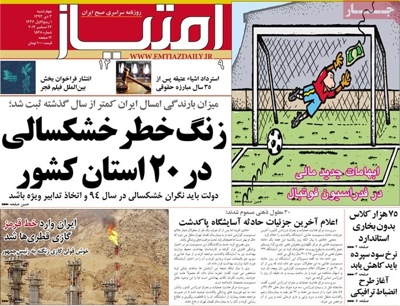
Emtiaz: Following a drop in precipitation levels this year, the threat of drought looms in 20 provinces across the nation.


Emtiaz newspaper 12 - 24


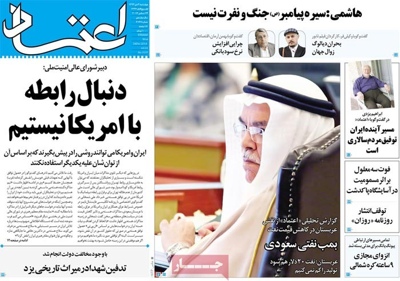
Etemad: Roozan daily has been banned.

Etemad: Saudi Arabia has dropped an oil bombshell by saying it wouldn’t cut crude production even if prices fell to 20 dollars a barrel.


Etemad newspaper 12 - 24


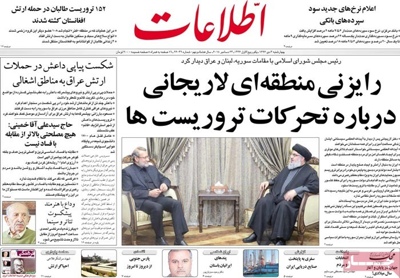
Ettela’at: Iranian Parliament Speaker Ali Larijani has held talks with officials in Syria, Iraq and Lebanon mostly on terrorist threats facing the region.

Ettela’at: IS terrorists have suffered back-to-back defeats following an Iraqi army offensive in the north.


Ettelaat newspaper 12 - 24


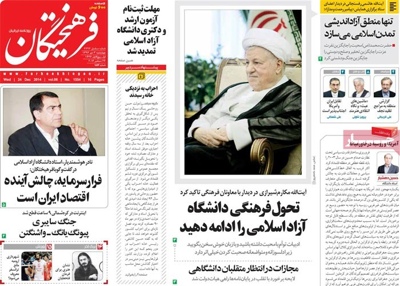
Farhikhtegan: A bill that envisions punishment for students who cheat in writing their dissertations has been presented to the Cabinet.


Farhikhtegan newspaper 12 - 24


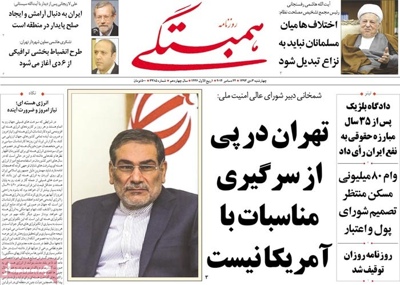
Hambastegi: “Differences of opinion among Muslims should not snowball into conflicts,” said Chairman of the Expediency Council Akbar Hashemi Rafsanjani.

Hambastegi: “Iran seeks to see security and sustainable peace prevail in the region,” said the Iranian parliament speaker after a meeting with senior Iraqi Shiite cleric Ayatollah Sistani.


Hambastegi newspaper 12 - 24


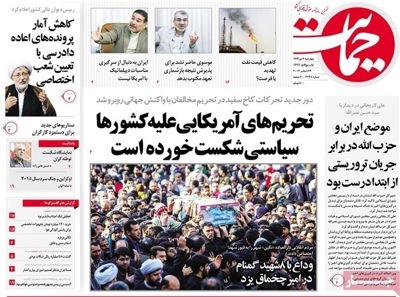
Hemayat: “Iran does not seek to resume diplomatic ties with the United States,” said Secretary of the Supreme National Security Council Ali Shamkhani.


Hemayat newspaper 12 - 24


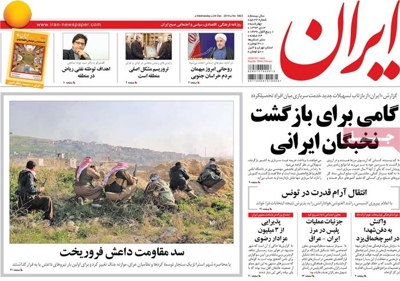
Iran: New arrangements to allow Iranian male expats who have not completed their military duty to pay fines instead is a major step that facilitates the return home of the elite.


Iran newspaper 12 - 24


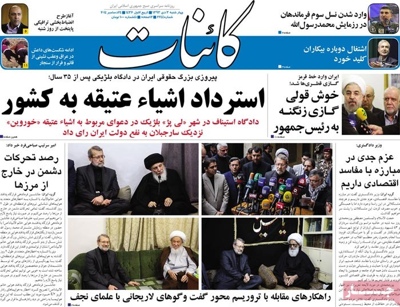
Kaenat: “Officials are determined to take on corruption,” said Minister of Justice Mostafa Pourmohammadi.


Kaenaat newspaper 12 - 24


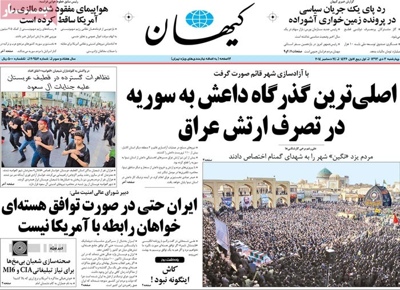
Kayhan: The Iraqi army has taken over the road IS militants use to travel back and forth between Iraq and Syria.


kayhan newspaper 12 - 24


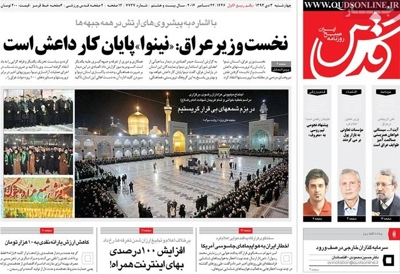
Qods: A Russian team seeks the signature of the captain of the Iranian national volleyball team. Saeed Marouf has been offered an astronomical figure.

Qods: Iran has warned foreign surveillance aircraft ahead of a major military maneuvers it will hold in the south.


Ghods newspaper 12 - 24


Resalat: Abbasali Kadkhodaei, an advisor to the secretary of the Guardian Council, has called for designation of a court to hear the cases of Mousavi and Karroubi [two candidates who disputed the results of the 2009 presidential elections and caused unrest].


Resalat newspaper 12 - 24]


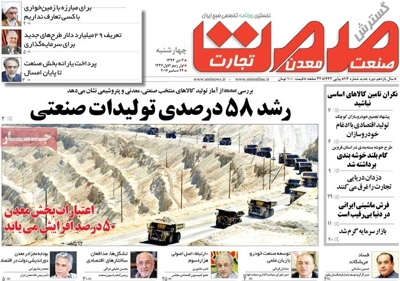
SMT: The budget allocated to the mining sector is to increase by 50 percent.

SMT: Iran’s industrial production has registered a 58 percent hike.


Samt newspaper 12 - 24


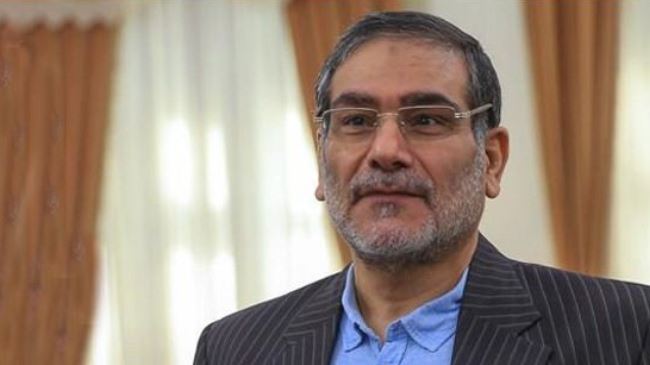
Resumption of ties with US not on Iran agenda: Shamkhani

Ali-Shamkhani

A senior Iranian official says Tehran does not seek to resume diplomatic ties with Washington even if a comprehensive nuclear deal is reached between the Islamic Republic and P5+1.

In an interview with the Financial Times, Secretary of Iran’s Supreme National Security Council (SNSC) Ali Shamkhani said Iran and the US “can behave in a way that they do not use their energy against each other [in the region]. A nuclear agreement can be very crucial in this regard.”

“Everything will depend on the honesty of the Americans in the nuclear talks,” he added.

He rejected assumptions that regular meetings between Iranian and American diplomats during the Iran-P5+1 nuclear talks could lead to rapprochement between the two countries.

Iran and the US severed diplomatic ties in the aftermath of the Islamic Revolution in the country in 1979.

“Negotiations are only for the nuclear issue,” the SNSC secretary said.

He emphasized that Iran would not buckle under international sanctions and would not retreat from its rights based on the Non-Proliferation Treaty (NPT).

“We will not die if there is no agreement and we will not go to heaven if we reach an agreement,” Shamkhani said.

Iran and the P5+1 countries – the US, Britain, France, Russia, China and Germany – wrapped up their latest round of talks on the Islamic Republic’s nuclear program in the Swiss city of Geneva on December 17. Iranian and American diplomats have also held a few rounds of talks over Tehran’s nuclear program.

Shamkhani further said the US-led airstrikes against the Takfiri ISIL terrorists in Iraq have been ineffective.

He said Iran only cooperates with the Iraqi government in the fight against terrorists.

The ISIL terrorists control some parts of Syria and Iraq. They are engaged in crimes against humanity in the areas under their control.

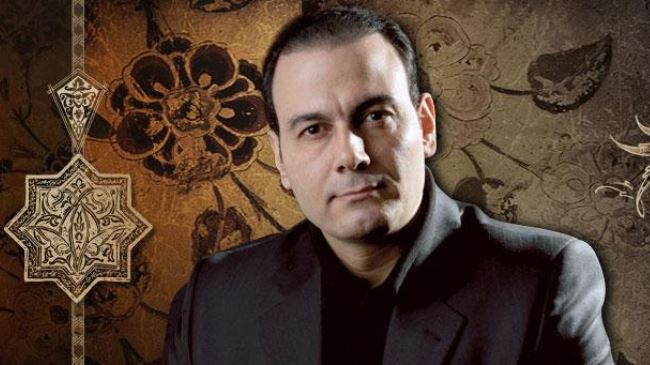
France to release Ali Reza Qorbani’s album

Iranian vocalist- Ali Reza Qorbani

Eminent Iranian vocalist Ali Reza Qorbani’s new album, Lost in Love, is slated to be released in French capital of Paris.

Recorded by the French company, Accords Croisés, the album includes Iranian traditional songs.

The songs have been inspired from the works by the classical Persian poets Abu-Saeid Abul-Kheir and Mowlavi as well as the works by the contemporary poets Fereidoon Moshiri and Mohammad-Reza Shafiei Kadkani.

Lost in Love was composed by the Iranian musician Saman Samimi, who is also a Kamancheh – an Iranian bowed string instrument – maestro.

The album will hit the market with the French title of Éperdument on January 27.

Qorbani has performed concert tours in a number of countries like Germany, Belgium, Algeria, Greece, Turkey, Denmark and Ireland.

He also took part in the Sounds of Persia Festival in Toronto, Canada, and the annual Festival de Saintes in France.

Qorbani, along with a number of Iranian and Tunisian musicians, also had Persian and Arabic performances in Morocco and France. He was warmly welcomed by the audience, particularly traditional Persian music lovers.

He has studied under prominent Iranian musicians like Khosrow Soltani, Behrouz Abedini, Mehdi Fallah, Ahmad Ebrahimi, and Dariush Tala’i, whom he accompanied in numerous concerts.