Monday, December 29, 2025
Home Blog Page 4996

How can a Muslim live in a pluralist world?

Imam Musa Sadr

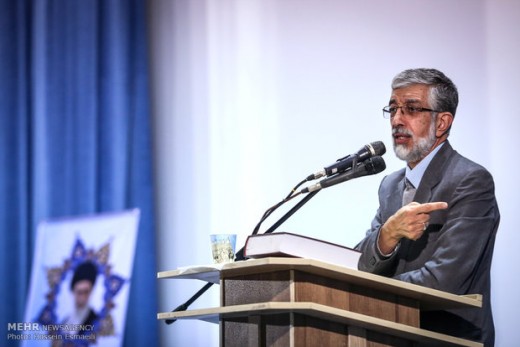
A meeting was held in Tehran early this month on Imam Musa al-Sadr [an Iranian-Lebanese philosopher and Shiite religious leader who disappeared in August 1978 during a visit to Libya] and Muslim Lifestyle in a Pluralist World. On December 3, Shahrvand daily’s Modern Plan Supplement partly focused on what Davood Feirahi, Ph.D. who teaches political science at the University of Tehran had to say at the meeting. The following is a partial translation of his speech, among other things, on consensus democracy:

The world is like a small society populated by people with various beliefs. The core feature of the world we live in is pluralism. One of the problems theoreticians raise about life in a pluralist society is religion. ‘How can one who assumes to be right and views others as wrong live in a society?’ they ask.

Imam Musa al-Sadr partly focused on multiculturalism and pluralism and put forth ideas to turn those concepts into reality. A pluralist society is a cultural-political-social mosaic made up of distinct ethnic, religious and linguistic groups. This entity, in turn, features cultural and identity-related gaps.

Each of the subcultures that thrive in this entity has its own red lines, beliefs, interests which are at times mutually exclusive. If one group goes too far in insisting on their beliefs, it is bound to find itself on a collision course with society.

Radicalism and Secularism

There are two widely-held beliefs when it comes to relations between religion and a pluralist society. A pluralist society either has to be dragged into factionalism, which leads to religious violence, also known as radicalism which is rife in the Middle East today, or opt for secularism and consequently rid the public atmosphere of religious literature.

In light of the fact that political scientists, legal experts and sociologists regard radicalism as perilous, they recommend secularism. Although secularism puts down faith in the public domain and thus entails violence, it does not cause religionists to take on one another. In other words, the violence which is spawned is not as bad as factional fighting. This is the least bad among the worst options. Imam Musa al-Sadr believed there had to be a third way, as Habermas does.

He believed secularism and factionalism should be pushed to the sidelines at the expense of a third way which draws a line between religiosity and radicalism and opts for the former. One in which democracy, not secular democracy prevails. Such democracy is today known as consensus democracy.

In such democracy, religiosity is there but the establishment is not ecclesiastical; religious people are part of society and politics, but the state does not carry a religious tag. Society exercises democracy but not maximal democracy. As Muslims that is what we need. […]

Negation of secularism-factionalism

[…] Imam Musa al-Sadr does not approve of secularism and disputes assumptions that the negation of factionalism necessarily amounts to the approval of secularism. He argues that one can dismiss both of them in the same breath.

One cannot let go of these two concepts unless they think of a third one. Imam says society can offset the negative impacts of factionalism-secularism if it takes advantage of religion – the third concept – and its positive results.

Negative factionalism

When a sect or faction walls itself off from others, it is practicing negative factionalism. In that case, it has two options: either isolation or confrontation. A true religion frowns upon both.

Imam Musa al-Sadr accepts two seemingly opposite concepts: pluralism and religion. He says if the plurality of factions causes a split in society, it’ll pose a threat to the country, but if it helps facilitate the exchange of experiences, it will help the country move forward.

Imam says religion should be protected. It should help people grow, not suffer harms. As for the government, he says it shouldn’t be factional, pluralist or elitist, stressing that the government should represent neither the majority nor the minority; rather, it should be a representative of people’s interests.

True religion and its fruits

Religion is like a tree. Bitter fruits are picked from bitter trees. Imam holds that to recognize a true religion, we should taste its fruits. He says a true religion offers services to the public and shows the correct path. Literacy and order, as well as eradication of ethical misconduct and poverty are the fruits of such religion.

A true religion, Imam says, does not push its followers toward isolation; neither does it ask them to abandon their social activities. The reverse holds true; proximity to God becomes achievable if one tries to serve people.

For Imam, the goal is to improve the living conditions of the Shiites and help them make up for their backwardness. If a religion can rid the Shiites of these woes, it is the true religion.

Politics means engagement in building the future

Imam says religion does not ban healthy political activity provided that it conforms to religion in terms of principles and objectives. This means politics should help eradicate poverty, ensure health and help develop it, and strengthen and pursue education. So a Muslim who is after political activity should get involved in these affairs too.

Healthy political activism materializes in participation in future-building efforts, Imam says, reaffirming that religion has left the future to its followers rather than to others.

Political involvement is not a win-or-lose game; rather it is after ways of forming a consensus. He says Muslims can cooperate with non-Muslims in pursuit of social goals such as the campaign against illiteracy and for national goals like safeguarding the country’s national unity. Add religious goals when it comes to cooperation with Sunni Muslims.

Dialogue is the only way forward

Imam challenges the either-with-us-or-against-us attitude of factionalists and says that dialogue is the only way forward, one which leads to unity and mutual understanding.

In a society which is run based on consensus democracy, people can engage in dialogue if they can meet its conditions: freedom, respect, trust, and tolerance.

In the absence of freedom, monologue will take the place of dialogue. When respect and trust are lacking, no one dares to talk. And talk will end up in fighting if tolerance remains elusive.

Pluralist society, the best of all

“To bring together varied thoughts and experiences and put them to good use, we need to promote mutual respect among people,” Imam says, who finds nothing wrong with religious plurality and believes a religion can live on thanks to variedness.

He says, “The country’s power rests with the trust people have in each other”. He also says that the [Grand] Assembly [of Shiites in Lebanon] is basically for dialogue, adding that dialogue in the absence of organization is harmful.

Imam believes in a religious mentality which is fit for living in a pluralist society, or a cast of mind on how to live with and accept other people, and not reject them.

“I respect all factions and religious groups which are formed in the name of faith. To me religiosity differs from factionalism. From among secularism, factionalism and religious moderation – the three mindsets – I describe the last one as religiosity,” he says, adding, “Open-mindedness and opening up to others is a religious duty, and the main goal is to serve [others].”

The following is the gist of what Imam Musa al-Sadr has identified as the basic characteristics of religiosity:

Openness: Religiosity believes in the existence of different organized factions and their collective efforts to build a better human society. Imam takes pride in the plurality of Lebanese society.

Innateness: Imam says man’s nature which is pure can get along with a religion. If not, that religion is not genuine.

Honesty and integrity: “National unity is more profound than the unification of interests. It is the oneness of all hearts, intentions and objectives …. “To make this unity materialize, all countrymen should respect each other …,” says Imam, blaming the lack of honesty, as Imam Ali has put it, for the collapse of civilizations.

Freedom: Imam does not see religion as limitation. “Total freedom is the essence of religion,” he says, adding that to protect freedom, society needs freedom. “Unlike what is believed freedom is not finite”.

Organization: It is a religious duty. “Can unity, mutual understanding and dialogue be promoted without organization?” he asks.

That the followers of a religion should receive training to treat others positively is achievable only through organization.

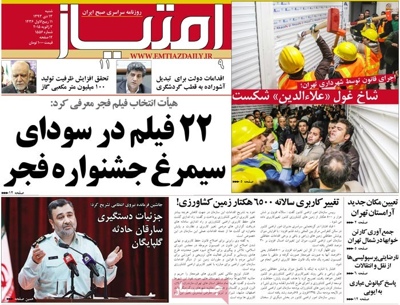
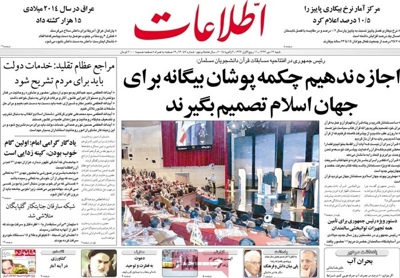
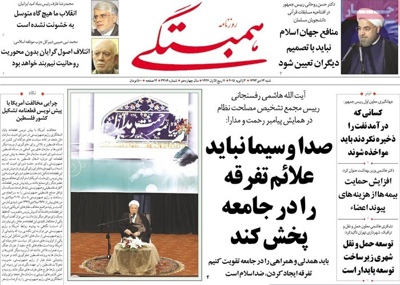
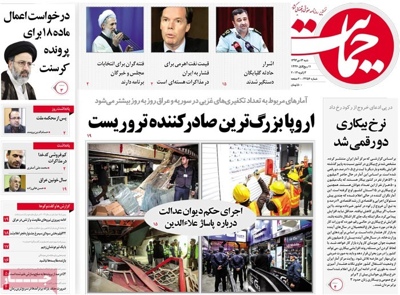
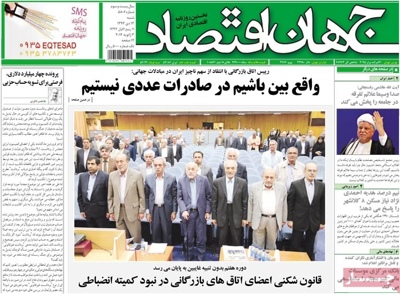
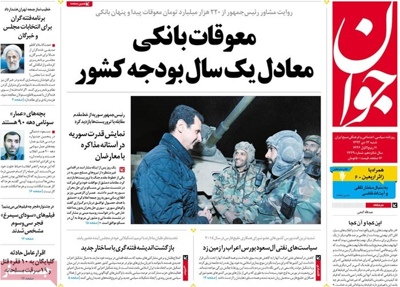
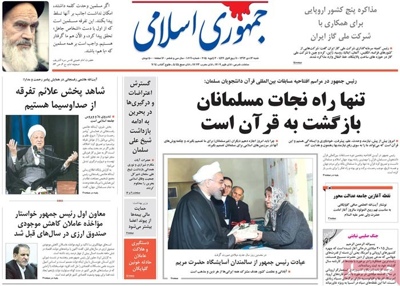
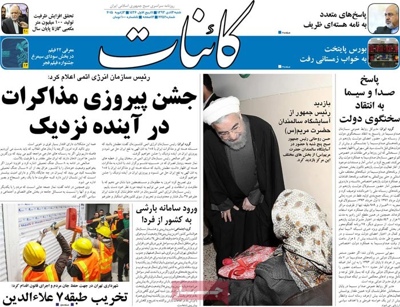
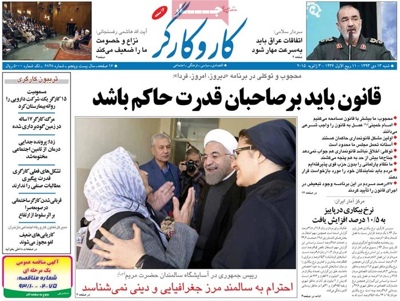
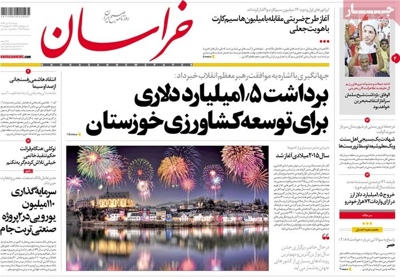
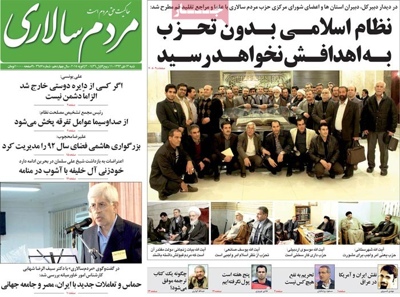
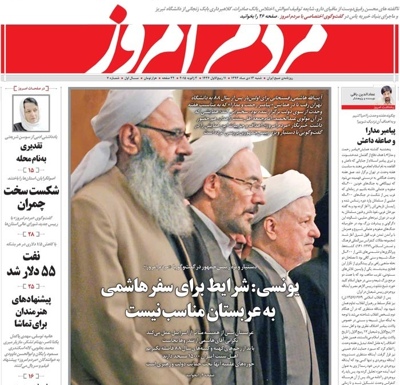
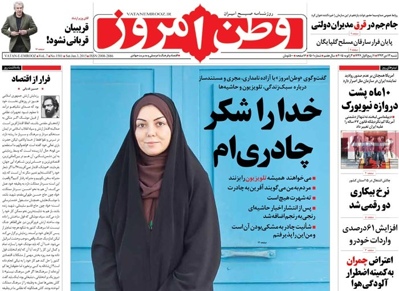
A look at Iranian newspaper front pages on Dec. 14

Iranian Newspapers Headlines

The massive presence of Shiites from around the world in Iraq, with some estimates putting the crowd at 20 million, to keep alive the memory of the Prophet’s grandson and the uprising he led against the oppressors of the time dominated the front pages of Iranian newspapers on Sunday.

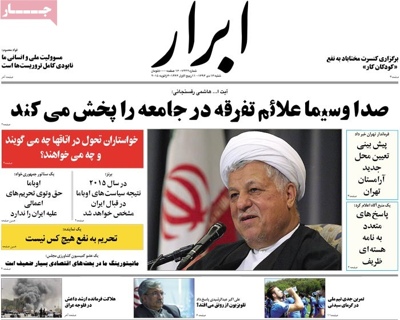
Abrar: “In nuclear talks we act in keeping with the principles of the establishment and we won’t quit that path,” said President Hassan Rouhani.


Abrar newspaper 12 - 14(1)


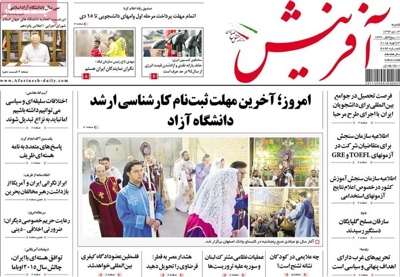
Afarinesh: “Iranian pilgrims who have traveled to Iraq without passport should return home only through Chazabeh Border Crossing,” announced the Iranian Interior Ministry.


Afarinesh newspaper 12 - 14'


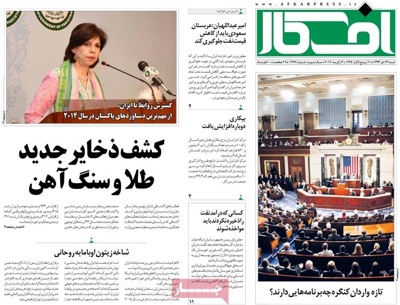
Afkar: “As much as 80 percent of next year’s development budget is unlikely to materialize,” predicted a member of parliament’s Development Committee.


Afkar newspaper 12 - 14


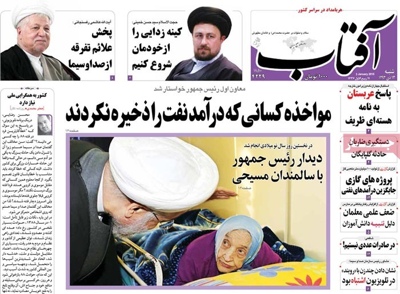
Aftab-e Yazd: “President Rouhani’s government is facing a mountain of problems. Just like Lionel Messi and Cristiano Ronaldo, the previous government only sought to set new records,” said a minister who served in the Cabinet of President Ahmadinejad.

Aftab-e Yazd: For the first time a junior drug rehabilitation center is to be launched in Iran.

Aftab-e Yazd: “The Islamic Republic of Iran Broadcasting [national broadcaster] would not allow me to talk about corruption on its talk shows,” said Justice Minister Mostafa Pourmohammadi, who previously served as inspector general.


Aftabe yazd newspaper 12 - 14


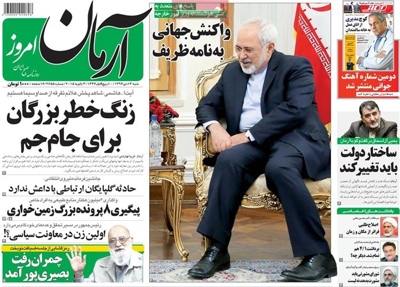
Arman-e Emrooz: As many as 100 officials who served under President Ahmadinejad will be summoned to court.

Arman-e Emrooz: “President Rouhani faces a crisis every four days. Mid-level managers of the government still act in line with the policies set by Ahmadinejad. Principlists have benefited the most from the moderation President Rouhani practices,” said Ahmad Khorram, a former minister of roads and transportation, in an exclusive interview with the daily.


Armane emruz newspaper 12 - 14


Asr-e Iranian: “Termination of all sanctions should be part of any comprehensive nuclear deal,” said Iran’s envoy to the International Atomic Energy Agency.


Asre iranian newspaper 12 - 14


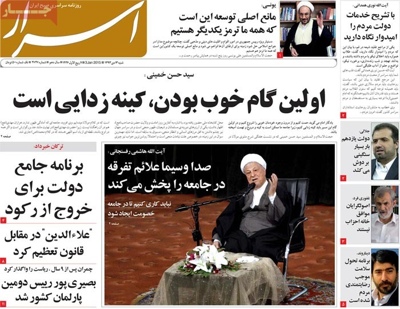
Asrar: Iranian actress Merila Zarei has won the Best Actress Award at the Asia Pacific Screen Awards (APSA) festival in Australia.

Asrar: “People should not be stripped of their legitimate freedoms under the pretext of religiosity,” said Seyyed Hassan Khomeini, the grandson of the architect of the Islamic Republic.


Asrar newspaper 12 - 14


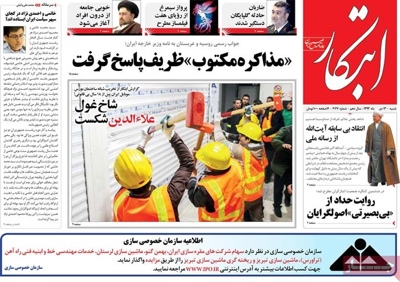
Ebtekar: Esfandiar Rahim Mashaei, President Ahmadinejad’s chief of staff, has eventually broken his silence. “I have quit politics once and for all.”


Ebtekar newspaper 12 - 14


Eghtesad-e Pooya: Saffron exports have registered a 36 percent hike.

Eghtesad-e Pooya: Under next year’s budget bill some $5 billion dollars will be injected to the banking system.


Eghtesade puya newspaper 12 - 14


Etemad: “As many as 100 people are suspects in a string of acid attacks in Isfahan earlier this year,” said the deputy interior minister for security and police affairs.

Etemad: The grandson of Imam Khomeini has warned of a propaganda blitz by a group of upstarts against revolutionary figures.


Etemad newspaper 12 - 14


Ettela’at: Some 2 million Iranian pilgrims took part in Arba’een [a Shiite religious observance that comes 40 days after Ashura, which marks the martyrdom of the grandson of Prophet Muhammad] ceremonies in Iraq.


Ettelaat newspaper 12 - 14


Hambastegi: “Iranian pilgrims who are in Iraq have 10 days to return home,” said the Iranian deputy interior minister.

Hambastegi: “A cultural justice plan is to be implemented,” said Ali Jannati, the minister of culture and Islamic guidance.


Hambastegi newspaper 12 - 14


Hemayat: “A new round of nuclear talks between Iran and P5+1 will open in Geneva on Wednesday [December 17],” said Iranian Deputy Foreign Minister Seyyed Abbas Araghchi.

Hemayat: The presence of as many as 20 million Shiites in Karbala to take part in Arba’een ceremonies took IS terrorists and their masters off guard.


Hemayat newspaper 12 - 14


Iran: President Rouhani had a meeting with the families of Iranian combatants who made the ultimate sacrifice [during the Iran-Iraq war in the 1980s], before attending an Arba’een function.


Iran newspaper 12 - 14


Iran Daily: [Iran’s] First petrochem[ical] shipment for Belgium.


Iran daily newspaper 12 - 14'


Javan: With oil companies downsizing, Saudi Arabia’s [cheap] oil has taken a toll on stock exchanges around the world.


Javan newspaper 12 - 14'


Jomhouri Islami: The IS terrorists have executed 200 from among their own ranks [apparently for fleeing the theater following a Syrian army assault].


Jomhorie eslami newspaper 12 - 14'


Kaenat: The FBI has alleged that Iranian hackers are bent on mounting cyber-attacks against American businesses.


Kaenat newspaper 12 - 14


Kayhan: A special train service has been launched to take Iranian pilgrims who were in Iraq back to Tehran.


Kayhan newspaper 12 - 14


Khorasan: The freefall of the black gold continues. Crude prices fall below $60 a barrel.


Khorasan newspaper 12 - 14'


Payam-e Zaman: “[Iran’s Caspian island of] Ashuradeh won’t be handed over [to become a tourist center],” said Director of the Environment Protection Organization Masoumeh Ebtekar.


Payame zaman newspaper 12 - 14


Qods: A mourning function was held in Tehran with the Supreme Leader in attendance to mark Arba’een.


Ghods newspaper 12 - 14'


Roozan: Four Iranians have walked away with awards from the Asia Pacific Screen Awards (APSA) festival in Australia.


Ruzan newspaper 12 - 14


Sharq: “It may take two years to purge Iraq of IS terrorists,” said Iraqi Foreign Minister Ibrahim al-Jaafari in an exclusive interview with the daily.


Shargh newspaper 12 - 14


SMT: The Iranian government spokesman has said 246 major projects will be inaugurated in March 2015.

SMT: Saipa [a giant Iranian carmaker] is to launch cooperation with German firms on production of environment-friendly automobiles.


Samt newspaper 12 - 14


Israel must pay Iran for pipeline project loss: Arbitration panel

Iran-Israel-pipline

A Swiss arbitration panel has ruled that Israel should pay Iran for the loss of its stake in the Eilat-Ashkelon pipeline.

The pipeline project was a joint venture by the former Iranian regime and Israel in 1968, but it crashed after the 1979 Islamic Revolution of Iran.

According to the panel’s preliminary ruling, Israel should pay Iran the value of a 50% stake in compensation for the loss.

The damages are estimated at between $50 million and $100 million, but the verdict is not still finalized.

The ruling was issued after some 20 years of legal battles but was made public on Wednesday after almost a year.

The process of arbitration dates backs to 1994 when the National Iranian Oil Company (NIOC) appointed an arbitrator according to the 1968 contractual agreement between the then NIOC and Israel.

The Swiss arbitrator in its ruling in mid-2013 made a decision in favor of Iran and asked Israel to pay up to $100 million in compensation for the loss of the Iranian stake.

The pipeline was designed to transport Iranian oil to Israel’s Red Sea port of Eilat and ship it to terminals in the Mediterranean coastal city of Ashkelon, and from there to Europe.

On the eve of the 1979 revolution, the 242-kilometer pipeline contained about 800,000 tons of unrefined Iranian petroleum. That was reportedly worth $120 million at the time and about $400 million today.

Israel initially refused to take part in the proceedings and tried several times to stop them in European courts. A Swiss court turned down one of its petitions in 2012. Last year an appeal to the Swiss Federal Court was also rejected, and Israel was forced to pay $250,000 in court costs, The Associated Press reported.

Deviant and reactionary currents are too dangerous

Mohammad Khatami

Aftab-e Yazd, a reformist daily, on December 14 reported the remarks of former President Mohammad Khatami and the founder of BARAN [Foundation for Freedom, Growth and Development of Iran] on the need for the portrayal of a kind, constructive and pioneering face of the Islamic Republic. What appears below is a partial translation of what the reformist president had to say in a meeting with the family of martyr Mostafa Mousavizadeh:

Efforts should be made to show a neat, kind, constructive and pioneering face of the Islamic Republic to the whole world. This is what the late Imam Khomeini, martyrs and people have called for.

We are now at a critical juncture. There are groups in the region which commit unspeakable crimes in the name of Islam. They are perverse, devious and reactionary currents which walk down the path already taken by big powers.

Over-reactionary and suspicious currents have tightened the screws [on people in the region] and this is dangerous.

Iran’s revolution introduced an Islam which sought honor, glory, progress and welfare for people, one which tried to help serve justice. We need to respect such an Islamic mindset and its achievements.

Arba’een in the holy city of Karbala in photos

Karbala-Arbaeen

The Iraqi city of Karbala on December 13, which marked Arba’een, the 40th day after Ashura, the anniversary of the martyrdom of Imam Hussein, played host to the largest annual Shiite gathering. The following is a photo gallery of the religious ceremony that the Islamic Republic News Agency (IRNA) posted on its website:


The uprising of Karbala won’t be forgotten; Islam is a religion of compassion

Mohammadi Golpaygani

The Chief of Staff of the Supreme Leader has said the fact that as many as 20 million people, 4.5 million of them from overseas, are in the Iraqi holy cities of Najaf and Karbala to take part in Arba’een ceremonies and honor the memory of Prophet Muhammad’s grandson shows that the Messenger of God and his infallible household have been very successful in capturing the hearts and minds of the faithful.

According to Tasnim News Agency Hojatoleslam Mohammad Mohammadi Golpayegani made the comment at a function at Shahcheragh Shrine in the southern Iranian city of Shiraz. The following is the translation of what else the leader’s chief of staff told the service Friday evening:

Many pilgrims have walked long distances on their way to the Iraqi holy cities. […] The uprising Imam Hussein launched in Karbala [centuries ago] won’t drift into oblivion. On the contrary, its glory and loftiness are bound to increase by the year.

[…]

Today IS terrorists and their American and Israeli masters pose the gravest threat to the Muslim faith. Islam is a religion of compassion and love, but the stooges of Global Arrogance, including IS and other Takfiri groups around the world, are portraying it as a violent religion.

[…]

Iran test-flies nine new drones during war games

Drones

Iranian military forces’ aerospace technicians flew nine new types of drones during Toward Beit ul-Muqaddas (occupied Jerusalem) War Games in Dashtestan desert of Bushehr province on Friday.

Basiji Pilot General Mohammad Ja’farabadi told IRNA on the sidelines of the war games that film-taking from the operation field of the war games, land control of the drones, and real-time dispatching of images to the control center were among drone capabilities tested on Friday.

“Among the nine drones flown on Friday there was a hexacopter capable of taking images and real-time transferring of them as well as an electronic glider with innovative capabilities.

[…]

UN must play real role in Syria crisis: Iran diplomat

Hossein-Amir-Abdollahian

A senior Iranian diplomat has stressed the importance of adopting a realistic approach to the developments in Syria, saying the United Nations should play a real role in settling the conflict in the war-torn country.

“The Islamic Republic of Iran wants to see the United Nations [playing its] real role between the sides for and against [the Syrian government],” Iran’s Deputy Foreign Minister for Arab and African Affairs Hossein Amir-Abdollahian said in a meeting with Deputy UN Special Envoy to Syria Ramzy Ezzeldin Ramzy in Tehran on Friday.

The Iranian diplomat hailed efforts made by UN Special Envoy to Syria Staffan de Mistura to settle the conflict in the country and expressed Iran’s willingness to help advance a UN proposal for the suspension of fighting in the northern city of Aleppo.

Amir-Abdollahian also slammed the United States and its regional allies for their attempts to train and arm the Takfiri groups operating against the Damascus government, saying such a move violates the UN plan to establish a ceasefire in Aleppo.

On October 30, the UN envoy proposed an action plan for areas where Syrian forces are fighting Takfiri terrorists, and said the proposal includes “freeze zones” in Syria to allow deliveries of humanitarian aid, starting with the country’s largest city, Aleppo.

Syrian President Bashar al-Assad on November 10, expressed his readiness to study the UN initiative, saying Aleppo, which has been divided into militant and government-held territories since July 2012, has been cited as a potential opening stage.
Ezzeldin Ramzy, for his part, called for Iran’s support for the UN-proposed plan in Aleppo and expressed hope that it would be implemented in the near future.

He said the proposal, should it succeed, could serve as a model for the implementation of similar plans in other parts of Syria.

The diplomat also pointed to a four-point plan devised by the Islamic Republic earlier this year to help settle the Syria crisis, calling for the implementation of the proposal’s first article, which calls for the establishment of a truce in Aleppo.

Iran’s proposed peace plan stresses a political resolution to the Syrian crisis, the territorial integrity and independence of the Arab country as well as its people’s right to self-determination.

Syria has been grappling with a deadly crisis since March 2011. The violence fueled by Takfiri groups has so far claimed the lives of over 200,000 people, according to reports.

Australia liable for Iranian asylum-seeker’s death

Iran-Australia-Khazaei

A newly-leaked document shows that the Australian government is liable for the death of a young Iranian asylum-seeker by delaying his transfer from an offshore detention camp to hospital, Press TV reports.

The document, which was revealed on Friday, showed that the 24-year-old Iranian did not receive proper medical attention because the Australian government had delayed issuing a visa for his evacuation.

Hamid Khazaei was suffering from septicemia caused by an infection spreading as a result of a cut in the foot and had sought medical attention for days. However, he was denied treatment despite his repeated pleas in the Australian detention center on Papua New Guinea’s Manus Island.

The 24-year-old Iranian national was medevaced for emergency treatment from the detention camp on Manus Island to intensive care at Mater Hospital in Brisbane on August 27. He was later declared brain dead at the hospital.

The new report revealed that the Australian government officials had ignored the urgent request of medical staff even though they were told that Khazaei’s condition was life threatening.

In February, Reza Barati, 23, was bashed to death as a result of a “brutal beating” by an Australian guard on the same island. He sustained fatal head injuries after hundreds of asylum-seekers tried to break out of a camp on Manus Island.

Refugee groups say the Australian government is responsible for the death of Khazaei and Barati and have called for the resignation of the Immigration Minister Scott Morrison. However, with Morrison’s newly acquired powers and Australia further distancing itself from the UN Refugee Convention, that seems to be an unlikely outcome.

The developments come as Australia’s lower house of parliament on December 5 narrowly approved amendments to the country’s controversial immigration laws by introducing temporary visas for refugees, which do not grant settlement in Australia.

Iran criticizes IAEA unofficial rejection of offer over Marivan site

Iran-IAEA

Iranian Ambassador to the IAEA Reza Najafi said Thursday night that the Agency has acted unprofessionally by apparently rejecting Iran’s proposal through an e-mail to the Reuters news agency.

“The Agency (IAEA) cannot evade its responsibility just by sending an e-mail to a news agency,” he added.

The IAEA claimed on Thursday that Iran’s offer does not help address the agency’s concerns pertaining to the issue of alleged high-explosive experiments at the Marivan site.

“The Agency explained clearly to Iran – on more than one occasion – that an offer of a visit of Marivan does not help address specific concerns related to the issue of large-scale high-explosive experiments,” said the IAEA’s public information director, Serge Gas, in an email.

Najafi said that the UN nuclear body’s unofficial refusal to send its inspectors to the site proved that the IAEA’s November 2011 claims about large-scale high-explosive experiments at the Marivan site were baseless.

The only solution now is that the Agency declares impartially and professionally that information provided by certain IAEA member states about high-explosive experiments at the Marivan site has been fabricated and, thus, the IAEA cannot act to verify the claims, he added.