Monday, December 29, 2025
Home Blog Page 4997

Imam Hussein lovers en route to Karbala ahead of Arba’een

Arbaeen-Imam Hossein

Saturday December 13 is Arba’een, a religious ceremony that comes forty days after Ashura, which marks the martyrdom of Imam Hussein, the grandson of the Prophet Muhammad (PBUH). Shiite Muslims all over the world hold services to mourn the loss of the third Imam, with some heading to the holy shrine of the martyred Imam.

This year Iranians have set out, in droves, on a journey to the holy Iraqi city ahead of Arba’een, but the massive influx of pilgrims has promoted officials to shut down Shalamcheh and Mehran border crossings on the Iran-Iraq border, asking them to make a return.

The following are photos Tasnim News Agency and the Iranian Students News Agency (ISNA) have posted online of the true lovers who are heading to Karbala, Iraq prior to the occasion. Take a look:


Iran Architecture in Photos: Ancient Forg Castle

Forg Castle in Iran

Forg Castle is located in Forg Village, one of the districts of Darmian town, 90 km east to Birjand City and 10 km to Asadieh City in eastern province of Southern Khorasan.

Materials used in the building include stone, brick, clay, gypsum, lime and mortar (Sarouj).

The ancient castle dates back to the Afshar era. It was built by Mirza Baqa Khan during the Nader Shah era.The interior part of the castle includes the residence of servants, animal shelter and ammunition depot.

The following is a photo gallery of Forg Castle posted online by the Mehr News Agency. Take a look:

Intelligence Minister: We do not pry into people’s private lives

Iran's Intelligence Minister Seyyed Mahmoud Alavi

Aftab-e Yazd newspaper on December 10 reported the remarks of Intelligence Minister Seyyed Mahmoud Alavi in Bojnurd, North Khorasan province on his ministry’s responsibility of injecting a sense of security into society and its refusal to dig into people’s past and present. The following is the translation of what he said:

Thanks to unity among officials, people have grown more hopeful about the future and the noose has been tightened around the neck of adventurists and rouge elements.

When a sense of hilarity, happiness and security prevails in society, hope and dynamism will be created and the wheels of economy, industry and science start to spin.

A society with a boom economy will render enemy-imposed sanctions toothless, no matter how tough they are. Such a society will march toward scientific and economic stability.

People are the pillar of security in society and the Intelligence Ministry is seeking to ensure security and instill a sense of security in society in cooperation with members of the public. The country’s intelligence is based on religious concepts, and nothing comes out of the ministry but efforts to serve [people].

Today the stage has been set for the country to grow and develop due mainly to the unity and security which exist in the country. People from all walks of life can freely speak their mind, and political parties and groups are pursuing their goals through healthy rivalry facing no problem whatsoever.

Political parties and groups face no ban on their activities as long as they continue to act within the law and with no security issues in their gatherings. Political parties need to define what they do within the framework of healthy political rivalry; in case such rivalry grows [between them], political bickering and disputes find no room to thrive.

The Intelligence Ministry and the Unknown Soldiers of Imam Zaman [a term widely used to refer to intelligence agents] support no political groups and undertake their responsibility according to what law prescribes.

The plurality of parties and groups is a must to have hilarity and dynamism in society. We believe that all authorized political parties and groups are like children of a family where the multiplicity of taste does not translate into conflict.

A sense of security is also felt by students and professors in universities and seminary schools. They can stake out their views and positions [on different issues] facing no problem thanks to prevailing security [in society].

The government is not trying to marginalize political currents. The Intelligence Ministry and the Unknown Soldiers of Imam Zaman will not seek to promote or eliminate any political current. As far as the Government of Prudence and Hope is concerned, the ground will be prepared for those who contribute to the country’s march toward development.

All political parties and groups should concentrate their efforts on increasing synergy in the country since we are serving in the Islamic Republic under the auspices of the Vali-e Faqih [Guardian Jurist], and as the president put it, under one single flag raised by the Supreme Leader. The Islamic Republic has many things to offer to logically respond to its political opponents; In order to do so, there is no need for unfriendly terms or harsh treatment.

The intelligence forces have mobilized their potential not to bring disgrace on people; accordingly they take extra care when responding to inquiries [by government bodies] about individuals’ past performance. In reviewing such inquiries, when intelligence agents come to the conclusion that some ambiguities surround a person’s case, they invite him/her, put some questions to him/her and carry out field investigation to remove the ambiguities so that the rights of people are not trampled upon.

The country’s intelligence, judicial and police forces attach great significance to respecting people’s rights. The Intelligence Ministry which deals with people more than other bodies has to place respect for people’s rights on its agenda.

The Intelligence Ministry does not pry into people’s private lives because it is prohibited under the Sharia law. We should not create stress and fear for people. We have not been given a mission to read people’s minds [and learn about their intentions]. Since what we do has to do with people’s rights, we should take extra care in our behavior in order not to breach the rights of anybody.

Police in Sistan and Baluchestan to be indigenized: Commander

General Hossein Rahimi

The Commander of Sistan and Baluchestan Police Force said the provincial law enforcement force seeks to delegate more of the responsibility to ensure security in the southeastern border province to local residents. The following is the translation of part of Brigadier General Hossein Rahimi’s comments as reported by Arman-e Emrooz daily on December 10:

The provincial police chief said at present locals account for some 30 percent of the provincial law enforcement force, adding recruitment of Baluchi, Sunni locals is already underway.

Brigadier General Rahimi further said efforts are underway to admit between 400 and 600 local officers to provincial police academies by yearend [March 21, 2015].

We need to attract foreign investment: Iranian deputy trade min.

Mehdi Karbasian
Mehdi Karbasian

On December 10, SMT, a daily, ran a brief report about the comments of Deputy Trade Minister and Chairman of the Iranian Mines and Mining Industries Development and Renovation Organization (IMIDRO) Mehdi Karbasian about the necessity of the inflow of foreign investment. He also offered some explanations about the terms of a June MoU between Iran and Kuwait. What appears below is a partial translation of what he had to say:

“Domestic sources for investment are not enough if Iran is going to fulfill the objectives of the 20-year Economic Outlook Plan [which is due 2025] and consolidate its position as the leading economic power in the region. Iran is in strong need of foreign investment along with improved productivity,” said the deputy minister.

“Under a Memorandum of Understanding signed in June, 2014 between Iran’s IMIDRO and Kuwait Steel Company, the two sides agreed to jointly build a steel mill in the Persian Gulf Special Mineral Industry Zone (Bandar Abbas),” the chairman of IMIDRO added.

“The expanse of land where the steel plant will be constructed has been chosen and is under preparation for the joint project. In late November a delegation representing Kuwait Steel Company and a number of investors travelled to Bandar Abbas [in the southern Iranian province of Hormozgan]. That was followed by a decision as to where the steel plant was to be built. The Persian Gulf Special Mineral Industry Zone is now getting the lot prepared,” he further said.

Elaborating on the details of the joint construction project Karbasian said, “Under the MoU, a direct reduced iron (DRI) facility with the capacity of 1.6 million tons will be constructed in the first phase of the joint project. The second stage includes the construction of a steel mill with the capacity of 1 million tons. In the third phase, a rolling mill with a capacity of one million tons will be set up and a pelletizing plant with the capacity of five million tons will mark the final stage of the joint venture.”

Kazakhstan says ready to host Iran-P5+1 nuclear talks

Kazakhstan

Kazakhstan is ready to host the next round of talks between Iran and six world powers over Tehran’s peaceful nuclear problem, said a joint statement issued after US-Kazakh talks on partnership.

Talks were held on Wednesday led by US Secretary of State John Kerry and Kazakh Foreign Minister Yerlan Idrisov, ITAR-TASS reported.

“Kazakhstan said the country was ready to host P5+1-Iran talks,” the document noted. Kazakhstan urges these negotiators to keep working “in constructive way to attain a comprehensive accord in 2015,” the statement said.

Iran and 5+1 (Russia, China, the US, Britain, France and Germany) wrapped up seven days of intensive nuclear talks in Vienna on November 24 without securing a long-awaited comprehensive deal.

They decided to extend talks on Tehran’s peaceful nuclear program for seven more months.

The latest round of negotiations was held ahead of the November 24 deadline.

On November 24, 2013, Iran and P5+1 signed an interim nuclear deal in the Swiss city of Geneva.

The Geneva deal (the Joint Plan of Action) came into effect in January and expired in July, when the parties decided to extend negotiations until November 24 in the hope of clinching a final deal that would end a decade of impasse over Tehran’s peaceful nuclear energy program.

Zanganeh denies Iran, Russia ‘oil bartering’

Bijan-Zanganeh

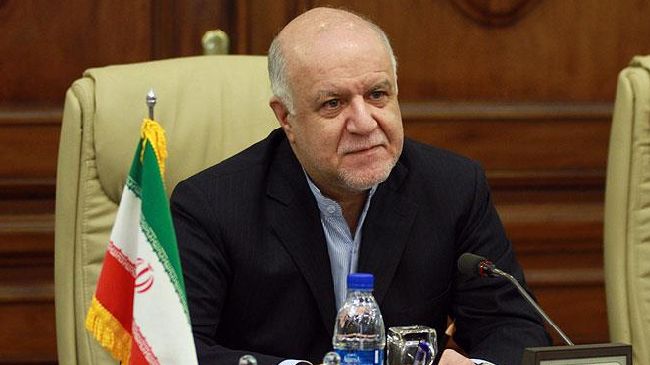
Iran’s oil minister rejected remarks by Russian officials that Iran has signed agreement with the country to barter oil for essential goods.

Bijan Namdar Zanganeh told Mehr News Agency on Wednesday that Iran and Russia cooperated merely on oil and gas industries.

The Russian minister of economic development had already told the media that Iran and Russia would start bartering oil for essential goods. Zanganeh roundly rejected the claim, adding that no such agreement had been signed between Iran and Russia.

“According to agreements on oil and gas, Iran will use Russian technology and expertise in its oil and gas development projects,” he said.

Last September, on the sidelines of Iran-Russia joint economic conference, Russian Federation Minister of Energy Alexander Novak said that no such agreements [oil barter for essential goods] had been signed by both sides; no article of oil and essential goods barter had been asserted in joint economic memorandum of understanding either.

Meanwhile Azerbaijan Republic’s ambassador to Moscow told reporters last September that the Republic would welcome oil swap agreements with two northern and southern neighbors.

Moscow Times wrote in a report last week that Russia would embark on oil barter for essential goods with Iran according to an oil-for-goods program.

[Minister of Economic Development of the Russian Federation] Alexey Valentinovich Ulyukaev told the Russian media last Thursday that he would not reject the possibility that the agreement articles would actually be implemented by the end of the year.

US Secretary of State Spokesperson Jen Psaki emphasized that Washington was ‘aware’ of Iran-Russia talks and it might trigger a US reaction if bartering violated so-called international sanction regime against Iran.

The inverse swap of oil with Russia by Iran due to similar properties of oil produced by Iran and Russia had elicited mixed comments by Iranian, Russian and US officials in recent 2 years.

Mehdi Senaei, Iran’s ambassador to Moscow told Russian Kommersant Daily that Russia could built a second nuclear reactor in Bushehr as paying for oil received from Iran, thus implicitly confirming the inverse swap of oil.

Senaei also pointed to ‘other goods of transportation sector’ as payment for oil or ‘building small refineries.’

Iran diplomat: Persian Gulf states laud Iran’s role against the ISIL

Amir-Abdollahian

The Persian Gulf states praise Iran’s positive role in countering the ISIL terrorists in the Middle East despite foreign efforts to create rift between Tehran and the regional Arabs, a top Iranian diplomat says.

In a Wednesday interview, Iran’s Deputy Foreign Minister for Arab and African Affairs Hossein Amir-Abdollahian pointed to Iran’s support for Iraq and Syria in their campaign against ISIL and dismissed media allegations about Tehran’s interference in the countries.

“All the regional countries, all Arab states and the officials of the Arab countries laud Iran’s constructive, positive and progressive role in countering terrorism and this is the reality that exists between us and the regional countries,” he said.

The Iranian official added that mutual ties between the Islamic Republic and the Persian Gulf littoral states are based on friendship, cooperation and peaceful coexistence.

“However, some foreign parties may seek to create rift between us and the Persian Gulf littoral states by fueling debates such as Iranophobia,” he added.

Iran has repeatedly stressed that it will not interfere militarily in Iraq and Syria, but the Islamic Republic continues to provide support to both countries against ISIL in the form of defense consultancy and humanitarian aid.

At the onset of ISIL advances in Iraq, the Islamic Republic took rapid steps to mobilize popular forces in the country.

Tehran has also refused to join the so-called US coalition against ISIL in Iraq and Syria.

The US-led coalition began targeting positions held by the ISIL terrorists in Iraq in August. The coalition has been also conducting airstrikes against ISIL positions inside Syria, without any authorization from Damascus or a UN mandate.

Analysts believe that the US-led airstrikes have failed to play an effective role in the fight against ISIL and in some cases helped maintain the influence of the militant group.

Iran’s FM: Middle East violence is controllable

WAVE-1

Concentration of violent acts in the Middle East region is not an accidental phenomenon, Iran’s foreign minister said, but at the same time noted that the menace could be curbed.

“No other region like the Middle East has been the target of violence over the past several decades. However, concentration of violence is not an inherent phenomenon, but is an imposed one and could be controlled, managed and eradicated,” Mohammad Javad Zarif said on Wednesday.

He made the comments in a speech at the end of a two-day international conference on ‘World against Violence and Extremism’ (WAVE) held in Tehran.

Zarif explained that violence and extremism in the contemporary world are the results of “wrong policies and attitudes” adopted by certain countries.

“This is a duty of the whole members of the international community in general, and the regional countries in particular, to counter extremism and violence by recognizing them as the main threats to peace,” he added.

The Iranian diplomat underlined that Israel’s policies over the past seven decades have fanned the flames of violence in the Middle East, noting that the “strong and sustained influence of the trans-regional factors” are clearly obvious in the Israeli acts.

Iran attracted attention last year as one of the first countries that anticipated a growing trend in extremist moves in the world.

On December 18, 2013, the United Nations General Assembly overwhelmingly voted to approve Iranian President Hassan Rouhani’s WAVE proposal.

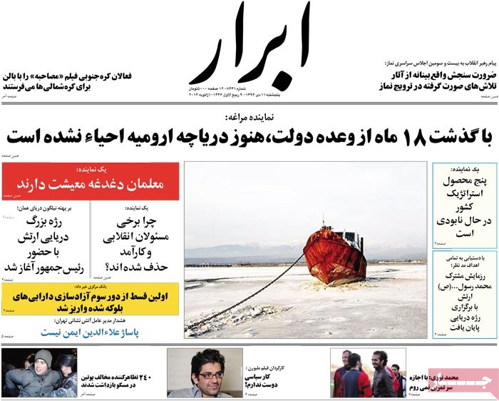
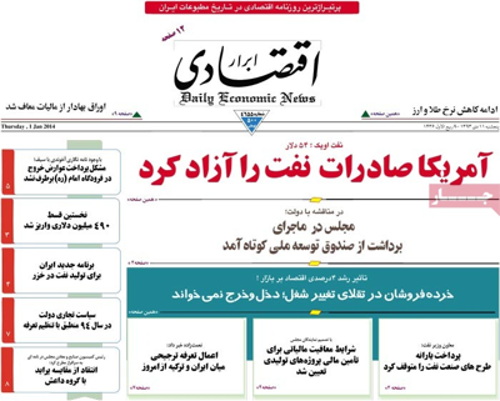
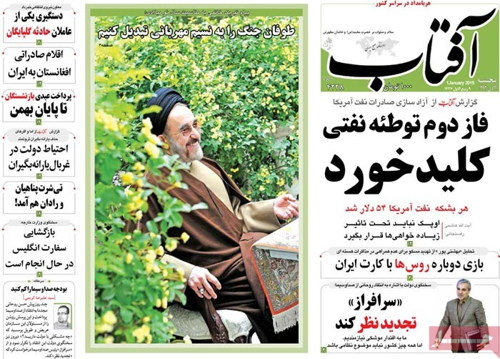
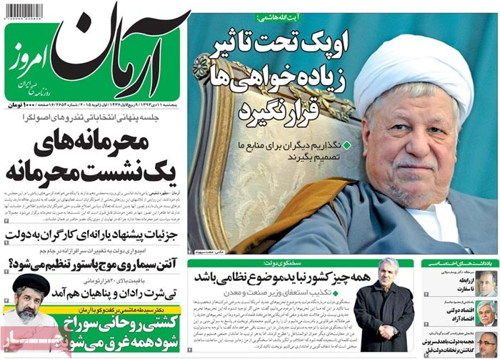
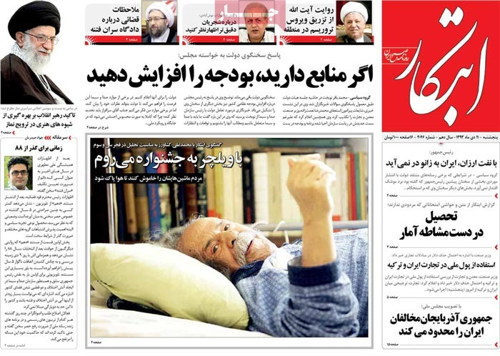
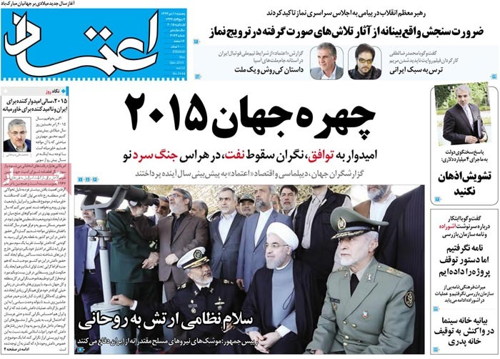
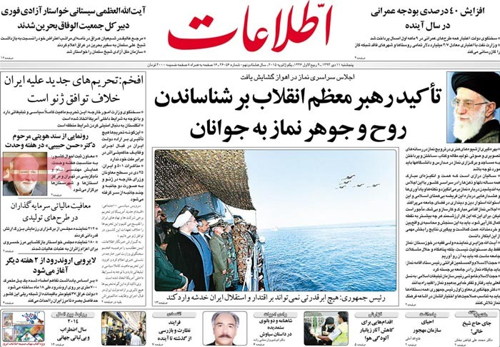
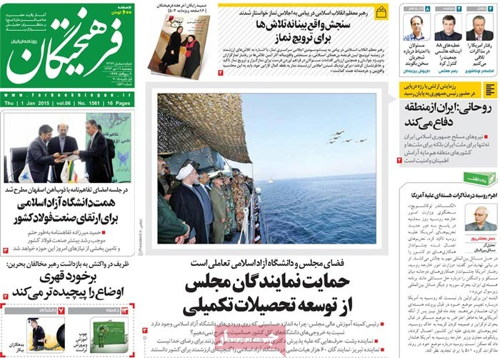
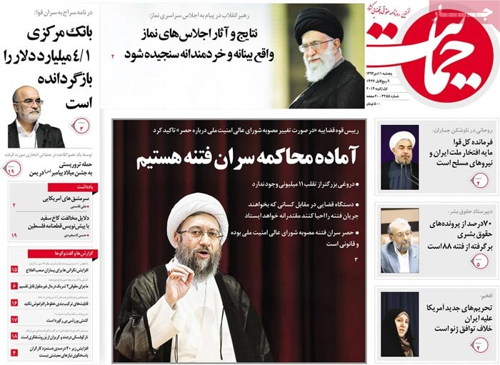
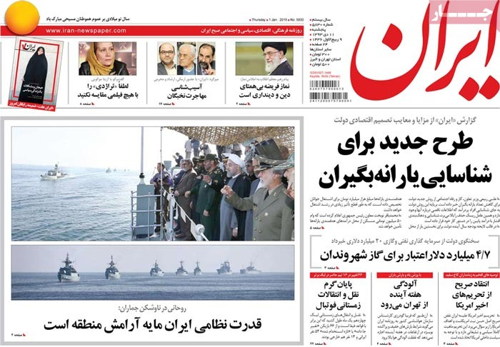
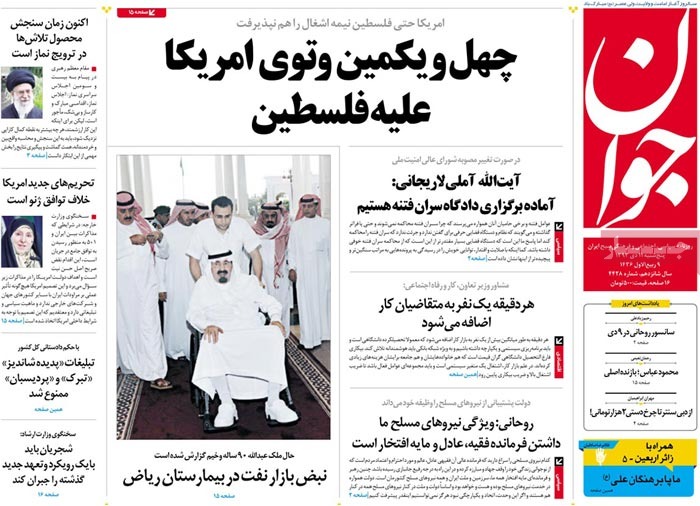
A look at Iranian newspaper front pages on Dec. 11

Iranian Newspapers Headlines

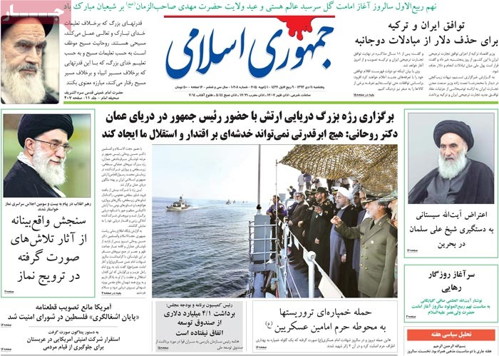
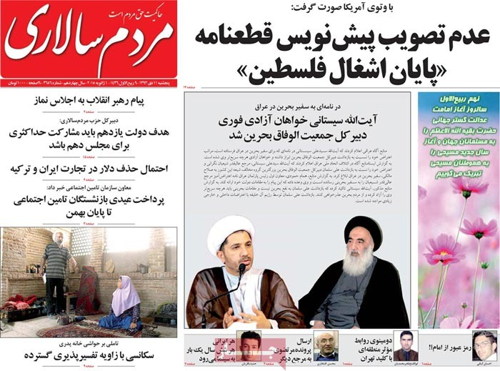
Images of pilgrims on their way to Karbala, Iraq to take part in Arba’een [a Shiite religious observance that comes 40 days after Ashura, which marks the martyrdom of the grandson of Prophet Muhammad] ceremonies dominated the front pages of Iranian newspapers on Thursday.

Abrar: The foreign ministers of Iran, Tajikistan and Afghanistan will soon hold a trilateral meeting.


Abrar


Afarinesh: “The [recent] drop in oil prices is part of a political plot hatched by some countries,” President Rouhani said.


Afarinesh


Aftab-e Yazd: “Women deserve to climb the social ladder higher than simply become a Cabinet minister,” said Naimeh Eshraghi, a granddaughter of the late Imam Khomeini, the founder of the Islamic Republic.


Aftabe Yazd


Arman-e Emrooz: “Unlike the budget bills of the previous government, the spending package President Rouhani’s government has sent to parliament for approval is realistic,” said Vice-President for Parliamentary Affairs Majid Ansari.


Armane Emrooz


Asrar: “Cutting diplomatic ties with Egypt is not in our best interest,” said Ayatollah Lotfollah Safi Golpaygani, a prominent cleric and Shiite source of emulation.


Asrar


Ebtekar: “Please, don’t worry too much; others around you are in possession of their senses, too,” said Parliament Speaker Ali Larijani to the so-called Worriers [staunch supporters of former President Ahmadinejad who proclaim to be worried about the state of affairs under moderate President Rouhani.]

Ebtekar: “Twelve people have been arrested in connection with a recent $4 billion corruption,” said the head of Kerman [provincial] Justice Department.


Ebtekar


Eghtesad-e Pooya: “Iran’s capacity to produce petrochemicals will increase by 2 million tons,” said the deputy oil minister.

Eghtesad-e Pooya: “The private lives of citizens are a red line,” said the deputy minister of communications.


Eghtesad Pouya


Emtiaz: Fear of bird flu has prompted officials to slap a ban on hunting migratory birds.


Emtiaz


Etemad: “Diplomacy is a means to take on violence,” Foreign Minister Mohammad Javad Zarif said.

Etemad: Those who have failed to serve their military duty can buy exemption for between 20 and 50 million tomans [almost $6,000 to almost $16,000].


Etemad


Ettela’at: The final statement of the Conference on World against Violence and Extremism [which wrapped up in Tehran on Wednesday] stresses inter-faith dialogue as well as efforts to promote the culture of peace.

Ettela’at: The number of Iranian pilgrims in Iraq to attend Arba’een ceremonies has hit the 1.2 million mark.


EttelaAt


Hamshahri: Government owes more than $3.5 billion to the Public Transport Department of the capital’s municipality.


Hamshahri


Hemayat: “Efforts to counter corruption should not be limited to the Judiciary,” said the deputy chief of the Judiciary.

Hemayat: “Next year’s proposed spending package does not increase the military budget,” said Government Spokesman Mohammad Bagher Nobakht.


Hemayat


Iran: The Supreme Cultural Revolution Council has designated December 18 as national Day against Violence and Extremism.


Iran


Javan: The Zionist regime has killed a Palestinian minister.

Javan: The Satan is ashamed following the release [by the Senate] of a report detailing widespread physical and mental torture of detainees at the hands of CIA agents. Torture scenes in Hollywood movies pale in comparison with what the CIA has actually done to the detainees.


Javan


Jomhouri Islami: The volume of natural gas produced at South Pars Gas Field will have increased by 140 million cubic meters by the end of the year [March 21, 2015].


Jomhouri Eslami daily


Kayhan: Details of a [Senate] report on the torture of detainees by CIA agents has taken the world aback.


Kayhan


Mardomsalari: “Iran’s national railway will soon be linked to that of neighboring Iraq,” said the government spokesman.

Mardomsalari: A historic inscription believed to be 700 years old has been found in Shiraz.


Mardom Salari Daily


Rah-e Mardom: “Some 15 percent of Iranian children are overweight,” said the deputy health minister.


Rahe Mardom


Resalat: “Gasoline prices won’t rise next year,” said Government Spokesman Mohammad Bagher Nobakht.


Resalat


Roozan: Many Iranian pilgrims [on their way to Iraqi holy cities of Karbala and Najaf] had to return home after Mehran Border Crossing was closed because of overcrowding.

Roozan: “Reports that the budget allocated to the Presidential Office has increased in next year’s proposed spending package are false,” the government spokesman said.


Rouzan


Sayeh: The World Health Organization has said that Iran has been successful in containing and eliminating malaria.

Sayeh: As many as 10,000 motorcycles need to be replaced with electric motorbikes in the capital each year,” said a member of the Transport Committee of Tehran City Council.

Sayeh: Famous actor Akbar Abdi has been hospitalized for high blood pressure.


Sayeh


Shahrvand: Tehran Meteorological Office has issued a high wind warning for the capital.

Shahrvand: A man in the capital has killed his wife and daughter before turning the gun on himself.


Shahrvand


Vatan-e Emrooz: After admissions by the first vice-president and foreign minister that the Saudis are part of an oil plot [to keep crude prices down], a reassessment of the miscalculations of the ministries of oil and foreign affairs seems to be in order.


Vatane Emrooz