Wednesday, December 31, 2025
Home Blog Page 4970

Equal opportunities for people is social justice: Rouhani

Rouhani-Healthcare

President Hassan Rouhani said creating equal opportunities for people is part of administering social justice, adding that public insurance is not all justice but certainly part of it.

The president was speaking in a ceremony to celebrate a new welfare plan launched by his government called ‘Public Health Insurance’. The plan aims to provide all Iranians with health insurance.
He said unemployment and ill-health are two major social problems, but the latter is even worse because ‘when you are unemployed but healthy, you can stand on your own feet, of course with some help from the government and others, but when you are ill, you have to endure unbearable sufferings’.
President Rouhani said when he took office last year around 9 million Iranians did not have health insurance cards of whom 8 million have received their cards so far.

He emphasized that all Iranians should be covered by health insurance.

The president said by implementing the ‘Health Plan’ and ‘Public Insurance’ projects, his government is trying hard to increase the efficiency of health insurance cards.

At the ceremony, the president handed the 8,000,001st health insurance card toa young girl.

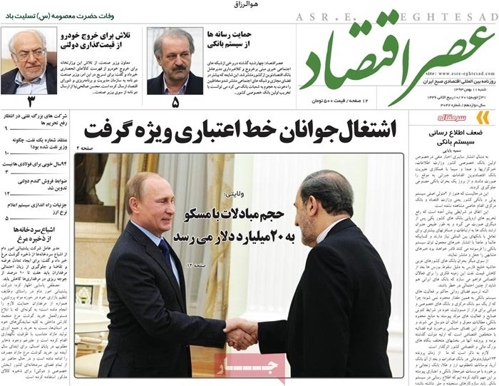
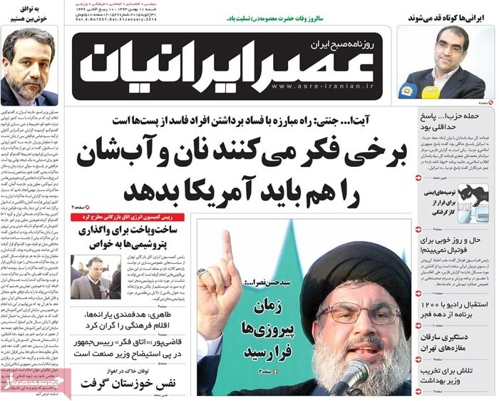
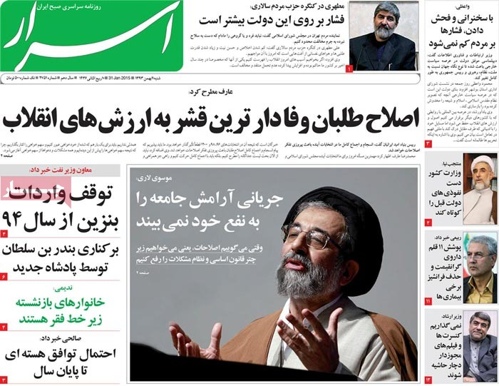
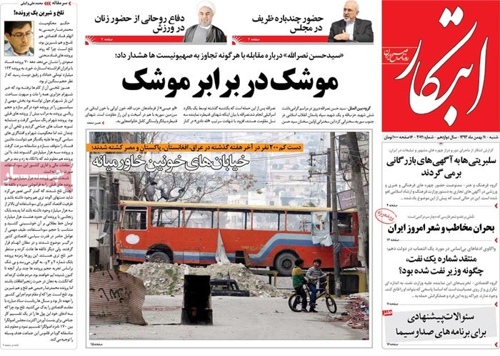
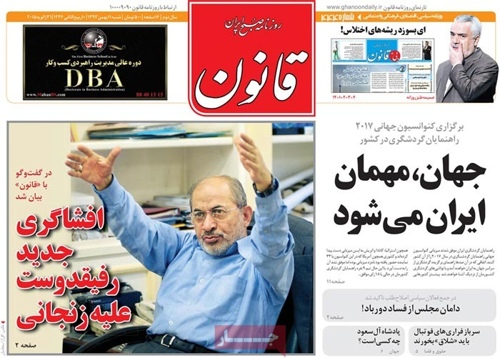
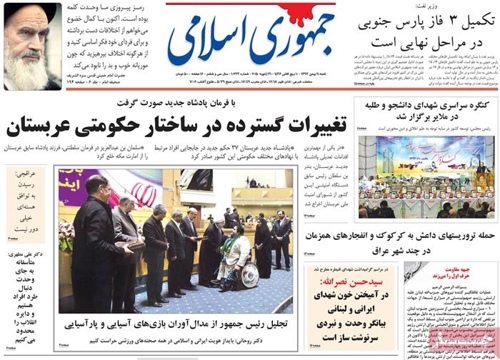
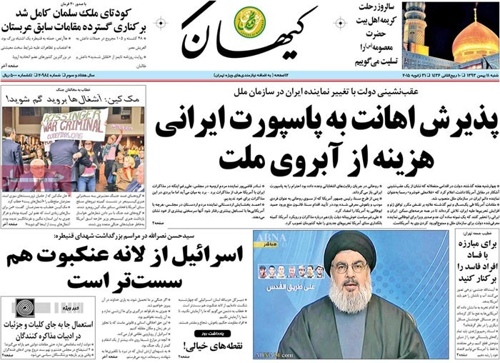
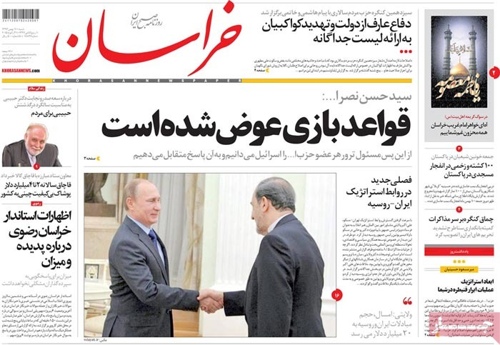
A look at Iranian newspaper front pages on Jan. 13

Iranian Newspapers Headlines

The call by the Iranian foreign minister on Russia to play a more active role in nuclear talks between Tehran and the world powers at a meeting with the Russian deputy foreign minister appeared on the front pages of many dailies on Tuesday. President Rouhani’s comments at a ceremony to celebrate the provision of health insurance cards to 8 million Iranians as part of the Healthcare Transformation Plan also were on the cover of many dailies. The interior minister’s pledge that his ministry will protect the rights of the public in elections made front-page headlines too.


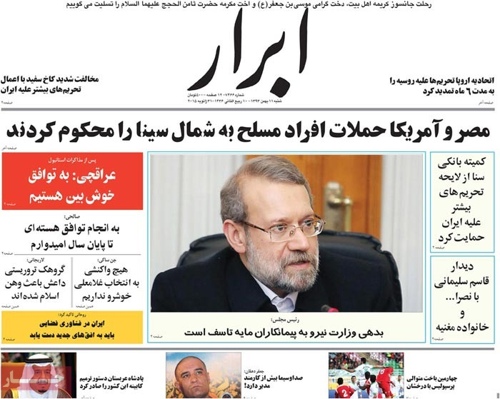
Abrar: President Rouhani is to visit Bushehr nuclear power plant.


Abrar newspaper 1- 13


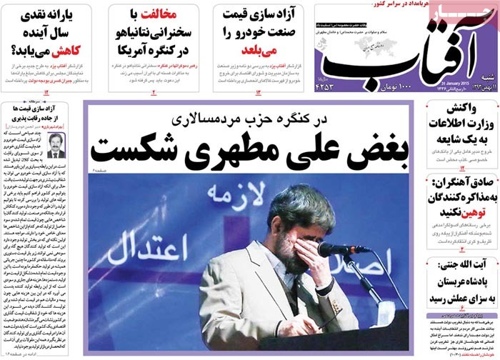
Aftab-e Yazd: Foreign Minister Mohammad Javad Zarif has called on Russia to play a more active role in nuclear talks between Iran and P5+1.

Aftab-e Yazd: Ali Akbar Nategh Nouri [a onetime principlist speaker of the Islamic Consultative Assembly] has been invited to attend a gathering of reformists.


Aftabe yazd newspaper 1- 13


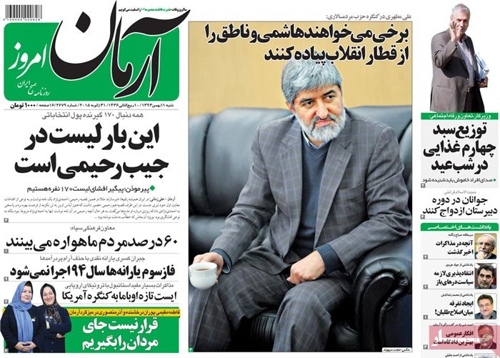
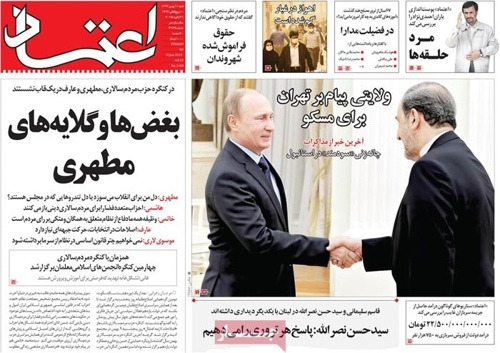
Arman-e Emrooz: Fifty MPs have filed a complaint against fellow deputy Ali Motahari for the comments he made on parliament floor on Sunday.


Armane emruz newspaper 1- 13


Asr-e Iranian: “Inflation has been curbed only on paper,” said Alinaghi Khamoushi, a former head of the Chamber of Commerce.


Asre iranian newspaper 1- 13


Asrar: “Police keep an eye on social networking sites,” said Police Chief Brigadier General Esmail Ahmadi Moghaddam.

Asrar: The Portuguese coach of the Iranian national soccer squad says his team is being victimized by political sanctions. In a post-match press conference after Iran beat Bahrain 2-0 in the AFC Asian Cup, Carlos Queiroz took a swipe at FIFA for its failure to release the money it owes Iran because of banking sanctions facing the country.


Asrar newspaper 1- 13


Ebtekar: “Rendering services to the public lends legitimacy to the governments,” President Rouhani said.


Ebtekar newspaper 1- 13


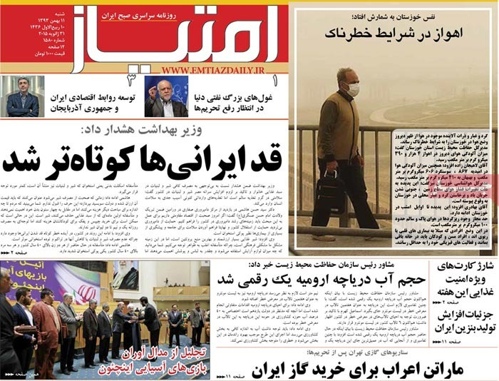
Emtiaz: Iranian police in the south have seized more than seven tons of opium hidden in a truck.

Emtiaz: “It only takes a single trip to Iran by foreign tourists to change their opinion about Iran,” said the director of the National Library of Iran.


Emtiaz newspaper 1- 13


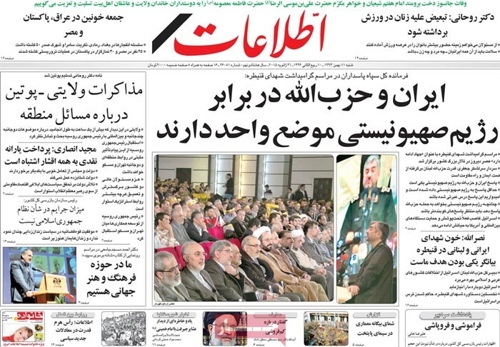
Ettela’at: “Maintaining a calm atmosphere in the country is the duty of everyone,” said the speaker of the Islamic Consultative Assembly.

Ettela’at: The Iranian judiciary says fighting organized crime on the economic front is its top priority.


Ettelaat newspaper 1- 13


Hemayat: A 115-page report on violation of human rights in the US has been unveiled at Tehran University.


Hemayat newspaper 1- 13


Iran: Iran has broken the world record in production of natural gas.

Iran: The Ministry of Culture and Islamic Guidance has said that the case of Vatan-e Emrooz daily [its publication of material harmful to Iran’s ties with neighboring countries] will be heard in a court.


Iran newspaper 1- 13


Jomhouri Islami: The Planning and Budget Committee has announced that government has not withdrawn any money from the National Development Fund.

Jomhouri Islami: “The Interior Ministry simply protects the rights of the people in elections,” said the interior minister.


Jomhorie eslami newspaper 1- 13


Kaenat: “The list of state managers who are accused of corruption will be made public,” said the chairman of parliament’s Article 90 Committee.


Kaenaat newspaper 1- 13


Kayhan: “Those who spilled blood and terrorized the people in Golpayegan [a reference to an armed robbery and its ensuing bloody high-speed chase] will be punished at the very same site they committed the criminal acts,” said the attorney general.


Kayhan newspaper 1- 13


Mardomsalari: There are three women in the newly-released Afghan Cabinet lineup.


Mardom salari newspaper 1- 13


Qods: A man has reunited with his brothers after separation for 70 years.


Ghods newspaper 1- 13


Resalat: “The population of Tehran will hit the 22 million mark by 2021,” said the mayor of the capital.


Resalat newspaper 1- 13


Shahrvand: “In the first 10 months of the year [started March 21, 2014] land grab grew 40 percent and embezzlement registered a 22 percent increase,” said the head of the police’s Criminal Investigation Department.


Shahrvand newspaper 1- 13


Iran condemns terror attack in Pakistan

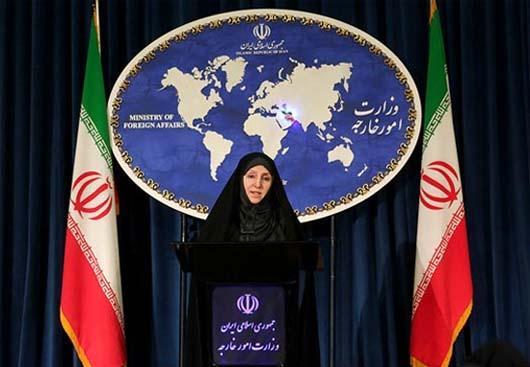
Iran - Marzieh Afkham

Iran’s Foreign Ministry strongly condemned a terrorist bomb blast that killed several Shiite Muslims in Pakistan.

“The Islamic Republic of Iran condemns acts of terrorism targeting innocent people and regards it as violation of the teachings of Islam and humanitarian values,” Foreign Ministry Spokeswoman Marzieh Afkham said on Monday.

She also expressed condolences to the families of the victims and wished aspeedy recovery of those who were injured.

Afkham said such terrorist incidents clearly play into the hands of the enemies of the Pakistani nation and the Islamic community.

“Undoubtedly, the Pakistani Muslim government and nation will vigilantly foil plots aimed at causing division and insecurity,” she added.

At least eight people were killed and several others wounded after a bomb blast ripped through a Hussainia (a congregation hall for Shia commemoration ceremonies) in Rawalpindi on Friday.

Thousands of Pakistani Shiite Muslims have been killed in targeted attacks by extremist groups in recent years.

International human rights groups, including Human Rights Watch, have slammed the Pakistani government’s failure to stop killings and other abuses against minority Hazara and other Shiite Muslims.

Iranian FM stresses peaceful solution to problems on Korean Peninsula

Zairf-North Korea

Iranian Foreign Minister Mohammad Javad Zarif expressed pleasure with North Korean Leader Kim Jong-un’s offer for peace talks with Seoul, stressing that tension in the Korean Peninsula should be soothed through peaceful means.

“We believe that the Korean Peninsula issues should be settled peacefully,” Zarif said in a meeting with North Korea’s new Ambassador to Tehran Kang Sam Hyon on Monday.

He described foreign meddling in issues related to the two Koreas as harmful, and said, “Our approach lays emphasis on talks and avoiding the use of force and military action.”

Zarif also referred to his North Korean counterpart’s visit to Tehran, and said, “Bilateral issues are on the agenda and we will follow the existing ground to expand relations.”

Sam Hyon, for his part, conveyed the greetings of the North Korean foreign minister to Zarif, and said, “North Korea is willing to develop economic relations with Iran along with the political ties.”

Earlier this month, Kim Jong-Un proposed the “highest-level” talks with South Korea, opening the way to a historic summit.

The sudden move, made during Kim’s traditional New Year message, would clear the path for the first inter-Korean leaders’ meeting since a 2007 summit in Pyongyang.

“Depending on the mood and circumstances to be created, we have no reason not to hold the highest-level talks,” Kim said in the televised speech, calling for a thaw in icy relations between the two Koreas, which remain technically at war.

Seoul welcomed the overture as “meaningful”.

Biggest ever narcotic drug consignment seized in Fars Province

Iran’s War on Drugs Serving Youth Worldwide: Official

The biggest haul of narcotic drugs was confiscated in Fars Province, Iranian law enforcement force announced on Monday.

According to a report released by police, the traffickers had hidden seven tons of opium valued at almost $4 million and over 12 kg of heroin in a cement bulker truck.

The truck was escorted by cars carrying traffickers which were all confiscated by the police in the southern province.

No power can bring united Iraq to knees: Rafsanjani

hashemi Rafsanjani

In a Monday meeting with visiting Iraqi Oil Minister Adil Abdul-Mahdi al-Muntafiki in Tehran, the chairman of Iran’s Expediency Council said the recent gains made by Iraqi troops and volunteer forces on the battlefield against the ISIL terrorists mark an important juncture in the history of the Arab state.

He emphasized the need for unity among all religious groups in Iraq, including Shias, Sunnis, and Kurds, saying Takfiri groups will have no room for terror operations in a country which has an inclusive government backed by people and religious scholars.

Ayatollah Rafsanjani called on the Iraqi nation to continue supporting the government so that they could prevent further bloodshed at the hands of ISIL extremists, adding, “No power can bring such people to their knees.”

The Iraqi oil minister, in turn, pointed to the ISIL atrocities in areas under its control and outlined the victories achieved by the Iraqi army and volunteer forces in their fight against the terror group on different fronts.

He also highlighted the religious, cultural, and historical commonalities between the neighboring Iranian and Iraqi nations, expressing Baghdad’s readiness to further promote cooperation with Tehran in various spheres.

Muntafiki said his talks with Iranian officials would focus on issues related to joint oil wells, petrochemical exports as well as oil prices, which have witnessed a severe slump in recent months.

Iran, Iraq urge closer cooperation to uproot terrorism

ZArif-Iraq

On Monday, Iranian Foreign Minister Mohammad Javad Zarif met with visiting Iraqi Oil Minister Adil Abdul-Mahdi al-Muntafiki in Tehran to discuss further enhancement of bilateral and regional ties, particularly in the political and economic spheres.

The two sides further emphasized the significance of Tehran-Baghdad cooperation in the fight against terrorism, saying it is important for all Middle Eastern states to join hands and find solutions to uproot terrorism in the violence-ravaged region.

The meeting comes as Iraq has witnessed a surge in terror operations over the past months, with the ISIL Takfiri group controlling large swathes of lands in the Arab nation.

The extremist group had seized large areas in Syria before expanding its terrorist activities to neighboring Iraq.

The Islamic Republic has been providing support to both Arab countries against ISIL in the form of defense consultancy and humanitarian aid.

Iranian religious, political pundits’ take on Islamophobia after Paris attacks

paris attacks

Last week’s bloody terrorist attacks in France which claimed 17 innocent lives stunned the world. World leaders were swift to condemn the acts of terror targeting innocent people. In Iran too officials from the president on down denounced the attacks. On January 11, Mardom-e Emrooz daily published an interview with Seyyed Hossein Nasr, a prominent Islamic researcher and a George Washington University professor, on Islam and whether it promotes violence as some in the West allege. The daily also featured an opinion piece by Ebrahim Yazdi, a political activist and former foreign minister of the interim government that came to power immediately after the victory of the Islamic Revolution in 1979. Here is a partial translation of the two items which reflect the viewpoints of two individuals who are familiar with the Western culture and lifestyle firsthand:


Seyyed Hossein Nasr

In traditional Islam, Muhammad is identified as the prophet of compassion, but recent years have seen some Muslims adopt a radical, violent approach to dealing with the West and modernism. What do you think should be done to burnish the image of real Islam?

Hossein Nasr

Attention should be paid to words and deeds. When it comes to words, we need to speak in a way that creates harmony among followers of different faiths. That is what I have been doing for five decades now.

When it comes to deeds though, the behavior of Islamic leaders comes to the fore. They have a big responsibility to shoulder on that front. There are only a small minority who display violent behavior.

Some Western texts allege that Islam is potentially violent. What’s your take on such allegations?

I believe such allegations are baseless. If you take a look at the history of Christianity, you’d see that there have been more cases of violence and massacre than in the history of Islam.

For instance, in India which is called the land of peace, there have been many tribal and factional wars. Violence has nothing to do with religion. It is part of human nature. Medieval Europe hid behind religion to commit all manner of crimes. After the secularization of the continent, economy and politics replaced faith as new pretexts to wage war.


Ebrahim Yazdi

Ebrahim YazdiUnder the Blasphemy Act approved by the Parliament of England, it is an offense to show disrespect for religious beliefs. In other words, one cannot use freedom of speech and pen to treat religious sanctities with contempt.

When Salman Rushdie had his book – The Satanic Verses, which included disparaging remarks about the Prophet Muhammad – published which sparked widespread outrage among Muslims throughout the world, the Muslim Council of Britain drew on the very same law to press charges against Salman Rushdie.

However, the court refused to address their complaint, citing the fact that the act only applies to Judaism and Christianity. Later, a group of Muslims called on the parliament to amend the act, so that it can apply to Islam too.

I am not aware how the appeal was addressed, but what is more important than how the parliament responded to the appeal is that in England there is a law that does not allow disrespect for the religious beliefs of Jews and Christians in the name of freedom of speech and pen.

Likewise, in France, there are some rules that restrict freedom of speech and pen. For example, one such law considers any display of doubt over the number of Jews victimized in the Holocaust as an offense which can result in prosecution.

As for the Holocaust, there are two points worth considering. The first one is that in Nazi Germany, spite and resentment toward Jews were so deep that Jewish men, women and children were detained and sent to horrific concentration camps simply because they were Jewish. [The second point] is that at such camps, lots of people lost their lives. How many were actually murdered is open to dispute.

The Zionist government has put the number of victims at 6 million. Regardless of the number, such an incident which took place not in Europe of the Medieval Ages but at the cradle of a  European civilization just in the middle of the 20th century is by itself shameful and has shocked the conscience of humanity.

According to Verse 32 of Maidah Surah in the Koran, if an innocent person whether a monotheist, non-monotheist, white or of a different color, is killed unfairly, it is as if the whole mankind has been murdered.

Nonetheless the passage of a law in France which regards doubting the number of Holocaust victims as an actionable offense seems to be absolutely stunning and controversial.

A number of European researchers have presented evidence which suggests that the number in question has been exaggerated.

It’s worth noting that in Paris, a leading figure like Roger Garaudy – a French philosopher – was tried on charges of dismissing the figure as incorrect in his book, was convicted and his book was not granted the go-ahead to be published. […]

Such conviction was not deemed a violation of freedom of speech and pen and failed to draw objections from the French president and other European and US officials.

[…]

Following the collapse of the former Soviet Union which brought down the curtain on Marxism – known as the ideology of revolution – and marked the end of the Cold War, ties among countries of the Northern Hemisphere (developed nations) and the world of Islam became the centerpiece of international relations.

Any review of such relations should distinguish between Islam, as an idea, and the status of Muslims, as a human community. Islam is spreading irrespective of how Muslims behave. Some researchers hold that Islam is once again playing a creative role in human society.

Islam’s innate magnetism and its spontaneous growth have triggered reactions from Christian and Jewish neocons in the West and led to the emergence of “Islamophobia”. What some Takfiri groups have done in the name of Islam has fueled such a phobia too.

Whether or not the hidden hands behind [tragic] incidents, such as Paris terror attacks, ISIL [crimes] in Iraq, Pakistan school massacre or deplorable acts at the hands of Boko Haram in Nigeria, are linked with certain Western circles – who took and still take the simplicity and emotionality of Muslim youth hostage – should be meticulously studied.

As I said above, ties between Northern Hemisphere countries and the Islamic world are one of the pillars of international relations. The strategic interests of Muslims lie in the containment of anti-Islamic movements. This is achievable on two fronts.

On the one hand, Muslims around the world should overlook tribal and religious attachments, stand united to take on extremist, violent Salafi groups in a coordinated fashion, and do anything humanly possible to subdue them. Muslims should not get carried away by sensations and should not show uncalculated, emotional reactions to anti-Islamic developments.

One of the main challenges the world of Islam is facing is how to bring these groups under control and put them back on the right path. To make it a reality, military tools alone are not enough.

On the other hand, Islamic institutes, groups and figures, especially those based in Western countries, can tap into available democratic mechanisms and make laws to prevent provocative and confrontational acts.

The Muslim prophet has been quoted as saying that if you want to remain immune to a certain tribe, try to learn their language. Clearly the Prophet does not mean the language people use to speak; rather, understanding the mentality, or the “psyche”, of nations is important.

That France has passed laws which incriminate those who doubt the number of Holocaust victims, or the Blasphemy Act which has been enacted in Britain shows that the Jews and Christians hold sway in these countries’ legislatures.

Today Muslims who account for significant demographic groups in Europe and America can exploit their potential to ratify laws banning disrespect for Islam and the religious beliefs of Muslims.

It has proved a success in the US. The Muslim Public Affairs Council (MPAC) which acts as the executive arm of US Muslims in Washington D.C., including on Capitol Hill, has successfully tested this method. […]

We need to use this well-tested method in other places as well. Once Muslims were depicted as camel-riding Arabs wielding swords in a desert, but today they are living next door to Christian and Jewish citizens in Europe and the US.

Universal peace and serenity hinges on knowing each other and showing respect for the religious beliefs of other people. Christians used to curse the Jews and Turks – who represented Muslims – in their Sunday mass. The prayer was removed from their religious rituals by order of the Pope a few years ago.

For their part, Islamic groups, institutes and figures can sit down for talks with European officials and convince them to pass appropriate laws which forbid insults to religious beliefs of not only Muslims but those of other religions as well.

They can also put forward legal mechanisms for lodging complaints with courts against [the release of] contemptuous materials. The Islamic governments too can use diplomatic tools to help it come true.

Golden Eagles in Iran’s Alborz and Zagros Mountains

Iran wildlife-Golden Eagles

Among other places in the world the Golden Eagle inhabits the mountainous regions of Iran.

The eagle’s habitat is mainly barren or wooded mountains and highland wooded lakes. That said, it moves to low lands, plains and semi-deserts in heavy winters.

The big bird, whose wing span is 2 m, can lift weights as heavy as 7 kg.

The Golden Eagle feeds primarily on rabbits and hares in Iran, although it can kill large prey such as cranes, young sheep, young ibex and domestic livestock.

Golden Eagles live in their nesting territory all year, but some may migrate due to lack of food during the winter.

They are loyal to their mates during their lifetime. An eagle will usually look for a new mate only if its companion dies.

They stay away from human activity; they live mostly in areas where they can’t be disturbed by people. When they are disturbed, they abandon their nest.

The following are photos Tasnim News Agency put online of the giant birds on January 10:


The controversy a speech on the floor caused

Motahari

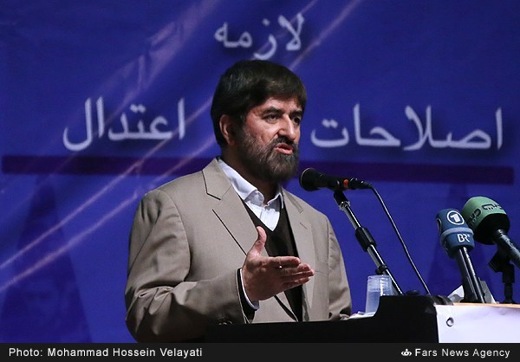
The contentious comments of Ali Motahari, a principlist MP, on parliament floor on Sunday (January 11) sparked a brawl that disrupted the legislative proceedings.


What did Motahari say?

Ali Motahari led off his speech with a condemnation of terror attacks on journalists in France, saying, “We condemn the recent terror attacks in Paris, although repeated publication by the satirical magazine Charlie Hebdo of cartoons of the Prophet is condemnable too.”

On domestic issues, he said, “As everybody knows on December 30, 2009 [the day Iranians turned out in force to renew allegiance to the Supreme Leader and the ideals of the Islamic Revolution] people defended the revolution and the Islamic Republic despite violations committed by the two sides of the Sedition. If we try to make December 30 a symbol of division of the nation, it will not be a Day of God anymore….”


A call on the president

That comment pushed up tension levels in the chamber and finally led to physical efforts by some MP to force Ali Motahari to stop his speech.

Motahari went on to say, “Everybody knows that I’m not attached to Messrs. [Mir-Hossein] Mousavi and [Mehdi] Karroubi. Actually I voted for Mr. [Mohsen] Rezaei in the 2009 election.”

He added, “I want to defend a bigger issue and that is the Islamic treatment of the government’s critics as Imam Ali (PBUH) acted in dealing with his opponents. His critics and opponents stayed free and enjoyed full social rights as long as they did not take up arms. Imam’s opponents would criticize him in the mosque as he delivered his sermons, and Imam would not let anybody attack them.”

Shouts of protest by the MPs quickly turned into slogans against the son of Ayatollah Motahari, and chants of ‘Down with the seditionist’ and ‘Down with the hypocrite’ soon echoed in the chamber.

He then put forward a proposal on how to end the controversies surrounding the 2009 incidents and said, “The solution is this: we should confess to our mistakes in 2009, among them a lack of proper reaction to [televised] debates, announcement of national celebrations […]”

The rush of deputies toward parliament’s pulpit to bring down Ali Motahari was so forceful that Abed Fattahi, Nader Ghazipour and Mesbahi Moghadam formed a human wall between Motahari and the attackers calling on him to stop his speech. Some MPs were even trying to get into a physical fight with him.

At this time, the deputy speaker who presided over Sunday’s open session turned into a critic of Motahari’s remarks. Telling Motahari that what has been done to these two people [Mousavi and Karroubi] has come with maximum compassion.

Mohammad Hassan Aboutorabi Fard objected to the remarks by saying, “Raising the issue this way will draw the protest of MPs who are here to represent people. You are expected to take into account our national interests, religious orders and the Constitution.”

Following the attack by the MPs, the deputy speaker ordered the end of the open session.


What does the Constitution say?

The incident came despite the fact that Article 86 the Constitution states: “Members of the Assembly are completely free in expressing their views and casting their votes in the course of performing their duties as representatives, and they cannot be prosecuted or arrested for opinions expressed in the Assembly or votes cast in the course of performing their duties as representatives.”


Reactions

Newspapers and MPs with different political leanings reacted differently to Motahari’s comments.


Against

For instance, Javan, a principlist daily which represents the viewpoints of the Islamic Revolution Guard Corps, wrote, “The behavior of Ali Motahari shows that his radical views have been taking him down a very steep slope over the years. He now dares talk audaciously against the beliefs of the people.”

Javad Jahangirzadeh, an MP representing Orumiyeh in the Islamic Consultative Assembly, said, “Those who seek to undermine the December 30 epic should know that December 30 is a Day of God and will remain so.”

Kayhan, another principlist daily, said in its editorial, “What Motahari says every once in a while, like his comments on January 11, draws a very warm welcome from American and Zionist media and admiration from anti-revolutionaries.

“What he said this time around is nothing new. Others have made similar remarks time and again in the past without drawing much attention from the enemy and anti-revolution circles. No doubt, it is not his comment that makes him important to the enemy. What is important is that he is associated with Ayatollah [Morteza] Motahari.

“Anti-revolutionaries and the media affiliated to them have without fail identified him as ‘Ali Motahari, the son of Ayatollah Motahari’. Hardly can you find one medium which has not associated him with his esteemed martyred father.

“So one can easily conclude that without association with Martyr Morteza Motahari, Ali Motahari would be unimportant to the same media which are now hailing him.”


For

Some MPs and newspapers defended the conduct of Ali Motahari. For instance, Abdolvahid Fayazi, who represents Nour in the chamber, said, “Such incidents damage the reputation of the assembly and play into the hands of foreign media which are always bent on undermining the Islamic establishment.

“In defending what they had done, some deputies alleged that Mr. Motahari had charged them. He continued his speech as calmly and politely as possible. His bravery is praiseworthy.”

Mohammad Bagheri Bonab said, “Mr. Motahari just expressed his views. If other deputies had objections to what he was saying, they should have waited their turn to express their objection. They shouldn’t have made the atmosphere tense. Besides, the presiding board could have acted better in bringing things under control.”

And Masoud Pezeshkian, who represents Tabriz in the Islamic Consultative Assembly, said, “The presiding board and MPs failed to abide by the law. Parliament should be above such incidents. MPs should have allowed Mr. Motahari to complete his speech. […] What happened yesterday seemed to be much of a show to secure qualification [from the Guardian Council ahead of next parliamentary elections.]”


Complaint filed and the top MP reacted

According to Tuesday’s edition of Arman-e Emrooz daily, on January 12 Parliament Speaker Ali Larijani told reporters, “There are more important issues in the country we need to address, the less tense the atmosphere, the better the MPs can focus on settlement of issues. It [contributing to creation of a calm environment] is a national duty.

“We need to create a calm atmosphere in the assembly. Media can play an effective role on that front. As the Supreme Leader has said calm and harmony are necessary for the country.”

In response to a question as to whether the Presiding Board has received a complaint, he said he was not aware of any such thing.

But Safar Naimi-Raz, who represents Astara in the chamber, said more than 50 MPs have filed a complaint against Motahari with the board that supervises the performance of the deputies.

He went on to say although he was the one who was involved in the dispute with the principlist MP, he had not signed the letter of complaint.