Monday, December 29, 2025
Home Blog Page 4963

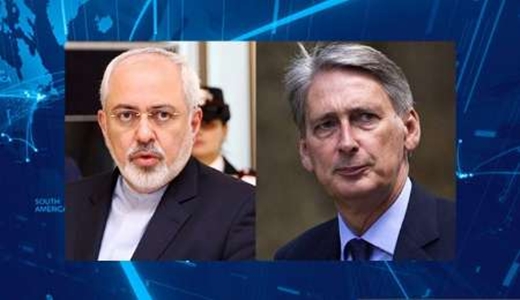
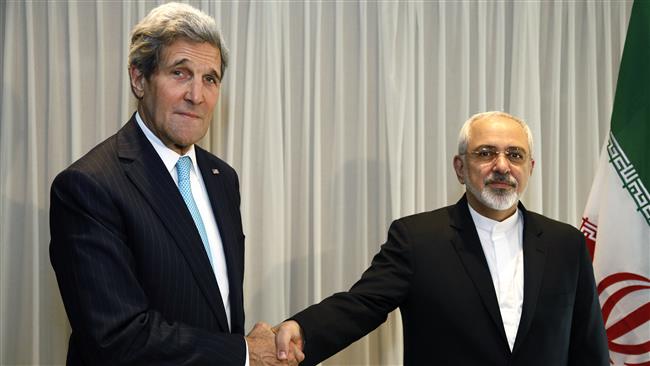
Iran’s Zarif, France’s Fabius set to meet in Paris

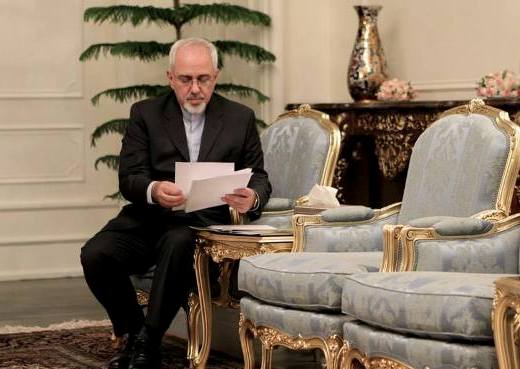
Mohammad Javad Zarif

French Foreign Minister Laurent Fabius is set to hold a meeting with his Iranian counterpart Mohammad Javad Zarif in Paris.

Zarif, who has finished three rounds of nuclear talks with his American counterpart, John Kerry, in Geneva, will meet Fabius on Friday.

A surprise third round was added to the pre-planned two rounds.

US State Department officials said earlier that Kerry and Zarif held “substantive” talks in the Swiss city.

The Iranian foreign minister will also visit Berlin on Thursday to meet with his German counterpart Frank Walter Steinmeier.

A meeting is then slated to be held with European Union foreign policy chief Federica Mogherini in Brussels, the EU’s de facto capital.

Nuclear negotiators from Iran and P5+1– Russia, China, France, Britain, the US and Germany – wrapped up their latest round of talks on Tehran’s nuclear issue in Geneva on December 17, 2014.

The Geneva discussions were held almost three weeks after Tehran and the six countries failed to reach a final agreement by a November 24 deadline despite making some progress.

The two sides agreed to extend their discussions for seven more months until July 1, 2015.

They also agreed that the interim deal they had signed in Geneva in November 2013 should remain in place during the negotiations.

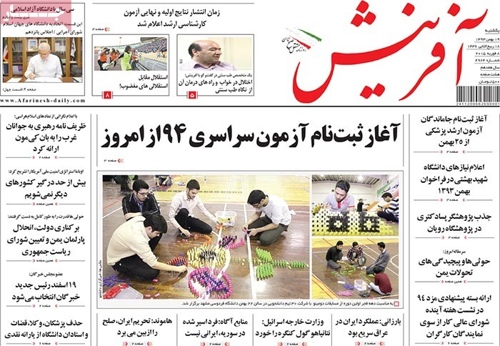
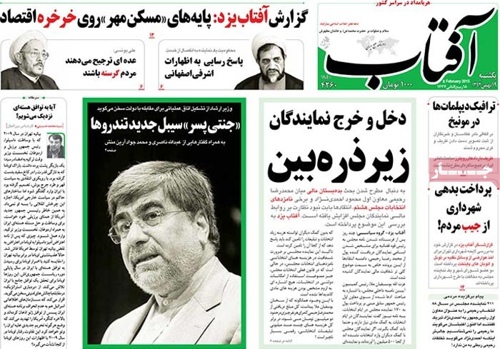
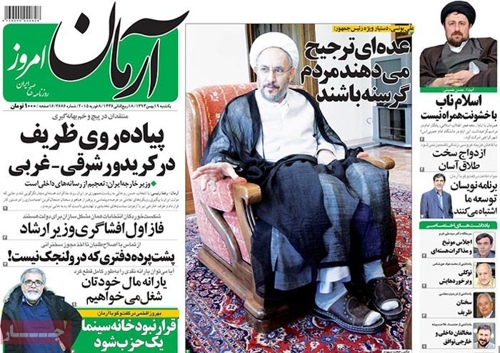
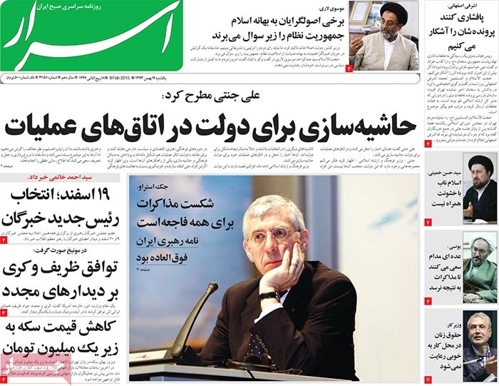
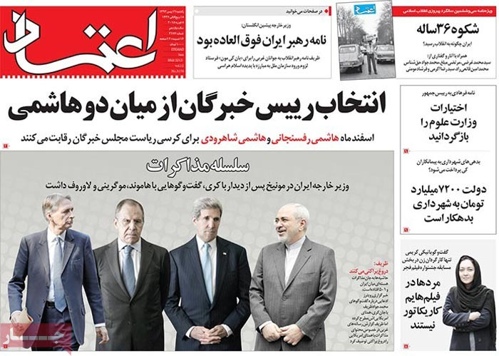
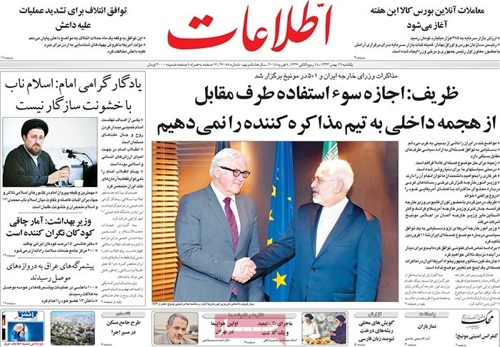
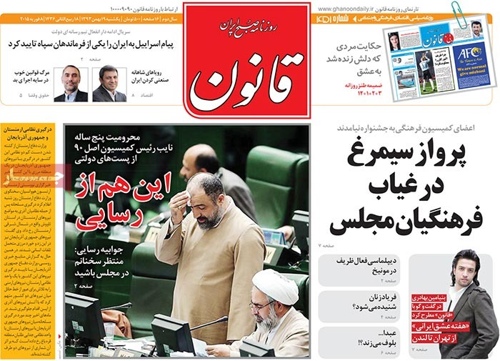
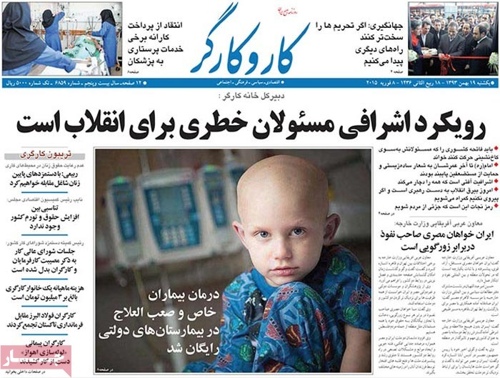
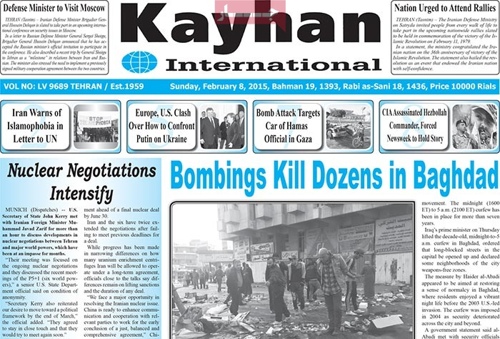
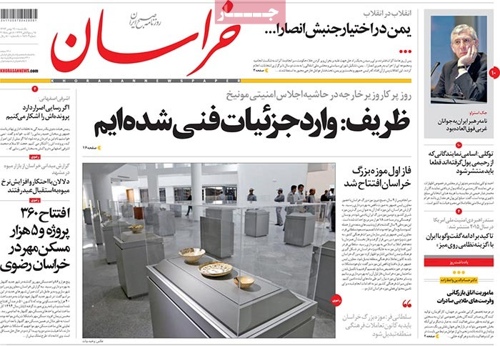
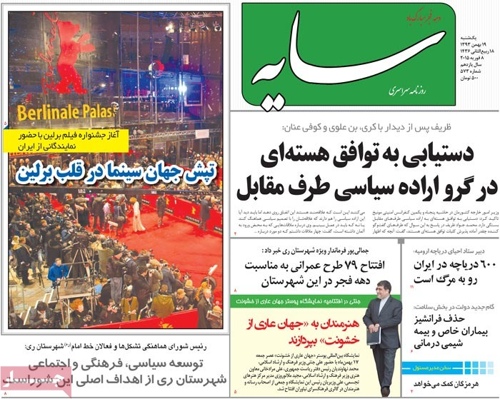
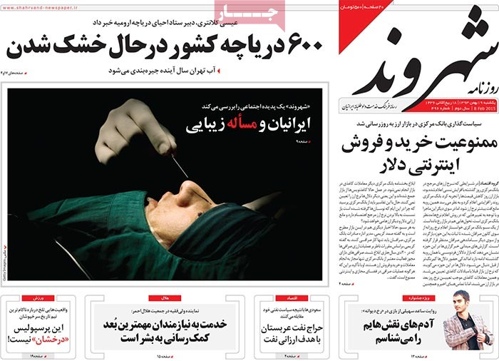
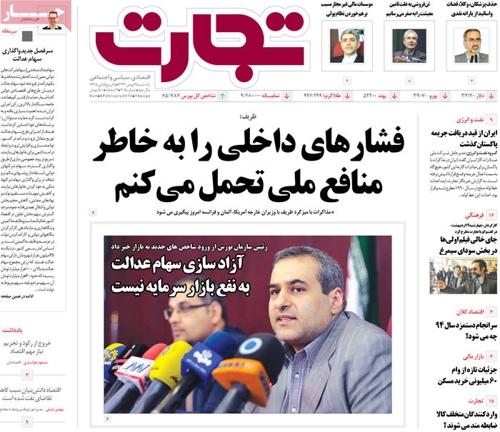
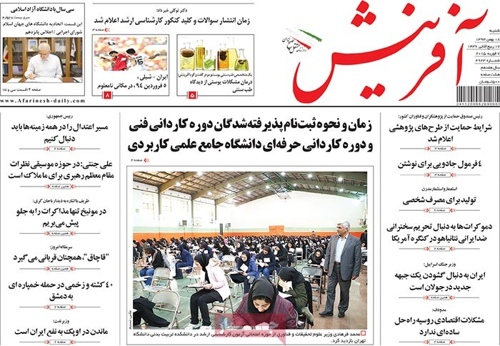
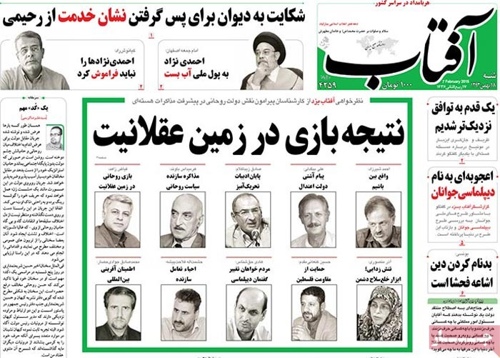
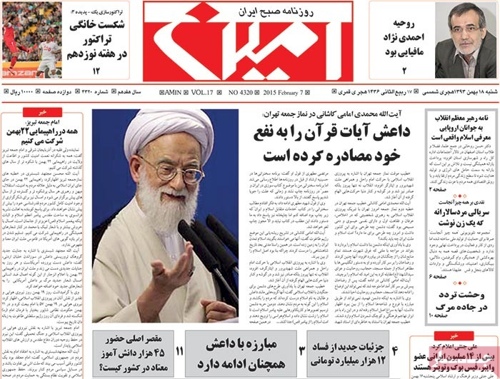
A look at Iranian newspaper front pages on Jan. 15

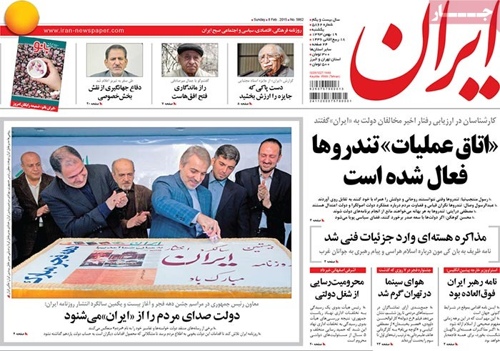
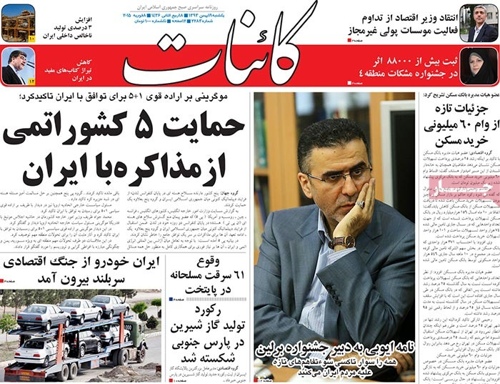
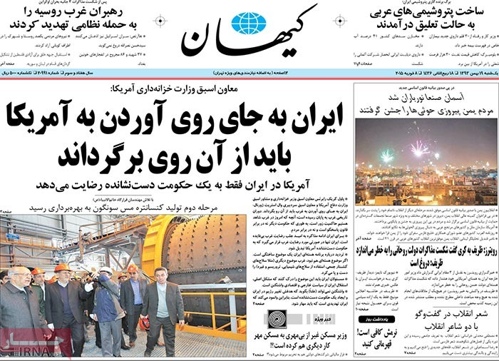
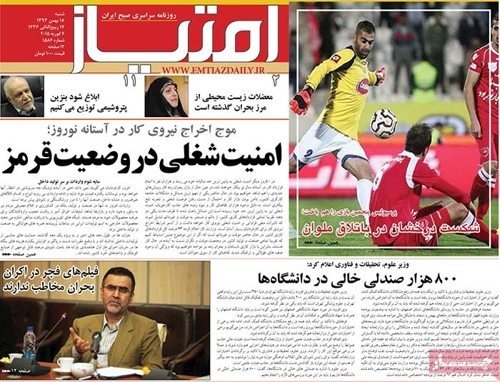
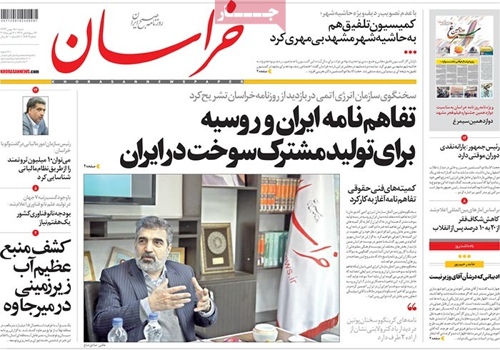
Iranian Newspapers Headlines

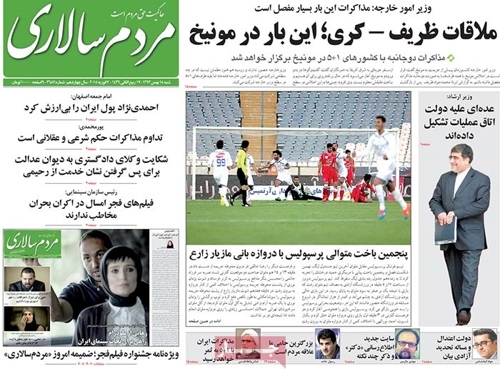
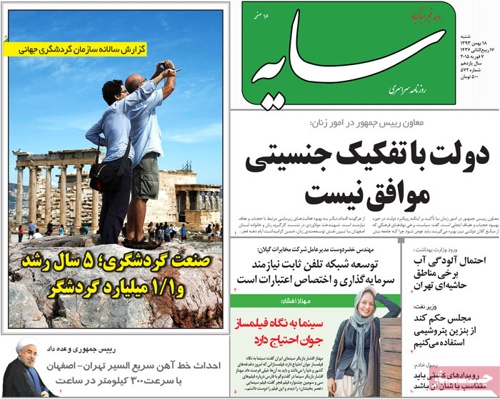
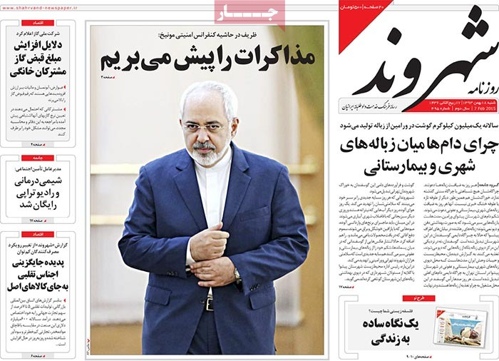
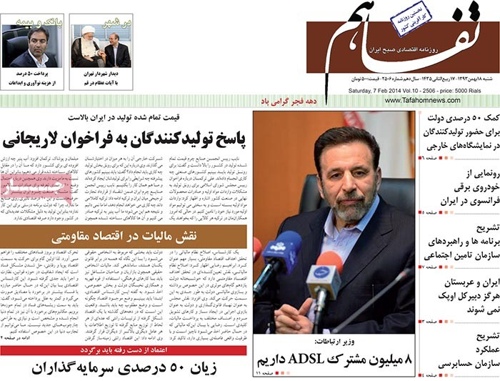
Talks in Geneva between the Iranian and US top diplomats which also saw them take a walk on the streets of the Swiss city dominated the front pages of the Iranian dailies on Thursday. Muslim condemnation of the French satirical weekly Charlie Hebdo’s reprint of images insulting the Prophet Muhammad made front-page headlines too. And reformist dailies also covered on their front pages the comments of Ayatollah Rafsanjani about the upcoming Assembly of Experts elections.


Afkar: Eighteen members of a terrorist group have been arrested in the border province of Sistan and Baluchestan.

Afkar: Air pollution in Tehran is at an alarming level.


Afkar newspaper 1- 15


Aftab-e Yazd: Ayatollah Rafsanjani has criticized those who are stoking division ahead of Assembly of Experts elections.


Aftabe yazd newspaper 1- 15


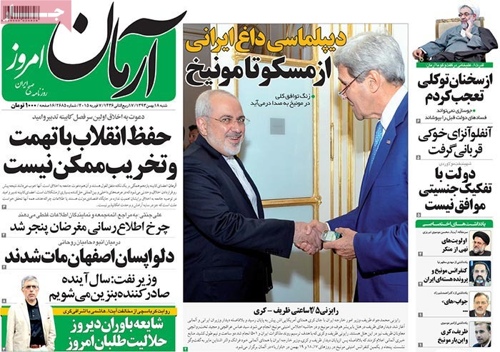
Arman-e Emrooz: Foreign Minister Mohammad Javad Zarif has held a 100-minute meeting with US Secretary of State John Kerry in Geneva. A nuclear deal is within reach.

Arman-e Emrooz: The Ministry of Sports and Youth Affairs is to launch an official matchmaking website.

Arman-e Emrooz: Carols Queiroz’s team [Iran’s national soccer squad] will take on Qatar in the AFC Asian Cup in Australia on Thursday.


Armane emruz newspaper 1- 15


Asr-e Rasaneh: Iranian airliners cannot buy or rent jets which have rolled off the production line more than 15 years ago.

Asr-e Rasaneh: Following a drop in petrochemical prices, Iran has denied allegations that it is selling its petrochemicals cheap.


Asre resaneh newspaper 1- 15


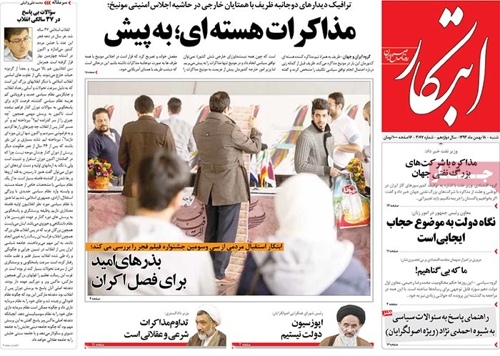
Ebtekar: Iranian crude oil is now cheaper than bottled water.

Ebtekar: [Principlist MP] Ali Motahari has said that he will take part in a rally against himself [scheduled for Friday]!


Ebtekar newspaper 1- 15


Eghtesad-e Pooya: “A special police unit is to be launched to clamp down on corruption,” said Police Chief Brigadier General Esmail Ahmadi Moghaddam.

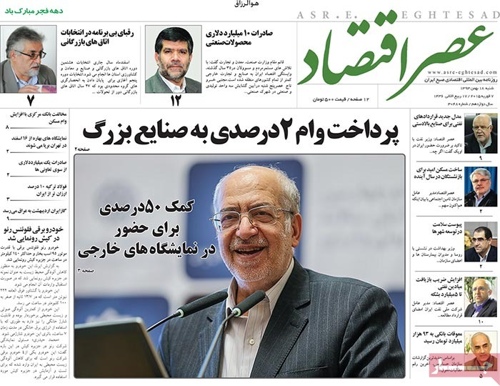
Eghtesad-e Pooya: “Some $5 billion will be invested in the steel industry,” said the managing director of the Iranian Mines and Mining Industries Development and Renovation Organization (IMIDRO).


Eghtesade puya newspaper 1- 15


Etemad: In an unprecedented move the top diplomats of Iran and the United States walked the streets of Geneva as they talked about Iran’s nuclear program.


Etemad newspaper 1- 15


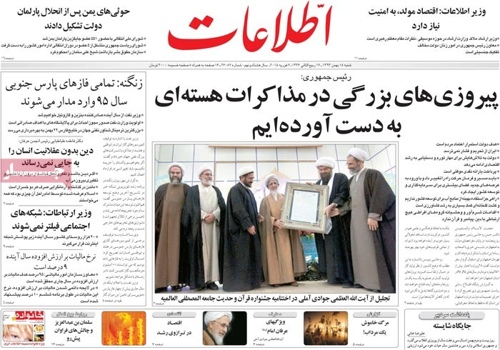
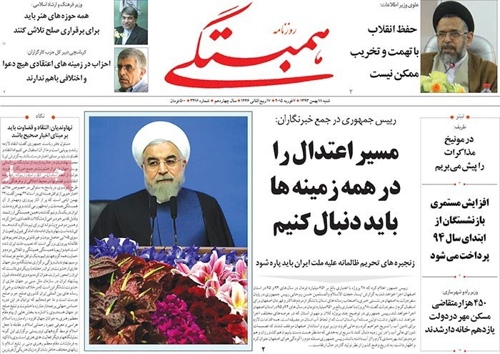
Ettela’at: “To prop up our national interests, we need to let go of our partisan interests,” said the president.

Ettela’at: The Muslim world has condemned the desecration of the Prophet Muhammad by French weekly Charlie Hebdo.

Ettela’at: Members of a terrorist cell have confessed that they have been financed by two Arab countries.

Ettela’at: “For nuclear talks to make progress, new proposals should be floated,” said the Iranian foreign minister.


Ettellat newspaper 1- 15


Farhikhtegan: Hardliners are putting pressure on the Ministry of Science, Research and Technology in a bid to interfere with its investigation into illegal scholarships [granted under President Ahmadinejad].


Farhikhtegan newspaper 1- 15


Hadaf va Eghtesad: Iran’s exports to Russia have registered a 50 percent hike.


Hadafo eghtesad newspaper 1- 15


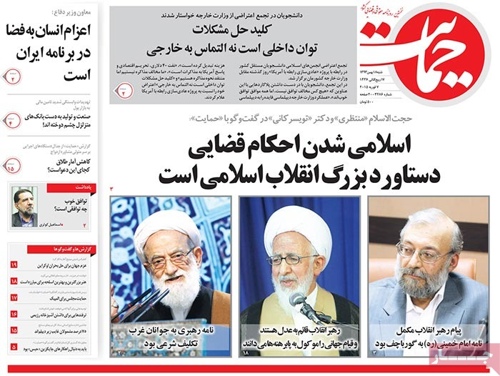
Hemayat: With oil prices continuing to drop, the share of the National Development Fund from oil revenues has decreased.


Hemayat newspaper 1- 15


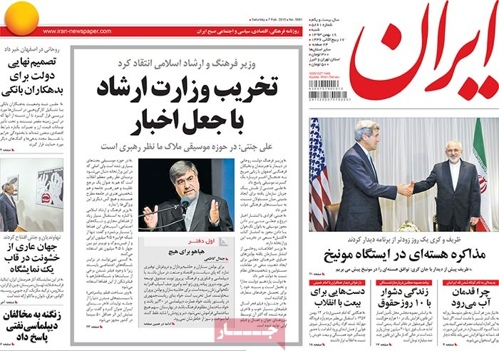
Iran: Forty Somali pirates who were arrested by the Iranian Navy have served out their sentence at Tehran’s Evin Prison.


Iran newspaper 1- 15


Jamejam: Students of a class in a school in Hamadan [western Iran] have shaved their heads as a sign of sympathy with their teacher who is suffering from cancer.


Jame jam newspaper 1- 15


Javan: “New [US] sanctions would spell an end to the nuclear talks,” said the Iranian Foreign Ministry spokeswoman.


Javan newspaper 1- 15


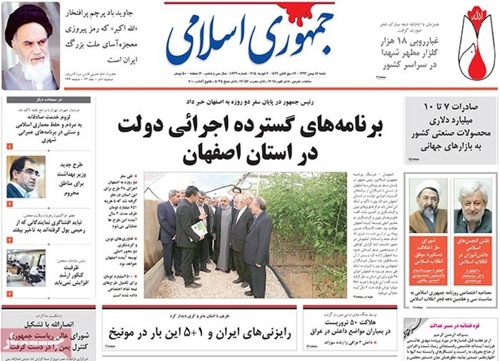
Jomhouri Islami: Iran is to build cement plants in Iraq and Libya.

Jomhouri Islami: With President Rouhani in attendance, a project to develop the southern port of Bushehr has got under way.


Jomhorie eslami newspaper 1- 15


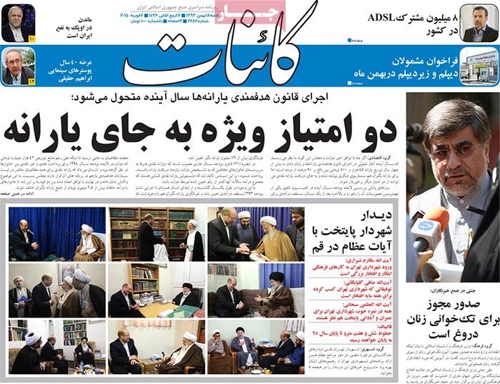
Kaenat: As much as eight tons of particulates is produced in Tehran on a daily basis.


Kaenaat newspaper 1- 15


Kayhan: Oil prices have dropped to six-year lows.


Kayhan newspaper 1- 15


Resalat: The judiciary chief has urged the government of President Rouhani to put a clampdown on corruption on its agenda.


Realat newspaper 1- 15


Shahrvand: Bushehr is to turn into an international maritime relief and rescue center.


Shahrvand newspaper 1- 15


Sharq: The Supreme Court has upheld some of the convictions of former First Vice-President Mohammad Reza Rahimi.


Shargh newspaper 1- 15


Siasat-e Rooz: British Prime Minister has thrown his weight behind the move [by French weekly Charlie Hebdo] to insult the Muslim Prophet.


Siasate ruz newspaper 1- 15

A mountain that never stops burning (Photos)

Iran-Tashkooh

Tashkooh (Firing Mountain) is a mountain near the Mamatin village, between Ramhormoz and Izeh in Khuzestan province, whose flames never die down.

Also known as Atashkooh, the mountain is always burning due to the sulfur vapors rising from the porous layers of its surface and flames fanned by sublimation and nebulization.

The burning fire is a picturesque scene at night when tourists huddle together around the mountain whose constant emission of gases does not allow the ignition of another fire nearby.

The following are the photos the Young Journalists Club (YJC) has placed online of the amazing mountain:


Iran nuclear talks serious

Abbas Araghchi

A senior Iranian nuclear negotiator has described as “serious” nuclear talks between Tehran and P5+1.

“The atmosphere of the negotiations is completely serious and transparent, and the parties [to the talks] are interested in reaching an agreement [on Iran’s nuclear energy program],” Iranian Deputy Foreign Minister for Legal and International Affairs Seyyed Abbas Araghchi said on Wednesday.

Araghchi made the remarks after Iranian Foreign Minister Mohammad Javad Zarif and US Secretary of State John Kerry met in the Swiss city of Geneva to discuss the progress in Iran’s nuclear talks.

The meeting in Geneva comes before a fresh round of nuclear talks between Iran and P5+1 – the US, the UK, Russia, China, France and Germany. Both sides are still working on outstanding issues for a final deal over the Iranian nuclear energy program.

Like Iran, he added, the other side is also serious in the negotiations, and it is clear that the two sides are determined to clinch a deal.

“All efforts are underway,” the senior Iranian negotiator said, adding, “It is, however, too early to judge the outcome of the talks.”

“We hope to reach a comprehensive agreement in the end,” the Iranian diplomat further noted.

Iran and the six countries seek to seal an overarching nuclear deal by the July 1 deadline. The scale of Iran’s uranium enrichment and the timetable for the lifting of anti-Iran sanctions are seen as major sticking points.

Iranian FM urges respect for sanctities

Zarif-Iran

Iran’s Foreign Minister Mohammad Javad Zarif on Wednesday highlighted the necessity for respect for sanctities of all religions and cultures after a French magazine republished a cartoon of Prophet Muhammad (PBUH).

“We believe that sanctities need to be respected,” Zarif told reporters minutes before a meeting with his US counterpart in the Swiss city of Geneva on Wednesday.

He made the comments when asked about the most recent controversial move by satirical French weekly Charlie Hebdo that printed a cartoon on its cover depicting Prophet Muhammad (PBUH).

“Unless we learn to respect one another, it will be very difficult in a world of different views and different cultures and civilizations, we won’t be able to engage in a serious dialogue if we start disrespecting each other’s values and sanctities,” Zarif added.

Respecting such “sanctities” makes it easier to have respectful relations, he explained.

The French magazine has repeatedly aroused Muslim ire by publishing cartoons mocking the holy Prophet Muhammad.

Known for its caricatures of the Prophet Muhammad, as well as critical depictions of other religions and French politicians, the magazine regularly stirred controversy.

The Wednesday’s edition of Charlie Hebdo, which sold some three million copies, shows a cartoon of Prophet Muhammad holding a “Je suis Charlie”(“I am Charlie”) sign, a slogan widely used following the January 7 attack on the magazine.

Al-Azhar has voiced readiness to host a gathering of Shiite and Sunni scholars

Al-Azhar university

On January 14, Mehr News Agency quoted Grand Imam of Al-Azhar Ahmed Muhammad Ahmed el-Tayeb as telling Iraqi Prime Minister Haider al-Abadi that Al-Azhar University is ready to organize a conference between Shiite and Sunni scholars. The meeting is meant to have differences between the two sides discussed and resolved.

“Such disagreements have targeted the Islamic Ummah (community). By fanning the flames of division, some regional and international powers try to serve the enemies of Islam,” the senior al-Azhar official said.

Can this government build a nation?

Ashraf Ghani-Abdullah Abdullah

More than 100 days after Ashraf Ghani was sworn in as Afghan president, he finally named his cabinet. There are four women among his 25 nominees for ministerial positions. The president says they have been named based on their merit without any bias or ethnic consideration.

Among the proposed ministers are Lieutenant General Sher Mohammad Karimi,Salahuddin Rabbani and Nur ul-Haq Ulumi, who based on the decision of Afghanistan’s Government of National Unity are to take the helm of the ministries of defense, foreign affairs and the interior respectively. The following is the translation of a full-page report Mardom-e Emrooz daily published on January 13. It featured the viewpoints of two Afghan political experts.

Afghanistan’s Government of National Unity was forged on September 29. Deepening disagreement between Ashraf Ghani and his rival Abdullah Abdullah who both claimed to have secured the largest number of votes in the presidential elections, prompted Western governments, America in particular, to intervene and set the stage for the formation of a national unity government.

Under a power-sharing deal struck between the two rivals, Ashraf Ghani was named Afghan president while his rival Abdullah Abdullah was appointed as CEO of the fledgling government.

At his swearing-in ceremony, Ashraf Ghani vowed to name his cabinet within 45 days, a pledge which was delivered 110 days later, though.

In the meantime, by the president’s order, many former ministers were dismissed and for key portfolios, acting ministers were appointed.

The overdue decision of the government to name the cabinet drew a barrage of criticism. Some analysts blame the delay on disagreements between onetime-rivals-turned-partners Ashraf Ghani and Abdullah Abduallah.

Ashraf Ghani is now on a political honeymoon, but major challenges lie ahead.


Ethnic Challenges

There are four ethnic groups in Afghanistan: Pashtuns (make up 40 percent of the population), Tajiks (32 percent), Hazaras (16 percent), and other ethnic groups including Uzbeks (12 percent). Taliban insurgents, who affiliate themselves with Pashtuns, view Afghanistan as a land of Pashtuns and thus want Tajiks and Uzbeks to emigrate to Tajikistan and Uzbekistan. Time and again they have launched attacks against different ethnic groups, stoking a wave of insecurity throughout the country.

[…]
 

Economic Challenges

Ashraf Ghani must know that to launch an anti-corruption campaign, he needs to get prepared for confrontation with his enemies, those who raked in substantial fortunes in the previous government thanks to rampant corruption and rent and are now set to deal a blow to the government in case their interests are put at stake.

[…]
 

Religious Challenges

For years Taliban insurgents and their extremist affiliates have been trying to force the Afghans to commit to their radical interpretation of Islam. To counter such a move, the government should pave the way for fundamental social measures such as promotion of education, alleviation of poverty, creation of jobs and a crackdown on corruption.

[…]
 

The land of no consensus

By Fazel Rabi Wardak, an expert in Afghan affairs at The Asia Foundation


The Afghan government on Monday finally unveiled the full list of its Cabinet nominees. The announcement, after months of political uncertainty, is a promising piece of news. Over the past months, a lack of consensus among political leaders caused frustration among Afghan people. The history of Afghanistan remembers no political consensus among the country’s elite.

[…]
Time has come for Afghanistan, which has been in the grip of war for more than three decades, to honor the universally-accepted principles of democracy and take steps toward the rule of law. To do so, Afghanistan needs the contribution of all countries and it cannot wait for the establishment of peace to take action.

As a neighbor of Afghanistan, the Islamic Republic of Iran can be a leading player. Historically, Iran has always influenced Afghan issues. The fact that Iran has amicable ties with Abdullah Abdullah, the new government’s chief executive officer, makes it more likely that the two sides have had consultations on the cabinet lineup.

For years, Afghanistan has been ruled by governments in which ranking officials were appointed, but now the stage has been set for people in Afghanistan to get involved in politics.

Walking down the path of democracy, Afghanistan is facing multiple challenges. The formation of a new government will not solve all Afghan problems. The appointment of governors, managing local affairs and naming the heads of state institutions will be a time-consuming process.

Another challenge is the ethnic-sectarian mentality of the country’s leaders. It should be noted that the democratic principles should not be ignored only because such differences exist. The Afghan nation has no other choice but move in line with democratic principles under the banner of a law-abiding government. That’s why it cannot move backward.

Despite all barriers standing in the way, Afghanistan has taken a step forward by holding presidential elections, and more importantly revealing the cabinet composition. The solution to Afghanistan’s main challenge – tribal conflicts – lies not in giving each ethnic group their fair share of power, but in consensus among Afghan leaders.

The Afghan history shows that the Afghan people, made up of various tribes, have lived together peacefully and faced no problem whatsoever. Unfortunately those in power and tribal chiefs have fuelled sectarian differences and pitted ethnic groups against each other.

Afghanistan will relish in the prospect of a guaranteed future only when patriotic experts – irrespective of their tribal background – take charge. To pull through, the Afghans need to pin their hopes on the current government although it has staged a poor, inefficient performance over the past 100 days. The Afghans have to keep their hope alive, although there is just a glimmer.


This government is not a national unity government 

By Vahid Mojdeh, an Afghan affairs expert


The cabinet lineup was announced with delay because the government had to take into account some variables, including tribal issues and the share of different political groups. The tribal composition of the cabinet is one main reason behind the delay in revealing the Afghan cabinet.

Intragroup fighting was a factor too. It doesn’t mean that Ghani and Abdullah Abdullah were at odds; rather they each had disputes within their own political ranks. The pressures from other powerful political groups should be taken into consideration as well.

A legal advisor to the Afghan president has said that certain powerful people were jockeying to have their own choices included in the list of cabinet nominees.

In all fairness, the president was grappling with challenges before picking his cabinet choices. Prior to the announcement he had underlined meritocracy, but one should not forget that turning a promise into a reality is difficult. This, however, does not mean that seasoned ministers are absent on the published list.

I think Mr. Ghani has put forward his list based on some expediency to appease different political groups which were campaigning alongside him during the election. A number of those on the list have spent many years overseas with no experience in public office; that’s why there are doubts about their future performance in the government.

The standout feature of the government lineup is the presence of four women, as promised by the president. Mr. Ghani’s list also shows that he’s taken into account the political participation of all groups […].

The government is unlikely to face opposition in the Afghan parliament when it puts its proposed ministers to a vote of confidence because the absence of a cabinet three months after the formation of the unity government would create a political vacuum.

Furthermore, the Afghan MPs are preparing for a winter recess. So I think they will confirm the proposed ministers to break the current deadlock.

The unity government is more fragile than its predecessors. This government is beset by many problems among them war, insecurity and rampant corruption.

President Ghani has to overlook some issues to maintain his government on the one hand, and to meet the conditions set by the West on the other. As you know, the EU and the US have conditioned their financial assistance to Afghanistan on structural reforms and elimination of corruption.

War is yet another challenge the government is facing. The Afghan president cannot easily make insecurity a thing of the past in a country dogged by war for almost 36 years.

Terrorist attacks aimed at hindering Islamic states’ economic progress: Iranian official

Shamkhani-Iraq

Secretary of Iran’s Supreme National Security Council (SNSC) Ali Shamkhani in a meeting with Iraqi Oil Minister Adil Abdul Mahdi warned that attacks by terrorist groups are aimed at hampering economic progress of Islamic countries.

“Destruction of the regional countries’ economic infrastructure, including Iraq and Syria, by the terrorists and the ineffective attacks by the coalition fighter jets are interrelated actions to prevent Islamic countries’ economic growth,” Shamkhani said during the meeting in Tehran on Tuesday.

Elsewhere, he referred to the falling oil prices, and said it can provide an opportunity for the oil producing countries to decrease their dependence on crude sales and reform their economic mechanisms.

Shamkhani underlined Iran’s determination to increase its economic power based on cooperation with the neighboring states and weaken the influence of oil on political attitudes.

He also pointed to Iran and Iraq’s cooperation in extracting oil from joint oil and gas fields, and said such cooperation can be a role model for other countries.

Abdul Mahdi, for his part, stressed Baghdad’s interest in deepening ties and cooperation with Tehran, and said, “We are trying to use Iran’s valuable experience to reconstruct Iraq, especially its oil, gas and petrochemical industries.”

Iran and Iraq had agreed in July 2013 to pursue development of their joint oilfields through setting up joint companies under a single management. The two countries have also held comprehensive expert talks on the same issue.

Azadegan Oilfield is the biggest oilfield which is owned jointly by Iran and Iraq.

Other joint Iran-Iraq oilfields are Yaran, Naftshahr, Azar and Karkheh.

Under the agreement signed in July 2013, the two countries will establish joint ventures to carry out the exploration and development of joint oil and gas fields.

The two sides also agreed to work together to settle territorial and ownership differences.

Iran, which sits on the world’s second largest natural gas reserves after Russia, is making efforts to raise its gas production by increasing foreign and domestic investments, especially in South Pars gas field.

On Monday, Iranian Oil Minister Bijan Namdar Zanganeh and his Iraqi Counterpart discussed new ways to boost Tehran-Baghdad relations, particularly crude production in joint fields.

Zanganeh and al-Mahdi said that time is ripe for development of Tehran-Baghdad relations.

Iran obtains queen bee artificial insemination expertise as world’s 3rd country

queen bee

An Iranian researcher has managed to acquire knowhow for artificial insemination of queen bees, making Iran the world’s third country which has got access to the technology.

The Iranian scientist at the Science and Technology Park in Hamedan city, central Iran, has designed a tool for artificial insemination of queen bees, and developed a method for genetic improvement of bees and boosting their resistance against diseases.

Ali Ataiyan, the director of the project and German Kassel university graduate in bee breeding and artificial insemination, said the study is designed to build an artificial insemination system of bees to modify breeding and transfer positive genetic factors to the next generation of bees.

Using the device, the sperm of modified male bees is received and is injected into the queen bee. The queen bee falls unconscious by CO2 and then the artificial insemination is conducted under the microscope.

The method boosts honey production by 60 percent, keeps the hives clean and creates fewer baby bees. It also promotes resistance of the bees against the diseases.

He further added that Germany and Denmark are the only two countries which possess the artificial insemination expertise.

Iran Condemns Charlie Hebdo’s Insulting Cartoon as “Provocative”

Iranian Foreign Ministry Spokeswoman Marziyeh Afkham

Iran’s Foreign Ministry on Wednesday lashed out at the satirical French weekly Charlie Hebdo for printing a cartoon of the prophet of Islam on the cover, describing it as a repeated provocative move.

“We condemn the French weekly’s provocative move, because it hurts the sentiments of Muslims,” Foreign Ministry Spokeswoman Marzieh Afkham said in her weekly press conference on Wednesday.

“The abuse of freedom of expression in the West is unacceptable,” she underlined.

Her comments came in response to a Wednesday’s edition of the French magazine showing a cartoon on the cover that depicts Prophet Muhammad (PBUH) holding a “Je suis Charlie” sign.

The slogan in French “Je suis Charlie” (“I am Charlie”) was widely used following the January 7 attack on the magazine.

Three million copies of Wednesday’s edition have been printed.

The French magazine has repeatedly provoked Muslim ire by publishing cartoons mocking holy Prophet Muhammad.