Wednesday, April 22, 2026
Home Blog Page 4964

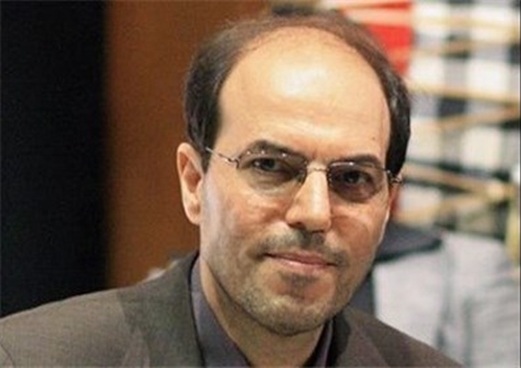
Global inequality aggravated by sanctions: Iranian envoy

Gholam Hossein Dehghani

The head of Iran’s UN mission described imposition of “illegal” sanctions on other countries by world powers as an effective factor behind the growing inequality across the world.

The “illegitimate and illegal” sanctions have been the major factor behind the worsening inequality in the countries that have fallen victim to those restrictions, Gholam Hossein Dehghani said in an address to the 53rd session of the United Nations Commission for Social Development at the UN headquarters in New York.

The destructive sanctions have also obstructed the victim countries’ achievement of the Millennium Development Goals (MDGs), he added.

Dehghani also referred to wrong “global financial policies” as another cause of the increasing inequality in the world.

At the Millennium Summit in September 2000, the largest gathering of world leaders in history adopted the UN Millennium Declaration, committing their nations to a new global partnership to reduce extreme poverty and setting out a series of time-bound targets, with a deadline of 2015 that have become known as the Millennium Development Goals.

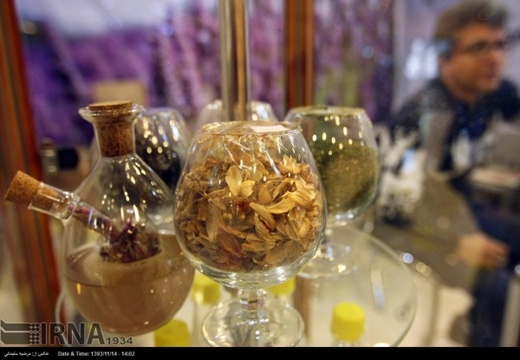
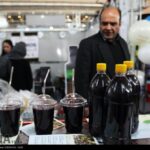
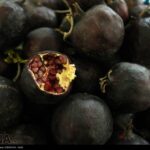
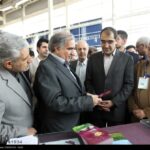
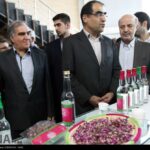
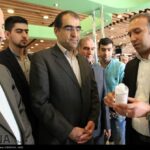
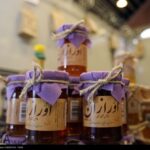
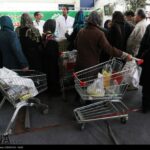
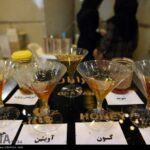
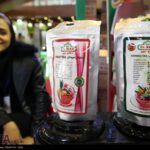
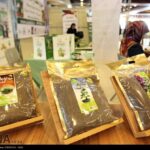
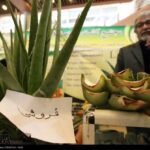
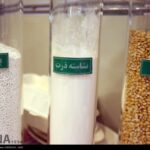
Organic food exhibition in Tehran (Photos)

Organic food exhibition in Tehran 19

A 7th Organic Food Exhibition was held in Tehran (January 31- February 5) and attracted many visitors.

During the expo, those with an appetite for organic food had the opportunity to look at tasty items on display.

The following are snapshots of the expo the Islamic Republic News Agency (IRNA) posted on its website:


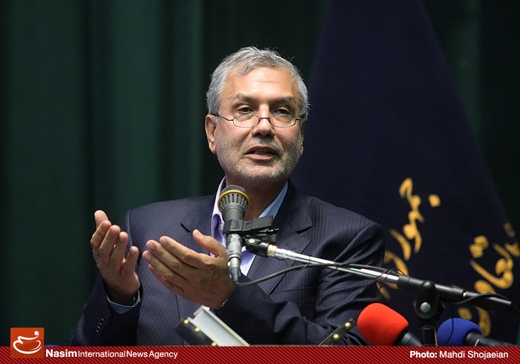
Labor Minister: We can and must be successful

Ali Rabii - Iran Labor Minister

The minister of cooperatives, labor, and social welfare has said that Iran should successfully show to the world that Islam and the revolution are a well-oiled machine.

Ali Rabiei made the remark in a ceremony in Qom marking the anniversary of the victory of the Islamic Revolution. The following is a partial translation of his remarks as reported by nasimonline.ir on February 5:

The minister said that regional developments and Islamic Awakening [movement] are among the Islamic revolution’s achievements. “Unfortunately, the Islamic Revolution has been subjected to injustice. Movies have been made and books have been written against the revolution over the years. They have all tried to depict the Islamic Revolution as nothing but a dictatorial system with no achievement.”

He also said, “Today the Supreme Leader addresses the youth in Europe and North America and says that they [the youth] can remain under the umbrella [of the revolution]. I was once a factory worker and now I am a minister. This is what we highlight as religious democracy. This is the thing that can take our society toward prosperity.”

Rabiei further said, “We should not let the efficacy of the [Islamic] establishment be challenged. We need to spread the revolution’s tenderness and leniency so much so that bigger crowds of people can come under its umbrella. We should remain accountable to the public as we try to win their satisfaction.”

He continued, “Efforts should be made not to allow the most unpopular regime – the Zionist regime which indiscriminately kills children – to be cast as popular; rather, the oppressed should be endeared. Iran’s foreign policy wants to show that there are people in Islamic Iran who want peace for the world, they speak the truth in a mild tone, but they stand up to injustice in order to reveal the true colors of an unjust regime.

“We are able to be successful. Failure is not an option. Any movement which seeks to cast Islam as inefficient does not help the revolution. We should show the efficient face of Islam and the revolution.”

As for the government’s economic performance, he said that his ministry has issued as many as 8 million health cards – a plan which has failed in the US and countries like Singapore – for which experts have praised Iran.

The minister further said that the government balanced this year’s budget based on oil prices of $40 a barrel, adding that when President Rouhani’s government took over economic growth was in negative territory, but the country has since posted three percent growth.

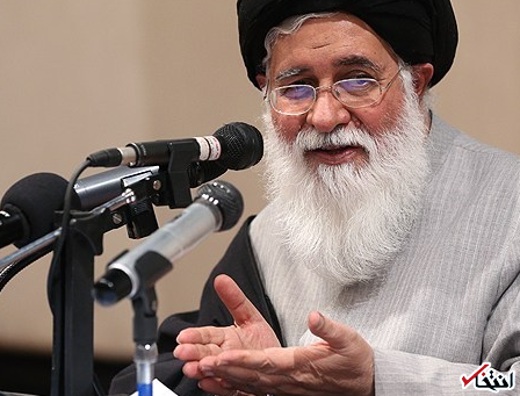
Leader has given go-ahead for talks, not friendship: Principlist cleric

Alamolhoda

Ayatollah Ahmad Alam al-Hoda, the Friday prayer leader of Mashhad and a member of the Assembly of Experts, said on Wednesday that principlists are not jockeying for position in the country; rather they insist on advancement of Islamic principles remaining the top priority of the revolution which should remain on track to further progress. The following is a partial translation of his comments as reported by Entekhab news website on February 4:

[…] What we’re saying is that officials need to take account of the ideal outlook of the revolution and run the country based on such an ideal, rather than sticking to economic matters at the expanse of the revolutionary cause.

That is the way the Supreme Leader deals with all groups and factions. They [the moderates] sought permission to hold talks and the leader granted permission for talks, and not for friendship. That they [the president’s men] mock their opponents by saying that principlists find fault with everything, including the way the foreign minister dresses, is not correct. What we are saying is that at a time when the US supported a [French] publication which released 3 million copies insulting the Prophet, our foreign minister was out for a promenade with his American counterpart.

No one questioned the stroll itself. […] Are you supposed to hold talks or strike up a friendship? We are not supposed to befriend a country with which the [Islamic] establishment has been at war for 35 years, particularly at a time when global powers are going out of their way to bring down our establishment.

We trust the government and the foreign minister because they have the leader’s backing. Opposition to them would amount to opposition to the leader. But what we are asking is whether the government is taking account of the ideal outlook of the revolution or it is just looking a few yards ahead? What we are saying is that those who are appointed government ministers should see the ideal outlook of the revolution.


Officials should run the country with an eye to bolstering the revolution. Our foreign policy should be aimed at promoting such a mentality, rather than using politics to simply advance the country’s economic agenda.

Judiciary chief stresses wide public support for Islamic establishment

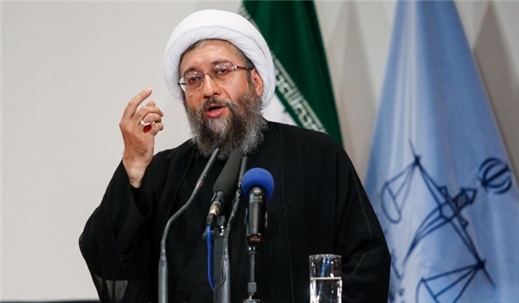
Iran’s Judiciary Chief Sadegh Amoli Larijani has underscored the failure of sanctions against Tehran, saying that the Iranian nation is firmly supporting the Islamic Republic ruling system.

“The Iranian nation is firmly determined to defend the Islamic Republic’s achievements,” Amoli Larijani said on Wednesday.

He called for massive public turnout in rallies that will be held on February 11 to celebrate the anniversary of the victory of the 1979 Islamic Revolution in Iran, and said, “By their large participation in the February 11 rallies, the Iranian nation will show to the world, especially the hegemonic powers, that plots and sanctions cannot influence these people and the Iranian people bear the hardships but never give up their divine goals.”

In relevant remarks in November, President Rouhani underlined that P5+1 (the US, Russia, China, Britain and France and Germany) had come to the conclusion that sanctions and pressures cannot halt Iran’s progress in various fields, including the nuclear technology.

“There is no doubt in the continued operation of Iran’s nuclear technology and installations and today, the negotiating sides are of this belief that pressures and sanctions against Iran don’t yield any fruit,” Rouhani said in an interview with the state-run TV.

The 10th round of negotiations between Iran and the six world powers was held in Vienna from November 18 to 24, where the seven nations decided to extend the talks until July after they failed to strike an agreement.

The latest round of the nuclear talks between the two sides was held at the level of deputy foreign ministers in Geneva, Switzerland, on January 18.

The two sides decided to continue their talk early in February.

Iran and P5 +1 have underlined that cutting a final deal before the July 10 deadline is possible.

A look at Iranian newspaper front pages on Feb. 5

Iranian Newspapers Headlines

“We don’t need nukes, we have a great, selfless nation to rely on,” was part of the comments President Rouhani made in Isfahan which dominated the front pages of Iranian newspapers on Thursday. Also on the covers of dailies were the announcement by the government spokesman that civil servants will receive almost $200 in yearend annual bonuses and the amount of fines draft dodgers will have to pay to secure exemption from military service.


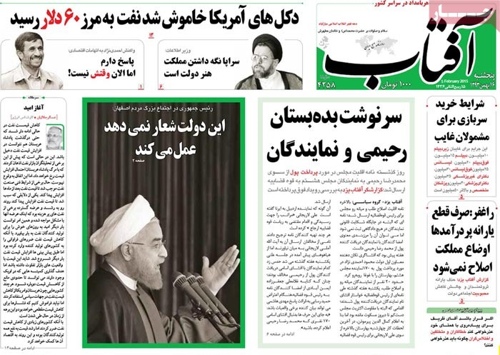
Aftab-e Yazd: “I have answers to provide, but time is not right,” said former President Mahmoud Ahmadinejad in response to corruption allegations leveled against his government.
 

Aftabe yazd newspaper 2 - 5 - 2015


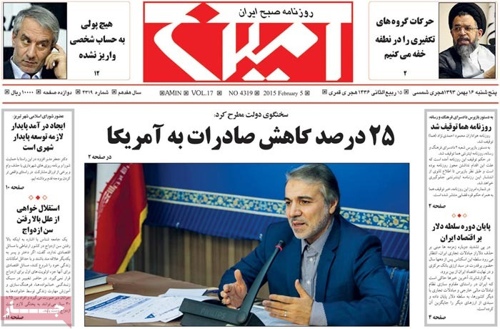
Amin: “Iran’s exports to the US are down 25 percent,” said the government spokesman.
 

Amin newspaper 2 - 5 - 2015


Arman-e Emrooz: “We do not need nuclear weapons,” President Rouhani said in a speech in Isfahan.
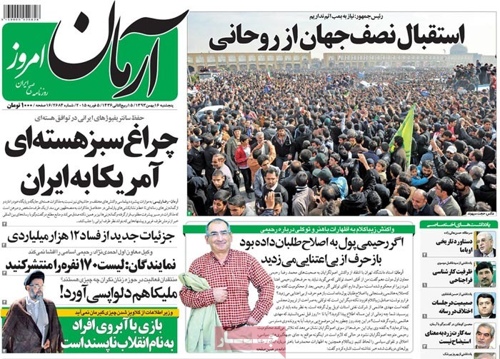
 

Armane emruz newspaper 2 - 5 - 2015


Asrar: “Ahmadinejad was a law-breaker,” said principlist MP Ahmad Tavakoli.
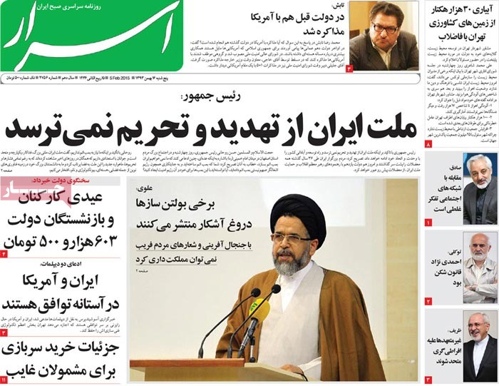
 

Asrar newspaper 2 - 5 - 2015


Eghtesad-e Pooya: “Iran’s world business ranking has improved 20 notches,” said the deputy economy minister.
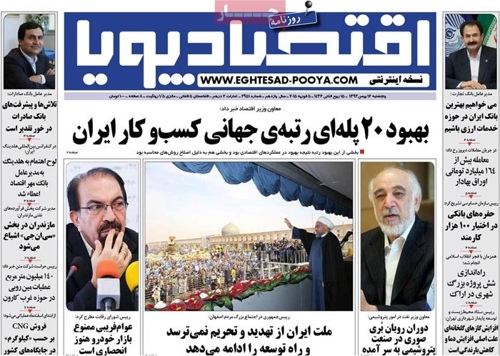
 

Eghtesade puya newspaper 2 - 5 - 2015


Emtiaz: The country’s first trash-burning power plant will be inaugurated next week.
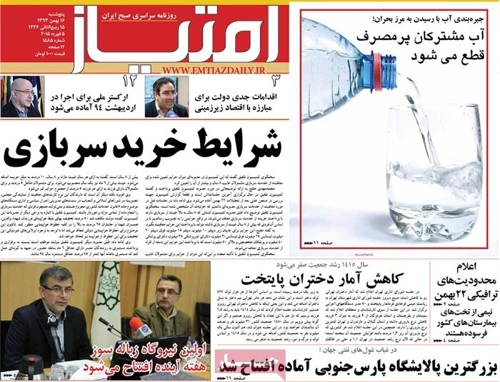
 

Emtiaz newspaper 2 - 5 - 2015


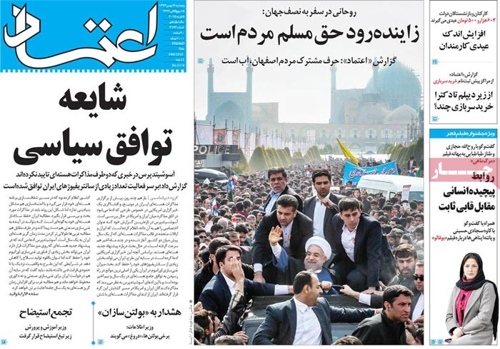
Etemad: In a report which has yet to be confirmed by negotiators from Iran and P5+1, The Associated Press said that the two sides have struck a deal over the operation of a large number of centrifuges.
 

Etemad newspaper 2 - 5 - 2015


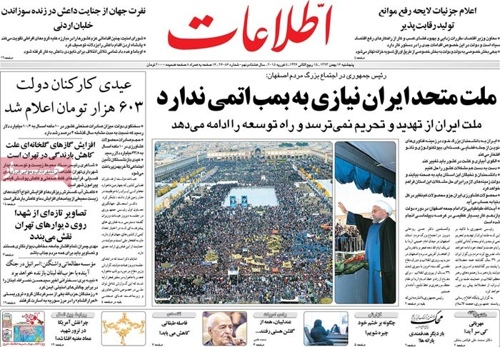
Ettela’at: “Threats and sanctions don’t frighten the Iranian nation which will remain steadfast on the path to progress,” the president told a large crowd in Isfahan.

Ettela’at: A rise in greenhouse gas levels is to blame for a lack of precipitation in the capital.
 

Ettelaat newspaper 2 - 5 - 2015


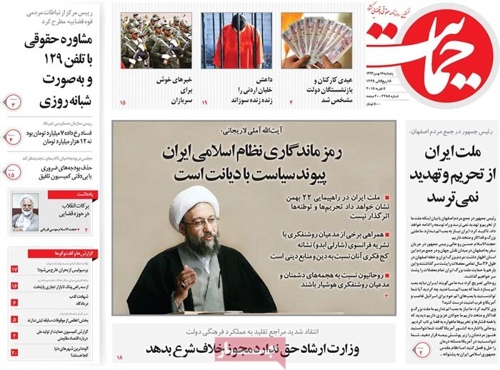
Hemayat: “The bond between politics and religiosity holds the key to the survival of the Islamic establishment,” said Judiciary Chief Ayatollah Sadegh Amoli Larijani.

Hemayat: A number of senior clerics have lashed out at the cultural performance of the government. “The Ministry of Culture and Islamic Guidance has no right to issue permission for events which are in contradiction with Sharia Law.”
 

Hemayat newspaper 2 - 5 - 2015


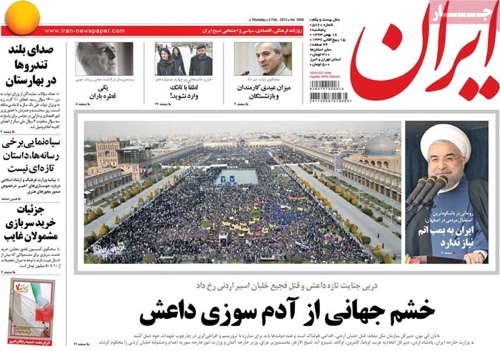
Iran: The barbaric killing of a Jordanian pilot has sparked global outrage at IS.
 

Iran newspaper 2 - 5 - 2015


Javan: “Iranian fate should be decided in Tehran, not in London or Washington,” said Gholamali Haddad Adel, [a senior principlist MP and a former parliament speaker].
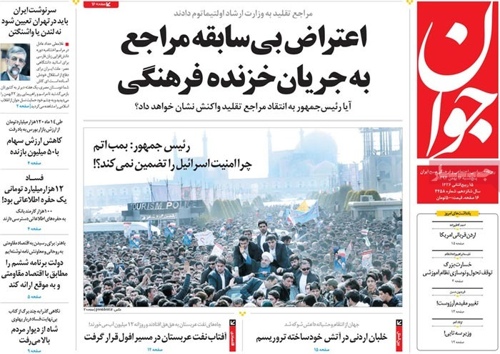
 

Javan newspaper 2 - 5 - 2015


Jomhouri Islami: Iran has strongly condemned the heinous killing of a captive Jordanian pilot at the hands of IS.
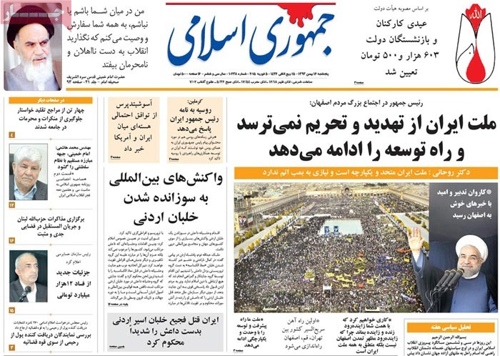
 

Jomhorie eslami newspaper 2 - 5 - 2015


Kaenat: “We are keeping an eye on every move by Takfiri groups,” said the intelligence minister.
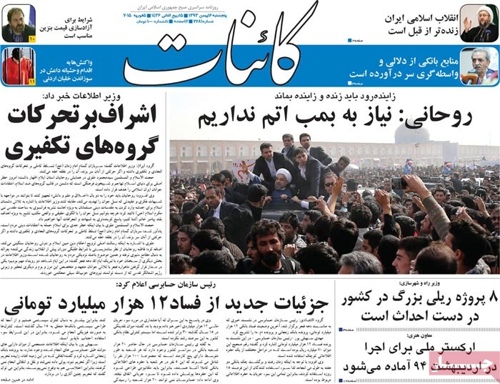
 

Kaenaat newspaper 2 - 5 - 2015


Kayhan: The go-ahead of the Ministry of Industries for imports of cigarettes has prompted MPs to summon the minister to parliament to answer some questions.
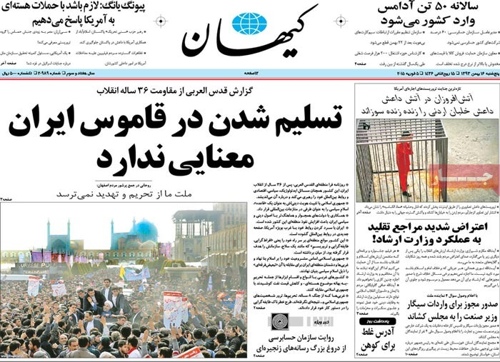
 

Kayhan newspaper 2 - 5 - 2015


Khorasan: Oil prices have jumped $9 in the recent week.
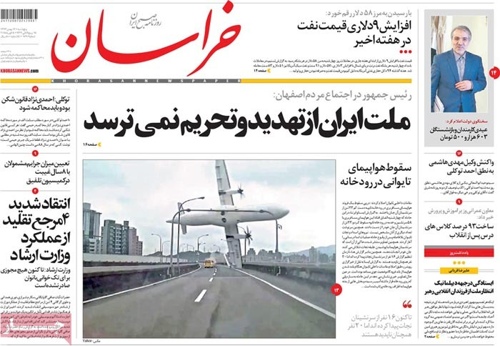
 

Khorasan newspaper 2 - 5 - 2015


Sharq: “Safe houses are to be set up to settle girls and women who are exposed to violence,” said the deputy director of the Welfare Organization of Iran.
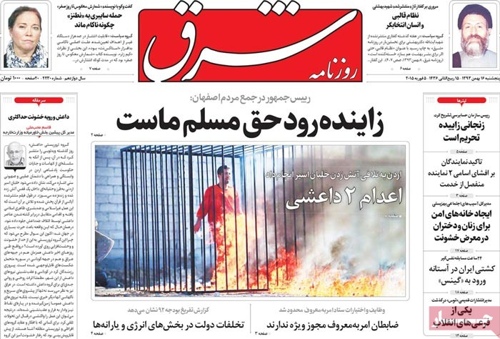
 

Shargh newspaper 2 - 5 - 2015


Siasat-e Rooz: “It’s now Saudi Arabia’s turn to show how honest it is,” said the Iranian ambassador to Riyadh.
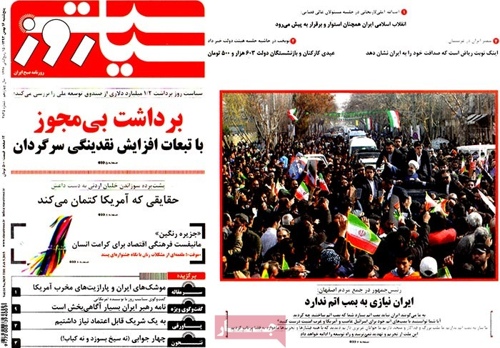

 

Siasate ruz newspaper 2 - 5 - 2015


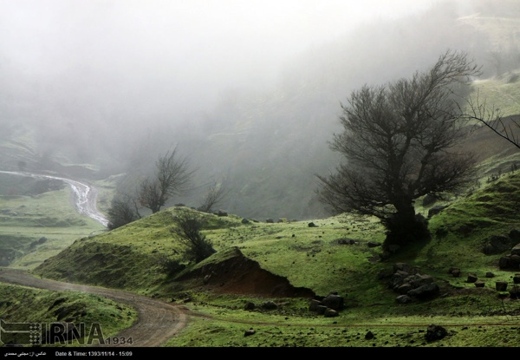
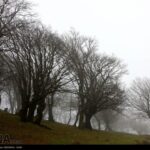
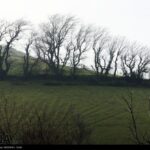
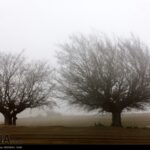
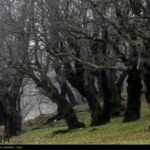
Rasht surrounded by a patch of fog (Photos)

Fog in Rasht-Iran7

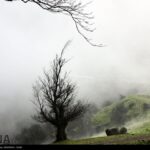
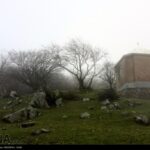
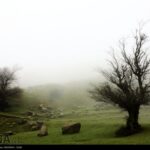
A blanket of fog has shrouded the forested areas in Rasht, the capital city of Gilan province.
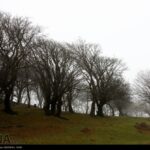
Dense fog in the dead of winter has added to the dazzling beauty of the northern city, internationally known as the “City of Silver Rains”.

The following are photos the Islamic Republic News Agency placed on its website on February 3:


Iran’s auto production up by over 60%

Iran Auto production

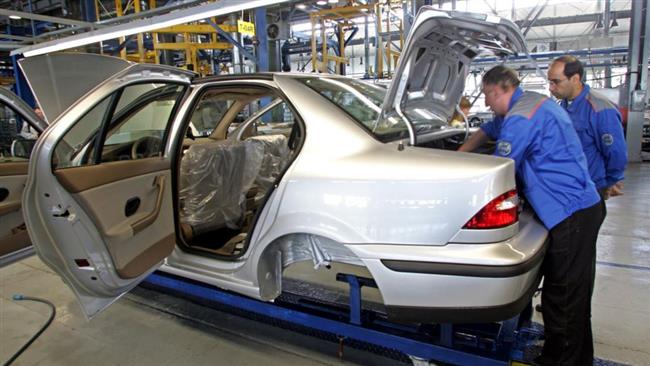
Iran’s auto industry has witnessed a sharp rise in the production of motor vehicles over the past 10 months.

Local media reports say Iranian carmakers have manufactured more than 930,000 vehicles in the first 10 months of the current Persian calendar year (which started March 21).

The figure shows a 61.6 percentage point rise, compared with the same period last year.

Iran is the second manufacturer of automobiles and automotive parts in the Middle East after Turkey, and the car industry is the second most active in the country after oil and gas.

Following the West’s sanctions against Iran over its nuclear energy program, the Iranian auto industry suffered a partial decline and major international automakers operating in Iran were forced to leave the country.

However, after the partial suspension of sanctions in the wake of Iran’s interim nuclear deal with the five permanent members of the UN Security Council – the United States, France, Britain, Russia and China – plus Germany in Geneva in November 2013, the industry witnessed a gradual growth, and giant foreign auto manufacturers, including Peugeot and Renault, expressed keenness to return to the Iranian market.

IMF calls Iran 2nd biggest economy in ME, N. Africa, Central Asia

IMF

The International Monetary Fund (IMF), in its latest report on the economic situation in the Middle East, North Africa, and Central Asia, announced that Iran has become the second biggest economy in these regions.

In the report, the IMF pointed to Iran’s $406 billion gross domestic product (GDP) in 2014, and said the country’s economy is now the second among 30 countries in the Middle East, North Africa, and Central Asia.

Saudi Arabia, with a GDP of $752 billion and the UAE with a total GDP of $401 billion rank first and third, respectively, among the countries.

The total GDP of these regions amounted to $3,459 billion in 2014, $2,579 billion of which belongs to the oil producing countries.

Given that oil prices have fallen by half over the past months, the IMP has predicted that the GDP of the oil producing countries will decrease by $303bln and stand at $2276bln.

According to analysts, the drops in oil prices are the result of a glut of supplies by certain oil producing countries such as Saudi Arabia.

Iranian officials have repeatedly said that the decline of crude oil price is not just an economic issue, but the result of a political plot hatched by certain states.

Iran seeks alternative ways to increase non-oil revenues

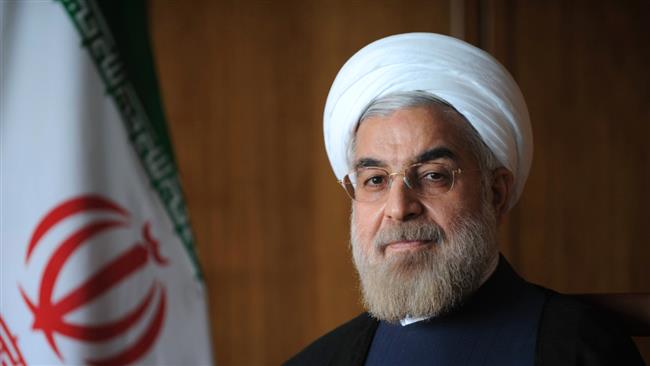
Rouhani-Iran

President Hassan Rouhani has highlighted the country’s need for alternative ways of boosting its non-oil revenues.

Rouhani said on Wednesday that Iran should invest more in new technologies and related areas to that end.

He also said his administration was set to develop Iran’s foreign policy in the next Persian calendar year (starting March 21) so that the country will witness better conditions.

His comments came at a gathering of business entrepreneurs in the central province of Isfahan, where he called for more investment in the local tourism industry.

The Iranian president further noted that his cabinet has managed to curb the country’s inflation rate and lower it from a 40 percent peak almost two years ago to around 16 percent.

Official figures confirm that the country’s economy has attained positive growth for the first time in two years.

Recent figures by the Central Bank of Iran show the economy expanded 4.6 percent in the first quarter of the current Iranian calendar year (started March 21, 2014).