Monday, April 13, 2026
Home Blog Page 4952

FM reiterates inefficiency of sanctions policy against Iran

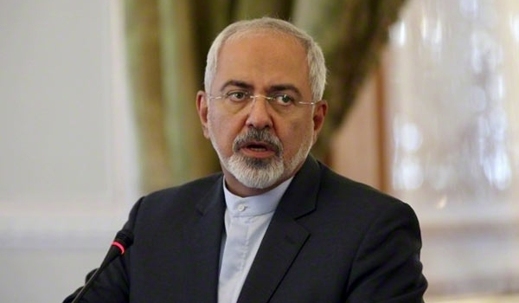
Fm Zarif

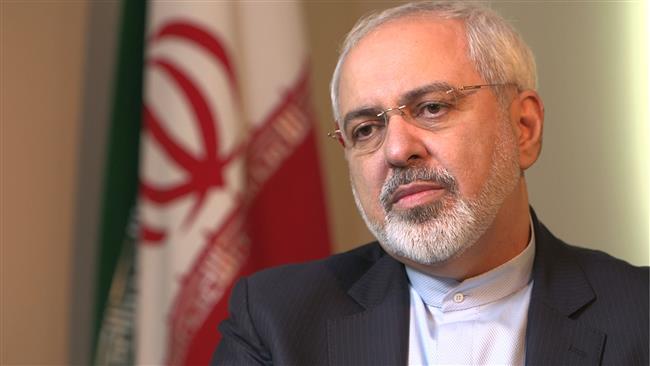
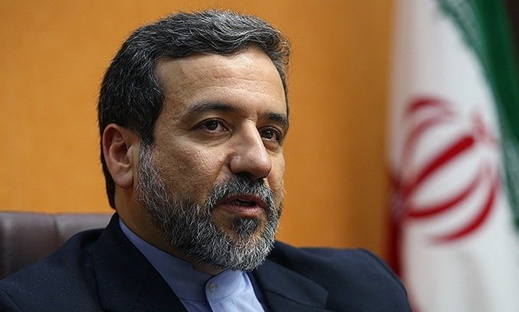
Iranian Foreign Minister Mohammad Javad Zarif reiterated that the only way out of the decade-long nuclear standoff between Iran and the West is dialogue and not sanctions since pressures can only deteriorate the case.

“If they really think that their sanctions are effective, then why do they negotiate with us? They can continue their sanctions on Iran,” Zarif told reporters on Friday.

He also reiterated that respect and negotiations are the only way which would lead to fruitful results in dealing with Iran, adding Iran wants to prove that its nuclear program is merely for peaceful purposes.

On Wednesday, Iran’s Supreme Leader Ayatollah Seyyed Ali Khamenei warned of the arrogant powers’ plots to impede Iran’s progress in different scientific and technological fields, and said even if Tehran accepts all the demands of the world powers in the nuclear standoff, the Western states would never remove their sanctions against the country.

“Their main goal of such measures (sanctions) is humiliation of the Iranian nation and stopping the nation and Islamic Republic’s great move towards a new Islamic civilization, and I believe that even if we accept the demands that they (want to) dictate on us in the nuclear issue, the sanctions will not be removed since they are opposed to the (Islamic) Revolution in essence,” Ayatollah said in Tehran, addressing a large number of visiting Iranians from East Azerbaijan Province.

He blasted US threats and the European states’ obedience to the US policies, and said, “If sanctions are to be imposed, the Iranian nation too can slap sanctions (on them), and it will do so.”

Iran atomic energy head to join Geneva nuclear talks

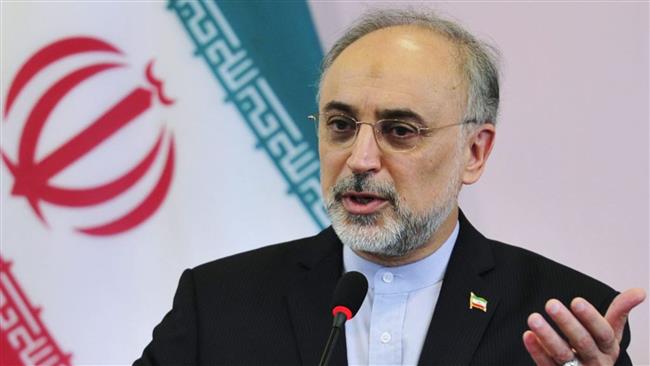
Ali Akbar Salehi-1

According to Behrouz Kamalvandi, the spokesman for Iran’s Atomic Energy Organization, Ali Akbar Salehi will leave Tehran for Geneva Saturday morning to meet US Energy Secretary Ernest Moniz.

Salehi will hold talks with Moniz to discuss “the technical issues” of nuclear negotiations between Iran and P5+1, Kamalvandi added.

Salehi is also scheduled to meet his Swiss counterpart, reports said.

On Friday, representatives from Iran and the United States started a fresh round of intensive talks on Tehran’s nuclear program in Geneva to narrow remaining gaps ahead of the March 31 deadline for a final agreement.

Iran’s Deputy Foreign Minister for Legal and International Affairs Abbas Araghchi and US Under Secretary of State for Political Affairs Wendy Sherman held talks on Friday.

Iran’s Foreign Minister Mohammad Javad Zarif and US Secretary of State John Kerry are scheduled to join the talks on Sunday and hold discussions for two days.

The negotiations will focus on the timetable for the lifting of sanctions against Iran as well as the extent of Tehran’s nuclear activities.

Iran and P5+1– Britain, France, China, Russia, the US and Germany – are seeking to seal a high-profile political deal by the end of March and to confirm the full technical details of the accord by July 1.

The scale of Iran’s uranium enrichment and the timetable for the removal of anti-Iran sanctions are seen as the major stumbling blocks in the talks.

Iran has so far suspended some of its enrichment program in return for certain sanctions relief.

A look at Iranian newspaper front pages on Feb. 21

Iranian Newspapers Headlines

Resumption of talks with the US in Geneva over Iran’s nuclear program dominated the front pages of Iranian dailies on Saturday. Foreign Minister Zarif’s comments that the US should opt for either talks or sanctions were in the headlines too. And reformist-leaning newspapers put on their front pages the comments of the grandson of the late Imam Khomeini on freedom, independence and religiosity.


Abrar: [Iranian Deputy Foreign Minister Abbas] Araghchi will meet with [IAEA chief] Yukiya Amano next week.

Abrar: Before talks with John Kerry, Foreign Minister Zarif will have a meeting with [his British counterpart] Philip Hammond.

Abrar: “Iran is among the world’s top 10 countries when it comes to building destroyers,” said the Iranian Navy commander.
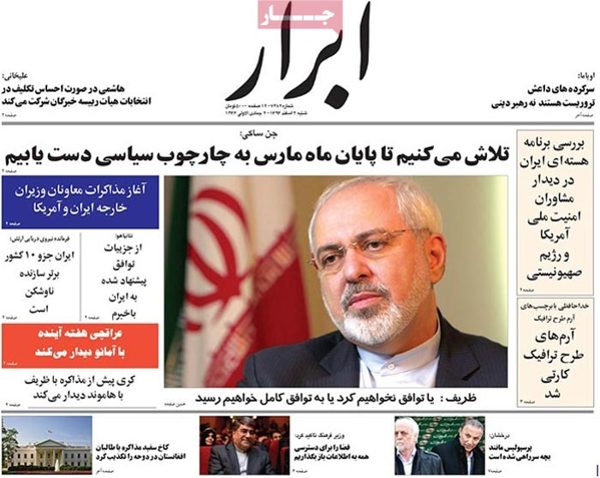
Abrar newspaper 2 - 21- 2015


Abrar-e Eghtesadi: Imports of diesel have stopped.
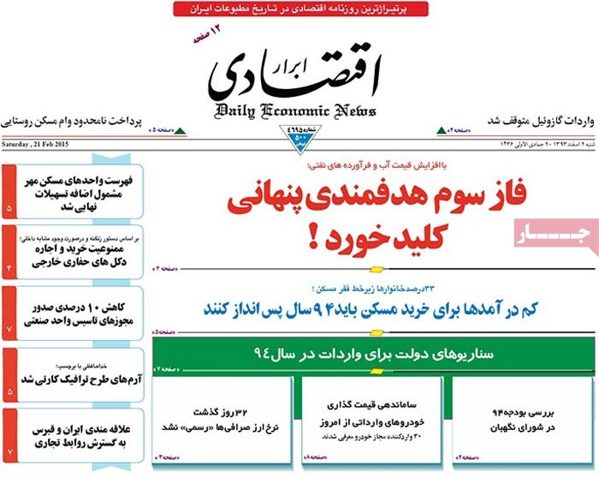
 

Abrare eghtesadi newspaper 2 - 21- 2015


Aftab-e Yazd: The Supreme Court has overturned a death sentence issued against Gholamhossein Khaledi, a park ranger.
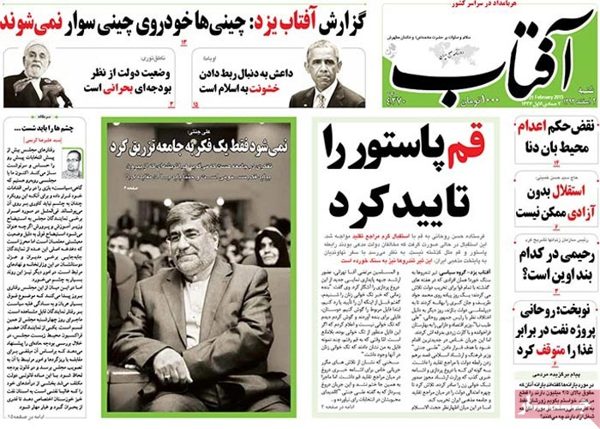
 

Aftabe yazd newspaper 2 - 21- 2015


Arman-e Emrooz: The grandson of the architect of the Islamic Republic has said that the late Imam shattered the idol of backwardness by issuing religious edicts on chess and music.
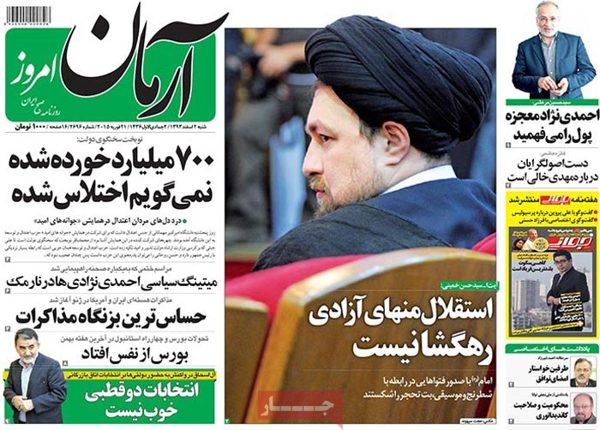
 

Armane emruz newspaper 2 - 21- 2015


Ebtekar: A wave of precipitation is sweeping the country. Snow is in the forecast for Tehran on Saturday.
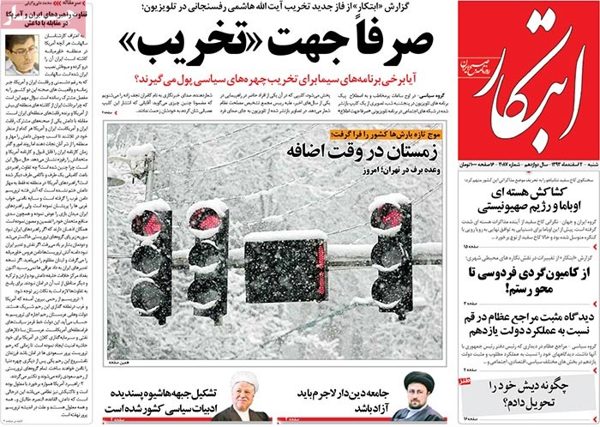
 

Ebtekar newspaper 2 - 21- 2015


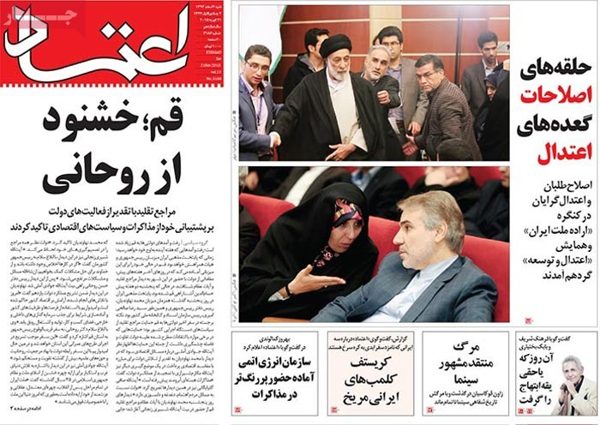
Etemad: The Atomic Energy Organization of Iran says it stands ready to have a more active presence in nuclear talks with P5+1.

Etemad: Qom is satisfied with Rouhani.

Senior Shiite clerics based in the holy city of Qom have praised the performance of the government and thrown their weight behind its economic policy as well as nuclear talks with P5+1.
 

Etemad newspaper 2 - 21- 2015


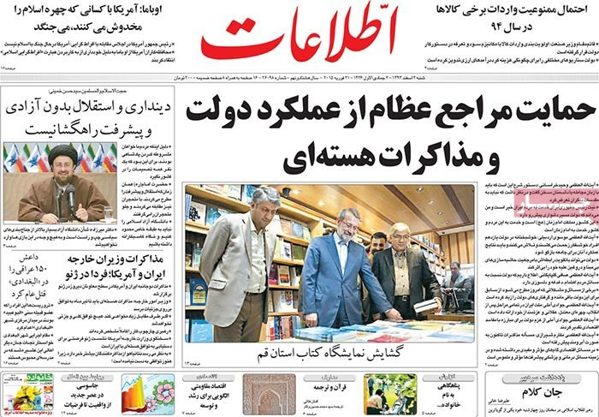
Ettela’at: A ban may be slapped on imports of certain products next year [starts late March 2015].

Ettela’at: “In the absence of freedom and progress, independence and religiosity won’t lead anywhere,” said Seyyed Hassan Khomeini.
 

Ettelaat newspaper 2 - 21- 2015


Farhikhtegan: Famous Iranian film critic and director Zaven Ghookasian has passed away.
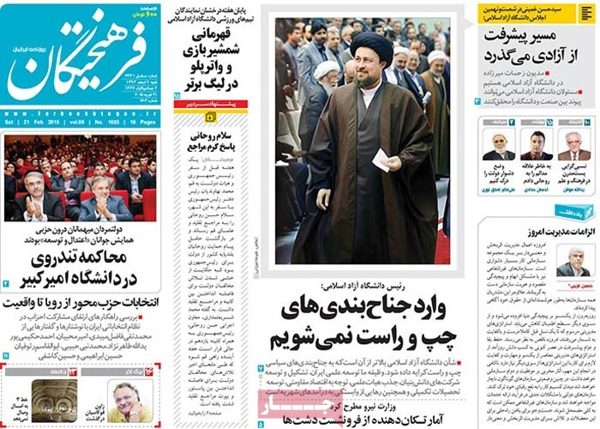


Farhikhtegan newspaper 2 - 21- 2015


Haft-e Sobh: Temperatures in Tehran will plunge below zero Saturday night.
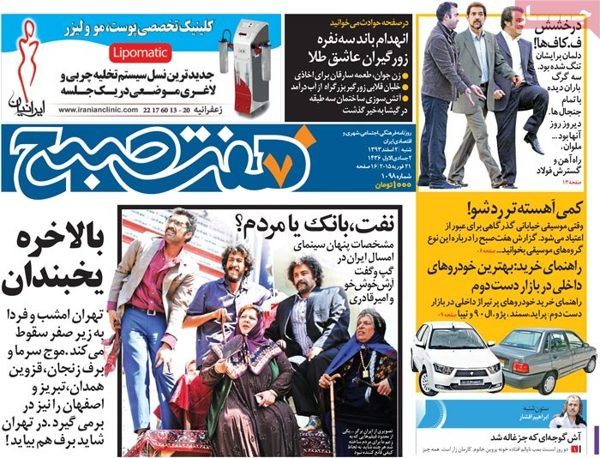
 

Hafte sobh newspaper 2 - 21- 2015


Iran: The president’s chief of staff has said that government takes account of the views of senior clerics in its decisions.
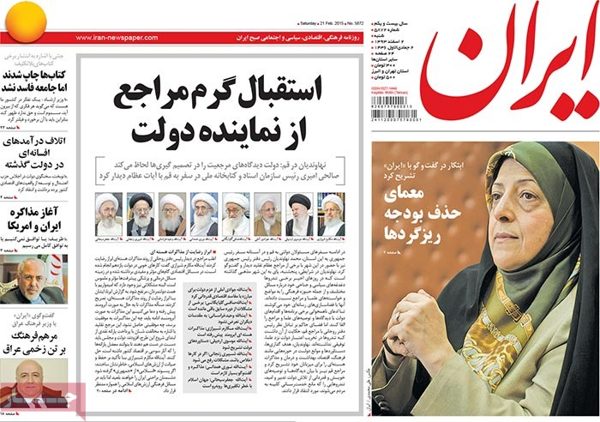
 

Iran newspaper 2 - 21- 2015


Jahan-e Eghtesad: “We’ll agree either on everything or nothing,” said Foreign Minister Mohammad Javad Zarif.
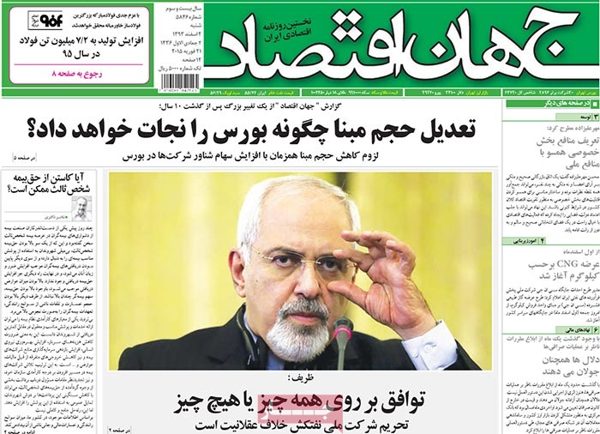
 

Jahane eghtesad newspaper 2 - 21- 2015


Jamejam: A new Support for Family law has taken effect.
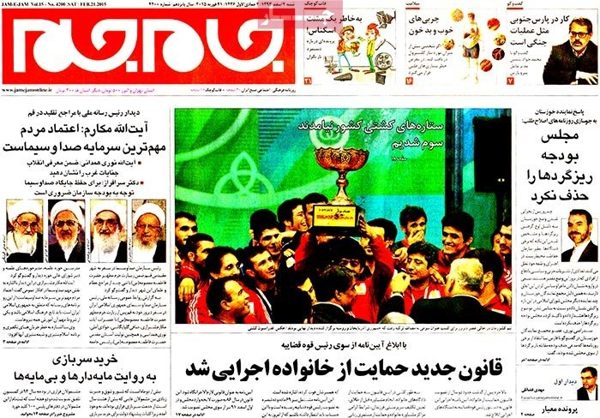
 

Jame jam newspaper 2 - 21- 2015


Jomhouri Islami: Phase 12 of South Pars gas field is complete and ready for inauguration.
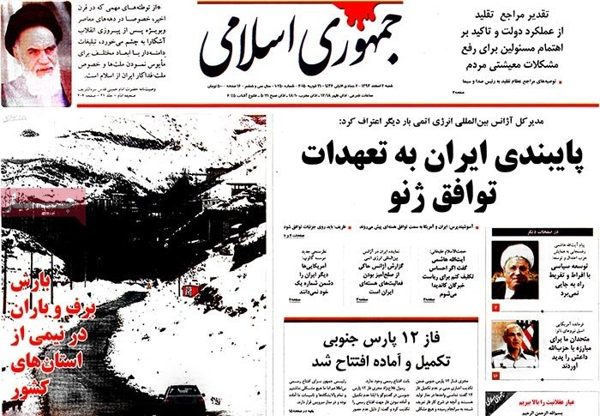
 

jomhorie eslami newspaper 2 - 21- 2015


Kaenat: Natural gas exports to Iraq and Turkey have earned Iran $7 billion in foreign revenues.
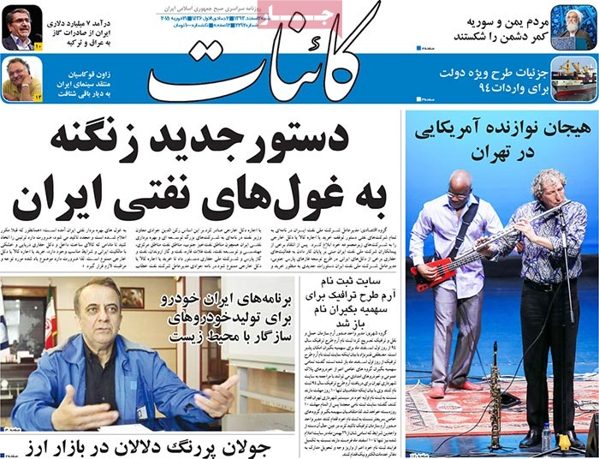
 

Kaaenaat newspaper 2 - 21- 2015


Kayhan: “Officials should not be indifferent toward cultural issues in society,” said Tehran Friday prayer leader.

Kayhan: “Either sanctions or talks, the US needs to choose one,” said FM Zarif.
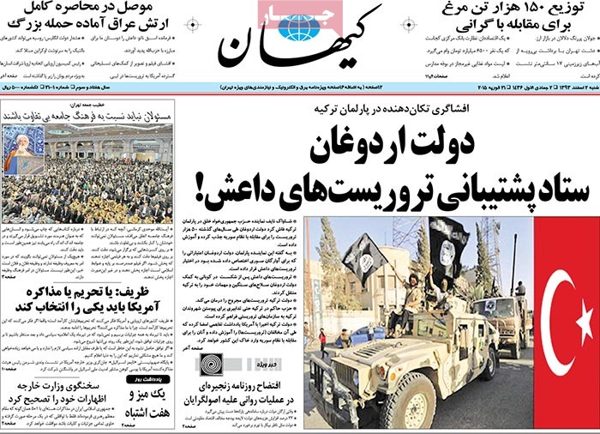
 

Kayhan newspaper 2 - 21- 2015


Khorasan: “ISIS got started through funding from our friends and allies,” said one-time NATO Supreme Allied Commander Wesley Clark.

Khorasan:Defending champions Iran have finished third in the world Greco-Roman Wrestling competitions.
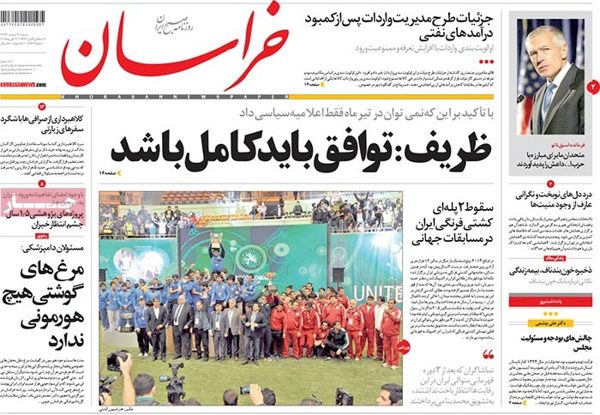
 

Khorasan newspaper 2 - 21- 2015


Mardomsalari: “The leader is in on the details of the talks,” said Mohammad Javad Zarif.
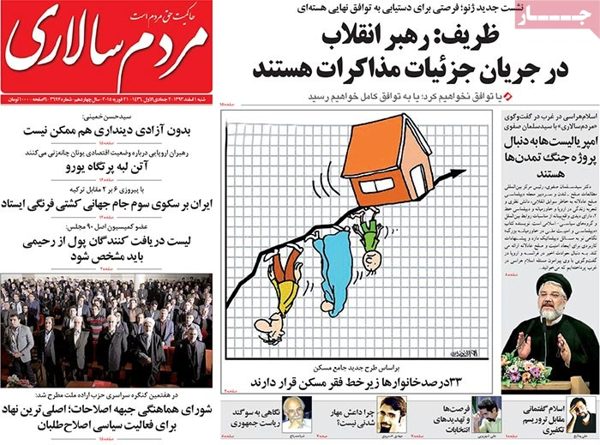
 

Mardom salari newspaper 2 - 21- 2015


Resalat: “Bahrain has sent arms to terrorist groups in Iran,” said Allaeddin Borujerdi, the chairman of Parliament’s National Security and Foreign Policy Committee.
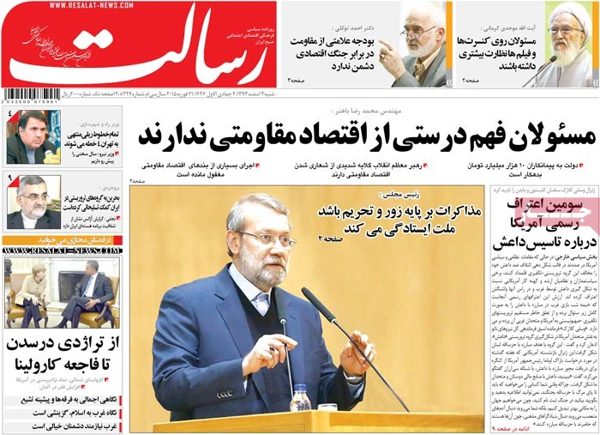
 

Resalat newspaper 2 - 21- 2015


Sharq: President Rouhani has called for formulation of a national document on water resources in the east of the country.
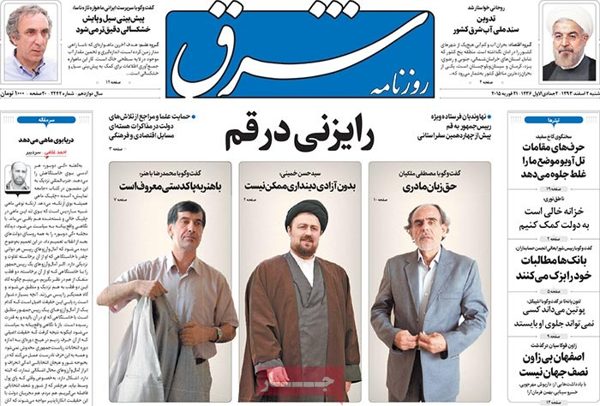
 

Shargh newspaper 2 - 21- 2015


Tafahom: “Next year’s budget relies more on oil than before,” said Tehran MP Ahmad Tavakoli.
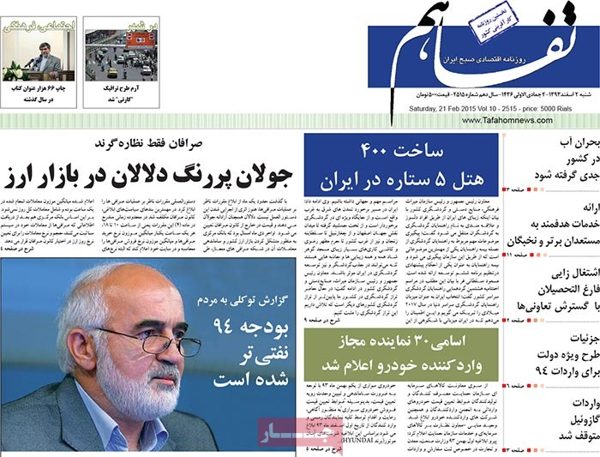
 

Tafahom newspaper 2 - 21- 2015


Iran should keep pace with global developments

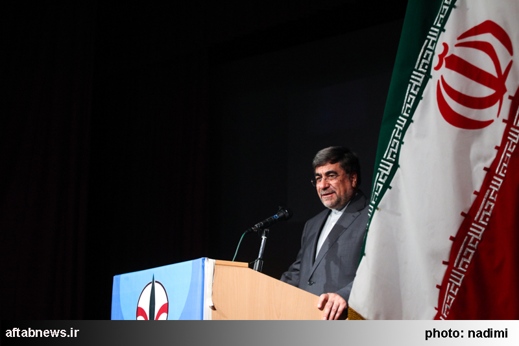
Ali Jannati

The minister of culture and Islamic guidance has said that development should take place in parallel on cultural, political and economic fronts.

Speaking in a congress of the Moderation and Development Party Thursday, Ali Jannati said that the world is undergoing technological and economic changes, and we need to learn about global developments in order to keep pace with them and tap into all available tools to secure progress.

There are two mindsets in Iran, although they may be in pursuit of one single goal which is the promotion of Iranian-Islamic culture, he said.

“One says people should be given access to information through satellite TV, press and social networking sites, so that they could choose what they deem is the right way of thinking. The other says any idea coming from outside the country is poisonous and should be countered. It argues that if a way of thinking comes in via satellite TV channels, it should be jammed, and if it is online, it should be blocked,” the minister said.

Jannati further said, “The [eleventh] government believes we should protect the younger generations from the ill effects of certain imports, but we should let people have access to information in an open atmosphere.”

As for the press, the culture chief said that unethical items and materials which are against national security and [religious] sanctities should be blocked, but pundits can [openly] speak their mind so that people can follow the things they choose.

It is impossible to simply inject one idea into society, Jannati said, adding that some think their ideas are divine revelations and only what they think should be taken into account, but we do not share that view.

The minister further said those who have new ideas can pen books, although some issues are off-limits under the law.

“Pundits should be allowed to express what they think. Over the past 18 months many books which were rejected [by the previous government] have been given the go-ahead to be printed and that has not corrupted our society,” he concluded.

EU move to re-impose bans defies logic: Iran FM

Mohammad Javad Zarif

Iranian Foreign Minister Mohammad Javad Zarif says the European Union’s move to put the country’s biggest tanker firm back on its sanctions list defies logic.

“Their move is against logic because the West has not yet realized that sanctions are a kind of liability rather than an asset for them, [with] which they cannot advance their objectives,” Zarif told Mehr news agency.

On February 12, European Union governments agreed to put Iran’s biggest tanker firm back on a list of sanctioned companies.

The EU move to put back the Iranian company on its sanctions list comes as Iran and the P5+1 group of countries – Russia, China, France, Britain, the US and Germany – are in talks to reach a comprehensive final agreement on Tehran’s nuclear program.

Zarif said that a serious deal would seem unlikely as long as the US and EU regard sanctions as an effective way to press ahead with their objectives.

“If they really think that their sanctions are effective, [then] why do they negotiate with us? They [can] continue their sanctions,” he added.

Iran’s nuclear talks

Zarif reaffirmed Iran’s stance that a nuclear deal would be reached only if the two negotiating sides agree on all issues.

He said that the two sides can reach a comprehensive agreement once certain key issues are settled.

“In my opinion, we should definitely agree on all details by [Iranian calendar month of] Tir (beginning June 22). We cannot simply issue a political statement in Tir and then wait to agree on details. That would be an endless process that benefits no one,” Zarif said.

The senior Iranian official once again stressed that a comprehensive nuclear agreement would be possible if the opposite side demonstrated political will.

“If an agreement cannot be reached, it is because the other side lacks the political will to do so or because it cannot stand up to the Zionist lobby and pressure groups or because it wants to make excessive demands,” Zarif said.

Since an interim deal was sealed in the Swiss city of Geneva in November 2013, the negotiating sides have missed two self-imposed deadlines to ink a final comprehensive agreement over Tehran’s nuclear program. Iran and the P5+1 have set July 1 as the deadline for their current talks.

European concerns over Iran are groundless

Yuri Honing

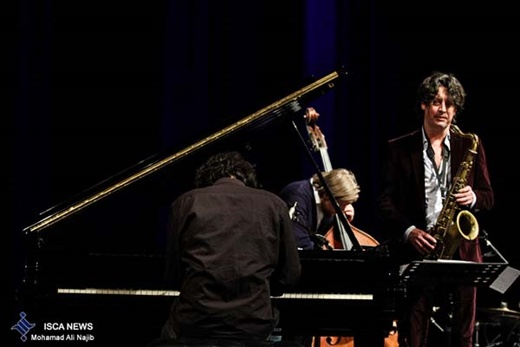
Yuri Honing, a Dutch jazz saxophonist who performed a quartet at Tehran’s Vahdat Hall on February 15 during the 30th edition of Fajr International Music Festival, has been quoted by Iscanews.ir as saying that his interest in Iran’s culture and its remarkable history has been the reason behind his visit to Tehran, adding the Europeans do not have a clear understanding of the Middle East, history and civilization of a country like Iran.

On the European tour of his band to mark the anniversary of 9/11 attacks, the distinguished Dutch musician said, “Widespread concern was felt throughout Europe, so it was time to go on a tour with my band. Our attention was focused on music and humanity. I was then introduced to an Iranian artist by a member of this band; that was how I learned about Iran’s annual music festival.”

Honing added, “Iran had captured my attention quite a while ago. Because it was home to those who speak Persian and I had read different things about its history. In Europe people confuse things. To them, Turkey is part of Europe. They do not know that the Middle East stretches from the west of Egypt to the north of Iraq.”

Highlighting that a majority of people in Europe do not have an accurate understanding of the Middle East and the Iranian civilization and history, he stated, “It’s hard for the Europeans to draw a line between different cultures of Middle Eastern countries. […] What one hears and reads about the Middle East in Europe does not conform to realities on the ground, including in Iran.”

Honing, a progressive musician in Europe, described his music as a combination of different styles of art music from Baroque to Rock.


Islamic establishment treats those under house arrest with tolerance

Mohammad Javad Larijani

The secretary of Iran’s Human Rights Council has said that the Islamic establishment has exercised tolerance in dealing with those who have been placed under house arrest [a reference to Mehdi Karroubi and Mir-Hossein Mousavi, two presidential candidates who disputed the 2009 election results and caused widespread unrest in the country].

Mohammad Javad Larijani, who was in Lorestan Province, said there is a lot of evidence pointing to commission of offenses in the case involving people who are under house arrest. [In order to put someone under house arrest] Either a judge’s order is necessary, or the Supreme National Security Council decides on the issue.

The following is a partial translation of the human rights official’s remarks as reported by Entekhab, a news website, on February 18:

As the judiciary chief has already said, putting people under house arrest should come through legal channels. One such channel is that a file is lodged [against individual(s)] in a court of law and a judge issues a verdict in the case.

The other channel is specifically for security cases. Under the law, if the Supreme National Security Council deems it necessary – on any grounds – to limit the freedom of an individual or a group to promote national security, it can communicate its decision to different government branches, among them the judiciary, and they have to act on the council’s decision.

Naturally, there is a lot of evidence pointing to commission of offenses in the case of people under house arrest, but it can be dealt with only through these two channels.

The house arrest of these individuals is quite legal and it has gone through the channel of the Supreme National Security Council.

I have not met with them [the people under house arrest]. Naturally, we do not hold personal grudges against individuals, especially those who have served the country in the past. The establishment normally treats them with tolerance.

The onus is on the security apparatus to protect these individuals. Nothing has gone wrong. They can even make trips to different parts of the country; they have access to medical services as well.

The services these people have rendered [in the country] have been always taken into account. But when a person commits offenses they should take responsibility for what they have done, even though they have served [the country].

Official: Moderation brings down curtain on certain groups

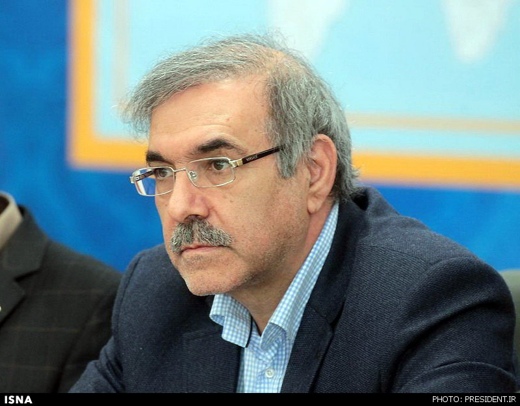
Morteza Bank

An official at the Presidential Office has said that the youth should not allow to be affected by extremist groups and those who think that the revival of moderation would sound their death knell.

Morteza Bank, Vice President for Supervision and Strategic Affairs, said in a congress of the Moderation and Development Party on Thursday despite the emergence of groups such as ISIL [which have hijacked the Muslim faith], Islam pursues moderation.

No extremist group can institutionalize extremist acts in the name of Islam in the country, he said.

He added that those who think development and conclusion of agreements with [the rest of] the world is dangerous for Iran defy the existing trend in the country [a reference to the policy of moderation and interaction].

Kerman qanats up for global registration

Kerman Qanats

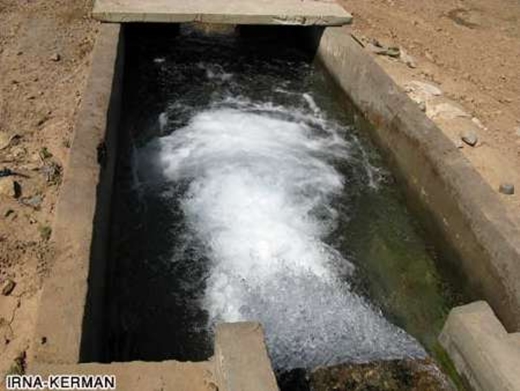
A deputy director of the Kerman provincial Cultural Heritage, Handicrafts and Tourism department has said that dossiers of three qanats in Kerman dating back to a century ago have been submitted to UNESCO for registration on global heritage list.

Mohsen Movahhedi said that Kerman is one of the historic provinces of the country with valuable qanats.

Since Jupar, Akbarabad and Qasemabad Baravat qanats seem qualified for global registration, their cases have been sent to UNESCO, he said.

Movaheddi also said that qanat is considered a valuable global heritage founded by Iran.

Extracting underground waters through qanats is one of the wonderful inventions by mankind which has played a crucial role in Iran’s agriculture since ancient times, he said.

Most of the historians and researchers have attributed the technology of qanat building to Iranians and consider Iran as the birthplace of qanats, he said.

Qanat is one of a series of well-like vertical shafts, connected by gently sloping tunnels. They create a reliable supply of water for human settlements and irrigation in hot, arid and semi-arid climates.

Iran, US to begin fresh nuclear talks Feb. 20: Iran negotiator

Abbas Araghchi

A senior Iranian negotiator says Iran and the United States will kick off a fresh round of talks on Tehran’s nuclear program in the Swiss city of Geneva on February 20.

The negotiations will begin on Friday when deputy foreign ministers from Iran and the US will hold talks on the Islamic Republic’s nuclear program, said Iranian Deputy Foreign Minister for Legal and International Affairs Seyyed Abbas Araghchi.

Araghchi further noted he and Iran’s Deputy Foreign Minister for European and American Affairs Majid Takht-e-Ravanchi will sit down with a US delegation headed by Under Secretary of State for Political Affairs Wendy Sherman.

The talks between the deputy foreign minister will continue on Saturday, Araghchi said, adding, “On Sunday and Monday, Iran’s Foreign Minister Mohammad Javad Zarif and US Secretary of State John Kerry will join the negotiators and the talks will continue” between the delegations from the two countries.

“It is also likely that after the fourth day [of bilateral talks between Iran and the US] the negotiations are held at P5+1 level,” Araghchi added.

Sherman and her team will travel to Geneva, Switzerland, on Thursday to hold negotiations with Iranian officials, the State Department said on Wednesday.

“These bilateral consultations will take place in the context of the P5+1 nuclear negotiations with Iran,” it added.

Iran and P5+1 – Russia, China, France, Britain, the United States and Germany – are seeking to seal a high-profile political deal by the end of March and to confirm the full technical details of the accord by July 1.