Sunday, December 28, 2025
Home Blog Page 4908

Vienna talks based on Iran’s plans, initiatives

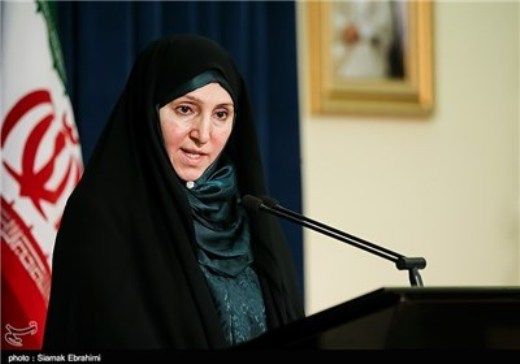
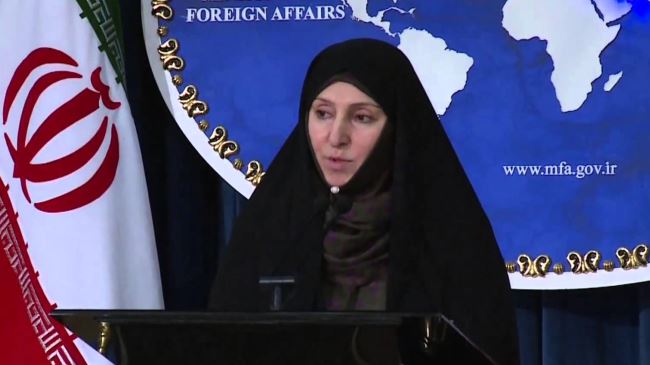
Marzieh Afkham

Iran’s Foreign Ministry says no new proposals have been offered by P5+1 during nuclear talks in Vienna and Iran was the sole party putting new initiatives on the table.

“During the past three days, intense and numerous bilateral and multilateral talks have been held based on multiple plans and initiatives offered by Iran’s negotiating team…[during previous talks] in Omani capital, Muscat,” Iran’s Foreign Ministry Spokeswoman Marzieh Afkham said on Friday.

She added that negotiations between the two sides will continue at various expert and political levels.

“No new plans have been offered by the member states of P5+1,” Afkham emphasized.

On Friday, Iran’s Foreign Minister Mohammad Javad Zarif said despite extensive negotiations between Iran and P5+1 in the Austrian capital, Vienna, the group did not offer any significant proposals to Iran.

“There were many discussions during Vienna negotiations, but there were no new ideas and no significant proposal that I could take to Tehran,” Zarif told reporters in Vienna.

Zarif met with US Secretary of State John Kerry and EU coordinator, Catherine Ashton, on Friday. The meeting was part of the negotiations between Iran and P5+1 – the US, Britain, France, Russia, China and Germany – to work out a final deal aimed at ending the longstanding standoff over the Islamic Republic’s nuclear energy program.

Sources close to the Iranian negotiating team say the main stumbling block in the way of resolving the dispute over Iran’s nuclear energy program remains to be the removal of all the bans imposed on the country, and not the number of Iran’s centrifuges or the level of uranium enrichment.

Tehran wants the sanctions entirely lifted while Washington, under pressure from the pro-Israeli lobby, insists that at least the UN-imposed sanctions should remain in place.

Over 270 Tons of Narcotics Seized by Police in Iran in 7 Months

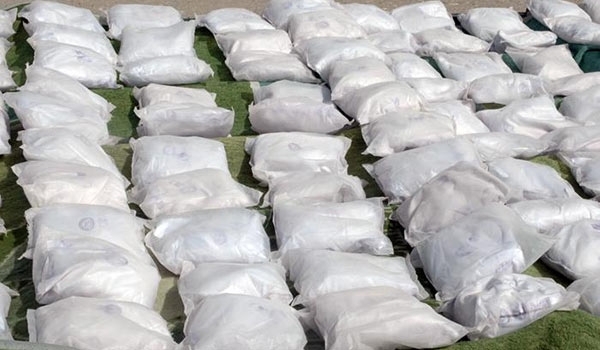
Narcotics Seized by Police in Iran

“The Iranian police have seized 272 tons of narcotics during March 21-October 22 period,” Deputy Head of Iran’s Anti-Narcotics Council Babak Dinizadeh told reporters on Thursday.

He reiterated that 179,000 drug traffickers were arrested and 3,654 drug gangs were also busted in the seven-month period.

Dinizadeh noted that the number of those arrested in thisperiodfor drug-related crimes showed a considerable rise compared with the corresponding period last year.

Earlier this year, Iranian Police Commander Esmail Ahmadi Moghaddam announced that the drug squads of Iran’s law enforcement forces had seized a sum of 500 tons of illicit drugs in the last Iranian year (ended March 20, 2014).

He noted that the amount of illicit drugs seized last year had shown a 14 percent increase as compared with the figures of the year before.

Iran’s geographical position has made the country a favorite transit corridor for drug traffickers who intend to smuggle their cargoes from Afghanistan to drug dealers in Europe.

Sistan and Balouchestan Province, where Iran, Pakistan and Afghanistan come together, has porous borders andbandits and drug traffickers there operate despite frequent entanglements and intense efforts of the Iranian law enforcement police.

Iran has recently established a central database and strengthened police-judiciary cooperation in a new effort to combat organized crime.

Nearly 4,000 Iranian security personnel have been killed fighting drug smugglers since Iran’s 1979 Islamic Revolution.

The Iranian anti-narcotic police have always staged periodic, but short-term, operations against drug traffickers and dealers, but latest reports – which among others indicate an improved and systematic dissemination of information – reveal that the world’s most forefront and dedicated anti-narcotic force (as UN drug-campaign assessments put it) have embarked on a long-term countrywide plan to intensify the crackdown on the drug trade since the beginning of the current Iranian year (started on March 21).

According to official estimates, Iran’s battle against drugscoststhe country around $1 billion annually. Strategies pursued by Tehran include digging canals, building barriers and installing barbed wire to seal the country’s borders, especially in the East.

Iran has long complained that the global community, especially the Western nations, does not play their role in the campaign against drugs, saying that Iran is makingefforts to block the transit of narcotics from Afghanistan to Europe and the US. Meantime, the Iranian police officials maintain that drug production in Afghanistan has undergone a 40-fold increase since the US-led invasion of the country in 2001.

While Afghanistan produced only 185 tons of opium per year under the Taliban, according to the UN statistics, since the US-led invasion, drug production has surged to 3,400 tons annually. In 2007, the opium trade reached an estimated all-time production high of 8,200 tons.

Ali Akbar Salehi: Iran does not allow ‘special’ inspection of nuclear sites

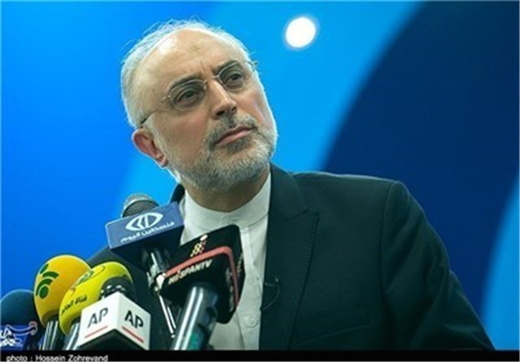
Salehi

Head of the Atomic Energy Organization of Iran (AEOI) Ali Akbar Salehi has said that Iran does not allow ‘special’ inspections by the International Atomic Energy Agency (IAEA) of its nuclear facilities, Tasnim News Agency reported on November 20.

“We will not accept any special inspection or process (exclusive to Iran’s nuclear program),” Salehi said on a TV news bulletin on Wednesday.

He said that Iran has inked the nuclear Non-Proliferation Treaty (NPT) and has been implementing its Additional Protocol for two and a half years.

Salehi further said that over 7,000 man-hours of inspections of Iran’s nuclear facilities have been carried out by IAEA experts and cameras installed at Iranian nuclear sites monitor them round the clock.

He stated that the AEOI has grown on technical, industrial and scientific fronts and its various products have begun to hit the market, adding that the country is seeking to employ nuclear energy for agricultural, industrial and medicinal purposes.

Salehi went on to say that the AEOI is building centrifuges for the health sector which will be unveiled on April 9 [The National Nuclear Technology Day], adding that one of those centrifuges is to be handed over to the Health Ministry soon.

He further said that the AEOI has produced radio drugs for medical purposes, adding that the radio isotopes developed by Iran can help treat 800,000 patients on an annual basis.

He also rejected reports that Iran has agreed to ship its nuclear fuel to other countries, including Russia, saying that Tehran and Moscow have inked protocols and agreements to have further nuclear cooperation.

The atomic chief further said that as many as 1,000 experts are working in the Bushehr Nuclear Power Plant [in southern Iran] and added the Bushehr plant is at a satisfactory level in terms of human resources.

The students who are majoring in related fields in universities should not be concerned about their future jobs, Salehi said, citing a new partnership agreement between Iran and Russia [to build eight nuclear power units in Iran].

The nuclear technology is the point where all other sciences such as mechanics, chemistry, metallurgy, physics and mathematics are employed [for a singular purpose], he said.

I hope the West does not dissuade Iran from cooperation

Ali Larijani
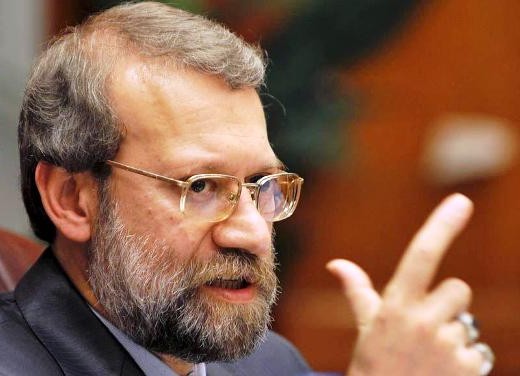
Ali Larijani

Speaker of the Islamic Consultative Assembly Ali Larijani said that Iran does not buy claims by the Americans that the US Congress is throwing obstacles in the way of the [Obama] administration when it comes to negotiations on Iran’s nuclear program.

Fars News Agency (FNA) quoted Ali Larijani on November 20 as speaking in a national conference on strategies to materialize the Resistance Economy. The following is the partial translation of comments by Iran’s top MP in the gathering in the northeastern city of Mashhad:

The US Congress raises some questions, but it does not mean that we buy what they [the Americans] are trying to sell. They should not do anything which may discourage Iran from the path it has taken. Iran does not make its decisions based on what the US Congress says.

No one [in Iran] would accept the miscalculated remarks the US Congress makes and claims by the Americans that congress is creating obstacles in the way of the US government as far as its role in the nuclear negotiations with Iran is concerned.

This is an [internal] problem of the Americans and they are the ones who are supposed to solve this problem. You [the Americans] should not do something that may make Iran regret what it has already opted for: cooperation and interaction with the West.

I remember efforts by the Iranian MPs who proposed a motion to limit inspections by the International Atomic Energy Agency (IAEA) of Iran’s nuclear facilities. The MPs are defenders of the Iranian nation’s rights in parliament. But back then I asked them to show patience arguing we were cooperating with them. […]

Now that Iran has decided to have interaction with the West, they [the Americans] cannot go ahead in this path as they wish, regardless of Iran’s [national] interests.

We really hope to see the West acts wisely in the nuclear talks. We hope misconceptions do not make Washington step into the wrong path. […]

A look at Iranian newspaper front pages on Nov. 20

Iranian Newspapers Headlines

Introduction of Mohammad Farhadi, a one-time health minister, by President Hassan Rouhani as his pick for science minister dominated the front pages of Iranian dailies on Thursday. A last round of talks in Vienna between Iran and major powers to clinch a nuclear deal ahead of the November 24 deadline also generated headlines. And news about the passing of Gholamhossein Mazloumi, a great soccer player in the late 1970s and early 80s, appeared on the front pages of most newspapers, too.

Afarinesh: Judiciary Chief Ayatollah Sadegh Amoli Larijani has voiced opposition to calls to give more powers to the justice minister.

Afarinesh: “Reports that nuclear talks have already been extended are not true,” said Foreign Ministry Spokeswoman Marzieh Afkham.
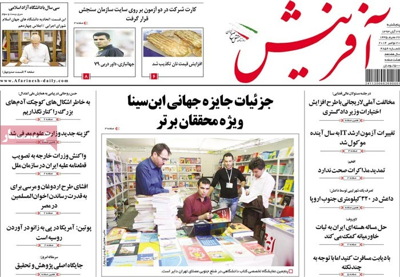
 

Afarinesh newspaper


Arman-e Emrooz: Mohammad Farhadi, a health minister in the reformist government [of President Khatami] has been named by President Rouhani to take over the Ministry of Science, Research and Technology, pending parliamentary confirmation.
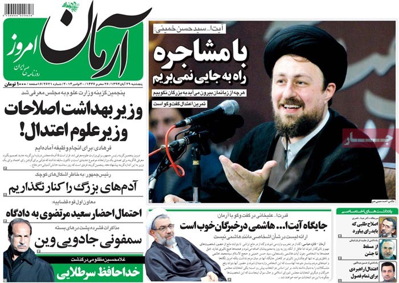
 

Armane Emrouz newspaper


Asr-e Eghtesad: The health minister has rejected reports that a “cancer tsunami” is sweeping the nation.

Asr-e Eghtesad: The Tales by [Iran’s] Rakhshan Bani-Etemad has been named as the best film at [the 20th] Kolkata International Film Festival.
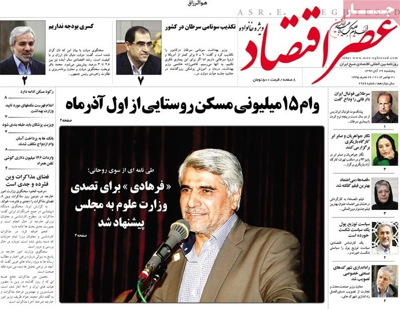
 

Asre Eghtesad


Asrar: [Following a hike in air pollution levels in the capital] Masoumeh Ebtekar, the director of the Environment Protection Organization, and Mohammad Bagher Ghalibaf, Tehran’s mayor, have been summoned to parliament for a review of measures to push down pollution levels.

Asrar: “In the absence of excessive demands, a deal [with P5+1] is within reach,” said President Hassan Rouhani.
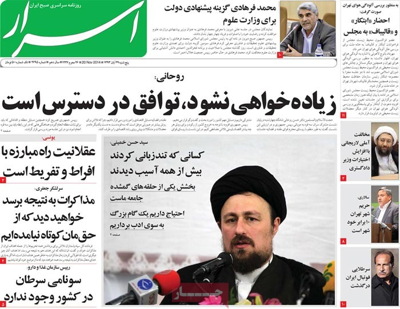
 

asrar newspaper


Ebtekar: International media reports suggest that nuclear talks in Vienna have made 95 percent progress.
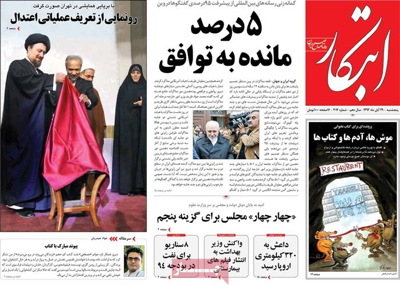
 

Ebtekar newspaper


Emtiaz: Seyyed Hassan Khomeini, the grandson of the architect of the Islamic Republic, has taken a swipe at firebrands [in a speech at a National Conference on Moderation].
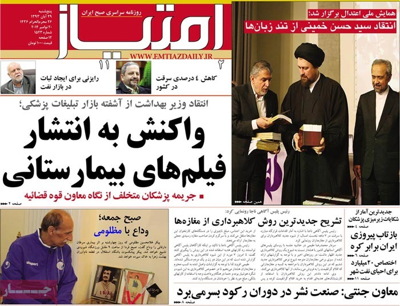
 

Emtiaz newspaper


Etemad: Iranian soccer player Gholamhossein Mazloumi, who was widely known for his superb headers, has passed away at the age of 64.
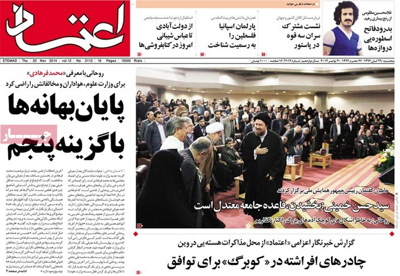
 

Etemad newspaper


Hadaf va Eghtesad: “Production at Iran Khodro has posted a 95 percent growth over last year,” said the managing director of the Iranian giant carmaker.
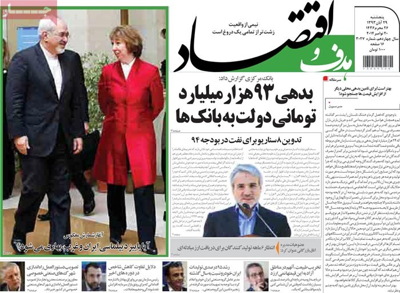
 

Hadafe Eghtesad newspaper


Hamshahri: Road accidents in North Khorasan Province on Wednesday alone claimed 10 lives, sending 77 people to hospitals.
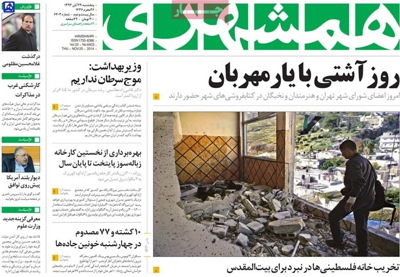
 

Hamshahri newspaper


Hemayat: “Nuclear talks should lead to the removal of sanctions and no new sanctions should be imposed [on Iran]” said the Iranian Judiciary chief.

Hemayat: The human rights resolution critical of Iran is hostile and politically-motivated, Iranian officials say.
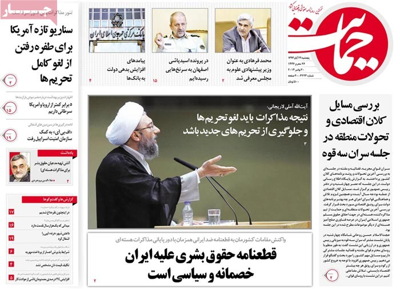
 

hemayat newspaper


Iran Daily: All-out efforts to clinch a [nuclear] deal before the deadline.
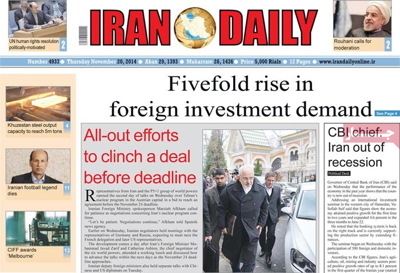
 

iran daily


Isfahan Ziba: “Recent incidents in Isfahan [acid attacks] seem to have been designed to hurt tourism,” said Police Chief Brigadier General Esmail Ahmadi Moghaddam.
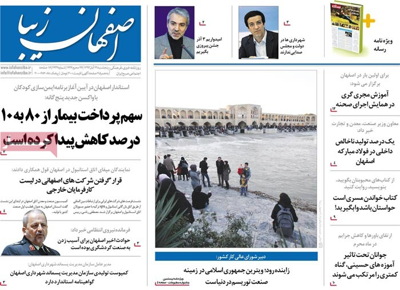
 

Isfahan ziba newspaper


Kaenat: Iran is making efforts to restore stability to global oil markets.
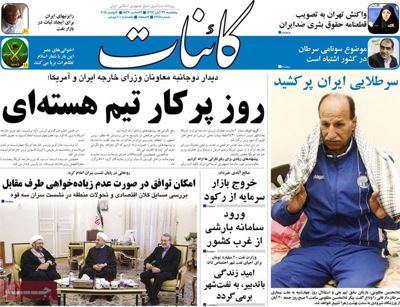
 

Kaenat newspaper


Kasbokar: “We are ready for any outcome,” said Government Spokesman Mohammad Bagher Nobakht of nuclear talks underway in Vienna.
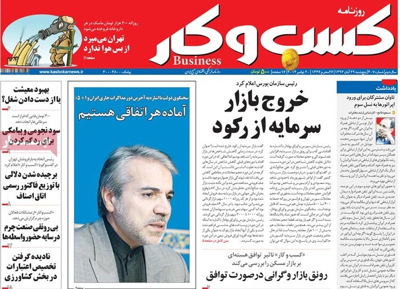
 

Kasbo Kar newspaper


Kayhan: The health minister said, “Equipment that jams satellite signals does not cause cancer.”
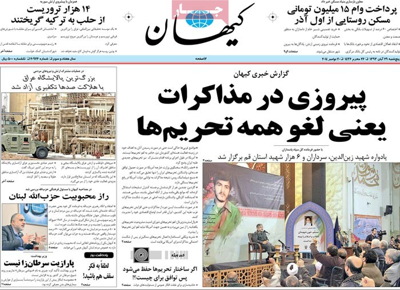
 

Kayhan newspaper


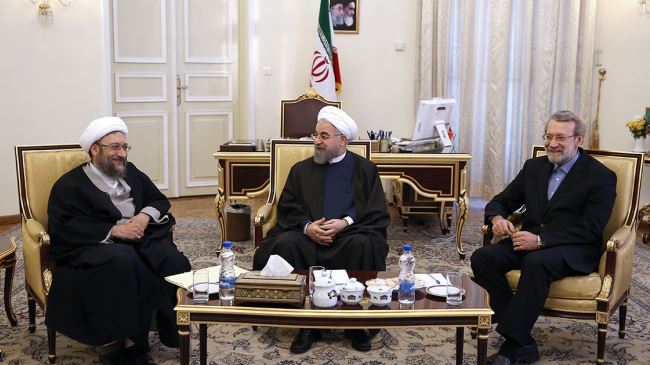
Khorasan: National economy, regional developments and nuclear talks took center stage at a meeting of the heads of the three branches of government.
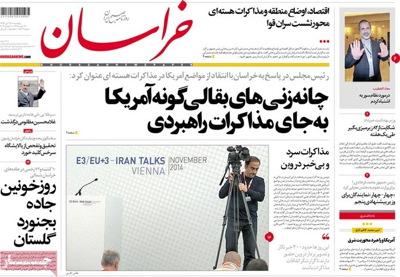
 

Khorasan newspaper


Mardomsalari: “Dialogue amounts to a practice in moderation,” said Seyyed Hassan Khomeini, the grandson of the late Imam Khomeini at a National Conference on Moderation in Tehran.
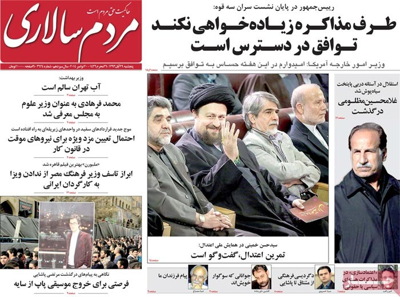
 

Mardom Salari newspaper


Qods: Health Minister Seyyed Hassan Hashemi has suggested that a law be drafted to deal with those who release unlawfully recorded videos of hospital procedures such as surgery.
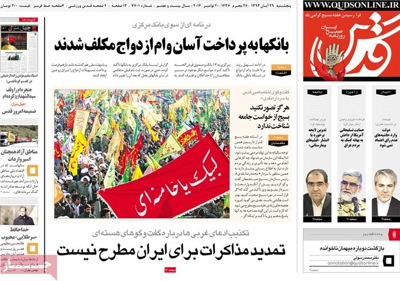
 

Quds newspaper


Roozan: Iranian movie Melbourne [directed by Nima Javidi] has won the Golden Pyramid of the 36th Cairo International Film Festival.
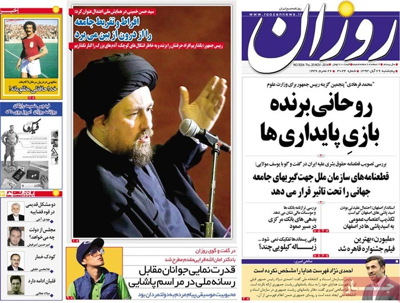
 

Rouzan newspaper


Taadol: “Investment has posted growth for the first time in two years,” said the deputy-governor of the Central Bank of Iran.
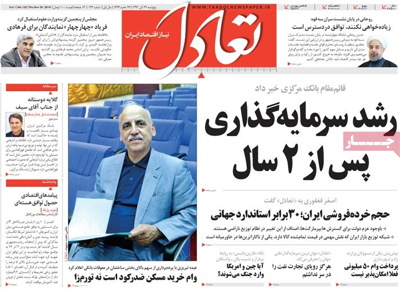

 

Taadol newspaper


Iran calls UN human rights resolution ‘biased’

Iran-FM-Afkham
Iran-FM-Afkham

Tehran has slammed a resolution by the United Nations General Assembly’s rights committee on alleged human rights violations in Iran.

Iranian Foreign Ministry spokeswoman Marzieh Afkham said on Wednesday that the UN’s legal mechanisms had turned into a tool in the hands of the West.

“It is unfortunate that human rights mechanisms… have been abused by Western countries,” Afkham said.

She added that Iran rejects the resolution as it does not take into account the “existing realities” and has been passed with a “political bias.”

The anti-Iran resolution depends on “unreliable sources” and is “replete with baseless, unfounded, and fictitious allegations,” said the Foreign Ministry spokeswoman.

On Tuesday, the UN General Assembly’s Third Committee adopted the resolution, presented by Canada, with a vote of 78 in favor, 35 against, and 69 abstentions.

Tehran has repeatedly criticized biased reports on human rights situation in the country.

Iranian Acting Ambassador to the UN Gholam-Hossein Dehqani also reacted to the move, calling the Canada-proposed resolution “hostile”.

Judiciary chief stresses national support for Iran’s nuclear team

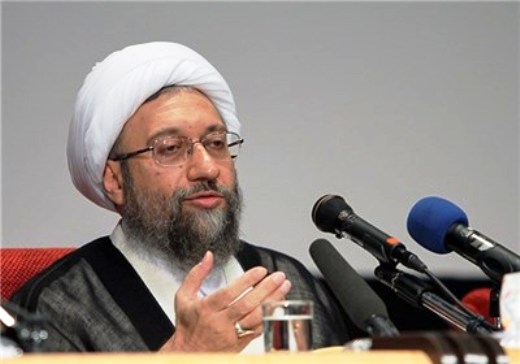
Amoli Larijani

Iran’s Judiciary chief reiterated the nation’s strong support for Iranian delegates in nuclear talks and urged them to remain steadfast in protecting the nation’s rights.

“We want the nuclear negotiators to not take one step back from (protecting) the nation’s rights in line with the policies set by the Supreme Leader of the Islamic Revolution and to remember that a great nation is backing them on this path,” Ayatollah Sadegh Amoli Larijani said on Wednesday, referring to the ongoing talks between Iran and world powers over Tehran’s peaceful nuclear program.

He underlined that the Iranian nation will not give in to the other side’s excessive demands.

Diplomats from Iran and P5+1 (Russia, China, the US, Britain, France and Germany) are in the Austrian capital of Vienna to hammer out a final, long-awaited agreement to resolve the West’s decade-old standoff over Iran’s civilian nuclear work.

Tehran and the world powers on November 24, 2013, signed an interim nuclear deal in the Swiss city of Geneva.

The Geneva deal (the Joint Plan of Action) came into effect in January and expired in July, when the parties decided to extend negotiations until November 24 in the hope of clinching a final, lasting accord.

Ayatollah Amoli Larijani further urged Iran’s diplomats in Vienna to emphasize in the negotiations that, after a possible deal, no new sanctions should be imposed against the Iranian nation under the pretext of ballistic missiles or human rights allegations.

Media reports say the main stumbling block in the way of resolving the Western dispute over Iran’s nuclear energy program remains to be the removal of all the bans imposed on the country, and the scope of the uranium enrichment.

Iran nuclear deal possible if excessive demands not pressed: Rouhani

President-Rouhani-meeting

“If the opposite party in the negotiations with the Islamic Republic of Iran has the political will for a deal and avoids excessive demands, the conditions are prepared for the conclusion of a deal,” Rouhani said Wednesday evening.

He added that the Islamic Republic’s officials are united on core issues being discussed and the goals being pursued during nuclear talks with the five permanent members of the UN Security Council – the United States, Britain, France, Russia and China – plus Germany.

The Iranian president said Iran is looking for an agreement that would “preserve and guarantee the rights of the Iranian nation and further stabilize the [Middle East] region.”

Rouhani noted that a long-term deal over Iran’s civilian nuclear activities will be in the interest of all countries, emphasizing that such an accord would fix economic problems in the world.

Earlier on Wednesday, Representatives from the Islamic Republic of Iran and the six major world powers opened the second day of talks in the Austrian capital, Vienna, as part of their last round of negotiations to reach a nuclear agreement before the November 24 deadline.

Iranian Foreign Minister Mohammad Javad Zarif, who heads Iran’s negotiating team, has lambasted what he termed the unhelpful red lines set by the six countries to satisfy pressure groups.

The chief Iranian diplomat said on Tuesday that Washington should accept the peaceful nature of Tehran’s nuclear activities, emphasizing that sanctions do not resolve the issue and run contrary to what Iranian negotiating parties tend to think.

Sources close to the Iranian negotiating team say the main stumbling block in the way of resolving the Western dispute over Iran’s nuclear energy program remains to be the removal of all the bans imposed on the country, and not the number of centrifuges or the level of uranium enrichment.

Tehran wants the sanctions entirely lifted while Washington, under pressure from the pro-Israeli lobby, insists that at least the UN-imposed sanctions should remain in place.

Nahavandian: Iran’s moderation has become globalized

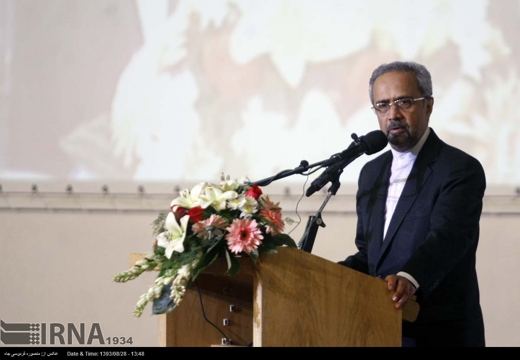
Nahavandian

Mohammad Nahavandian, President Rouhani’s chief of staff, was one of the speakers at the National Moderation Conference, which was held on November 19 at the National Library of Iran (NLI).

In his remarks at the conference initiated by NLI Director Seyyed Reza Salehi Amiri, Nahavandian underlined efforts to clarify the concept of moderation and analytically review this religious and intellectual approach and said it is politically incorrect to equate moderation, which arises from the teachings of the Pure Muhammadan Islam, with Western political schools of thought.

To reach moderation, some basic elements should be available, among them: a scientific approach to different issues, patience for objective materialization of moderation, efforts to tolerate the opponents and not be entrapped by extremism in reaction to radical moves and ill-tempered actions, avoidance of unilateralism and one-sided views, and abstention from insisting on singular ideals regardless of realities and the existing conditions.

Blaming irrational prejudice and ignorance as the root causes of extremism, Nahavandian held up the recruitment by ISIL of the poor as an example and described economic development as a way to take on extremism.

He said that centrifuges should spin, so should the economy, adding that efforts to safeguard people’s rights should be placed on the [government’s] agenda.

Nahavandian further stated that the UN adoption of Iranian president’s “World Against Violence and Extremism” (WAVE) proposal is a clear indication of the fact that moderation, the signature approach of Iran’s president, has gone global. What comes below is a partial translation of what else he said:

Time is at a premium. One opportunity has opened up for Iran to offer the discourse of moderation which is its practical model in political, social, economic and cultural areas.

Moderation is a requirement of justice and those who thought they could accompany a display of ill-temper with administration of justice were badly mistaken. One cannot be intolerant and seek moderation at the same time. One cannot be moderate and at the same time treat their opponents harshly.

To promote moderation we need to put forth operational approaches, and avoid unilateralism.

Submission to sanctions amounts to silence in the face of oppression

We should not and cannot close our eyes to the infringement of Iranian rights. Doesn’t the fact that Iranian assets are frozen and are unavailable to them amount to oppression? Is it not our responsibility to secure their return?

Moderation is impossible when there is no movement forward. We cannot have an 8 percent growth enshrined in our Outlook Plan and do nothing when our economic growth is pushed into negative territory. If we seek to counter extremism, we need to meet the needs of the youth first. Failure to focus on economic development will definitely help extremist movements.

Moderate society needs moderate people and spite-free hearts

Imposition of extremist methods is one of the things that dent moderation. We need to practice patience as much as we can. The moderate current has to constantly redraw the line separating it from extremist views.

To help moderation grow, we need to pay due attention to it on individual and social fronts. A moderate human flourishes in an open-minded university and in a society which is free of violence.

Those who lack mental health are unfit to hold public office. Focusing on convergence is key to social moderation. We need to keep distance from collective and factional immoderation.

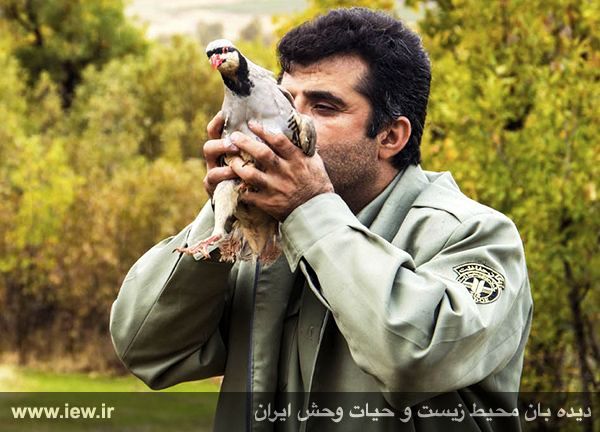
Kiss captivity goodbye

rahasazikabk-2

Environmental police in Marivan [a western city in Kurdistan Province] have seized seven wild partridges while searching the house of a poacher. They later released the birds in the wilderness.

On November 12, the website of Iran Environment and Wildlife Watch posted two photos of the birds before saying goodbye to captivity and becoming free as a bird, literally.