Monday, December 29, 2025
Home Blog Page 4897

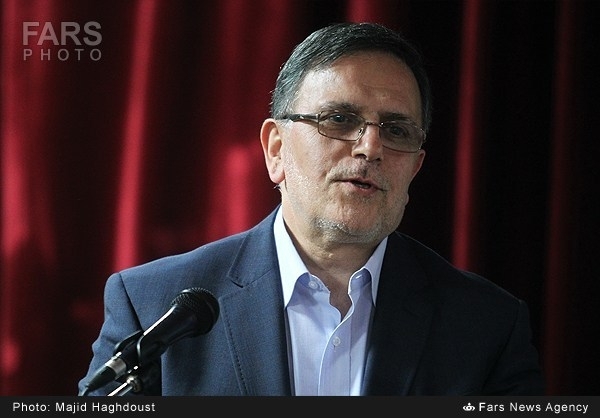
Central Bank chief expounds on new banking corruption case

Valiollah Seif
Valiollah Seif - Governor of the Central Bank

On December 7, the Islamic Republic News Agency (IRNA) filed a report on the explanations of Governor of the Central Bank Valiollah Seif on a corruption case involving an Iranian bank. What follows is the translation of his comments made during a live TV show on Channel One:

The corruption took place between 2006 and 2012, but we learned about it only last year.

After the mishandling of money in the banking system emerged in late September 2013, an investigation was launched and judiciary officials were filled in on the case.

That some have alleged upwards of $4 billion has been siphoned off is not true. In fact, $23 million was the maximum amount of money those implicated in the case got their hands on. Thanks to the banking activity the money in question set in motion, the overall figure rose to around $4 billion.

So far, all those involved in the case have been identified and indicted; one individual is under arrest.

Aside from paying back the initial amount of money borrowed from the bank, those involved in the case face fines calculated on an interest rate of 34%. Four tranches of the six-installment fines have already been paid and the last is due next month.

To safeguard the interests of the bank involved in the case, the announcement of the corruption case was delayed.

Reopening of British embassy; a game of ifs and buts

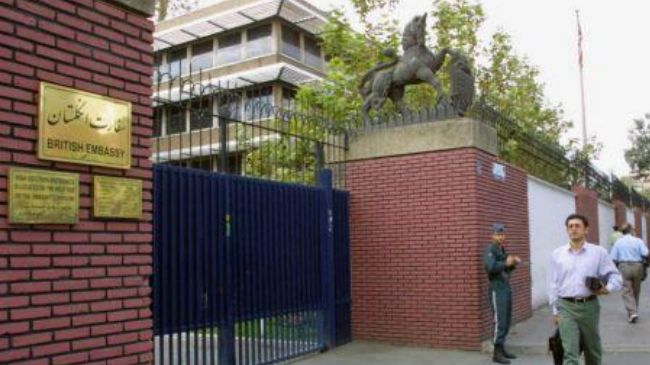
british embassy in tehran

Etemad newspaper ran a report on December 6 by Ehsan Badaghi on ifs and buts surrounding the reopening of the British embassy in Tehran, citing an Iranian MP as saying that the mission is likely to resume its operations by March 2015. The following is the partial translation of the report:

A new layer of paint coated the tacky gate of the British embassy in Tehran in August, giving a new face to it. But it has so far failed to change the official tone between Tehran and London which soured even further in November 2011.

It was a few months ago, in early August, when strong rumors swirled around the possibility of the reopening of the British embassy in Tehran. Although officials on both sides declined to fix a date for the reopening, they agreed that it would happen “shortly”.

Almost five months on, ties between the two countries have yet to see any practical change. Although a historical meeting between Hassan Rouhani and British Prime Minister David Cameroon on the sidelines of the 69th annual session of the UN General Assembly was a turning point in post-revolution Tehran-London relations, it did little to open the padlocked embassies in Tehran and London. “By yearend” [March 21, 2015] is the possible date the co-chairman of the Iran-UK parliamentary friendship group has floated for the unlocking of the two closed doors.

Iran-UK ties, ifs and buts

What Abbasali Mansouri Arani told the Young Journalists Club on December 5 about the reopening date comes with some ifs and buts. “If the British embassy reopens in Tehran, the problem associated with granting visa should be solved. First the consular part should be activated.”

What seems to be certain is the uncertainty about such an event taking place. Tehran-London ties have been battered by some storms over the past four years. An attack on the British embassy in Tehran in November 2011 was followed two years later by a trip to Iran by a British parliamentary friendship group chaired by the ex-foreign secretary Jack Straw. And the historic September meeting in New York between the two countries’ heads of government, the first in 35 years, took place less than a year later.

Those who stormed the British mission in the Iranian capital still stick to their guns saying that what they did back in 2011 was correct. The other side of the coin shows that those who are pushing for the normalization of ties believe that Iran’s national interests will be better served if tensions in relations between the two nations are eased.

These two groups go to great lengths to determine the policies adopted in dealing with the UK, a permanent member of the UN Security Council. The group favoring better ties held no sway in the country’s political decision making when the British embassy came under attack in 2011.

Things have changed now. The government and the executive institutions are controlled by this group which has some sympathizers in other institutions including in parliament where Mansouri, an Iranian MP, who hosted Straw one year ago, speaks in favor of the normalization of ties.

Straw’s trip to Tehran came six months after the government’s critics warned that they would not allow the former British foreign secretary to enter the chamber if he attended President Hassan Rouhani’s inauguration.

Is UK like other countries?

The latest update on embassy reopening provided by Mansouri said, “In accordance with the talks the two sides have held, Iran and the UK are to reopen their embassies.” […]

He went on to say, “We have no problem with the embassy reopening according to protocols. For us, Britain is no different from France, Italy and other countries. The two sides are waiting to see when the stage is set for the reopening.

“Britain is not a red line for Iran. There is no legal obstacle standing in the way of the reopening of the British embassy in Tehran. I think the British embassy will reopen here in Tehran by the end of this year.”

An eager government and circumspect critics  

Government officials have openly displayed willingness for the normalization of ties between Iran and the UK. That the image of Iran’s foreign minister shaking the hand of the US secretary of state is no longer a strange sight leaves no doubt that the eleventh government has put top on its agenda efforts to ease tensions with countries such as Britain – ties with whom are not part of Iran’s red lines.

A landmark meeting between Hassan Rouhani and David Cameroon in which the Iranian president underscored the need for a rise in foreign investment in Iran – where big economies such as Britain can claim a big share of foreign investment – is yet another sign of Iran’s willingness for resumption of normal ties with the UK.

In spite of this, the critics can resort to a parliamentary decision on downgrading Iran’s ties with Britain from an ambassadorial level to simply having charge d’affaires. That will leave the government very little room to maneuver.

The point is that those who have passed the motion are divided over what the government should do to execute the legislation. On the one hand, Alaeddin Boroujerdi, who chairs parliament’s National Security and Foreign Policy Committee, has said that the law is still holding, and on the other hand, Hossein Naghavi Hosseini, the spokesman of the same committee, has said, “To allow the reopening of the British embassy, the government does not need legislative measures.”

He has argued that the parliamentary act (adopted on November 23, 2011 by the eighth parliament) obliged the cabinet to downgrade ties with the British government, but the government was not given enough time to implement the act due to public reactions.

The act entails an article which authorizes the government to reestablish ties with London at a consular level if it finds out that London has learned a lesson and acts in the framework of its diplomatic and consular duties, he further said, adding that’s why the government needs no parliamentary go-ahead.

Still in contention is the issue of damages. Although Iran has accepted to pay compensations for the damage the mission sustained as a result of the attack under the Vienna Convention [on Diplomatic Relations which gives immunity to diplomatic premises], some members of the Iranian parliament have said Iran should offer no apology to the Britons.

Deputy chair of the National Security and Foreign Policy Committee Mansour Haghighatpour has even gone further saying, “It is very big of Iranians to let the Britons reopen their embassies.”

But this is not all. To reopen its embassy, Britain is expected to meet another condition: issuance of visa in Tehran.

With all being said, it will be clear by yearend if the upsides of the normalization of mutual ties could help remove the hurdles standing in the way, or a new chapter of ifs and buts will open in relations between the two nations.

Footer: On November 27, 2011, Iranian MPs passed a motion to downgrade diplomatic ties with the UK, in response to Britain’s decision to impose new sanctions against Iran. Following the decision, hundreds of Iranian students staged a protest outside the British embassy in Tehran, pulling down the UK flag and demanding the expulsion of the British ambassador. On November 30, London cut off its ties with Tehran, withdrew its diplomatic staff from Iran and the Iranian embassy in London was closed.

A look at Iranian newspaper front pages on Dec. 7

Iranian Newspapers Headlines

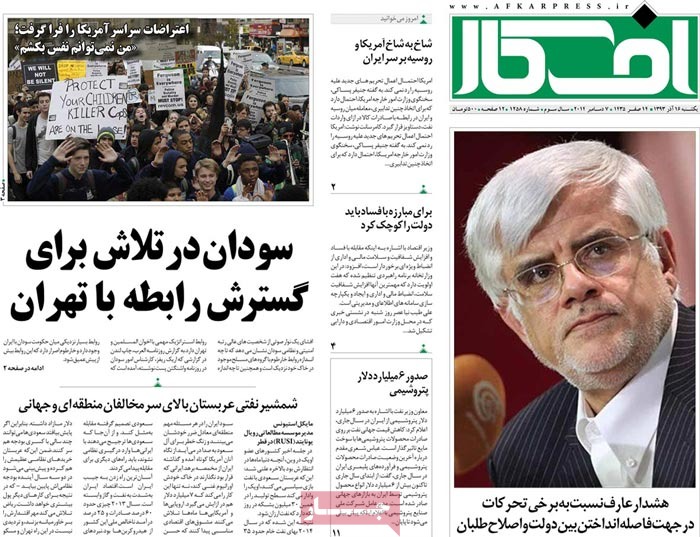
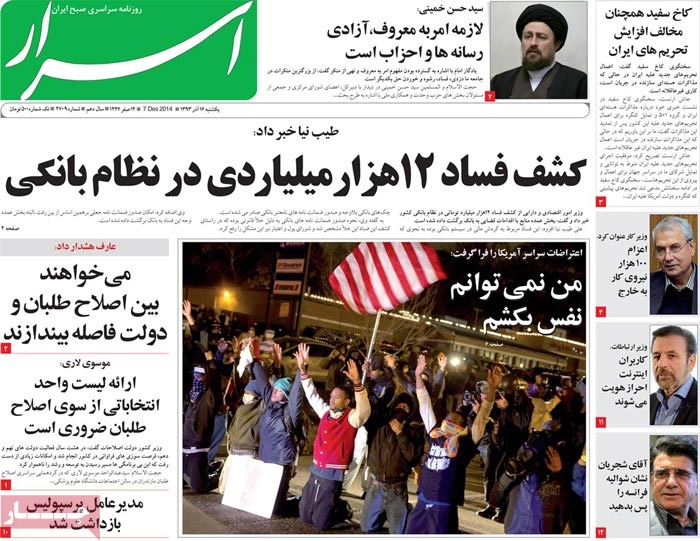
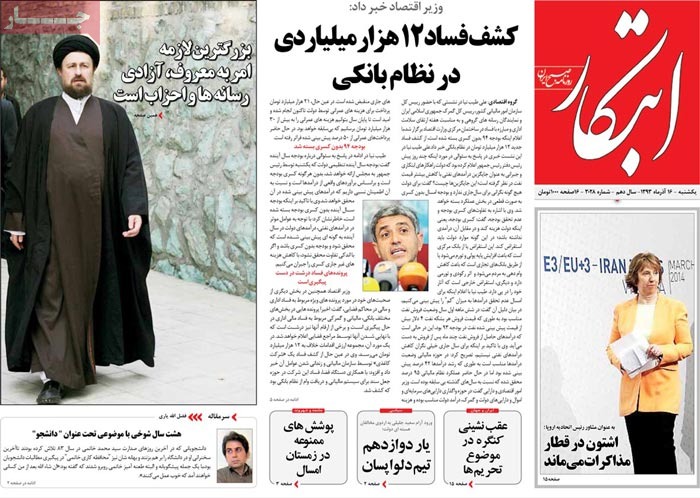
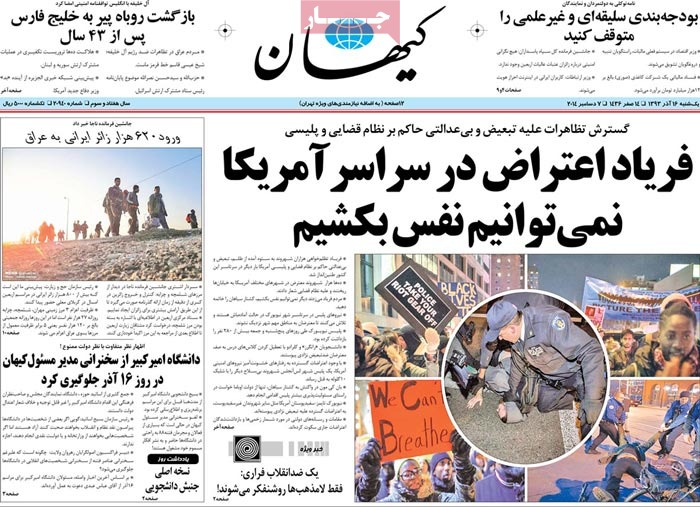
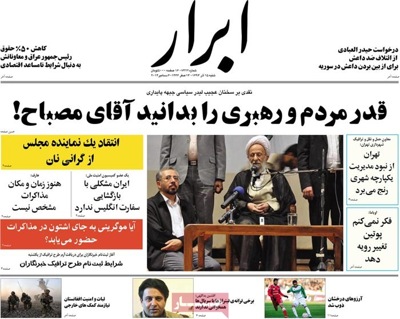
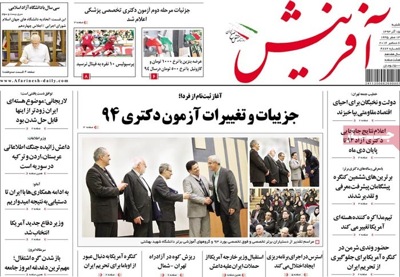
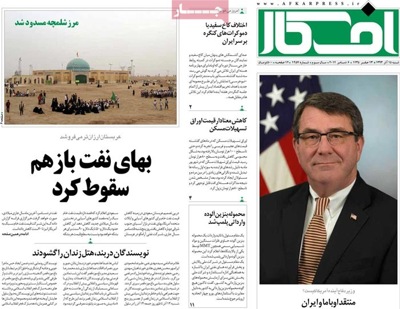
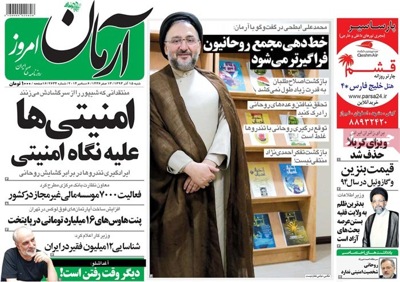
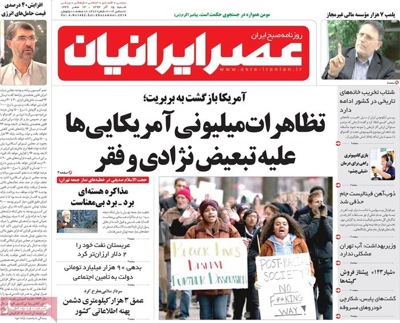
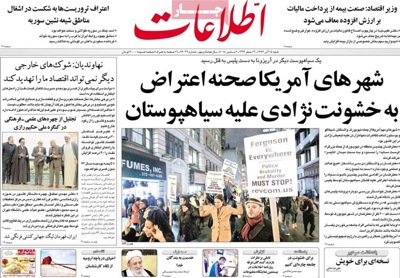
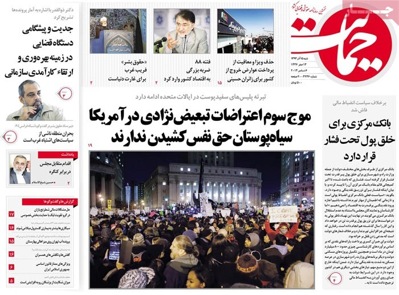
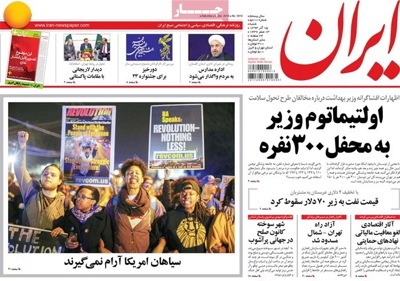
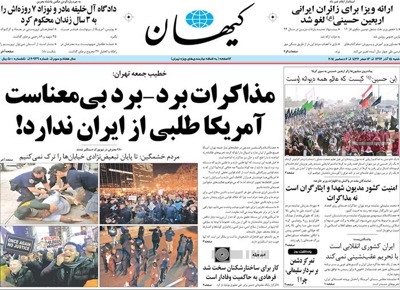
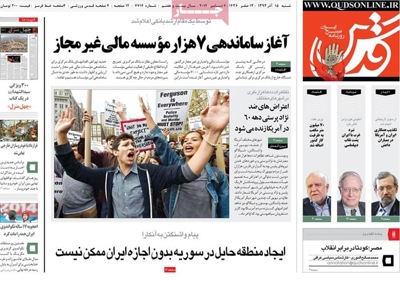
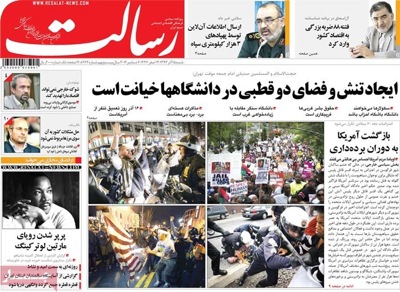
Images of continuing protests across the United States against police brutality dominated the front pages of Iranian newspapers on Sunday. Comments by Iranian minister of economy that a large-scale case of corruption in the banking sector has been unveiled also made headlines.


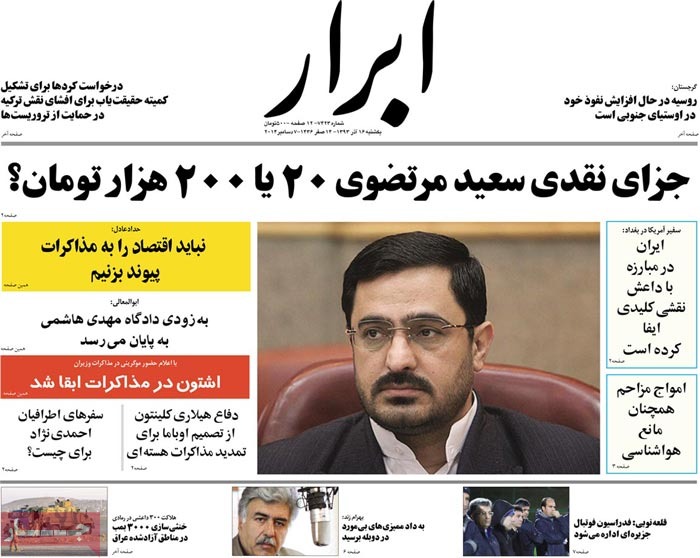
Abrar: The US ambassador to Iraq has said that Iran has played a key role in the fight against IS.

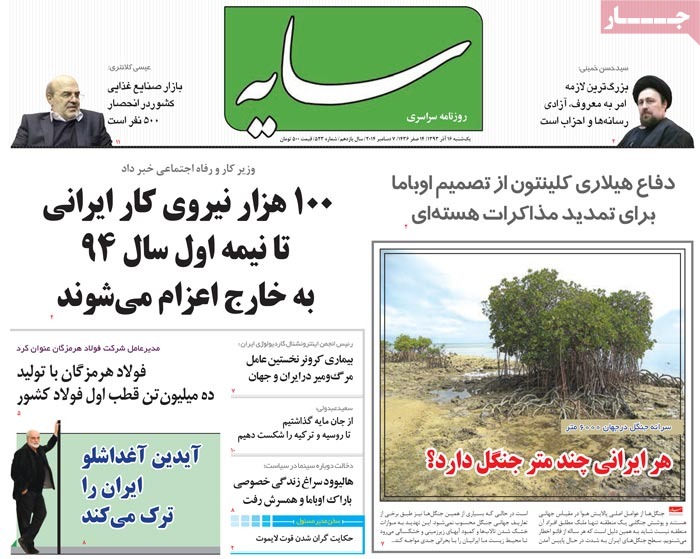
Abrar: Former US Secretary of State Hillary Clinton has thrown her weight behind President Obama’s decision to extend nuclear talks with Iran.

A look at Iranian newspaper front pages on Dec. 7


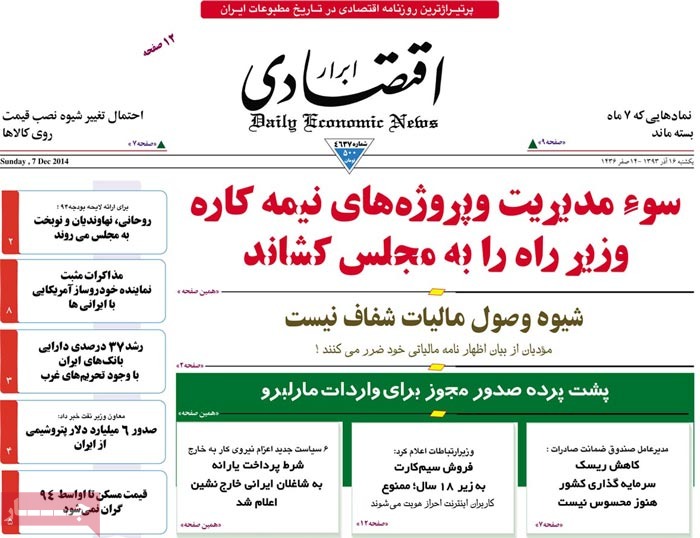
Abrar-e Eghtesadi: Mismanagement and unfinished projects have resulted in the minister of roads and urban development to be summoned to parliament to answer questions by MPs.

A look at Iranian newspaper front pages on Dec. 7


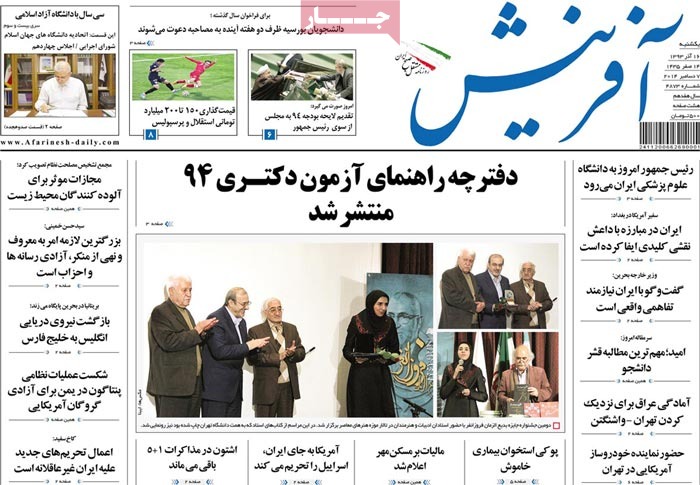
Afarinesh: The Expediency Council has voted for “effective punishment” for those who pollute the environment.

A look at Iranian newspaper front pages on Dec. 7


Afkar: “Exports of petrochemicals have brought in some $6 billion in revenues this year [started March 21, 2014],” said the deputy oil minister.

A look at Iranian newspaper front pages on Dec. 7


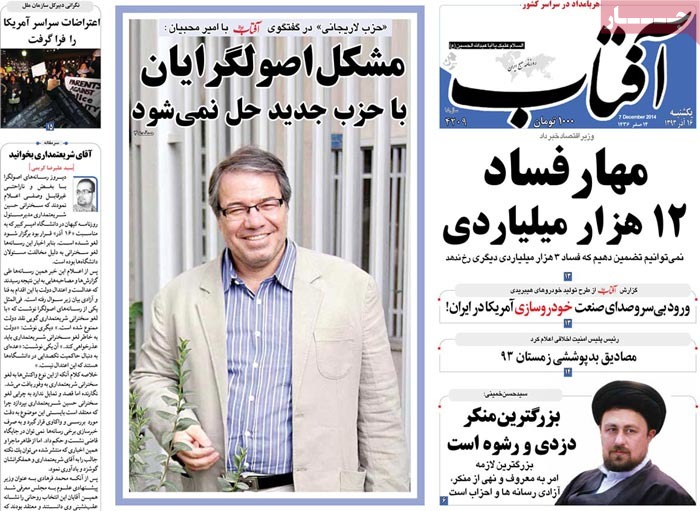
Aftab-e Yazd: The US auto industry has returned to Iran without drawing much attention.

A look at Iranian newspaper front pages on Dec. 7


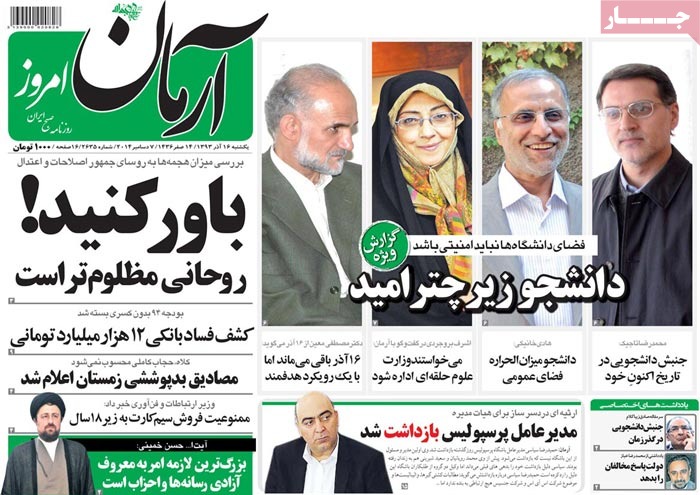
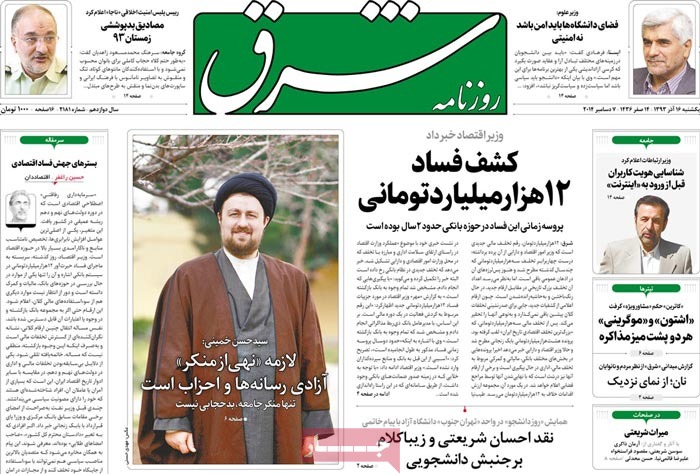
Arman-e Emrooz: “Freedom of press and parties is the most important requirement for the promotion of virtue,” said Seyyed Hassan Khomeini, the grandson of the architect of the Islamic Republic.

Arman-e Emrooz: The new managing director of the capital’s Persepolis Football Club has been arrested [apparently after sponsors filed a suit against the Reds].

A look at Iranian newspaper front pages on Dec. 7


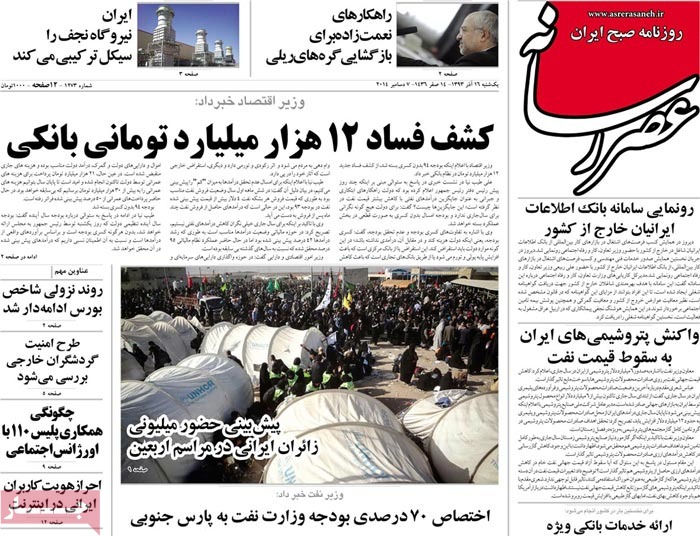
Asr-e Rasaneh: As much as 70 percent of the Oil Ministry’s budget will go to South Pars Gas Field.

A look at Iranian newspaper front pages on Dec. 7


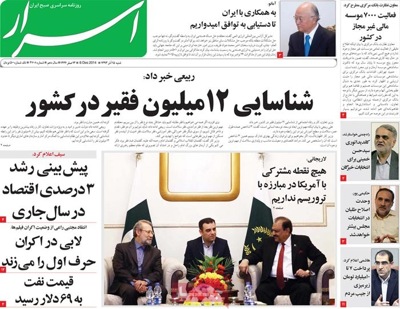
Asrar: I-can’t-breathe protests sweep the United States from coast to coast.

Asrar: “Some want to drive a wedge between reformists and the government,” warned Mohammad Reza Aref, a former vice-president under reformist President Mohammad Khatami.

A look at Iranian newspaper front pages on Dec. 7


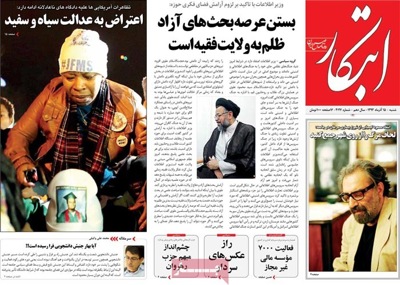
Ebtekar: Catherine Ashton will remain on board the train of negotiations [between Iran and P5+1].

A look at Iranian newspaper front pages on Dec. 7


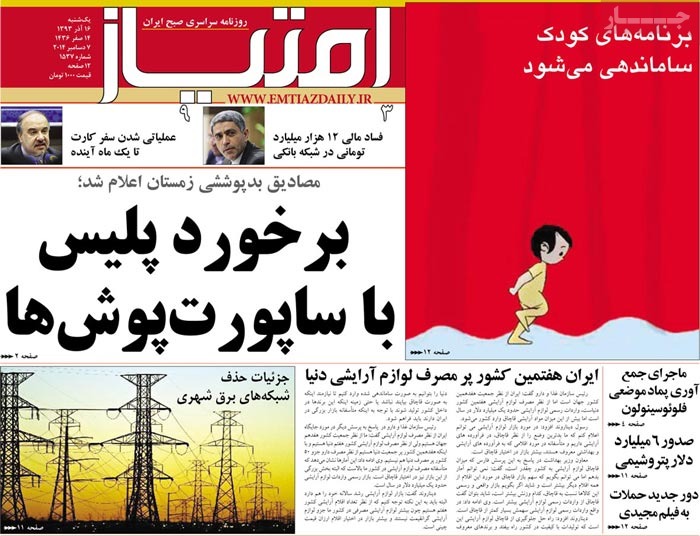
Emtiaz: Iran is the seventh largest consumer of cosmetics in the world.

A look at Iranian newspaper front pages on Dec. 7


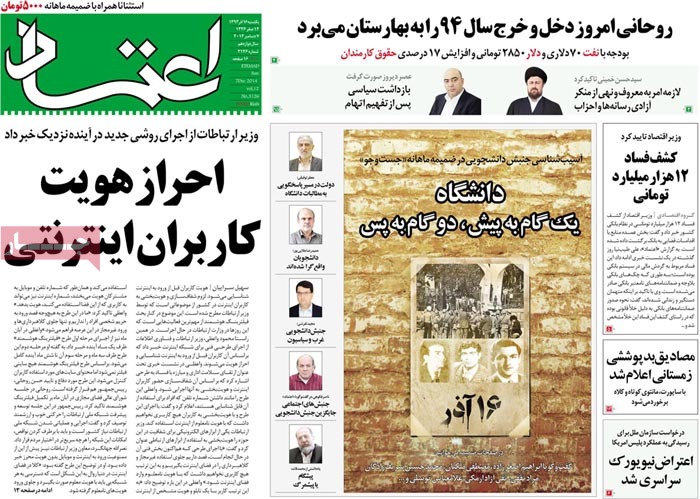
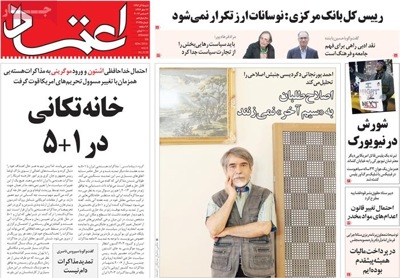
Etemad: President Rouhani is to present next year’s spending package to parliament on Sunday. The proposed budget has been worked out on assumptions that oil prices will hover around $70 a barrel. The package also enshrines a 17 percent pay rise for civil servants.

A look at Iranian newspaper front pages on Dec. 7


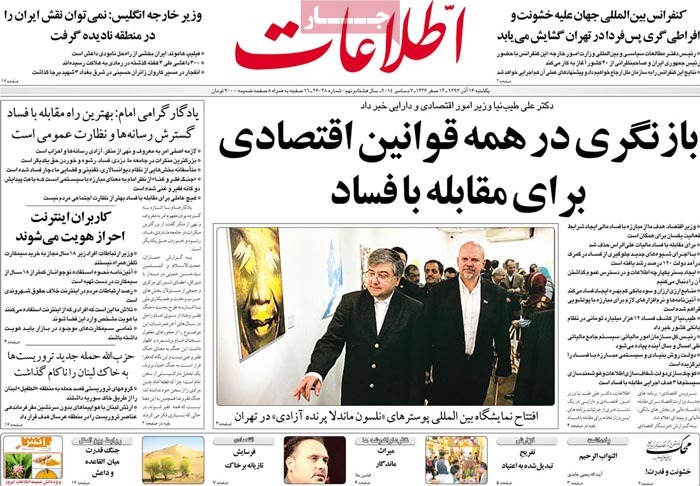
Ettela’at: British Foreign Secretary Philip Hammond said that the role of Iran in the region cannot be ignored.

Ettela’at: “In bid to counter corruption, all economic laws are to be reviewed,” said Minister of Economy and Financial Affairs Ali Tayyebnia.

Ettela’at: An international poster expo dubbed “Nelson Mandela; the Bird of Freedom” has opened in Tehran.

A look at Iranian newspaper front pages on Dec. 7


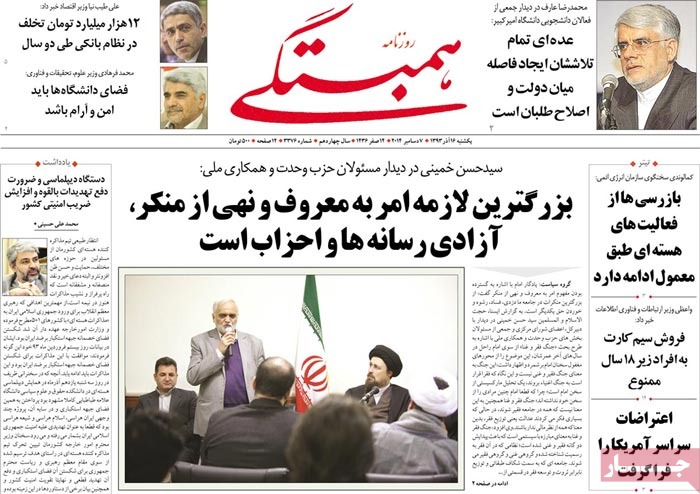
Hambastegi: “Individuals under 18 years of age cannot buy SIM cards,” said the minister of communications and information technology.

A look at Iranian newspaper front pages on Dec. 7


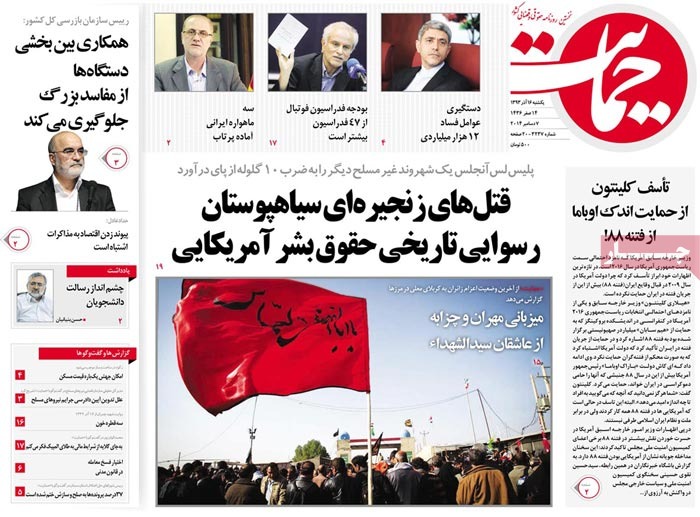
Hemayat: “Tying the country’s economy to [nuclear] talks is wrong,” said Gholamali Haddad Adel, a onetime speaker of the Islamic Consultative Assembly.

Hemayat: “Three Iranian satellites are set to be launched,” said the vice president of the Iranian Space Agency.

A look at Iranian newspaper front pages on Dec. 7


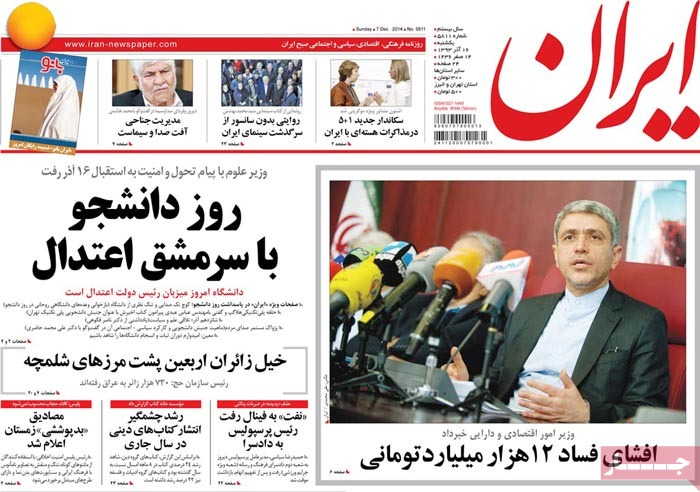
Iran: The Ministry of Economy and Financial Affairs has unveiled a banking corruption case involving billions.

A look at Iranian newspaper front pages on Dec. 7


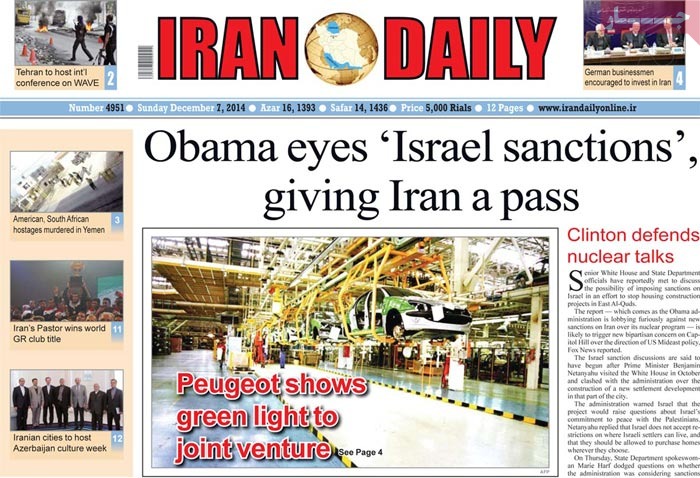
Iran Daily: Peugeot shows green light to joint venture.

Iran Daily: Tehran to host international conference on WAVE [World against Violence and Extremism on Tuesday]

A look at Iranian newspaper front pages on Dec. 7


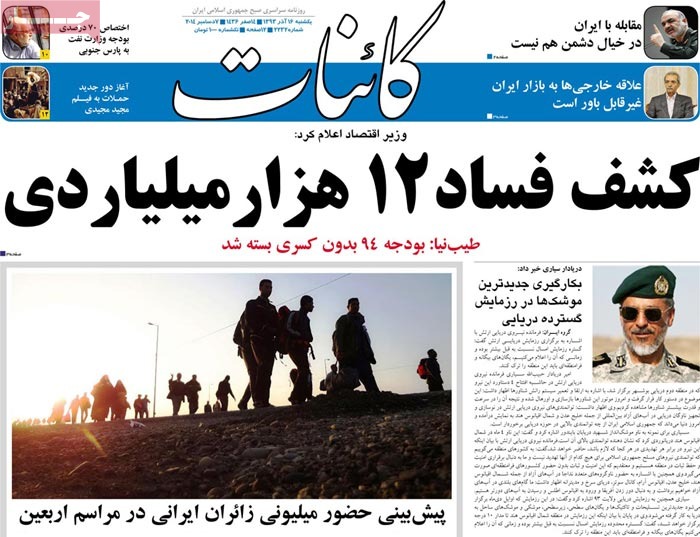
Kaenat: More than a million Iranians are predicted to take part in ceremonies in Iraq to mark Arba’een [a Shiite Muslim religious observance that occurs 40 days after Ashura, which marks the martyrdom of the grandson of Prophet Muhammad] on December 13.

A look at Iranian newspaper front pages on Dec. 7


Kayhan: Making comments that are not in line with the viewpoints of the executive branch seems to be forbidden! Amir Kabir University has cancelled the speech of the managing editor of Kayhan.

A look at Iranian newspaper front pages on Dec. 7


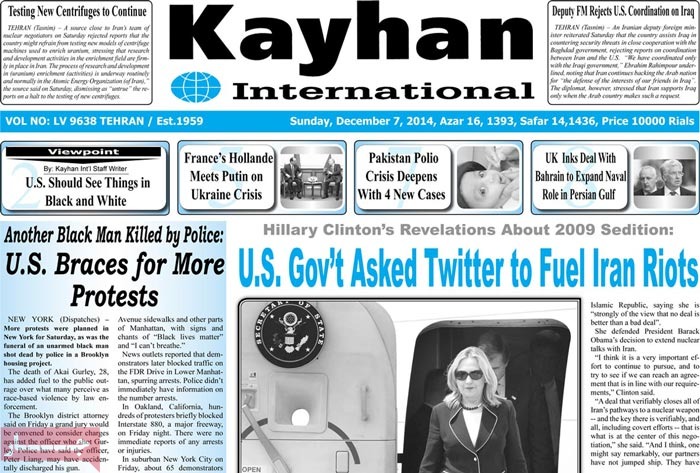
Kayhan International: “Testing new centrifuges to continue,” a source close to Iran’s nuclear negotiating team said.

A look at Iranian newspaper front pages on Dec. 7


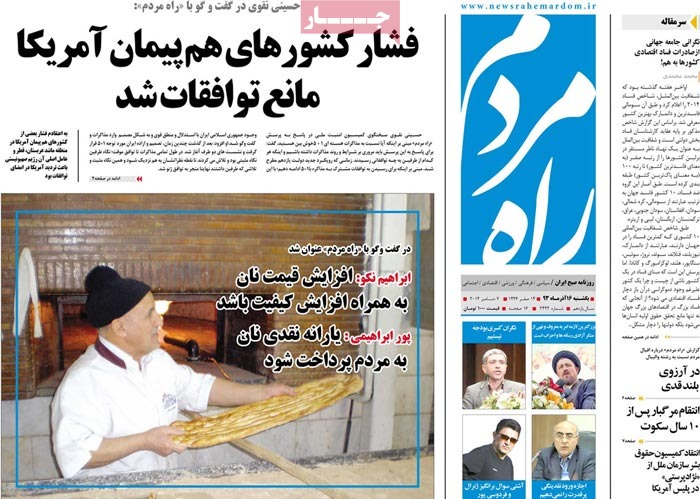
Rah-e Mardom: “Pressures exerted by US allies prevented the conclusion of a deal,” said the spokesman of parliament’s National Security and Foreign Policy Committee.

A look at Iranian newspaper front pages on Dec. 7


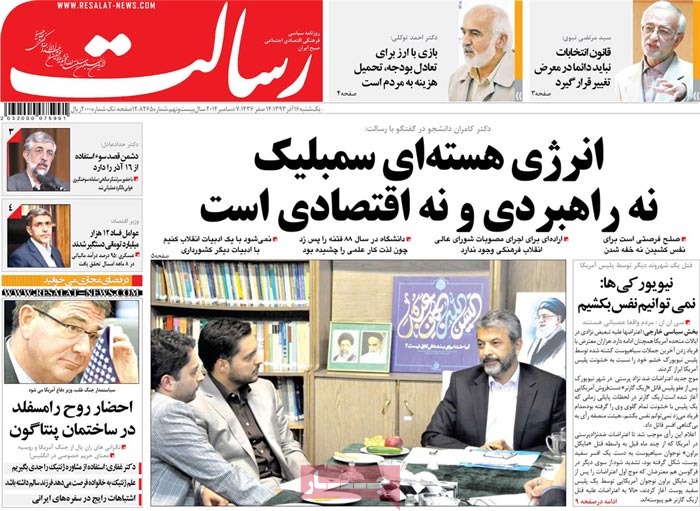
Resalat: “Symbolic nuclear energy is neither strategic nor economical,” said Kamran Daneshju, science minister under President Ahmadinejad.

A look at Iranian newspaper front pages on Dec. 7


Sayeh: The minister of labor and social welfare has said some 100,000 Iranians will have been sent abroad as workforce by late September 2015.

A look at Iranian newspaper front pages on Dec. 7


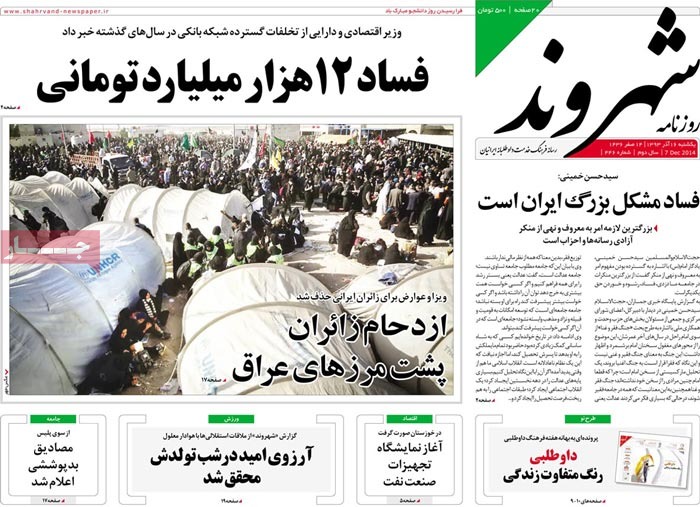
Shahrvand: An exhibition on equipment used in the oil industry has opened in Khuzestan Province, southwestern Iran.

A look at Iranian newspaper front pages on Dec. 7


Sharq: Police have revealed what they would view as failure to comply with the Hijab (the Islamic Dress Code) in the cold months of the year.

A look at Iranian newspaper front pages on Dec. 7


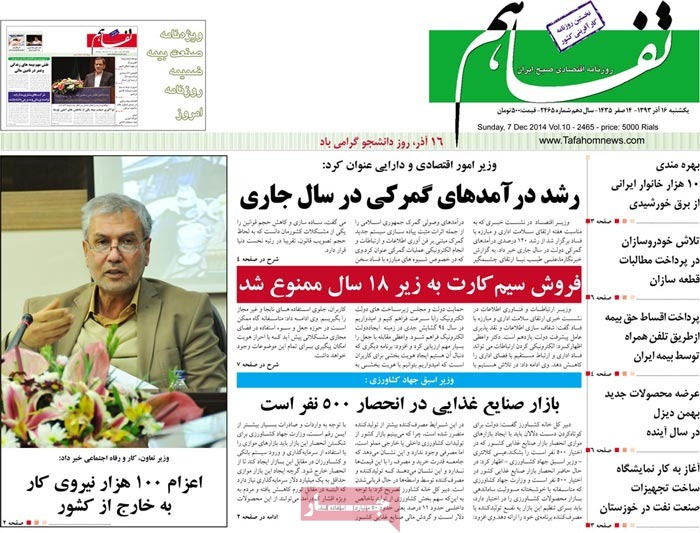
Tafahom: As many as 10,000 Iranian households are using solar electricity.

A look at Iranian newspaper front pages on Dec. 7


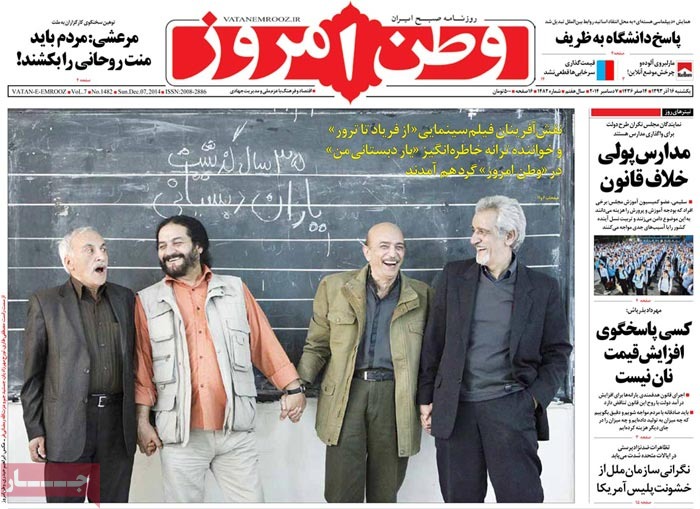
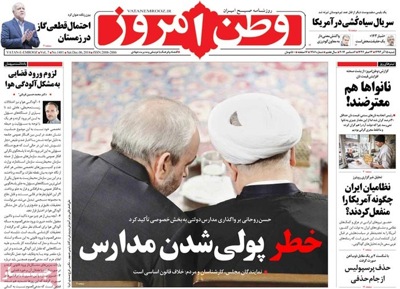
Vatan-e Emrooz: Parliament deputies are worried about privatization of schools.

A look at Iranian newspaper front pages on Dec. 7


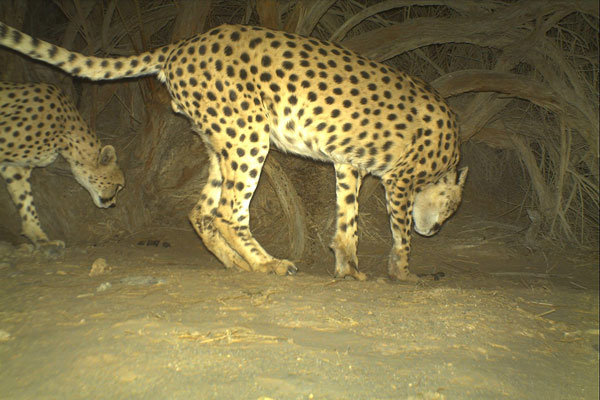
Another Asiatic cheetah sighted in Yazd

Asiatic Cheetah in Yazd

Director of Iranian Cheetah Society has announced the sighting and registering of another Asiatic Cheetah in Yazd Province.

Morteza Eslami told Mehr News that a number of camera traps had been placed in each of the cheetah habitats in Iran for an overall observation of the target species.

He noted that a series of photographs were released by the Department of Environment in Ardakan, Yazd Province last November, which showed three Asiatic cheetahs captured on camera traps.

“At first, these three cheetahs were believed to be the same ones registered in the first phase of Cheetah Protection Program in 2012,” said Eslami, “but further investigation revealed that one of these three cheetahs has never been captured on any trap cameras before.”

“And that is how a new male cheetah, the world’s second-rarest cat, has now been added to the list of other photographed ones in the Asiatic cheetah habitats,” he said.

So far, the number of Asiatic cheetahs in Iran has been estimated at 70.

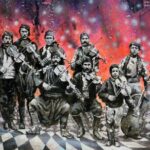
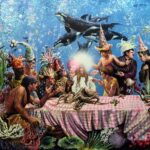
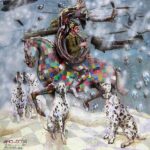
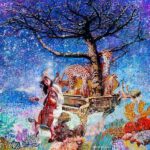
Artworks by Adel Younesi on display in Paris: “Eternal Feast”

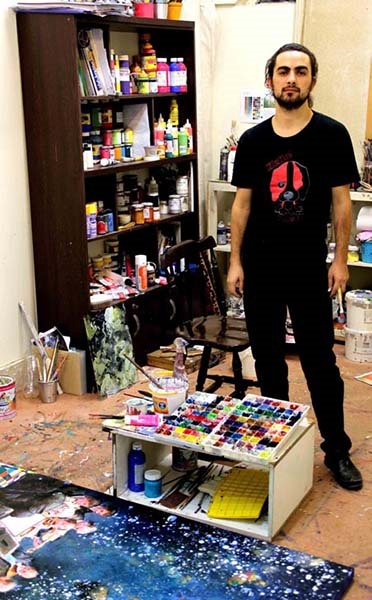
Artworks by Adel Younesi 19Honaronline.ir has filed a brief report on its website about an exhibition entitled ‘Eternal Feast’ in Paris’s Galerie Nicolas Flamel featuring the latest paintings of Iranian artist Adel Younesi. What comes below is the translation of the website’s introduction, followed by a photo gallery:

The exhibition displays a selection of over 20 paintings which were all created in 2014. Hesam Khalatbari and Yasi Metghalchi are the curators of the art exhibition.

Iranian painter Adel Younesi usually opts for large dimensions for his paintings. However, in this exhibition, his smaller-sized artworks have been put on display. All paintings presented at the art gallery have been done by acrylic and oil painting techniques.

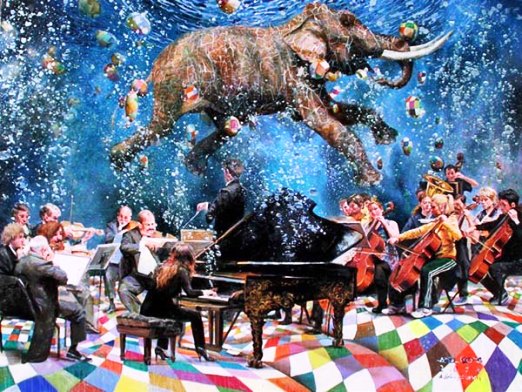
His artworks enjoy a complicated atmosphere and depict a dream-like world. Younesi assembles elements of his paintings like characters of a play in a frame. People, dolphins, tigers, zebras, old cars, clowns and well-known figures join in to form a full orchestra performing a musical for the audience, a story which takes place somewhere under the surface of the sea. However, every part of it seems so unfamiliar and astonishing that makes the visitor realize that no happy ending is in store for the world.

The ‘Eternal Feast’ exhibition opened on December 2 in Paris and will come to an end on December 9.


A look at Iranian newspaper front pages on Dec. 6

Iranian Newspapers Headlines

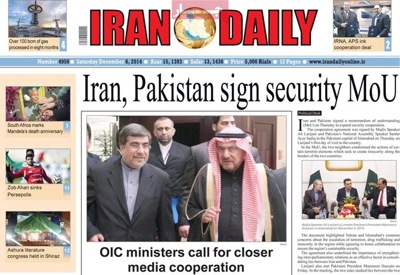
The news of ongoing rallies across America in protest against the decision of a grand jury not to indict a white New York police officer over the death of Eric Garner, an unarmed black man who was strangled to death after being placed in a chokehold, was splashed across many Iranian dailies on Saturday. On the national front, a visit by Parliament Speaker Ali Larijani to Pakistan and his remarks about regional security in meetings with Pakistani officials, including President Mamnoon Hussain, also came under the spotlight of newspapers.

Abrar: “Iran does not have any problem with the reopening of the British embassy in Tehran,” said a member of parliament’s National Security and Foreign Policy Committee.


Abrar newspaper 12 - 6


Afarinesh: “The makeup of American negotiating team will undergo some change; US Undersecretary of State Wendy Sherman has appeared in Congress in a bid to talk lawmakers out of slapping fresh sanctions on Iran. It comes as Congress seeks to bypass President Obama to impose new sanctions.”

Afarinesh: “Iran’s nuclear matter could have been resolved much earlier,” said Parliament Speaker Ali Larijani.


Afariness newspaper 12 - 6


Afkar: “Oil prices have taken another dive.”

Afkar: “Shalamcheh border crossing on the Iran-Iraq border has been closed down as a result of a massive influx of pilgrims heading to the holy city of Karbala ahead of Arba’een [a Shiite Muslim religious observance that occurs 40 days after Ashura, which marks the martyrdom of the grandson of Prophet Muhammad] on December 13.”


Afkar newspaper 12 - 6


Arman-e Emrooz: “Twelve million poor people have been identified in Iran,” said Minster of Labor, Cooperatives and Social Welfare Ali Rabiei.


Armane emruz newspaper 12 - 6


Asr-e Iranian: “Win-win nuclear talks are meaningless,” said Kazem Seddighi in a sermon to worshippers during weekly Friday Prayers in Tehran.


Asre iranian newspaper 12 - 6


Asrar: “Iran’s economy will see a 3-percent growth by yearend [March 21, 2015],” Governor of the Central Bank of Iran Valiollah Seif predicted.


Asrar newspaper 12 - 6


Ebtekar: “Suppressing the atmosphere of free discussion amounts to injustice to the Religious Jurisprudent,” said the intelligence minister.

Ebtekar: “There are 7,000 unauthorized monetary institutions in Iran.”


Ebtekar newspaper 12 - 6


Etemad: “The law concerning executions for drug convictions is likely to undergo change,” Chairman of the Human Rights Council of the Iranian Judiciary Mohammad Javad Larijani predicted.


Etemad newspaper 12 - 6


Ettela’at: “Pastor Andimeshk, Iran’s representative in the World Wrestling Clubs Cup – held in the southern city of Abadan (Dec. 4-5) – defeated Russia to secure the title in the Greco-Roman discipline.”

Ettela’at: “Efforts of prominent Iranian figures in the field of science and culture have been appreciated in the National Hakim Razi Congress.”


Ettelaat newspaper 12 - 6


Hemayat: “Iranian pilgrims who wish to visit Karbala do not need a visa and are exempt from paying the toll charged before leaving the country.”


Hemayat newspaper 12 - 6


Iran: “The administration of schools will be delegated to the public,” said President Rouhani.


Iran newspaper 12 - 6


Iran Daily: “Iran, Pakistan sign security MoU.”


iran daily newspaper 12 - 6


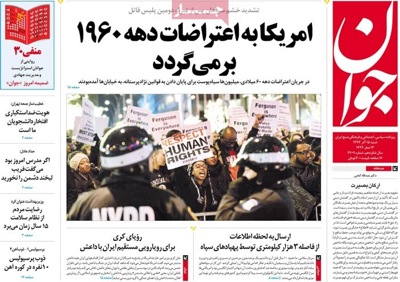
Javan: “The protests of the 1960s have returned to the US.”

Javan: “Drones built by Iran’s Islamic Revolution Guard Corps can transmit live updates from as far away as 3,000 km.”


Javan newspaper 12 - 6


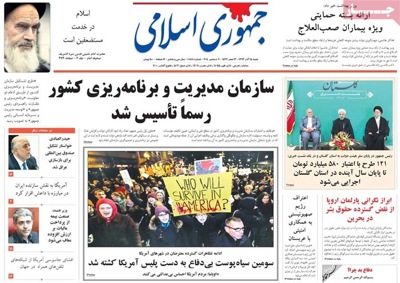
Jomhouri Islami: “The Management and Planning Organization has been officially reestablished.”

Jomhouri Islami: “The insurance industry will be exempt from paying the value added tax,” said Economy Minister Ali Tayyebnia.


Jomhurie eslami newspaper 12 - 6


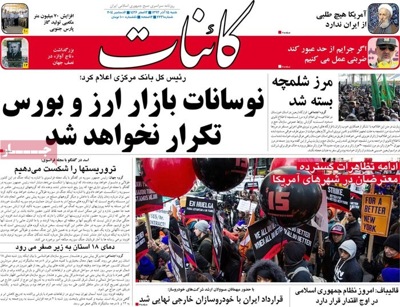
Kaenat: “A contract between Iran and foreign automakers has been finalized.”


Kaenaat newspaper 12 - 6


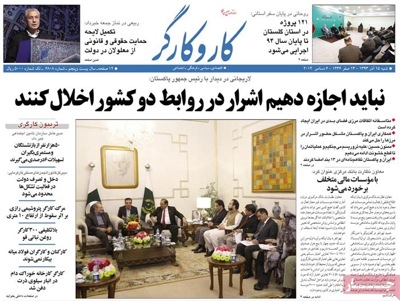
Kar va Kargar: “We should not allow outlaws to sabotage relations between the two countries,” Parliament Speaker Ali Larijani said at a meeting Friday with Pakistani President Mamnoon Hussain in Islamabad.


Karo karegar newspaper 12 - 6'


Kayhan: “We owe our national security to war veterans and those who lost their limbs [to serve our country], not to nuclear talks,” a number of MPs said in reaction to remarks by Foreign Minister Mohammad Javad Zarif.

Kayhan: “Things have turned tough for iconoclasts; Minister of Science, Research and Technology Mohammad Farhadi is loyal to the establishment.”


Kayhan newspaper 12 - 6


Qods: “Parliament Speaker Ali Larijani has dismissed reports that Iran is cooperating with America in air strikes against the ISIL positions.”


Ghods newspaper 12 - 6


Resalat: “A foreign shock cannot pose a threat to our economy,” said Mohammad Nahavandian, President Rouhani’s chief of staff.

Resalat: “Solutions to the country’s problems cannot be found beyond national borders,” said Tehran Mayor Mohammad Bagher Ghalibaf.


Resalat newspaper 12 - 6


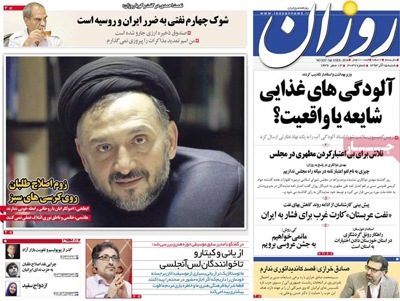
Roozan: “I am not going to put myself forward as a candidate for the upcoming presidential election,” said Seyyed Mohammad Sadegh Kharrazi, a member of the newly-formed NEDA [Farsi initials for a Second Generation of Reformism] Party.


Ruzan newspaper 12 - 6'


Vatan-e Emrooz: “Some MPs, experts and people are opposed to privatizing state-owned schools, citing its unconstitutionality.”


Vatane emruz newspaper 12 - 6


London, Rome, Tehran, Amsterdam to go to Europe

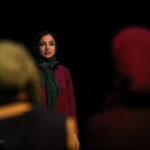
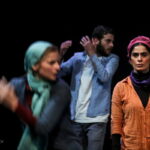
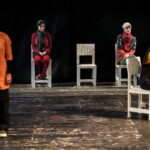
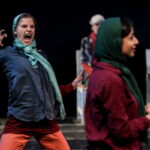
London, Rome, Tehran, Amsterdam Theater

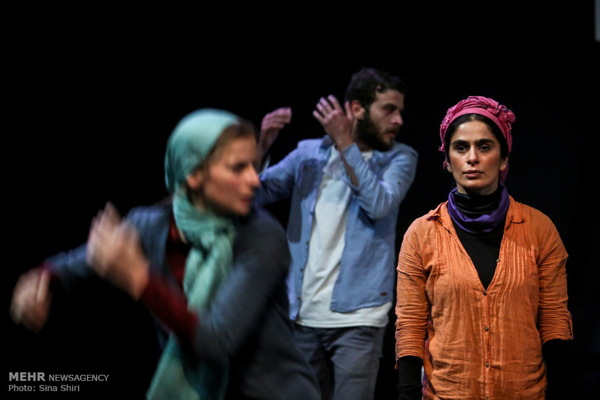
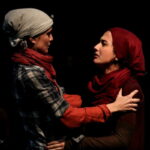
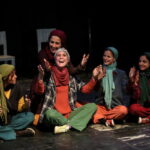
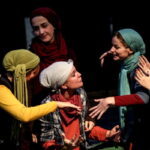
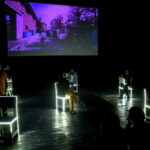
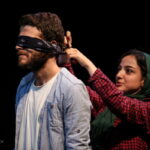
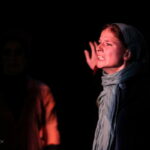
London, Rome, Tehran, Amsterdam [Reconsider Your Image of Me], a co-production of the Virgule Performing Arts Company from Iran and STET The English Theatre from the Netherlands, has gone on stage in Tehran’s Hafez Hall.

Mehr News Agency on November 17 reported the opening of London, Rome, Tehran, Amsterdam in Tehran, saying the play with a cast from Iran, England, Italy and the Netherlands will be performed in Europe in 2015. The following is part of that report:

The playfirst hit the stage on November 16 with the Dutch ambassador in attendance. The stage performance will run until December 12.

The play, which has brought together Iranian and non-Iranian cast, will have stage performance in Europe in 2015.

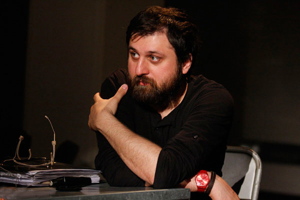
Arvand Dashtaray“The play is about daily life of people in different countries and shows how media and the Internet form stereotypes about other nations,” Mehr News Agency quoted Arvand Dashtaray, the leader of group, as saying.

He hailed the play as another intercultural experience of the ensemble and said that “the play is in accordance with cultural studies and addresses intercultural misunderstandings.”

In a news article the Dutch embassy said the following about the play, “The performance examines a current topic between Iran and the West, namely what are the images that we have of ‘the Other’, and to what extent fears, fantasies and imaginations are based on truth. By initiating a direct meeting with the Other and listening to each other’s stories, this group aims to create new images, based on the stories of the people who wouldn’t usually make the headlines. The piece is a multi-media, highly physical, speech performance.”

“It includes the actors’ own stories, dialogue between the actors, video installations with short documentaries about daily life in the countries of origin of the actors, and video collages of cultural milestones from these cultures. The physical form of the piece produces a third language. […]”


Norwegian investors willing to invest in Iran

Iran-Kerman

The Norwegian ambassador to Tehran has said the country’s investors would welcome investment in Iran’s economic projects.

Mrs. Aud Lise Norheim, who was in a meeting with Kerman’s provincial governor in southeast of the country on Wednesday, told Mehr News local correspondent that the visit was her first ever trip to Kerman since she resumed the position of ambassador.

“I hope and will have trips to Kerman in four years of my tenure in the office,” she told Mehr News. She highlighted the visit by Norwegian foreign minister after 12 years to Iran as an indication of bilateral ties improving.

Norheim said that Norwegian investors would welcome to participate in Iran’s economic projects; “even before sanctions both countries had good relations, and sanctions had little impact over trade,” she claimed, “If sanctions are removed, this trade would even be more extended; currently as well, we have a good level of economic exchange between two countries,” she added.

Norheim said one objective of her Kerman Province visit was to address the conditions of Afghan refugees in the province. She expressed gratitude for the Iranian government’s handling of these refugees and hoped that Afghans would return to their own country once the political volatile situation in Afghanistan ebbed away.

“Currently, Iran and Norwegian Office for Refugees provide good services for refugees; the opening of the UN Refugees Commission Office in Kerman also would help the conditions improved,” she asserted.

Norheim also said that Kerman’s tourism potential contributed to her trip to the province; “Kerman has prominent historical places; in Norway, many people are interested in visiting Iran, and those who visited, have taken with themselves good memories of their memorable visit,” she added.

Persian language course begins in North Ossetia University

North Ossetia University

The first educational course of Persian Language began in North Ossetia State University (NOSU).

In a ceremony in Iran’s cultural center at the university, Dean of History Faculty of the NOSU said in his speech that the event is important for those who are interested in Iranian culture.

He said that Iran is an ancient country with several thousand years of history and civilization and understanding Iranian culture and literature is impossible without knowing the Persian Language.

Head of Iran’s Cultural Center at the university, for her part, said interest in the Persian Language in the Caucasus region, especially in North Ossetia Republic, is growing.

She said beginning of the course at the university would be an important element for developing cultural ties between Iran and North Ossetia.

Iran’s Cultural Center at the NOSU was established two months ago following signing two cooperation agreements between Iran’s cultural attaché in Moscow and the university.

US anti-ISIL fight political stunt: Iran’s Majlis speaker

Iran-Ali-Larijani

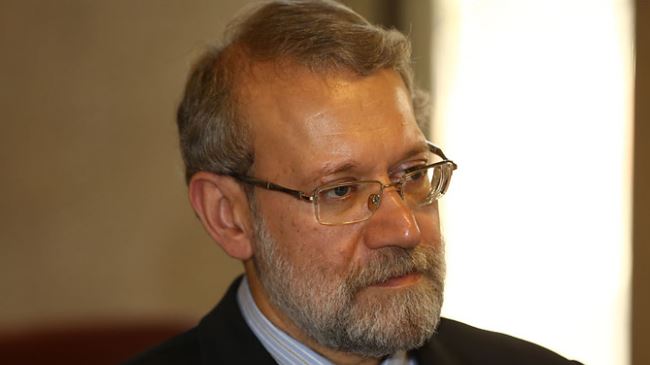
Iran’s Parliament (Majlis) Speaker Ali Larijani says the US has failed to seriously battle the ISIL terrorist group, stressing that Washington’s campaign against ISIL Takfiris is a political stunt.

“The coalition formed under the US leadership to fight ISIL is a propaganda campaign,” Larijani told reporters in Islamabad on Friday after holding talks with senior Pakistani officials.

He dismissed reports about joint airstrikes by Iran and the US against the ISIL militants, saying, “Iran has carried out no airstrikes either directly or in collaboration with others [against the ISIL terrorists] because it regards this course [of action] as wrong.”

He emphasized that it would be impossible to fight against terrorism through airstrikes, adding that Tehran has no commonality with Washington in the war on terror.

The Iranian Majlis speaker said terrorist groups including the ISIL Takfiris are created to sow division in the Muslim world to serve the interests of the US and the Israeli regime.

He added that Iran strongly opposes such terrorist and extremist movements and regards them as detrimental to Muslim nations.
Since late September, the US, along with its regional allies, has been conducting airstrikes against the ISIL inside Syria without any authorization from Damascus or a UN mandate.

This is while many of the countries joining the so-called anti-terror coalition, such as Turkey, Saudi Arabia and Qatar, have been staunch supporters of the ISIL Takfiri elements in the Middle East.

The airstrikes by the US and its allies are an extension of the US-led aerial campaign against the ISIL positions in Iraq, which started in August.

The ISIL terrorists currently control large swathes of territory across Syria and Iraq.