Monday, December 22, 2025
Home Blog Page 4888

Zarif: Military attack not to help Yemen

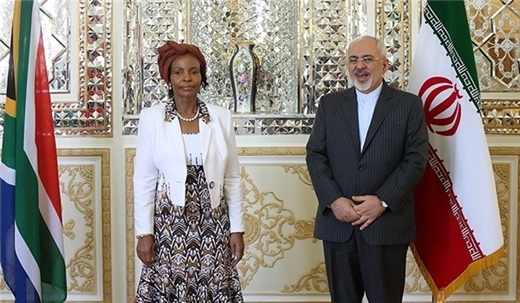
Zarif-Paki Speaker

Foreign Minister Mohammad Javad Zarif said on Friday that military attacks, bombardment and destruction of infrastructure would not help Yemen.

Zarif made the remark in a meeting with Pakistan’s National Assembly Speaker Ayaz Sadiq.

Touching on the Iran-Pakistan cordial relations, Zarif described terrorism, extremism and smuggling as concerns shared by the two countries.

The Iranian minister also appreciated Pakistan for his stance toward Tehran nuclear issue.

Sadiq, for his part, underscored that Pakistan and Iran could play a pivotal role in settling regional problems.

Pointing to the current developments in Yemen, he added all parties should be invited to the negotiation table, emphasizing that dialogue is a sole way to settle the dispute in this Arab country.

The Pakistani official also called for expansion of parliamentary cooperation between the two countries.

[…]
Everything lies in details, says Leader on nuclear talks

Supreme leader

“Everything lies in the details,” said the Leader in an address on Thursday.

“The other side which is known for backpedaling on its commitments may want to corner our country when it comes to the specifics [of the negotiations],” said Ayatollah Khamenei.

“So, it is pointless congratulating me and others at this point,” the Leader underscored.

Ayatollah Khamenei suggested that what has been done so far cannot ensure a final deal.

“What has been done so far neither guarantees [the clinching of] an agreement itself and its contents, nor ensures that the negotiations would proceed to the end,” the Leader highlighted.

Ayatollah Khamenei then pointed out that “he has never been optimistic about negotiations with the US,” but that he “has supported and will support the negotiators” in the current talks.

The Leader underlined that any deal would have to “ensure the interests and dignity of the [Iranian] nation.”

Iran and P5+1 group of countries – Russia, China, France, Britain, the US and Germany – along with officials from the European Union reached a mutual understanding on Tehran’s nuclear program after eight days of marathon talks in Switzerland last week.

The two sides will now work on drawing up a final accord by the end of the self-designated June 30 deadline.


‘Saudi making mistake’

Touching upon the developments in Yemen, the Leader denounced the Saudi aggression against the Arab country as a “mistake,” saying the invasion has “set a bad precedent in the region.”

The Saudi aggression against Yemen compares to Israeli atrocities against Palestinians in Gaza, Ayatollah Khamenei noted, slamming Riyadh’s attacks against the Yemeni people as a “crime and genocide” which could be prosecuted in international courts.

He said the aggression against Yemen will be to the detriment of Saudi Arabia, adding Riyadh will, by no means, emerge victorious in its aggression.

Ayatollah Khamenei touched upon Washington’s backing for Saudi Arabia in attacking Yemen, and noted the US always sides with the oppressor rather that the oppressed.

The Leader strongly denied the allegation that Iran is interfering in Yemen, taking a swipe at the Saudi-led air campaign against the Arab country which has “made the skies over Yemen unsafe.”

He said the “ill-wishers” hatching plots against Yemen have sought to create a power vacuum in the country like what happened in Libya, but “they have failed to achieve this objective.”

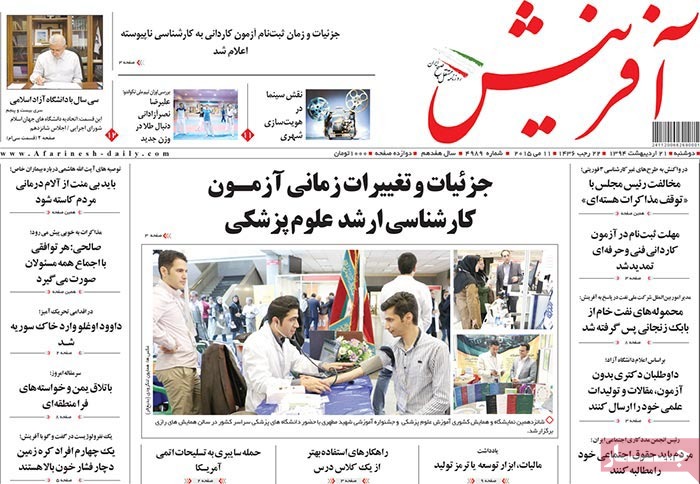
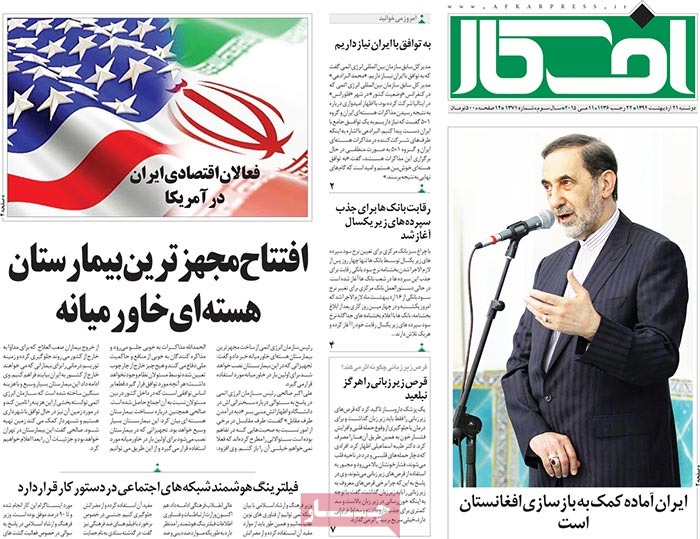
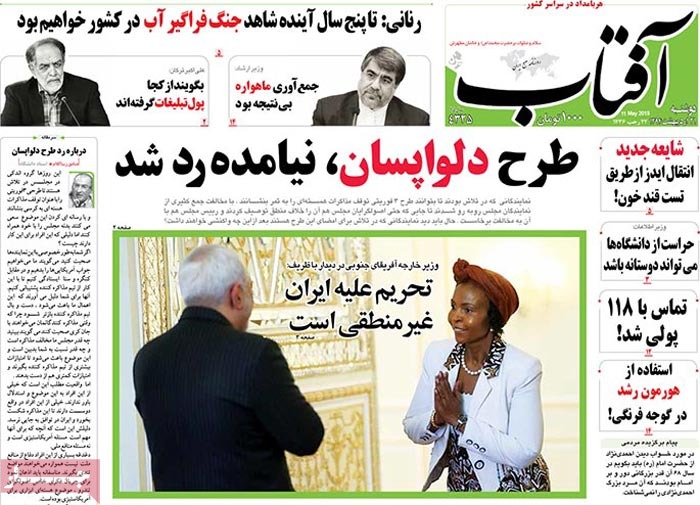
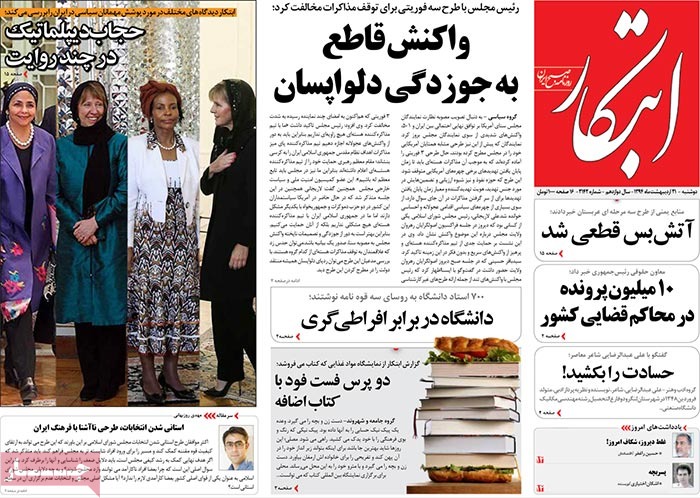
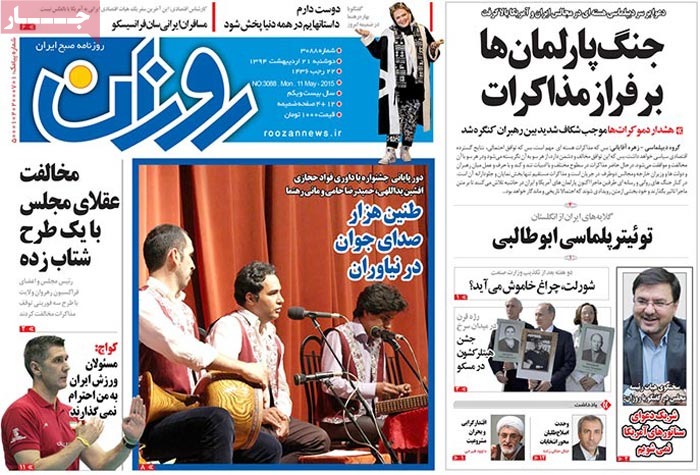
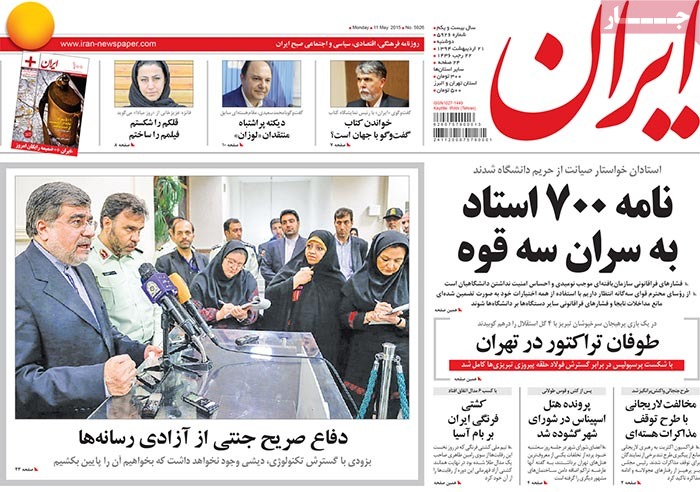
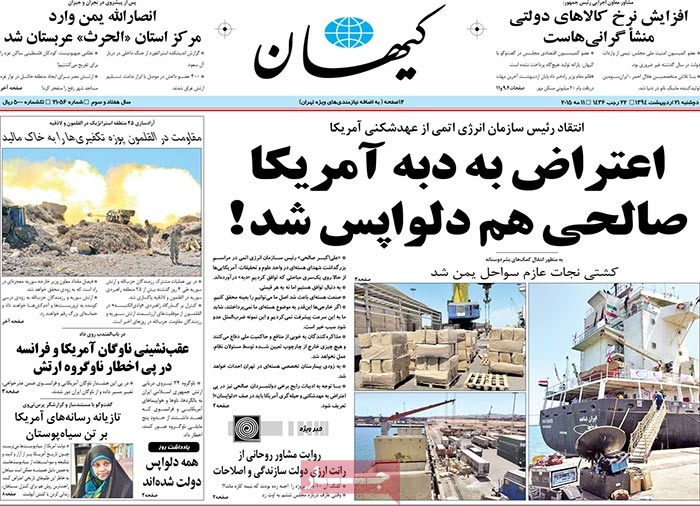
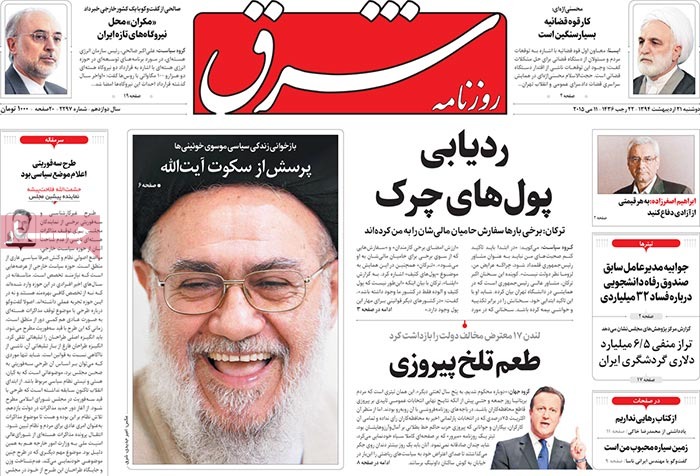
A look at Iranian newspaper front pages on April 9

Iranian Newspapers Headlines

Condemnation by Iranian officials of sexual assault against two Iranian teenage pilgrims in Jeddah, Saudi Arabia dominated the front pages of newspapers on Thursday. Completion of a report on an attack on an MP in the city of Shiraz in March was also on the covers of the dailies.

Abrar: The European Union has re-imposed sanctions on Iran’s Tejarat Bank and 32 shipping companies.

Abrar: A report on the Shiraz incident has been sent to the heads of the three branches of government.

In the incident in March assailants on motorbike attacked Tehran MP Ali Motahari who was in the southern city for a planned speech.


A look at Iranian newspaper front pages on April 9


Aftab-e Yazd: The assets of Babak Zanjani [an Iranian billionaire who stands accused of massive corruption] have been located in Tajikistan.


A look at Iranian newspaper front pages on April 9


Arman-e Emrooz: Saudi Arabia has not allowed a plane carrying Iranian Hajj pilgrims to land on its soil.

In reaction, Iranian MPs have called for the minor Hajj to be put on hold until further notice.

Arman-e Emrooz: Those involved in the Shiraz incident have been arrested.

In the incident Ali Motahari, a principlist MP, was in the southern city in March to deliver a speech when his car was attacked. The speech was called off.


A look at Iranian newspaper front pages on April 9


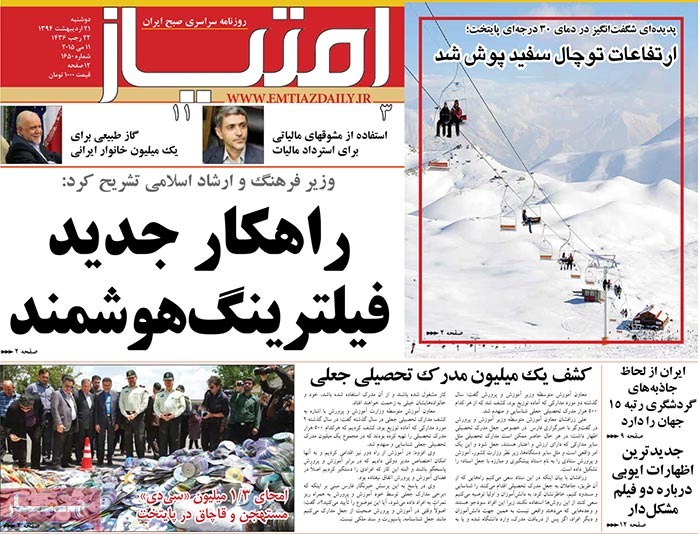
Eghtesad-e Pooya: The level of water at Orumiyeh Lake has increased for the first time in 18 years.


A look at Iranian newspaper front pages on April 9


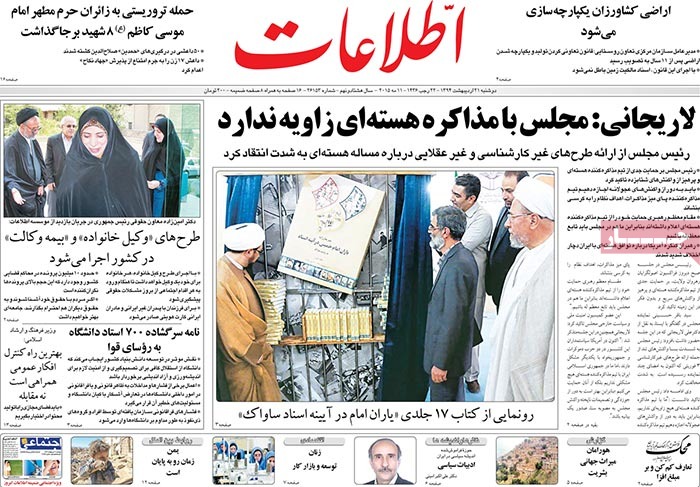
Ettela’at: Iran is to become an official member of the Shanghai Cooperation Organization.

Ettela’at: Executive institutions have been required to cut back on water consumption by 20 percent.

Ettela’at: Pakistan has said that it will decide about joining the Yemen offensive after consultations with Iran and Turkey.


A look at Iranian newspaper front pages on April 9


Hemayat: “The flaws and ambiguities of the Lausanne statement should not find their way into the nuclear deal.”

Judiciary Chief Ayatollah Sadegh Amoli Larijani made the comment as he supported the Iranian nuclear negotiating team and appreciated its efforts.


A look at Iranian newspaper front pages on April 9


Jamejam: The Central Bank of Iran has said that interest rates won’t increase.


A look at Iranian newspaper front pages on April 9


Jomhouri Islami: The nuclear statement of Lausanne continues to draw local and foreign support.

Jomhouri Islami: The sexual assault in Saudi Arabia on two Iranian pilgrims has drawn condemnation from Iranian officials and clergymen.

Senior Shiite clerics, the parliament speaker, the Judiciary chief and MPs have lashed out at the incident at Jeddah airport.


A look at Iranian newspaper front pages on April 9


Kayhan: New sanctions are the first achievement of the Lausanne deal!!


A look at Iranian newspaper front pages on April 9


Mardomsalari: The world’s largest petrochemical complex is to be built in Iran.


A look at Iranian newspaper front pages on April 9


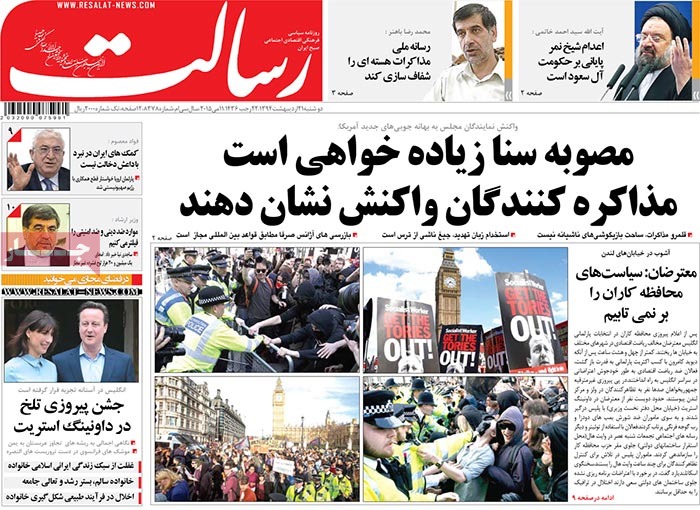
Resalat: “An assault on young pilgrims in a country which claims to be [the cradle of] Islamism is shameful.”

Parliament Speaker Ali Larijani made the comment in reaction to sexual assaults against two teenage Iranian pilgrims in Saudi Arabia.


A look at Iranian newspaper front pages on April 9


Shahrvand: Al-Nassr from Saudi Arabia were brought to their knees at a packed Azadi Stadium in Tehran.

The capital’s Persepolisclub edged the Saudi team 1-0 in Group A of AFC Champions League on Wednesday.


A look at Iranian newspaper front pages on April 9


Sharq: Iran is trying to contain the Yemen crisis; Zarif flew to Islamabad from Muscat.


A look at Iranian newspaper front pages on April 9


Iran envoy urges deadline for global nuclear disarmament

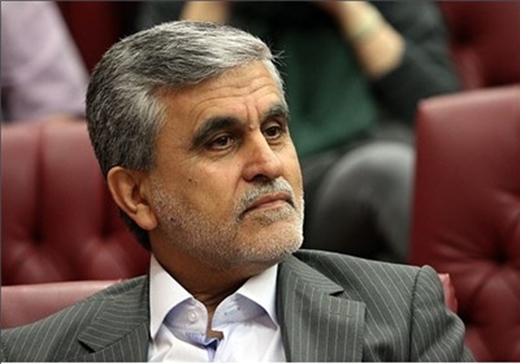
Gholam Hossein Dehghani

Iran has criticized the five nuclear weapons states for failing to take concrete measures to eliminate their stockpiles, urging a deadline for nuclear disarmament across the world.

Addressing the UN Disarmament Commission on Wednesday, Iran’s Deputy Ambassador to the UN Gholam Hossein Dehghani called on the nuclear powers – the United States, Britain, Russia, France and China — to engage in negotiations on a treaty to achieve nuclear disarmament by a target date.

He emphasized that “a comprehensive, binding, irreversible and verifiable” treaty is the most effective and practical way to get rid of nuclear weapons.

The five nuclear powers have promised to disarm their nukes, but have so far failed to make any significant progress, the Iranian envoy said.

As a non-nuclear weapon country and a signatory to the Non-Proliferation Treaty (NPT), Iran believes that the time is ripe for ending the incremental approach toward disarmament and opening negotiations with all nuclear and non-nuclear weapon states on a convention that would set a deadline for global disarmament, Dehghani pointed out.

The commission, comprising all 193 UN member states, is supposed to make recommendations on disarmament, but has failed to make substantive proposals in the past decade.

Some nuclear weapons states, including the United States, have launched a program to modernize their nuclear bombs despite promises to disarm.

Dehghani’s remarks came after Iran and the five permanent members of the UN Security Council plus Germany reached a mutual understanding over Tehran’s nuclear program in the Swiss city of Lausanne on April 2 after eight days of marathon talks.

Iran and its negotiating partners are now expected to start work to draw up a final comprehensive deal over the Islamic Republic’s nuclear program by the end of the self-designated June 30 deadline.

Iran has repeatedly dismissed allegations that its nuclear program pursues military objectives and argued that as a committed signatory to the NPT and a member of the International Atomic Energy Agency (IAEA), it has the right to use nuclear technology for peaceful purposes.

Meanwhile, numerous reports by the UN nuclear agency have verified the peaceful nature of Iran’s nuclear program.

Saudi government perpetrated crimes against humanity in Yemen

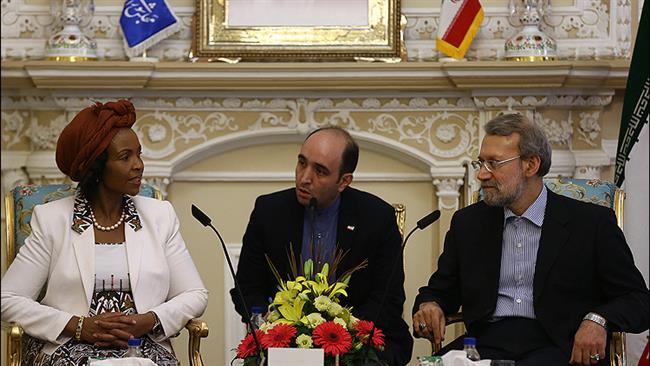
Ali larijani-qatar

Iranian Parliament Speaker Ali Larijani said on Wednesday that the Saudi government perpetrated crimes against humanity in Yemen by indiscriminate bombardment of the civilian targets killing several hundred innocent civilians.

‘We are witnesses to the occurrence of disputes in the Islamic society today. What is really going on (in the Muslim World)? What is this mess that the Saudis have made in Yemen? Is it not enmity against God?’ said Larijani in a meeting with the spouses of the parliamentarians.

[…]
The parliament speaker said, “The Takfiri terrorists are today generating disputes among the Islamic Ummah, using religion as a tool at the service of the enemies of Islam and the Muslims need to act as a solid arm to counter that serious plot”.

Larijani reiterated that many of the problems prevailing in the Islamic world are due to the negligence of the Muslims about such plots, which has led to the prevalence of broad corruption in various parts of the Islamic world.

“Isn’t it misdemeanor for a country that claims to be the guardian of Islam that a young man is treated so much beneath the human dignity there and insulted so harshly? Can such a society be called an Islamic society?” he said referring to the defaming of a couple of young Iranian Hajj pilgrims in a Saudi airport.

The parliament speaker further posed the question: Why were the wars against Syria and Yemen launched?

‘The Great Prophet (Peace Be upon Him) says that the Muslims resemble a single body and if a limb of that body is hurt it will lead to pain for the entire body,’ he added.

Inspection of military sites a red line, says Iranian defense minister

General Dehghan

Iranian Defense Minister Brigadier General Hossein Dehghan brushed off media reports that in the recent nuclear talks in Lausanne, Switzerland, there has been any talk of allowing access to Iran’s military sites.

Dehghan on Wednesday dismissed the reports as phony assertions and said there has been “no agreement on inspection of Iran’s military centers and no visits will be allowed (to these centers).”

He stressed that access to the country’s military sites is among Iran’s red lines.

Iran and 5+1 (Russia, China, the US, Britain, France and Germany) adopted a joint statement on April 2 after more than two weeks of marathon talks in Lausanne, with both sides committed to push for a final, comprehensive accord until the end of June.

The framework provides a series of solutions that will be the basis of a comprehensive joint plan of action.

General Dehghan further said that the Iranian nuclear negotiating team that enjoys the judicious support of the Supreme Leader of the Islamic Revolution as well as the backing of the Iranian nation and the country’s branches of power, is determined to safeguard Iran’s nuclear rights and national interests in the future talks.

Iran marks National Nuclear Tech Day, unveils nuclear achievements

Rouhani

Iran marked the National Nuclear Technology Day, with President Hassan Rouhani unveiling the country’s latest nuclear achievements at a ceremony in Tehran.

Among the achievements unveiled on Thursday were three radio-medicines. President Rouhani delivered an address in the ceremony.

Rouhani said that a statement [a reference to the Lausanne statement] was not Iran’s only achievement in the nuclear talks with P5+1, but that the Islamic Republic’s chief gain was the fact that US President Barack Obama acknowledged that the people of Iran will not surrender to bullying, sanctions and threats.
This is a triumph for our country that the first military power in the world admits this fact, the Iranian president said.

President Rouhani then pledged that all the sanctions on Iran would be removed upon the first day of the implementation of a nuclear deal with the world powers.

He said that the Iranian nation has been and will be the victor in the negotiations.

Rouhani further said that the Iran seeks constructive interaction with the rest of the world.

Pointing to the Saudi air strikes in Yemen, Rouhani said, “Nations will not surrender to bombardment,” adding that the future of Yemen will be determined by its people alone.

He called on the other world nations to adopt the path of moderation as well.

Zarif calls for Yemeni solution to Yemen situation

Zarif

Iranian Foreign Minister Mohammad Javad Zarif has called for a ceasefire in Yemen, which is being bombarded by Saudi warplanes since late March.

“Yemen’s issue only has a Yemeni solution,” Zarif said at a joint press conference with Sartaj Aziz, the Pakistani premier’s adviser on national security and foreign affairs, in the capital Islamabad on Wednesday.

“The people of Yemen should not have to face aerial bombardment,” he added, calling for an urgent ceasefire.

The Iranian foreign minister noted that all countries “including Iran, and Saudi Arabia” should help to end the war against the impoverished country.

“It is up to Yemen how it wants to do it. We can only facilitate [the process] as countries in the region,” Zarif said.

Zarif’s two-day visit to Pakistan began on Wednesday following his meeting with Omani Foreign Minister Yusuf bin Alawi in Muscat earlier in the day.

The high-ranking diplomat, who is visiting Pakistan at the head of a 22-member delegation, is scheduled to meet Prime Minister Nawaz Sharif on Thursday.

Saudi Arabia’s air campaign in Yemen started on March 26 in a bid to restore power to former Yemeni President Abd Rabbuh Mansur Hadi, a close ally of Riyadh.

On March 25, the embattled president fled Aden, where he had sought to set up a rival power base, to Riyadh after Ansarullah revolutionaries advanced on Aden, where fighting continues.

To go between nations or go beyond norms

Erdogan

A daylong trip by Turkish President Recep Tayyip Erdogan to Iran against the backdrop of recent regional developments, especially Saudi airstrikes on Yemen, has brought under the microscope Ankara’s stance, with Turkey watchers saying that the country is trying hard to act as a go-between in regional hot spots.

Javan daily on April 8 published an opinion piece by Hadi Mohammadi on Erdogan’s pragmatism and the role his country plays in regional conflicts. The following is the translation of the piece:

Laicism defines the essence of policies adopted by Turkey’s [Muslim] Brotherhood-style Islamist government [of the Justice and Development Party (AKP)] which draws on absolute pragmatism to work out its approaches to domestic and foreign affairs. The government is called Islamist – a decorative title though – but ideological or human values are absent in the government’s official and unofficial policies.

That’s why this government’s alliance with Satan [presumably a reference to the US] is not lambasted and its support for murder, terrorism and extremism is justified as a means to advance the country’s agenda. The Turkish government makes use of Machiavellianism and hypocrisy to put its domestic and foreign policies on track and rationalize its approaches.

Support for ISIL, Alqaeda and the al-Nusra [Front] in Iraq, Syria and the Sinai Peninsula is cast as support for democracy and people. Turkey’s policies revolve around the question of how much economic productivity they can create, and alliance with colonial powers and dictators as well as the role this country plays [in different regional events] are justified only when they produce economic profits and guarantee the country’s gross domestic product (GDP) and economic growth.

The intermediary or rental economy is the centerpiece of Turkey’s economic ties with Iran, something which Ankara has properly taken advantage of. Today Turkish officials once again feel the necessity of mediation, which has assumed a political form this time around.

Erdogan who has, without doubt, drummed up and insisted on support for terrorism at the hands of ISIL and al-Nusra in the region, is weighing up the strategic circumstances in the region as follows: the conclusion of a nuclear deal with the West would weaken the economic position of Turkey in Iran to the level of its passive security and political ties with the Islamic Republic.

His insistence on an upgrade of economic relations with Iran means that Turkey makes no profit from Iran’s nuclear deal with P5+1 and is asking for something in return for its political approach in Yemen where Ankara has failed to join the Saudi-led military operations.

Although the Turks have calculated that the US stances on Yemen – which do not conform to Saudi Arabia’s – are good reason for not following the Saudis in killing the Yemeni people, they do not want to miss out on the political opportunity they have been offered in the Yemeni crisis.

By the same token, the Turkish foreign minister said in a meeting with the visiting Saudi deputy crown prince Muhammad bin Nayef in the buildup to Erdogan’s trip to Tehran that his respective government can act as a go-between in the Yemeni crisis and score [political] points.

Although Saudi Arabia is trying frantically to drag Pakistan and Egypt into ground war in Yemen through staggering financial favors it offers, Turkey seeks to repeat the empty talks of Saudi Arabia on Iran’s interference in the affairs of regional countries and cover up the bloodshed in Iraq, Syria and Yemen only to get concessions from Tehran and Riyadh. To show that it is working with Iran, Ankara tries to pose as a mediator.

It is true that Iranian officials have ignored Erdogan’s stances with magnanimity and welcomed growing ties with Turkey and other regional nations, but the fact of the matter is that Erdogan’s approach to Yemen – which prescribes excessive pragmatism – is similar to his reaction to the Iraqi and Syrian crises.

Mediation in Yemen signifies that Turkey is not ready to follow Saudi Arabia or that Turkey can claim no share in Yemen, so it can only take advantage of bloody tensions in Yemen in the capacity of a mediator.

Turkey’s new stance does not indicate that it is consumed by a human feeling and concerned by the massacre of Yemen’s people by napalm and cluster bombs Saudi Arabia rains down on the defenseless people in Yemen.

The foreign policy Ahmad Davoud Oglu, the former Turkish foreign minister, pursued to give a key and unique status to Turkey [in the region] has now downgraded to a Turkey which acts as a political middleman and Iran has welcomed Turkey’s new role.

EU’s sanctions bring about loss of confidence: Afkham

Marziyeh-Afkham
Marziyeh-Afkham

The European Union measure to re-impose sanctions on an Iranian bank and 32 shipping companies is “unconstructive”, Iran says.

Foreign Ministry Spokeswoman Marzieh Afkham said on Wednesday that revoking a decision by a European court to lift the bans leads to “loss of confidence” as Iran and P5+1 are still in talks to clinch a final nuclear accord by the end of June.

“While negotiations continue and efforts are underway for a comprehensive agreement, the EU’s measure… is unconstructive,” Afkham said.

She further voiced “regret” over the EU’s neglect of “decisions by European courts”, noting that reintroduction of the sanctions “will not help the current process of the talks and causes loss of confidence”.

In January, the General Court of the European Union annulled the illegal bans on Bank Tejarat and 40 Iranian shipping companies, citing lack of enough evidence against them.

However, the EU’s Official Journal said Wednesday that 32 of the companies as well as Bank Tejarat are back on the sanctions list based on “a new statement of reasons”.

The decision followed a mutual understanding reached between Iran and P5+1 – the United States, Britain, Russia, France, China, and Germany – in the presence of EU officials in the Swiss lakeside city of Lausanne on April 2. Based on the prospective agreement, all the sanctions will be removed in exchange for some nuclear-related measures taken by Tehran.