Monday, December 22, 2025
Home Blog Page 4889

Iran has put together its own factsheet: Negotiator

Iran Condemns US Blacklisting of Its Nuclear Chief

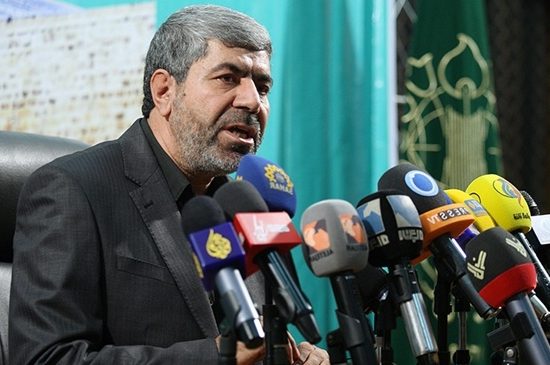
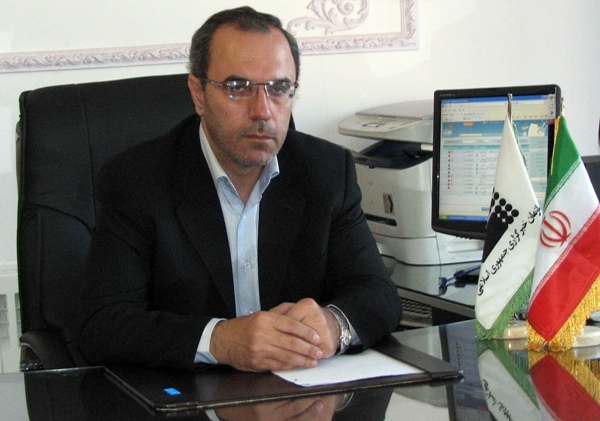
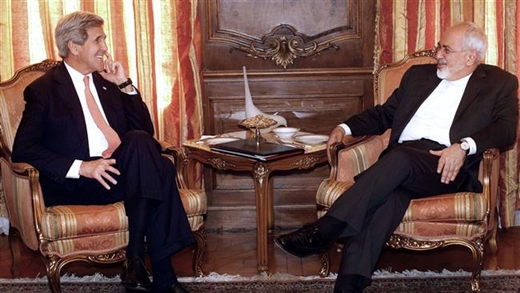
The Ministry of Foreign Affairs and the Atomic Energy Organization of Iran (AEOI) have jointly drawn up a factsheet [on the Lausanne statement] which could be released by Foreign Minister Mohammad Javad Zarif to quell ambiguities about the nuclear statement if and when he deemed it expedient, AEOI Director Ali Akbar Salehi was quoted by Iranian Students News Agency as telling reporters Wednesday.

In response to a question as to why Iran did not produce its own factsheet when the talks were still ongoing, Salehi said there are many people out there who are opposed to talks between Iran and P5+1.

In light of the fact that some are at work to disrupt the process, such sensitive talks should be kept under wraps as much as possible in order not to provide anyone with any excuse to disrupt the process, Salehi said.

His comments came after Ebrahim Agha-Mohammadi, an MP, said deputies at the Islamic Consultative Assembly are signing a petition to be sent to the foreign minister to immediately release an Iranian factsheet to counter the untruthful comments of American statesmen.

A plea by deputy environment chief before Afghan president visits Iran

Iran-Helmand-lake-map

Ahmad Ali Keykha

Deputy Director of the Environment Protection Organization Ahmad Ali Keykha has appealed for a number of environmental questions to be raised in talks between senior Iranian and Afghan officials when Afghan President Ashraf Ghani visits Iran on April 18.

On April 6, Khabaronline, a news website, quoted the deputy environment chief as saying “Preservation of Hamoon Lagoon, fed by the Helmand River which originates in Afghanistan, should be an important factor in determining Iran-Afghanistan ties.”

He further said, “Hamoon is holy in different religions like Zoroastrianism, Judaism, Christianity and Islam. To protect and revive the endangered lagoon, every opportunity, including diplomatic potential, must be seized.”

He blamed damage to the environment and the marine ecosystem that Iran and Afghanistan share on inappropriate diplomatic conduct, and said, “It’s true that in the last decade, our interaction with world was not properly regulated, and unfortunately, the general atmosphere was not in favor of Iran.”

He added, “But things have now changed and the current government has put establishment of proper relations with the world countries on its agenda. Some of our interests are embedded in interaction with the rest of the world, and neighboring countries are of immense importance to that end. Neglectful of issues in neighboring countries, we cannot move our national development plans forward.”

Portuguese Castle in Southeastern Iran

Portuguese Castle (2)

The so-called Portuguese Castle is located on top of a hill in the village of Tis which was an important Iranian seaport during the Achaemenid Empire. The castle which is five km away from Chabahar was built during the Safavid era. As the Portuguese started to expand their naval fleet in the 16th century, they used the castle as a base to extend their influence in Iran and other Persian Gulf countries. The area where the castle is built on dates back to the pre-Islamic era. The castle has been registered on the list of Iran’s national heritage sites and is being restored.

The following images have been released by different websites:


Environment protection and development remain elusive in the absence of peace and security

Masoomeh-Ebtekar

The head of the Environment Protection Organization said Wednesday that the nuclear agreement Iran and P5+1 struck in Lausanne last week carried a message for the whole world: Iran has a pivotal role to play in creating a balance in a troubled region beset by incessant wars and [growing] insecurity.

The Islamic Republic News Agency (IRNA) quoted Masoumeh Ebtekar as further saying that the negotiating capability of the Iranian nuclear team is a source of pride for the Iranian nation. The following is a partial translation of what else the environment chief said:

She said that the outbreak of different wars in the region has rendered Western Asia and the Middle East region insecure, adding that a multi-lateral agreement on the nuclear rights of the Iranian nation and the removal of unjust sanctions against Iran show Tehran’s pivotal role in maintaining the regional equilibrium.

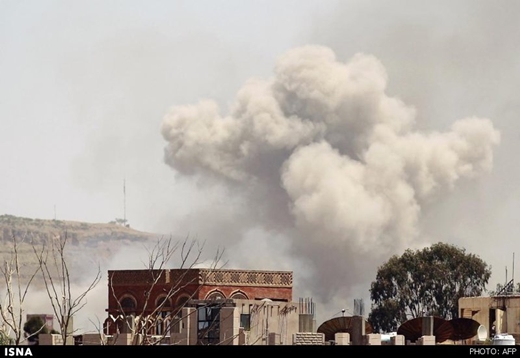
Ebtekar said that we have witnessed cases in which go-it-alone policies and interference have created insecurity in countries, adding that a case in point is what Saudi Arabia is doing now against Yemen.

Ebtekar went on to say that the Lausanne statement signals a clear message to the world that Iran has taken a positive attitude toward settling disputes as it tries to serve the interests of its people and respect their dignity.

Iran has demonstrated its determination to hold dialogue to reach a comprehensive agreement which can protect Iran’s rights and help lift the sanctions, she said, adding that the current conditions are a turning point in regional and international relations.

The environment chief further said regional balance, security and peace are the prelude to progress and substantially contribute – from various angles – to improving people’s living conditions and the environment, maintaining balance, restoring security and calm, and establishing cooperation at a global level.

Ebtekar then touched upon the Dialogue among Civilizations – an initiative put forward by the then Iranian president [Mohammad Khatami] in 2001 – and said Iran’s initiative preceded the 9/11 attacks. “President Rouhani’s WAVE (World against Violence and Extremism) proposal was also floated before the emergence of ISIL – an ominous phenomenon – and this shows that Iran has been a pioneer in establishment of peace as well as regional and global balance.

She went on to express hope that all parties involved in nuclear talks will show goodwill and work for a fair, balanced agreement.

Ebtekar said the Lausanne agreement carries much weight for Iran environmentally because security and calm together with the settlement of disputes come before sustainable development.

Regional conflicts which have caused huge collateral damage along with sanctions which target people’s lives have taken a heavy toll on the environment, she said, stressing that sanctions put on hold Iran’s efforts to live up to air quality standards and curb greenhouse emissions. Consequently, Iran embarked on the implementation of its international obligations on greenhouse emissions later than expected.

The environment chief also thanked the Supreme Leader for guiding the Iranian negotiating team as it held talks with world powers.

She praised the serious efforts the president has put in and the professional endeavors of Foreign Minister Mohammad Javad Zarif and his team, saying this is a praiseworthy example of the resolution of international disputes.

She said that the breakthrough [in Lausanne] is a great achievement for both the Iranian nation and the international community, adding that it shows the victory of multilateralism over unilateralism.

It is an outstanding achievement that Iran managed to build a consensus despite differences of opinion and conflicts of interest, she said, adding that the Lausanne agreement can be viewed as a major milestone in international efforts to solve differences.

A look at terrorist attacks and casualty figures in Iran in seven months

Terrorists-Border

A deadly attack by armed bandits on Iranian border guards in the southeast left eight of them martyred. The bloody attack prompted Khabaronline, a news website, to take a look back at acts of terror in Iran in the past seven months.

The following is a list of terror attacks and their casualty figures the website posted online on April 7:

1. An attack on a border area in Chabahar, southeastern Iran, on April 6, 2015 left eight border guards killed.

2. An assault on police in the southwestern province of Khuzestan on April 2 left three police officers killed and another two wounded.

3. Two citizens in the southeastern province of Sistan and Baluchestan were fired upon on January 2. A Shiite teacher and a Sunni Basij volunteer lost their lives in the terrorist attack.

4. A deadly ambush against an IRGC [Islamic Revolution Guard Corps] patrol in a border area in the southeast on December 28, 2014 left three IRGC members killed.

5. A staff member of Iranshahr Governor’s Office was assassinated on October 12.

6. A mortar attack on a police station in the southeast on October 9 left three police officers martyred.

7. An attack against a police station in Saravan, in southeastern Iran, on September 9 left one soldier and two Basij volunteers martyred.

A look at Iranian newspaper front pages on April 8

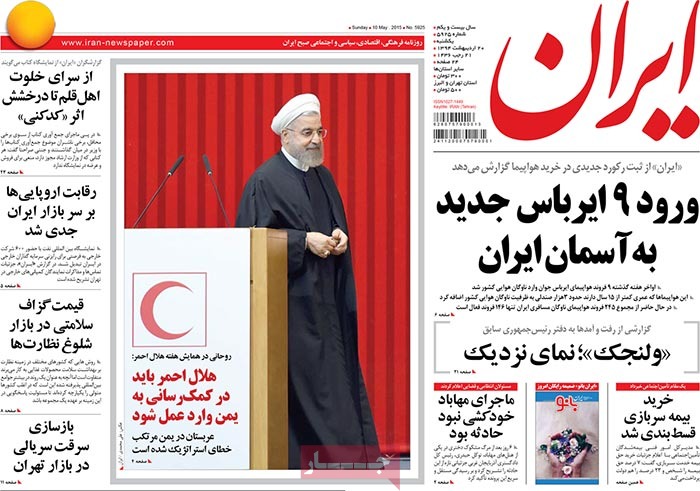
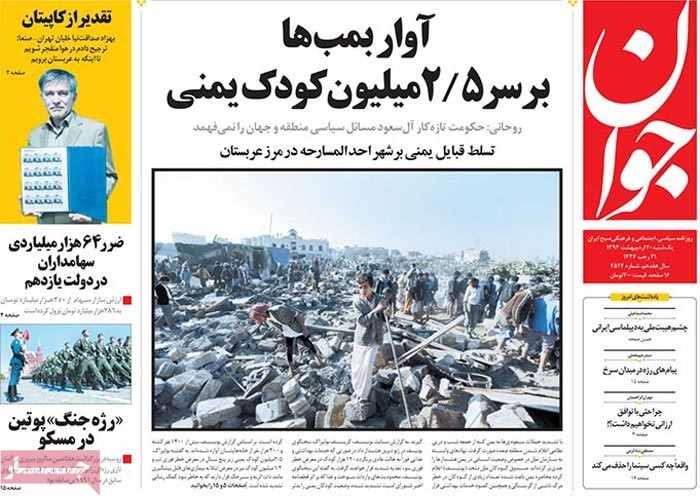
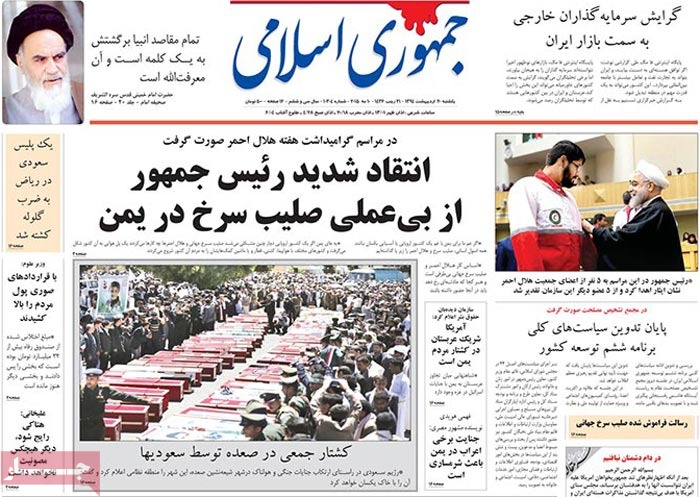
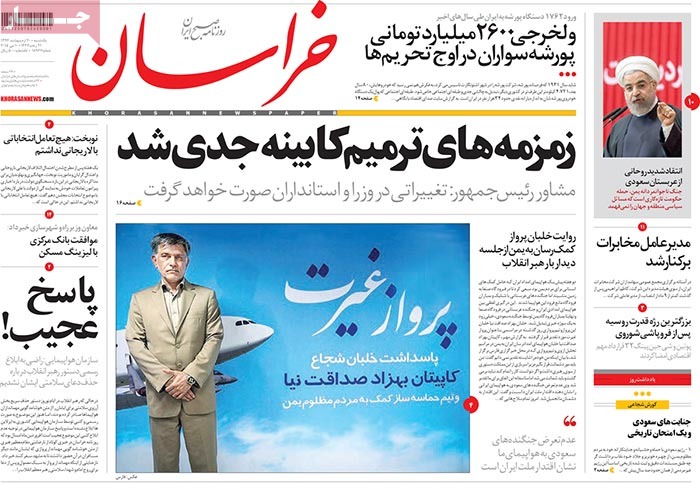
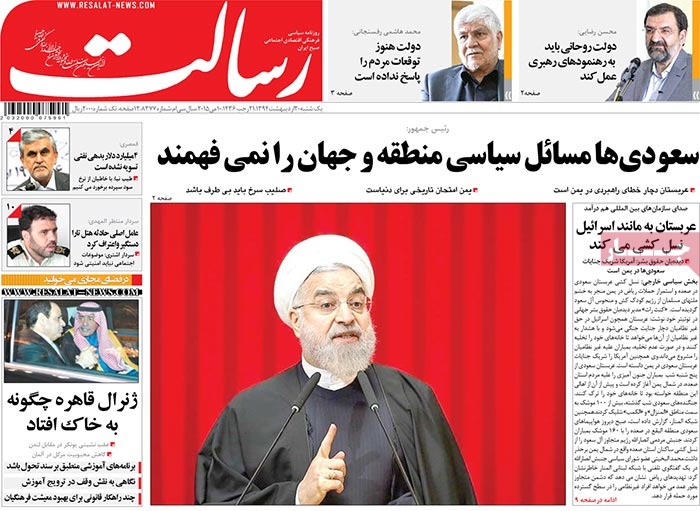
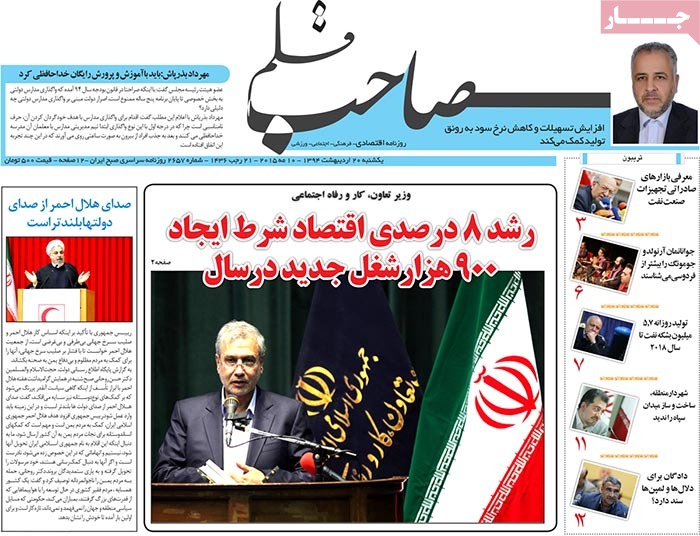
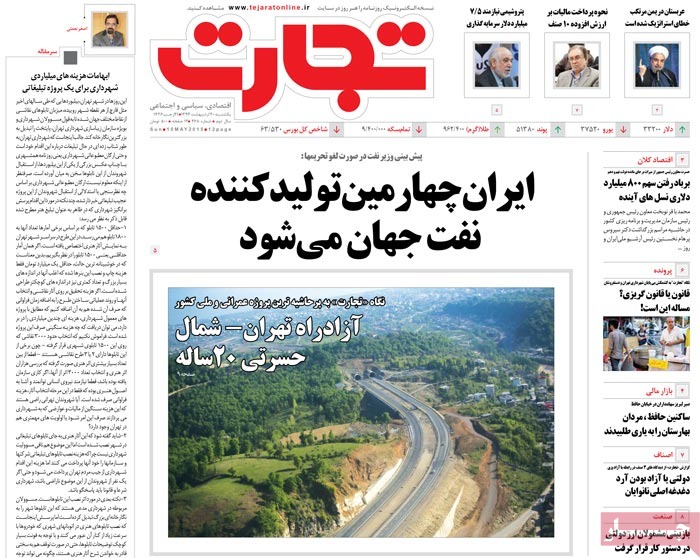
Iranian Newspapers Headlines

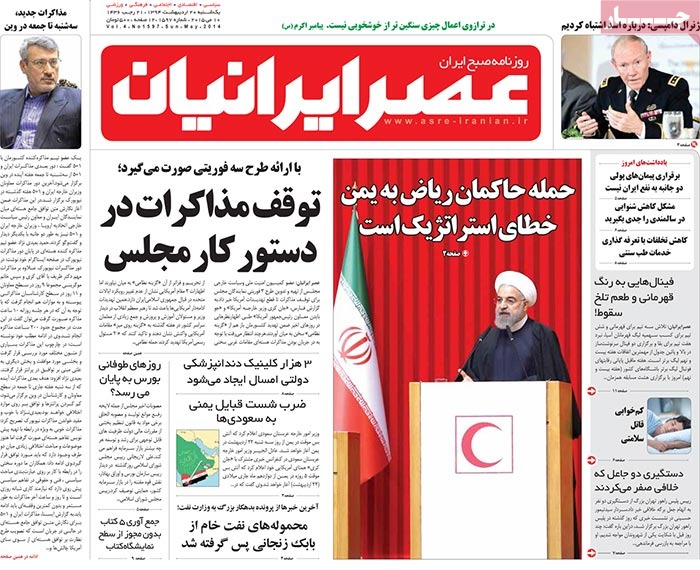
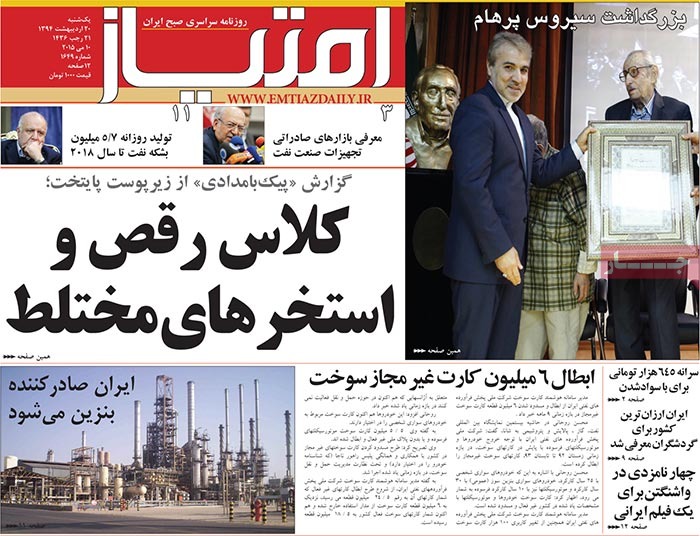
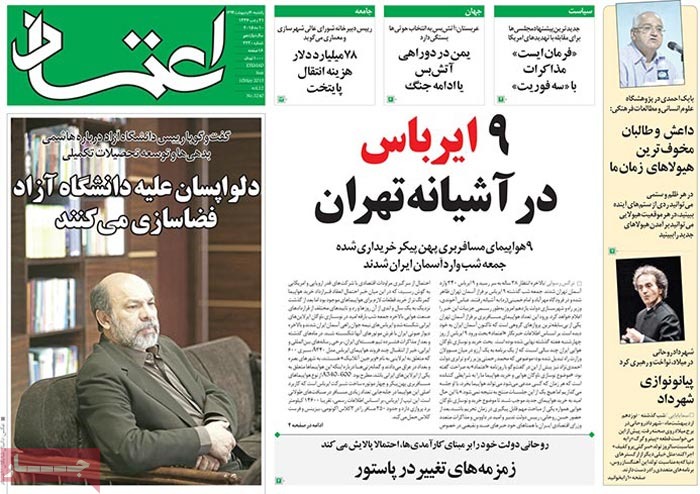
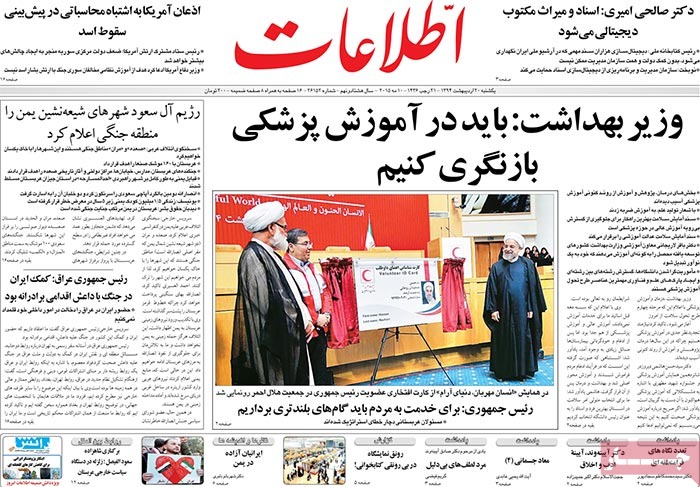
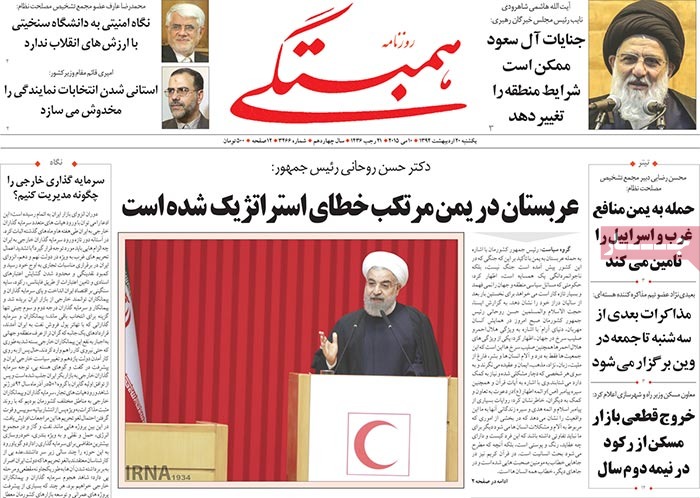
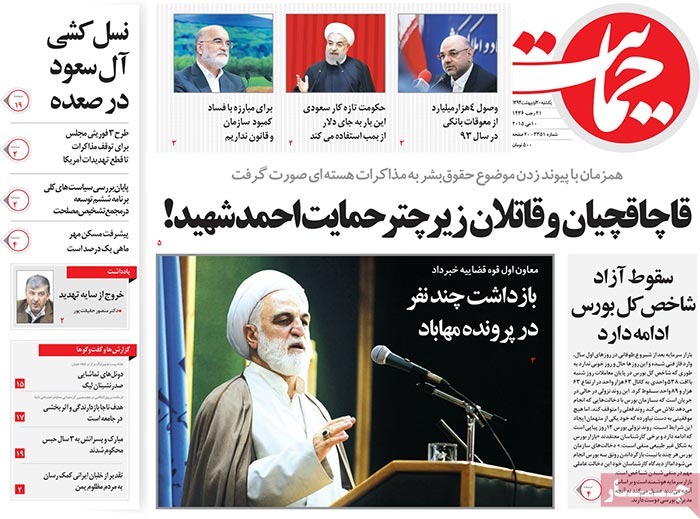
The meetings of visiting Turkish President Recep Tayyip Erdogan with the Supreme Leader and President Rouhani and the agreements Iran and Turkey signed during President Erdogan’s day-long visit dominated the front pages of Iranian newspapers on Wednesday. Also on the covers of the dailies were the comments of Ayatollah Rafsanjani and Major General Mohammad Ali Jafari in support of the nuclear statement Iran and P5+1 released in Switzerland earlier in April and the Iranian negotiating team.


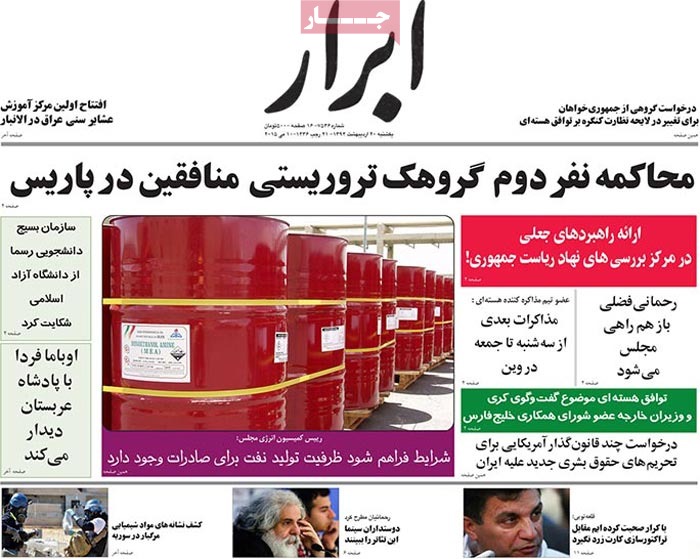
Abrar: An IS attack on an area near Iraq-Saudi Arabia border has been foiled.


A look at Iranian newspaper front pages on April 8


Afarinesh: “The post-nuclear statement liveliness of the people is an asset to the establishment,” said Ayatollah Akbar Hashemi Rafsanjani.

The chairman of the Expediency Council made the comment at a meeting with the vice-president for women and family affairs and a host of MPs, scholars and university professors.


A look at Iranian newspaper front pages on April 8


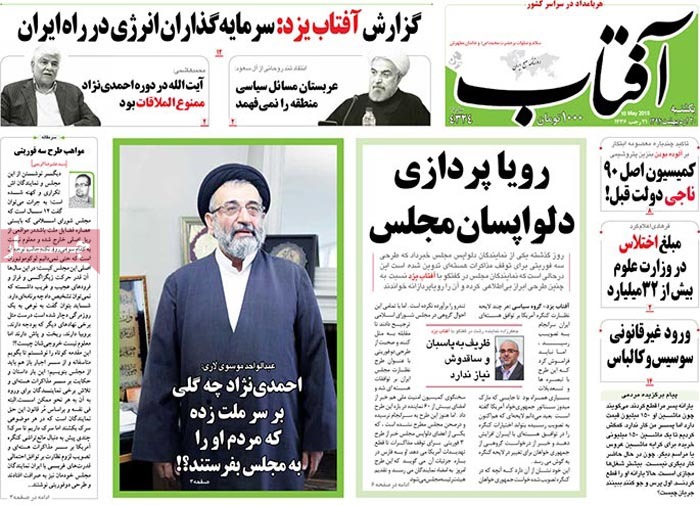
Aftab-e Yazd: “An end to attacks on Yemen and termination of foreign interference are key to settling the crisis of Yemen,” the Supreme Leader said.

Ayatollah Seyyed Ali Khamenei made the comment at a meeting with President Erdogan of Turkey.

Aftab-e Yazd: Women’s political participation in Iran is less than three percent.


A look at Iranian newspaper front pages on April 8


Amin: “Extremism needs to be cracked down on,” President Rouhani told a joint press conference with his Turkish counterpart.


A look at Iranian newspaper front pages on April 8


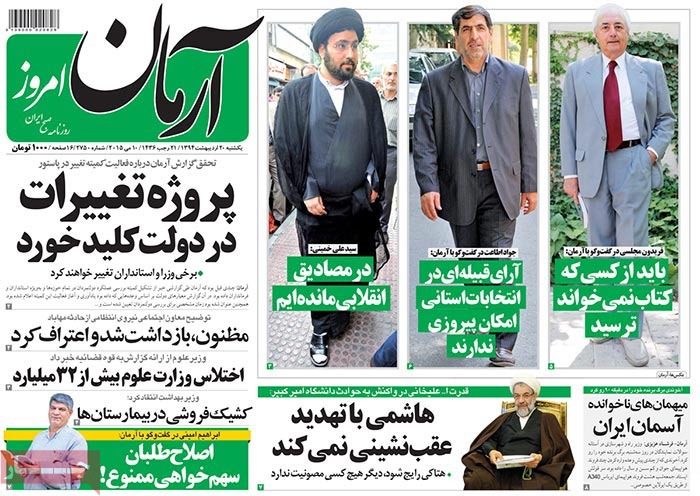
Arman-e Emrooz: Mohsen Rezaei has returned to the Islamic Revolution Guards Corps.

Rezaei, who once commanded the Revolution Guards, has written a letter to the Supreme Leader demanding to return to the IRGC.

The Leader has accepted the request, and Rezaei is now teaching at Imam Hussein University.


A look at Iranian newspaper front pages on April 8


Asrar: The commander of the Islamic Revolution Guards Corps has said that IRGC appreciates the efforts of the nuclear negotiating team.


A look at Iranian newspaper front pages on April 8


Ettela’at: Eight Iranian border guards have been martyred in a terrorist attack in the southeast of the country.


A look at Iranian newspaper front pages on April 8


Haft-e Sobh: A young man has admitted to killing his own father and sister in Tehran.


A look at Iranian newspaper front pages on April 8


Iran: Insurance coverage of housewives will be finalized this year.

The promise was made by the vice president for women and family affairs ahead of Women’s Day on Friday.


A look at Iranian newspaper front pages on April 8


Javan: Bookstores won’t have to pay taxes anymore.

The announcement was made by the spokesman of the Ministry of Culture and Islamic Guidance.


A look at Iranian newspaper front pages on April 8


Kayhan: High interest rates banks offer to depositors kill enthusiasm to invest in the manufacturing sector.


A look at Iranian newspaper front pages on April 8


Qods: The Portuguese head coach of the Iranian national football team has been given 72 hours to decide whether he’s staying in Iran or not.


A look at Iranian newspaper front pages on April 8


Sayeh: Three major steel projects will be inaugurated in the country this year.

Sayeh: “I’m happy to be back in Iran,” said Branko Ivankovic.

The Croatian national who has been named head coach of Tehran’s Persepolis Football Club led Iran’s national team in the 2006 World Cup.


A look at Iranian newspaper front pages on April 8


Iran’s annual foreign trade hits $102 billion

Trade ship

The Iranian Customs Office announced on Tuesday that the value of the country’s foreign trade in the last Iranian year [which ended on March 21] surpassed one hundred billion dollars.

According to the data released by the public relations department of the Iranian Customs Office, the country has exported $49.744bln and imported $52.477bln worth of goods over the 12 months of the last year.

The volume of Iranian exports in the mentioned period amounted to 98.416 million tons and the figure for the Iranian imports hit 41.234mln tons, the report said.

It also showed that the volume of Iran’s exports last year witnessed a 4.83 percent increase compared to a year earlier, and the value of exports jumped by 18.87 percent.

Back in March, Iranian President Hassan Rouhani announced that the country’s non-oil exports hit a record high, emphasizing that the success was achieved despite Western sanctions.

Speaking at a session of the cabinet on March 18, President Rouhani said the country exported nearly $50 billion worth of non-oil goods in 12 months.

Up to 553 tons of narcotics confiscated last year in Iran: Official

Alireza Jazini

Deputy secretary general of the Drugs Control Headquarters said on Tuesday that 553 tons of different types of illicit drugs was confiscated in Iran last year.

Alireza Jazini made the remarks during a visit of Interior Minister Abdolreza Rahmani Fazli to the headquarters.

Jazini said that 350,000 people were arrested for drug-related crimes or abuse of narcotics last year.

He added that narcotics are a complicated and multi-dimensional issue.

He expressed concern about new issues such as the drop in the age of people who pick up the habit, addiction rate, relations between drug trafficking and political and security issues and a change in the pattern of drug consumption from traditional to industrial.

He said that narcotics production in Afghanistan has risen up.

He criticized the international organizations for negligence about the international campaign against drug-trafficking.

Iran opposes foreign meddling in all countries, including Yemen: Supreme Leader

Leader-Erdogan

Yemen is an example of a new class of problems the Muslim world is faced with, Supreme Leader Ayatollah Ali Khamenei told visiting Turkish President Recep Tayyip Erdogan Tuesday, adding Iran opposes foreign meddling in all countries, including Yemen.

At the meeting the Leader said the US and Zionists are happy to see divisions crop up in some Islamic countries and that the only way to settle this problem goes through cooperation among Islamic countries and adoption of practical, constructive measures.

Ayatollah Khamenei further stated that efforts by Muslims nations to bolster each other and keep division at bay are central to Islamic Republic’s general policy, and that promotion of Iran-Turkey ties serves that purpose.

Recalling the barbaric acts of terrorist groups in Iraq and Syria, the Supreme Leader said those who fail to see the footprints of the enemies of Islam in the developments of these two countries are in fact fooling themselves.

Ayatollah Khamenei said we believe an end to attacks on Yemen and termination of foreign interference are key to settling the crisis of Yemen whose people should determine the future of their country.

At the meeting which was also attended by President Rouhani, the Turkish president said the region is facing many problems and that regional countries should cooperate with each other to settle these problems. “We should not wait for [the assistance of] the West.”

President Erdogan also said he personally does not view IS members as Muslim and has taken a stance against the grouping.

Tehran, Ankara sign eight cooperation documents

Erdogan-Rouhani

Iran and Turkey at a ceremony on Tuesday signed eight cooperation documents and a joint communiqué as part of efforts to boost the value of bilateral trade to $30 billion this year.

Iranian President Hassan Rouhani and his Turkish counterpart Recep Tayyip Erdogan, who is visiting Tehran at the invitation of his Iranian counterpart, as well as a number of other senior officials from the two countries attended the ceremony.

During the ceremony, which was held after the two presidents’ joint press conference, Rouhani and Erdogan underscored the necessity for further expansion of diplomatic and economic ties between the two countries.

They said they viewed the signing of the documents as an important step in the development of Tehran-Ankara relations.

Iran and Turkey have plans to hike the volume of their trade to $30 billion by the end of 2015.