Thursday, January 15, 2026
Home Blog Page 4882

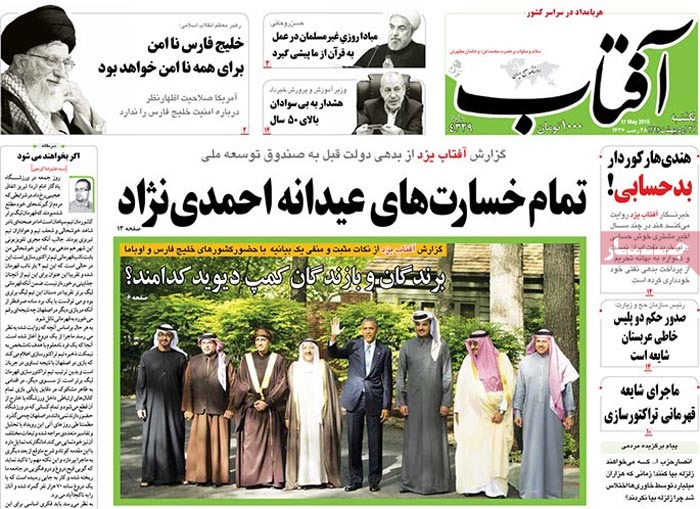
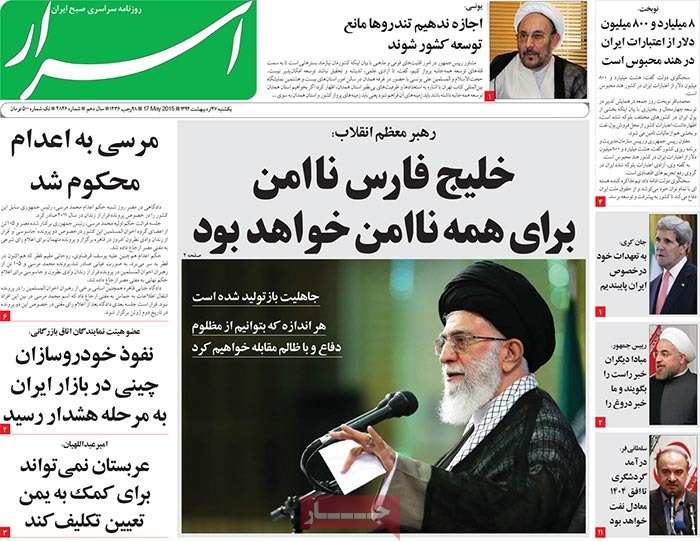
Tehran raps as “contradictory” US-Arab Camp David statement

Afkham

Iran’s Foreign Ministry spokeswoman has denounced as “contradictory” a recent statement released by the United States and the (Persian) Gulf Cooperation Council at Camp David.

On Friday, Marzieh Afkham said that the Camp David joint statement exposed the contradiction in the words and deeds of the US and its regional allies.

“Unfortunately, actions such as launching a foreign military attack on Yemen and disregarding its territorial integrity and the US support for this aggression not only contravene international law, but also run counter to some of the contents of the Camp David statement,” Afkham stated.

The emirs of Qatar and Kuwait as well as the crown princes of the United Arab Emirates, Bahrain, Oman, and Saudi Arabia traveled to the US for a meeting with President Barack Obama at the White House on May 13 and at Camp David, Maryland, on May 14.

“There is no military solution to the regions’ armed civil conflicts, which can only be resolved through political and peaceful means; respect for all states’ sovereignty and non-interference in their internal affairs; the need for inclusive governance in conflict-ridden societies; as well as protection of all minorities and of human rights,” read the joint statement released following the meetings on Thursday.

It came as the statement contradictorily supported the Saudi aggression against the Yemeni people, with Washington vowing “to use all elements of power… including the potential use of military force” in its attempt to defend the Persian Gulf Arab monarchies against “external threats.”

Afkham also rejected allegations about Iran’s destabilizing role in the Middle East as mentioned in the statement, saying the realities of the region bear proof of the falsity of such claims.

Iran has never advised a military solution to any of the regional conflicts, she said, adding that those states that attack the infrastructure of their neighboring country and endanger the peace and stability of the region are in no position to pass judgment on others.

The Iranian Foreign Ministry spokeswoman expressed Tehran’s readiness to negotiate and cooperate with the Persian Gulf Arab countries, calling on them to stop their accusatory tone towards Iran and adopt “confidence-building measures.”

The Iranian diplomat also called on all the intentional and regional sides to focus their efforts on fighting the growing threat of Takfiri terrorist groups in the region.

[…]

Executive, legislative, judiciary chiefs discuss domestic, regional issues

Rouhani-Larijani

President Hassan Rouhani, Parliament Speaker Ali Larijani and Judiciary Chief Ayatollah Sadegh Amoli Larijani met on Saturday to discuss major domestic issues as well as regional developments.

They stressed efforts to continue dialog and tap into the regional countries’ potential to reduce tension and restore calm in the region, according to a media release by the Presidential Office where the heads of three branches of the government met.

They also called for a complete cease in attacks on Yemen, the dispatch of relief and medical aid to the oppressed Yeminis and the start of the inter-Yemeni negotiations.

Iran, P5+1 very likely to reach nuclear agreement: Zarif

Javad Zarif

Iranian Foreign Minister Mohammad Javad Zarif has voiced optimism over reaching a final deal with the P5+1 group of countries on Tehran’s nuclear program.

If the other side shows “seriousness” in the ongoing negotiations, “an agreement is very likely,” said Zarif in an interview with German magazine Spiegel published on Friday.

The senior Iranian diplomat also lashed out at the Saudi regime for considering the prospective nuclear deal between Tehran and the six world powers as a threat to its security.

There has recently been a “flood of offensive comments from Saudi Arabia,” said Zarif, adding, “Some people in the region seem to have panic” about Iran’s final nuclear deal.

Earlier in the day, representatives from Iran and the P5+1 group held a plenary session on Tehran’s nuclear program in the Austrian capital city of Vienna.

The session finalized four days of talks between the two sides. The next round of negotiations between Iran and the six world powers will be held next Wednesday.

Iran and the P5+1 countries – the US, Britain, France, Germany, China and Russia – have been negotiating to reach a comprehensive agreement over Iran’s civilian nuclear activities, and have set June 30 as the deadline for the conclusion of the deal.

The possible deal would see the removal of sanctions imposed on the Islamic Republic in return for enhanced transparency by Iran in its nuclear program.

The sides reached a mutual understanding on the parameters of the Joint Comprehensive Plan of Action (JCPOA) — as the potential deal is called — in the Swiss city of Lausanne on April 2.

Iranians listen to music with all their hearts: German musician

Anja Lechner

Well-known German violoncellist Anja Lechner was born in Kassel. Along with François Couturier, a veteran French pianist, she first performed Tarkovsky Quartet at Tehran’s Vahdat Hall on February 16, 2013 with. The following is the translation of an excerpt of an interview that Ramin Sedighi, a journalist with honaronline.ir, has conducted with the German musician:


Ms. Lechner, have you had a good time in Iran?

I must answer your question in one word: absolutely. Its attractiveness has made me travel to Tehran for a third time. During my trips to Iran, I have found it easy to establish a bond with the local culture and traditions. If I research my genealogy, I might come across my Eastern stock.

Were you satisfied with your two performances at Niavaran Cultural Center?

First of all, I found it unusual to stage solo performances for two nights in a row; it’s uncommon even in places where there is a mass audience. All tickets were sold out for the two solo performances, something which I had never experienced throughout my musical career. It struck me as unusual. To me, it’s one of the reasons why I consider performing in Iran appealing.

How was your performance received?

What was more important than the packed house was the way the audience formed a bond with us. That how much listeners concentrate on the quality of performance or digest the music in a heartfelt manner differs from audience to audience. For instance, I have not seen it much in Germany or other countries. People there might have considerable knowledge of previous works, but they listen to music, relying more on their prior knowledge than listening to the music.

Musicians do not experience what happens in Iran very often; particularly in my case, because I opted for pieces which had not been heard much.

When did you start playing music and what made you go for violoncello?  

I think it’s the musical instrument that picks you. Initially, I played the piano, but suddenly I took a liking to violoncello when I was nine. That was when I took it up.

Do you possess academic qualifications in music? Do you teach music?

Yes, I did a course in Munich; I received my master’s degree in Switzerland and completed my higher education in the US.

In some parts of Iran, music is part and parcel of the daily lives of people. Are you familiar with Iran’s folklore music?

I have not been in close contact with it but I have a lot of Iranian friends who share Iranian music with me. In my opinion, the approach that Iranian ethnic groups have toward music is noticeable and astonishing. This style of Iranian music is the very music which is dying out in the West. It’s true that people there keep listening to music but they no longer know what music is for. It lies in the background of their lives, thus it does not serve any function. From my perspective, that people don’t know why they listen to music marks the beginning of the end of music in the world.

The traditions that exist in the music of Iranian ethnic groups keep music alive, so Iranian people should preserve them.

Science can solve the problem of particles

10May2015-JameJam

Once a problem limited to a few cities or provinces, the question of dust particles has now turned into a transnational and regional headache. Water shortages – triggered by global warming and climate change – have precipitated this environmental challenge. If left unattended, the problem could turn into a serious crisis for the entire Middle East in the not-too-distant future.

The issue has even flown its way into the United Nations where officials have expressed readiness to help Middle Eastern countries with the problem and researchers have offered their own prescriptions.

Gary Lewis, United Nations Resident Coordinator and the UNDP Resident Representative in Iran, has said his agency is ready to offer a helping hand, provided that officials in the affected countries admit that dust storms pose a grave threat and call for UN help in efforts to make this problem a thing of the past.

Jamejam daily has published an interview with Mr. Lewis about the particles and his agency’s plans to tackle the issue. The following is the translation of excerpts from his remarks in the interview:


UN activities in Iran

The UN has taken multiple measures in a number of countries, including Iran. Those measures have been mainly implemented to reduce poverty; boost health – in Iran it largely focuses on tackling diseases such as malaria, tuberculosis, HIV/AIDS and cancer; offer humanitarian and refugee-related services; help sustainable environmental development; contain drugs [trafficking]; and manage natural disasters.


UN role in curbing particles

First of all, the problem should be identified. Iran’s neighbors should admit that there is a problem and then we can begin to explore solutions. We need to help countries – those in which dust particles are produced and those which are at the receiving end – reach an agreement before we can work out solutions to the problem. […]

The UN stands ready to help the government and people living in dust-prone regions, both at counseling and implementation levels.


The origin of particulates in Middle East

They are coming from the countries in the west and southwest of Iran which are on the Persian Gulf. Statistically, particulates mainly enter Iran from Iraq.


Dust particles, from Iraq to Tehran

Currently shortage of water is to blame for dust storms. Water levels at the Tigris and Euphrates – two rivers which largely help with the soil fertility of the surrounding areas and could prevent particulates from entering Iran – are on the decline. This has aggravated the situation. Lack of soil sustainability which is a direct result of urbanization is also to blame for the dust issue. […]


Natural resources mismanagement

Environmental problems account for 10 percent of particulates in Iran and the remainder has its roots beyond Iran’s borders. Water shortages worsen the problem of particles. Attention should be paid to the ways agricultural lands are used inside the country. […]


Weather patterns and dust storms

Global warming and climate change accelerate this trend. When the earth gets warm and weather patterns change, water resources are depleted and the lands grow dry. This helps winds easily lift the particle and move them to cities. What matters here is the way we exploit and manage our natural resources.


Water resources management

[…] Iran needs to take practical measures in this regard. Efficient management is needed when the country faces a crisis and this is not what one organization can handle on its own. Management on a larger scale is needed for water resources. The UN will lend support if the Iranian government asks for its help.


UN help

[…] The United Nations can help the [Iranian] government on three fronts: 1) It can coordinate between regional countries and use diplomacy to create convergence between them on addressing and solving the problem. 2) It can take steps at a national level and help each government independently. For instance, it can see help residents of Khuzestan. 3) It can hold a conference bringing together the Middle Eastern countries which are interested in solv­ing this problem. This can help them share scientific and operational strategies for tackling the dust issue.


Lack of regional cooperation

[Iran’s environment chief] Mrs. Ebtekar is trying to bring regional countries together to take steps toward solving the dust issue [establishment of a regional fund]. History suggests that countries show least interest in carrying out a plan when they reap no benefits.

The UN has the responsibility to bring countries together and convince them that a problem which has now plagued Iran is likely to take a toll on them – Iraq, Saudi Arabia and Kuwait – down the road.

Iraq is another thorny issue. Iraq which is mainly to blame for the dust storms in Iran is now grappling with security problems and the onslaught of ISIL and other terrorist groups. […] There are up to 80 centers in Iraq which cause dust storms. We need to identify those regions and take initial steps to stop the spread of this [harmful] phenomenon. […]

We know about the danger spots in Iraq, but we cannot take proper measures – such as planting trees, mulching and effective management of water resources and agriculture – due to security problems in that country.


How long does it take for the dust to settle?

[…] Ten years have passed and we are now at a juncture in which we are trying to find solutions. We need to allow for another ten years to see everything return to normal, if practical measures are taken toward curbing the problem of particles.


What does science say?

Science can offer a solution to the problem of dust storms. Conditions can be normal like in the past if the countries affected by dust particles show strong determination to solve the problem. We need to operationalize the existing solutions.


What has happened?

For their part, humans fail to help the environment. Instead of blaming the politicians for their decisions, we should look at what we are doing. […] Today humans are heavily engaged in their routines, but ignorant of the future and the long-term consequences of their inattention to the environment. […] We need to change our mindset and try to solve the problems that lie ahead.
[…] We need to take into account the eastern part of Iran. Shrinking water levels in the Helmand River and Hamoon Lagoon also help dust particles kick up storms. […] Wind takes these particles to Afghanistan. We need to pay close attention to the situation in Iran’s neighbor and do something for the eastern part.
A love story, ISIL-style, at Tehran Book Fair

ISIS-Women-Book

War and Sexual Adventure in ISIS, a book by Iranian writer Amirreza Porhelm, has gone on display at the 28th Tehran International Book Fair.
The book narrates the story of the Islamic State of Iraq and the Levant (ISIL) [or Daesh in Arabic term] and explains the creation of a fake Islamic State [IS] by Abu Bakr al-Baghdadi as well as the violent hit-and-run fighting of IS members in Syria and Iraq.

Khabaronline, a news website, has run a report on the 177-page book – written in English – which features the crimes committed at the hands of ISIL and its cruel treatment of people. The following is the translation of excerpts of the report:

War and Sexual Adventure in ISIS also depicts jihad al-nikah [or sexual jihad which is a controversial practice of women within some Wahhabist groups allegedly offering themselves in sexual comfort roles to fighters for the establishment of Islamic rule] and stupid love [affairs] between Takfiri terrorists and Jihadi women [also referred to as Jihad brides].

The book – which deals with those women who are lured to go to Syria to join the terrorist group – is a story of slavery and sexual exploitation of women in the fake state authorized by fatwas released by Salafi muftis.

The terrorist group’s brutal and merciless treatment of people has been also given enough space in the book.

The book has 20 chapters among them: Womanizers; The youngster battalion; Sexual Jihad uninterrupted; Marriage in stable; The city of women and bondwomen; Battle in hell; and the immediate departure to paradise.

[…]

Qeshm Island’s Geo-park Museum, Prominent One in Iran

Qeshm Geo-park Museum; Prominent Wildlife Museum in Iran

Qeshm Island’s Geo-Park Museum is one of the most complete wildlife museums in Iran as far as biodiversity is concerned. In an area of over 1,000 square meters, the museum is home to more than 3,000 animal species.

Qeshm Island’s Geo-Park Museum has been established in 1995 by the Qeshm Free Zone Organization. The museum’s standout feature is containing more than 95 percent of indigenous species.

Women’s shelter; can they find home away from home?

Safe Houses women

Safe houses have been set up in 18 provinces across the nation to help women victims of domestic violence pick up the pieces. As a safety precaution, the location of these houses is not made public.

Valiollah Nasr, the director of the State Welfare Organization’s Department for Social Harms, made the comment and added that these houses run around the clock and offer social and therapeutic counseling to victims of domestic violence free of charge.

Arman-e Emrooz on May 11 published a report on government efforts to launch domestic violence shelters and develop safety plans to protect abused and battered women and provide them with rehabilitation services. The following is the translation of excerpts from that report:

Nasr said we have reached out to social workers and psychologists to solve the problems of women who live in these houses which tend to solidify family foundations, adding Islamic principles have been tapped to strengthen family ties.

He said the temporary shelters in the provinces rendered services to 2,000 victims last year, adding those in need [of counseling and rehabilitation] can seek refuge in these centers through self-admission, or they can go to social emergency services [departments] and judicial or police centers [and apply for admission to these houses] .

[…]

Nasr also said that the addresses of the safe houses remain unknown and tight security is in place in these centers. Even the husbands of these women cannot easily go to the safe houses because their presence is likely to carry risks for the women, Nasr said.

When the relations between the stricken women and their families are deemed as healthy and unproblematic, we pursue the case, oversee their relationship and return the women to their family life where they belong, he added.

Most of these women grin and bear it when it comes to their children, because they do not want to estrange themselves from their kids, so they bear the unbearable situation at home, the official said, adding sometimes this causes them to end up in unpleasant incidents.

That’s why we have set the stage for these women to keep and bring up their children themselves, Nasr said.

These houses operate under the radar because they are like a double-edged sword.

The State Welfare Organization is trying to prevent the safe houses from fuelling family differences, and going off course, he said, adding the safe houses should protect the women who have been subjected to violence.

[…]

Tehran Book Fair (PHOTOS)

Tehran Book Fair000

A 28th Tehran International Book Fair which opened on May 5 with a motto of “Reading, dialogue with the World” will close on May 16. As many as 300,000 local titles and 160,000 foreign titles have been on the display at the expo.

Snapshots of the exhibition posted online by different websites:

IAEA access to non-nuclear sites to be based on Additional Protocol: Araqchi

Abbas Araghchi

In a Thursday interview with Press TV, Abbas Araqchi, the Iranian deputy foreign minister for legal and international affairs, said he had held talks with IAEA Secretary-General Yukiya Amano over the agency’s future inspections of Iran’s non-nuclear sites as part of the Additional Protocol that Iran could undertake to implement under a final deal over its nuclear program.

The possible inspections of Iran’s non-nuclear sites would not go beyond the framework of the Additional Protocol, said Araqchi, adding that more than 120 countries all over the world only allow such access.

He added that Iran could allow access to its non-nuclear sites under “special conditions,” and such “coordinated” inspections would be aimed at environmental sampling.

The senior Iranian diplomat also highlighted the IAEA’s important role in a possible deal over Tehran’s nuclear program.

“Since we have negotiations with P5+1 countries and we are close to an agreement and the role of the agency would be very crucial in the agreement to verify the nuclear measures we have undertaken, so we are in direct, regular contact with Mr. Amano and his team to make sure that everything would go smoothly after the deal,” he pointed out.

Araqchi stated that the deputy-level talks between the representatives of Tehran and the six world powers will also continue next week, while differences still remain between the two sides.

“We do think that we need more time in order to reduce the differences as much as possible and just leave a few important ones for the ministers to decide,” he said.

Iran and the P5+1 countries – Russia, China, France, Britain, the US and Germany — are seeking to finalize a comprehensive deal on Tehran’s nuclear program by the end of June. The two sides reached a mutual understanding in Lausanne, Switzerland, on April 2.