
House of Aminis is a historic place for mourning in Qazvin, central Iran.It was constructed in 1858 by a merchant called Haj Mohammad Reza Amini.
The following images of the site have been released by Shakhesnews.com:
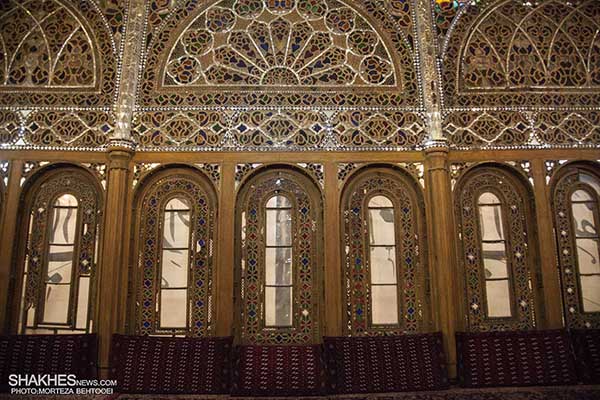
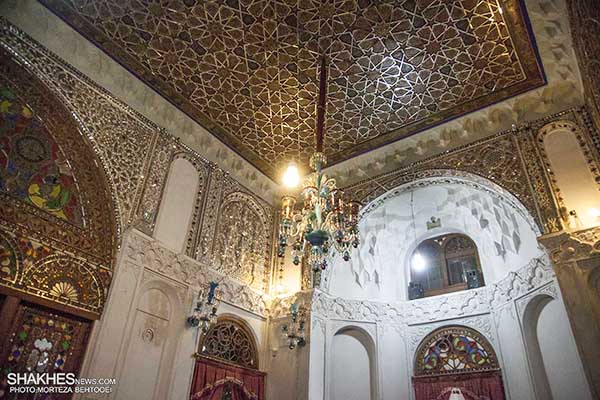
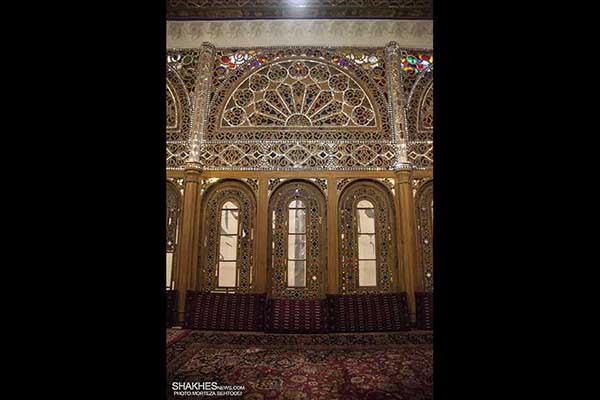
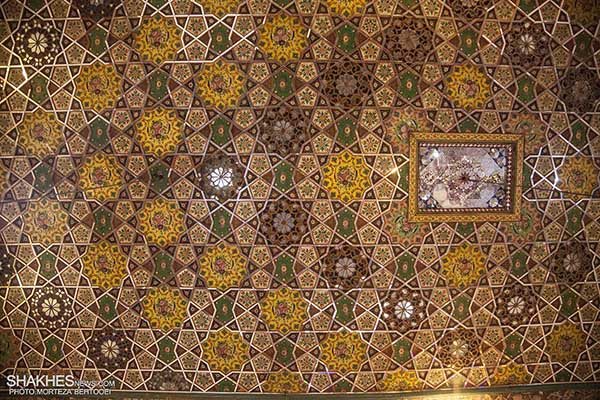

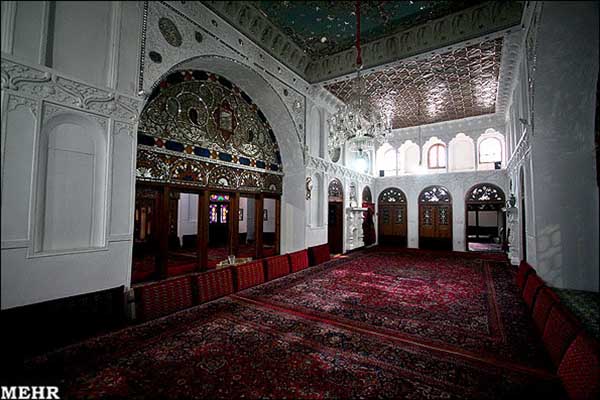
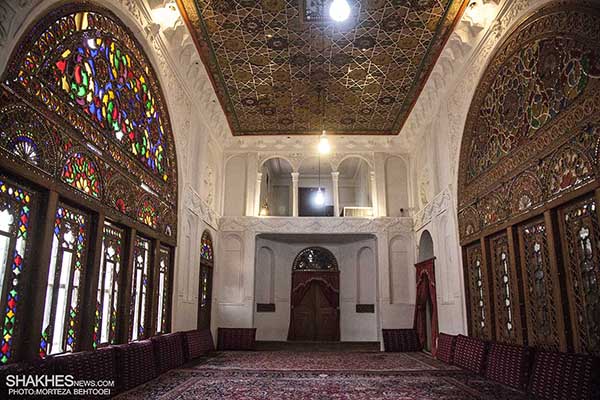
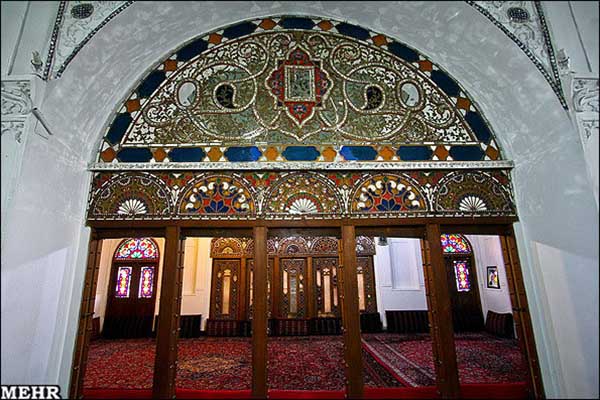
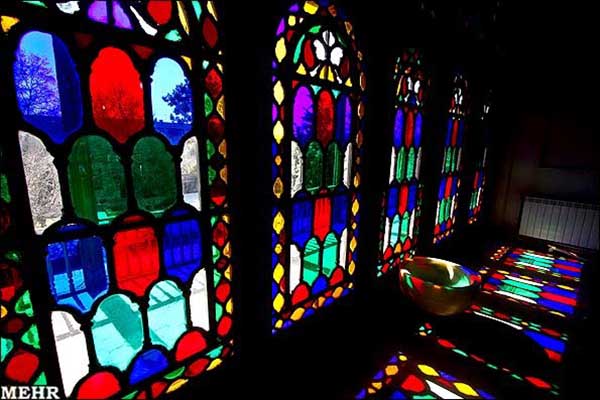
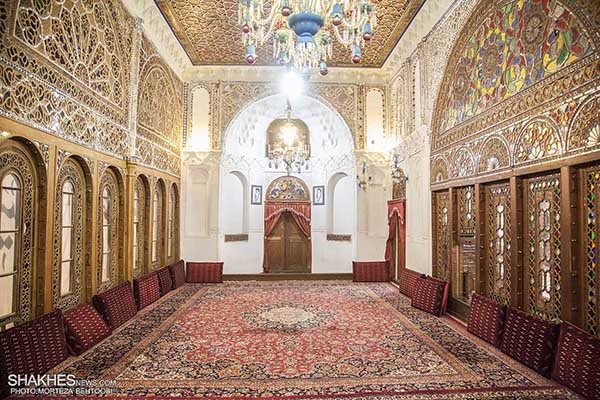
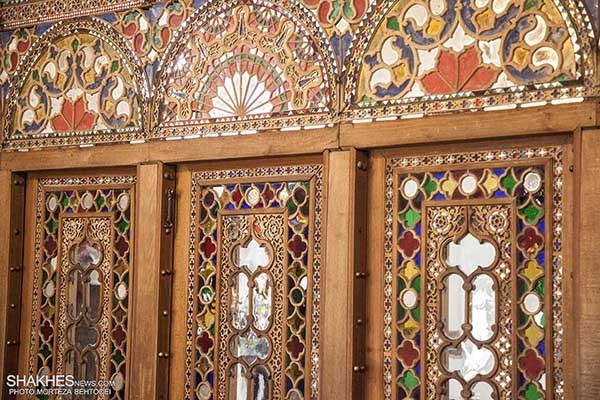
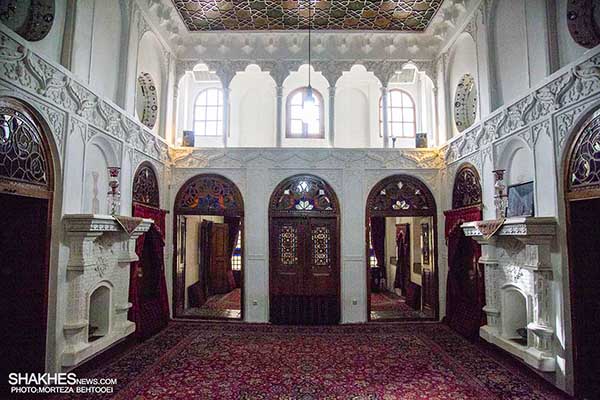
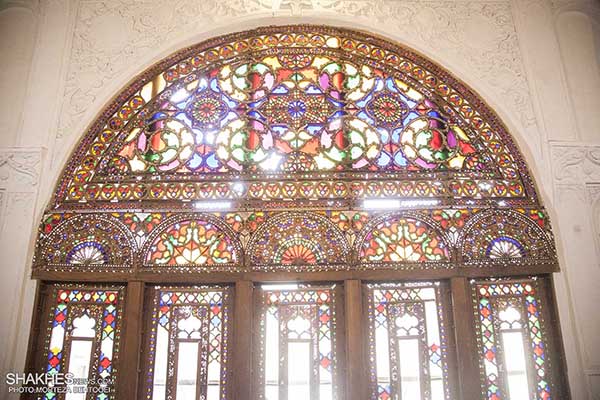
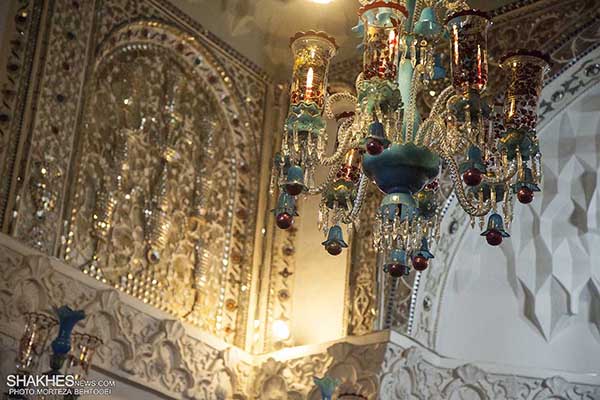
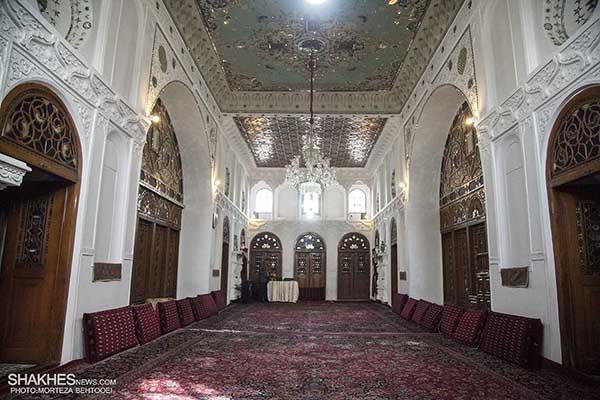
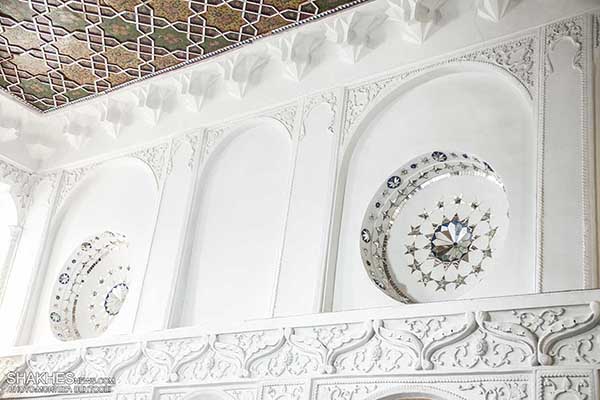
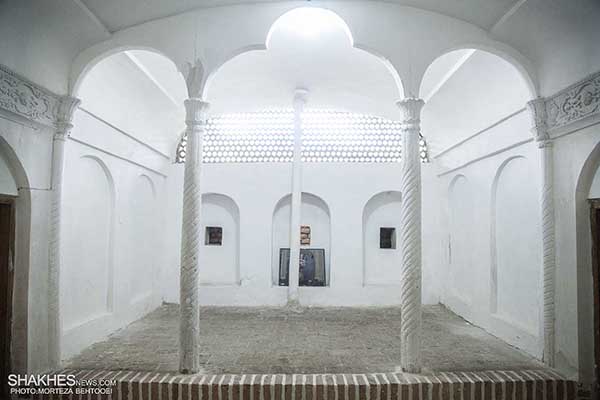
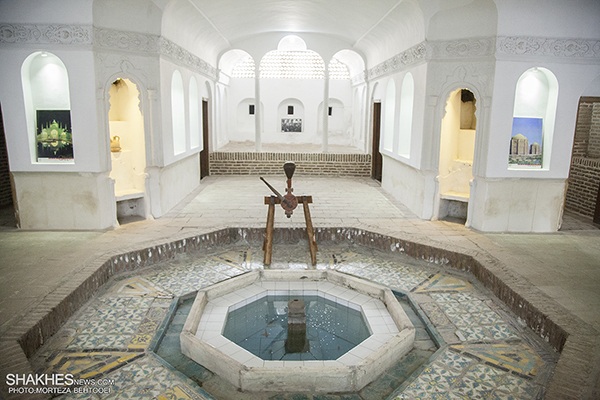
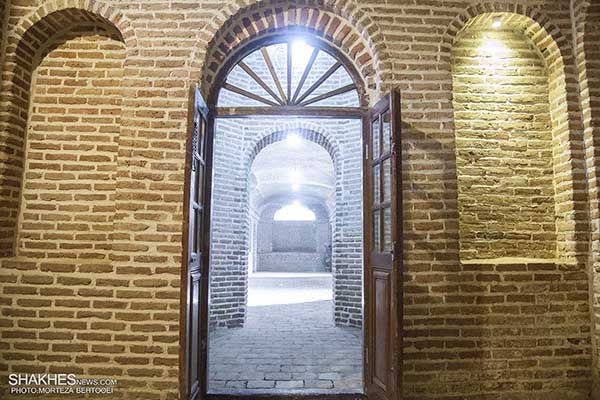
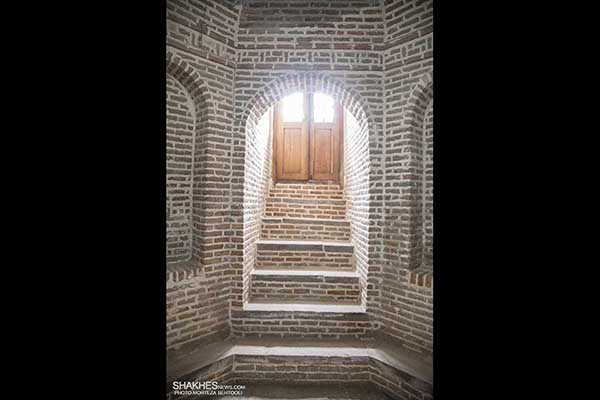
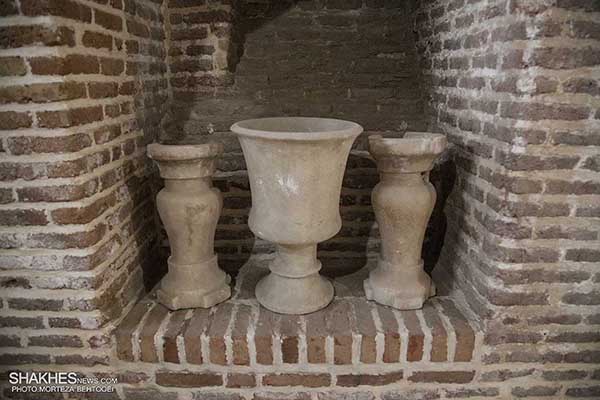

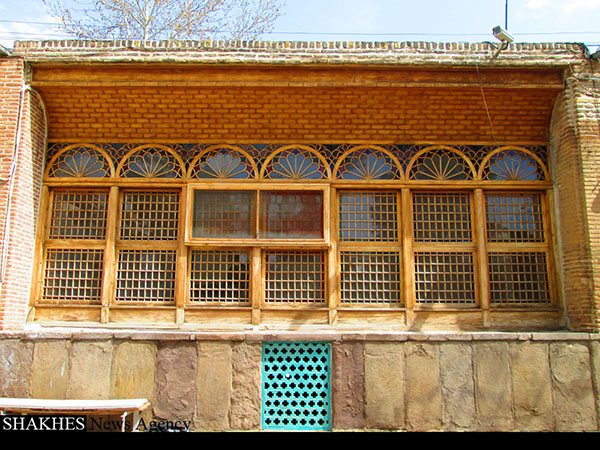
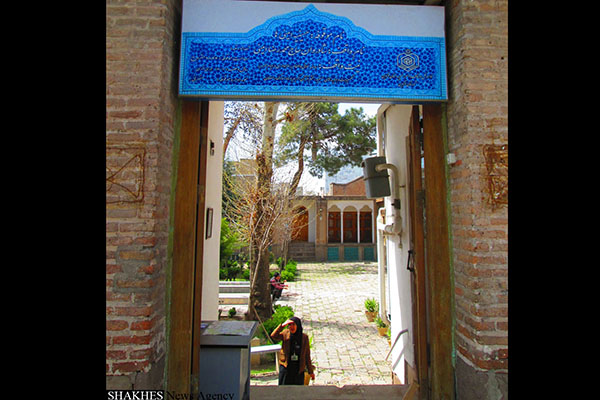
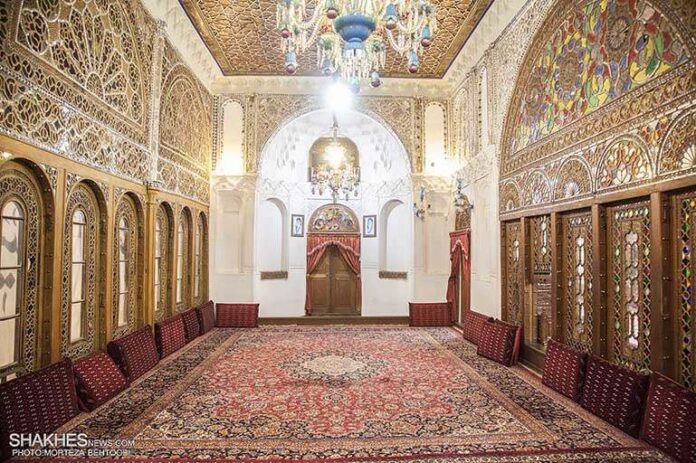
House of Aminis is a historic place for mourning in Qazvin, central Iran.It was constructed in 1858 by a merchant called Haj Mohammad Reza Amini.
The following images of the site have been released by Shakhesnews.com:
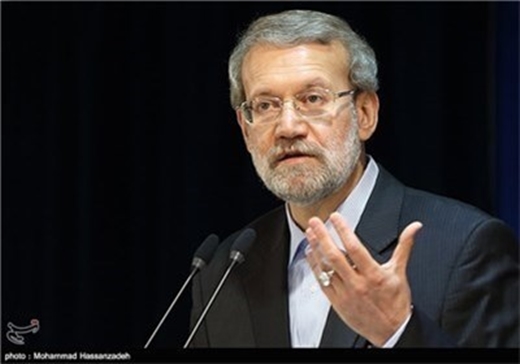
Iranian Parliament Speaker Ali Larijani said some Western countries involved in the ongoing nuclear negotiations with Tehran want to undermine the talks by raising excessive demands.
The Westerners have no choice but to accept Iran’s nuclear knowledge, Larijani said in a ceremony held in Varamin, south of Tehran, on Thursday evening.
He added that the West should know that the framework set by Tehran for nuclear talks is completely clear and the Leader has knowledge about it and the Iranian negotiators can negotiate just within that framework.
“If the westerners issue excessive statements beyond the framework of negotiation, that means they are seeking to disrupt the negotiations…,” Larijani said.
He made the remarks in response to recent calls by some Western countries for access to Iran’s military sites and interviews with nuclear scientists amid ongoing talks between the Islamic Republic and 5+1 (Russia, China, the US, Britain, France and Germany) to hammer out a lasting accord that would end more than a decade of impasse over Tehran’s peaceful nuclear program.
On April 2, the two sides reached a framework nuclear agreement in Lausanne, Switzerland, with both committed to push for a final deal until the end of June.
In relevant remarks, Supreme Leader of the Islamic Revolution Ayatollah Seyyed Ali Khamenei has ruled out any request for interviews with Iranian nuclear scientists, describing it as an instance of “interrogation”.
“I would not let foreigners come (here) and talk to the Iranian nation’s dear scientists…, who have expanded this wide knowledge to this stage,” the Leader said on May 20.
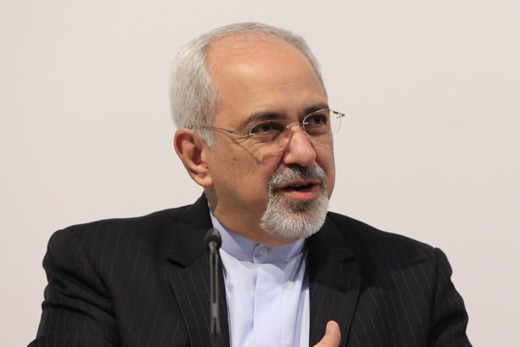
Iran’s Foreign Minister Mohammad Javad Zarif says any attempt to revise the framework of a potential deal on Iran’s nuclear program, which was reached in the Swiss city of Lausanne in April, will result in the failure of efforts to reach a final agreement.
Iran and the P5+1 group of countries reached a mutual understanding on the parameters of the Joint Comprehensive Plan of Action (JCPOA) – as the potential comprehensive agreement on the Islamic Republic’s nuclear program is called – in the Swiss city of Lausanne on April 2.
Zarif told Rossiya-24 television on Friday that the “solution” to reach a final agreement on Iran’s nuclear program was “agreed in Lausanne”.
“All parties must understand that we can reach an agreement only in the framework of these solutions. Any attempts to revise the agreement will lead to failure,” he added.
The Iranian foreign minister further noted the P5+1 group – the United States, Britain, France, Russia and China plus Germany – should show political will to finalize a deal on the nuclear program.
“The biggest problem we have is the need to make a political decision,” Zarif stated.
The remarks by Zarif came as representatives from Iran, who arrived in the Austrian capital Vienna on Thursday, and the P5+1 continued nuclear negotiations on drafting the text of a final deal over the Islamic Republic’s nuclear program on Friday.
Iranian Deputy Foreign Ministers Abbas Araghchi and Majid Takht-e-Ravanchi sat down for talks with European Union deputy foreign policy chief Helga Schmid and US Undersecretary of State Wendy Sherman.
The deputy foreign ministers of Britain, France, Germany, Russia and China also held talks with the two senior Iranian officials.
The Iranian deputy foreign ministers will leave Vienna Saturday, but the talks will continue at the expert level in the Austrian city.
Iran and the P5+1 countries have been working on the text of the potential deal ever since they reached the mutual understanding on its parameters.
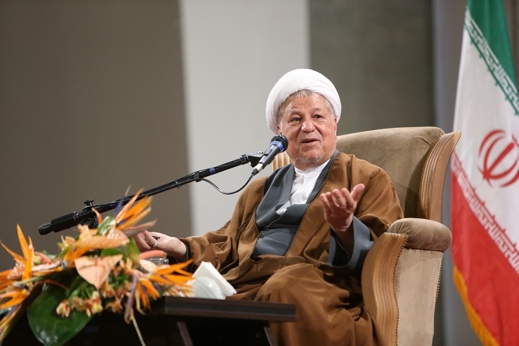
The chairman of the Expediency Council says that the late Imam Khomeini championed a revolution which could not stand violence.
Ayatollah Akbar Hashemi Rafsanjani made the comment in the opening of an International Conference on World without Violence in Imam Khomeini’s Worldview which was held earlier this month and added that the revolution the late Imam Khomeini championed was free of violence.
Aftab-e Yazd daily on June 6 published the top councilor’s remarks. The following is the translation of what else Ayatollah Rafsanjani said in the conference:
[…]
Islam is a religion of kindness and compassion and the late Imam – who was a harbinger of Islam in modern times – was a promoter of Islamic mercifulness. The revolution the late Imam spearheaded was free of any [form of] violence, and violent acts had no place in his planning.
A world free of violence is what the wise and thoughtful humans deserve in modern times. Humans should not live with violence; rather, they are expected to base their lives on logic and reasoning.
Regrettably the world of Islam has turned out to be the most violent. Now that humans who have taken giant steps toward elevation, each day the Islamic world is witnessing a catastrophe and this is counter to the delicate and humane soul of Islam.
[…]
Prior to the revolution when armed activities were a means of struggle [against the Pahlavi regime], the late Imam would instead focus on people’s potential, disapproving of armed struggle.
[…]
Compared with other revolutions in the world, Iran’s Islamic revolution is unique because it was formed building on people’s willpower and heartfelt desire and has since been supported by the people.
[…]
The late Imam would always underline that people are the real rulers of the [Islamic] establishment, they have the right to govern and they can solve the problems on their own.
[…]
Following the victory of the Islamic revolution, by the order of the late Imam all institutes inside the country were kept unchanged and only certain individuals who had committed crimes were put on trial. The communist revolutions, however, carried out bloody purges and a number of office holders from the previous systems were punished.
If the world takes a fair look at the late Imam, his remarks and works, it will learn that the Islamic Republic has been designed based on a broad framework. One should admit that there are weak points [in the system], but they are all the result of [the performance of] the lawmakers.
In this establishment, all affairs – including choosing the Supreme Leader, president, parliament [members] and Cabinet ministers – are administered by people, directly or indirectly. This establishment loses its validity in the absence of people’s choice.
There are some who intervene in certain affairs, trample upon people’s rights and think they have every right to ignore popular vote. Such measures are not in line with Islamic orders and way of thinking as well as the late Imam’s viewpoints. Even God Almighty does not let go of those who trample upon people’s rights. They have to win people’s satisfaction; in other words, they need to secure the satisfaction of every single person in the country if they seek divine forgiveness.
During the imposed war, the Iraqis fought against the Iranians, did injustice and set foot on our soil. Some of them were captured, but they attended Friday prayers in the country thanks to the kindness they were shown by the Iranians. Members of the Badr Brigade that are now taking on ISIL in Iraq are from the ranks of the POWs who repented of their wrongdoings in Iran.
When it comes to talking about elections, some turn fearful. It should not be so. To handle the elections, love should be present. Some reactionaries try to display ossified behaviors. It is true there are some people like that, but they do not belong to the Islamic establishment, revolution and the [ideals of the] late Imam.
Iran’s Constitution has called for a society free of violence. If you see violence [anywhere], it is against our principles. Iran has been repeatedly subject to injustice. They [the Westerners] armed Saddam to fight against Iran, but Iran refused to take revenge.
[…]
What Saudi Arabia is doing in Yemen is condemnable. Why is that Saudi Arabia – which hosts Muslims [for Hajj Pilgrimage] and is the guardian of the Kaaba – is raining down bombs on the Yemenis and killing civilians each day?
What Saudi Arabia is doing is a dark stain which will stay on history. Under the influence of Wahhabism, the Saudis have displayed such inappropriate behavior. Their ancestors were those who destroyed Karbala and Medina. Not only did they kill the Shiites, they also shed the blood of fellow Sunnis.
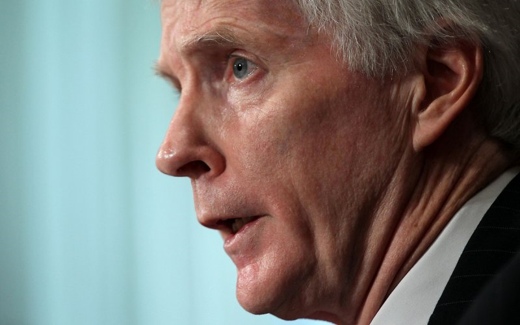
Ambassador Ryan Crocker was living in Baghdad when Iraq was under occupation. He had first-hand knowledge about many cases, among them: the security agreement between Baghdad and Washington; power-sharing in Iraq; the reason behind the rise of terrorism and extremism in the region, especially in Iraq; the formation of the National Council for the Awakening of Iraq; and arming the Sunni tribes.
His remarks in a recent interview with Foreign Policy on Iraq caught many people off-guard. The former US ambassador talked about the risk of Iraq’s disintegration and the measures the US administration has failed to adopt in dealing with Iraq over the past five years.
The Islamic Republic News Agency on May 31 published an analysis of the ambassador’s remarks in the interview. What you read below is the translation of excerpts from the analysis:
[…]
US failures
To jog the memory of US officials and diplomats, especially Mr. Crocker, the following, particularly what the Americans should have done over this past year, seem to be worth mentioning:
Support for the legitimate Iraqi government: The Americans failed to honor their commitments under the US-Iraq Security Agreement which calls for US support in defusing crises threatening Iraq’s territorial integrity, chief among them ISIL’s sudden onslaught in June 2014 and the capture of Iraq’s second city of Mosul;
Timely delivery of the arms purchased by the Iraqi government: The Americans failed to hand over the F16 fighter jets, attack helicopters and military hardware the Iraqi government has bought over the past year; this comes as the terrorist group ISIL is still being armed by US allies in the region;
Controlling Washington’s regional allies: The US has fared badly when it comes to its allies which have hysterically been engaged in shaking the foundations of regional equations in recent years, displaying unruly behaviors – among them motivating terrorist groups as well as lending financial and arms support to them and opening communication routes for them;
Serious measures to cut the critical lifeline of terrorist groups: This is direly needed to make their turnover drop in the banks of US allies;
Encouraging the friendly nations not to engage in trade with ISIL: This is what the US is expected to do, especially when it comes to oil purchase from the terrorist group;
Integrity in the fight against ISIL: The US has formed a fake international coalition which has [so far] failed to produce a flawless performance. Over the past few months, columns of ISIL terrorists have moved back and forth on Syrian and Iraqi roads around the clock without being targeted. This was confirmed by US military pilots who said several days ago that they did not get clearance from their commanders to hit ISIL targets and columns. [Veterans Today: US military pilots carrying out the air war against the ISIL terrorists in Iraq and Syria are voicing growing discontent over heavy-handed rules of engagement hindering them from striking targets. They blame a bureaucracy that does not allow for quick decision-making. One Navy F-18 pilot who has flown missions against ISIL voiced his frustration to Fox News, saying, “There were times I had groups of ISIL militants in my sights, but couldn’t get clearance to engage.”]
Taking measures to prevent Ramadi from falling into the hands of ISIL through proper air cover [Protective use of military aircraft during ground operations]: As military and security experts say the Americans cannot claim that they have failed to monitor – through their state-of-the-art armaments – the movements of columns of ISIL terrorists whom the US has admitted have entered Al Anbar from Syria;
Correction of mistakes: In recent months, the Americans have – on 22 occasions – bombarded Iraqi forces and Al-Hashad Al-Shabi (Popular Mobilization) forces, later saying it was a mistake;
Ambiguity associated with US airdrops of aid to ISIL;
A fair look at the political trend in Iraq as well as at the country’s political parties and groups
[…]
Iraqi disintegration
Mr. Crocker has called the Iraqi disintegration “more dangerous than an all-out war”, for which the US is the main culprit. Who is behind plans to form a Sunni government, redraw the Middle East map, and help extremist forces in defiance of legitimate governments in Syria and Iraq?
The US has hosted – over the last year – Iraqi individuals and teams that pursue a breakup plan, and their trips to the US have not been approved by the Iraqi government. The US Congress disintegration plot is yet another evidence that the Americans are trying to splinter Iraq. […]
Ties with Saudi Arabia
The former ambassador also touched upon Saudi Arabia’s hostility toward the Iraqi government since 2003 when Saddam was ousted, saying Riyadh refused to confirm the legitimacy of the Shiite government.
Just to remind the Ambassador, one should say that Saudi Arabia does not endorse the legitimacy of any independent regional country whose government comes to power through ballot box and is against Riyadh’s policies. Isn’t it true that Shiites garnered the majority of votes in the last three elections [in Iraq]? What does Saudi Arabia seek in Iraq? Doesn’t it want to help a minority loyal to Riyadh rise to power?
Basically, the Saudis disapprove of the governments which have come into office by popular vote since they [the Saudis] have yet to experience even a one-man-show election and have their own parliament. Another case in point is their policy in Yemen.
They support ISIL and fellow terrorist groups in Syria, Iraq and Lebanon, push their own agenda in Yemen through military force, and help the government in Bahrain which is cracking down on the majority that seeks change.
With that being the case, can Saudi Arabia – which lacks popular legitimacy – talk about the legitimacy of popular governments?
Mr. Crocker, who knows well about concepts such as terrorism, ISIL and Popular Mobilization, has implicitly expressed concern about Shiite groups. For sure, he cannot claim that he does not know the difference between Popular Mobilization forces and terrorist groups; those who have defended their own lives and homeland, taken up arms to defend their country’s integration and sported combat gear to take on terrorism and extremism vis-à-vis those who know nothing about the most basic human principles and have been recruited from other lands.
The Popular Mobilization forces – the youth from universities, factories and offices who have answered a call to arms – are fighting to defend Iraq’s territorial integrity. They are also fighting against terrorism on behalf of all world nations, among them the Americans.
Carrying the Iraqi flag, they go to the battlefield and their bodies are draped in Iraqi flags to be taken to the holy shrines, but ISIL raises a non-Iraqi and non-Syrian flag […], a flag which unleashes terror, causes panic and triggers off a media frenzy wherever it is hoisted.
The fight on terrorism can be pursued in different ways: cutting financial and arms support to terrorists in Iraq and Syria; blocking their access routes to the outside world; cutting their economic and financial lifelines; aiding governments which are on the front lines of the battle against terrorists; and dropping unwavering support for Riyadh in its aggression against Yemen – which will produce no other result than growing Al Qaeda and ISIL’s power in the impoverished nation.
[…]
Shouldn’t the Americans have doubted the voracity by certain [Arab] sheikhs for getting weapons? Couldn’t they ask the sheikhs where the weapons they were handed from 2006 to 2009 for the [so-called] National Council for the Awakening of Iraq are now?
In brief, Mr. Crocker knows Iraq better than other Americans and understands the issues raised here [better than anybody else]. The veteran diplomat seems to have forgotten many things either due to aging and his years-long absence from Iraq, or he’s made these comments in the framework of the US gamesmanship.
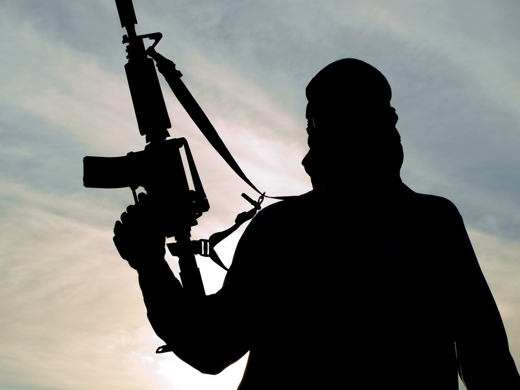
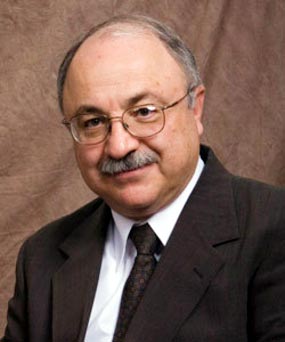
A US-based Iranian professor has said that the Islamic State of Iraq and the Levant (ISIL) poses a serious threat to Iran in the long run.
Nader Entessar, who is a professor in and the chair of the Department of Political Science and Criminal Justice at the University of South Alabama, made the comment in an interview with Mosalas, a weekly Iranian news magazine. The following is a partial translation of excerpts of his remarks in the interview which came out in late May:
Iran and ISIL
Tehran seems to lack a long-term, comprehensive plan to take on ISIL. It needs to take the movements of the terrorist grouping along its eastern and western borders seriously and develop a long-term defense strategy to deal with the terrorists.
Iran and Saudi Arabia
Saudi Arabia has adopted an aggressive foreign policy in the region. In recent years, Riyadh has treaded lightly – both on domestic and foreign policy fronts – but the kingdom seems to be experiencing big changes thanks to the rise to power of a new king and the current conditions in the region. One such change is the spread of local conflicts which will also have an impact on Iran’s security.
Iran’s current policy in dealing with Saudi Arabia does not work properly. Riyadh is trying to take insecurity to within Iranian borders. The closer Iran gets to clinching a nuclear deal with P5+1, the more the Saudis show [high-risk behavior and] adventurism.
What Riyadh is seeking is an Iran isolated forever. Now it is hard to predict what Saudi Arabia will do next. If Saudi Arabia gets caught in the quagmire of Yemen, it will suffer huge setbacks, something which will eventually serve Iran’s interests.
If Riyadh achieves its goals in Yemen [helping President Abed Rabbo Mansour Hadi who fled the country in March return to Yemen; cracking down on and eliminating the Houthis; and establishing a federal system in Yemen with two main regions: north and south with the two regions enjoying the right to self-determination but remaining under the Saudi influence], the Saudis will get emboldened. What unfolds in the future will determine the approach Iran has to adopt to properly deal with the kingdom.
Iran and Saudi conflict
There is an outside chance for Iran and Saudi Arabia to get engaged in war. The Riyadh government lacks the needed combat experience and this [Saudi weakness] is clearly evident in its airstrikes against Yemen.
That’s why Riyadh is seeking to align itself with powerful allies such as the US, but the fact remains that the United State under President Barack Obama is not seeking to fuel insecurity in Iran. Obama’s tenure comes to an end in one and a half years’ time [and the next president will have his or her own policies]. If a Republican wins the race for the White House, the change in US policies on Iran will be far from predictable.
The role the Israeli regime plays in the developments against Iran squarely hinges on the policies the White House adopts on Iran. The Israeli government lacks the guts to go it alone and attack Iran.
Iran and nuclear negotiations
The future of nuclear talks between Iran and P5+1 looks bright if Tehran accepts the Additional Protocol [of the Nuclear Non-Proliferation Treaty (NPT)]. The two sides seem to be going to ink a nuclear deal, but the comprehensiveness of the possible agreement remains uncertain. […]
In other words, the deal will determine the commitments of the parties to the talks, but the two sides seem likely to need to continue the talks.

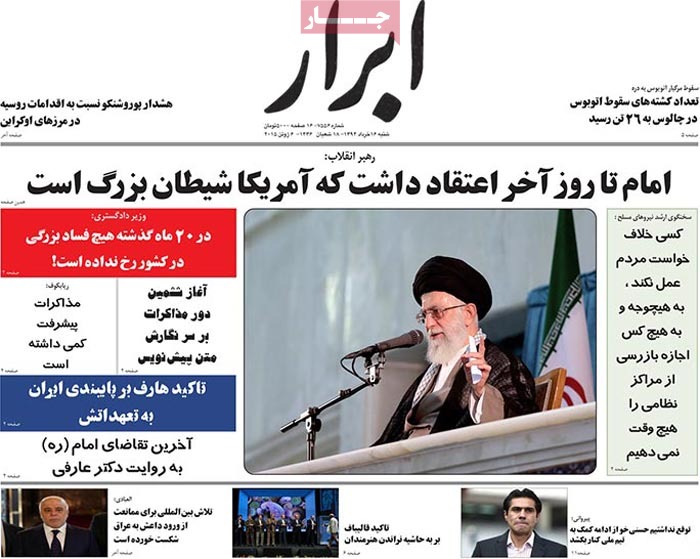
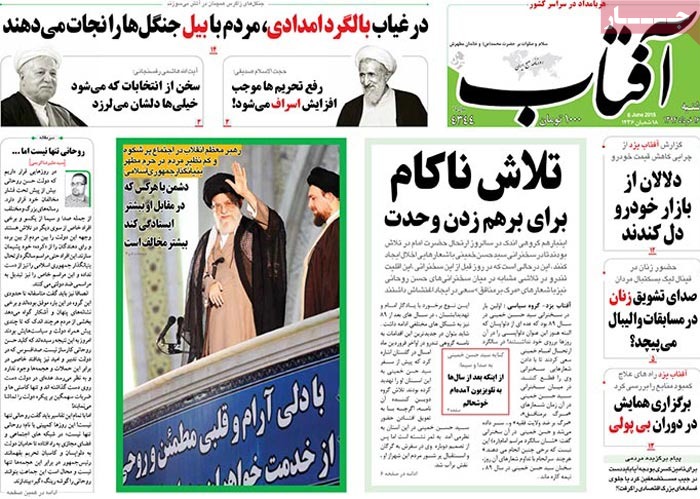
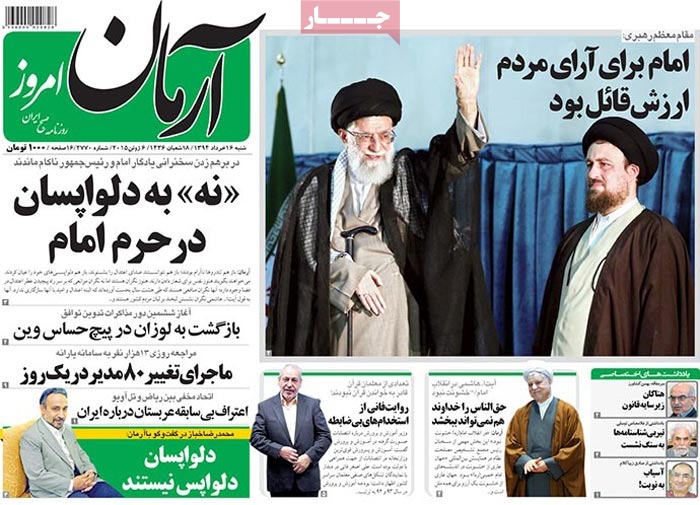
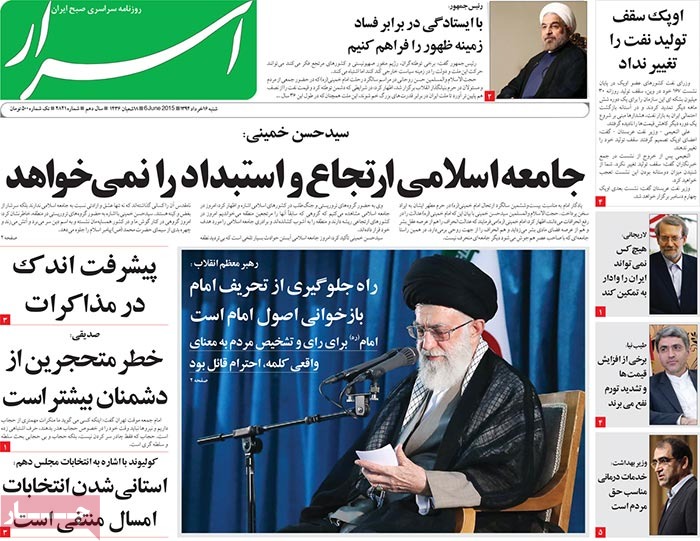
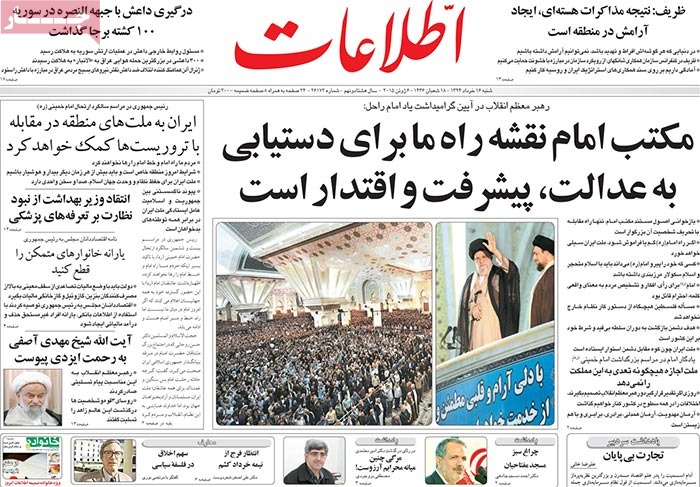
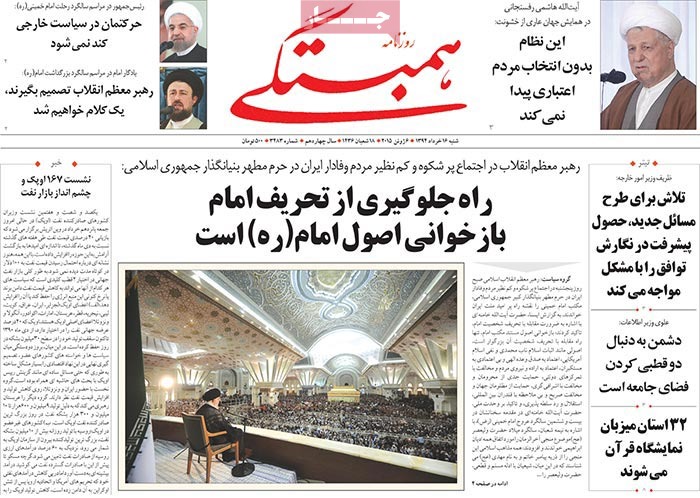
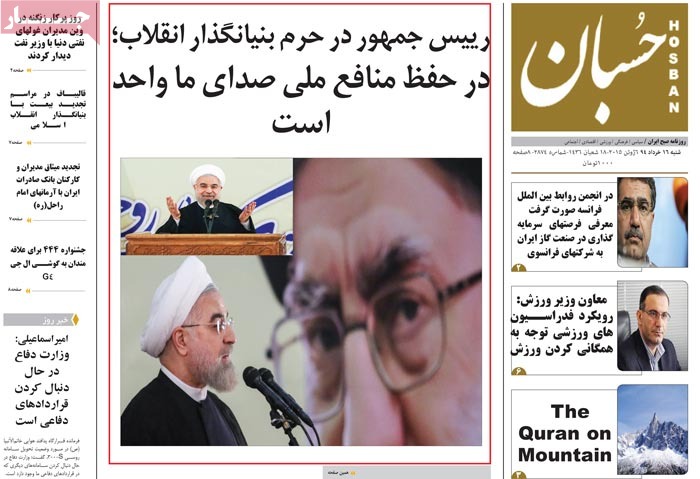
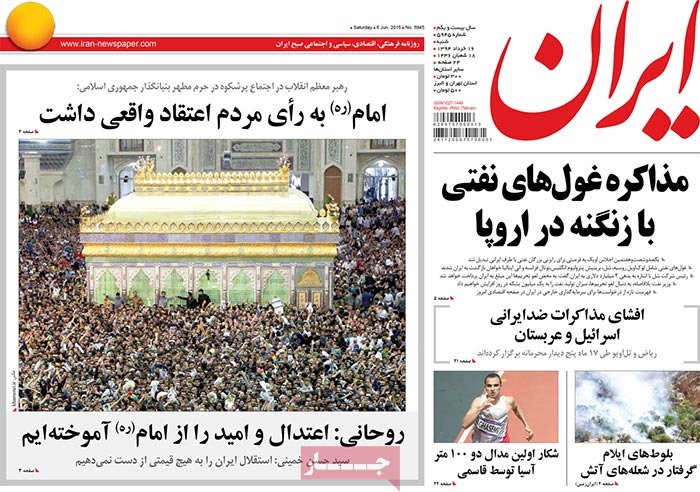
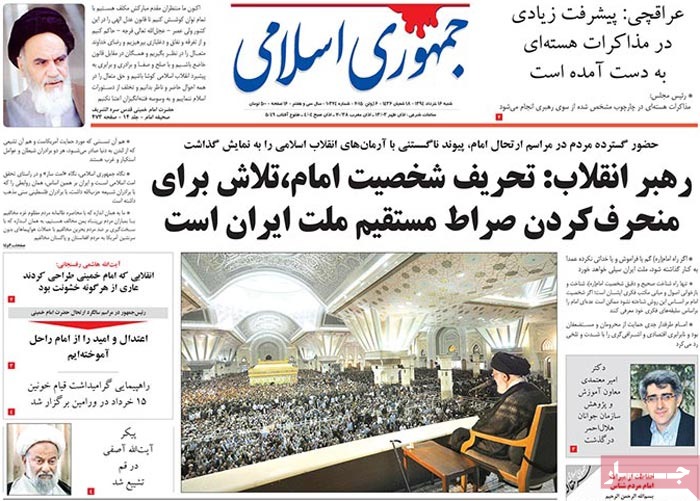
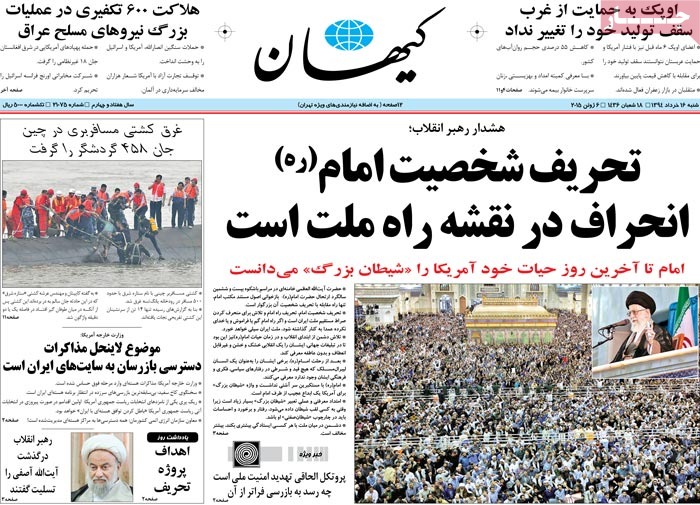
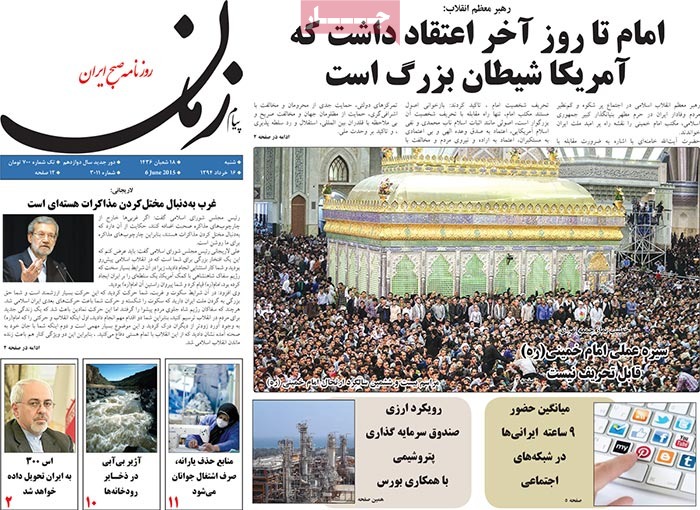
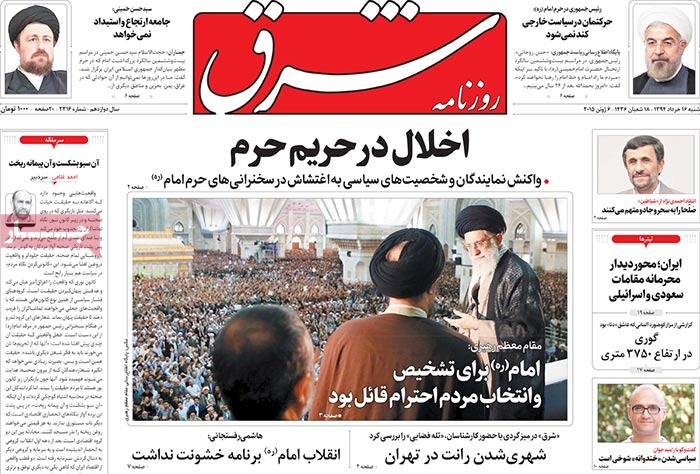
The comments of the Supreme Leader at a ceremony to mark the 26th anniversary of the demise of the founding father of the Islamic Republic dominated the front pages of Iranian newspapers on Saturday. Comments of President Rouhani and Seyyed Hassan Khomeini at the same ceremony also made front-page headlines.
Abrar: The number of people killed in a deadly road accident involving a passenger bus carrying Iraqi nationals in northern Iran has reached 26.
Abrar: “There has been no case of massive corruption in the country in the past 20 months,” said the justice minister.
Aftab-e Yazd: “Removal of sanctions will result in wastefulness,” said Tehran Friday Prayer Leader Kazem Sedighi.
Arman-e Emrooz: Saudi Arabia has made unprecedented admission on Iran; Riyadh and Tel Aviv are in cahoots.
Asrar: “An Islamic society does not stand reactionary attitude or despotism,” said Seyyed Hassan Khomeini, the grandson of the late Imam Khomeini.
He made the comment in a speech at Imam Khomeini Mausoleum to mark the 26th anniversary of his grandfather’s demise.
Ettela’at: “Iran helps regional countries take on terrorism,” said President Hassan Rouhani.
Hambastegi: “Our movement on the foreign policy front won’t slow down,” vowed President Hassan Rouhani.
Hosban: Opportunities for investment in Iran’s gas industries have been presented at the French Institute of International Relations.
Iran: Representatives from the European energy giants have held talks with [Iranian Oil Minister Bijan Namdar] Zanganeh.
Jomhouri Islami: “Nuclear talks have come a long way,” said Iranian negotiator Abbas Araghchi.
Kayhan: “Any measure to paint a distorted image of the late Imam’s character would amount to an attempt to distort the roadmap of the nation,” said Supreme Leader Ayatollah Seyyed Ali Khamenei.
Payam-e Zaman: “Imam Khomeini believed to the end that the US was the Great Satan,” said Supreme Leader Ayatollah Khamenei.
Sharq: “The revolution the late Imam championed did not favor violence,” said Ayatollah Hashemi Rafsanjani.
Sharq: “The late Imam respected the choice of the public,” said the Supreme Leader.
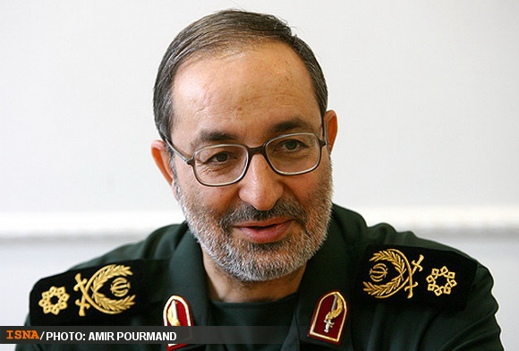
A high-ranking Iranian commander says the Islamic Republic’s armed forces will not allow any inspection of the country’s military sites.
“We will never allow any kind of visit to military centers, whether it is limited and controlled, or unlimited or in any other form,” ISNA quoted Deputy Chairman of the Chiefs of Staff of the Iranian Armed Forces Brigadier General Masoud Jazayeri as saying Friday.
He underlined that the Iranian nation will never give in to the excessive demands being made by arrogant powers during the course of nuclear negotiations between Iran and six other countries.
On May 30, senior Iranian nuclear negotiator Seyyed Abbas Araghchi, who is Iran’s deputy foreign minister for legal and international affairs, also rejected calls for inspections of Iran’s military sites and interviews with Iranian nuclear scientists.
Araghchi described as “a decisive and serious guideline” the recent statements by Leader of the Islamic Revolution Ayatollah Seyyed Ali Khamenei, who rejected calls for the inspection of Iran’s military sites and interviews with the country’s nuclear scientists as part of a final nuclear deal.
“We have fully informed the other [negotiating] side that this (the issue of inspections and interviews) will never be on the agenda” of the negotiations, Araghchi said on May 29.
On May 20, Ayatollah Khamenei said Iran will not allow any inspections by foreign countries of its military sites. He also stressed that foreigners will not be permitted to interview Iranian scientists in the nuclear domain.
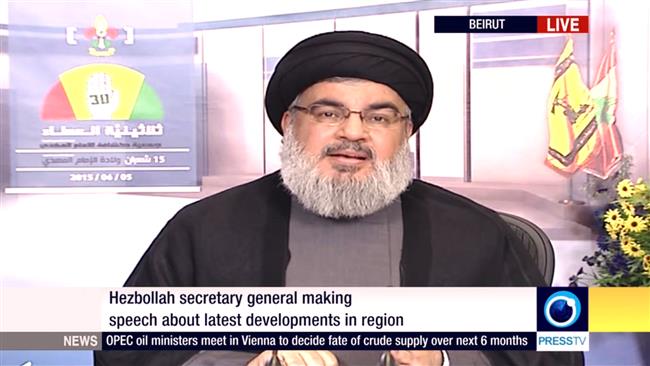
The secretary general of the Lebanese Hezbollah resistance movement, Seyyed Hassan Nasrallah, has warned Israel against potential military strikes against Lebanon.
Nasrallah said the Israeli regime should not think that Hezbollah is preoccupied with the operations in Syria against terrorist groups, saying a strong response awaits Israel if it attacks Lebanon.
The Hezbollah leader said that despite all the propaganda against the resistance group, it gained many achievements in the Qalamoun region on the Lebanese-Syrian border.
He said Hezbollah fighters have liberated many areas from the Takfiri al-Nusra Front militants in the border region.
The Hezbollah fighters and the Syrian army now have the upper hand in Qalamoun, Nasrallah said.
He said the battle on the outskirts of the town of Arsal will continue, but emphasized that Hezbollah fighters do not plan to enter the town itself, the liberating of which is the responsibility of the Lebanese army.
On the Takfiri ISIL terrorist group, the Hezbollah leader said the group was originally formed in Iraq, and later spread to Syria.
Nasrallah said ISIL split from the al-Qaeda terrorist group, which was itself created by the US, Saudi and Pakistani intelligence agencies.
On the Saudi military strikes against Yemen, the Hezbollah leader said that Saudi Arabia does not want anyone to criticize the military aggression against its impoverished neighbor.
He said the stance of Hezbollah has from day one been to condemn the Saudi military strikes against Yemen.
Out of the goals declared by Saudi Arabia in the military aggression against Yemen, Nasrallah said, none were achieved.
“Yes, they killed, they destroyed… criminal gangs can do that; aside from that, none of the declared goals were achieved,” he said.
Saudi Arabia has to end the aggression and the blockade against Yemen, the Hezbollah leader said.
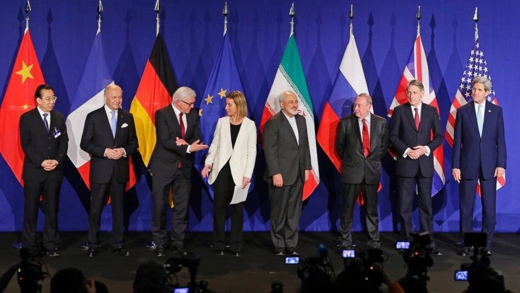
Will Iran and P5+1 ink a final deal? This question has overshadowed Iran’s domestic, foreign, economic and social policies in the past couple of years. The country is waiting to see the results of the talks before it can make crucial decisions on different fronts. With the talks entering a critical stage, some political experts are concerned that the breakdown of nuclear talks will come with dire consequences in different sectors. The concern stems from the fact that public opinion expects nothing less than settlement of the nuclear case.
Fararu on June 1 asked experts about the talks, their upshot and public expectations. The First Part (Second Part) focuses on the view of Nasser Imani, a principlist political expert. The following is the translation of his remarks:
The eleventh government has focused heavily on the talks with the West and a nuclear deal ever since it has come to power and even prior to that – on the campaign trail. Government’s insistence on the conclusiveness of a deal has caused the expectation of officials and members of the public about a nuclear deal to grow. Even reformist political experts criticize government’s fixation on the issue, which has been reflected on different fronts and among people.
I think government has still time to draw a line between the need for continuing the talks – and efforts to produce results – and certainty about reaching an agreement.
Too much concentration on the certainty of the nuclear deal by the officials of the executive branch – chief among them the president – will have domestic and foreign reflections. Failure to strike a deal would turn the spotlight on it [the certainty of a deal or lack thereof] even more than before.
In case nuclear talks fail to produce a final deal, the very first consequence will be the declining popularity of government and its supporters because people will think that government has hit a stalemate in its biggest project.
A weakened government is to the detriment of the whole establishment. The Supreme Leader has always underlined that he supports all governments [in the country]. This shows how important the position of government is and a weakened government will have consequences for the entire establishment.
No doubt, government will face problems pursuing other projects if the talks break down and its position is undermined, and this would cause the radicals to raise their voice [louder than before].
We need to take into account the fact that the Western side wields more power in the talks, so the focus on the conclusiveness of the talks should not raise [people’s] expectations.
Government’s failure in [nuclear talks and] realizing its economic, social and cultural promises will see other individuals throw their hat in the ring for the next presidential elections, with Rouhani losing his chance of winning reelection.
There is still another possibility: A weakened government may seek to strengthen its [vulnerable] position. To that end, it may make mistakes which would in turn dent the country’s national interests.
This brings us to the conclusion that tying the [solution to] all problems the country is grappling with to the conclusion of a nuclear deal will yield no positive result. Government has to seize the opportunity and do what it can to distinguish between these two issues.
© All Content by IFP News ( Iran Front Page ) is licensed under a Creative Commons Attribution 4.0 International License.
