Tuesday, December 30, 2025
Home Blog Page 4850

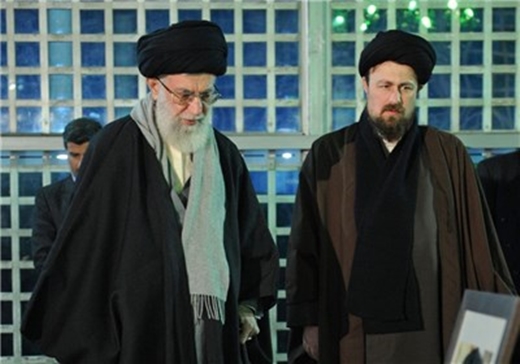
Supreme Leader, president pay tribute to late Imam Khomeini

Leader-Imam Khomeini

Supreme Leader of the Islamic Revolution Ayatollah Seyyed Ali Khamenei on Wednesday paid tribute to the late founder of the Islamic Republic, Imam Khomeini, a few days before the beginning of Ten-Day Dawn ceremonies, marking the victory of 1979 Islamic Revolution.

The Iranian nation toppled the US-backed Pahlavi regime 36 years ago, on February 11, 1979, ending 2,500 years of monarchic rule in the country. The Revolution, led by the late Imam Khomeini, established a new political system based on Islamic values and democracy.

Every year Iranians mark anniversary of their Islamic Revolution from February 1 to 11, known as the Ten-Day Dawn ceremonies. February 1, 1979 was the date when Ayatollah Ruhollah Khomeini returned from exile in Paris to Tehran. On February 11 each year, Iranian people pour into the streets in their millions to commemorate the great victory of the Islamic Revolution.

Ayatollah Khamenei also paid homage to Iranian martyrs laid to rest in Behesht-e Zahra Cemetry in southern Tehran including martyrs of June 28th, 1981 bombing at the headquarters of the Iran Islamic Republic Party in Tehran, while the members in a meeting.

Seventy-two officials of the Islamic Republic were killed, including Chief Justice Ayatollah Mohammad Beheshti – who was the speaker of the parliament – four cabinet ministers, 27 members of Parliament and several other government officials.

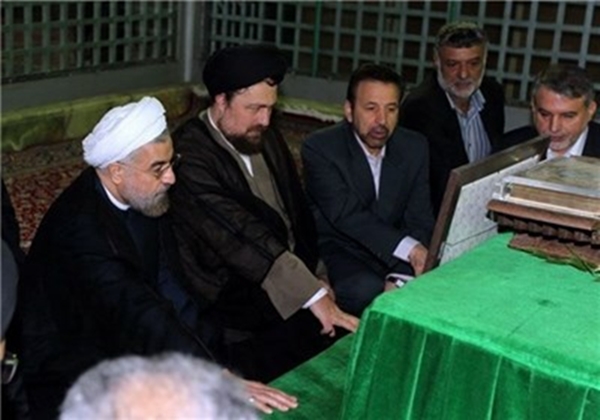
Later in the day, President Rouhani paid a similar visit to the mausoleum of the late Imam to renew allegiance to the ideals of the founding father of the Islamic Republic.


Rouhani-Imam Khomeini

Zarif deplores fault-finding, unfair criticism

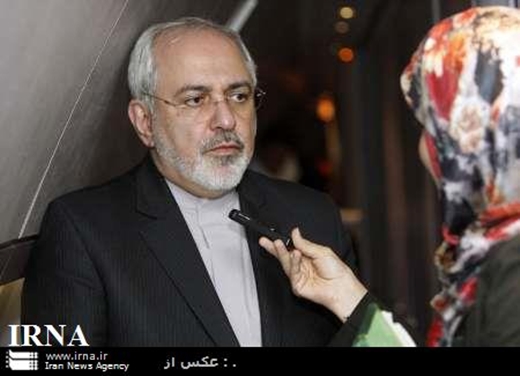
Zarif

Foreign Minister Mohammad Javad Zarif on Wednesday complained about unfair criticism by radicals of nuclear negotiators, saying that taking a walk with US officials during nuclear talks is nothing new.

In an exclusive interview with IRNA, the top diplomat said by calling for confrontation with the West, the radicals have embarrassed the negotiators.

How do you expect the negotiators to proceed with brainstorming negotiations when they are subject to unfair and illogical criticism?

“I respect the right of everyone to be critical, but I would like to mention two points. First, critics should make sure that their criticism is not detrimental to the national interests; they should keep in mind that the negotiating team are representing the Islamic Republic of Iran and believe in safeguarding national interests. They do not seek to cross the red lines. Second, the negotiators have been put through a difficult period by illogical and unfair criticism,’ Zarif said.

He recalled the remarks of the Supreme Leader who said the negotiators have withstood the enemies to defend our national interests just like an army division.

Zarif urged radical members of parliament to put national interests ahead of partisan interests and focus on fair criticism rather than finding fault with negotiators.

Yanni weighs in on his probable visit to Iran

Yanni

Yiannis Chryssomallis, known as Yanni, is a Greek pianist, keyboardist and composer. On January 27 Sharq daily published an interview with the well-known composer in which he said, “I sincerely hope I have a chance to visit Iran.” What comes next is a partial translation of the Q and A:

To many Iranians, your name is synonymous with your concert at the Acropolis in Greece where you took the stage as Shahrdad Rouhani [a world-renowned Iranian musician] conducted. What was your cooperation with him like?

To me, Shahrdad is a noble and remarkable artist I have had the privilege to work with. I have always appreciated working with him at the Acropolis concert in 1993. Shahrdad was a distinguished member of the team and played an important role in rendering the concert spectacularly successful.

By and large, how much do you know about Iran, its history, artists and musicians?

The Iranian culture and history was part of my school curriculum in Greece. I have never been to Iran, but I hope I can visit the country soon. One of my greatest wishes is travelling and learning more about cultures and nations.

What are your thoughts about the people who listen to your music, especially those in the Eastern countries?

I am honored that people listen to my music. That my music is said to have had an impact on lives of people is a source of honor. In fact, any time there is a mention of people living in the East, I feel there is a close relationship between me and them, particularly those of the Middle East and Iran.

Aside from cooperation with Shahrdad Rouhani, have you ever considered working with other Iranian musicians?

My main cooperation has been with Shahrdad Rouhani. We had close cooperation at the Acropolis concert and since then we have maintained our contact. I am willing to acquire similar experience with other Iranian musicians.

Over the past few years, we have kept hearing that you are going to hold a concert in Iran. Why have they been called off?

I love to stage a concert in Iran and get first-hand knowledge about its culture and people. There have been reports about an imminent concert in Iran over the past few years, yet none has ever materialized.

Will you have a concert in Iran in the near future?

I sincerely hope that I get a chance to visit Iran and hold a concert there. The fulfillment of this objective requires planning, and mutual cooperation from different groups. I really hope I will have a concert in Iran at the proper time under good conditions.

[…]

You have a lot of fans in Iran. What do you want to tell them?

Iranians understand me and there is a good emotional bond between us. I have a lot of fans in Iran whom I have met during my tours around the world. I appreciate their support and emotions and hope that the day will come when I can have a concert in Iran and meet them in person.

Iran: Israel to suffer consequences for Golan attack

Amir Abdullahian

An Iranian deputy foreign minister says Zionist regime’s officials will suffer the consequences of Tel Aviv’s recent airstrike that killed six Hezbollah members and an Iranian commander in Syria’s Golan Height.

Hossein Amir-Abdollahian, Iran’s deputy foreign minister for Arab and African affairs, said on Tuesday that following the attack, the Islamic Republic sent a message to the United States “through diplomatic channels,” warning that the Israeli regime should suffer the consequences of its fatal aerial assault against the Hezbollah convoy on the Syrian soil.

“In this message, we declared to the Americans that Israel has crossed Iran’s red lines by taking this action,” said the senior Iranian diplomat.

On January 17, an Israeli military helicopter fired two missiles into Amal Farms in the strategic southwestern Syrian city of Quneitra, close to the line separating the Syrian part of the Golan Heights from the Israeli-occupied sector.

Six Hezbollah members as well as Brigadier General Mohammad Ali Allahdadi, an Iranian commander, lost their lives in the Israeli assault.

Israel later claimed that it was unaware of the presence of an Iranian commander in the area where the attack happened.

Iranian officials, however, have rejected the claim, describing it as a routine tactic used by Israelis to hide their evil intentions.

Earlier on Tuesday, Major General Yahya Rahim Safavi, a top military advisor to Leader of the Islamic Revolution Ayatollah Seyyed Ali Khamenei, called Israel’s claims as mere “lies,” saying that such statements reveal the Tel Aviv regime’s fear of Iran’s retaliation.

The January 17 attack in Quneitra has sparked fears within Israel of Hezbollah’s possible retaliation.

Israeli media have reported over the past days that the regime is closely monitoring the movements close to the Lebanese border and in the occupied Golan Heights.

Iran parliamentary committee cuts National Development Fund’s share of oil

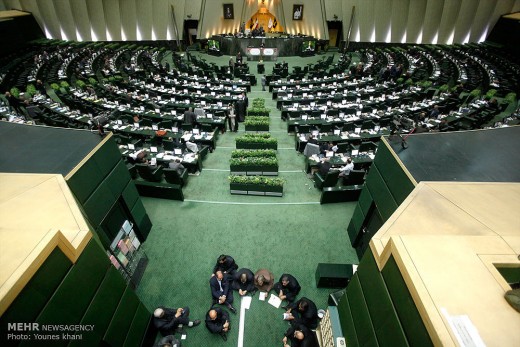
Iran Parliament

An Iranian parliamentary ad hoc committee reviewing the country’s national budget bill has cut the share of state-run rainy day kitty from oil revenues to 20 percent from 26 percent as oil prices keep falling.

“The share of National Development Fund of Iran (NDFI) from oil [revenues] has been reduced to 20 percent,” Mohammad Mehdi Mofateh, spokesman for the parliament (Majlis) Ad Hoc Budget Review Committee, said on Tuesday.

He said that a 20 percent share from Iran’s natural gas exports will also be funneled into the fund as of February.

The Iranian parliament is currently reviewing a budget bill President Hassan Rouhani has submitted for Iran’s next fiscal year which starts on March 21.

Rouhani has sought to reduce the share of petrodollars in Iran’s budget by a third as the country has seen its oil revenues fall by 30 percent in recent months. Iran’s national budget has traditionally been drawn up based on revenues from oil which Iran holds in large quantity.

Mofateh said the budget for next fiscal year is based on $72 oil and that the lawmakers would not modify the figure.

Oil prices have plunged nearly 60 percent since June last year over increased supplies by certain countries such as Saudi Arabia and lackluster global economic growth.

OPEC, which pumps out about 40 percent of the world’s oil, has so far refrained from cutting its production to balance the market mainly due to opposition from Saudi Arabia. Iran is a leading producer of the 12-member Organization of the Petroleum Exporting Countries.

The parliament has already allowed the government to increase its revenues from income tax in the next Iranian calendar year by 22 percent and up its earnings from miscellaneous income tax by almost 40 percent.

Italian Red Cross opens school for volunteer nurses in Iran

Italian Red Cross

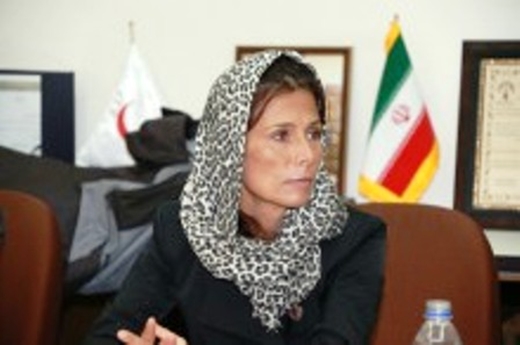
Deputy Chairman of Italy’s Red Cross in charge of humanitarian affairs said on Tuesday that the school for volunteer nurses has been launched in Iran.

During her stay in Iran, she is to visit the Red Crescent Society of the Islamic Republic of Iran to study the grounds for expansion of mutual cooperation.

The visit will help both sides to learn about the capabilities of each other of rendering humanitarian aid to affected people in due time, she said.

Head of Italy’s Red Cross Francesco Rocha who is visiting Iran for a second time described the aim of his visit as expansion of mutual cooperation with the Red Crescent Society.

She said they had already signed a memorandum of understanding (MoU) with former head of Iran’s Red Crescent Society to broaden scope of cooperation between the two organizations.

The MoU also called for running the school for volunteer nurses, she pointed out.

It is expected that the two sides’ invaluable experience in dealing with natural disasters such as earthquake will be useful in rescue operations, she said.

The nurses undergoing training at the school will be able to take part in rescue operations and rapid deployment in the disaster-hit areas as well as wars and military conflicts, she said.

Iran ex-veep hits back at Ahmadinejad following court verdict

Ahmadinejad-Rahimi

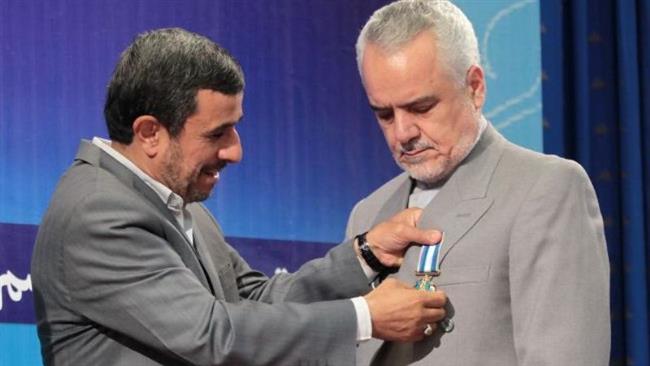
Earlier this month, the Supreme Court sentenced Mohammad Reza Rahimi, Iran’s first vice president under former president Mahmoud Ahmadinejad, to five years and three months in prison over corruption charges.

The court also ordered Rahimi to pay a 10-billion-rial (around $369,000) fine.

A court of first instance had initially handed down a 15-year prison sentence to Rahimi, but the Supreme Court commuted the term.

Following the court verdict, Ahmadinejad issued a statement saying the charges against Rahimi had nothing to do with the previous administration as the accusations date back to the time before Rahimi was appointed as first vice-president.

In a letter issued on Tuesday, Rahimi reacted to Ahmadinejad’s “equivocal” statement, criticizing the former president for turning his back on his deputy.

Rahimi said that he maintained friendship with former president for years, stressing that their differences of opinions over certain issues did not have an impact on their long-term friendship.

He said that he did his utmost to fulfill his duties and worked hard to improve relations between Ahmadinejad’s administration and the Iranian Parliament (Majlis).

Rahimi said that he was unwilling to take over as vice president due to certain “political grudges” aimed at tarnishing his reputation, and that he was appointed to the position despite his reluctance.

Rahimi said he expected Ahmadinejad to confirm that his deputy has “not betrayed the public purse.”

Rahimi also said that he is paying the price for the two-time former president’s “stubbornness” and his acts to tarnish others’ image, vowing to press ahead with his efforts to restore his reputation and prove his innocence.

Ahmadinejad has yet to comment back.

A look at Iranian newspaper front pages on Jan. 28

Iranian Newspapers Headlines

Comments by Foreign Minister Mohammad Javad Zarif that Iran and P5+1 see eye to eye on termination of sanctions made front-page headlines on Wednesday. Reformist dailies focused on the letter of grievance former Vice-President Mohammad Reza Rahimi has released following Mahmoud Ahmadinejad’s decision to distance himself from his deputy. And principlist papers underlined the call by three die-hard principlist MPs for adherence to the rules in the trial of the son of Ayatollah Hashemi Rafsanjani.


Afarinesh: “We have reached a deal with P5+1 over termination of all sanctions,” said Foreign Minister Mohammad Javad Zarif.
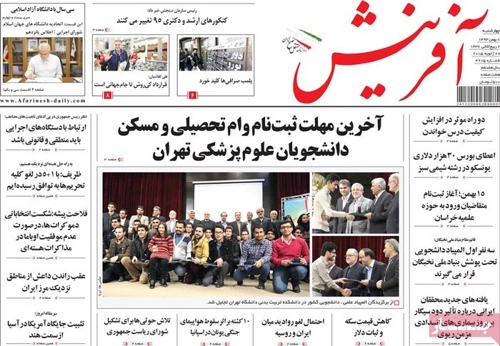
 

Afarinesh newspaper 1- 28


Arman-e Emrooz: The Russian ambassador to Tehran has said a visa waiver between the two countries is likely to come into effect shortly.
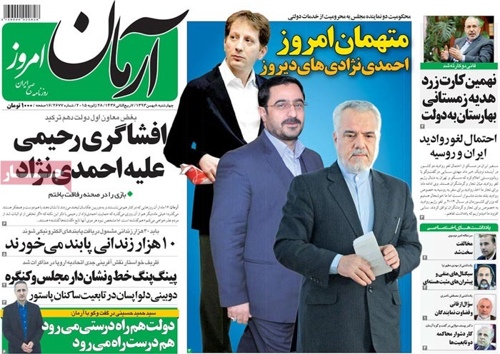
 

Armane emruz newspaper 1- 28


Asrar: The presidential office has issued a statement urging MPs not to build on unsubstantiated allegations when they question executive officials.
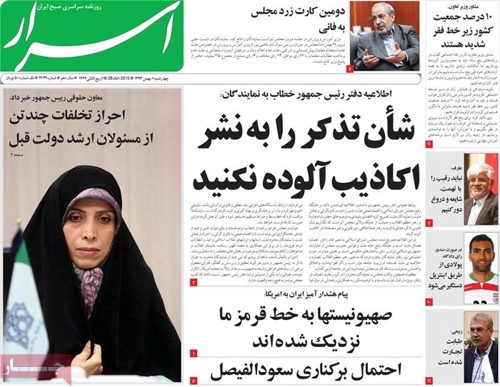
 

Asrar newspaper 1- 28


Ebtekar has used the headline “The Great Escape of a Draftee” to refer to the failure of Mehrdad Pouladi, a footballer who played for the national team in the AFC Asian Cup in Australia, to return home to serve his military duty.

Ebtekar: “I became a victim of your obstinacy and your measures to bring shame upon others,” said Mohammad Reza Rahimi, vice-president under Ahmadinejad, in a letter released in response to a statement by the former president in which he disavowed the actions of Rahimi, who is convicted of corruption and sentenced to more than five years in prison.

Ebtekar: Air pollution in the southwestern cities of Ahvaz and Abadan is 15 times more than the permitted level.
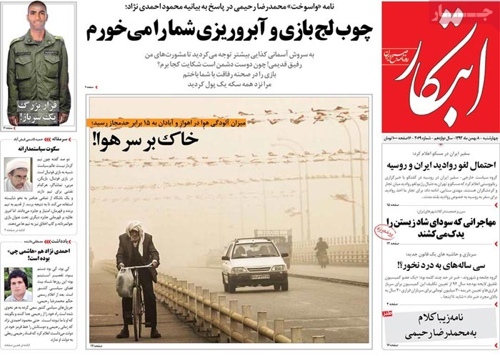
 

Ebtekar newspaper 1- 28


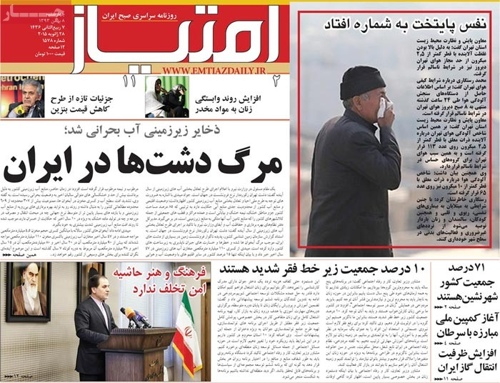
Emtiaz: Some 71 percent of the country’s population lives in cities.
 

Emtiaz newspaper 1- 28


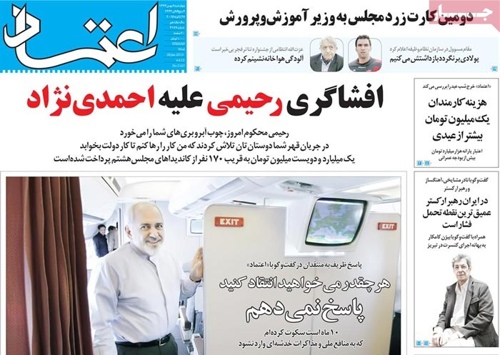
Etemad: “If Pouladi [a national soccer team player who has yet to serve his military duty] fails to return home voluntarily, we’ll have him arrested through Interpol,” said an official with the Conscription Organization.

Etemad: “Criticize as much as you want, I won’t fire back. I have kept silent for 10 months not to harm national interests, or the nuclear talks for that matter,” said Foreign Minister Zarif in comments aimed at his critics in parliament.
 

Etemad newspaper 1- 28


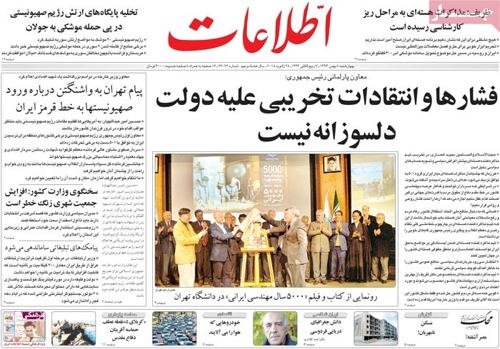
Ettela’at: A book on 5,000 years of engineering in Iran has been launched at Tehran University. A movie on the same theme was screened at the launch of the book.

Ettela’at: “Criticism leveled at the government is not well-intentioned,” complained the vice-president for parliamentary affairs.
 

Ettelaat newspaper 1- 28


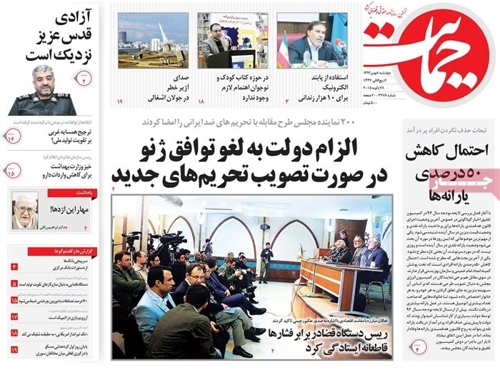
Hemayat: Some 10,000 prisoners are to wear electronic shackles.

Hemayat: Some 200 MPs have voted for a motion that requires the government to scrap the Geneva Deal in case new sanctions are imposed on Iran.
 

Hemayat newspaper 1- 28


Hosban: “Interior Ministry officials should not adopt a stance for or against a certain political party,” said the Interior Ministry spokesman.
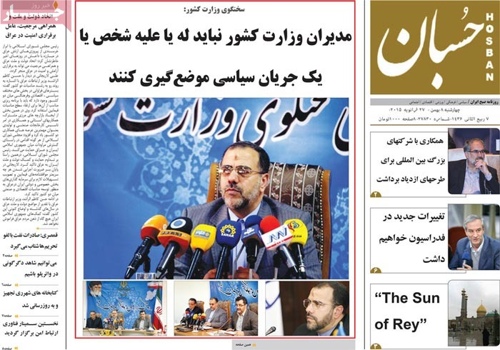
 

Hosban newspaper 1- 28


Jomhouri Islami: The education minister has been yellow-carded for a second time by MPs. That puts the education chief on the verge of impeachment.

Jomhouri Islami: There is division in the ranks of Republicans on Capitol Hill over continued nuclear talks with Iran.
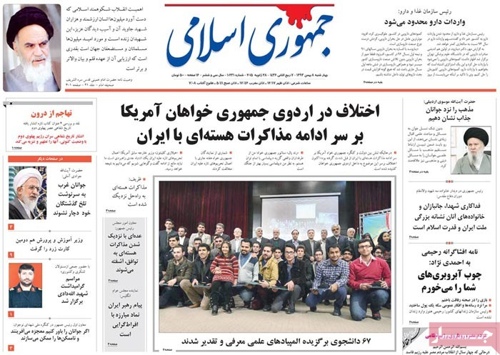
 

Jomhorie eslami newspaper 1- 28


Kayhan: “Twenty members of the Jaish al-Adl terrorist group have been arrested,” the spokesman of the Interior Ministry said.
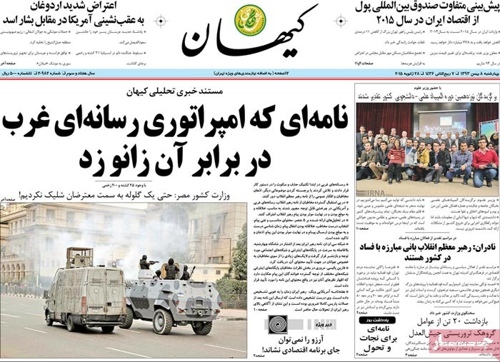
 

Kayhan newspaper 1- 28


Mardomsalari: “Two MPs and a senior executive manager who served under Ahmadinejad have been found guilty of administrative offenses,” said the chairman of a panel addressing administrative corruption.
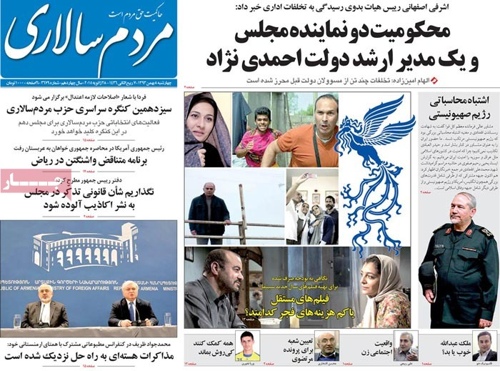
 

Mardom salari newspaper 1- 28


Qods: Officials should do something to help street children, up to 70 percent of whom are addicted to drugs and 40 percent are HIV-positive.
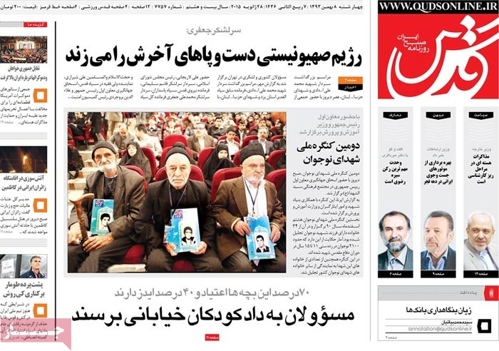
 

Ghods newspaper 1- 28


Resalat: Those who favor a clampdown on corruption have called for the corruption case involving Mehdi Hashemi [a son of Ayatollah Hashemi Rafsanjani] to be seriously followed.
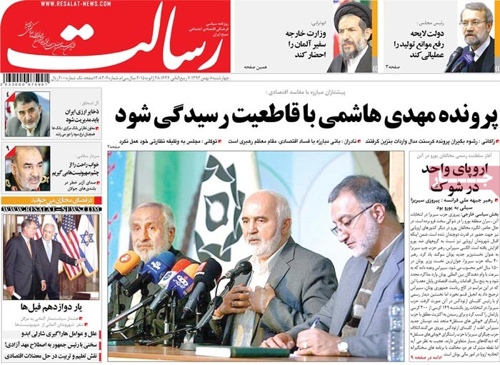
 

Resalat newspaper 1- 28


Shahrvand: A deputy foreign minister has said that following the martyrdom of General Allahdadi [during an Israeli helicopter gunship attack on Syrian soil] Iran warned the US about Israeli actions.
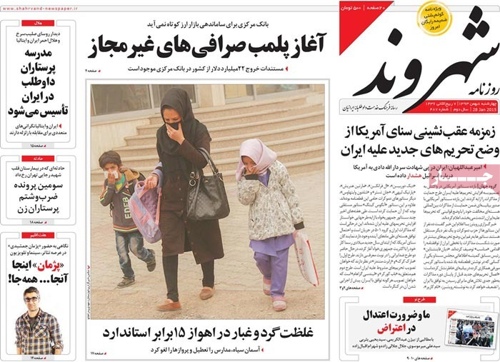
 

Shahrvand newspaper 1- 28


Sharq: The International Volleyball Federation has said Iran can host the FIVB Volleyball World League if it allowed female spectators into sporting arenas.
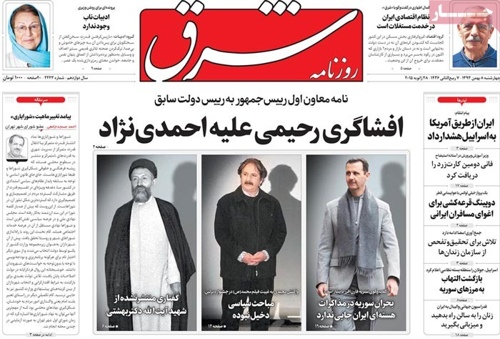
 

Shargh newspaper 1- 28


Tafahom: Foreign exchange offices which have failed to comply with regulations are being shut down.
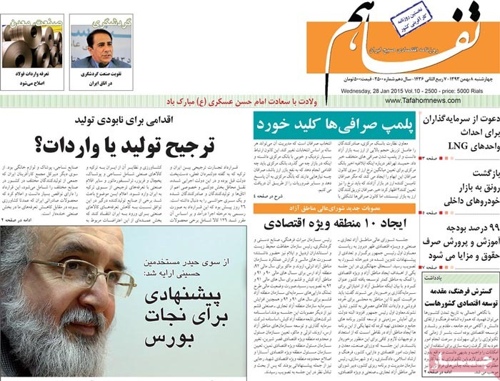

 

Tafahom newspaper 1- 28

Oppressive governments main reason for spiritual vacuum: Judiciary chief

Larijani-Religion

Iran’s Judiciary Chief Sadegh Amoli Larijani has criticized defamation of religion and called the recent French cartoons an insult to over 1.5 billion Muslims around the world.

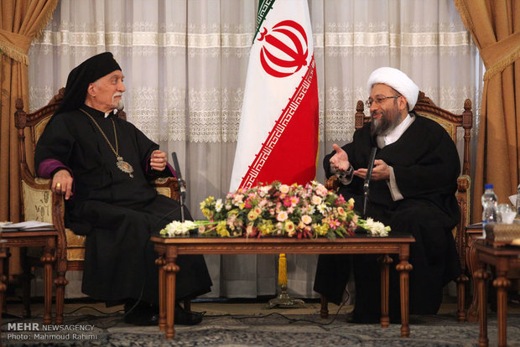
Ayatollah Amoli Larijani made the remarks at a meeting with the Patriarch of Armenian Catholic Church Nerses Bedros in Tehran.

Amoli Larijani described spiritual vacuum as the main problem in the world, and said “The reasons and causes of self-alienation and distance from spirituality and monotheistic religions abound in the modern world, and religious figures have a duty to introduce the truth of anti-oppressive nature of monotheistic religions to the public.”

He called on the religious scholars to take a stance against the violence of hegemonic leaders and Western governments against oppressed people, especially Muslims.

“Due to their influence in the world, Christian leaders are expected to take appropriate positions when and where aggression happens against innocent people,” Amoli Larijani underlined.

The top judge also called for greater engagement of religious scholars and thinkers of the West with the Islamic scholars to bring religions closer together and boost spiritual trends in the world, stressing that ruthless and aggressive governments keep people away from each other and strengthen their tendency toward materialism and enhance their distance from spirituality.

Larijani said divisive actions like insulting religions is decried and the recent cartoons published by Charlie Hebdo was a clear violation of over 1.5 billion Muslims’ rights.

The Patriarch of Armenian Catholic Church Nerses Bedros, while acknowledging the issues raised by Ayatollah Larijani, said that spirituality has declined, especially in Western countries due to the expansion of materialism in the world.

Iran’s foreign relations are developing: Minister

Janati-Portugal

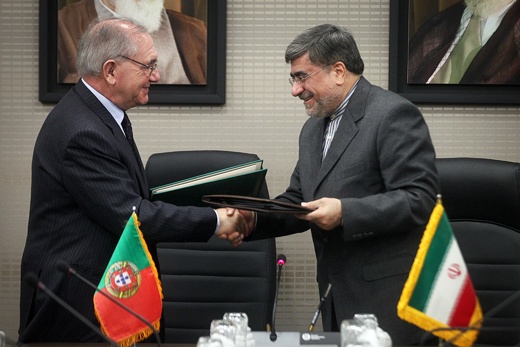
Iran has cultural agreements with many countries with some as old as half a century, Minister of Culture and Islamic Guidance Ali Jannati said in a meeting with Portuguese Foreign Minister Rui Machete in Tehran Tuesday.

At the meeting in which the two ministers signed a cultural agreement, Jannati said, ‘There is a solid base for expansion of bilateral relations and the two countries can have extensive cultural exchanges in the next couple of years.’

Jannati referred to 500-year-old bilateral relations between Iran and Portugal, calling for closer Tehran-Lisbon relations.

Referring to Iran Cultural Week held in Lisbon, Jannati said Iran presented various artworks among other things in music, cinema, at the event and ‘we hope to see Portuguese artists in Iran soon’.

Jannati also said Iran is ready to expand bilateral relations in different fields such as exchanging academic delegations, holding cultural exhibitions, and exploiting the two countries’ cultural potential.

He invited Portuguese film makers to participate in Fajr Film Festival which is held in Tehran annually in February.

Meanwhile, the Portuguese foreign minister called for the implementation of the cultural agreement, saying bilateral relations go back to the 16th century.

Machete expressed hope that the two countries would be able to present their art works to each other.