Tuesday, December 23, 2025
Home Blog Page 4847

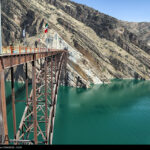
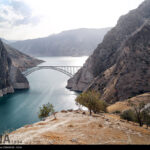
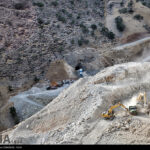
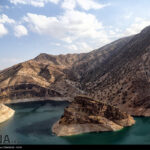
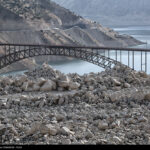
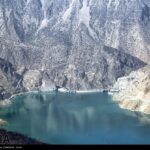
Khorramshahr in photos 26 years after end of war

Khorramshahr

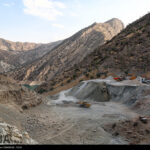
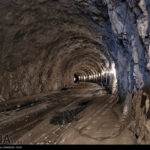
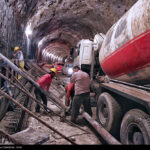
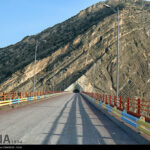
Twenty-six years after the end of the Iran-Iraq war, reconstruction is still in progress in the southern city of Khorramshahr, a city whose brave people still keep the memory of their martyrs and the blood of the innocent people shed during the war alive.

The city still bears the scars of the war imposed on Iran by Saddam. Tasnim News Agency released the following photos of the southern city:

False expectations about a price decline are aimed at harming government: Economist

Oil-dollar-rial

With a countdown to the probable lifting of sanctions on, speculations run rife that the removal of sanctions will translate into a decline in inflation and consumer prices. The question is how realistic such speculations are.

What is clear is that Iran’s economy has been grappling with galloping inflation in recent years. It hit back-to-back 10-year highs in 2012 and 2013. Now that hopes of the lifting of sanctions have risen, should we expect prices to take a plunge as fast as they surged?

Shahrvand daily has conducted an interview with Lotfali Bakhshi, an Iranian economist and university professor, to find an answer to that question. What comes next is the translation of excerpts of the interview published by the daily on May 24:

Some are under the impression that the lifting of sanctions and conclusion of a comprehensive deal will send prices plunging. What is your take?

With the conclusion of a final nuclear deal and subsequent removal of sanctions, one should not expect prices to go down, because our oil sales are limited. Even if oil exports increased twofold in six months, they would not be enough to meet the increasing needs of our economy.

Iran’s economic needs are huge. Even in case of a rise in our oil revenues, our economy will consume all foreign-currency revenues. Besides, global prices are not on the decline either, so we cannot expect a fall in domestic prices.

Some have predicted that the removal of sanctions will result in a drop in prices but the government is acting as an impediment. What do you think?

Even if all foreign-currency revenue expectations are met, prices won’t go down, because a drop in prices is an unrealistic expectation which defies scientific rules. Those who have made such predictions are either unaware of price trends or seek to exert pressure on the government.

In these conditions, do you think that raising the value of the rial against the greenback is a positive move? Or should the Central Bank prevent it from happening?

Keeping the value of the dollar artificially low plays into the hands of rent-seekers and causes an influx of imports which deal a blow to production. Only businesses that use the cheap dollar to import goods will benefit from such a move which is bound to deal a blow to domestic production.

The heavy dependence of the country on oil revenues has plagued the economy. If oil is excluded from the economic cycle, a dollar would buy as much as 100,000 rials. [That figure currently stands at around 33,000.]

Herat painting exhibition in Tehran (PHOTOS)

Herat painting00

Snapshots of a painting exhibition in Tehran featuring images of Afghanistan released by jamejamonline.ir:


Iran needs to keep its powder dry when it comes to regional events

Hashemi Rafsanjani-Majmae

The chairman of the Expediency Council has said that vigilance is direly needed in the face of ISIL’s new offensives in the region.

Ayatollah Akbar Hashemi Rafsanjani made the comment Saturday during a session of the Council and added we need to keep our guard up about what is playing out in the region.

The following is the translation of excerpts – reported by Entekhab.ir – of his remarks on the critical conditions in the region and a surge in terrorist acts by ISIL in Syria and Iraq:

[…]

We need to exercise more vigilance and prudence in the face of the dire threats and renewed onslaughts in the region and develop a better insight into the recent developments, Rafsanjani said, adding we have to know what is happening around us.

[He was referring to new attacks by ISIL in Syria and Iraq and the terrorist grouping’s capture of the Iraqi city of Ramadi in a fresh wave of onslaughts].

The top councilor then expressed regret over the continuation of unjust Saudi airstrikes against the defenseless people of Yemen and said, “Unfortunately, much of Yemen’s infrastructure is being destroyed thanks to the indifference of international organizations as well as regional and world nations”.

He rejected as “regretful and unfair” efforts to prevent Iran’s ship from taking humanitarian aid to the stricken Yemenis and said, “We hope the Islamic Republic of Iran continues to be the anchor of stability in the region”.

[…]

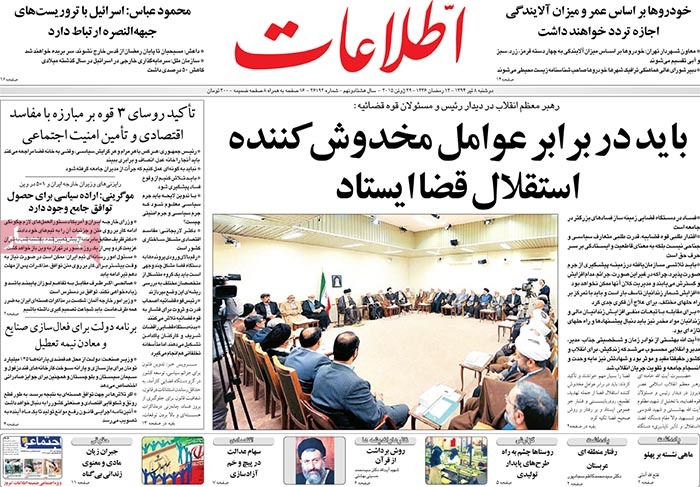
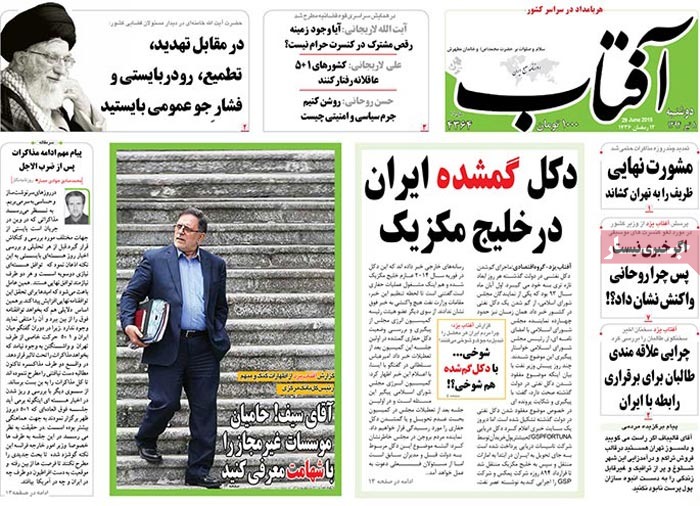
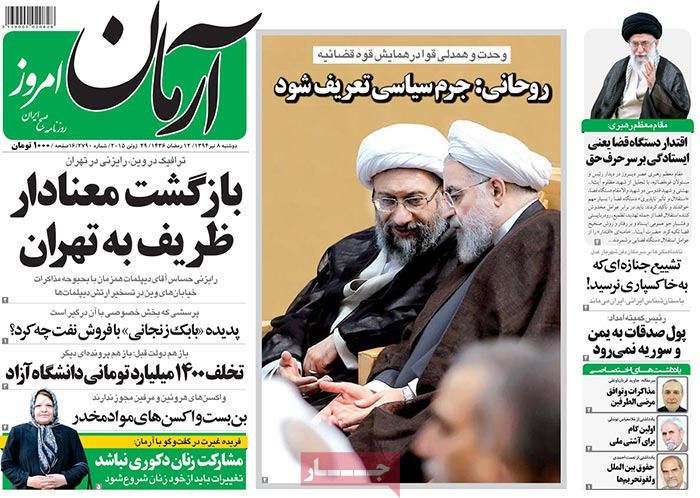
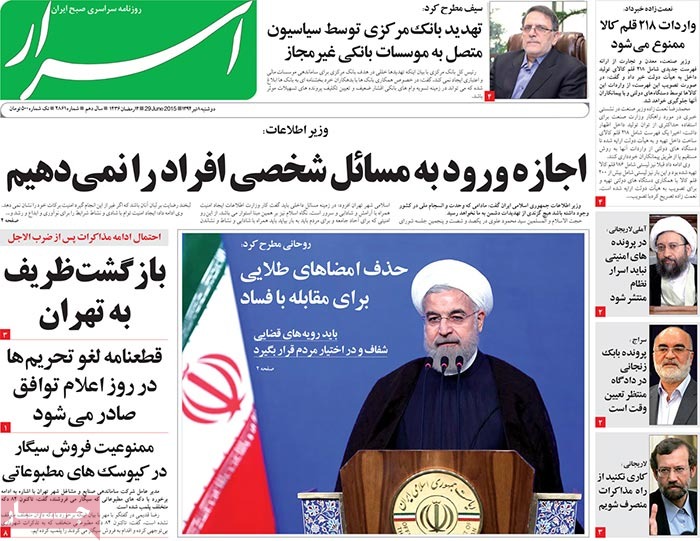
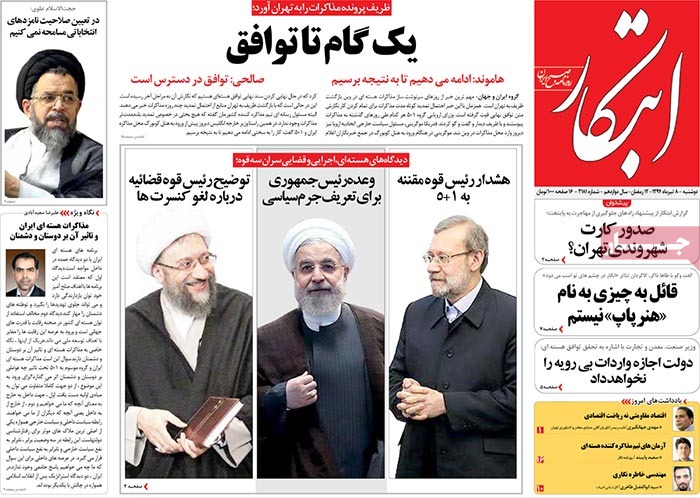
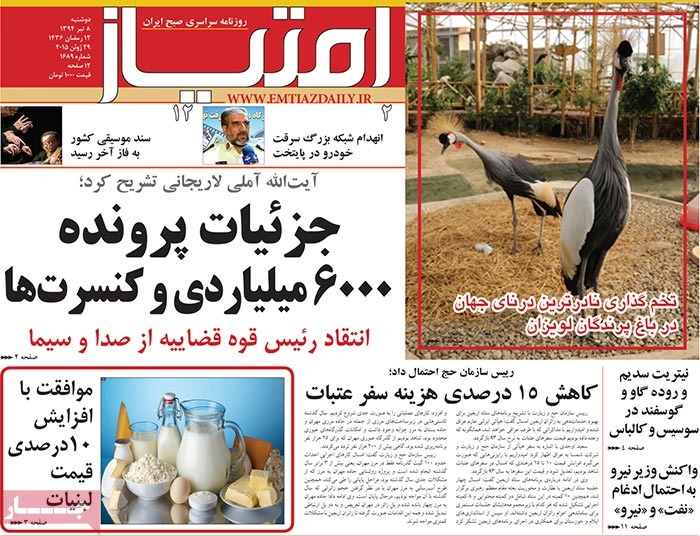
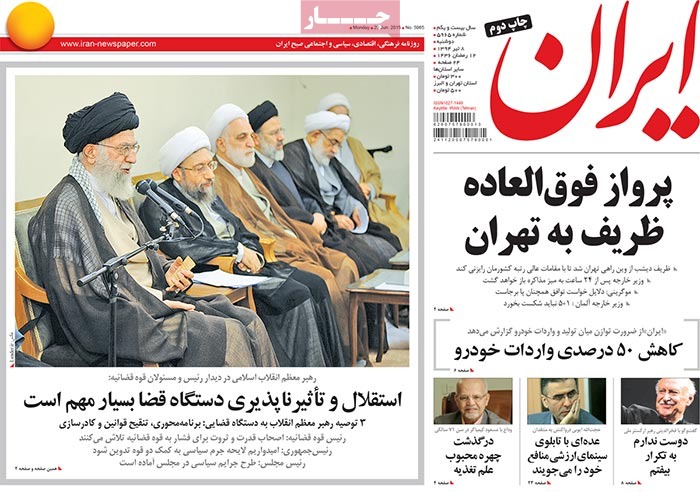
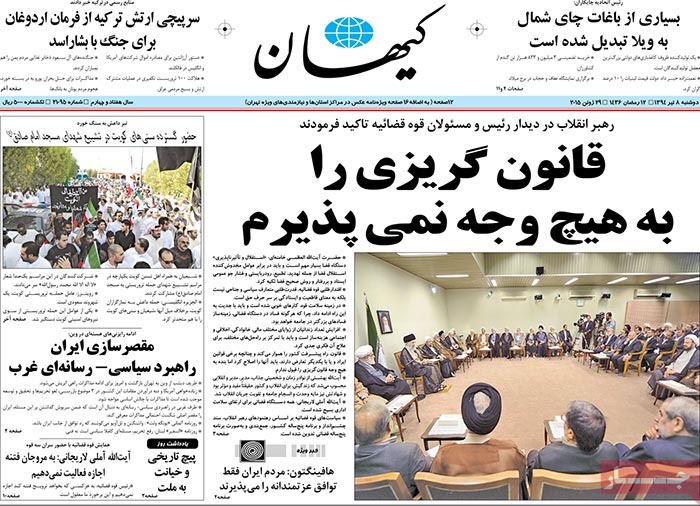
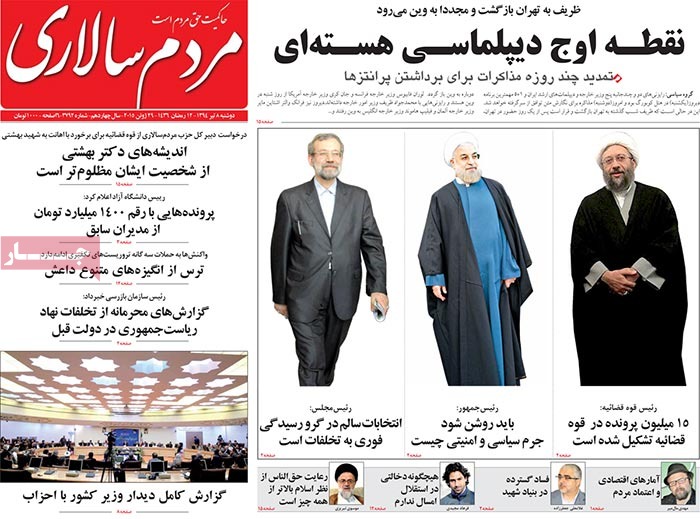
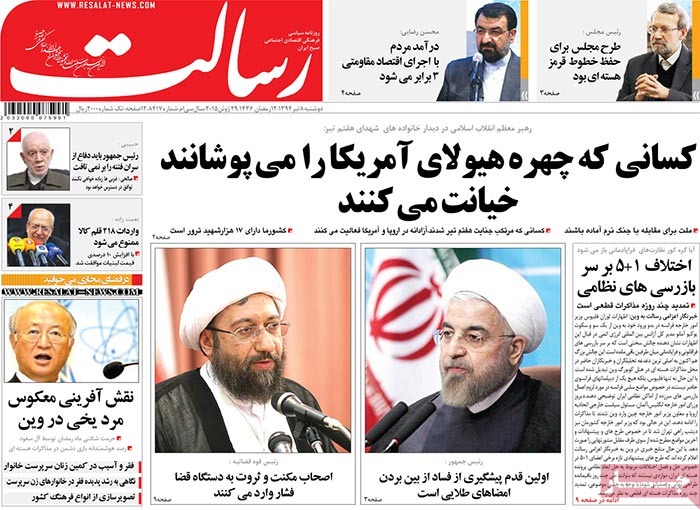
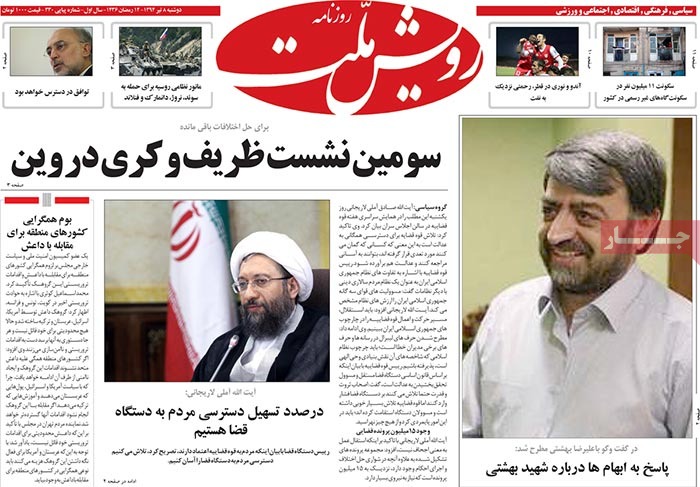
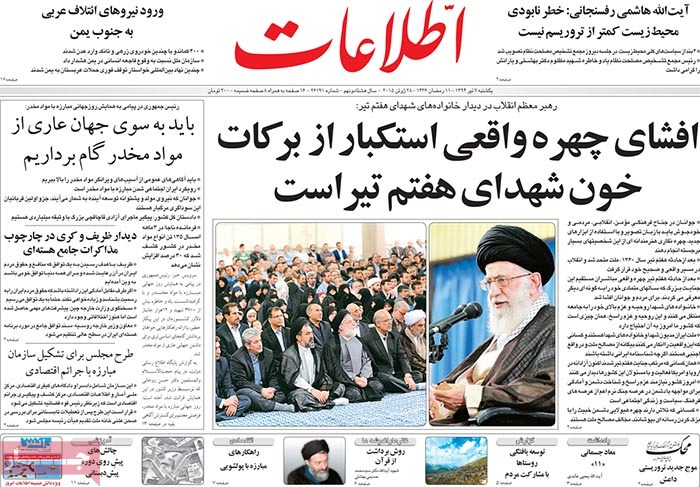
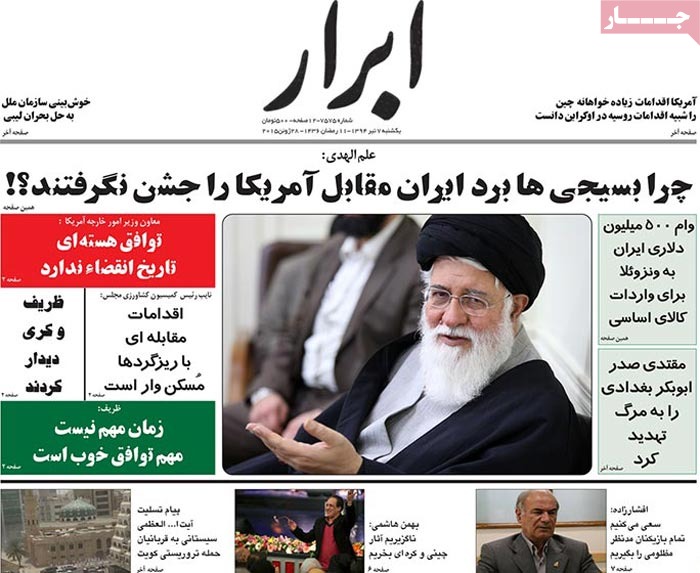
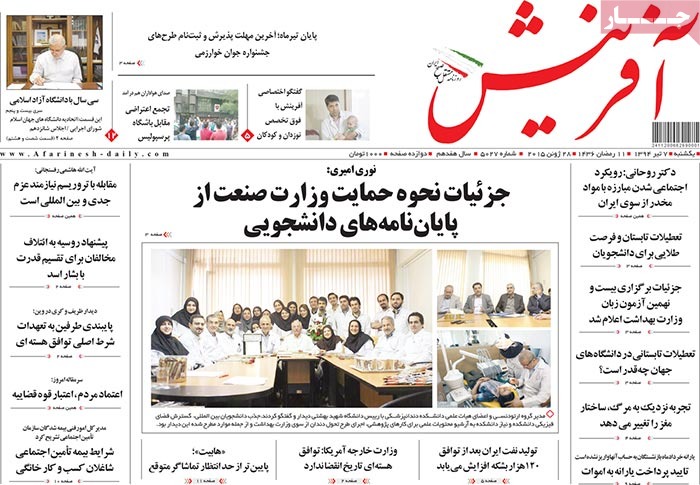
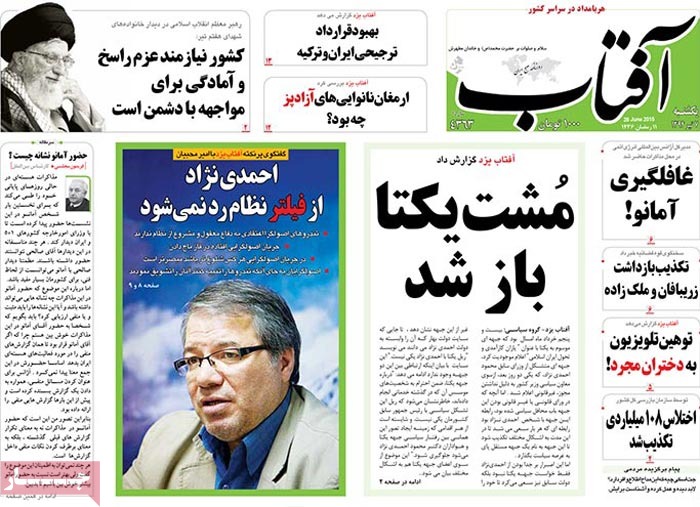
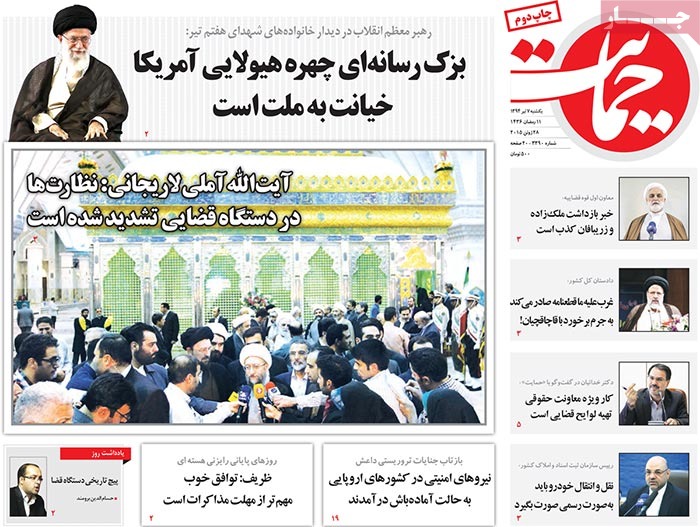
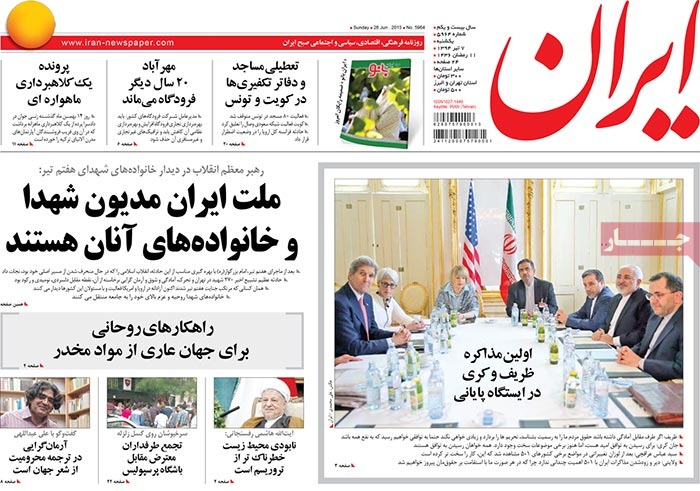
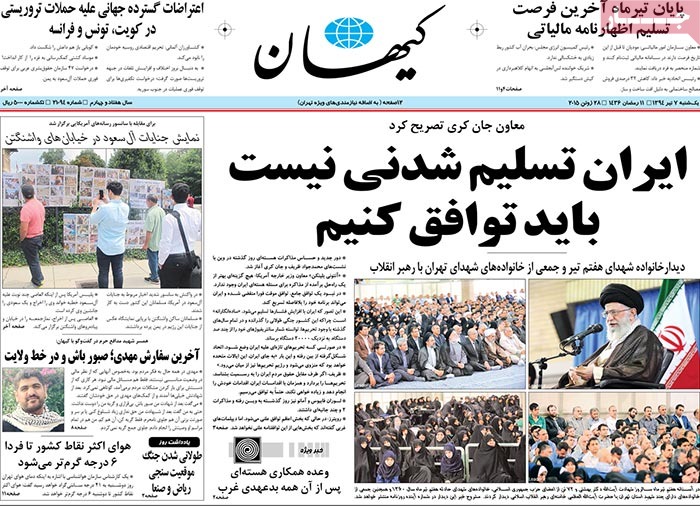
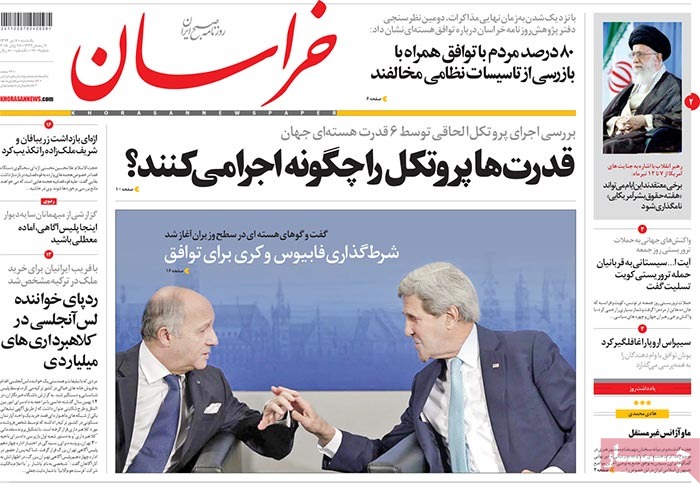
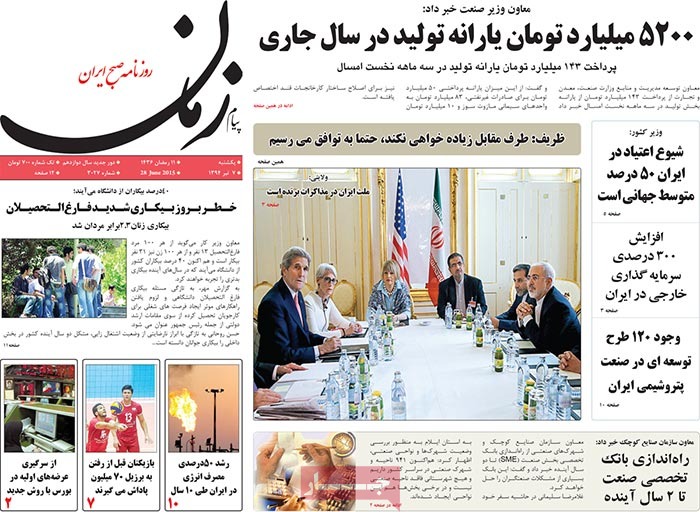
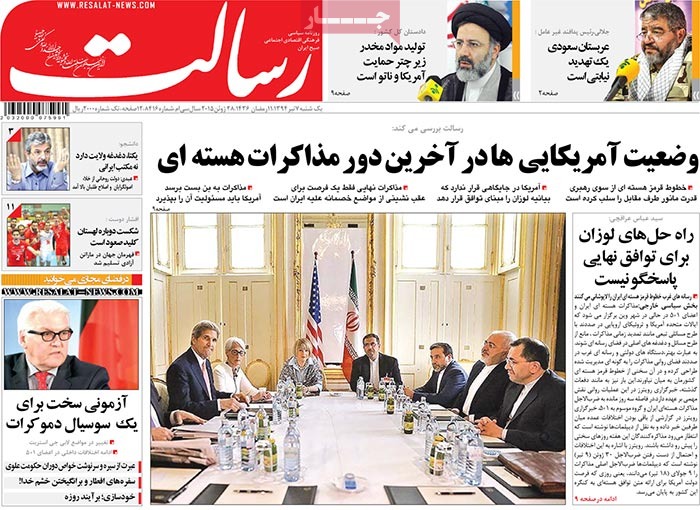
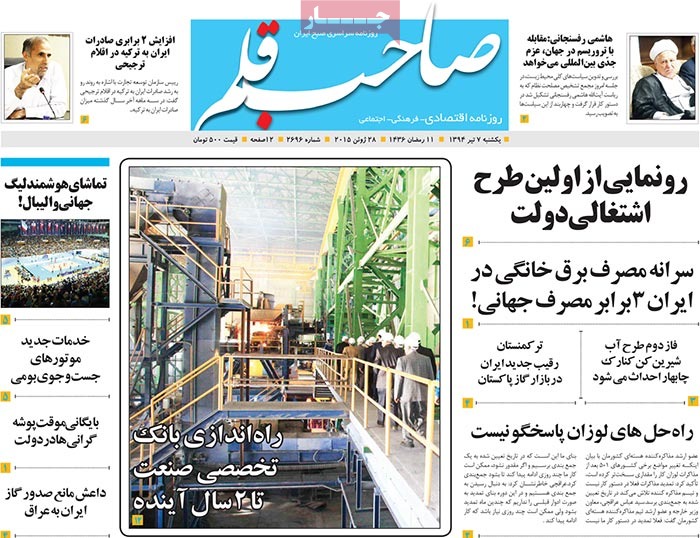
A look at Iranian newspaper front pages on May 24

Iranian Newspapers Headlines

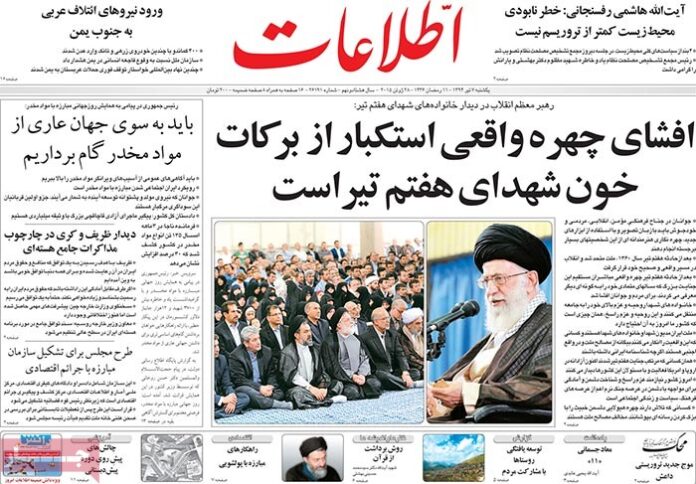
Comments by the Supreme Leader that any voice which fans the flames of division represents the enemy dominated the front pages of Iranian newspapers on Sunday. Also on the covers of most dailies were images of Khorramshahr, an Iranian city whose control was wrested back from the Iraqi Army 33 years ago today.


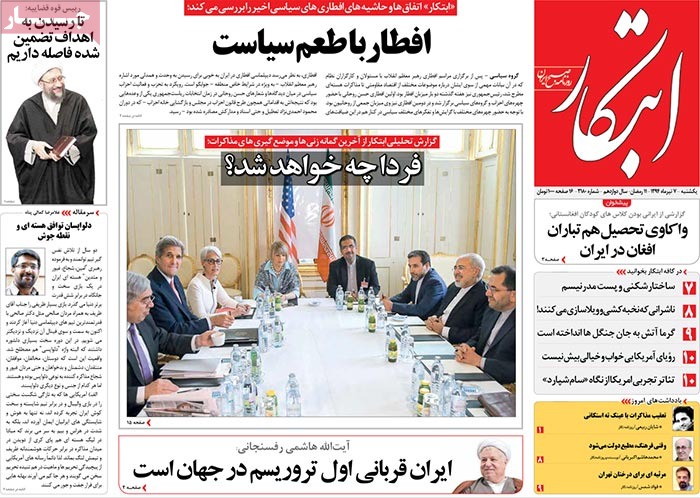
Abrar: A second stage of a military exercise by the Iranian Army got underway.

The successful launch of missiles by the Army marked the beginning of Beit ul-Moqaddas-27 Maneuvers.


A look at Iranian newspaper front pages on May 24


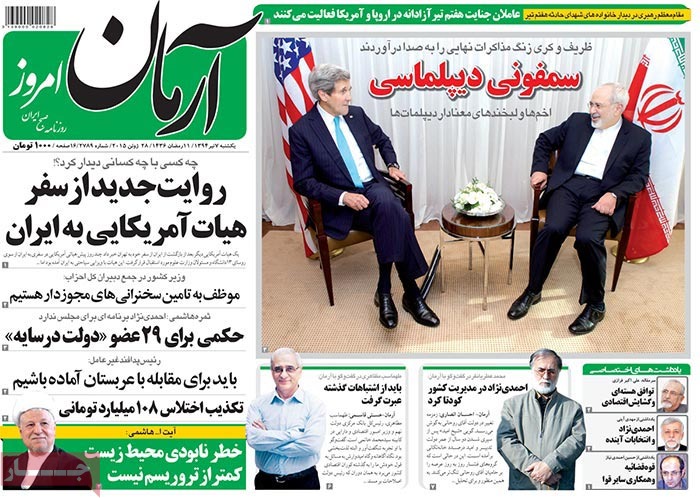
Arman-e Emrooz: Threats by hardliners did not work; Ayatollah Seyyed Hassan Khomeini visits Gorgan on Thursday.

[It comes after a statement purportedly by the Gorgan chapter of Hezbollah urged the grandson of the late Imam not to visit the northern province of Golestan.]


A look at Iranian newspaper front pages on May 24


Asrar: “No Iranian is banned from entering the country,” said Deputy Foreign Minister Hassan Ghashghavi.


A look at Iranian newspaper front pages on May 24


Ebtekar: Supreme Leader: Creation of division in the ranks of the Islamic community is a top priority of the enemies.

Ayatollah Khamenei made the comment at a meeting with Koranic reciters.

Ebtekar: As many as 15 million Iranians live below the poverty line.


A look at Iranian newspaper front pages on May 24


Emtiaz: “Crackdown on drug dealers and thieves are among top priorities of the law enforcement,” said Police Chief Brigadier General Hossein Ashtari.


A look at Iranian newspaper front pages on May 24


Esfahan Emrooz: Famous radio announcer Mehran Dousti has passed away.


A look at Iranian newspaper front pages on May 24


Ettela’at: “A directive on the fight against administrative corruption is being drawn up,” said Vice-President for Legal Affairs Elham Aminzadeh.

Ettela’at: The Central Bank of Iran has put inflation in the 30-day period to April 20 at 15.5 percent.


A look at Iranian newspaper front pages on May 24


Iran: The oil minister has said that decisions will be made within days on the price of gasoline and whether or not the cut-rate rations will remain in place.

Iran: Following a decision by the Expediency Council, the three branches of government have been ordered not to wield any influence in elections.


A look at Iranian newspaper front pages on May 24


Jomhouri Islami: The secretary general of Lebanon’s Hezbollah has said that he would soon mobilize the public against Takfiri terrorists [a reference to IS].


A look at Iranian newspaper front pages on May 24


Kar va Kargar: “The US seeks to take regional insecurity to the borders of Iran,” said Secretary of the Expediency Council Mohsen Rezaei.


A look at Iranian newspaper front pages on May 24


Nasl-e Farda: “Alcohol addiction rehabilitation centers will be launched,” said an official with the State Welfare Organization.


A look at Iranian newspaper front pages on May 24


Resalat: “Sanctions and threats won’t create a gap between the public and the establishment,” said Foreign Minister Mohammad Javad Zarif.


A look at Iranian newspaper front pages on May 24


Sayeh: The volume of trade between Iran and Europe is up by 11 percent.

Iran’s imports from the European Union have increased 5-fold.


A look at Iranian newspaper front pages on May 24


Obama’s anti-Iran remarks meant to foment tension in Mideast: Afkham

afkham

Iran has dismissed recent allegations by US President Barack Obama that the Islamic Republic seeks to take advantage of instability in the Middle East.

“The Islamic Republic of Iran is the source of stability and security in the unstable region of the Middle East and it seriously pursues and encourages political solutions and regional cooperation to counter violence and extremism,” Iranian Foreign Ministry Spokeswoman Marzieh Afkham said on Saturday.

In an interview with the American magazine The Atlantic on Thursday, Obama said Iran seeks to exploit instability in the region, including Yemen.

Afkham said Obama’s remarks are part of an Iranophobic plot aimed at “fomenting regional crises and fueling division and hatred,” adding that historical facts bear testimony to Iran’s “constructive and peaceful role” in the region and the world.

The Iranian official also stated that the US president falsely accuses certain countries of being the source of instability, while the issue of Islamophobia has spread on an unprecedented level across the world including in the United States. Afkham called for the US government to address such issues as Islamophobia and the massacre of Muslims by Takfiri terrorist groups instead of making false allegations.

Obama’s allegations that Iran interferes in regional countries, including Yemen, come as Saudi Arabia, a close ally of Washington, has been pressing ahead with its military air raids against Yemen without a UN mandate since March 26.

The United Nations says that, since March 19, over 1,800 people have been killed and 7,330 injured due to the conflict in Yemen, which was exacerbated by the Saudi airstrikes.

Iran permits ‘unofficial’ US trade link

Gholamreza shafei

The Iranian government has given the green light to private business owners to forge trade ties with their American counterparts, an official said on Saturday.

Head of Iran Chamber of Commerce, Industries, Mines and Agriculture Gholamreza Shafei said the government had “advised” for initial connection between the two countries’ private sectors before formal trade links could take shape.

“Unofficial connections could pave the way for establishment of joint chambers of commerce between Iran and America,” he told the Mehr news agency.

Shafei said the idea of setting up a joint chamber of commerce with the Americans was first mooted 10 months ago.

“We thought that the view of the establishment should be taken into account and Iran Chamber of Commerce, Industries, Mines and Agriculture should not act independently.

“Hence, necessary consultations were made with the government and we were advised that a connection should be initially forged between Iranian and American private sectors and strengthened in order to pave the way for establishment of a joint chamber and formal ties among traders,” Shafei said.

He said unofficial links would set the stage for big gatherings where traders of the two countries could get in touch.

The American entrepreneurs, he said, have voluntarily formed a joint Iran-US chamber of commerce but the formation has not been officially registered and the chamber functions as a firm.

Shafei also said American businessmen were showing great interest in building trade relations with Iran, but no official request has been made for face-to-face negotiations yet.

“They are especially showing interest as they see most Western countries are sending big trade delegations to Iran. The Europeans and Southeast Asian countries have no deficit as regards US technology and its quality of machinery. But trade ties with America are important for Iran’s exports because our traditional goods have a favorable market in that country,” Shafei said.

US, UK, Canada to blame for failure of NPT Review Conference: Iran official

npt-usa

A senior Iranian official has blamed the US, the UK and Canada for the failure of the 2015 Review Conference of the Parties to the Non-Proliferation Treaty (NPT) to adopt a final document aimed at achieving a Middle East free of nuclear weapons.

“The onus for the failure of the conference is clearly on the US, UK and Canada,” Hamid Baeidinejad, the director general for political and international security affairs at Iran’s Foreign Ministry, wrote in a message posted on his Instagram account.

After four weeks of negotiations, the 2015 NPT Review Conference ended without agreement in New York on Friday, after the United States, Britain and Canada opposed a proposal to set up a nuclear weapons-free zone in the Middle East. The Israeli regime also opposed the proposal.

“Whereas after four weeks of round-the-clock negotiations, it was expected that the conference would succeed in approving the final document of the conference today (Friday), the US, the UK and Canada suddenly announced this afternoon that they cannot agree to the text proposed by the presidency of the conference on account of being unhappy with the segment of the text relating to the creation of a region free of nuclear weapons in the Middle East,” Baeidinejad said.

The final draft of the conference’s concluding statement was expected to task the UN with convening an international conference by March 2016 on creating a Middle East free of nuclear weapons, with or without Israel’s participation.

Israel, the sole possessor of a nuclear arsenal in the Middle East, is a non-signatory to the NPT.

Following Israel’s objection, US Arms Control Under Secretary Rose Gottemoeller told the conference that provisions on holding the conference were “incompatible with our long-standing policies.”

Gottemoeller argued that the proposed idea did not stand a chance of success without the consent of all sides involved, referring to Israel’s opposition.

Britain also said the terms for convening the conference were “a stumbling block for us,” while Canada said it could not agree to the document because of the provisions.

Criticizing the three countries for blocking a consensus, Baeidinejad said Iran, as the rotating president of the Non-Aligned Movement, spared no effort to have a final text documented.

He said the US, UK and Canada are willing to shoulder “the high cost of their opposition to the document only to safeguard the interests of a non-party regime to the treaty that has endangered peace and security in the Middle East and the world by developing nuclear weapons capability.”

The Tel Aviv regime defies global calls to join the NPT and does not allow international inspectors to observe its nuclear program.

Iran to dispatch 2nd aid ship to Yemen

Iranian Red Crescent Society

Iran is going to send a large consignment of humanitarian supplies for the people of Yemen on board a cargo ship as the country’s first aid ship has now docked in Djibouti.

According to Shahaboddin Mohammadi Araghi, the Iranian Red Crescent Society’s deputy director for international and humanitarian affairs, the second ship will be loaded with 12,000 tons of humanitarian supplies, including foodstuff, for war-hit Yemenis.

It will take one week to load the humanitarian supplies on the ship, he said, but added that a precise date for dispatching the cargo ship has not been set yet.

Plans for delivering the new consignment were made public after Iran’s first ship, carrying 2,500 tons of humanitarian aid, started unloading its cargo in Djibouti on Saturday following coordination with the World Food Program (WFP) for sending the goods to Yemen.

Iran’s Nejat (Rescue) ship set sail on May 11 to deliver the consignment of foodstuff and medicine to the war-hit people of Yemen, who are under a siege imposed by a Saudi-led coalition.

On March 26, Saudi Arabia and some of its Arab allies began to launch deadly air strikes against the Houthi Ansarullah movement in an attempt to restore power to the fugitive former President Abd Rabbuh Mansour Hadi, a close ally of Riyadh.

According to Yemen’s Freedom House Foundation, the Saudi airstrikes have claimed the lives of nearly 4,000 Yemeni people so far while more than 7,000 others have been wounded, most of them civilians.

In the meantime, the Office of the High Commissioner for Human Rights (OHCHR) revealed that 2,453 civilians have been injured, among whom 130 were women and 234 children.

Also, the International Organization for Migration (IOM) has launched an $84 million appeal to address some of the prevalent humanitarian issues, which have been compounded by a resumption of violence since the humanitarian pause ended on May 17.

According to IOM, over 550,000 people have now been displaced by the conflict, with large numbers heading toward the Horn of Africa.
The US seeks regime change; deal is impossible

Hossein Shariatmadari

Iran’s nuclear dispute with the West which has dragged on for 12 years is nuclear by name only. It does not merely revolve around nuclear issues. Iran is after a satisfactory agreement, but in this dispute the US is looking for an excuse to pursue its regime change policy vis-à-vis Iran.
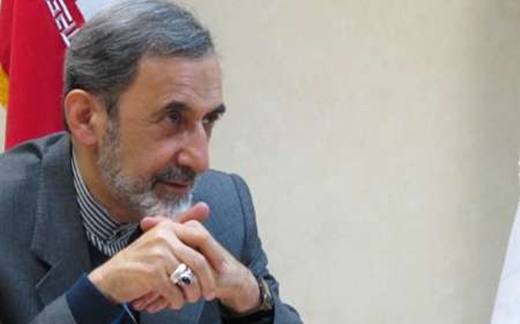
This is part of remarks made by Hossein Shariatmadari, the editor-in-chief of Kayhan, a principlist daily, in a conference on the opportunities and challenges of the Islamic Revolution in Sari on Thursday.

Without doubt, conclusion of a nuclear deal is a zero possibility, Shariatmadari said, citing what the US seeks to get out of nuclear talks [regime change]. The following is the translation of excerpts of his remarks in the conference and the answers he gave in response to the questions of some participants:

[…]

The Americans know that none of their dreams will come true thanks to the Supreme Leader’s tactfulness, even if they got the [Iranian] negotiating team to make promises and imposed some commitments on them through deceitfulness and gamesmanship.

A question arises here as to why the US is insisting on its demands? If we admit that the United States has problem with the existence of an Islamic Iran, we will not look for an answer in the [nuclear] agreement; rather, we can clearly see traces of a regime change project.

[…]

Military option is just a big and hollow bluff to intimidate us. Today this region has turned into a window of the back-to-back defeats of the US and its allies in Afghanistan, Iraq, Palestine, Lebanon, Syria, Yemen, etc.

[…]

God forbidden, if we gave in to what has been mentioned in the Lausanne agreement, that would set the stage for the US to take military action [against Iran]; in other words, it is exactly against the views of those who say the agreement would help prevent a military attack.

[…]