Monday, December 29, 2025
Home Blog Page 4835

Trees are sacred to Iranians

Trees in Iran

Trees were regarded as holy in ancient Iran. They have been also respected in Islam. But the way they are treated today shows no trace of sanctity or respect whatsoever.

Etemad newspaper on Feb. 3 ran an opinion piece by Ali Yachkaschi – a professor of environmental science, environmental activist and author – on the sanctity of trees in ancient Iran and the place of trees in Iranian culture. What appears below is a full translation of the piece:
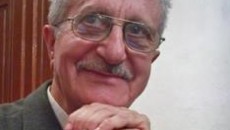
 

Professor_Ali_YachkaschiTress and forests were of immense significance in Iranian mythology which hails trees as good humans who have turned into trees after their death and have been given an eternal life. So cutting huge fruit trees was a practice widely frowned upon.

Ancient Iranians believed that anyone who cuts a tree would lose a loved one in the same year. Unlike what the Food and Agriculture Organization of the United Nations (FAO) claims, designation of a tree-planting day dates back to [the Prophet] Zoroaster’s time in a bid to protect and develop green space and forests. Zoroaster himself would plant a sapling on the tree planting day each year.

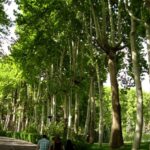
Platanus, cedar and Ziziphus were among the trees which were popular with the Iranians. The huge platanus tree has a wide leafy shade. People used to say that it would help prevent a breakout of fever and infectious diseases.

They held a similar belief about cedars which have had a key role in [ancient] Iran’s literature and art. Today medicine has proved that certain trees help kill microbes by emitting different kinds of essence into air.

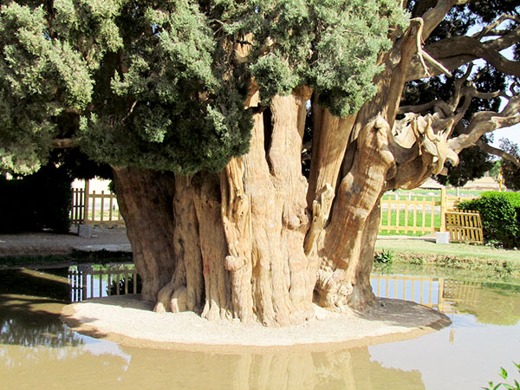
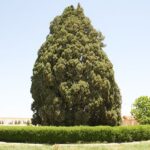
Cedars hold a special place among tree species in Iran. Ancient Iranians always showed respect for them. Cedar was sacred for the Persians who showed high esteem for the tree. They also believed that eating cedar’s pollen, leaves and buds would lead to greater longevity. According to Persian myths, cedar had originated from the paradise, so it was called the Minoo [Paradise] tree.

The spiritual impact of this tree on Iranians was so much that its signs are still evident in all manifestations of the civilization. Islam too attaches vital significance to trees and forests. The Prophet Muhammad (PBUH), for instance, said that breaking a tree branch amounts to cutting an angel’s wing. The Prophet has even stressed – in different hadiths – the spiritual reward associated with planting trees and the scolding that comes with cutting them, or their branches.

Several hundred years Before Christ, Xerxes [of Persia, a king of the Achaemenid Empire] created the world’s first protected area. During a military offensive in which he took his troops to Asia Minor, Xerxes delegated the protection of a cedar forest to a royal guard.

According to reliable historic texts, Iranians made considerable practical efforts to take care of tree planting, forestry and forest management 445 years Before Christ, and drew up codified and legally binding laws in this regard.

Sperber holds that Iranians were the first people who established a forestry organization and paid special attention to sustainable development. “Others planted [trees] and we ate the fruits; we are expected to plant [this time] so that others can eat the fruits” is the meaning of “sustainable development” an Iranian old village man said in response to Anooshiravan [Khosrau] 14 centuries ago.

Von Hagen, a renowned German forester in the 19th century who was inspired by the old village man’s words, writes, “Exploit the forest as much as its trees grow and hand it over to posterity at least the way you got it from those living in the past.”

These comments which have been known as Hagen’s “golden words” mark the start of scientific thinking about sustainable development in Europe and the world. Later laws were passed on the exploitation of natural resources based on economic interests of European countries.

The International Union for Protection of Nature was held for the first time in Bern, Switzerland in 1913, and 35 years later the International Union for Conservation of Nature (IUCN) was formed. It set the stage for the establishment of the first world park.

In 1972, the United Nations Conference on the Human Environment was held in Stockholm, Sweden and designated Dasht-e-Arjan National Park in south-western Iran as an international park where researchers from all over the world could do studies. For the first time the conference took into account the whole universe whose resources should be tapped into based on the principle of sustainable development.

An important question arises here: how come the wide expanses of forests are being destroyed in a country which attaches so much significance to the trees and forests, and treats them as holy things? As a case in point one can make mention of 2 million hectares of forests in northern Iran which were cut down in the first half of the 20th century.

The answer to this question cannot be offered here in this article, but we can in brief point to a change of attitude and consumption patterns in modern times, something which has resulted in irregular exploitation of natural resources, among them forests.

I hope I can elaborate on this topic in another piece and provide an answer to this vital question.
 

Tehran’s environmental issues are serious but solvable: Mayor

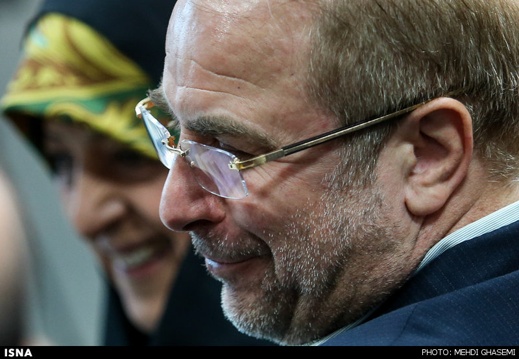
Mohammad Bagher Ghalibaf

“Today, we have major problems on the environmental front. Rather than saying that the lives of citizens are on the line, we must say that environmental hazards are claiming lives. In cooperation with the government and the private sector, the municipality can within four years turn all garbage produced in Tehran into clean energy,” the Iranian Students News Agency quoted Tehran Mayor Mohammad Bagher Ghalibaf as telling the opening ceremony of a first trash incineration power plant in Iran. The following is a partial translation of a report on his speech at the event:

In comments aimed at Director of the Environment Protection Organization Masoumeh Ebtekar, Ghalibaf said, “You might say that we have budget and legal constraints, yet in my opinion, such problems are basic. We have failed to tap into our monetary and legal potential.”

He further said, “Let’s accept the fact that our grave problem is managerial in nature, because everyone wants to embark on a new cycle and set aside what others have done. We must accept that the danger is truly serious.”

Touching on the crippling problem of air pollution emanating from a recent dust storm in Dezful and Ahvaz, in Khuzestan Province, Ghalibaf added, “It might be said the dust storm has external roots and not much can be done to address it. What has been done for the cities of Tabriz, Isfahan and Tehran whose pollution has roots in internal and industrial problems which can be brought under control?”

Underlining that to improve environmental conditions, measures which do not need any money or additional rules can be taken, the mayor said, “Such measures require willpower which is missing, because it looks as if the lives of people are not important to some. These measures are not something which the municipality, the government or the public can undertake on their own; rather every single individual should feel duty-bound to pull their weight.”

Saying that mobile sources [motor vehicles, marine vessels and aircraft] account for 70 percent of air pollution, he added, “When we can swiftly bring things under control, but we do not bother, how will we answer to God later [for evading our responsibility]? We might hold interviews and gloss over things, but how would we answer to God on Judgment Day?”

The mayor added, “As a person who serves the public in the City Hall, I feel obliged to assume responsibility. I stand ready to turn Tehran into a truly habitable place if I am offered support and if faultfinding attempts are set aside.”

He further said, “Production of garbage is a serious issue our city is dealing with. We do not want to tell residents to consume less, rather we want them to avoid wastefulness because such practices are an unforgivable sin from the perspective of our religion. Besides, on the economic front, potential will go down the drain.”

Highlighting that environmental standards have been observed in the establishment of the trash incineration plant, Ghalibaf stated, “We can set up such power plants across the city. There are over 20 incineration power facilities across Tokyo. We can copy that here in Tehran.”

Describing sloganeering as unnecessary in dealing with environmental issues, the Tehran mayor said, “Blue sky and clean earth is not a slogan; in fact they can come true as a result of enormous measures by the municipality.”

Stressing that today’s major environmental issues have put lives from unborn babies to the elderly on the line, Ghalibaf added, “If those in authority at the national level feel that construction in Tehran poses a threat to the public, Tehran Municipality is poised to stop issuing construction permits to industrial, residential and commercial applicants.”

Underlining that Aradkooh trash incineration facility and the waste digestion power plant can only treat 1/20 of garbage produced in the capital, he went on to say, “We do not want to adopt a destructive approach to this matter. It has been more than half a century since we started using Kahrizak, a suburb of Tehran, as landfill. Now those who were in charge in the past must now answer what has been done in the past 50 years to prevent the contamination of water, soil and air? Presently, we do not dump hazardous waste in this area and we have adopted the technology of incineration to treat trash.”

The Tehran Mayor concluded, “We must try to encourage the private sector to fully finance trash incineration facilities.”

The report above was originally published under the headline “Environmental problems claim lives: Ghalibaf”.

Iran’s car sales up 32%

iran-Car-Saipa

Iran’s auto production and sales rose 32 percent in 2014 from the year before as the industry started emerging from sanctions, an official has said.

As many as 1.1 million units were sold in the current Iranian year which ends on March 21, 2015, head of the commerce and sales office of Saipa Co. Mohammad Reza Abbasi said. Iran sold 737,000 cars in 2013 as the industry suffered under sanctions.

Sales however picked up after the Europeans lifted the sanctions on the Iranian auto industry under a temporary nuclear agreement reached in November 2013.

Abbasi said that Saipa saw both production and sales rise by 32 percent in 2014.

Saipa and Iran Khodro account for 82 percent of the country’s auto market.

Abbasi said that Saipa has currently two plans in the works in order to defeat sanctions and increase sales.

He said the automaker will start producing a low-cost car, Saina, in the first half of the new Iranian year. Saipa will also unveil more than 10 models at the next auto show in the central city of Isfahan.

Iran’s auto industry is the biggest in the Middle East. The country produced 1.6 million vehicles in 2011, the year new sanctions were introduced by the Europeans.

Pieces of Life are there on the table at an art gallery

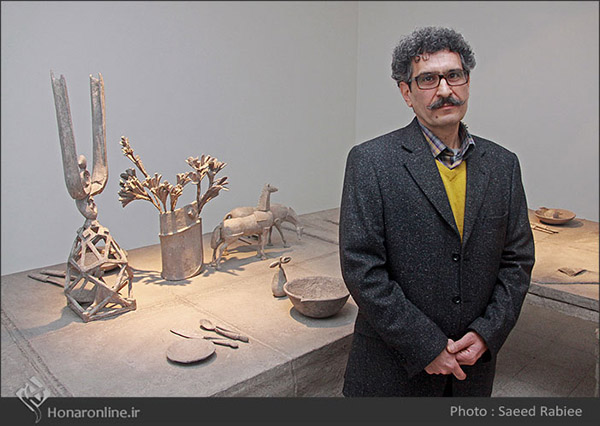
Reza Lavasani

You are taken off guard. This is the very first reaction art lovers show when they visit the final exhibition underway at Assar Art Gallery in Tehran this year [ending March 20, 2015].

On February 3, honaronline.ir, a news agency focusing on the world of art, filed a report on Life, a unique work by Reza Lavasani – a painter and a gifted sculptor – at the Tehran gallery. The following is a partial translation of the report:

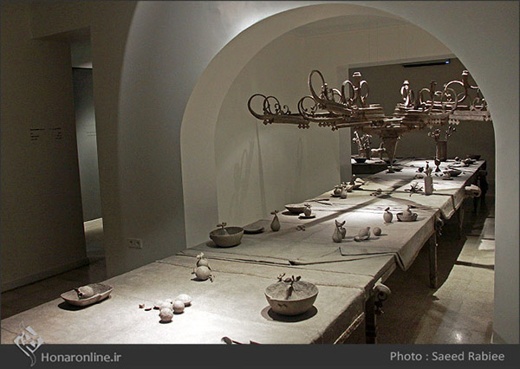
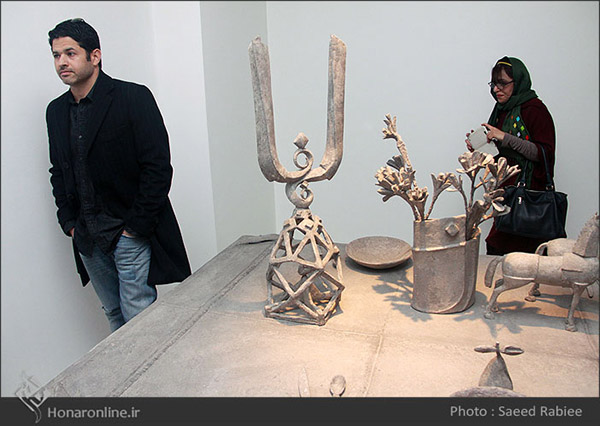
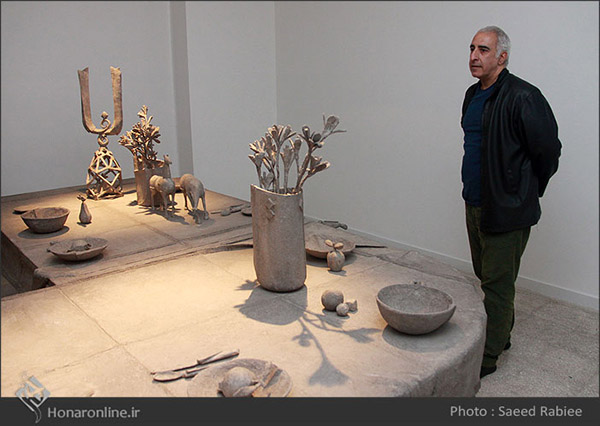
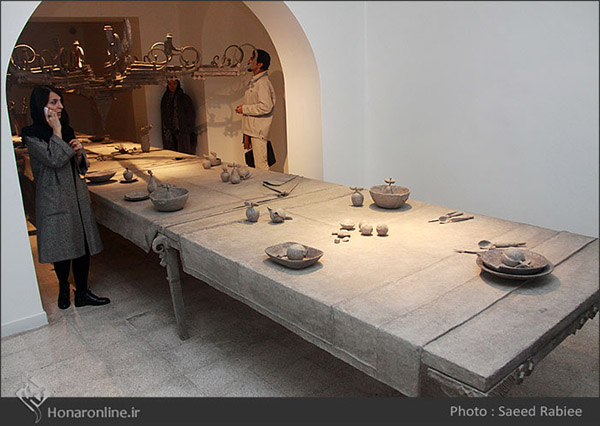
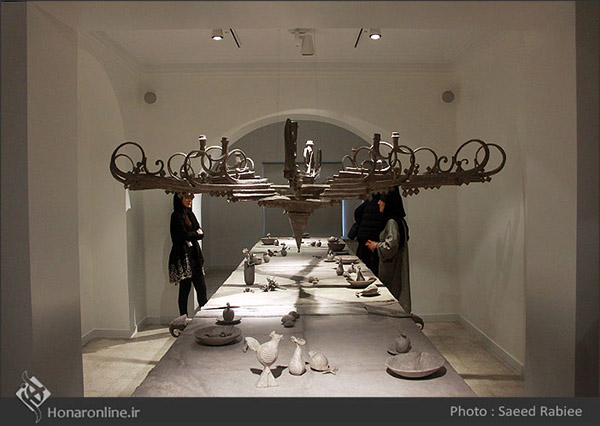
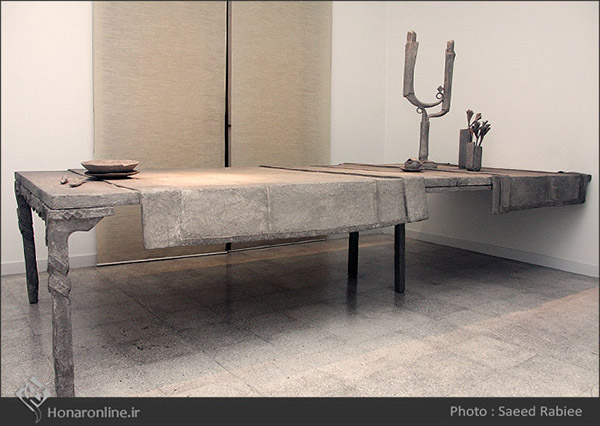
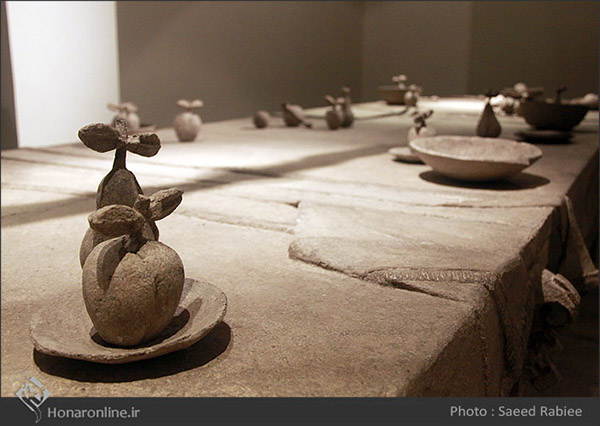
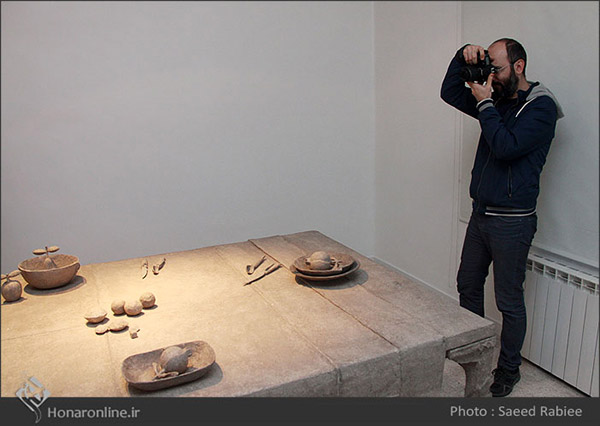
Life, the only work on display at the gallery, is just one piece of conceptual art by Reza Lavasani. Life, which has occupied the whole gallery space, is simply a magnificent large table which narrates life from the artist’s perspective.

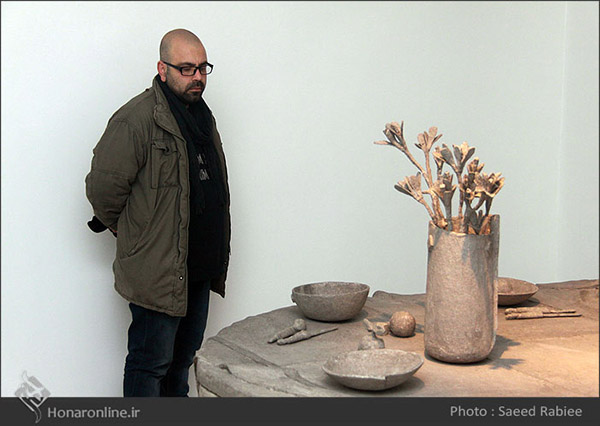
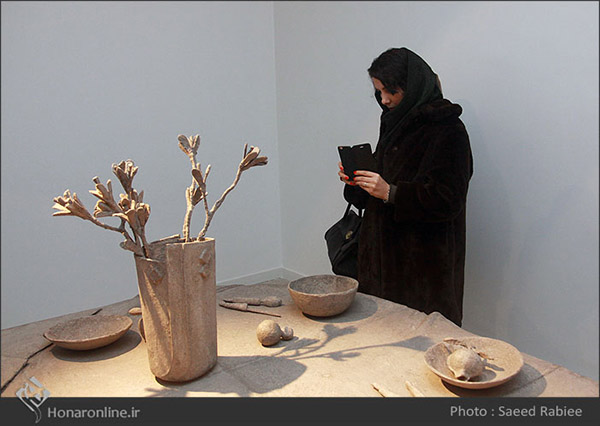
Visitors have to walk around the table and watch the objects and creatures on it to grasp their own interpretation of Life. So it is quite natural that everyone will have their own interpretation of life depending on their experience.

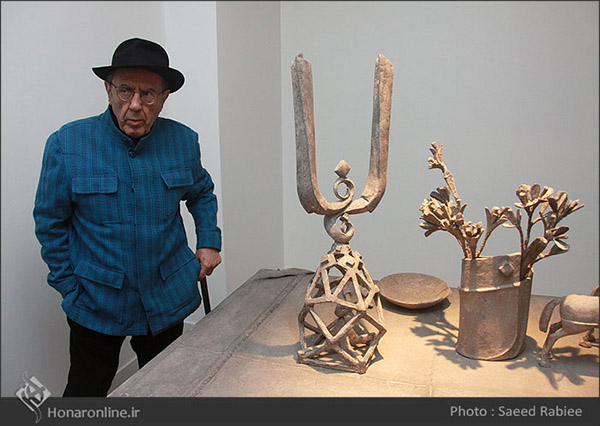
Plates, dishes and spoons as well as statuettes of a horse and a bird, a vase and candlesticks sit on a 17-meter L-shaped table with a huge chandelier hanging overhead. What is amazing is that all pieces of this artistic work have been made of papier-mâché [or paper mache, the French for “chewed paper” which is a composite material consisting of paper pieces or pulp, sometimes reinforced with textiles, bound with an adhesive, such as glue, starch, or wallpaper paste].

As for the papier-mâché installations, Maryam Majd, who is the Assar Art Gallery’s curator, said that it is a museum work and the Assar Gallery is to put it on display in different museums around the world.

She further said that Reza Lavasani, who has won the first prize of [Tehran’s] 4th Biennial of Sculpture [and 6th Biennial of Illustration], has an artistic style of his own.

She went on to say that Life has not been created instantaneously; rather, it is the result of a special look at the universe. That’s why it took Lavasani three years to create Life.

Majd said that Life is a selection of Reza Lavasani’s life from the past to the present, saying it does not end at this point and his take on life goes on.

“Looking at Life, we first see glory and grandeur, but a closer look reveals the ups and downs that lie ahead [for everyone] in life. We see tablecloths which have been crumpled, and finally we see a life which has been minimalized; it has become simplified. Technically, everything in Life is patchy – in other words, it is in pieces, like the life itself which exists in a piece and the other pieces are added to it.

[…]

WTO stresses support for Iran’s tourism industry

WTO

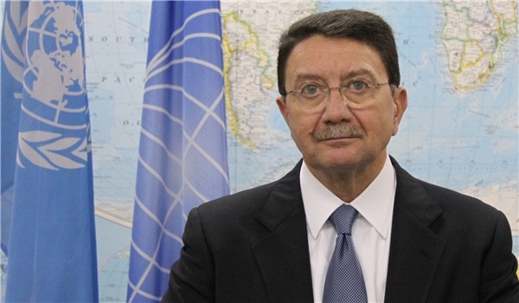
Secretary-General of the World Tourism Organization Taleb D. Rifai has underlined that the WTO is resolved to develop the tourism industry in Iran.

Rifai, who is in Iran to attend the 8th International Tourism Exhibition in Tehran, made the remarks during a tour of the exhibition.
“My presence in Iran means that the WTO is planning to help with promotion of tourism industry in Iran,” Rifai said on Thursday.

He reiterated that the World Tourism Organization is resolved to help Iran with its tourism industry.

Tourism companies from South Korea, Turkey, India, Switzerland, Venezuela, Armenia, Thailand, China, Vietnam, Tunisia and Malaysia are participating in the 8th International Tourism Exhibition in Tehran.

In January, Iranian Vice-President and ICHHTO Chief Massoud Soltanifar reiterated that the number of foreign tourists visiting Iran in recent months has considerably increased as they see the country as a safe destination despite the Western propaganda.

“Despite smear campaign (by Western countries), foreign tourists see Iran as a hospitable, clam and safe country,” Soltanifar said.

“I believe that our country has very high potential for attracting foreign tourists,” the ICHHTO chief added.

He noted that Iran is among the world’s top 10 attractive tourist resorts.

Soltanifar noted that 4.8 million tourists visited Iran last year, and said, “Half of the foreign tourists visited the country’s holy cities of Mashhad and Qom in the period.”

He said that during the first half of the current Iranian year (March 21-September 22), the number of foreign tourists showed a 200 percent rise compared to the corresponding research in Australia.

He said that 90 percent of the foreign tourists come to visit Iran for its natural, historical and religious sites, and said, “Only 10 percent of foreign tourists come to Iran to attend conferences.”

Soltanifar said Iran has over one million historical and natural sites, adding that only 31,100 or nearly three percent of them have been registered.

In August, the ICHHTO chief said that the foreign tourists brought around $5.5 billion of revenues to the country despite all sanctions and limitations.

In March, Soltanifar invited foreigners to visit Iran’s various tourist destinations, and stressed that the country enjoys a high level of security for foreign tourists.

A look at Iranian newspaper front pages on Feb. 14

Iranian Newspapers Headlines

Air pollution in the southwest and government efforts to settle the problem dominated the front pages of Iranian newspapers on Saturday. At attack on a Shiite mosque in Pakistan along with the silence of some Western media outlets over the killings of three Muslims in Chapel Hill, North Carolina also appeared on the covers of dailies.


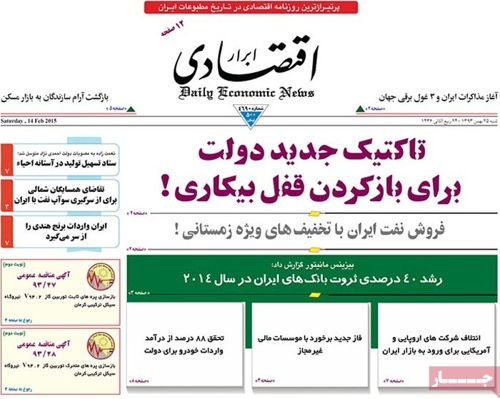
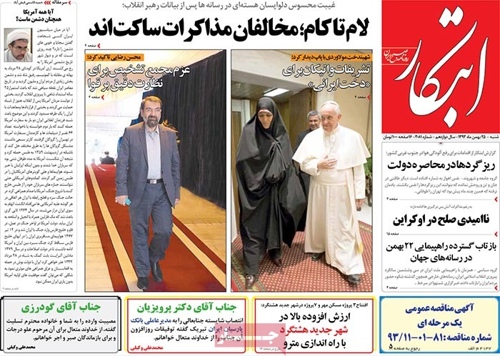
Abrar-e Eghtesadi: Iran opens talks with three world electricity giants.

Abrar-e Eghtesadi: European and US firms are forming coalitions to find their way back onto the Iranian market.


Abrare eghtesadi newspaper 2 - 14 - 2015


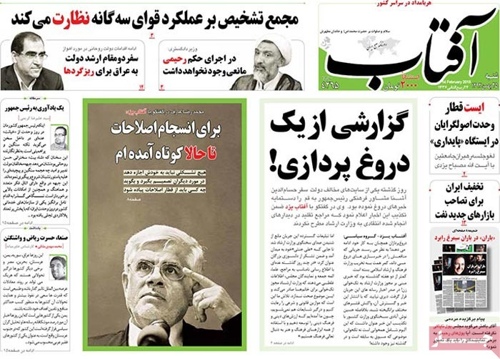
Aftab-e Yazd: Two senior government officials are to visit Iraq to follow up on efforts to tackle the problem of particulates.

The visits are part of broader efforts by the Rouhani administration to settle the air-related problems of Ahvaz, the provincial capital of Khuzestan. A dust storm in the city of late has reduced the quality of air there.

Aftab-e Yazd: Iran offers discount to secure new oil markets.


Aftabe yazd newspaper 2 - 14 - 2015


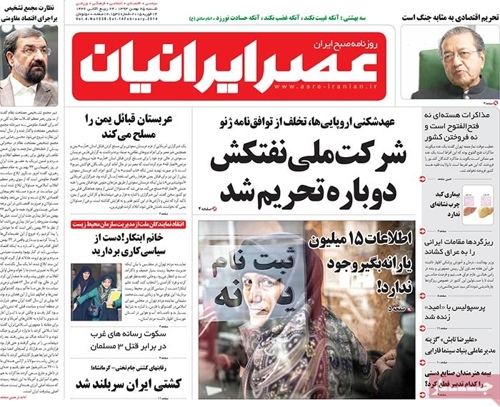
Asr-e Iranian: Western media have kept silent on the murder of three Muslims in the US.


Asre iranian newspaper 2 - 14 - 2015


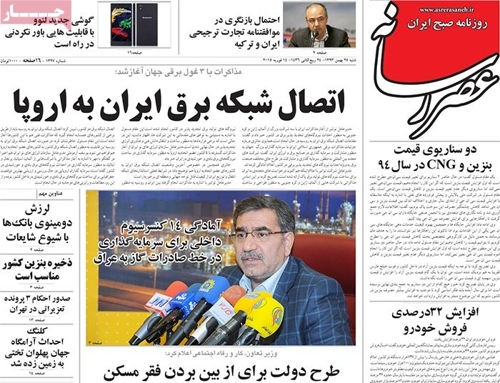
Asr-e Rasaneh: The preferential trade deal between Iran and Turkey might be reviewed.

Asr-e Rasaneh: Car sales in Iran have registered a 32 percent hike.

Asr-e Rasaneh: Fourteen local consortiums stand ready to invest in a gas pipeline project to export natural gas to Iraq.


Asre resaneh newspaper 2 - 14 - 2015


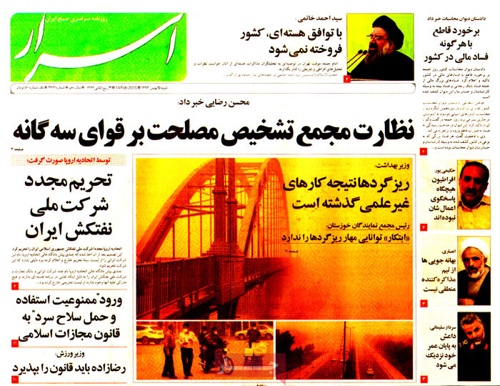
Asrar: “Faultfinding with the nuclear negotiating team is not logical,” said vice-president for parliamentary affairs.

Asrar: The European Union has imposed new sanctions on the National Iranian Tanker Company.


Asrar newspaper 2 - 14 - 2015


Ebtekar: “The Expediency Council is determined to supervise the workings of all three branches,” said the secretary of the council.

Ebtekar: Opponents of a nuclear deal are tight-lipped.

Following the recent comments of the Supreme Leader in which he supported a nuclear deal, the so-called Worriers [supporters of former President Mahmoud Ahmadinejad who are bitterly opposed to President Rouhani] are conspicuously absent in the media.


Ebtekar newspaper 2 - 14 - 2015


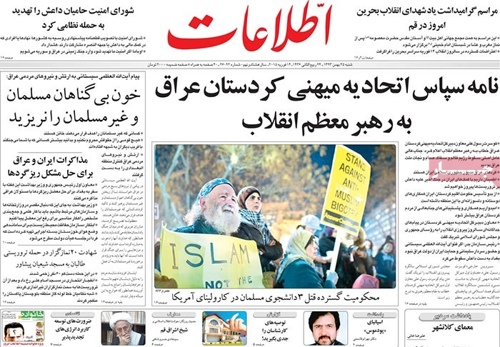
Ettela’at: Don’t shed the blood of innocent Muslims and non-Muslims.

In a message to the Iraqi army and popular forces fighting IS terrorists, Grand Ayatollah Sistani said those who specifically target non-Muslims are traitors.

Ettela’at: Iraq’s Patriotic Union of Kurdistan has sent a letter of appreciation to the Supreme Leader.

In the letter, the deputy secretary general of the union has said Iraqi Kurds owe a debt of gratitude to the Iranians.


Ettelaat newspaper 2 - 14 - 2015


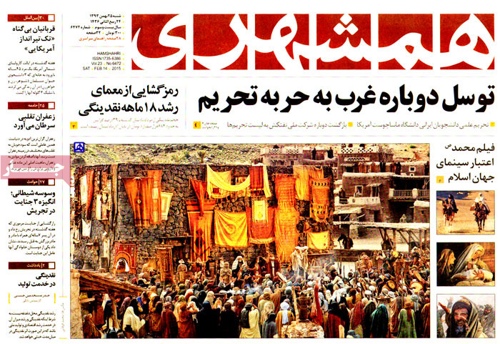
Hamshahri: The West has once again resorted to sanctions.

Iranian students in Massachusetts were subjected to scientific sanctions, as the European Union placed the National Iranian Tanker Company on its sanctions list.


Hamshahri newspaper 2 - 14 - 2015


Hemayat: “A two-phase deal is a Western ploy to push excessive demands,” said the deputy judiciary chief.


Hemayat newspaper 2 - 14 - 2015


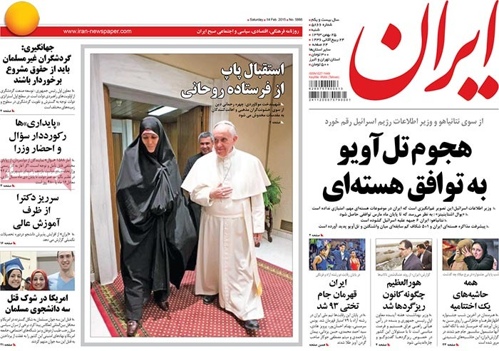
Iran: “The legitimate rights of non-Muslim tourists should be respected,” said the first vice-president.


Iran newspaper 2 - 14 - 2015


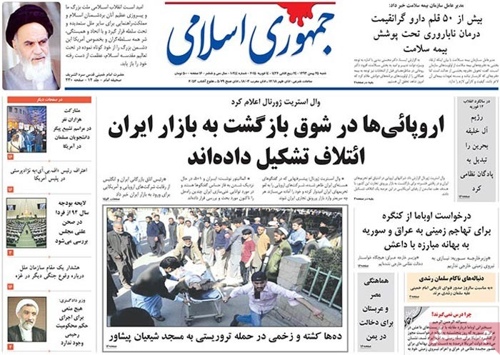
Jomhouri Islami: An attack on a Shiite mosque in Peshawar has left scores of worshippers dead or injured.

Jomhouri Islami: “There are no hurdles in the way of implementing the sentence of the former VP,” said the justice minister.


Jomhorie eslami newspaper 2 - 14 - 2015


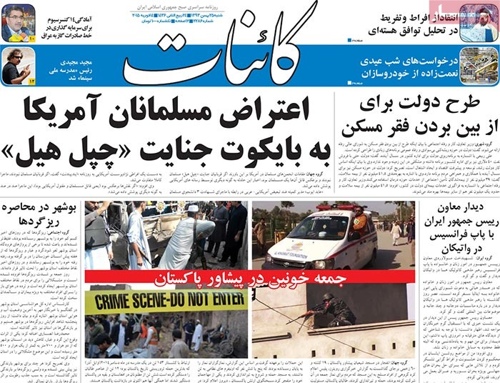
Kaenat: The Iranian vice-president has met with Pope Francis.

Kaenat: Renowned director Majid Majidi has been named administrator of National Cinema School.


Kaaenat newspaper 2 - 14 - 2015


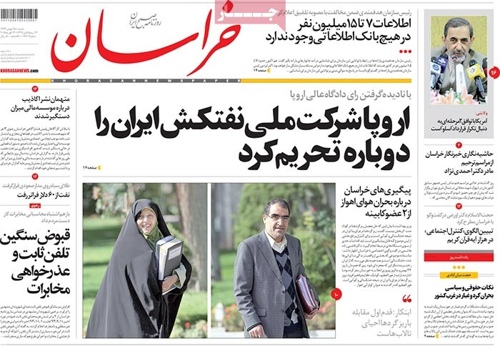
Khorasan: “By seeking a two-phase deal, the US seeks a repeat of the Oslo Accords,” said an advisor to the Supreme Leader.


Khorasan newspaper 2 - 14 - 2015


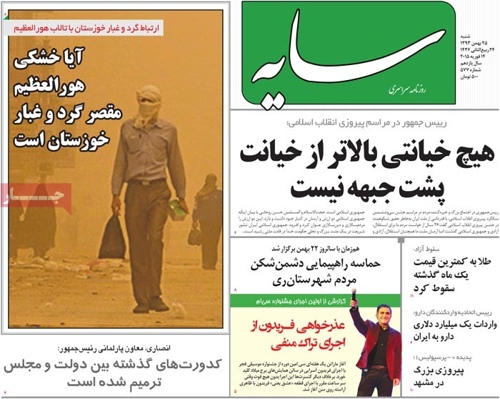
Sayeh: “The previous problems between parliament and government have been settled,” said the vice-president for parliamentary affairs.


Sayeh newspaper 2 - 14 - 2015


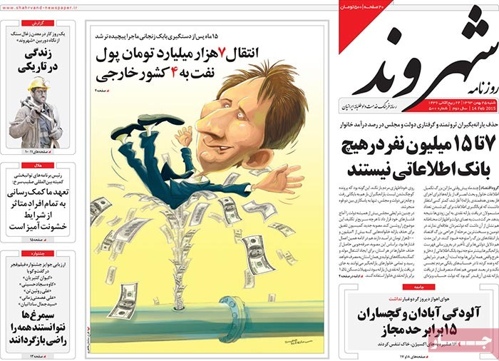
Shahrvand: Transfer of some $2.3 billion in oil money to four foreign countries

Fifteen months after the arrest of Babak Zanjani [who stands accused of massive corruption] his case has gotten more complicated with revelations that he has transferred oil money to foreign countries.

Shahrvand: The names of 7-15 million Iranians appear in no databanks.

This complicates efforts to eliminate high-income individuals from the list of people eligible for cash subsidies.


Shahrvand newspaper 2 - 14 - 2015


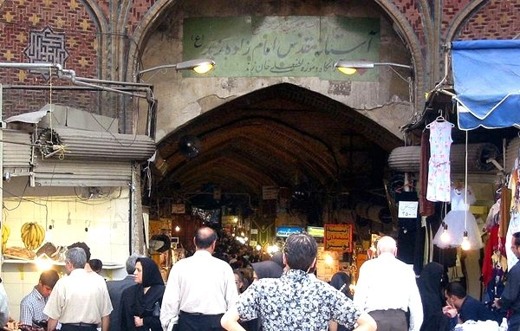
When the going gets soft, people go shopping

Nowrooz-Bazar

The New Year is approaching in Iran, and the annual yearend bonuses of white- and blue-collar workers are only days or weeks away. This has caused a lot of commotion in the capital where people are on the move to get prepared for the turn of the year.

On February 7, Mehr News Agency filed a report on market conditions and shopping destinations in the run-up to the New Year, saying that the shopping boom time is indicative that Iran is climbing out of recession. The following is a free translation of the report:
 

People are making planning to compile their shopping list and shopping malls are teeming with frenzied shoppers these days.

Some prefer early shopping to avoid the last-minute hustle and bustle of trade centers as well as the problems associated with late shopping.

Storekeepers hold winter sales or offer cut-rate items not to keep much inventory. They say their items suit every pocket, but people’s take is somewhat different. Sellers are happy that people have lost an appetite for foreign products thanks to the quality items Iranian producers have put on the market.

Those with limited budgets go after off-season shopping. Some buyers say they’ve seen no rise in prices over the past two months thanks to stable foreign exchange rates, although they admit that the prices of clothing have doubled in twelve months.

People’s rush to the market in the final days of the year and booming business are proof that Iran’s economy is climbing out of recession.
14 consortia ready to finance Iran-Iraq gas pipeline: Official

Iran-Gas-Iraq

A top Iranian energy official says a total of 14 domestic consortia have voiced readiness to finance the construction of a pipeline that will transport natural gas from Iran to its western neighbor, Iraq.

The groups of companies have already received the necessary documents related to investment in the project, and should offer their qualifications by the set deadline, Hamid Reza Araghi, an Iranian deputy oil minister and managing director of the National Iranian Gas Company (NIGC), said on Friday.

He added that the company qualifications will be later reviewed by NIGC, and companies capable of financing up to USD 1.5 billion will be declared eligible.

Araghi further noted that a total of USD 500 million is needed in order to start the project, adding that any interested party holding such a capital will be able to initiate the work and fulfill their obligations within the next two years.

The Iranian energy official pointed out that the investment will be gradually recouped once Iran starts pumping natural gas to Iraq, and upgrades the delivery.

Based on agreements signed between Tehran and Baghdad, seven million cubic meters (mcm) per day of Iran’s natural gas will be delivered to Iraq in the first phase, but the pipeline will finally carry 25 mcm of gas per day to Iraq.

According to NIGC managing director, the infrastructure needed for pumping Iran’s natural gas to Iraq will be ready by late April.

The 270-kilometer pipeline stretches from the village of Charmaleh, located in Iran’s western province of Kermanshah, into the town of Naft Shahr on the border with Iraq.

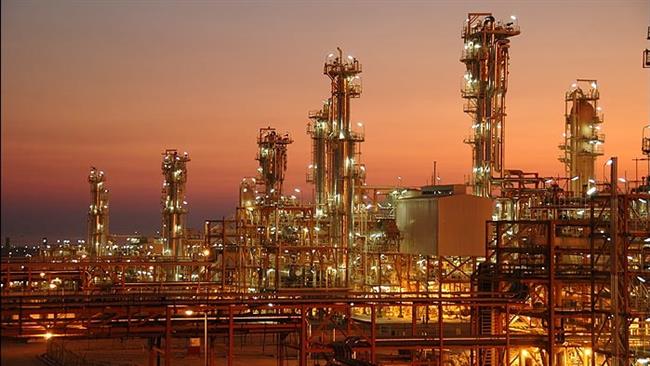
The pipeline, which is estimated to earn Iran $3.7 billion a year in revenues, will be fed by the massive offshore South Pars gas field in southern Iran.
The South Pars gas field is located in the Persian Gulf on the common border between Iran and Qatar. The field is estimated to contain about 14 trillion cubic meters of gas and 18 billion barrels of condensate.
A well that is doing well in attracting tourists (Photos)

Varzaneh

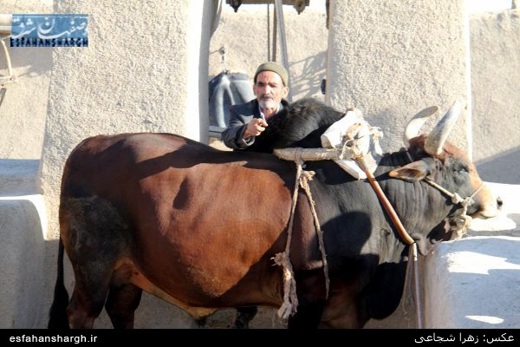
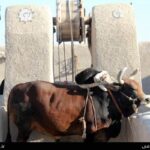
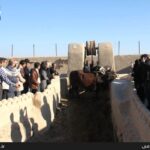
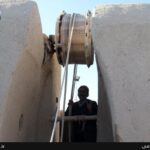
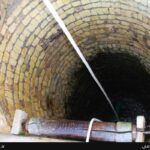
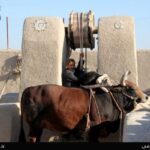
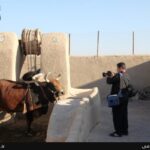
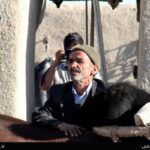
A 60-year-old man in Varzaneh, east of Isfahan – known for its traditional architecture and indigenous traditions – has renovated an ox-well complex (‘Gav Chah’ in Farsi), turning it into a tourist attraction.

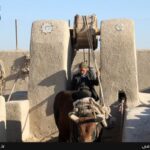
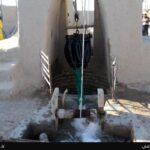
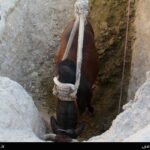
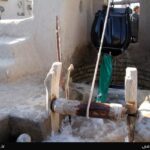
The complex which features a well, an ox, some rope, a pulley and a bucket pumps water to nearby farmland, without producing air pollution.

Esfahanshargh.ir has filed a report on what Haj-Ibrahim has done to irrigate agricultural land which has also been a pull for tourists. What appears below is a brief translation of the report followed by a collection of photos of the process:

Haj-Ibrahim, who has restored an ox-well complex, says, “We can irrigate some 3,000 square meters of land twice a day through this traditional method which does not need electricity.”

An ox moves on a corridor with a slight slope, called Gav Chah, to take the water-filled bucket from the well. What is astonishing is that Haj-Ibrahim’s ox works only when his owner sings a song.

After restoration, the complex has managed – in a short period of time – to attract visitors who come to the historic city to see the place and its traditional irrigation method firsthand.

The urban structure in Varzaneh conforms to the Iranian architecture and people living there are known for their adherence to local traditions.


A new type of embryonic stem cells has been discovered in Iran

stem cells

On February 10, the Iranian Students News Agency (ISNA) quoted Head of Yazd Reproductive Sciences Institute Abbas Aflatoonian as saying, “Scientists at R&D of the Stem Cell Biology Department have discovered a new type of embryonic stem cells.” What comes next is the translation of what else the researcher said:

Two types of stem cells we chose to call Yazd 1 and Yazd 2 were already discovered a while ago, Aflatoonian said, adding “Embryonic stem cells are derived from a human fetus during blastocyst. These cells have the ability to turn into other cell types, that’s why they are called pluripotent stem cells; they are of tremendous importance because of their potency.”

He expressed hope that the recently discovered stem cells, Yazd1, Yazd 2, Yazd 3, will set the stage for fundamental studies in different fields such as cell therapy, pharmacology, toxicology, developmental biology and tissue engineering.

With the endeavors of some experts at Shahid Sadoughi University of Medical Sciences and following the launch of a research project aimed at studying the success of In Vitro Fertilization (IVF) in infertile couples, Yazd Reproductive Sciences Institute was established in October 1988.

The center was initially designed to develop the technology needed to address infertility in the country, help develop this science in the province and the country, and treat infertile couples who had to travel to Europe to get medical treatment. At present, some 9,000 couples refer to the center on the yearly basis to have their infertility problem solved.

Among the therapeutic achievements of the center are first Iranian IVF baby in 1990, first Iranian Intrauterine Insemination (IUI) baby using Electroejaculation in 1992, first Iranian baby using egg donation in 1994,first Iranian Intra-Cytoplasmic Sperm Injection (ICSI) baby in 1995, first Iranian baby using Percutaneous Epididymal Sperm Aspiration (PESA) and microinjection in 1996, first Iranian baby using Testicular Sperm Extraction (TESE) and microinjection in 1997, first Iranian baby using  Assisted Zona Hatching (AZH) in 1997, first Iranian baby using frozen embryo in 1997, first Iranian baby using Testicular Round Spermatid and microinjection in 1998 and first Iranian baby using In Vitro Maturation (IVM).