Friday, January 2, 2026
Home Blog Page 4806

World countries vying for Iran market: Spokesman

nobakht

The Iranian government spokesman said Iran’s conditions to choose its trade partners are today very different from the past since world countries are in a rush to Tehran to win economic opportunities.

Speaking to reporters in Tehran on Tuesday, Mohammad Bagher Nobakht said Iran has many options to choose its trade partners.

“In the post-sanctions period, we are not forced to deal with only a handful of countries,” he said, adding that many things have changed compared to the past when companies and countries treated Iran from the position of exclusivity.

“The countries that had been calling for implementing tougher sanctions on Iran are today overtaking each other in a rush to Tehran in search for business opportunities. But they should realize that Iran will pursue its own interests.”

“We never get overexcited about the arrival of any trade delegation,” Nobakht underscored.

In similar remarks earlier on Sunday, President Rouhani had highlighted the country’s policy to seek win-win economic interaction with the world once the anti-Iran sanctions are lifted, adding that Tehran would not allow excessive imports of foreign products.

After the successful conclusion of nuclear talks with world powers, Iran is now ready for a win-win interaction with global economy, Rouhani said in the western province of Kurdistan Sunday.

“We are not going to open our doors to imports, but we are looking for investments and new technologies, and an increase in our exports,” the Iranian president said.

After Iran and six world powers reached a deal over Tehran’s nuclear energy program on July 14, many foreign companies from around the world have announced their readiness to enter the Iranian market.

Experts say the comprehensive nuclear deal and subsequent termination of anti-Iran sanctions would result in a hike in Iran’s trade with the world and boost foreign investment in the country.

Iran condemns attacks of Israeli settlers on al-Aqsa Mosque

Foreign ministery

Marzieh Afkham said that such moves are directly supported and guided by Tel Aviv regime.

She said that invasion against al-Aqsa Mosque displayed aggressive nature of the Zionist regime in violating human rights of the Palestinians.

The spokesperson called for support of different countries, especially Islamic states, international and regional organizations to stop desecration of the Islamic sanctities and violation of human rights of the Palestinians.

Araghchi clarifies “reversibility” of JCPOA commitments for Iran

araghchi10

Iran’s Deputy Foreign Minister Abbas Araghchi said the country will be able to “immediately” reverse its commitments under a final nuclear deal with world powers if it finds out that the other side has breached commitments under the Joint Comprehensive Plan of Actions (JCPOA).

Iran and P5+1 on July 14 finalized the text of a lasting agreement on Tehran’s nuclear program.

Dubbed JCPOA, the 159-page document has subjected Iran and the six other countries to comply with a series of commitments, resulting in the termination of sanctions on Iran in exchange for certain restrictions on Tehran’s nuclear program during a defined period of time.

Afterward, the 15-memebr United Nations Security Council passed a resolution that endorsed JCPOA.

According to the UNSC Resolution 2231, all previous UNSC sanctions imposed on Iran over its nuclear program will be terminated when JCPOA takes effect.

The new resolution has also devised a reversibility mechanism in condition that a party complains about a “significant non-performance of commitments under JCPOA”.

The resolution stipulates that once the UNSC receives a notification by a JCPOA participant state about a significant non-performance of commitments, it will have 30 days to vote on a draft resolution to “continue in effect the terminations” of the previous anti-Iran resolutions.

It also notes that if the UNSC does not adopt a resolution to continue in effect the termination of the past anti-Iran sanctions, all of the previous anti-Iran resolutions will be reinstated in the same manner as before.

The so-called “snapback” plan has caused concern for some Iranian critics. They say that even if Iran makes a complaint about breach of the JCPOA commitments by the other parties, again the UNSC will have the authority to adopt a resolution for keeping the Resolution 2231 in place. Otherwise, the previous anti-Iran resolutions will be automatically reinstated.

In response, Araghchi, who was also a senior negotiator in the nuclear talks, told the Tasnim News Agency that JCPOA and the UNSC Resolution 2231 should be taken into account together.

“The talk of reversibility begins from the agreement (JCPOA) and it includes a 60-day process,” he said.

Araghchi explained that in case a party cites any breach of the deal, “the issue should be put forward firstly in a joint commission, then in a meeting of foreign ministers of Iran and P5+1, and then in a three-member consultative council,” before the UNSC resolution could be considered.

“It is natural that if the complainant is Iran, the country will no more wait for the (UN) Security Council’s decisions if the issue will be referred to the Security Council after those stages, because the Security Council’s decisions will relate to its own members,” he explained.

Whenever Iran feels the other side has not honored its commitments, the “reversibility” of Tehran’s nuclear program will happen immediately, he said.

“While such reversibility for them requires the case to be sent to the Security Council and going through those processes, for us, it could happen immediately and after 30 days,” Araghchi pointed out.

Talks of Iran-US regional cooperation “premature”: Iran’s official

ravanchi1

Iran’s Deputy Foreign Minister Majid Takht Ravanchi has stressed that counter-terrorism is one possible area for future cooperation between Tehran and Washington, but it is too soon to talk about such a matter.

Takht Ravanchi, who is responsible for European and American Affairs in the foreign ministry, helped to negotiate a comprehensive nuclear agreement between Iran and 5+1 (Russia, China, US, Britain, France, and Germany) announced in Vienna on July 14. In the aftermath of that accord – which he called a “new baby” – he laid out Iran’s view of relations with Washington.

Iran and the US will have “opportunities” for greater cooperation in tackling terrorism if the nuclear agreement is implemented successfully, Takht Ravanchi said in a Tuesday interview with The Telegraph in Tehran.

He stressed that it is “premature” to go into detail, but the struggle against terrorism was one possible area for future cooperation.

“For the future, it is premature to see whether there will be possibilities for Iran and the United States to work together on regional issues. First we have to see how this new baby, if I can say, can be brought up,” he said.

“If everything goes well in the implementation of the agreement, I think there will be opportunities. I cannot say now to what extent Iran can cooperate with the West.”

For now, Takht Ravanchi said the priority was to ensure the nuclear deal was “nurtured, protected, and supported.”

“Suppose that this matter is being implemented properly and over time the necessary confidence is built, there are opportunities – and first and foremost is over how to deal with this problem of terrorism and extremism,” he added.

Takht Ravanchi further said, “This is an issue which is not confined to a specific region, which is not related to only one country. So these are the opportunities that can be discussed, can be elaborated, between Iran and others in the future.”

As for the timing of any future cooperation with the US, Takht Ravanchi stressed how the progress of the nuclear agreement, officially known as the Joint Comprehensive Plan of Action (JCPOA), would be the decisive factor.

“It seems to us that we need four to five months before this JCPOA begins to be implemented. So we are talking about somewhere around six months to one year – and I think it is not really wise to talk about it now,” he said.

Takht Ravanchi stressed how the ISIL (Islamic State in Iraq and the Levant) “menace” transcended national boundaries. “This is an international threat and this needs an international response. We believe that all members of the international community should come together and try to address this problem.”

He also touched upon the recent war rhetoric by various US officials, saying that Iranians understand such remarks were “for domestic consumption”.

“Talking about the use of force is an empty threat and does not solve any problem. But we know they have difficulties back home, they have to address the concerns being raised in the Congress. As far as reaction to those comments in Iran is concerned, I think the Iranian people know these are not something they should really worry about,” he stressed.

“There is a bitter history between Iran and the United States. As I said, this nuclear deal can be the foundation for possible future interaction.”

Takhti Ravanchi’s remarks came as Supreme Leader of the Islamic Revolution Ayatollah Seyyed Ali Khamenei on April 9 made it clear that the talks with the US revolve only around the nuclear issue and nothing else, but at the same time noted that such nuclear negotiations provide an experience to test the possibility of talking on other subjects if Washington puts aside objections.

Takht Ravanchi referred to the opening of Iranian and British embassies, making it clear that both embassies would soon reopen.

“There are a number of issues which need to be resolved, but I think these are not difficult issues,” he said. “We have not discussed officially when that specific date should be, but I don’t think this is going to be a major problem.”

Philip Hammond, the British Foreign Secretary, suggested last week that Britain’s embassy in Tehran could reopen by December. For his part, Takht Ravanchi said, “I think we can do it even earlier, because these issues are not really serious issues.”

British Embassy in Tehran has been closed since 2011 after a group of angry Iranian students stormed the embassy and pulled down that country’s flag following Britain’s decision to impose sanctions on the Central Bank of Iran.

Following the incident, Britain withdrew its diplomatic staff from the country on November 30 and asked Iran’s diplomatic delegation in London to leave within 48 hours.

Iran condemns terrorist attack in Somalia

Afkham

“Extremism will have no other outcome than the death of innocent humans and strengthening of the roots of hatred and violence,” Iran’s Foreign Ministry spokeswoman, Marzieh Afkham, said on Tuesday.

She extended the Islamic Republic’s condolences to the Somali government, nation and the bereaved families of the victims.

At least 15 people, including a Kenyan diplomat , a Chinese embassy guard and two journalists, were killed in a massive truck bomb that went off in front of a hotel in Mogadishu on Sunday.

The five-story luxury hotel, which houses the diplomatic missions of China, Qatar and the United Arab Emirates, is very popular among government officials and foreign visitors. The United Nations and African Union Mission in Somalia (AMISOM) are also based in the hotel.

The al-Qaeda-linked al-Shabab militants, who have attacked the hotel in the past, claimed responsibility for the blast in a statement.

The UN Security Council also condemned the attack “in the strongest terms.”

Somalia has been the scene of deadly clashes between government forces and al-Shabab militants since 2006.

The militants have been pushed out of Mogadishu and other major cities across the African country by government troops as well as AMISOM (African Union Mission to Somalia) forces, largely made up of soldiers from Uganda, Ethiopia, Burundi, Djibouti, Kenya and Sierra Leone.

However, the al-Shabab militants, who have been attempting to oust the central government in Somalia, have continued to launch attacks on Mogadishu despite being driven out from their bases in the seaside city in 2011.


EU’s Mogherini arrives in Tehran

Mogherini

Federica Mogherini, the EU foreign policy chief, arrived in Tehran on Tuesday to meet with senior Iranian officials.

She was welcomed by Iranian Foreign Ministry officials upon her arrival at Mehrabad Airport.

In her one-day stay in Tehran, she will hold talks with senior Iranian officials about the Vienna agreement and the fight against terrorism.

Mogherini is accompanied by her deputy Helga Schmid.

Khavidak Castle in central Iran (PHOTOS)

Khavidak Castle000

Khavidak Castle is one of Iran’s tourist attractions at the heart of desert. The ancient castle has been built with local raw materials based on traditional architectural methods.

In the past, villagers would take shelter in the castle, which dates back to the Sassanid era (224 AD to 651 AD), to protect themselves against attacks by bandits.

Images of the ancient castle released online by Shabestan News Agency:

Iran’s first manned spacecraft unveiled (PHOTOS)

spacecraft0

The first Iranian-built manned spacecraft has been unveiled at the Museum of Science and Technology.

The space capsule was originally scheduled to place an individual in orbit at an altitude of 170 km by March 2016, but the project was put off for three years.

Prior to the manned mission, two dummies and a monkey will be launched into space as part of an experimental project.

The capsule is to take individuals to the International Space Station in the future. Some 150 Iranians have so far signed up as volunteer for the space mission.

Images of the space capsule posted online by Young Journalists Club:


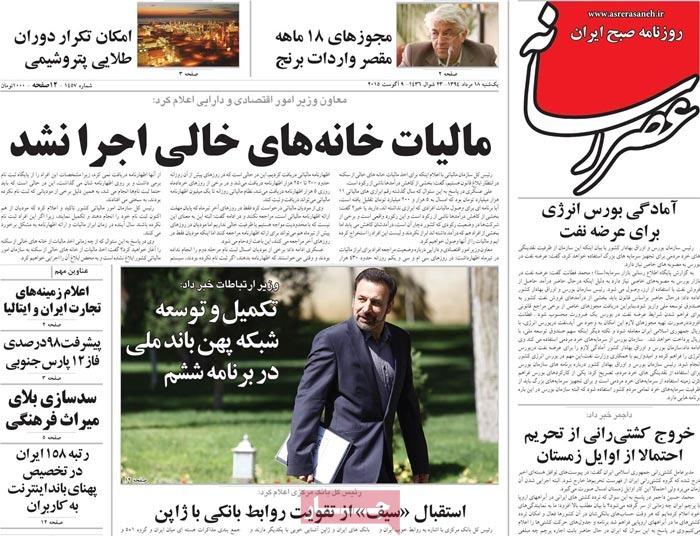
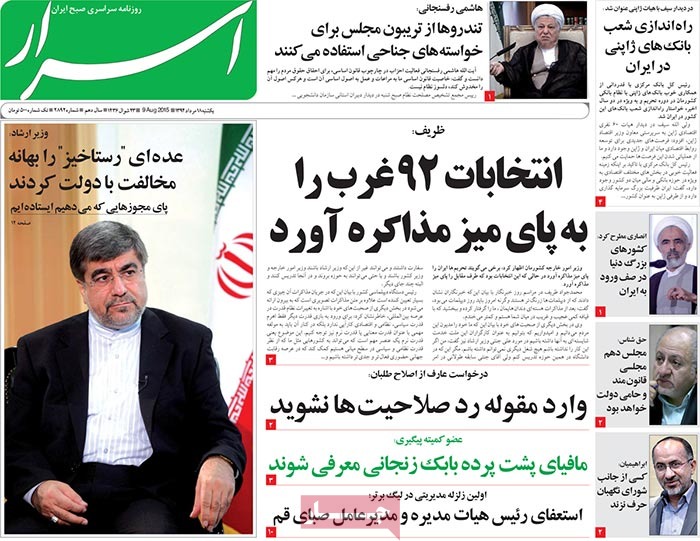
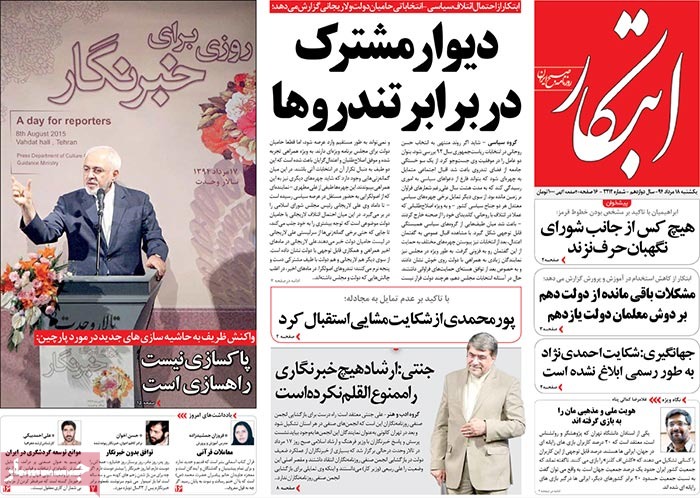
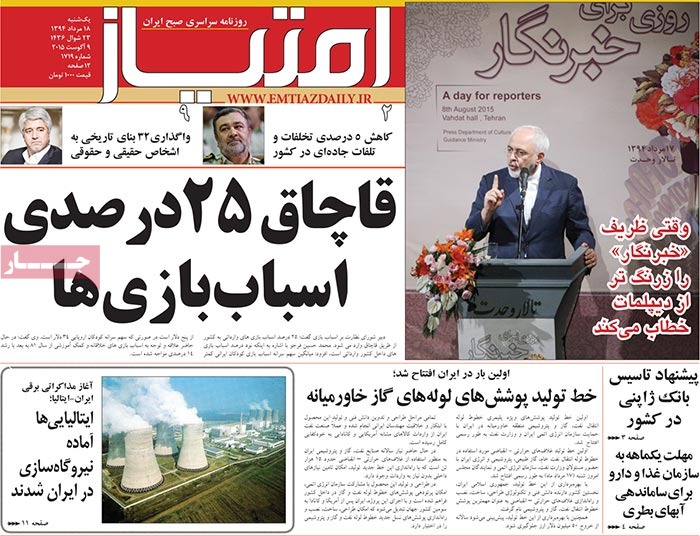
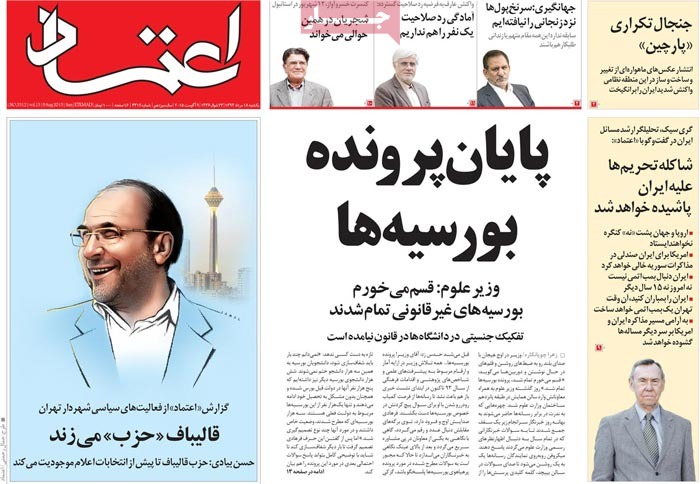
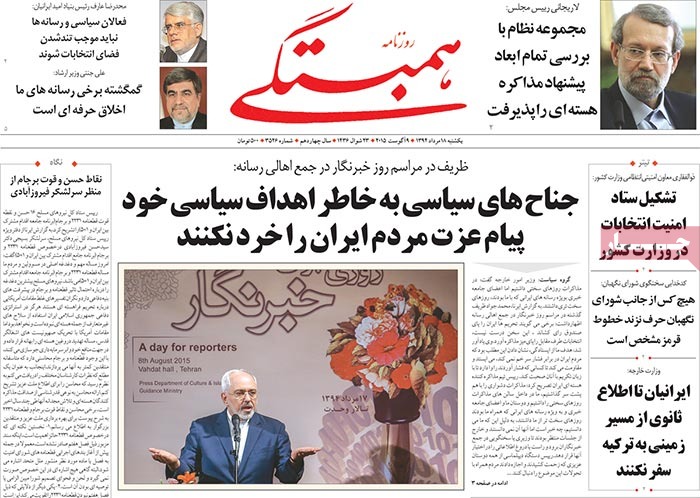
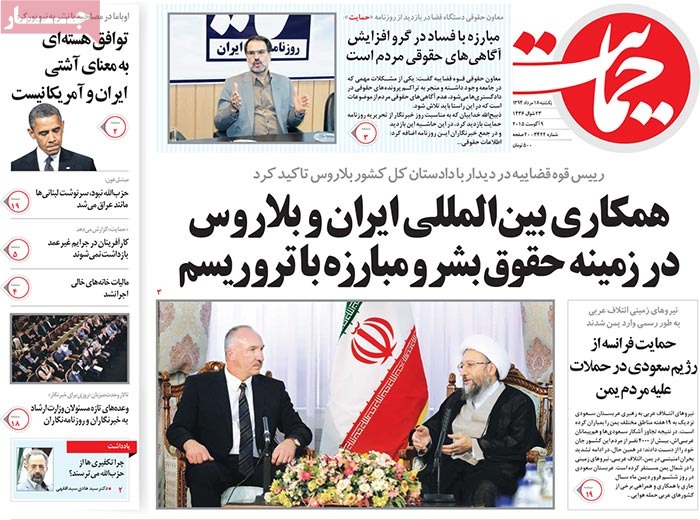
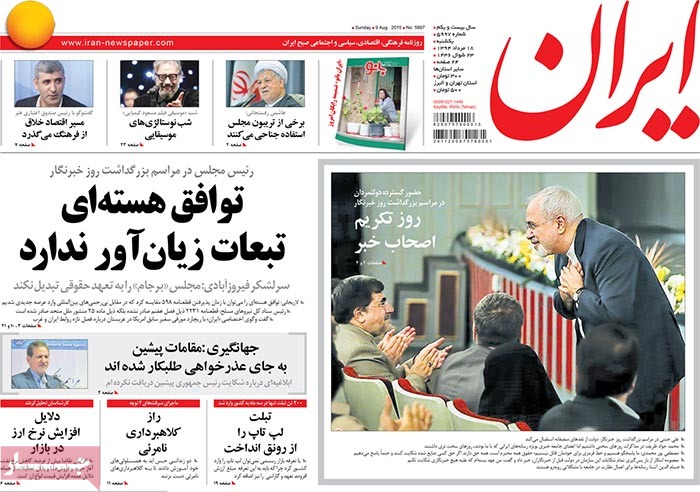
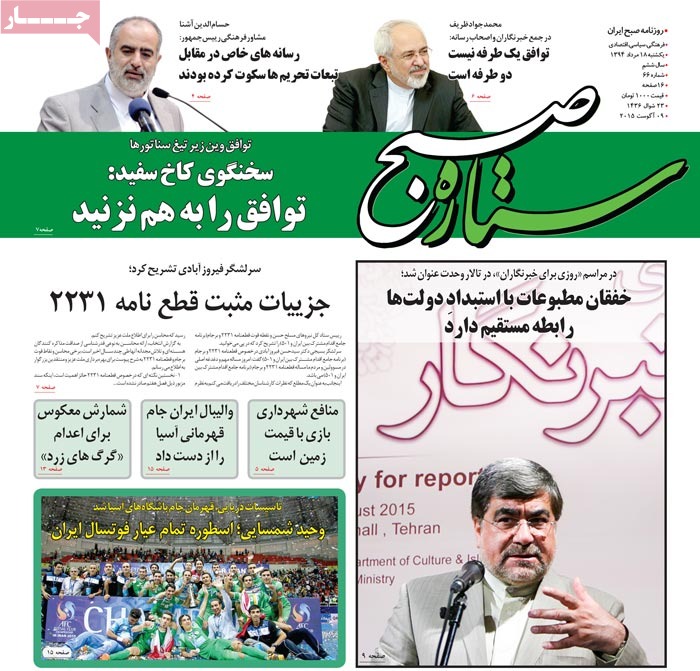
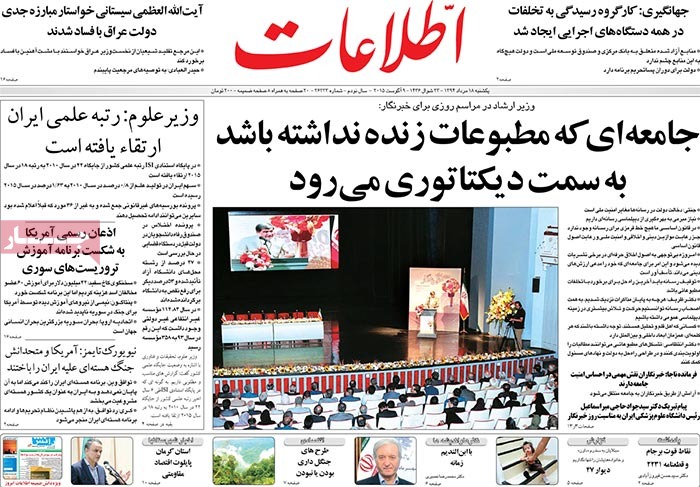
A look at Iranian newspaper front pages on July 28

Iranian Newspapers Headlines

Calls for more regional cooperation in the face of the threat posed by terrorism made in meetings between visiting Iranian Foreign Minister Mohammad Javad Zarif and Iraqi officials and the expected arrival in Tehran of senior European diplomats dominated the front pages of Iranian newspapers on Tuesday.


Ettela’at: “A mighty Iran serves as a guarantor of regional stability and security,” said President Rouhani.

He further said his administration favors moderation, equality, stability, security and peace.


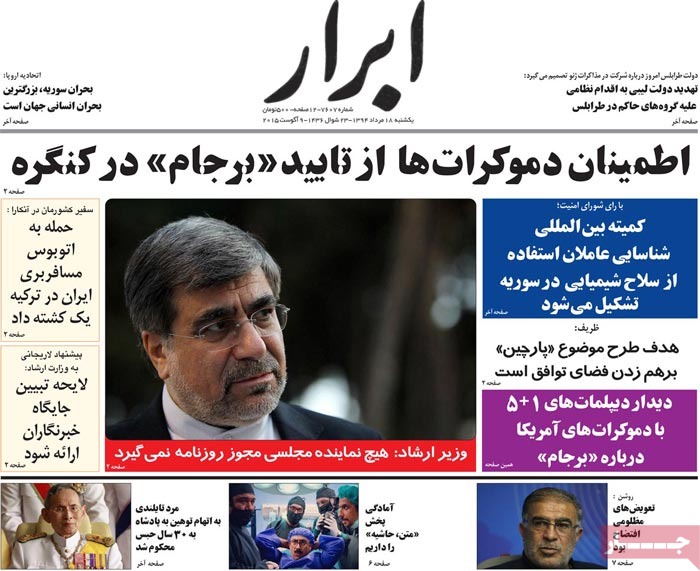
Abrar: Turkish fighter jets have continued to pound PKK and IS targets [in Iraq and Syria].


A look at Iranian newspaper front pages on July 28


Afkar: “Extremism and terrorism pose a threat to all,” Foreign Minister Zarif said.


A look at Iranian newspaper front pages on July 28


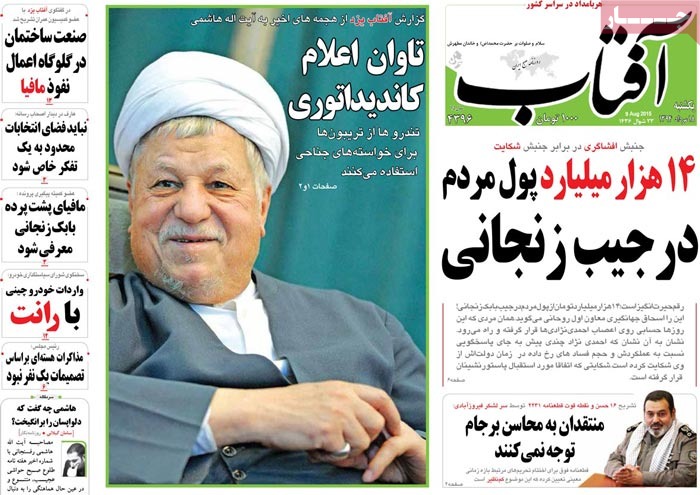
Aftab-e Yazd: “Do not politicize the case involving imports of tainted blood from France,” the Iranian health minister said.

Hassan Hashemi was reacting to criticism [by some principlists and hardliners] of the upcoming Iran visit by French Foreign Minister Laurent Fabius.

Aftab-e Yazd: The president of Islamic Republic of Iran Broadcasting [state broadcaster] has mounted an unprecedented attack on the executive branch.

Aftab-e Yazd: “My father got happy when he was not elected into the presiding board of the Assembly of Experts,” said Fatemeh Hashemi Rafsanjani, a daughter of the chairman of the Expediency Council Ayatollah Rafsanjani.

In an exclusive interview with the daily, she said women should have their own ticket for upcoming parliamentary elections.


A look at Iranian newspaper front pages on July 28


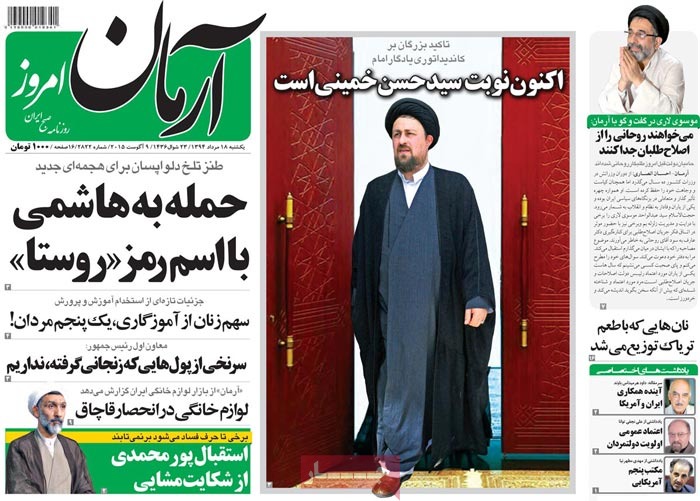
Arman-e Emrooz: The smiling female diplomat pursues diplomacy in Tehran.

Federica Mogherini’s visit will be the first by a P5+1 negotiator to Iran following the July 14 nuclear deal in Vienna.

Arman-e Emrooz: “Eight-hundred Iranian individuals and entities have been taken off the sanctions list,” Iranian nuclear negotiator Abbas Araghchi said.

Arman-e Emrooz: Prosecutors have said the officials who failed to fulfill their responsibility before and during last week’s deadly flooding in the north will be dealt with.


A look at Iranian newspaper front pages on July 28


Emtiaz: The education minister has said all teachers who were arrested in a guild gathering have been freed.

Emtiaz: Iran has held talks with 30 European firms.


A look at Iranian newspaper front pages on July 28


Etemad: A convoy of European officials in Tehran

The back-to-back arrival in Iran of European officials marks the beginning of a new era.


A look at Iranian newspaper front pages on July 28


Iran: The nuclear deal [Iran has signed with P5+1] has raised hopes of settling regional conflicts.

The issue came up in meetings between Iranian Foreign Minister Zarif and senior diplomats from Persian Gulf countries.


A look at Iranian newspaper front pages on July 28


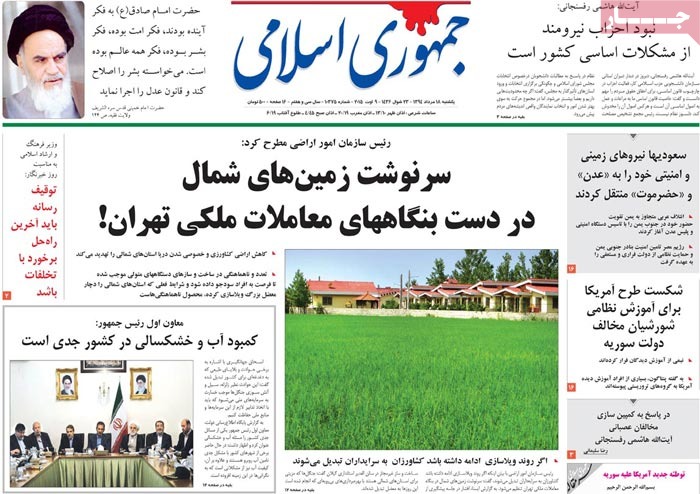
Jomhouri Islami: “Iran always stands by the Iraqi people and government in the fight against terrorism,” Iranian Foreign Minister Mohammad Javad Zarif after a meeting with senior Iraqi Shiite cleric Ayatollah Al-Sistani.

Jomhouri Islami: “Thirty-one development projects worth around $290 million will be implemented in Kurdistan,” the president said at the close of a visit to the western province.


A look at Iranian newspaper front pages on July 28


Kaenat: “The enemies will never see Iran surrender, not even in their dreams,” said the chief of staff of the Supreme Leader.


A look at Iranian newspaper front pages on July 28


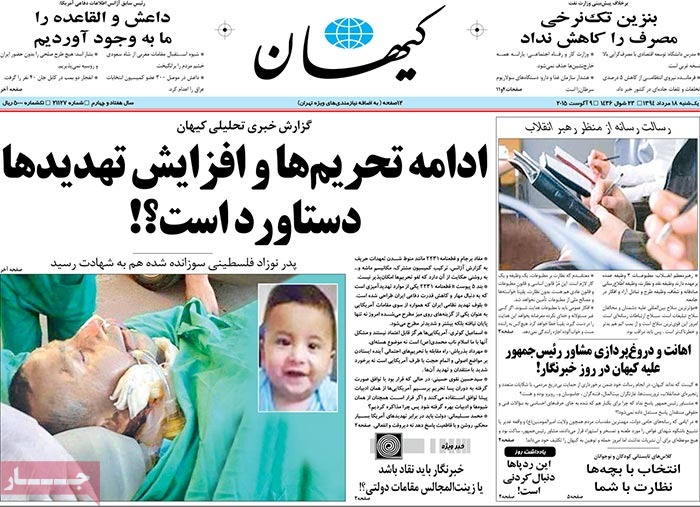
Kayhan: The remains of 76 Iranian combatants who were martyred during the Iran-Iraq war have returned home.


A look at Iranian newspaper front pages on July 28


Khorasan: EU foreign policy chief Mogherini arrives in Tehran today; French Foreign Minister Fabius is due in the capital tomorrow.


A look at Iranian newspaper front pages on July 28


Resalat: “Twenty-two gangs of thieves and muggers have been busted,” said the head of the Tehran Criminal Investigation Department.


A look at Iranian newspaper front pages on July 28


India’s Culture Week Festival in Iran (PHOTOS)

India’s Culture 00

India’s Culture Week Festival opened on July 27 in Tehran’s Niavaran Palace with Indian Ambassador to Tehran DP Serio Stava and Iranian Deputy Foreign Minister for Asia-Pacific Affairs Ebrahim Rahimpour in attendance.

The event features Qawwali, a form of Sufi devotional music, handicrafts exhibitions, publications and photos, tourism booths, Indian clothes, henna painting, and Indian food and tea.

Images of the festival posted online by different websites: