Friday, January 2, 2026
Home Blog Page 4807

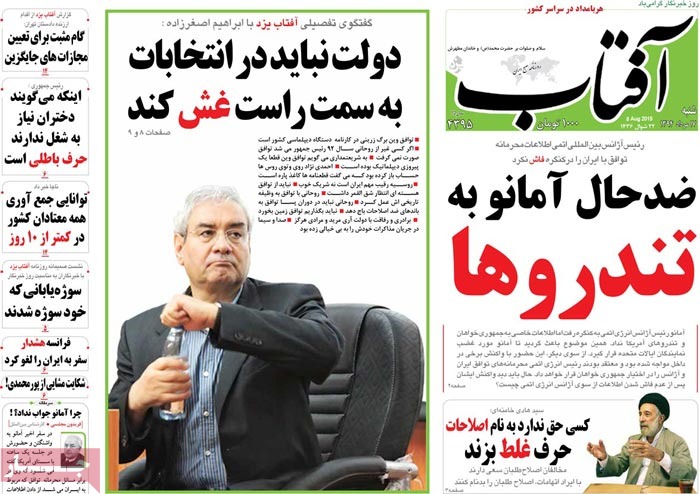
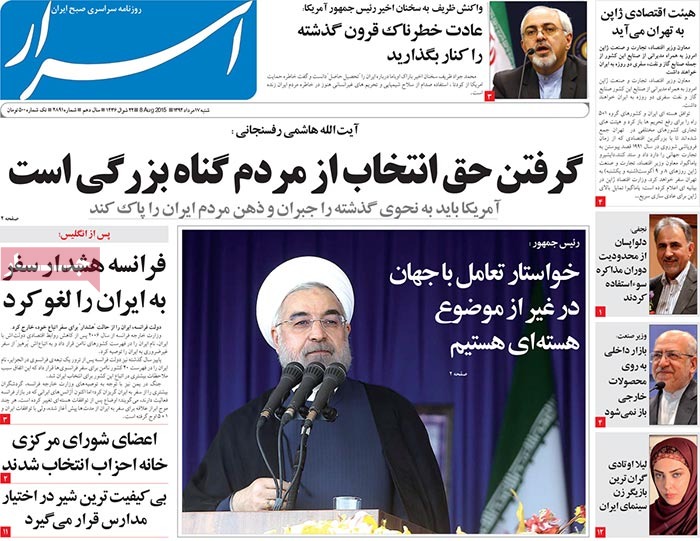
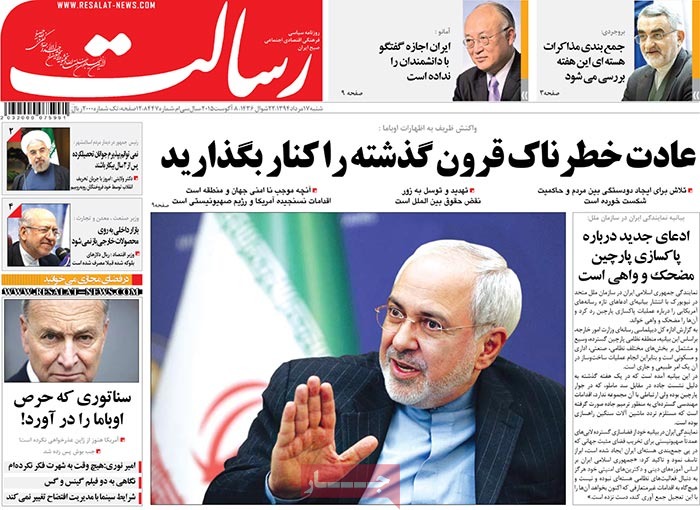
We are striving for a safer world of which Iran should have its full share: French FM

Laurent Fabius

French Foreign Minister Laurent Fabius says after years of tough yet constructive negotiations, he is delighted to visit Tehran at the invitation of his Iranian counterpart Mohammad Javad Zarif.

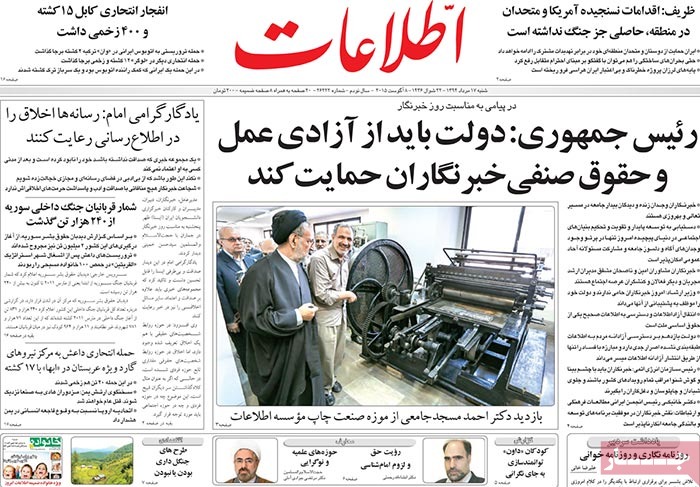
The following is the translation of a piece the French top diplomat published on July 28 in Iran, a Farsi-language newspaper officially representing the government of the Islamic Republic:

The French have always been fascinated by Iran, especially by its ancient culture and its role in the history of science and thought. Iranian students are amazing too. As the face of Iran they shine in French universities. The stage has now been set for an improvement in and upgrade of exchanges between the two countries.

The nuclear deal of July 14 was a pivot. For that pivot to work, each side has signed up commitments which should be implemented according to a timetable. Only in that case will the efforts made by all sides result in building trust.

The two countries’ industrialists have been working with each other for a long time. The French technology and products have a cachet. We know that they can meet the needs of Iranian consumers and entrepreneurs. There is a new prospect for the two countries, and we can make further progress in our economic cooperation.

So the stage is set for resumption and continuation of bilateral dialogue. France, which is a power that favors peace and stability, has always had relations based on respect with Iran, even in cases involving different approaches by the two countries.

With that in mind, I am traveling to Iran where I will build on such mentality to bring up all issues [at meetings] with Iranian officials. We will talk about peace and stability in the Middle East which is gripped by a lot of tension.

As an influential country, Iran can play a positive role in countering crises and tragedies. The deal we have struck entrusts Iran, as well as us, with certain responsibilities.

We want to strive toward a safer world and Iran should have its full share of this world. That is the message I’m taking to Tehran.

Car imports into Iran down by 68%

cars

A senior Iranian car industry official says auto imports into the country have fallen nearly 70 percent during the first two months of the current Iranian calendar year (Starting on March 21).

Amir Hossein Ghanati, the head of Automobile Industry Department of the Ministry of Industries, Mines and Trade said according to the latest figures published by Iran’s Customs Administration, car imports into the country witnessed a 68% year-on-year decrease during the first two months of this year.

The plunge in car imports to Iran comes against the backdrop of Iranian officials’ plans to boost auto exports from the country.

The 2014 production statistics by the International Organization of Motor Vehicle Manufacturers (OICA) show Iran’s auto production increased by 46.7 percent in the 12-month period.

The figures indicate the Iranian automakers produced 1,090,846 cars and commercial vehicles last year.

Earlier this month, the CEO of Iran Khodro Industrial Group (IKCO), Iran’s leading car manufacturer, said IKCO is in final talks with four major foreign companies to set up joint ventures.

Hashem Yekeh Zareh said IKCO has finalized a new contract with its French partner, Peugeot, which will be inked soon.

Under the new agreement, IKCO will have access to Peugeot’s export market via setting up a joint venture, said the Iranian official.

“Iran Khodro has resumed cooperation with Renault. Ties will also be expanded with Japanese auto maker Suzuki. Also talks with a German automaker have already reached a final stage,” said IKCO chairman.

Yekeh Zareh described Iran’s car market as “lucrative” for foreign companies. He predicted that more foreign automakers will request to enter Iranian market in coming months.

“Iran will have cooperation with companies which seek to set up joint ventures. We don’t want to simply produce cars… It is not in interest of our auto industry to manufacture cars under the license of French carmakers. We seek to develop production through partnership,” said IKCO managing director.

Iranian media have already speculated that the country’s auto industry could witness a major rise in production of cars in 2015.

According to a survey conducted by the Business Monitor International (BMI), the production of cars in Iran is expected to witness a 28% increase following the conclusion of nuclear talks between Tehran and P5+1.

BMI also predicted that Iran’s total auto output could rise to above 2 million cars within five years.

The car industry is considered Iran’s largest non-oil sector, accounting for nearly 10% of the oil-rich country’s gross domestic product (GDP).

The Islamic Republic of Iran ranks 18th on the list of the world’s top auto manufacturers.

Iran Khodro and Saipa companies account for more than 90 percent of the total domestic production in Iran.

Revelation and rejection of a cable that alleges bribery

Ahmad Shaheed

Ahmed Shaheed, the UN Special Rapporteur on human rights in Iran, in an interview with the BBC Monday denied allegations that he received bribes from the Saudis as he tried to elaborate on the sources he gets his information from.

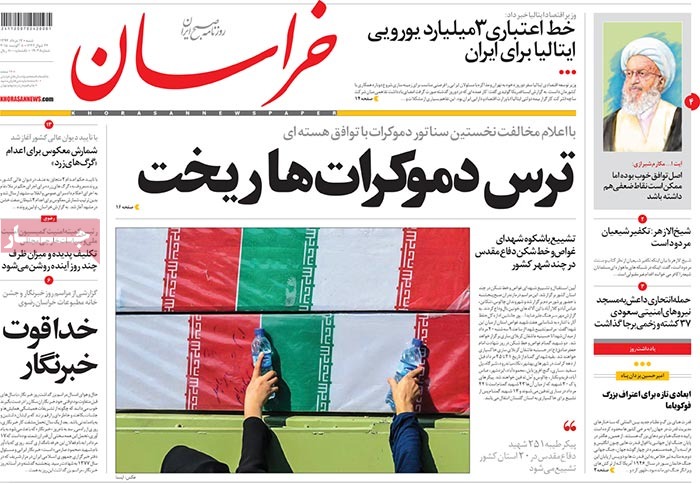
In an analytical report on July 28, the website of Khorasan daily, assessed the conduct of the UN special rapporteur. The report featured a news story by Arabic-language news website http://www.alwaienews.com/ that claimed a leaked WikiLeaks cable suggests the UN rapporteur has received $1 million in bribes from the Saudi embassy in Kuwait to take a tougher line against the Islamic Republic.

Khorasan has rejected the sources and the way the UN rapporteur gathers information on Iran by saying, “There are many indications that Ahmad Shaheed is pushing the agenda of the anti-revolutionaries as part of a grand plan.”

The Khorasan report also included the reaction of the UN official to the allegation by Alwaie News and said,” Ahmed Shaheed, the UN Special Rapporteur on human rights in Iran, in an interview with the BBC Monday denied allegations that he received bribes from the Saudis as he tried to elaborate on the sources he gets his information from.”

It added “Without denying the report, WikiLeaks simply asked – on its Twitter account – the source that published the news to ‘show which cable this claim is based on’.”

[It should be noted that on Monday Iranfrontpage.com translated a report by the Young Journalists Club that suggested the UN rapporteur has received bribes from the Saudi embassy in Kuwait. Since Iranfrontpage seems to have been the first website to have released the English version of the controversial news story, WikiLeaks directed its Twitter demand at Iranfrontpage which in turn mentioned Alwaie News and the Young Journalists Club as the sources of its translated story].

Iran says planes ready for US flights

Iran Air-Plane

Iran’s aviation officials say the country is technically prepared to launch direct flights to the United States, but an authorization to do so is still needed.

“Iran’s aviation fleet is equipped with long-range planes that can make direct flights to the US without having to stop and refuel anywhere,” said Mohammad Khodakarami, the caretaker head of Iran’s Civil Aviation Organization (CAO).

Khodakarami has been quoted as saying by the domestic media as saying that launching a direct flight to the US requires obtaining the necessary “diplomatic authorizations” from the related organizations.

“Once the authorizations to do so are issued, CAO will start following up the other aspects involved in this issue,” he said.

Iran’s Fars News Agency reported in September 2013 that President Hassan Rouhani has ordered to study the possibility of launching direct flights to the US.

Fars said the order had been issued after President Rouhani had met Iranian expatriates living in the US on the sidelines of UN General Assembly in New York.

Also, the former CAO head Alireza Jahangirian was quoted by the media as saying in August 2014 that several aviation majors including Boeing have voiced readiness to help launch direct flights between Iran and the US.

“Those companies have obtained an authorization from the US Treasury Department [for direct flights to Iran] and have started to talk to some Iranian airliners,” Jahangirian was quoted by Mehr News Agency.

“At present, both sides are taking care of the last stages of finalizing related deals for this,” he said.

The current sanctions prohibit Iranian airlines from flying to the US. However, the recent breakthrough in Vienna between Iran and the P5+1 group of countries has already revived hopes in Tehran for the eventual removal of the sanctions.

Iran and the P5+1 – the five permanent members of the Security Council plus Germany – announced in Vienna on July 14 that they had agreed over certain restrictions on the Iranian nuclear energy program in return for the removal of economic sanctions against Iran.

“With regards to the issue of the removal of sanctions, several global plane makers from different countries have presented proposals for cooperation to Iran,” Khodakarami told reporters.

“Those proposals – that range from sales of planes to Iran to sales of airport facilities – have been submitted to the relevant institutions and are already under study,” he added.

Sanctions end on 800 Iranians soon: Araghchi

Araghchi

Iran’s Deputy Foreign Minister Seyyed Abbas Araghchi said hundreds of Iranian individuals and institutions will soon be taken off the blacklist of the Society for the Worldwide Interbank Financial Telecommunication (SWIFT) after the nuclear agreement recently struck between Tehran and six world powers is put into effect.

“SWIFT is a cooperative organization in charge of securing the safety of global financial transactions and not a system of sanctions against Iran and its citizens; however, it has prevented some Iranian individuals and entities from receiving its services,” the official said.

He said the list includes Iranians who have been placed under sanctions by the UN Security Council, Europe, and the United States in past years due to Iran’s nuclear issue.

Araghchi said once the deal struck by Iran and the world powers in Vienna on July 14 comes into effect hundreds of Iranian citizens and entities will be struck off the Swift sanctions list in two phases.

“In the initial step, 800 Iranian institutions, organizations and individuals will be taken off the list on the day the agreement is put into practice,” he said.

According to Araghchi, the few names which remain on the list will be denied services until later stages.

[…]

Iran sees Mideast security as own: Iran FM

Zarif-Iraq

Iranian Foreign Minister Mohammad Javad Zarif says Iran considers the security of Middle East countries its own.

“We (regional countries) may have different opinions regarding developments in Syria, Iraq and Yemen, but we stress that the security of each and every country in the region is like our own security and we will work to boost this collective security,” said Zarif in a joint press conference with his Iraqi opposite number Ibrahim al-Jaafari in Baghdad on Monday.

The Iranian top diplomat further emphasized that Iran will continue to support Iraq’s ongoing fight against the ISIL Takfiri group, adding, “The Iranian government and nation will stand beside Iraq in the war against terrorism.”

He underlined that regional countries are linked through numerous commonalities, including religion, and added they should not allow terrorist and extremist groups to commit crimes in the region in the name of Islam and tarnish the image of this divine faith.

Iran’s diplomacy chief said Tehran stands ready to cooperate with Mideast countries to fight problems facing the region, including sectarianism.

Zarif also highlighted the significance of a recent breakthrough in talks between Iran and global powers on Tehran’s nuclear program, saying it has “resolved common problems with regional countries.”

“Now we can address our principal priority which is cooperation with neighboring and regional countries,” Zarif said, reiterating that Iran poses no threat to any country in the region.

On July 14, Iran and P5+1 – the United States, Britain, France, China and Russia plus Germany – finalized the text of an agreement, dubbed the Joint Comprehensive Plan of Action (JCPOA), in the Austrian capital of Vienna.

Under JCPOA, limits are put on Iran’s nuclear activities in exchange for a set of commitments by P5+1, including the removal of all economic and financial bans against the Islamic Republic.

Zarif said the negotiations showed that interaction is superior to antagonism, adding that the cloud of Iran’s nuclear dispute that covered the Middle East has now cleared off.

For his part, the Iraqi foreign minister hailed the growing status of relations between Iran and Iraq, saying the two neighboring countries will continue to deepen their cooperation in various fields.

Jaafari said Iraq has done its utmost in the fight against terrorism, adding the Arab country is quite “proud” of its record in fighting ISIL.

World Christian gathering in Chaldoran a sign of religious freedom in Iran

Christians-Chaldoran

Christians-IranConvergence of Christians on the Saint Thaddeus Monastery [or Ghara Kelisa – Literally “The Black Church” – in West Azerbaijan Province] is a sign of religious freedom in Iran, Tehran’s Armenian archbishop was quoted by Alef, a news website, as telling the head of the Political Department of the Interior Ministry Sunday.

At the meeting, Archbishop Sebouh Sarkissian said, “Such freedom should be cherished.”

The following is the translation of a report the website published on the meeting on July 26:

Describing Iran as a country which preserves the heritage of different global religions, Sarkissian said, “We should safeguard this invaluable treasure called Iran, because only a few kilometers away from the borders of this country, churches are being destroyed.”

The archbishop added, “When the so-called supporters of human rights look at Iran, they put on dark glasses. But when they look at countries such as Saudi Arabia, they put on rose-colored glasses. In reality though, there is a huge difference between Iran and Saudi Arabia.”

For his part, Reza Rezazadeh, the official with the Interior Ministry, pointed to the Islamic Republic’s constitutional article which recognizes divine religions and said, “Presently, 57 religious institutions (27 Christian, 27 Zoroastrian and three Jewish) are active in the country and they are at full liberty when it comes to holding religious ceremonies.”

Each year Armenians from Iran and around the world descend on this house of worship in Chaldoran, in northwestern Iran, for ceremonies which run between three and five days. The monastery is a World Heritage site.

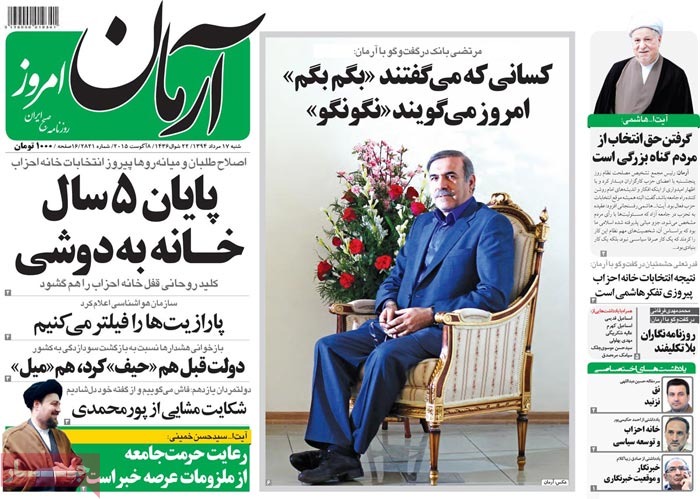
International interaction can help facilitate adaptation: Rafsanjani

Israel doomed to historic failure

Chairman of the Expediency Council Ayatollah Akbar Hashemi Rafsanjani says he hopes interaction between the Iranian legal system and international organizations can result in the refinement of judicial regulations.

In a message to an international conference on independence of lawyers and bar associations Sunday, Ayatollah Hashemi highlighted the importance of human rights, and said, “Adaptation of the country’s judiciary and legal representation system to internationally-accepted standards will contribute to the effectiveness of the judiciary on the global stage.”

Given that cultural concepts are constantly changing, legal representation should be updated with the passage of time, the top councilor said.

The following is the translation of an excerpt of his message posted online by the Islamic Republic News Agency on July 26:

When it comes to legal representation, the emphasis is on the independence of lawyers, a key principle stipulated in the Universal Declaration of Human Rights and the International Covenant on Civil and Political Rights and Basic Principles on the Role of Lawyers [adopted by the Eighth United Nations Congress on the Prevention of Crime and the Treatment of Offenders, Havana, Cuba, in 1990].

The independence of bar associations and that of defense attorneys are an intrinsic part of this covenant.

[…]

Islamic texts urge the faithful to resort to arbiters and legal representatives when they are at odds with each other. There is no doubt that arbitration and representation are a religious issue encouraged by the Muslim Prophet. The Islamic judiciary system should organize international gatherings as such to promote the positive aspects of legal representation and facilitate adaptation.

I hope what is related to human rights is deemed as important globally and in the future there are no instances of injustice in the world. Of course, satisfaction and dissatisfaction are inevitable concepts when it comes to court cases and performance of lawyers.

The day-long gathering held on July 26 in Tehran’s Milad Tower brought together a number of ambassadors and heads of bar associations from the Netherlands, Austria, France and Turkey as well as officials from the International Bar Association.

Local dolls narrate joys, sorrows of rural women (PHOTOS)

Local dolls000

Dolls whose production in South Khorasan, Ardabil and Qazvin dates back five millennia have found their way to Tehran from the provinces.

These dolls which tell the stories of the joyful and sorrowful experience of women in rural areas put on display the forgotten local traditions and culture of rural communities.

Afsaneh Ehsani, who leads a project aimed at creating sustainable employment in keeping with the preservation of pastureland, says these dolls are environment friendly and carry rich cultural values.

Images of the dolls posted online by Mehr News Agency:

Volkswagen on course to replace Peugeot in Iranian market

car

The famous saying of “what goes around comes around” can best apply to present relations between Iran Khodro, Iran’s leading automaker, and France’s Peugeot.

Although some are set to celebrate the reunion of the two giant carmakers [after the conclusion of a deal between Iran and P5+1 which will eventually see sanctions lifted], it seems that Germany’s Volkswagen has caught Iran Khodro’s eye as a better choice of partner.

The following is the translation of an analytical report published by Donyay-e Eghtesad daily on July 25 about ups and downs of partnership between Iran Khodro and Peugeot and the reason why the Iranian automaker is more inclined to choose Volkswagen, rather than Peugeot, as its main partner:

Early in 2012, Peugeot unilaterally broke up its 24-year partnership with Iran Khodro. Without giving any reason, it upped and left the Iranian market. Later it became known that tempting offers by General Motors were behind the abrupt end of partnership.

Leaving Iran Khodro to its own devices at a time when the company was in dire straits and was grappling with a production crisis dealt a heavy blow to the Iranian company.

Iran Khodro had to fix the problem and in doing so, it even reached out to other companies, because General Motors, Peugeot’s new American partner, would not allow the French automaker to help Iran Khodro address the issues of the cars they used to manufacture together.

Pivot toward Volkswagen

According to well-placed sources, Volkswagen has apparently presented better partnership offers than Peugeot. That’s why Iran Khodro considers replacing the French automaker with its German rival.

Some experts believe that apart from technical and technological advantages of Volkswagen, other factors have contributed to Iran Khodro’s decision to shift from Peugeot to Volkswagen.

Some other experts argue that Peugeot’s failure to honor its partnership commitments and Iran’s concerns about a repeat of such behavior by the French automaker have contributed to the shift toward Volkswagen.

Critics of Peugeot believe that the company has done Iranian customers and automaking industry injustice and must be punished and that Iran Khodro should not easily re-enter into partnership with the French firm.

That said, well-placed sources say that a series of developments which unfolded over the last 18 months, between the Geneva interim agreement and the nuclear deal in Vienna, coupled with talks between Iran Khodro and foreign companies have convinced the Iranian automaker to shift its attention from France to Germany.

In other words, Iran Khodro has reached the conclusion that in the current conditions, Germany in general, and Volkswagen in particular, is a better choice for partner and can better help the Iranian auto-making industry.

That of course does not amount to an outright removal of Peugeot from Iran Khodro’s cooperation list, and the French company is not out of the picture yet.

Based on reports released by Iran Khodro, the company seeks to divide its market among four partners, with the main partner holding a 50 percent share and the rest of the shares divided among the other three.

If such reports turn out to be true, as Iran Khodro’s main partner, Volkswagen will secure a 50 percent share of the company’s market and Peugeot should try to secure a substantial share of the other half of the market of the largest automaker in the Middle East.