Wednesday, December 24, 2025
Home Blog Page 4801

Seminary student opens brew bar

1

No one says you are doomed to a traditional lifestyle when you are a student at a seminary school. There are many seminary students in Iran who engage in modern social activities. At times their foray into the unusual is frowned upon.

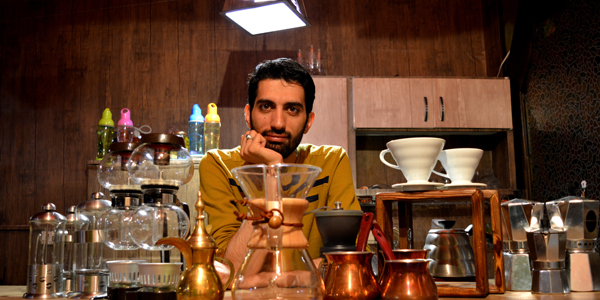
One such student, Hadi Hosseini has recently opened up a café, or what he calls a “brew bar”, in his home town: Isfahan in central Iran.

“We usually give our foreign customers a package. This place abounds with tourists because of its proximity to the city’s main tourist spot. The package contains a copy of the letter the Supreme Leader wrote to the European youth. Some time ago a Danish man came here and said he had read the letter already but had some questions about its content. I said I was ready to answer his questions. It took us a cool three hours to go through all his questions,” Hadi said in an interview with bultannews.com.

What follows is the translation of an excerpt of the interview:

You are a seminary student, why this?

Ever since I started studying in university and then in seminary, I have always had a job. I have done marketing, freelance taxi driving, and even journalism. I believe working is a necessity for everyone.

During the war my family was on the move. Once I returned to Isfahan, my wife had a sum. So we decided to start a business. We had several options to choose from, among them a fast-food restaurant, a trade company and or a café. After much thinking and consulting experts, we decided to open this shop.

Why did you choose a café?

I believe seminary clerics must be in contact with people and live among them. The more we reach out to different social strata, the more impact we can have on them. People from all walks of life come here to spend some time. This is the best opportunity for a cleric like me to tell them what they need to hear about Islam. When a customer sees a café owner has religious looks and receives them well, they will probably become a regular and take a liking to what they have to say.

Have you tried to make this place look religious?

No, not at all. As you can see, we have opted for a romantic décor in here. Except for a few photos of famous poets, actors, politicians and thinkers which have given this place a social tinge, no other symbols can be seen in the café. Customers here are not treated based on how they look, whether religious or not.

Have you ever received any training for what you are doing here or you have learned the ropes over time?

Our religion instructs us to do everything based on knowledge and training. Accordingly, before opening this place I started looking for a trainer. I came across a member of the Coffee Association of Europe who had officiated at a final round of a barista competition in Iran. I took two training courses with this man. I am proud to say that we are Isfahan’s first “brew bar”. Very few brew bars are up and running in Iran, and we are one of them.

How was the café received by your friends and acquaintances?

Up to 80 percent of the reactions have been positive and encouraging. I have been flattered by their comments about my venture. Others do not approve of the move and sometimes make sarcastic comments. I am sure these comments are out of concern, so I don’t get offended.

2

Iran oil to hit 4.7 million bpd ‘soon’

Zangeneh-Iran-Oil-Minister

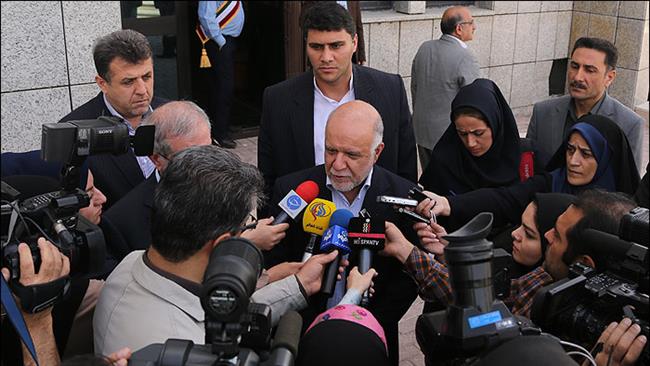
Minister of Petroleum Bijan Zanganeh says Iran will raise its oil recovery to 4.7 million barrels per day “in the near future” and unveil its new Iran Petroleum Contract (IPC) in the month which begins on Aug. 23.

He made the announcement on Monday at a meeting with a delegation of German state officials and executives of industries and businesses headed by Economy Minister Sigmar Gabriel on their visit to Tehran.

“Iran has the biggest hydrocarbon reserves in the world and deems itself responsible for the world’s energy security,” Zanganeh said.

“Gas production in Iran will surpass 1,000 million cubic meters per day in the next three days. Moreover, oil production is expected to reach 4.7 million bpd in the near future,” he added.

The country plans to restore its oil production which intensified Western sanctions have sliced by half. To achieve that goal, Iran has lined up new contracts in order to attract foreign investors to its ageing oilfields to ramp up output.

Zanganeh said he hoped German companies would participate in Iran’s oil industry projects after the new contracts were announced.

“Investment in the petrochemical sector, refining, storage, energy use optimization and development of new energies are among many of the projects which German companies will participate in,” he said.

Executives from Linde, an industrial gases and engineering company, and Europe’s biggest engineering company, Siemens, are accompanying Gabriel along with representatives of other big German firms on the visit to Tehran.

In a joint news conference with Zanganeh, Gabriel said it was time for Iran and Germany to “open a new chapter in economic ties”, the website of Ministry of Petroleum’s Shana news agency said.

“Some people believe the effects of the nuclear agreement will not be tangible but we want to prove that this accord will kick-start economic cooperation and have positive impact on the life and prosperity of the people and lead to a boom in business,” it quoted Gabriel as saying.

Zanganeh said Iran is also counting on small- and medium-size German companies for the implementation of projects.

“For contracting and EPC (engineering, procurement, construction) contractors, it is in the best interests of the German companies to register in Iran and work along with Iranian firms,” he said.

“Iran has a very valuable educated workforce which Germany companies can use,” he added.

Zanganeh said the most immediate hurdle to bilateral trade was banking and insurance restrictions which the sanctions have created.

“We hope this issue will be resolved as soon as possible so that an immediate cooperation of the companies is facilitated.”

The minister said Iran and Germany will soon hold their first joint trade meeting after a 14-year gap.

German officials foresee bilateral trade, which totaled 2.7 billion euros ($3 billion) in 2014, expanding to 6 or 7 billion euros in 2016.

Zarif hits back at US official for ‘military option’ remark

‘Political resolve, goodwill key for comprehensive nuclear deal’

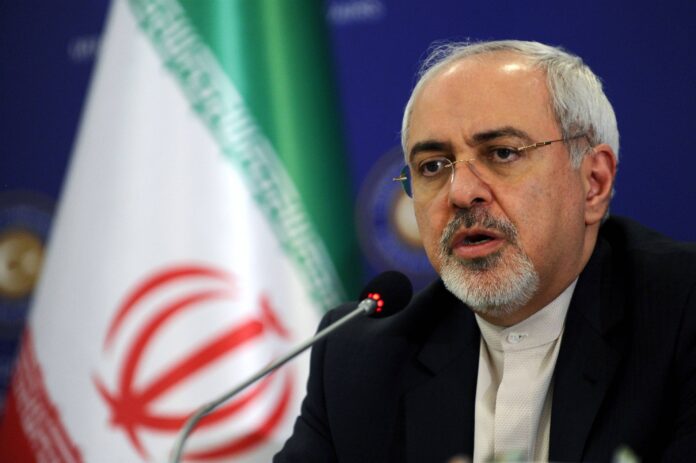
Iran’s Foreign Minister Mohammad Javad Zarif says those who have used the language of force against the Islamic Republic after the successful conclusion of negotiations between the country and the P5+1 are incapable of properly engaging in diplomacy.

“At a time when the world considers last week’s agreement in Vienna the victory of diplomacy over war and violence, unfortunately, there still are people who speak of the illegal and illegitimate use of force to achieve their delusional objectives,” Zarif told IRNA on Monday.

Zarif made the remarks after US Defense Secretary Ashton Carter said on Sunday that the agreement between Iran and P5+1 does not prevent Washington from using military force against the Islamic Republic.

“One of the reasons why this deal is a good one is that it does nothing to prevent the military option,” Carter told reporters on board a flight to Israel.

Zarif, who led Iran’s negotiating team with P5+1, further said, “These individuals do not seem to be able to understand that the use of force to violate others’ rights is not an option, but a dangerous and injudicious temptation,” Zarif said.

The use of force is “often put forth by those who lack the necessary capacity and capability to manage, push forward and consolidate diplomacy,” the Iranian foreign minister said.

[…]

Tehran storm catches citizens off guard, kills 20

storm

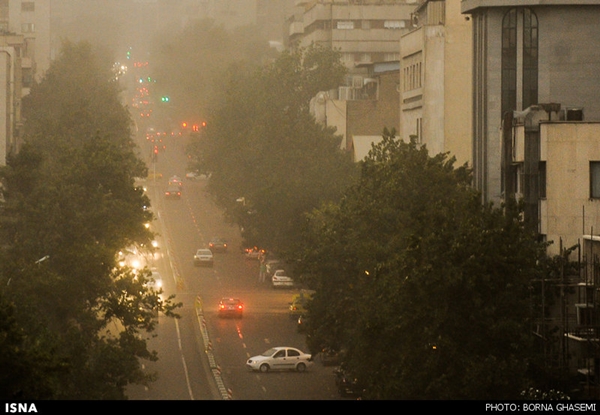
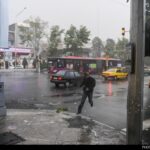
At least 20 people lost their lives as a freak storm hit the Iranian capital Sunday evening followed by heavy downpour almost halfway through a very hot summer.

Abolfazl Ghanaati, a member of the Presiding Board of Tehran City Council, said that the flood, triggered by heavy rainfall, caused a rockslide in Emamzadeh Davood district in the northwest of the Tehran.

Entekhab.ir, a news website, published a report on the freak weather in Tehran on Monday and the number of causalities. The following is the translation of the report:

The city councilor said that the rockslide knocked down trees, adding that a number of people trapped in the storm path lost their lives.

He further said details on casualty reports are still sketchy, adding the storm has claimed around 20 lives in the province.

Casualties in Karaj, Alborz Province

Heavy downpour caused the Karaj River to burst its banks Sunday night, leaving five people dead and more than ten others injured.

An official with the Crisis Management Center in Alborz Province said that the overflowing river washed away more than 50 cars on Karaj-Chalus road, adding that 15 cars have been recovered so far.

Meanwhile, an official with the Alborz Provincial Red Crescent Department said that according to local accounts as many as a dozen people have gone missing.


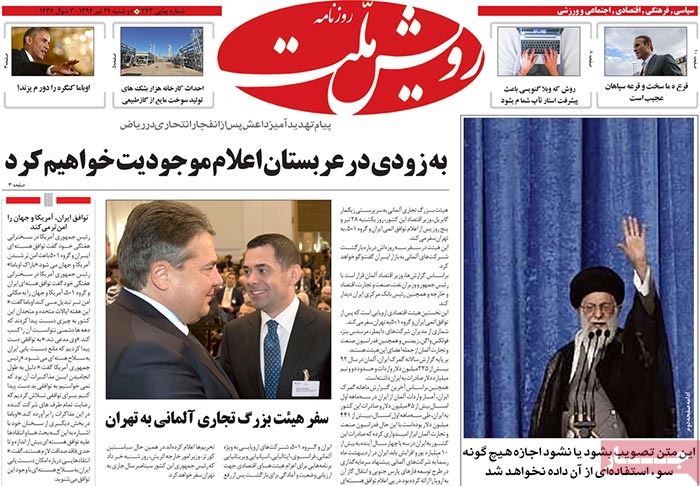
A look at Iranian newspaper front pages on July 20

Iranian Newspapers Headlines

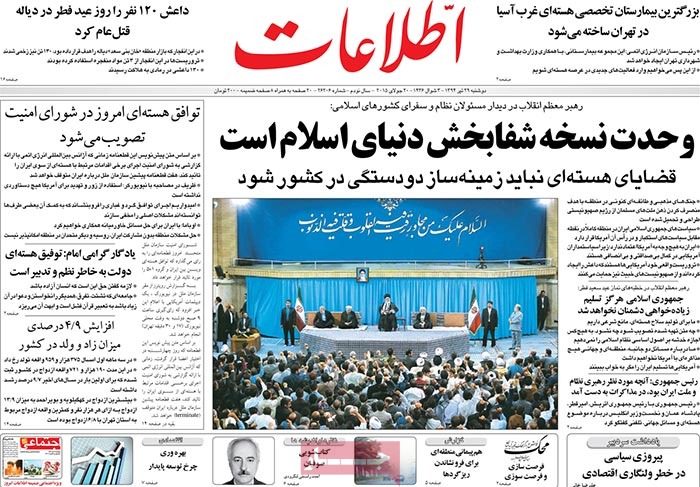
The comments of the Supreme Leader that the nuclear issue should not create division among the Iranian people dominated the front pages of Iranian newspapers on Monday.  


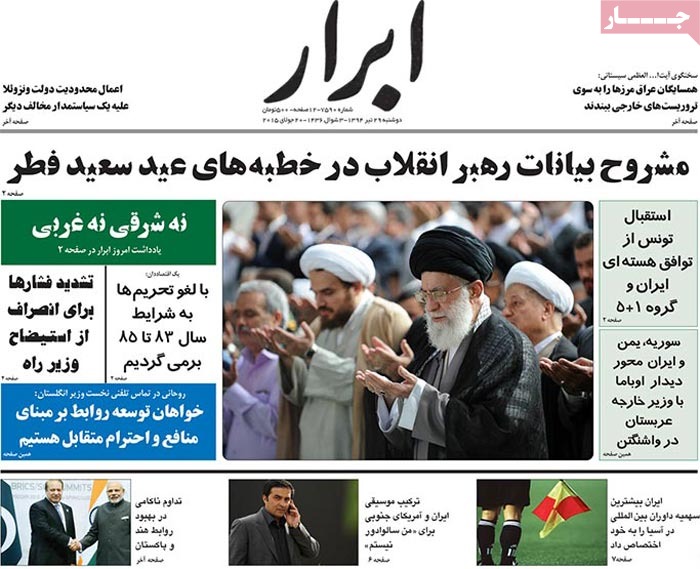
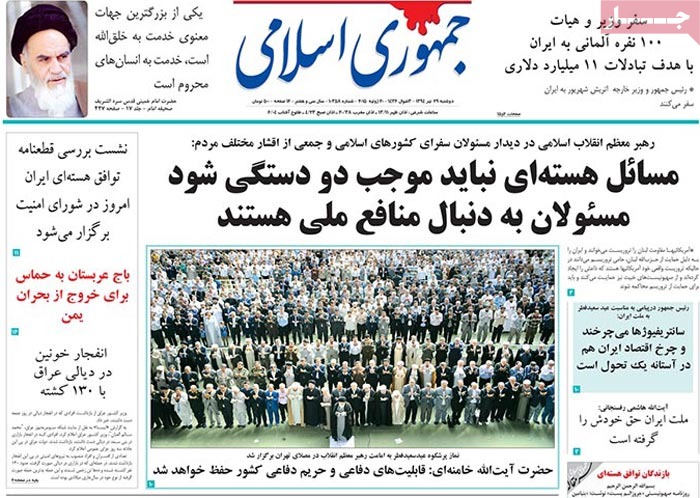
Ettela’at: “Unity is the only remedy for the world of Islam,” said the Supreme Leader at a meeting with state officials and Islamic ambassadors based in Tehran.

Ayatollah Khamenei also said that the nuclear issue should not divide the nation.


A look at Iranian newspaper front pages on July 20


Abrar: “We are in favor of expansion of ties based on mutual interests and respect,” President Hassan Rouhani told the British prime minister on the phone.


A look at Iranian newspaper front pages on July 20


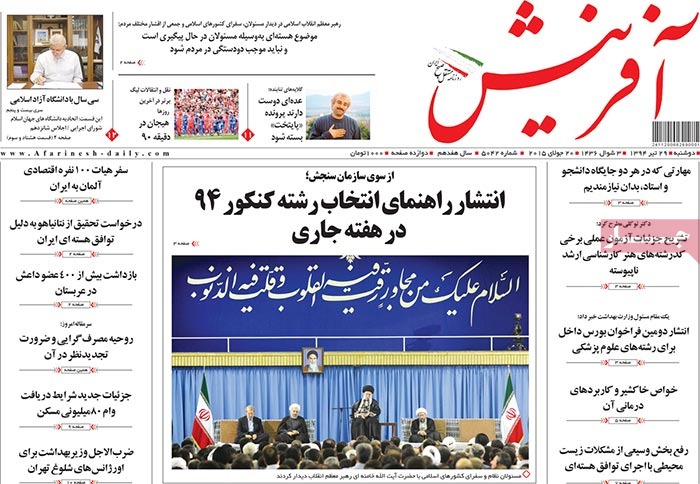
Afarinesh: Saudi Arabia has arrested more than 400 IS terrorists.


A look at Iranian newspaper front pages on July 20


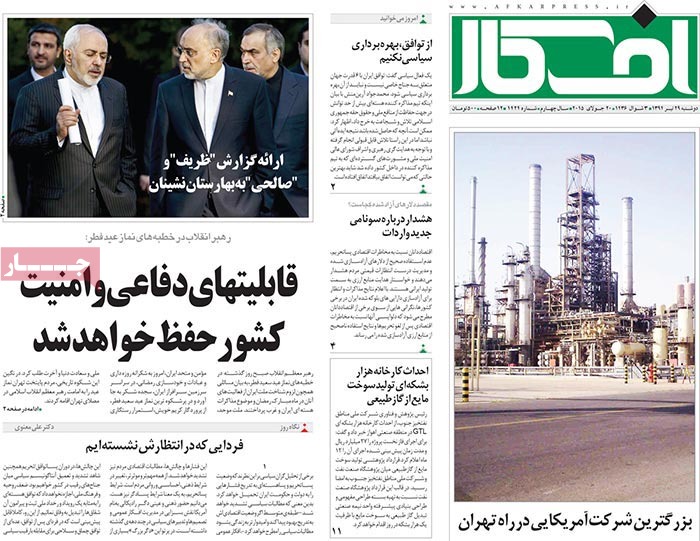
Afkar: “The country’s defense and security capabilities will be maintained,” said the Supreme Leader.

Afkar: Zarif and Salehi will be in Baharestan [a Tehran street where parliament is located] to present a nuclear report to MPs.


A look at Iranian newspaper front pages on July 20


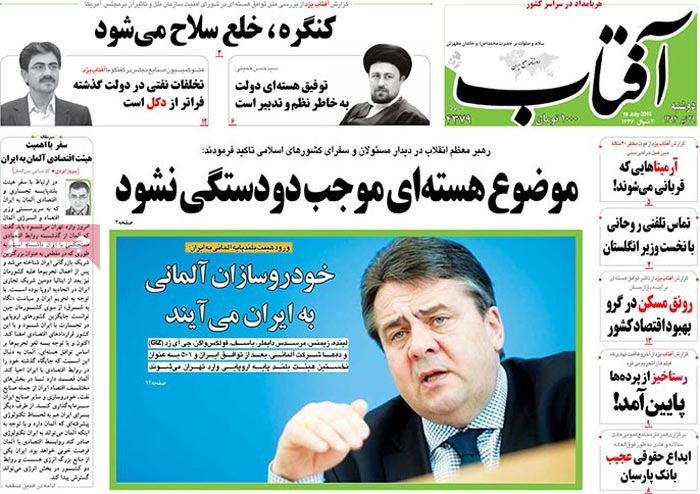
Aftab-e Yazd: “The oil-related offenses of the previous government are not limited to [the disappearance of] an oil derrick,” said a member of parliament’s Industries Committee.

Aftab-e Yazd: German carmakers make an Iran comeback.

Representatives of German automakers arrive in Tehran as part of a first Western delegation visiting Tehran in the wake of the nuclear deal.


A look at Iranian newspaper front pages on July 20


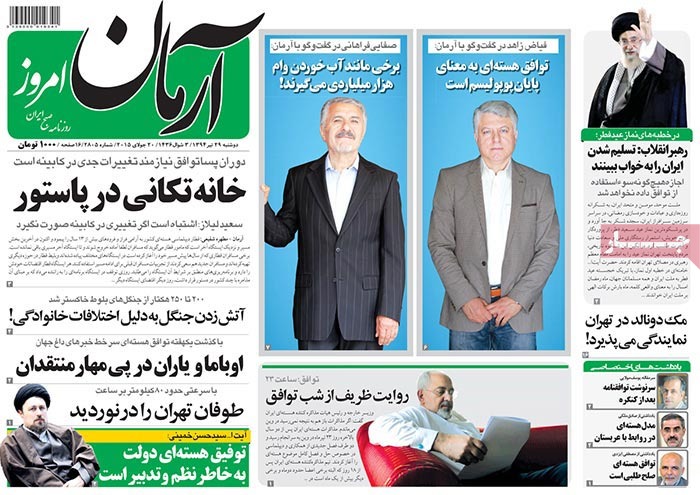
Arman-e Emrooz: “The nuclear deal will spell an end to populism,” said Fayyaz Zahed, a university professor and reformist activist.

Arman-e Emrooz: The post-deal era requires major changes in the Cabinet lineup.

“Failure to introduce a shakeup would be a big mistake,” said economist Saeed Laylaz.

Arman-e Emrooz: A storm with gusts of 80 kph ripped through Tehran.

Arman-e Emrooz: McDonald’s is to set up an outlet in Tehran!


A look at Iranian newspaper front pages on July 20


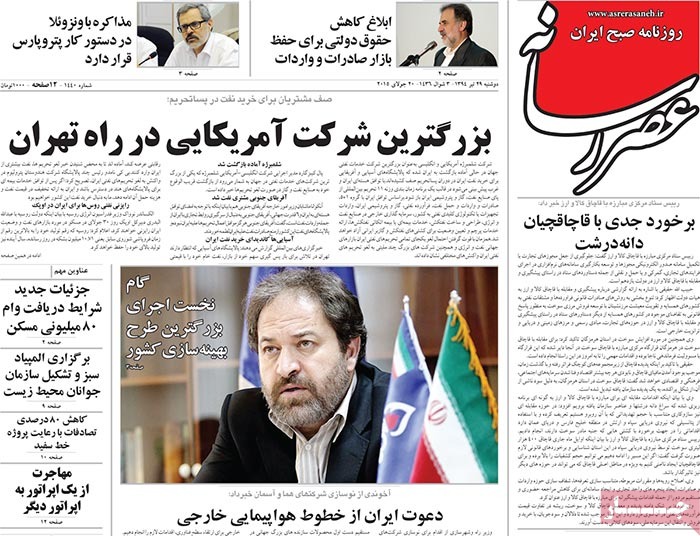
Asr-e Rasaneh: The biggest American company on its way to Tehran to purchase Iranian oil in the post-sanctions era.


A look at Iranian newspaper front pages on July 20


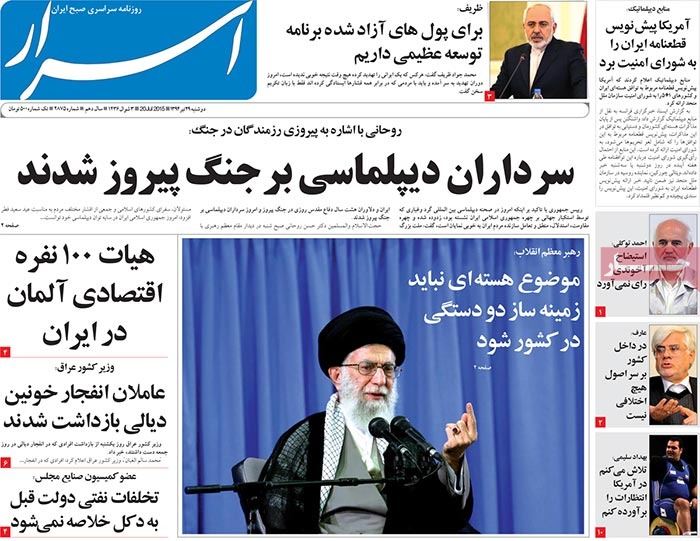
Asrar: “We have a massive development plan to implement when our assets are unfrozen,” said Foreign Minister Zarif.

Asrar: The Iraqi interior minister has said that those behind the deadly bombing in Diyala have been arrested.


A look at Iranian newspaper front pages on July 20


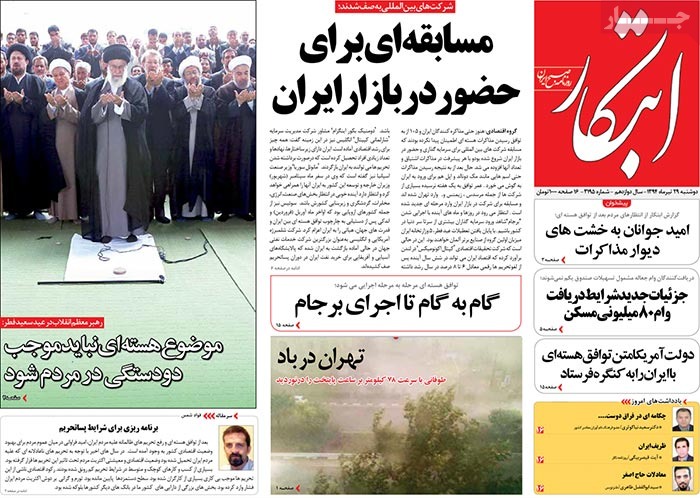
Ebtekar: The race is on for presence in Iran’s market.

Ebtekar: “The nuclear issue should not spark division in the country,” said the Supreme Leader.


A look at Iranian newspaper front pages on July 20


Jomhouri Islami: “The Iranian nation has reclaimed its right,” Chairman of the Expediency Council Ayatollah Akbar Hashemi Rafsanjani said.


A look at Iranian newspaper front pages on July 20


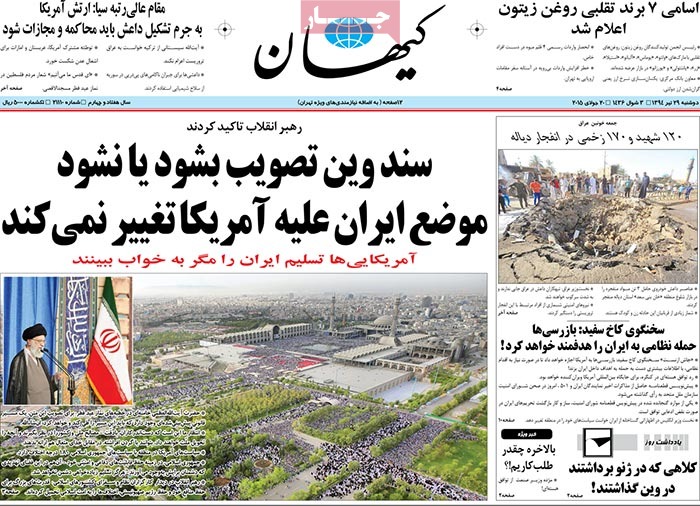
Kayhan: “Whether or not the Vienna deal is approved, Iran’s stance vis-à-vis the US won’t change,” said the Supreme Leader.

“Only in their dreams will the Americans see Iran capitulate,” Ayatollah Khamenei said.


A look at Iranian newspaper front pages on July 20


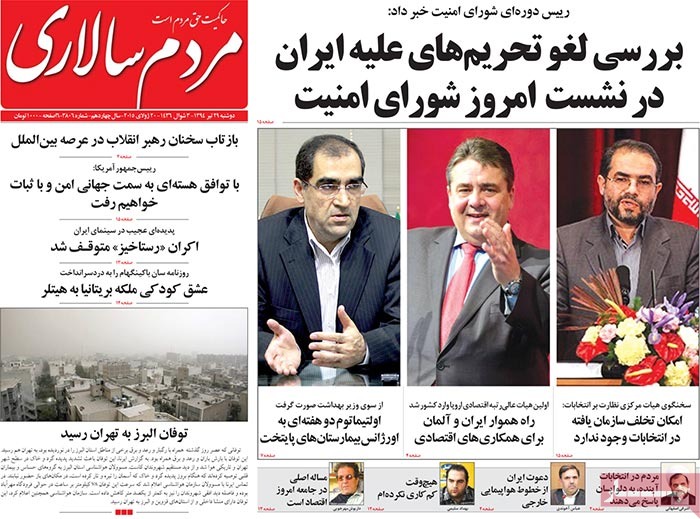
Mardomsalari: The health minister has given the capital’s hospitals two weeks to get their ER house in order.


A look at Iranian newspaper front pages on July 20


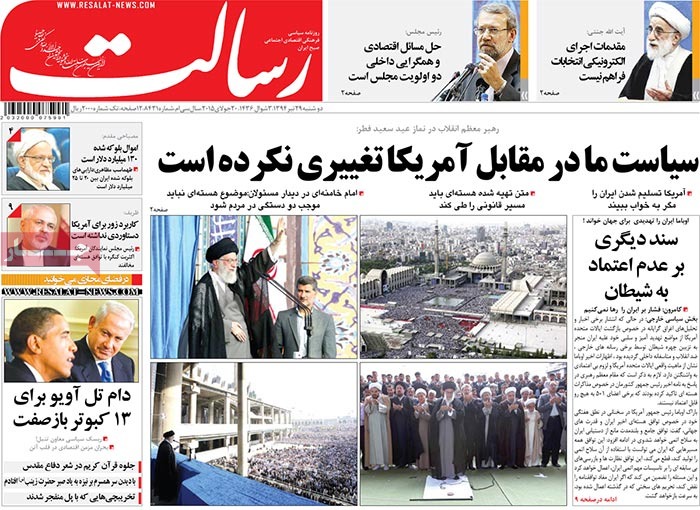
Resalat: “The stage is not set for holding electronic elections,” said the secretary of the Guardian Council.


A look at Iranian newspaper front pages on July 20


Rooyesh-e Mellat: In a threatening message, IS has said that it will soon make its presence in Saudi Arabia official.


A look at Iranian newspaper front pages on July 20


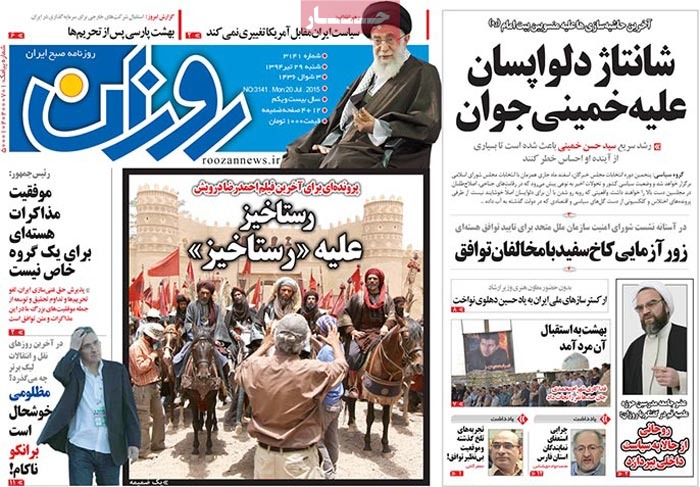
Roozan: “The breakthrough in nuclear talks is not limited to one group,” said President Rouhani.


A look at Iranian newspaper front pages on July 20


German vice-chancellor in Tehran heading big trade team

German-Economy

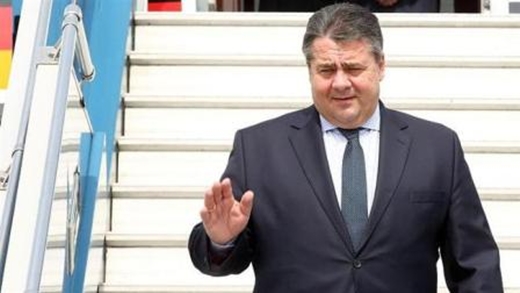
The Deputy to Chancellor of Germany who also serves as Minister for the Economy and Energy Sigmar Gabriel arrived in Tehran on Sunday at the head of a high-ranking economic and business delegation.

Gabriel, who is equivalent of a deputy prime minister and is the president of the Social Democratic Party of Germany (SPD), and his 60-member delegation are visiting Iran at the invitation of Oil Minister Bijan Zanganeh, Shana Petro Energy Information Network reported.

“This is the first high-ranking European delegation visiting Tehran in the wake of the nuclear agreement with P5+1,” Oil Ministry Director General for Europe, America and Caspian Sea Hossein Esmaeili said.

The visiting representatives from 10 major German firms as well as SMEs specialized in high-tech and industrial equipment will meet their counterparts in private and public sectors, he added.

According to the official, meeting with ministers of oil, foreign affairs, energy and industries, and members of the Iran Chamber of Commerce is on the visit schedule of the German delegation.

US in desperate need of Iran’s assistance

Iran-Obama

The former president of the Foreign Press Association, London, has said remarks recently made by the US president after reaching a historic nuclear deal with Iran, indicate that Washington is in dire need of Tehran’s assistance to get rid of the existing crises in the Middle East.

Mustapha Karkouti said, ‘The United States desperately needs Iran’s assistance’ is, in a nut-shell, the obvious essence of the content of US President Barack Obama’s speech and press conference last Tuesday and Wednesday, respectively, following the announcement of the nuclear deal with Iran last week.

The UAE-based Gulf News quoted Karkouti as saying, “One thing was absolutely reconfirmed through President Obama’s comments, which is the president’s solid commitment to seal his policy of physically pulling out of the region and Asia and opening a new page in the uncertain history of the Middle East. The latest agreement with Iran is undoubtedly designed to publicly recognize Tehran’s wider role in the region and beyond.

“It is a well-established fact that a Washington-Tehran mutual understanding was largely helpful to bring the US military withdrawal from Afghanistan in 2011 to an end, despite the presence of Iran’s American-led Western boycott regime. More importantly, it would have been almost impossible for the US to conclude its withdrawal from Iraq, had there been no general agreement with Iran to take up responsibility to secure the vacated predominantly Shiite areas, including the oil-rich South and the capital Baghdad.

“The latest nuclear deal provides Iran with a greater potential to improve its standing in the region. It will certainly help Tehran in taking yet another vital step of a strategic dimension, this time in the heart of the Arab region.”

How should the Iran nuclear deal be analyzed?

Final Talks

With a nuclear deal at hand, signatories to the agreement, that is to say, Iran and P5+1, are expected to do their own share to implement the deal. Some say the fact that the two sides will not take parallel measures in the implementation phase means Iran is giving concession(s) to the West, but there is no denying that the other party’s possible non-fulfillment of its promises will bolster national distrust of the West among the Iranians.

The landmark deal will overshadow the Islamic Revolution’s anti-imperialism approach if it relays the following message to Iranian society: resistance to imperialism does not pay off and we need to cooperate with it. One does not need a legal or political review to better shape the minds of people. What forms people’s cast of mind is the way the West behaves in dealing with the Iran nuclear deal.

Alef.ir, a news website, on July 16 released an analysis by Seyyed Farid Haji Seyyed Javadi on how to critique the nuclear deal Iran and six world powers inked after almost two years of intense negotiations and what is necessary for such critiques. The following is the translation of the analysis in its entirety:

Ever since Iran and P5+1struck a historic deal on July 14, its critics and defenders have opened up discussions about and carried out analyses of the text of the nuclear deal. The extension and complexity of the text of the deal provides parties to such discussions with multiple opportunities to critically analyze the landmark deal [and support their own interpretation and challenge that of the other side]. This is also a good opportunity for Iranian society to experience how to contemplate and judge international documents.

The fact remains that the deal’s objective achievements, not its legal provisions, will form our judgment about the agreement down the line. A look at Resolution 598, for instance, shows that although it entailed an article on international cooperation for reconstruction of the places damaged during the [Iran-Iraq] war, it was practically ineffective [on that front].

[Article Seven recognizes the magnitude of the damage inflicted during the conflict and the need for reconstruction efforts, with appropriate international assistance, once the conflict is ended and, in this regard, requests the Secretary-General to assign a team of experts to study the question of reconstruction and to report to the Security Council.]

However, another article – which revolves around the identification of the party which had to be held accountable for the hostility [the war] – has met Iran’s demand thanks to the atmosphere which prevailed in the world following Saddam’s 1990 invasion of Kuwait.

[Article Six requests the Secretary-General to explore, in consultation with Iran and Iraq, the question of entrusting an impartial body with inquiring into responsibility for the conflict and to report to the Security Council as soon as possible.]

The deal clinched in Vienna too will undergo many changes in its implementation phase thanks to the numerous details it contains. That’s why what will matter for Iran over time will be the objective achievements and genuine outcomes of the nuclear deal. If this deal can take Iran’s economic relations on the world stage to where they were eight years ago and reaffirm the country’s right to enrichment, its direct results will be welcomed and approved of by people.

The critics of the deal here at home are mostly concerned about what might happen beyond the clear-cut provisions of the deal. If the deal instills into society the mentality that there is no way to stand up to imperialism and that we have to cooperate with it, it will definitely betray the anti-imperialism principle of the Islamic Revolution.

Provision of a legal or political review of the nuclear deal is not an appropriate way to deal with such mentality. What forms the frame of mind in society about this deal, in the long and middle run, is the behavior the West, led by the United States, will display in the future.

Any focus on distinction between a legal review – which takes into account the provisions of the deal – and the real impacts of the deal on society’s political culture can affect the evaluation and critique of the nuclear deal, one way or another. For instance, the parties to the deal are not expected to act on their end of the bargain simultaneously and this could be viewed, from a legal angle, as a concession granted to the West. Nonetheless, the Western side’s possible failure to honor its commitments will boost and cement national distrust in the US and the West, by and large.

Therefore, building on the red lines – which have been previously defined to critically analyze the deal – should not lead to stereotyping. The logic and wisdom tapped in setting those red lines should be highlighted and included in the content of the critiques. If so, the audience of those critiques [a reference to people] can evaluate the West’s behavior through objective standards.

To that end, concentration on the parts [of the deal] which have no tangible, objective effects will be useless. For example, the line between suspension and lifting [of sanctions] remains blurred in practice, because such a distinction has no objective and palpable effect. However, a delay in removing the financial and banking obstacles will be understandable [by people].

Any critique made public should be proportional with people’s mentality and their sensitivities. Instead of focusing on the legal connotation of the words [and phrases in the deal], the critiques should underline the deal’s outcome for the public.

It would be a good idea for symbolic key words to be identified so that people can use them as a yardstick to judge the behavior of the Western side. For instance, the term “back out” – which [Director of the Atomic Energy Organization of Iran] Ali Akbar Salehi used in one of his interviews – was much more effective than over hundreds of pages of detailed critiques.

Those critics who are concerned about the [possible] losses and harms resulting from the bad implementation of the nuclear deal should find the main aspects by which they can critically analyze the West’s behavior as far as the implementation of the deal is concerned and establish criteria for such analyses.

These critics are expected to speak [their mind] according to the mental values and assumptions of the general public and set aside personal and collective attitudes. With that being the case, the West’s failure to make good on its promises, its obstructionist measures and strictness when it comes to the implementation of the nuclear deal will confirm the critics’ cynicism.

However, if the critics confine their analyses to the literature and provisions of the nuclear deal, they will pull in a limited audience.

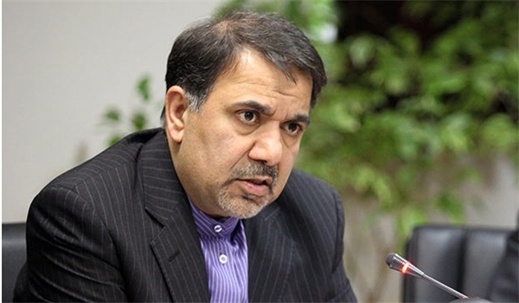
Iran planning to renovate airlines: Minister

Akhoundi

Iranian Roads and Urban Development Minister Abbas Akhoundi announced that the Iranian airlines will be renovated by purchasing new airplanes.

“Renovation plans have been devised for the Iran Air and Iran Aseman airlines,” Akhoundi said on Saturday.

Abbas Akhoundi reiterated that the renovation will help Iran regain its previous position as a key aviation hub in the region.

On Wednesday, Akhoundi informed that Tehran has been conducting negotiations with international aviation giants to purchase light passenger planes.

“We have negotiated with the French manufacturers of light passenger planes for short-distance flights,” Akhoundi told reporters.

The Iranian roads and urban development minister also pointed out that those US firms that have been registered in Europe may also supply such planes to Iran and can partner in Iranian projects.

Earlier this month, Akhoundi announced that representatives of several French firms are slated to visit Iran in September to help renovate the airports of Tehran and Mashhad.

Akhoundi made the remarks after his visit to France and his several meetings with French industrialists and tradesmen.

“France’s best investment companies will come to Tehran in September to help renovate airports of the capital Tehran and Mashhad,” Akhoundi said.

Akhoundi visited France to participate in the International Air Industry Exhibition in Paris on June 15-21.

[…]

Zarif, Salehi to brief lawmakers on nuclear deal

Zarif-Salehi

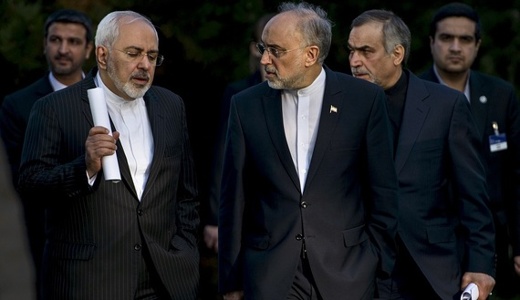
Foreign Minister Mohammad Javad Zarif and Head of the Atomic Energy Organization of Iran (AEOI) Ali Akbar Salehi are scheduled to appear before parliament on Tuesday to brief the lawmakers on the outcome of nuclear negotiations in Vienna.

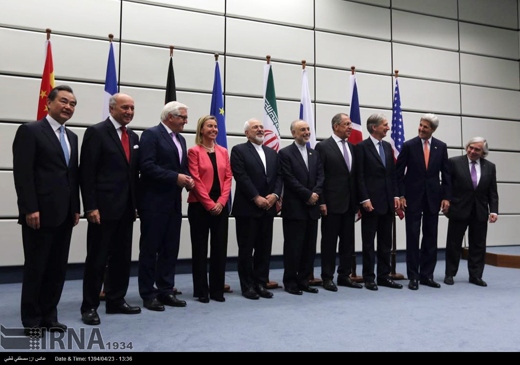
After 18 days of intensive negotiations in Vienna, Iran and the P5+1 – the United States, Britain, France, Russia and China plus Germany – finally arrived at a final deal on July 14 which is likely to put an end to a 12-year nuclear dispute.

The Iran deal contains 100 pages including the text and its annexes which were agreed upon by all the negotiating parties.