Thursday, April 30, 2026
Home Blog Page 4792

Iranian exports to EU up 14% in six months

81729805-70112105

Iran’s exports to the 28 member states of the European Union in the first half of 2015 witnessed a 14-percent increase over the corresponding period last year, according to data released by the EU statistical office, Eurostat.

The bloc’s imports from Iran during the six months reached €550 million, showing a 14-percent rise compared to €480 million for the same period in 2014, said the Eurostat report.

Total trade between Iran and the EU in the first half of the current year amounted to €3.705 billion — a rise of seven percent compared to the figure for the same period in 2014.

The value of Iran-EU trade in the corresponding period last year stood at €3.465 billion, the report said.

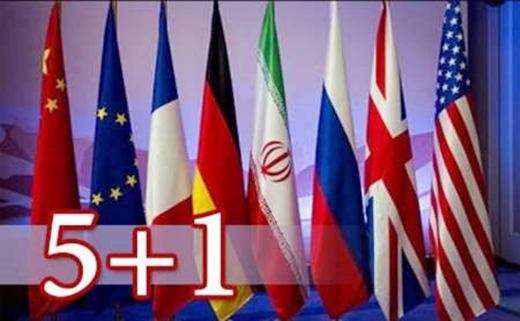
Experts expect Iran’s trade with the world, especially the European countries, to rise remarkably after the final nuclear deal between Tehran and P5+1 takes effect.

On July 14, Iran and six world powers reached an agreement on the text of a comprehensive 159-page deal on Tehran’s peaceful nuclear program. The deal envisages the removal of all sanctions once it goes into effect.

100+ former Iranian envoys, diplomats support JCPOA

81729766-70112046

More than 100 former ambassadors, consuls general, Iranian representatives at international organizations and directors of the Foreign Ministry have thrown their weight behind the nuclear agreement reached between Iran and P5+1.

In a statement, they said the Joint Comprehensive Plan of Action (JCPOA) drafted under the management of Foreign Minister Mohammad Javad Zarif opened a new chapter in Iran’s diplomacy which deserves to be exalted.

The signatories said while the deal cannot naturally meet every demand of Iran and the opposite party, it is the best one available under current conditions which secures Iranian nation’s main demand: recognition by world powers of its right to nuclear technology, and continued research and development, simultaneous with the removal of oppressive sanctions against Iran.

They said the Supreme Leaders’ prudent guidelines, president’s objective policy, and effective diplomacy along with resilience of the Iranian nation and major achievements of scientists as well as defense forces capabilities led to the successful conclusion of the deal.

“In the history of international relations, no similar case can be found in which world’s major powers hold long-run negotiations with a regional power which results in an equal give-and-take, and not in imposition of one side’s will,” read the statement.

The former envoys and diplomats also said JCPOA has elevated Iran’s international standing as well as its strategic options in the region and world, suggesting that the outcomes of the deal and the opportunities for Iran’s increased regional role will be manifested in the future.

The joint statement expressed concern over the Zionist regime’s plots to torpedo the nuclear deal, warning that creating problems in the way of its implementation will bring more harm to those who fan tension and instability by opposing it.

Spokeswoman slams Obama’s anti-Iran remarks

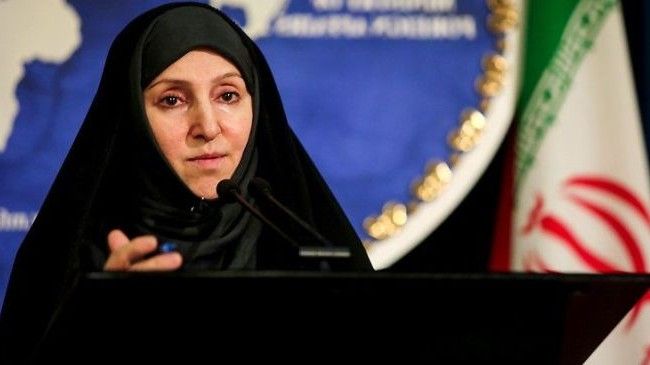
Iranian Foreign Ministry Spokeswoman Marziyeh Afkham

Iranian Foreign Ministry Spokeswoman Marzieh Afkham blasted the recent remarks by US President Barack Obama who threatened the Islamic Republic with military action.

Afkham’s remarks came after the US president told the Republican-dominated Congress that the military option against Iran will remain on the table for several years despite the nuclear agreement between Iran and world powers in Vienna on July 14.

“Repeated allegations by US officials which are made in line with the Zionist regime’s interests and to satisfy the pro-Israel lobbies show the American officials’ uncertainty and deep confusion when it comes to their own national preferences,” Afkham said on Saturday.

She said warmongers and the so-called advocates of diplomacy in the US both rely on illusionary, dangerous and horrific ideas which have so far inflicted irreparable damage on the world and are today one of the root causes of international insecurity.

“The Zionist regime is the most important source of instability and spread of terrorism in the Middle East and the US government’s support for this regime and the policy of creating and supporting the terrorist groups as well as training and equipping them have placed the US in the dock,” Afkham said.

The Iranian Foreign Ministry spokeswoman reiterated that the threat of military attack on Iran is a violation of the UN Charter and principles and will bring about international liability for the US government and officials.

Afkham said that the Islamic Republic of Iran would never accept any restriction in defending itself in political, military and security fields.

“Should Iran seek to dash toward a nuclear weapon, all of the options available to the United States — including the military option — will remain available through the life of the deal and beyond,” Obama wrote to Congress on August 19, the New York Times reported.

Iran’s presence at Expo Milano 2015 under scrutiny of Iranian media

DETTAGLIO_IRNA

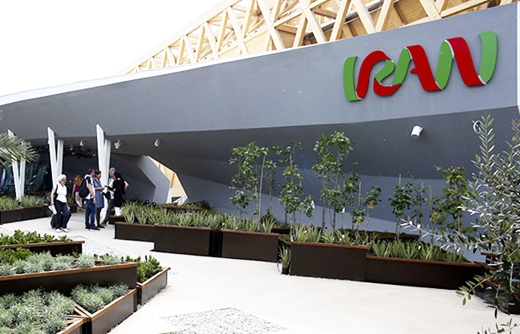
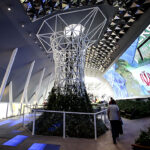
Iranian officials have tried to make the country’s pavilion at Expo Milano 2015 beautiful enough to attract visitors and make them familiar with Iran, but the pavilion has no feeling of Iran and the country’s [hand-woven] carpets and 2,500-year-long civilization are conspicuous by their absence in the expo.

Iranian Labor News Agency (ILNA) on August 16 released a report on Iran’s presence at Expo Milano 2015 and critically reviewed the performance of those in charge of the Iranian pavilion at the international event. The following is the translation of parts of that report:

The Expo is a place to introduce countries to each other and help visitors get familiar with the culture, economy and politics of other nations. Developed nations hold one expo every five years and this year Italy has hosted 147 countries which have come to Milan with their famous brands. World Avenue, the venue of the expo, is quite a distance away from the city center, but the visitors have access to public transport to get there.

[…]

World Avenue

[…] World Avenue – the exposition site – has only one intersection. Iran, Switzerland, Austria, the US, Germany, Turkey, Japan, Qatar, Russia, and a few other countries are located on the western side of the intersection. […]

Iran face to face with the US and Germany

[…] Visitors can see the US and then go to Iran’s pavilion [on the first floor] which is like a table cloth which displays the country’s four seasons. Iranian officials have not fared successfully in this regard, but the country’s pavilion still plays host to many people from other countries.

Iran and other nations

Young students are working in Iran’s pavilion as translators […]. They say they seek to introduce their country to foreign visitors in the best way possible.

At the entrance of the pavilion, a young student gives Iran’s flags to children and welcomes the visitors. They first watch different species of plants, but unfortunately there are no names or extra information of the species and where in Iran they grow.

Iran’s pistachios in the window

A few steps down the hall, visitors get a glimpse of flowers which carry no name tag or other information. Then they see pistachios and saffron in display windows. Although Iranians are famous [around the world] for their hospitality and generosity, there are no pistachios to entertain the visitors. […]

Iran’s art and culture on display on LED TV

Different films in English on Iran’s art and culture are screened on a big LED TV, giving detailed information about agricultural industries and Iran’s music. […]

Ground floor and Iran’s food

After watching the first floor, the visitors go to the ground floor where an Iranian restaurant is located. It is a private sector-run restaurant which uses Iran’s name to provide its customers with foods which are not excellent in quality. The [high] price and [not so good] quality of what it offers is noticeable in this restaurant. […]

No sign of Persian carpets and Iran’s ancient civilization  

There is no sign of Persian carpets and Iran’s 2,500-year-old civilization in the 5,000-meter-plus Iranian pavilion. Those in charge of Iran’s pavilion could have seized this opportunity if they had paid more attention to the content of the pavilion. If Iran’s carpets and history had been displayed in Italy, it would have been more useful for Iran, because at the heart of Europe people have no sufficient knowledge about Iran. A number of visitors asked about Iran’s civilization and wondered why nothing of that civilization is seen in Iran’s pavilion! […]


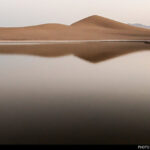
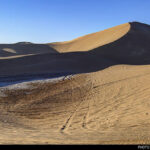
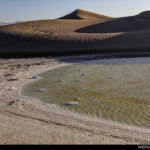
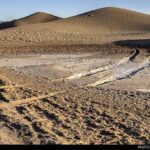
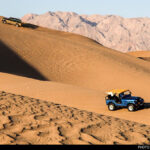
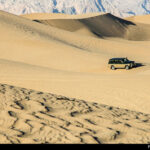
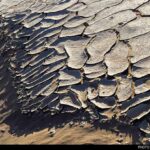
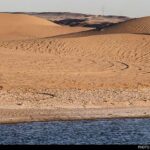
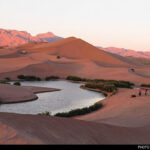
Manmade reservoir at the heart of desert in central Iran (PHOTOS)

desert0

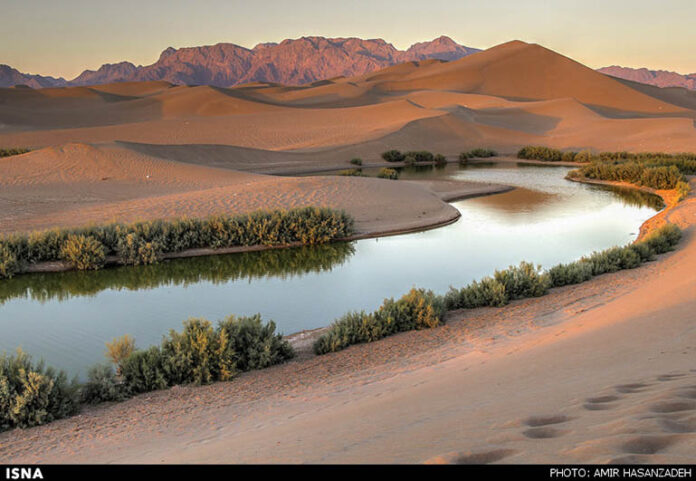
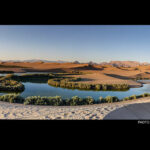
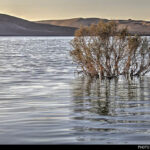
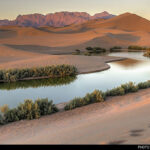
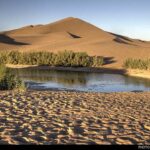
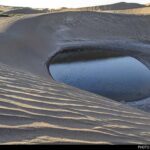
The water released by Yazd Sewage Treatment Facility has created a beautiful reservoir four km to the north of the provincial capital of Yazd.

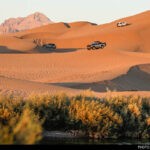
The reservoir, three km in length and one km in width, is encircled by reeds on its banks and is 1,145 m above sea level.

Given the shortage of water in the region, the reservoir has turned into a water hole for the wildlife. Birds flying over the region usually make a stop at the reservoir and migratory birds use it as a place for their winter stay.

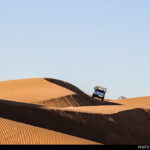
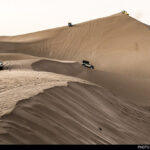
The water is used for irrigation of the city’s green belt. Over the weekends, the place is often visited by a large number of people who drive over in their off-road vehicles to spend some time in the desert.  

Images of the reservoir released by Iranian Students’ News Agency:

Leader decries schemes to create rifts among Muslims

Supreme Leader

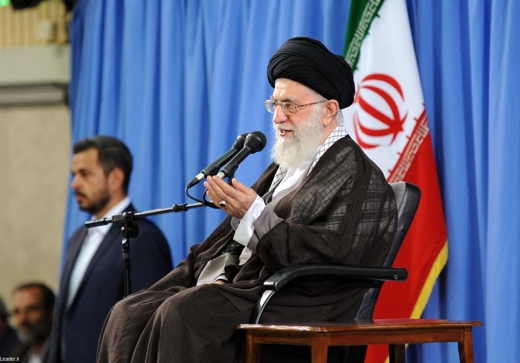
Supreme Leader of the Islamic Revolution Ayatollah Seyyed Ali Khamenei has lashed out at those who distort realities and sow discord among Muslims.

“Hajj does not only belong to us Iranians, but belongs to the Islamic Ummah and guarantees the continuation of Islam,” the Leader stated while addressing a group of Iranian Hajj officials in Tehran on Saturday.

The Leader added that Hajj symbolizes convergence among Muslim nations.

“Hajj is the real symbol of Islamic rapport and empathy,” Ayatollah Khamenei underlined, and went on to say “May God curse those who tried to alienate the minds [of people] from the reality and significance of Islam, and to divide Muslims into different groups with different motives.”

The Leader then took a swipe at efforts to aggrandize other nationalities against the grandeur of the Islamic community, saying, “Grandeur belongs to the Islamic Ummah.”

Iranian painter with no hands creates magnificent artworks

download (1)

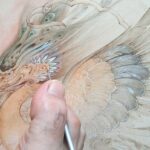
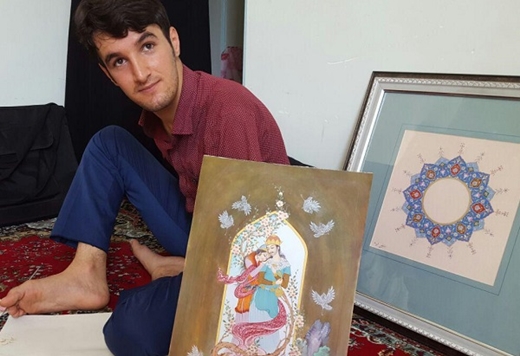
Rahim Azimi is a disabled Iranian artist in her early twenties who has lost his arms to an accident when he was only 10 years old. What makes the works of this young artist, who hails from Azerbaijan Province, distinguishable is that he just uses his feet to draw and paint.

The following is the translation of an excerpt of a report Amin, a daily, published on August 20 about the young artist who did not give up on his love of painting in spite of the curves life threw his way:

Pencils, paintbrushes, palettes and pieces of paper are strewn on the floor of his room which resembles an art gallery. In the corner, stands a small wardrobe where he keeps his citations and awards.

When asked about how he started using his feet to replace his hands in taking care of daily chores, Azimi said, “I was interested in education, so I decided to write with my feet. After practicing for a few months, I finally succeeded in writing with my toes.

Although at first, I went through a lot to excel at using my feet to get things done, I knew well that I could finally cut it.”

The young artist added, “I found it too challenging to put up with the difficult conditions at first, but with every passing day, I got better at using my toes to write and draw.”

Azimi described reliance on God, perseverance and his interest in drawing as the three factors contributing to his success.

He said, “It is a labor of love, yet I would want to sell my works someday, because that’s the only thing I can do to make money.”

On top of painting, Rahim can turn over the pages of newspapers on his own; he operates a finger-touch smartphone and a personal computer as well.


Former US negotiator: Zarif is a strategic thinker

Hillary Mann Leverett 1

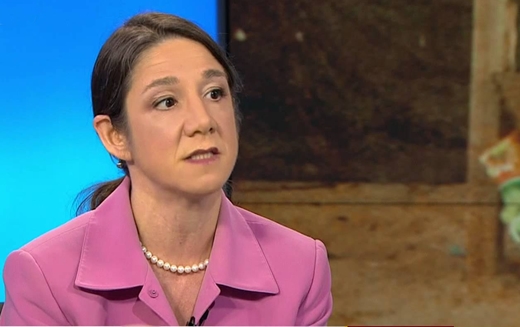
A former US negotiator has said that Iran’s Foreign Minister Mohammad Javad Zarif is a strategic thinker with unique characteristics and that the personal diplomacy he pursued during nuclear talks on the balcony of a Vienna hotel and through his tweets was very productive.

Hillary Mann Leverett served – in the Clinton Administration – as Political Advisor for Middle East, Central Asian and African issues [for the US Mission to the United Nations], Associate Director for Near Eastern Affairs at the National Security Council, and Special Assistant to the Ambassador at the US embassy in Cairo. She also worked in the US embassies in Saudi Arabia, the United Arab Emirates, Qatar, Egypt and Israel [in 1990-1991].

From 2001 to 2003, she was one of US diplomats who negotiated with Iranian officials over Afghanistan, Alqaeda and Iraq.

Tolou magazine – an Iranian weekly – has published an interview with Mrs. Leverett. IFP has translated into English the Farsi version of her remarks in the interview:

As a negotiator, how do you evaluate the Vienna talks?

Interaction between the United States and Iran was the core of nuclear talks, and such interaction helped the talks produce a result. In the meantime, these multi-lateral talks allowed the US to encourage fellow Western delegations to play a bigger role [in the talks] as it [Washington] was seeking to slow things down and pile pressure on Iran. This was evident in the final week of the talks in Vienna when the US was trying to meet a July 9 deadline.

In Washington, some analysts believed that it was the Iranian side which used this tactic to prod other P5+1 delegations to play a larger role. They argued that the Iranian delegation was encouraging Russia to insist that a UN Security Council resolution [on Iran] should lift conventional arms embargoes and other sanctions against Iran.

But my experience from the time I was a member of the US Mission to the United Nations tells me that Zarif and Lavrov know each other well from their previous stints in New York. I think they knew well about the interests of their respective governments as far as the provisions of [the UN Security Council] resolution went.

As you know, Mr. Zarif showed up at the balcony of Vienna’s Coburg Palace hotel and talked with reporters during nuclear talks or he tweeted his message to the world. What’s your take on such diplomacy?

After [an agreement on] a set of parameters [that outline the nuclear restrictions, monitoring and verification, and sanctions relief in a final Joint Comprehensive Plan of Action] was announced in Lausanne in early April, the American side launched a massive media campaign on its own preferred interpretation of those parameters in a bid to gradually instill its own view into the [minds] of the world public opinion.

The US built on this [campaign] to say that Iran has gone back on the commitments it agreed in Lausanne to honor. In turn, Mr. Zarif’s “personal diplomacy”, including his appearance on the balcony of Coburg Palace hotel and his Twitter messages, together with the media diplomacy efforts of the Iranian team was very much productive.

As a negotiator, what’s your take on the performance of the Iranian delegation headed by Mr. Zarif?

Since the appointment of Mr. Zarif as foreign minister, I predicted that personal relations between Zarif and [US Secretary of State John] Kerry would matter greatly as far as the conclusion of the talks was concerned. My experience in working with Dr. Zarif over Afghanistan in 2001-2003 suggests that he is one of the most fascinating and knowledgeable strategic thinkers one can have interaction with. I think it was – and still is – the reason why John Kerry wanted to spend more time with Zarif than with any other foreign minister.

Nonetheless, the international order has changed dramatically compared with the 2001-2003 period when I had the opportunity to work with Dr. Zarif. Between the end of Cold War era and 2003, the US was the unrivaled superpower of the world. Today the world is getting multi-polarized and it is not enough for Iran or any other country to solely have constructive ties with the US to protect its own interests.

What do you think about the negotiating strategy of the Iranian team and its difference with the Western teams?

What counts more in Dr. Zarif’s approach during the talks was his strategic concentration. Since day one [of the talks] he knew what he wanted and how he could achieve it. He was ready to do what it took to achieve his goal. This is an impeccable and highly valuable trait for a diplomat. He also has a strong personal educational background. Dr. Zarif speaks fluent English and knows how he can – as a negotiator – interact with Westerners effectively.

During the period when Dr. Jalili was in charge of Iran’s nuclear talks, which was an important stage for Iran, the country showed to the US that it would not give up its nuclear rights. In addition, it was in that period that assets were accumulated [in the country], something Dr. Zarif placed on the negotiating table so that he could ink an agreement which recognizes Iran’s nuclear rights.

The world is joyful about the Iran nuclear deal, but some in the US Congress who are provoked by Netanyahu are trying to kill this deal. Do you think this is likely to happen, and if yes, how will the world react?

Netanyahu and some others are trying to stand in the way of continued positive relations between the US and Iran. They are ready to do what is possible to have the Iran deal disapproved in Congress. They may succeed in their efforts, but President Obama has to get enough votes [to get the Iran deal through Congress or] to veto the congressional rejection of the deal [Only 34 Senate votes are needed to sustain a veto].

As a matter of fact, the opponents – under pressure from Congress to vote down the Iran deal – are seeking to delegitimize the deal on the US political landscape and pave the way for the next US president to shelve it.

Why are Israel and certain Arab nations in the Persian Gulf extremely concerned about and enraged at the nuclear deal? What is their strategy to scupper the deal?      

Israel and Arab nations’ concern about the deal has nothing to do with their fears of Iran’s [possible] atomic attack against them. They are concerned because Iran has maintained its might and capabilities to expand its regional influence even under pressures from the sanctions and continued animosity by the US which remains the world’s most powerful country.

Israel and Arab nations in the Persian Gulf are not concerned about Iran’s attack; [rather,] they are concerned that an independent and powerful Iran [may] limit their capability in (for instance) launching military action in Bahrain, Gaza and Lebanon, and in promoting Takfiri extremism in the region.

How can the nuclear deal contribute to Iran and the US in their fight against ISIL?

The nuclear deal potentially removes the obstacles standing in the way of Iran-US cooperation against ISIL. To establish such cooperation, the US should build on this deal and avoid cooperation with Saudi Arabia, Turkey and other regional allies which are trying to arm and train militants to topple the Syrian government. They should, instead, concentrate on a genuine solution that can include cooperation with the Assad government.

As the final question, do you have any recollection of the talks with Dr. Zarif during the days you were negotiating on Afghanistan?

Yes, certainly! Dr. Zarif and other Iranian diplomats with whom we held negotiations over Afghanistan and Alqaeda defied any cliché about the Islamic Republic I – as an American expert in the Middle Eastern affairs – had been fed with.

Up until 9/11, I would not dispute the traditional alliance between the US and Saudi Arabia, Pakistan and Israel. Nor would I question Washington’s hostility toward Tehran. Dr. Zarif and his colleagues showed to us how Iran played a highly constructive role in regional ties.

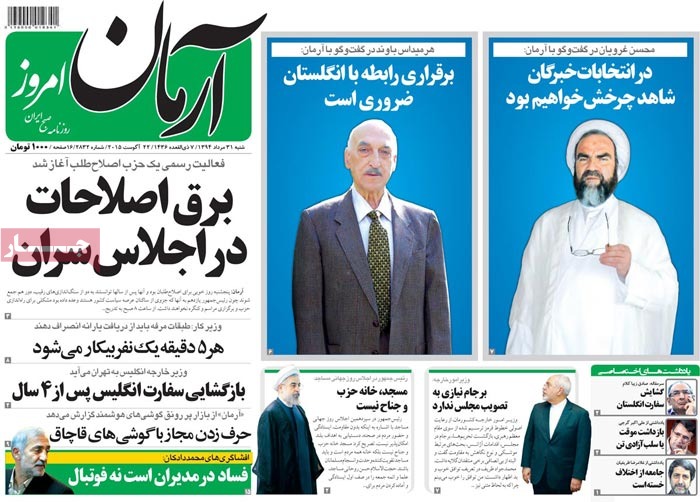
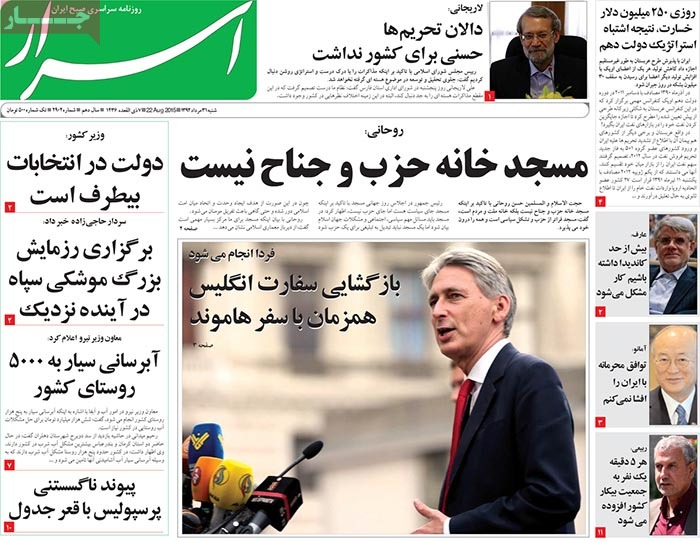
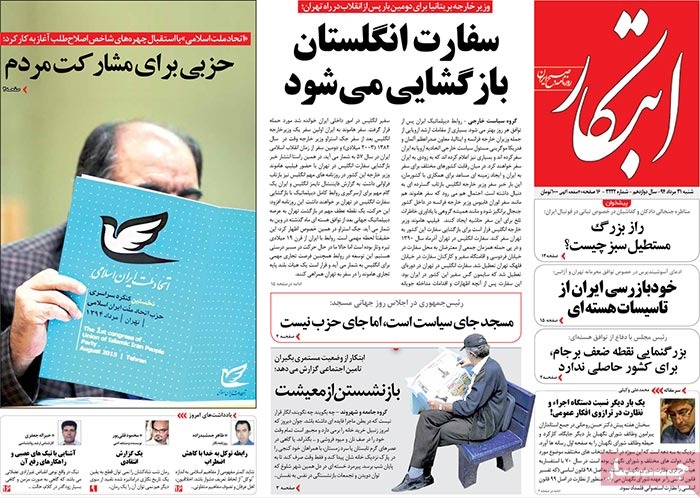
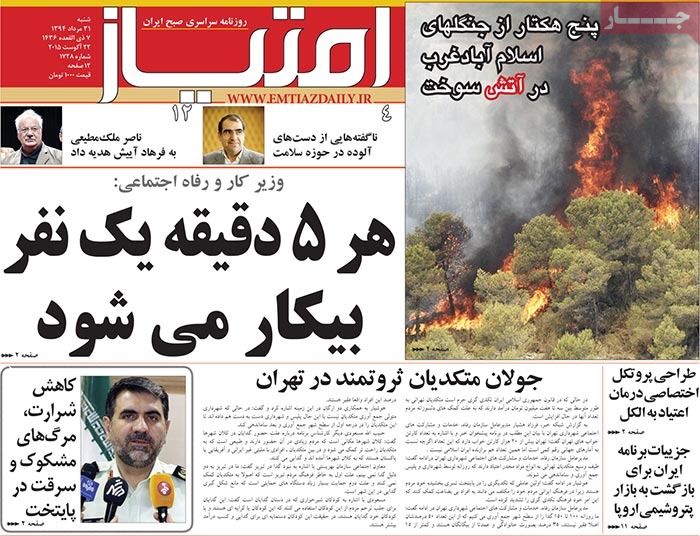
A look at Iranian newspaper front pages on August 22

Iranian Newspapers Headlines

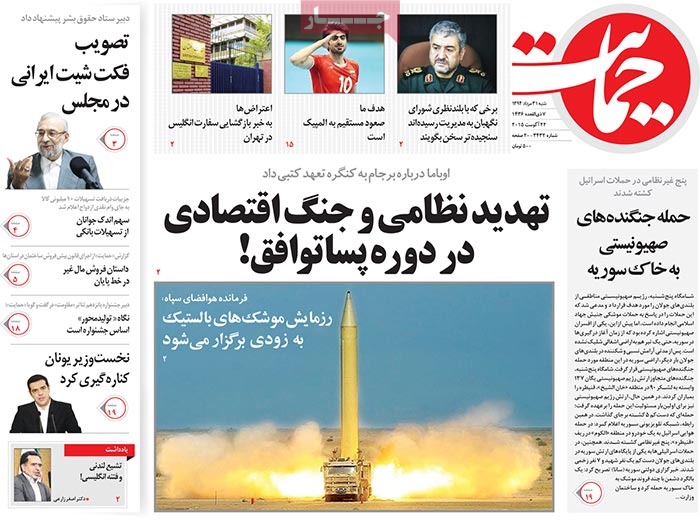
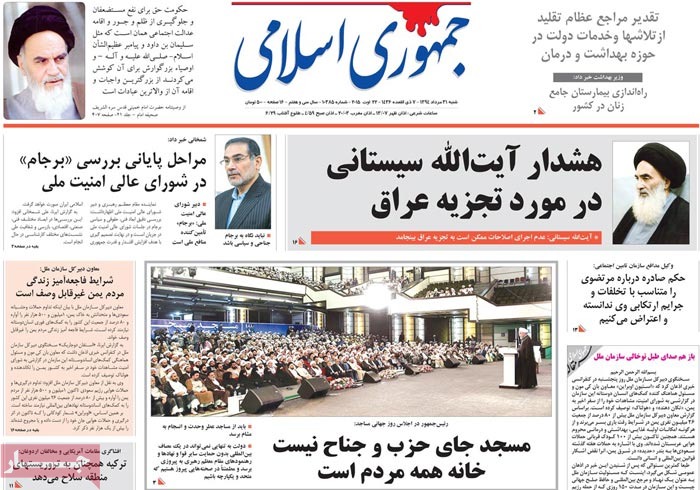
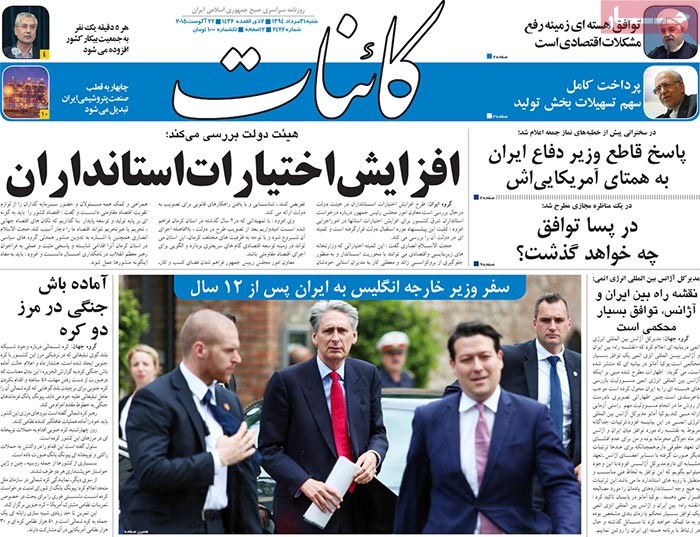
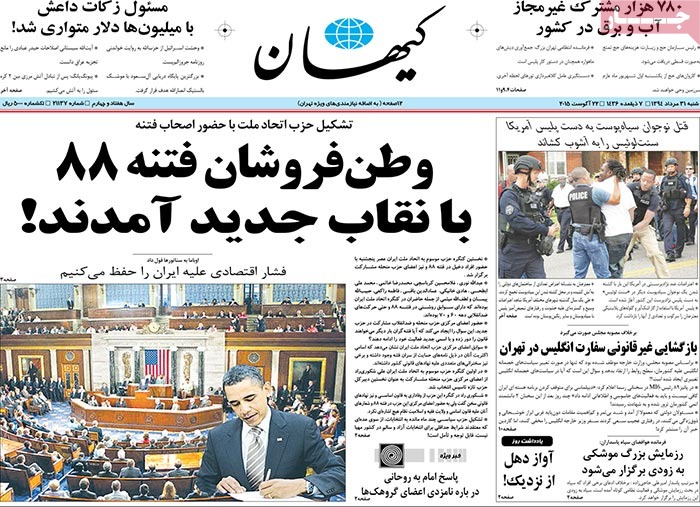
The reopening of the British and Iranian embassies in Tehran and London dominated the front pages of Iranian newspapers on Saturday. The comments of the defense minister on Iran’s military doctrine also appeared on the cover of dailies.
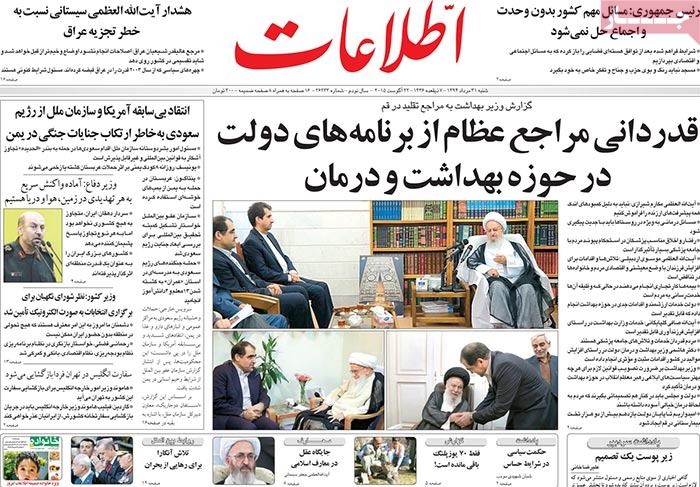
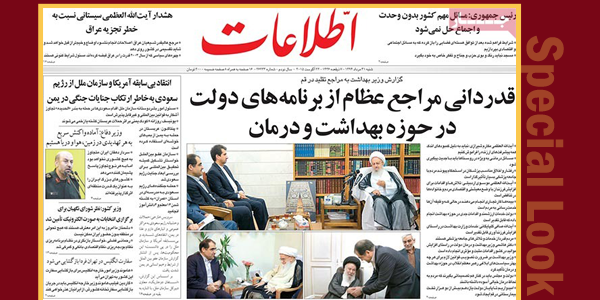
Ettela’at: Sources of emulation have thanked the Rouhani government for its plans to promote healthcare.

It came as the health minister met with Grand Ayatollahs Makarem Shirazi, Mousavi Ardebili, and Safi Golpayegani.


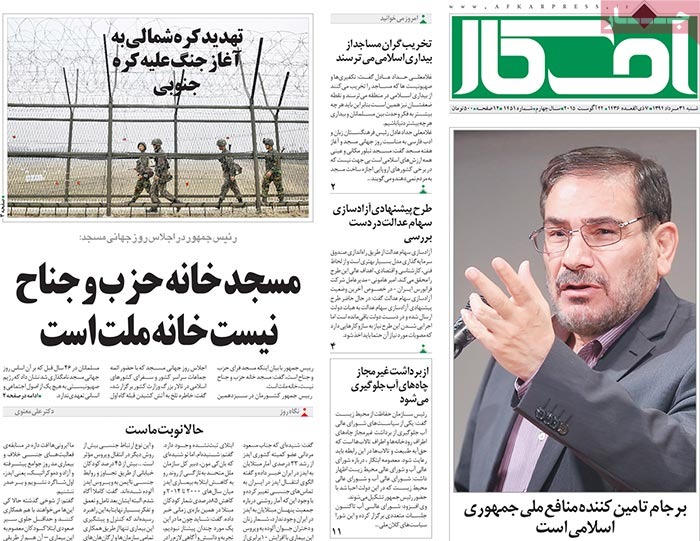
Afkar: “The Joint Comprehensive Plan of Action serves the interests of the Islamic Republic,” said the secretary of the Supreme National Security Council.


A look at Iranian newspaper front pages on August 22


Arman-e Emrooz: “Mosques are places of worship, not partisanship or factionalism”, President Rouhani said.

Arman-e Emrooz: Foreign Minister Zarif has said that the Joint Comprehensive Plan of Action does not need to be ratified by parliament.


A look at Iranian newspaper front pages on August 22


Asrar: A daily loss of $250 million is the result of the strategic blunders of the 10th government.

Asrar: “The ranks of the unemployed grow by a dozen an hour”, said the minister of labor.


A look at Iranian newspaper front pages on August 22


Ebtekar: “Blowing the weaknesses of the Joint Comprehensive Plan of Action won’t serve the country’s interests,” said Parliament Speaker Ali Larijani.


A look at Iranian newspaper front pages on August 22


Emtiaz: Iran has worked out plans to return to the European petrochemical market.

Emtiaz: A protocol has been formulated for the treatment of alcohol addiction.


A look at Iranian newspaper front pages on August 22


Hemayat: “Those who have risen to power thanks to the generosity of the Guardian Council should make well thought-out comments,” said the commander of the Islamic Revolution Guard Corps.
[Major General Mohammad Ali Jafari took a jab at the president for his comments about the Guardian Council which oversees elections and vets candidates.]


A look at Iranian newspaper front pages on August 22


Jomhouri Islami: “The review of the Joint Comprehensive Plan of Action is in its final stages at the Supreme National Security Council,” said the secretary of the council.
 

A look at Iranian newspaper front pages on August 22


Kaenat: A first visit to Iran by a British foreign secretary in 12 years


A look at Iranian newspaper front pages on August 22


Kayhan: The IS treasurer has made off with millions of dollars in donated money!

Kayhan: The traitors of the 2009 sedition have emerged under a new mask.

The seditionists are members of a new party called Unity of Nation.


A look at Iranian newspaper front pages on August 22


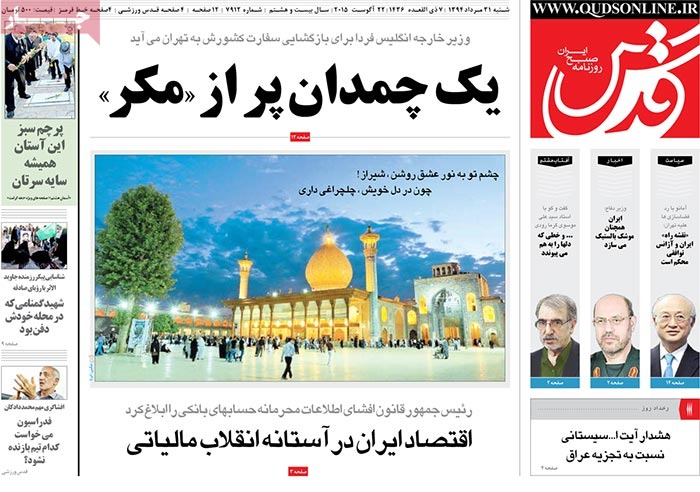
Qods: Iran’s economy on the verge of a tax revolution

The president has communicated a law that makes it possible for authorities to look into the banking information [of those suspected of tax evasion].


A look at Iranian newspaper front pages on August 22


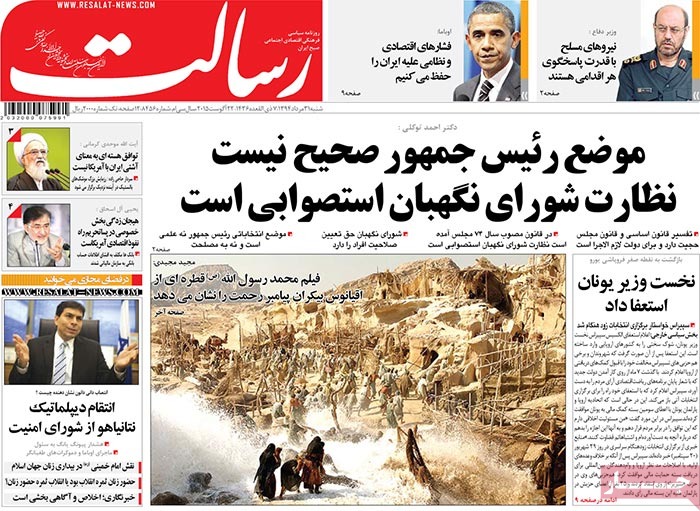
Resalat: “The nuclear deal with P5+1 won’t amount to reconciliation with America,” said Tehran’s Friday prayer leader.


A look at Iranian newspaper front pages on August 22


Highlights of Ettela’at newspaper on August 22

Ettelaat Highlights-post

 Sources of emulation have thanked the Rouhani government for its plans to promote healthcare.

It came as the health minister met with Grand Ayatollahs Makarem Shirazi, Mousavi Ardebili, and Safi Golpayegani.

 President Rouhani has said that the country’s main problems won’t be settled unless through unity and consensus.

The post-deal era has created a condition for the country to focus on social and economic issues, he further said.

 Grand Ayatollah Ali Sistani has warned of the threat of Iraqi disintegration.

The senior Shiite cleric has said that failure to introduce reforms might see things get worse.

 The unprecedented criticism of the UN and the US of Saudi Arabia for committing war crimes in Yemen

UNICEF has said as a result of Saudi airstrikes eight Yemeni children get killed or wounded on a daily basis.

 The defense minister has said that the Iranian armed forces are ready to counter any threat on land, in the air or at sea.

Brigadier General Hossein Dehghan said that Iran would not strike first, but our response would make any potential aggressor regret their decision.

 The interior minister has said the conditions set by the Guardian Council to hold electronic elections have been met.

He further said that today our enemies admit that in the absence of Iran no major development in the region is possible.

 The British Embassy in Tehran would reopen tomorrow.

The British foreign secretary will be on hand for the reopening of the mission.