Saturday, December 27, 2025
Home Blog Page 4788

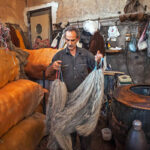
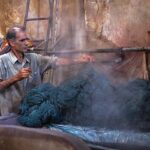
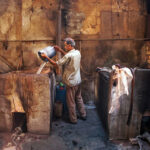
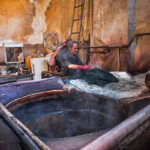
Zoorkhaneh (PHOTOS)

Zoorkhaneh00

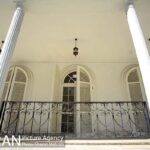
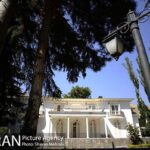
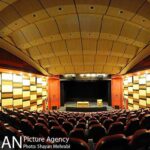
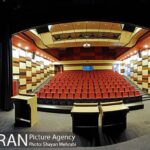
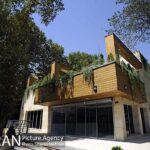
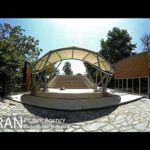
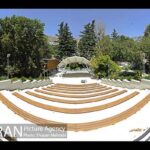
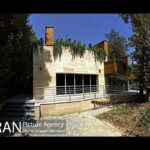
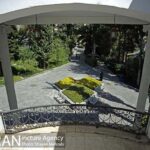
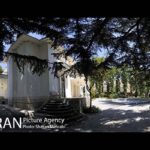
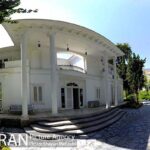
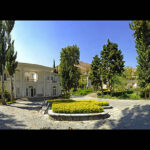
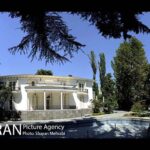
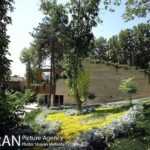
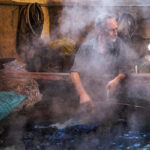
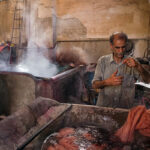
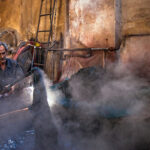
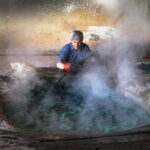
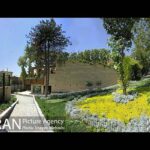
Zoorkhaneh (traditional Iranian gymnasium) features a system of athletics originally used to train warriors. It is believed to have been pioneered by Pourya-ye Vali, who was famous for his chivalrous behavior and strength, about 700 years ago.

The traditional sport is assumed to be much older; ancient Iranians practiced traditional wrestling to build up their physical stamina.

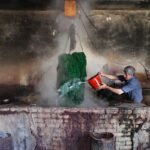
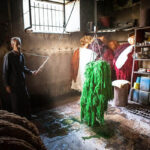
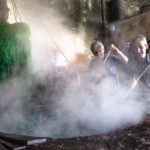
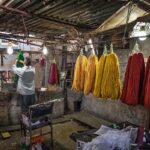
Images of Zoorkhaneh posted online by Tasnim News Agency:

Germany to set up Bank in Iran: Official

139404111551065115612554

Central Bank of Iran (CBI) Governor Valiollah Seif announced that in a recent visit by a high-ranking German delegation to Tehran, it was agreed that Germany establish a bank in Iran.

In a meeting with representatives of Tehran Chamber of Commerce, Industries, Mines and Agriculture on Monday, Seif said that there is no restriction for foreign banks to establish financial institutions in Iran.

“According to the regulations of free trade zones, foreign investors can establish new banks or bank branches in these zones,” he said.

Seif further pointed to his recent meeting with the German economic delegation, saying it was decided in the meeting that the Germans launch a bank in Iran.

Back on July 19, a 100-strong German delegation, headed by Vice-Chancellor and Minister for Economic Affairs and Energy Sigmar Gabriel, arrived in Tehran to meet with top Iranian officials and hold talks on ways to boost economic ties.

[…]

Experts believe that Iran’s economic growth will rise remarkably after a nuclear deal it struck with world powers on its nuclear program in July takes effect.

Iran billed ‘most lucrative’ hospitality market

fa6898dc-b904-4f1b-b5bf-8503e31fc828

Hotel groups in Persian Gulf Arab states are seeking to boost their portfolios in Iran as they see the country emerging as the most lucrative hospitality development market.

Iran has an ambitious target to increase annual visitor count by five folds to 20 million by 2025 in order to generate $30 billion a year.

International hoteliers are heartened by the plan and spurred by the recent finalization of nuclear talks, they see the ground being paved for expansion of the country’s infrastructure and industrial base.

“There has already been talk of an investment of $185 billion in oil and gas projects, as well as further development of the country’s metals and automotive industries, while general trade is certain to rise which will give a tremendous boost to the region,” president and CEO of UAE-based Cristal Hotels Peter Blackburn says.

The legion of traders, entrepreneurs and politicians is already trickling in and Tehran is struggling to offer suitable and sufficient accommodation.

“In addition to business interests, there is considerable demand for Iran as a new tourism destination,” Blackburn told the Arabian Business.

“And we can see potential to grow in all sectors in the country, taking advantage of new financial incentives as well as the transformation of the image of Iran in global markets,” he added.

According to Iranian officials, hotel groups from Germany, Greece, South Korea and Singapore have recently traveled to Iran for talks.

Europe’s largest hotel group Accor is reportedly building two four-star hotels at Imam Khomeini International Airport outside the Iranian capital.

The UAE-based Rotana plans to open a five-star 600-room hotel in Tehran this year and another in the pilgrimage city of Mashhad.

Head of the Iran Touring and Tourism Investment Company (ITTIC) Mohsen Gharib has said the country has to prepare for a “tsunami” of foreign tourists. But the torrent is on course to pose serious challenges, given Iran’s underdeveloped hospitality market.

Majority of Iranians support JCPOA: Araghchi

araghchii

Deputy Foreign Minister and top nuclear negotiator Seyyed Abbas Araghchi said on Monday that according to opinion polls the majority of Iranians support and are pleased with the Joint Comprehensive Plan of Action (JCPOA).

The deputy foreign minister who made the comment at a meeting with university researchers and media analysts did not offer statistics on the opinion polls he mentioned.

[…]

Araghchi praised the political growth and maturity of the general public in recognizing national interests and the macro-scale security sensitivities of the country, giving them assurances that President Rouhani’s Cabinet tries to observe maximum transparency in informing the public.

“With all due respect for surveys on Iranian nation’s opinion of JCPOA, the agreement’s international and regional aspects are worth thorough review,” said the top member of the Iranian nuclear negotiation team.

US playing with ISIL pawn: Iran parliament speaker

ad45e974-0b7a-46a2-9cf1-79e123cb1b47

Iranian Parliament Speaker Ali Larijani says the United States is using the ISIL Takfiri terrorist group as a means to advance its own interests in the region.

“It seems that the US is playing with the ISIL pawn in the region,” Larijani said Monday in a meeting with visiting Serbian Foreign Minister Ivica Dačić.

The top Iranian legislator said that a lack of serious efforts by the US in dealing with ISIL has enabled the terrorist group to freely operate in the region.

Larijani said such a policy has further emboldened ISIL terrorists to press ahead with their crimes, which is detrimental to peace and security in the region.

Drawing a comparison between the developments in the Balkans in the early 90s and the current situation in the Middle East, Larijani said in both cases “intervention by outside elements” hampered the restoration of tranquility.

The Serbian foreign minister, for his part, criticized the international community’s double standards vis-à-vis the war on terror, saying the policy has exacerbated violence and extremism.

Dačić slammed the big powers for their interventionist policies in various parts of the world, saying they sow discord among ethnic and religious groups with the aim of disintegrating big countries.

He said such policies further intensify instability across the world.

Iran-Serbia business council to meet

Earlier in the day, Dačić also met with Iranian Foreign Minister Mohammad Javad Zarif and the two top diplomats discussed ways of boosting bilateral relations, especially in business and economic fields.

During the meeting Zarif welcomed a proposal by Dačić for the holding of the 14th Iran-Serbia Joint Economic Committee.


cc8ae8eb-40ad-4914-a9c5-bb572e6f293c


Zarif welcomed the proposal, saying, “In this regard, an economic delegation from Iran’s government and private sectors will head for Belgrade in the future.”

Referring to the countries’ long-standing and favorable relations, Zarif expressed hope for the development of bilateral cooperation in political, economic, energy, agricultural, parliamentary, cultural, scientific, and academic areas.

The Serbian minister, for his part, voiced Belgrade’s readiness to open a new chapter in ties with the Islamic Republic in the political, economic, and parliamentary fields.

The Serbian official also felicitated Iran on the conclusion of nuclear talks between Tehran and P5+1 – the United States, Britain, France, China, Russia and Germany – in the Austrian capital Vienna last month.

First the neighbor, then the home; simply a piece of ethical advice or a strategic necessity?

Zarif

Mohammad Javad Zarif, the foreign minister of the Islamic Republic of Iran, has published an article in Arabic in four regional newspapers, namely Lebanon’s Assafir, Qatar’s Al-Sharq, Alrai of Kuwait and Ashorooq of Egypt, in which he has described friendly ties with neighboring countries as a priority of the Islamic Republic.

The following is the translation of the article whose Farsi version appeared on the website of the Ministry of Foreign Affairs on August 3:

First the neighbor, then the home is a sagacious piece of advice underscored by the ancient tradition of our region and by the monotheistic religion of Islam, which bonds all of us together. In the modern world, this farsighted piece of advice which dates back 14 centuries is an undeniable imperative. Welfare and security will only be available [to a nation] in surroundings blessed with these two great gifts.

The first priority of Iran is to have solid, good relations with its neighbors. That [policy] has been reiterated and pursued, especially since the new government took office in Tehran. My regional tour that took me to Kuwait, Qatar and Iraq immediately after Iran struck a historic deal with P5+1 in Vienna was in line with the same foreign policy strategy of the Islamic Republic.

Presently, this region of the world is restive and exposed to grave threats which target the social foundations and the culture of many Muslim nations. Iran has built on the flexibility of its population and, at the same time, on its resistance in the face of domination to open new chapters in constructive interaction [with the rest of the world]. Thank God, this has helped it cling to stability and security. Still, it cannot remain indifferent to the massive destruction in its surroundings. Our experience has taught us that instability and unrest know no bounds. Today, the security of no country in this globalized world can be guaranteed in an insecure environment.

The Vienna accord was an imperative start for our region. Not only does it not harm the interests of any of our neighbors, but it constitutes an achievement for the entire region, because it brought to an end an unnecessary 12-year-long dispute that posed more threat to our region than anywhere else.

It is now time to get on more important things, chief among them, launching a quest that allows Iran and other regional countries to uproot the factors that fuel tension and mistrust in the region. Establishment of a regional assembly to promote dialogue in the Persian Gulf and at a later stage among all Muslim nations in the Middle East to facilitate interaction is a necessity which should have been addressed long ago.

Such regional dialogue should be based on joint goals and some general principles signed off on by regional countries. Respect for sovereignty, territorial integrity and political independence of all nations as well as for their inviolable borders, non-intervention in the internal affairs of countries, peaceful settlement of disputes, avoidance of threats or use of force, and promotion of peace, stability, progress and prosperity top the list of such principles.

We all have to accept that gone is the time of zero-sum games that suggested you either win or lose. The path to sustainable security does not go through exposing others to insecurity. No nation can cling to its interests without taking account of the interests of others. Whether we like it or not, that is an unavoidable destiny. “And do not dispute and [thus] lose courage and [then] your strength would depart; and be patient. Indeed, Allah is with the patient.” (Al-Anfal Chapter of the holy Koran, Verse 46)

This inevitability, though, does not prescribe bitter interaction with the enemies. Rather, it is a sweet process of affinity among members of a family who have been away from each other for a while. “The believers are but brothers, so make settlement between your brothers.” (Al-Hujurat Chapter, Verse 10)

Nowhere in the world is the importance of such mechanisms more evident than in the Persian Gulf and the Muslim Middle East. The need for an intelligent assessment of regional complexities and adoption of sustainable policies to counter them is undeniable. The fight against terrorism is one such example. No one can take on violent extremist groups like the so-called Islamic State – which is neither Islamic nor a state – in Iraq as they promote these groups in Yemen and Syria in parallel.
If we were to choose one of the ongoing regional tragedies as a topic to launch serious discussions about, Yemen would be a good example. Iran has put forth a rational, practical approach to end this painful, unnecessary crisis.

The four-point plan Iran has proposed calls for an immediate ceasefire, shipment of humanitarian aid to Yemeni civilians, facilitation of talks among Yemeni groups in their country and eventual formation of a broad-based government of national unity. After consultation with some neighboring countries and other players, we presented a similar initiative two years ago to help peace and stability return to Syria.

In parallel with efforts to end the crisis in Yemen, the Syria initiative can be placed on the agenda in cooperation with other Islamic countries under the auspices of United Nations mechanisms.

At the same time, these strategic talks can be used to take definitive steps and develop a better understanding to address issues such as terrorism and extremism, prevent sectarian and tribal conflicts, diversify scientific and industrial cooperation, and expand and upgrade relations among Islamic countries in the region.

Peaceful nuclear cooperation could be a perfect example of such collaboration. Iran and fellow Muslim countries in the Middle East are entitled to the benefits associated with peaceful nuclear technology in keeping with international law.

Cooperation of all regional countries to secure such objectives is imperative. Such collaboration can pursue the following: Turning enrichment facilities into a regional hub to produce nuclear fuel in cooperation with Islamic nations on the technical front, and intensifying international efforts to create a nuclear-free Middle East on the political front.

Finally, as Muslim nations of the Persian Gulf and the Middle East, our religious, cultural, political and geographical common ground give us all the necessary tools to launch constructive cooperation that benefits the people of the region and the entire world.
The numerous challenges we face in the region are so serious that we should not use ethnic issues and personal differences to hold up any longer the courageous, farsighted launch of critical cooperation to target the root causes of unrest in the Muslim Middle East, the Persian Gulf in particular.

We should not pin our hopes on the very same ones who have played a role in the creation of these problems to settle them for us. This is a unique opportunity to interact and our people rightfully expect us not to blow it. “And say, ‘Do [as you will], for Allah will see your deeds, and [so, will] His Messenger and the believers.”’ (At-Tawbah Chapter, Verse 105)

A dhow workshop in southern Iran (PHOTOS)

boats0

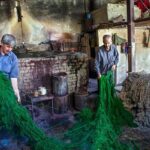
The port city of Kong in Hormozgan Province is home to workshops where sailing boats are built.

The following are images of a dhow workshop released online by the Iranian Students’ News Agency:

Iranian stylists show their stuff at festival (PHOTOS)

stylists504

At a festival held in a Tehran park late in July, male stylists tried to put on display their skills to cut hair.

Images of the festival released online by Mehr News Agency:

Official: Positive signals are coming from Saudi Arabia

amir-abdolahian1

Iran’s deputy foreign minister for Arab and African affairs says that Tehran has received positive signals from Riyadh and is waiting to see what the Kingdom does in practice.

Hossein Amir-Abdollahian made the comment in an interview – with Al-Alam News Network – which covered a wide range of questions, including ties with regional countries and the fight against ISIL. The following is the translation of parts of his remarks in the interview as reported by entekhab.ir on August 3:

Iran’s policies

Interaction with neighbors and regional countries tops the list of Iran’s foreign policy priorities. The eleventh government is trying to pay more attention to its main priority [ties with regional nations] after the Iran nuclear deal. To that end, Tehran is seeking to deepen ties with regional countries on all fronts, including environmental and security issues. A new opportunity has opened up for the region to take appropriate measures to get out of regional crises.

Iran held talks with P5+1 simply on the nuclear issue. The Foreign Ministry has had no plan for talks with world powers on regional issues, because Tehran believes regional questions should be solved by regional nations.

Saudi Arabia

The Saudi solution to regional problems, especially its aggression against Yemen, is a strategic blunder. Iran does not approve of this Saudi approach, but seeks to help Tehran-Riyadh ties return to previous levels. Iran and Saudi Arabia can have constructive interaction to both settle bilateral differences and solve regional problems. […]

I met with Saudi Foreign Minister Adel Al-Jubeir on the sidelines of an Organization of Islamic Cooperation conference in Jeddah and provided transparent and frank answers to his transparent comments on regional questions.

At that meeting, we agreed that diplomacy is the only way forward to remove misunderstandings and set the stage for the two countries to help settle regional disputes. We agreed that Iran and Saudi Arabia should launch straightforward, constructive talks, play a positive role in the fight against extremism and terrorism and help restore security and stability in the region.

I heard positive remarks from Mr. Al-Jubeir there. We hope what he said will materialize in practice. We also hope the Saudis pave the way for working out a diplomatic solution in Yemen, Syria, Lebanon and other regional countries.

We have received positive signals from the Saudis, but they are just messages. We are waiting to see what Saudi Arabia does in practice. We will respond positively if Riyadh plays a constructive role. Saudi Arabia is expected to act insightfully, stay away from war, stop the killing of civilians in Yemen and focus on diplomatic approaches in its regional policies.

Bahrain

[…] If Iran had intended to get involved in the Bahraini question, the situation in the Persian Gulf country would have been different. Authorities in Bahrain are creating security scenarios simply to suppress public demands. […] Manama’s resort to force and its human rights violations have widened the gap between people and the government. The Bahraini government is expected to return to the diplomatic path and reconcile with its people. Now that the stage has been set for regional cooperation, Manama is expected to play a constructive, not destructive, role. Iran has always supported a national dialogue and diplomatic solution in Bahrain.

Syria

Regional players have changed their Syria policies, stressing the need for a diplomatic, not military, solution to the Syrian crisis. We have held constructive talks with Mr. Staffan de Mistura [the UN special envoy in Syria] whose new initiatives will be discussed at the UN Security Council soon. […] The Syrian foreign minister will be in Tehran later this week to talk with his Iranian counterpart on the pursuit of Iran’s solution to his country’s crisis.

The nuclear deal 

The Iran nuclear deal revived a long-forgotten concept in the international relations: diplomacy and dialogue can solve the most complicated of political problems. Another message the deal carried was that it is possible to let go of war and walk down the path of diplomacy to reach solutions. It can set an example for regional countries to follow. The deal showed to regional nations that they can solve all regional crises through diplomacy and without foreign interference.

Fight against ISIL

Iran and Turkey have strategic ties, although they do not see eye to eye over Syria’s future. Turkey’s security matters to Iran, but Tehran does not support measures which endanger the sovereignty of Turkey’s neighbors. The fight against terrorism, especially on ISIL, by Turkey or any other country should be in coordination with the Syrian and Iraqi governments. Countries should not take measures which violate the territorial integrity and sovereignty of neighboring countries. […]

Cooperation with the US

Iran was among the first countries to help Iraq and Syria in their fight against terrorism and ISIL in the region. Tehran has no plan to enter partnership with the US against ISIL. We will continue to offer assistance, including consultation, to Baghdad and Damascus.

The US has its own plans for taking on ISIL. Washington has adopted double-standard policies on terrorism. We have no contact or cooperation with the US on fighting ISIL. In the future, Iran will simply help those regional countries which have been targeted by terrorist threats.

Israel

[…] The Zionist regime’s officials make comments [on Iran] out of fear, weakness and concern. The nuclear deal Iran has clinched with P5+1 has raised the regime’s concerns. Western officials have repeatedly said that the Iran nuclear deal has boosted Israel’s security, but the fact remains that the Zionist regime is now at the nadir of its power.

Lebanon

The political future of Lebanon is of great significance to Iran, so is this country’s security. Iran supports the finalization of the political process in Lebanon and the pick of a president in the Middle Eastern country. We hope diplomatic efforts will bear fruit in the next several weeks and Lebanon can enjoy more security and move toward bolstering its political stability.

Egypt

Iran has always welcomed establishment of sustainable, constructive ties with Egypt. It is now up to the Egyptians to decide about the development of relations with Tehran. Talks at political levels are ongoing between the two nations. Iran approves of Egypt’s stance on taking on extremism and terrorism in the region. We hope the challenges in Egypt can be overcome and the demands of revolutionary Egyptian people can be met.

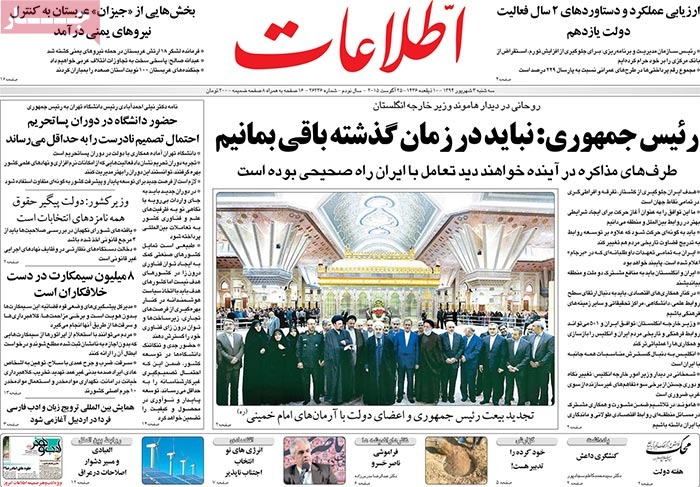
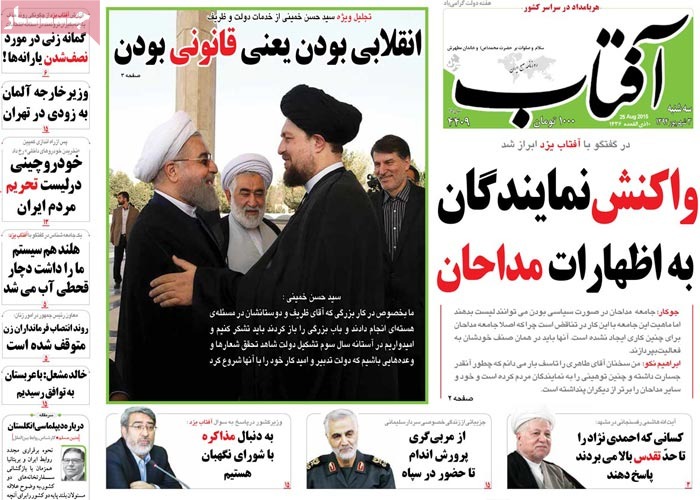
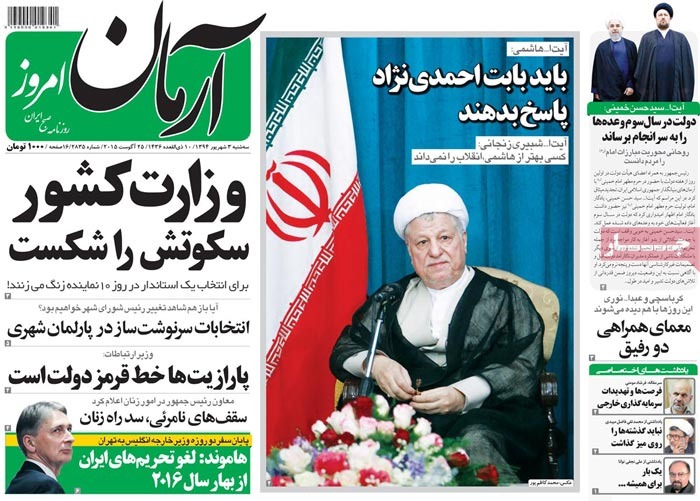
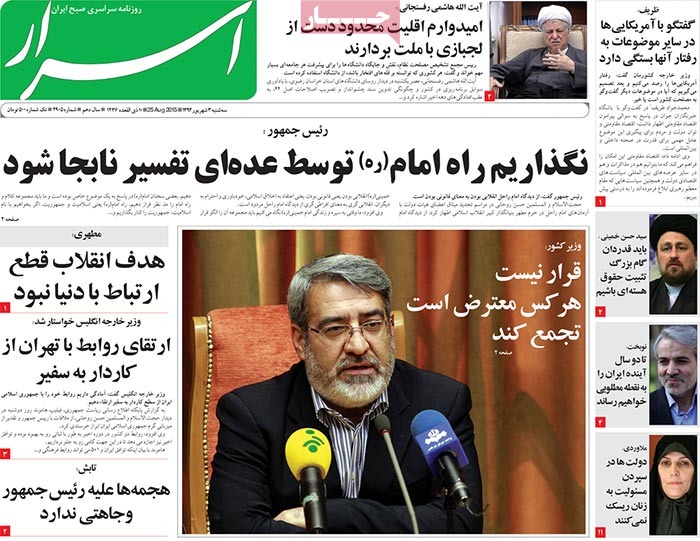
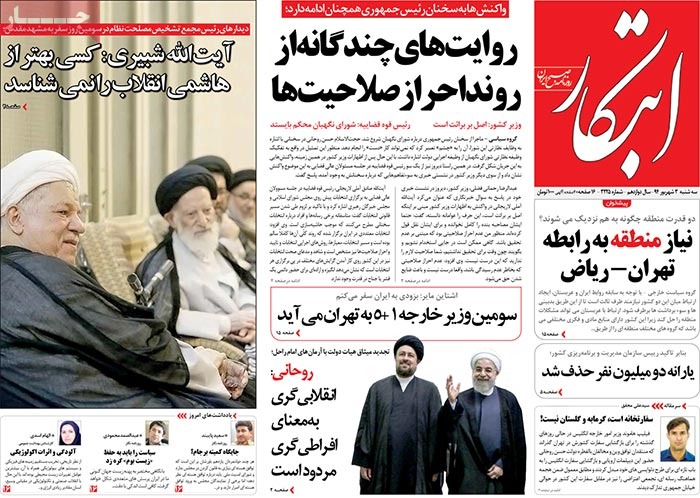
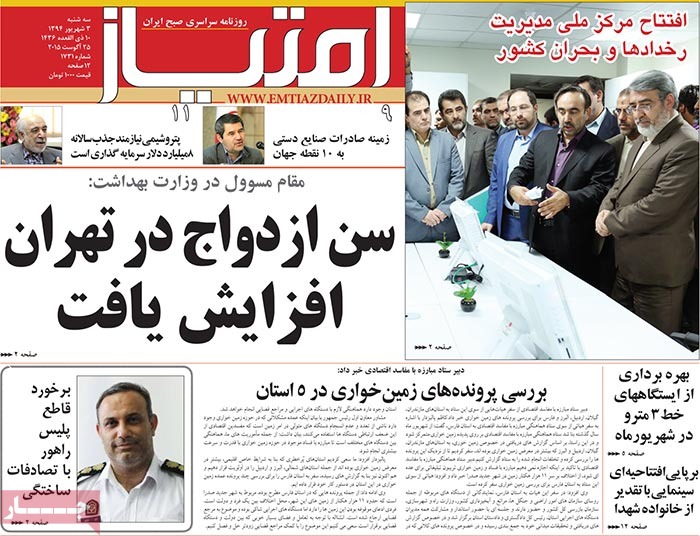
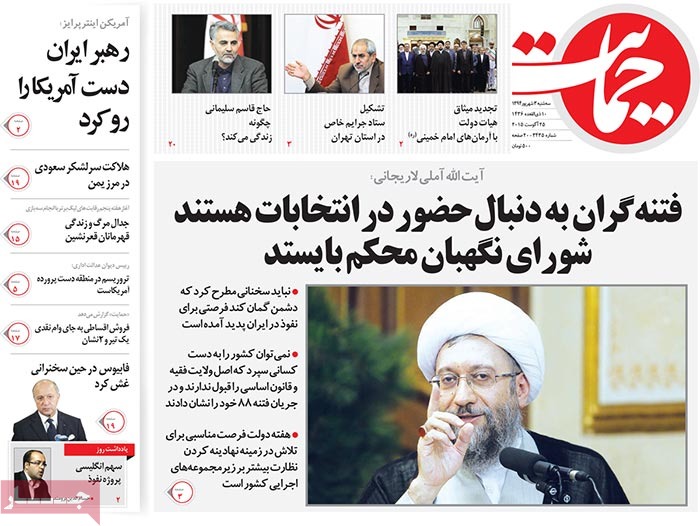
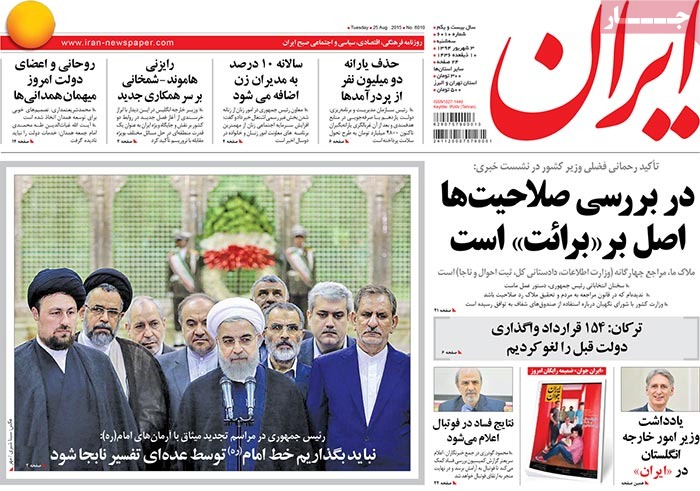
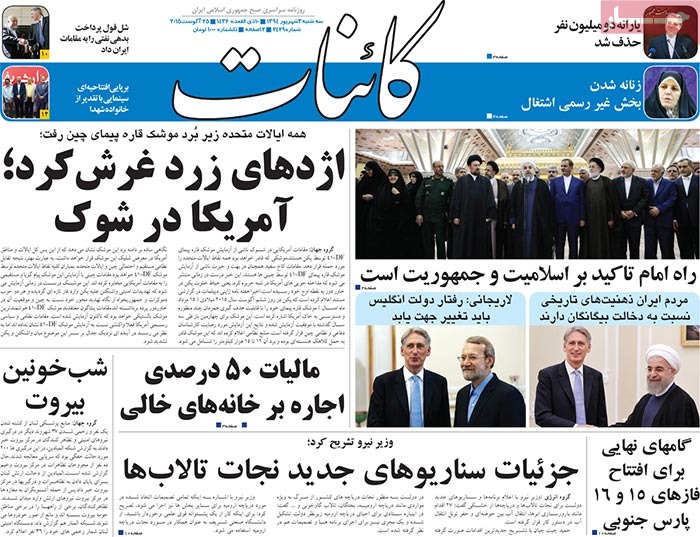
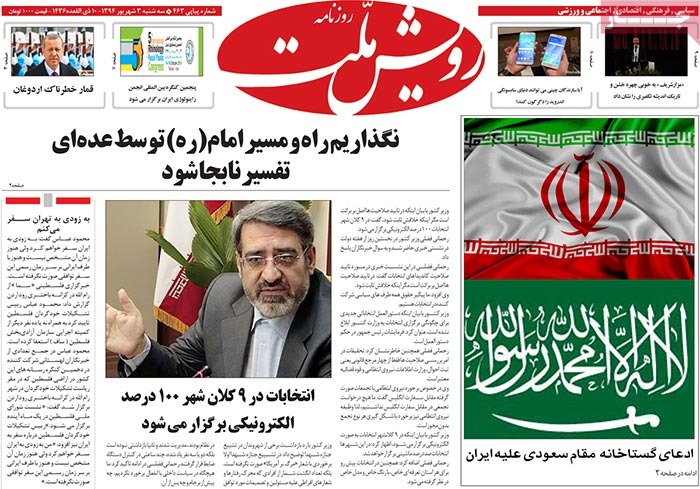
A look at Iranian newspaper front pages on August 3

Iranian Newspapers Headlines

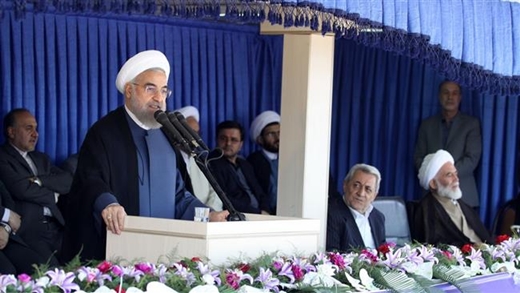
The comments President Rouhani made in a televised speech on the nuclear deal Iran has struck with P5+1 dominated the front pages of Iranian newspapers on Monday. Also in the news were the comments of the oil minister about the corruption case involving Babak Zanjani.


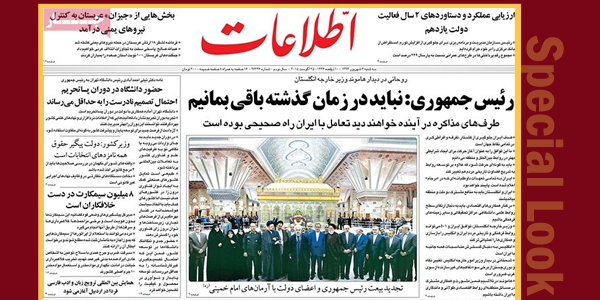
Ettela’at: “Next year will usher in a transformation in the country,” President Rouhani said in a televised speech.

“Having Iran’s nuclear case removed from Chapter VII of the United Nations Charter without a war was quite an achievement.”

“The ideology that one needs to either defeat the world or be defeated by it is wrong; there is a better way: interaction with the rest of the world.”


Abrar: The details of the Joint Comprehensive Plan of Action will be discussed in parliament’s National Security Committee with members of the negotiating team in attendance.


A look at Iranian newspaper front pages on August 3


Afarinesh: Deputy Foreign Minister Abbas Araghchi has said that revealing what was said at a private meeting with IRIB [a reference to state broadcaster] officials runs counter to national interests.


A look at Iranian newspaper front pages on August 3


Afkar: First Vice-President Eshagh Jahangiri has called for expansion of Tehran-Yerevan ties.

Afkar: A first phase of the Tehran-North Highway Project will have become operational by the end of the year [March 20, 2016].


A look at Iranian newspaper front pages on August 3


Aftab-e Yazd: The previous government purchased run-down oil derricks!

Nader Ghazipour, an MP, has said that there is evidence that the previous government has bought two dilapidated derricks, which have yet to be delivered to Iran.

He further said that apparently the derricks have been seized in Sharjah, UAE.

Aftab-e Yazd: There would have been no nuclear deal, if Rouhani had not been elected president.


A look at Iranian newspaper front pages on August 3


Arman-e Emrooz: “Those who benefitted from sanctions are now mad,” President Rouhani said in a speech.

He further said that the 2013 presidential election amounted to a nuclear referendum.

Arman-e Emrooz: Reclamation is taking a toll on the environment.

There are around 500,000 illegally-built villas around the country.

Arman-e Emrooz: Mohsen Hashemi, [a son of Chairman of the Expediency Council Ayatollah Akbar Hashemi Rafsanjani] has not ruled out a run for parliament.


A look at Iranian newspaper front pages on August 3


Asrar: “We face no restrictions as far as cooperating with American firms is concerned,” said the Iranian oil minister.


A look at Iranian newspaper front pages on August 3


Ebtekar: The Iranian Foreign Ministry has rejected reports that Foreign Minister Zarif’s son has been the best man of US Secretary of State John Kerry’s son-in-law.

Ebtekar: The government spokesman has said this year’s budget won’t be realized.


A look at Iranian newspaper front pages on August 3


Esfahan Emrooz: Krzysztof Wielicki, a Pole whose name has gone down in history for the first winter ascent of Mount Everest, has come to Isfahan to talk about his experience to Iranian climbers.


A look at Iranian newspaper front pages on August 3


Etemad: Truthfulness versus rhetoric

The president said in a televised speech that some wanted to slap a ban on social networking platform, but that he opposed the move.

“I asked President Obama whether the Americans are serious in the talks and his answer was in the affirmative,” President Rouhani said.

“At the end of this government’s term in office, the 40-year dream of securing sustainable single-digit inflation will have been realized.”


A look at Iranian newspaper front pages on August 3


Hemayat: The justice minister has said that the nuclear deal will be reviewed from a legal standpoint at the Justice Ministry.


A look at Iranian newspaper front pages on August 3


Iran: The prices of Chinese-made cars on Iranian market are declining.

Iran: “There is no truth to reports that there is a second Babak Zanjani [a young billionaire who stands accused of massive corruption when Ahmadinejad was in office],” the oil minister said.

Bijan Namdar Zanganeh further said rumors that there has been a second embezzler are designed to play down the hideousness of Babak Zanjani’s measures.


A look at Iranian newspaper front pages on August 3


Jomhouri Islami: “The number of people taken off the list of individuals eligible to get cash subsidies will have increased to 2 million by the end of the month [August 22],” said the minister of cooperatives, labor and social welfare.


A look at Iranian newspaper front pages on August 3


Kayhan: A number of MPs have said that American atrocities against the Iranian people won’t drift into oblivion on the back of the nuclear deal.

Kayhan: A funeral procession has been held in Damavand for a young Iranian national who was killed at the hands of terrorists in Syria.


A look at Iranian newspaper front pages on August 3


Mardomsalari: “Iran is owed $8.5 billion in oil money,” said the oil minister.

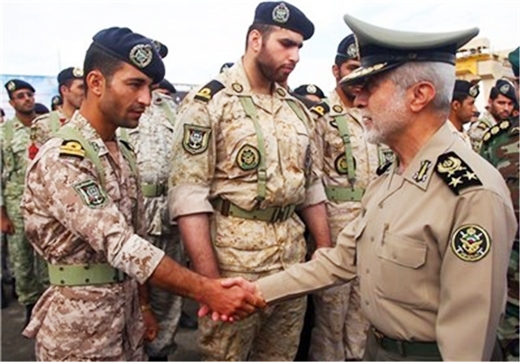
Mardomsalari: The commander of the Iranian Army says his men keep a close eye on regional developments.


A look at Iranian newspaper front pages on August 3


Setareh Sobh: Renowned Iranian actor Nasser Malek Motiei has said that he would not move out of his homeland.


A look at Iranian newspaper front pages on August 3


Sharq: “Eighty MPs support Ahmadinejad,” Akbar Torkan, an advisor to the president said.


A look at Iranian newspaper front pages on August 3