Wednesday, December 24, 2025
Home Blog Page 4769

Iran’s Judiciary vows to take legal action against Saudi siege of Yemen

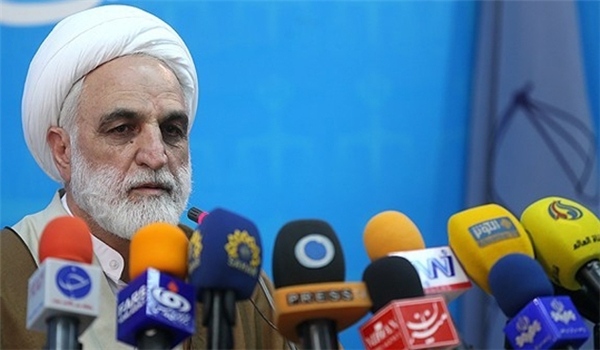
Ejei

The Iranian Judiciary announced plans to take legal action against Saudi Arabia after the latter’s fighter jets intercepted several Iranian cargo planes that intended to land in Sana’a to supply humanitarian aid to the war-stricken people in Yemen.

“The crime being committed in different parts of the region and Yemen today is a scandal for those who claim to be supporters of human rights,” Judiciary Spokesman Gholamhossein Mohseni Ejei told reporters in a press conference in Tehran on Monday.

He blasted Saudi Arabia, the US and their allies for blocking humanitarian aid to Yemen, including three Iranian planes that were carrying food and medicine for the Yemeni people and were warned by the Saudi fighter jets to stay away from Yemen’s airspace.

“Today, the people in Yemen are experiencing an acute lack of water, electricity, fuel, medicine and equipment in hospitals and the situation resembles the Gaza siege and the office of Iran’s prosecutor-general will certainly adopt the necessary measures in this regard,” Mohseni Ejei said.

[…]

Protecting, not limiting, people can show the government’s craftsmanship

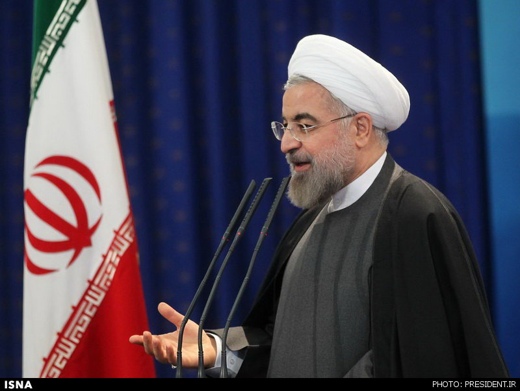
Rouhani-12

The Iranian president says that imposing restrictions on people is not a feat, adding that providing people with protection is the fine craftsmanship of a government.

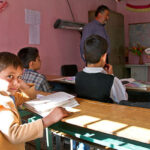
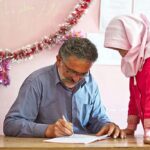
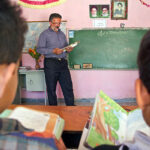
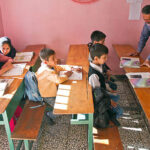
President Rouhani made the remark in a ceremony Monday to appreciate teachers across the nation and added the government is doing what needs to be done to offer quality and inexpensive education to the Iranian youth.

The president also hit back at those who raised ballyhoo about his comments that police have a duty to enforce the law, not Islamic rules, saying those who carry weapons around to enforce the law cannot be asked to make judgments about what is religiously correct and what is not.

The following is a partial translation of the president’s remarks as reported by the Iranian Students’ News Agency:

[…]

[In remarks which were believed to be targeting a ban by the Education Ministry on teaching foreign languages in the capital’s schools, both state and private] The president took a swipe at the strict limitations imposed on schools and said, “I don’t know the reason for rigorous restrictions in schools. We do not let students learn a foreign language at school, but students know that it [learning a foreign language] is a necessity for today’s life so they go to private language schools to pick it up”.

Today science is taught through certain languages, Rouhani said, adding one cannot make it to the depths of knowledge if they are not equipped with those languages.

[…]

As for art, Rouhani said, “Some restrictions are imposed in schools and we argue that schools are not a good place for these [artistic] works. But the youth like the art […] You cannot tie their hands. If you padlock the art classes, students try other ways to learn it. School is not the only place for learning. Family, media, cyberspace and society can offer lessons for the youths to learn from.

“We need to explore the ways we can establish contact [with the youth] and the ways the Education Ministry can take up a leadership role. We are always trying to limit the youth, […] but we should offer them protection. […]”.

President Rouhani said that the government is trying to offer cost-effective, quality education to the youths, adding if we can train powerful and protected people, we can say that we have done a great job.

The president then addressed the teachers and said, “The government is your servant and is not separate from you. We used to be the students of these teachers in society. The government has done what it takes to be helpful. This government respects and recognizes the right of people from all walks of life to protest.

“You saw this year the laborers came to the streets and staged [May Day] rallies and this has been unprecedented in the past several years. […] I was told that workers would pour to the streets, express their views and voice their complaints. We need to have [political] openness and tolerance.

“I do recognize teachers’ right to protest because they are respectful. We know there are problems, so do they. This government has done many things to the best of its ability, although it is still far from satisfactory. The Education Ministry’s budget was around $4 billion (12,000 billion tomans) four years ago; this year the ministry’s budget stands at about $8 billion (24,000 billion tomans)”.

Despite the fact that the country has slipped into a budget deficit, oil prices have halved and sanctions still remain in place, the government has tried its best to pay off its [material and spiritual] debts to those involved in the education system, the president further said. […]

Iran, Russia start using national currencies in banking transactions

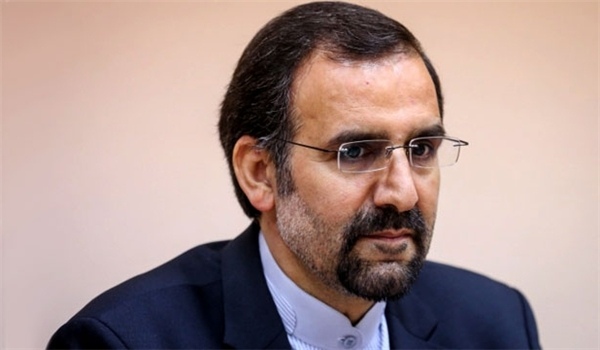
Mehdi Sanayee

Tehran and Moscow have started implementing a recently signed banking memorandum of understanding (MoU) which calls for the establishment of a joint bank to ease bilateral trade through national currencies, Iran’s Ambassador to Moscow Mehdi Sanayee announced on Monday.

“Three measures are underway (within the framework of this agreement), including opening of a joint bank account by Iran and Russia, presence of several Russian banks in Iran and choosing a Russian bank for rial-based trade exchanges in Russia,” Sanayee said, addressing a meeting of Iran-Russia Joint Chamber of Commerce in Moscow in Monday.

He noted that the representatives of two Russian banks came to Iran and held talks with officials of the Central Bank of Iran last week, and said, “The second step to broaden banking relations between Iran and Russia will be opening a joint account.”

Sanayee pointed to facilitating cash transfer for Iranian exporters through Russia’s Mir Business Bank as the third step to expand bilateral banking relations.

In March, Sanayee announced that Mir Business Bank was ready to facilitate money transfer for Iranian traders.

“Russia’s Mir Business Bank is ready to render financial services to Iranian traders according to a recent agreement signed by Iran and Russia,” Sanayee said in Moscow at the time.

He noted that financial transactions by Mir Business Bank take place within the framework of the Russian Central Bank, and said, “Legal and real entities can now exchange indefinite amount of foreign currencies with Iran’s rial.”

The Iranian ambassador said that the move has taken place to encourage Iranian exporters and pave the way for the transfer of the cash earned from exports of Iranian goods to Russia and Central Asia and the Caucasus.

Also in March, Sanayee announced that Iran and Russia had signed a memorandum of understanding (MoU) on the supervision of their central banks over the financial operations of the two countries’ banks.

“The MoU was signed by the deputy governors of the Iranian and Russian central banks during a visit to Moscow by a high-ranking Iranian banking and financial delegation from March 10 to 12,” Sanayee said.

He noted that Iran’s banking delegation also visited Russia’s central bank and other major banks during its stay in Moscow.

[…]

We shouldn’t cause trouble for those who stand up for our rights: Rafsanjani

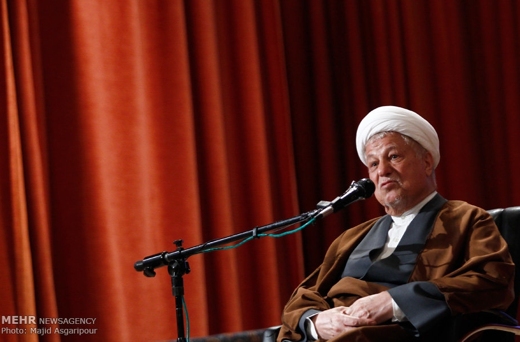
Rafsanjani

Plots hatched so many years ago to oversee the disintegration of regional countries are being put to the test again, Chairman of the Expediency Council Ayatollah Akbar Hashemi Rafsanjani was quoted by Mehr News Agency as saying.

Reacting to discussions in the US Congress on the disintegration of Iraq, Ayatollah Rafsanjani, who was speaking at an event to mark Teacher’s Day on Monday, said “Of course, the Americans wouldn’t talk about the disintegration of Iran, because our country is so strong that they can’t even say that they want it to be broken into pieces.”

Describing Iran as the reliable anchor of security in the region, Ayatollah Rafsanjani said, “Iran plays a vital role in safeguarding the region.”

He hailed the government’s foreign policy and said, “The whole world has realized that our logic in dealing with the nuclear case is the logic of peace and not war. Some are disrupting the process, though. The US Congress is opposed to a nuclear deal and the Zionist lobby has gone into overdrive. That’s why we shouldn’t cause trouble for those who stand up for our rights.”

Rafsanjani went on to say, “That does not mean that we should ignore those who hold opposite views; rather, logic should reign. Good things can come out of such disagreements if logic is the order of the day.”

He concluded, “Today’s conditions are not tougher than wartime conditions. Relying on preparedness and unity, we can ride out the storm.”

Daesh will fade into history, Daeshism will live on

Abbas_Vali

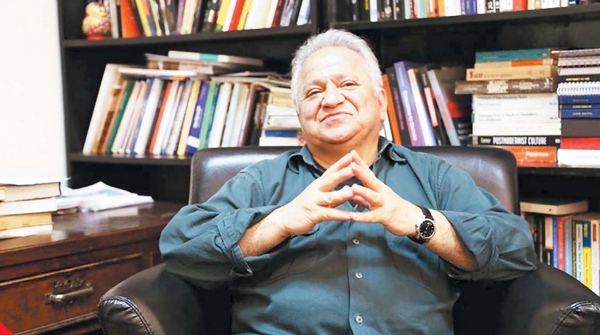
A Turkish sociologist says that the Islamic State of Iraq and the Levant (ISIL) will become history, but its ideology will live on among nations.

In his interview with Sharq daily published on April 27, Professor Abbas Vali, who is a distinguished Kurdish political and social theorist specializing in Modern and Contemporary Political Thought and Modern Middle Eastern Politics, has addressed the root causes of the crisis in the Middle East and the inefficiency of a nation-state solution from a sociological aspect.

The Turkish theorist – who is also the head of the Department of Sociology at Bogazici University in Istanbul – says that Daesh [the Arabic term used for ISIL] has emerged from the depths of endless political violence, which is bare and systemicin the region.

The following is a summarized translation of the interview. The first part offers a general analysis of the situation in the Middle East and the second part entails the professor’s views on Turkey’s domestic issues and an assessment of the performance of President Recep Tayyip Erdogan’s government as far as the Middle East is concerned.

The following is the Part One of the Interview:


At the 11th International Conference on the European Union, Turkey, the Middle East and the Kurds, you referred to political legitimacy and crisis which are two interrelated terms. Do you think the multilayer legitimacy crisis can still apply to the situation in the Middle East?

Yes. If we take a look at the Middle East’s history, especially after the Arab Spring, we realize that the political crisis in the Middle East has entered a new phase.


What do you mean by a new phase?

I mean the quality of the crisis, its players, and the possible outcomes of the roles of these players have changed. The Arab Spring – which was sparked by a democratic protest in Tunisia and spilled over into Egypt – stemmed from a chronic crisis of political legitimacy in these countries, because political legitimacy had turned into legality of power, facing challenges even in its diminished form. […]

Facing a legitimacy crisis, the protesters and those who sought regime change seemed satisfied with constitutional changes which envisioned political openness and the democratic run of the country. […]

Following the [political] changes in Egypt, failure to achieve positive results and the comeback of dictatorship, the opponents of [former dictator Hosni] Mubarak realized that their problems will remain unresolved if they stick to the legitimacy crisis and reformist demands, and that the crisis is deepening there.

[…]


Your look at the situation in the Middle East reminds us of [Giorgio] Agamben’s State of Exception.

As for Agamben, his study [State of Exception] which stems from Carl Schmitt’s [legal] theory refers to a state of crisis and collapse when a power emerges and transcends the rule of law in order to restore order and enforce the previous law based on new principles. […]

Agamben excludes exception from the decisions of an individual or institution and bases it on the dialectical framework of a conflict between law and violence. It is true that in the democratic [peace] theory, law is placed against violence – law will not be enforced in the absence of violence if this relationship is looked at through a dialectical framework – and violence is found inside the law. When the law becomes toothless, violence emerges, suspends the law and then reestablishes order.


Can the Middle East situation be analyzed through this prism?

It is not the case in the Middle East. A sovereignty crisis has existed there and the political power which has been mentioned in the constitution has lost its ability to produce political supremacy. […]

I think the sovereignty crisis [in the Middle East] is so serious that we can talk about exceptional situations such as a coup or temporary dictatorship.


Given the interwoven crises [in the region], how do you evaluate the post-Daesh situation?

Certainly, Daesh will fail, but Daeshism will live on. What matters more here is that the anti-Daesh coalition is trying to base the political power on a national government – like what it did in Iraq, Syria, Jordan and Egypt. Hasn’t this framework [of government] proved a failure after one hundred years?

Will the Sykes-Picot Agreement – [officially known as the Asia Minor Agreement, was a secret agreement between the governments of the United Kingdom and France] which has been the historic and colonial frame of political power in Iraq, Syria, Jordan and Lebanon – be used again? Will this system take hold again? Or do we need to seek another system which can create a political framework not based on concepts such as tribes, nation and nationality as it also recognizes differences and special features of tribes, religions and nations?

I think the existing crises in Egypt, Syria and Iraq cannot be assessed simply based on the legitimacy crisis. The crisis in these countries has been based on the historic framework of their political power, something which has formed thanks to a similar linguistic, ethnic and cultural concept. The framework has stood the test of time for a century.

In a post-Daesh era, if we fail to develop an understanding of the nature of the [legitimacy] crisis and let the previous trend persist regardless of the current crisis and the defeat of the 100-year-old project in Iraq and Syria, the result will be nothing but the continuation of the previous intertwined crises.


What do political theories propose as replacement to prevent this cycle from repeating?

The survival of multi-ethnic and -religious systems which have been established in the form of a nation-state simply hinges on political violence, not enforcement of the law. Take a look at Iraq and Syria’s bloody past in which the violence hidden behind the law has always taken the place of the law.

That’s why Agamben, Schmitt and [Walter] Benjamin talk about contradictions in modern sovereignty, saying that the ruler has a contradictory nature because it has simultaneously fitted into and out of the law. In the Middle East, this contradictory sovereignty has been always given special treatment, allowing it to stand above the law.

Under such circumstances, a national government translates into the structure of a political power based on the classic characteristics of the national government on which not much hope can be pinned.

In Iraq and Syria, there is no hope for establishing a government which can develop a national-dialogue identity without resorting to brute force. This system is in tatters. A confederate system should be set up in these regions because [other systems] even federalism has failed in Iraq. Federalism has a necessary merging force which can keep it safe from the inside. In the US and Canada, very powerful capitalism acts as a protecting force [inside the system]. […]

Such a mechanism is absent in Iraq. We saw that following the fall of Saddam and the writing of a new constitution, the new power concentrated its efforts on the establishment of a united government.

A federal system can be established only if an advanced political culture exists among members of the confederate government, and these federal and confederate systems should give in to a political connection in the framework of a special political system.

The absence of such a political culture puts the federal and confederate systems at risk. That’s why when these systems face problems, hopes grow for the emergence of a powerful figure who cannot rise to the challenge without resorting to suppression and violence. So the onus is on political theoreticians to redefine the frameworks of a national government.


How can Daesh’s measures be redefined based on such political theories?

Daesh represents an overly extremist version of irrational domination and thinking. Through its political irrationality, Daesh has removed the borders between law and unlawfulness, and the boundaries between law and violence. Their interpretation of Sharia law and violence plays a structural role in their dialogue and performance. Unlike Saddam and other dictators who sought to conceal their violent nature only to maintain calm in society, Daesh is trying to showcase its violence in a naked manner because violence – in Daesh’s reading of Sharia law – is not a tool; rather it has a structural role to play.

Daesh is trying to put on display its violence because the demarcations between violence and law have been blurred. In his well-known article on political violence [The Critique of Violence], Benjamin says that violence is used as a tool because when the law seeks to administer justice, it considers violence as a tool to implement the law. Here the means and end are highlighted; end justifies the means and a cycle is formed. Two types of violence – violence of sovereignty and violence of ideology – emerge.

In the violence of the political sovereignty, the law is suspended – not repealed – under exceptional circumstances and the ruler does not need to resort to the show of force. In the violence of ideology, however, violence is not used as a tool when it comes to enforcing the law; rather it has a structural role and there is no need to justify it [violence].

It is at this point that Daesh has created a situation in which political theoreticians are expected to redefine such irrationality in the form of a theory. Perhaps interpretations by Daesh of political violence can be found in theological works which show how God has descended divine torment on a tribe/nation. Arguably the legitimacy of violence is inherently embedded in the use of violence.

Take a look at the ruins of the Parthian city of Hatra [near Mosul]. This [ISIL hammered away at the ancient city by smashing sledgehammers into its walls and shooting Kalashnikov assault rifles at priceless statues] is the violence history is subject to, a history which – in the eyes of this [terror] group – should not exist. As far as Daesh and its reading of religion are concerned, the interpretation of the passage of time makes no sense.

[…]

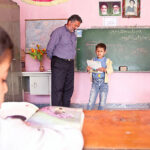
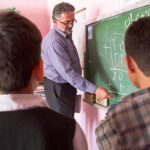
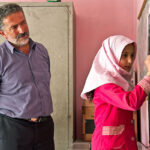
A selfless teacher (PHOTOS)

selfless teacher

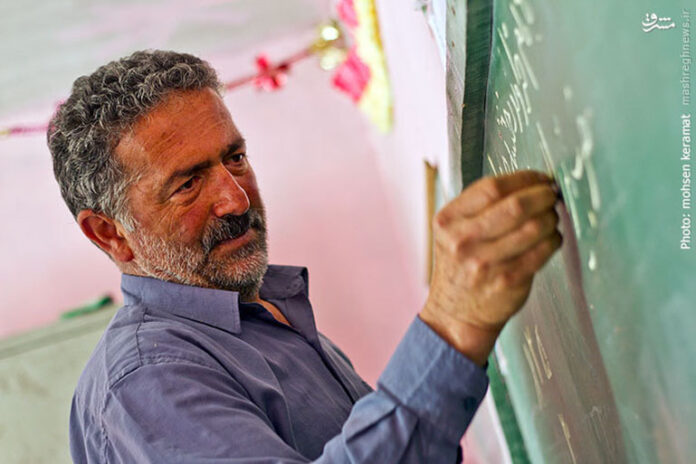
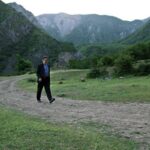
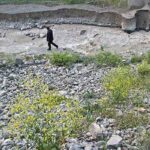
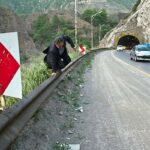
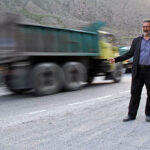
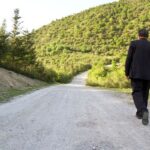
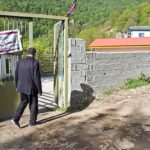
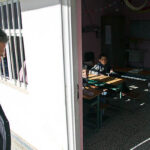
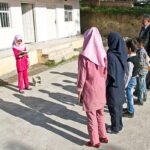
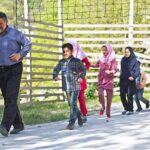
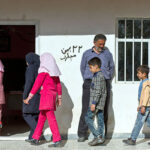
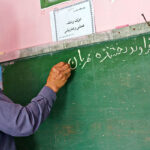
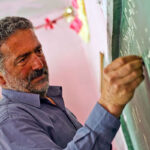
Mohammad Ali Soleimani, a teacher and superintendent of a primary school in a rural area, has a long daily commute of 20 km. He walks half of the distance and covers the remaining 10-km by car.

To him the gravest problem on the way to school are wild animals such as bears, tigers and boars he has encountered a few times already.

Images of the teacher put online by mashreghnews.ir:

Story of Iranian woman with no arms gets global media attention

woman_901

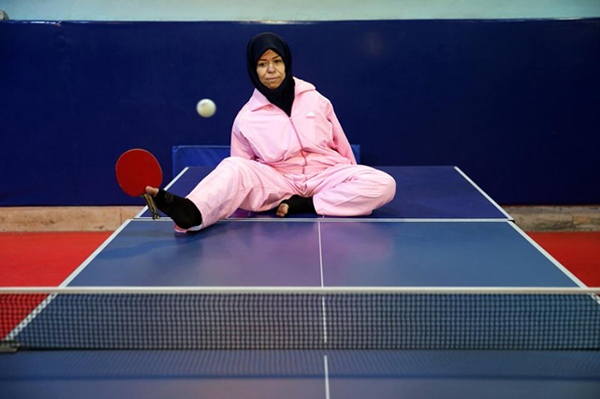
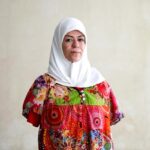
The Associated Press has filed a report on Zohreh Etezadossaltaneh who was born without arms, but that hasn’t stopped her from excelling in many activities, ranging from painting to table tennis.

Now 52 years old, the retired Iranian teacher has dedicated herself to helping others with similar disabilities live full and satisfying lives.

Her story is one of personal triumph and indomitable spirit.

“Each body might have some limitations and deficiencies. But if you have a pure, elevated soul I think the body won’t matter,” she said.

After receiving her primary education at a special school for disabled children, Etezadossaltaneh moved into the mainstream Iranian education system and eventually earned a degree in psychology.

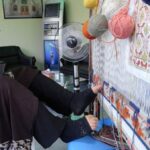
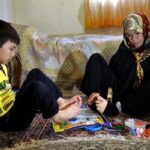
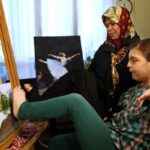
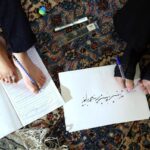
Now she works with young people with similar disabilities. Among her students is 9-year-old Roohollah Jafar, who lost his hands in an accident and is now learning from Etezadossaltaneh to paint and do calligraphy using his feet.

At the start of their lesson, Etezadossaltaneh skillfully massages the boy’s feet with her own feet and guides him on how to hold and control a pen between his toes.

Etezadossaltaneh’s feet have become dexterous enough to hold a ping pong paddle or a paint brush. She has staged multiple exhibitions and supplements her retirement pension by selling some of her artwork.

“She works so easily that I’ve totally forgotten she paints with her feet,” said her painting instructor, Parisa Samavatian.

Etezadossaltaneh’s skill at table tennis has led to her being featured in public exhibition matches. But she insists that she wants to be more than just a symbolic figure of inspiration.

“I want to play seriously and get a name,” she said. “I want to represent my country in competitions overseas.”

The following is a photo gallery of her posted online by fararu.com:


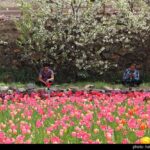
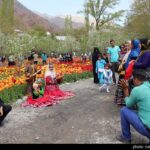
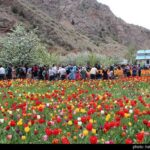
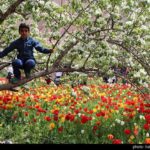
Tulip Festival

Tulip Festival1

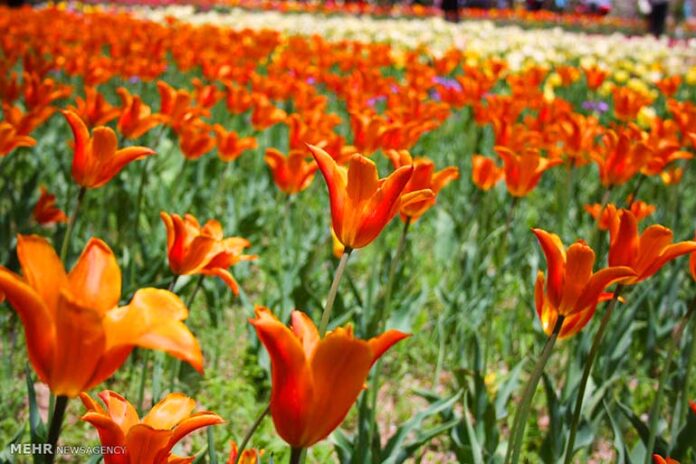
Each year in May tulips in 32 different colors are put on display in Garmab Village along Chaloos Road [that connects Tehran to the Caspian province of Mazandaran].

A large number of visitors are mesmerized by the beauty of local and imported tulips at the annual Tulip Festival.

Javad Gholami, who has been in the business of breeding and importing tulip bulbs from Central Asian countries for 30 years, is the organizer of the annual event.

“The first Tulip Festival was held by my father 17 years ago. He asked me to keep the festival going. He also urged me not to charge visitors,” Gholami was quoted by the Iranian Students’ News Agency as saying.

He went on to say that by holding the festival, he aims to expand green spaces and revive the friendship between people and Mother Nature.

He said that tulip bulbs are originally from Iran and have been taken to Europe through Turkey.

Highlighting that a majority of tulips in the garden are local, he said, “Only tulips with rare colors are imported so that we can work on their bulbs and produce their seeds.”

The Tulip Festival opened on April 28 this year and will run through May 10.

The event drew as many as 400,000 people to Garmab last year.


A look at Iranian newspaper front pages on May 4

Iranian Newspapers Headlines

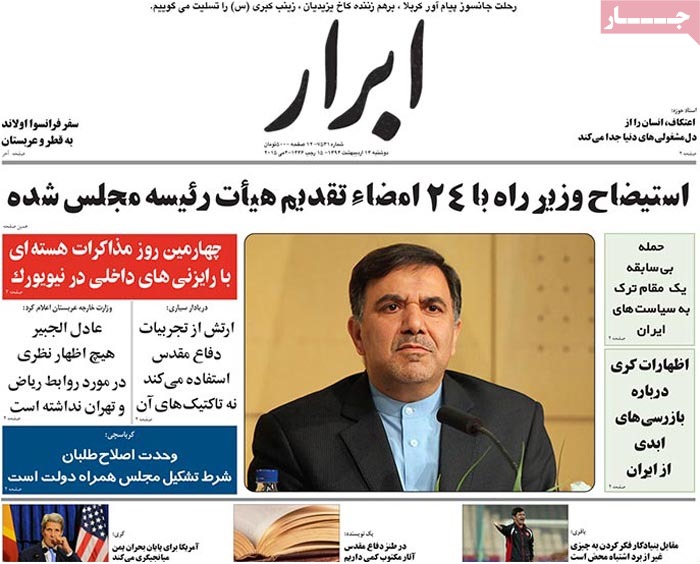
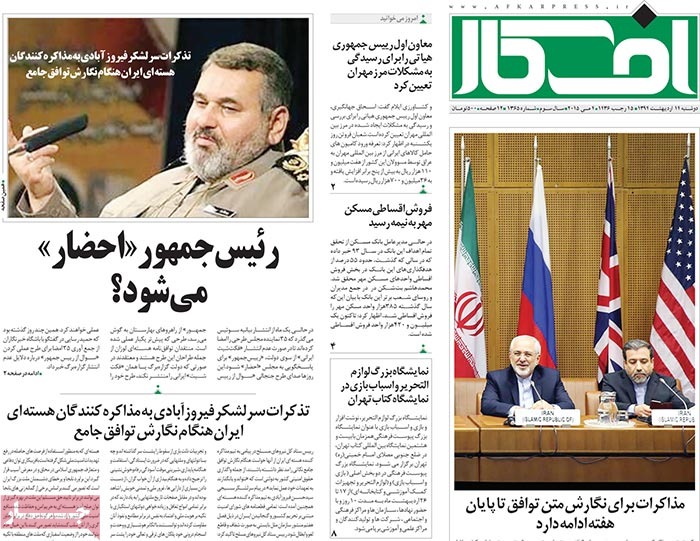
The warning by Chief of Staff of the Armed Forces Major General Hassan Firouzabadi that Iranian military facilities are off-limits to inspectors dominated the front pages of Iranian newspapers on Monday. Comments by the US secretary of state on the inspections regime and developments of the Saudi-led war against Yemen also appeared on the covers of dailies.


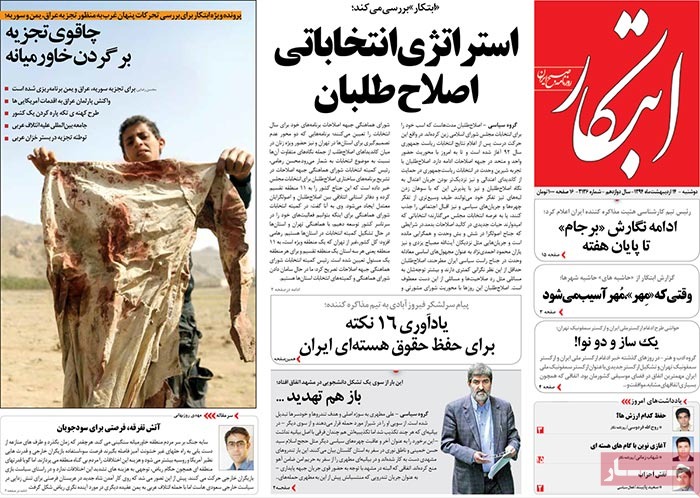
Abrar: A motion signed by 24 MPs to impeach the minister of roads has been handed to the Presiding Board of the Islamic Consultative Assembly.


A look at Iranian newspaper front pages on May 4


Afkar: Meetings to draft a final deal will run through the end of the week.


A look at Iranian newspaper front pages on May 4


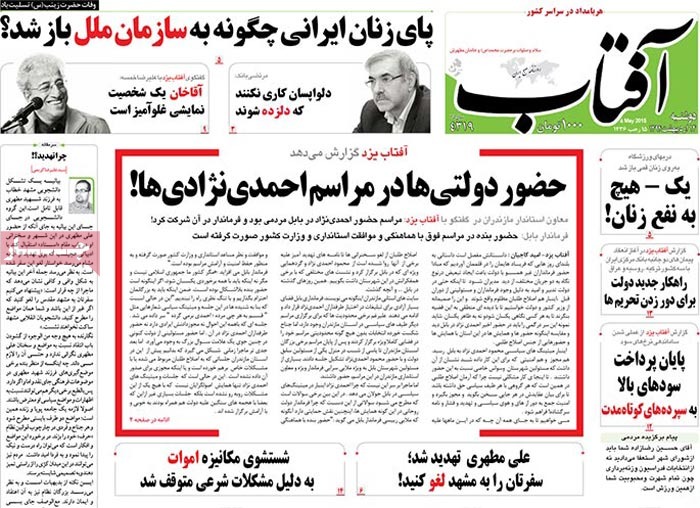
Aftab-e Yazd: Presence of government officials in a ceremony hosted by supporters of former President Ahmadinejad!

A deputy governor general of Mazandaran Province said that the event was public so the governor of Babol attended it.

The governor of Babol said his presence at the event was coordinated in advance with the provincial governor’s office and the Interior Ministry.

Aftab-e Yazd: Threats have been issued against Ali Motahari [who was attacked in Shiraz where he was to deliver a speech in a university].

Call off your Mashhad visit, the threat says.

Aftab-e Yazd: Women are ahead 1-0.

The doors of a stadium in Qom opened to female spectators.


A look at Iranian newspaper front pages on May 4


Ebtekar: Another threat [against Tehran MP Ali Motahari].

This time it is made by a student association based in Mashhad [ahead of a visit to the city by the principlist deputy].


A look at Iranian newspaper front pages on May 4


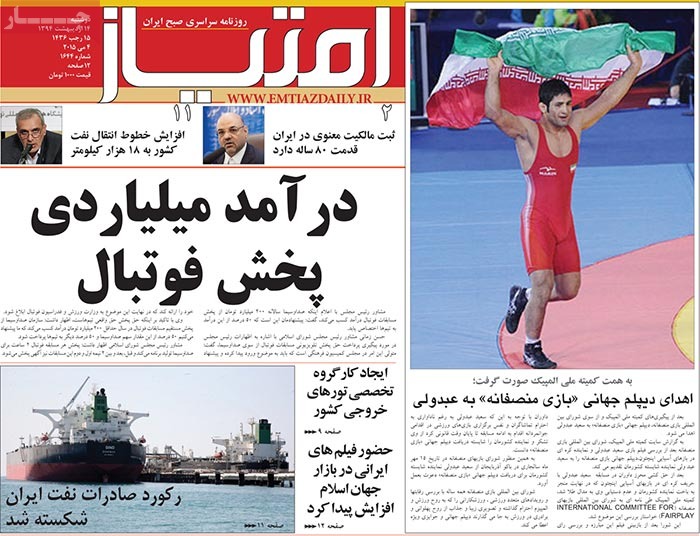
Emtiaz: Iranian wrestler Saeed Abdevali has received a diploma from the International Committee for Fair Play.

Emtiaz: Iranian films are making their presence felt in the Muslim world.


A look at Iranian newspaper front pages on May 4


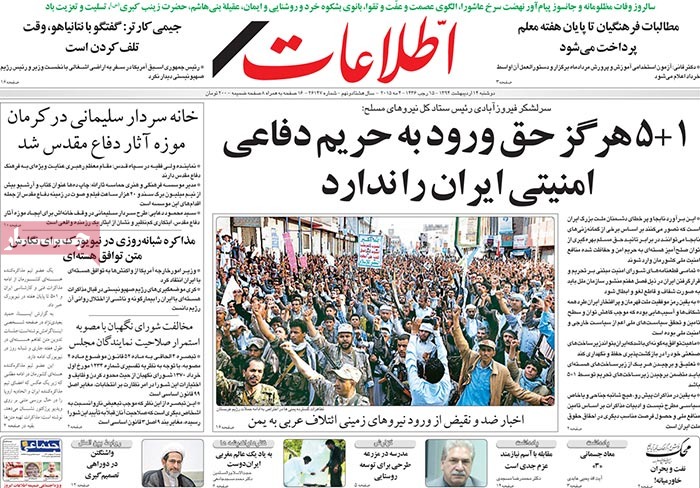
Ettela’at: The residence of [IRGC commander] Major General Ghasem Soleimani in Kerman has turned into a Sacred Defense museum.
Ettela’at: “P5+1 will never get the green-light to enter Iran’s defense and security sites,” said the chief of staff of the armed forces.


A look at Iranian newspaper front pages on May 4


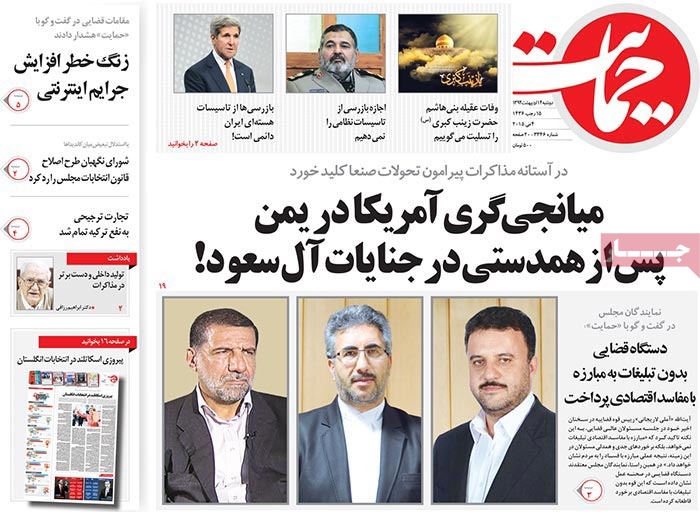
Hemayat: US Secretary of State John Kerry says inspections of Iran’s nuclear facilities will continue “forever”.


A look at Iranian newspaper front pages on May 4


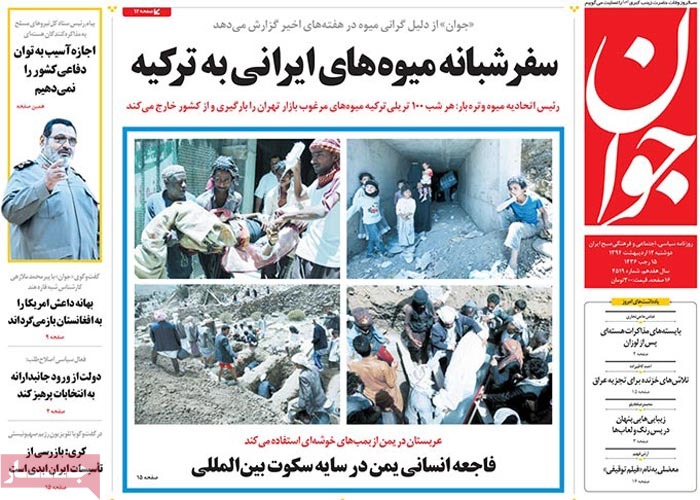
Javan: Iranian fruit is shipped to Turkey overnight.

Each night as many as 100 semitrailer-loads of Iranian fruit set out for Turkey.


A look at Iranian newspaper front pages on May 4


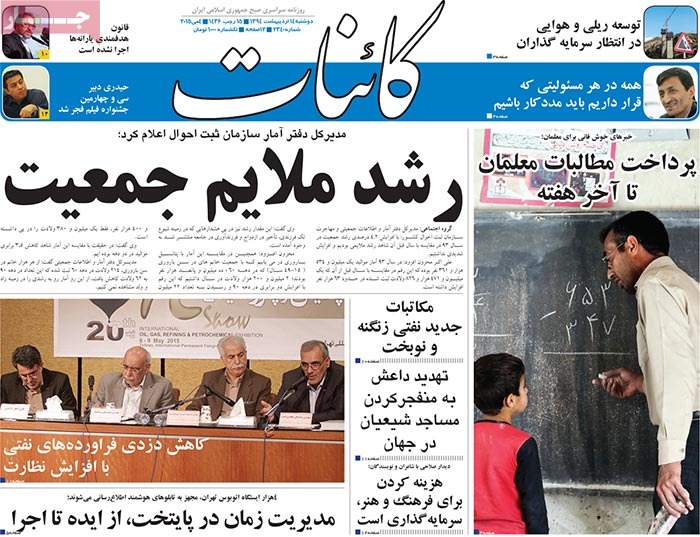
Kaenat: IS has threatened to blow up Shiite mosques around the world.


A look at Iranian newspaper front pages on May 4


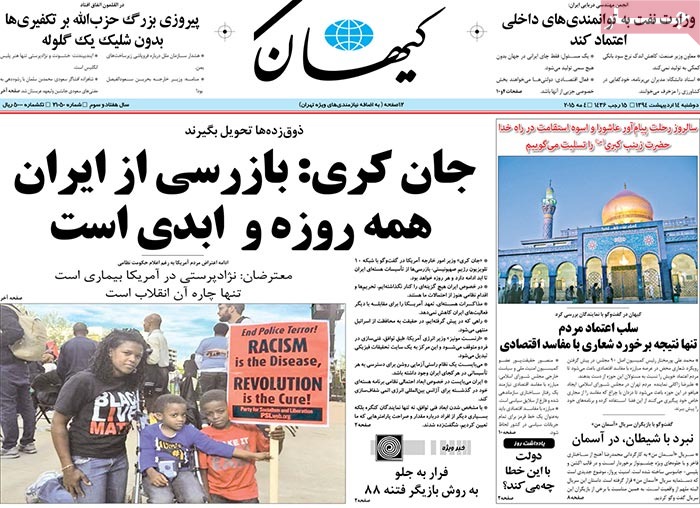
Kayhan: For the information of those who are overjoyed!

John Kerry: “We will have inspectors in there every single day… That’s forever.”


A look at Iranian newspaper front pages on May 4


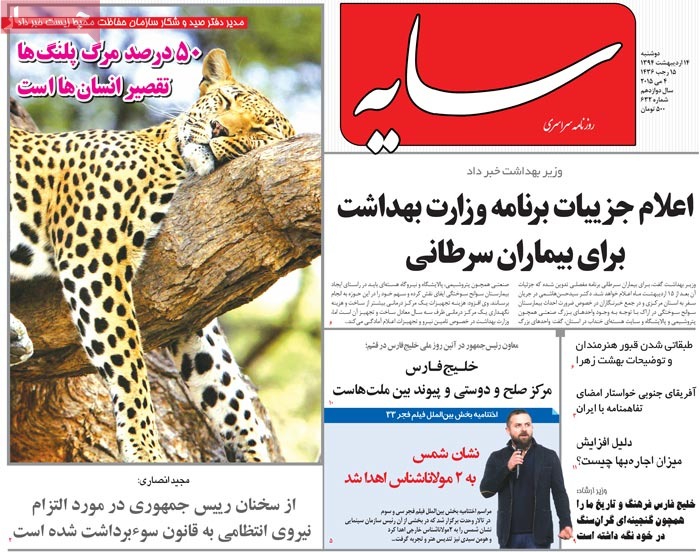
Sayeh: “President Rouhani’s comments on the duties of law enforcement as far as implementation of laws is concerned have been misinterpreted,” said Majid Ansari, the president’s deputy.


A look at Iranian newspaper front pages on May 4


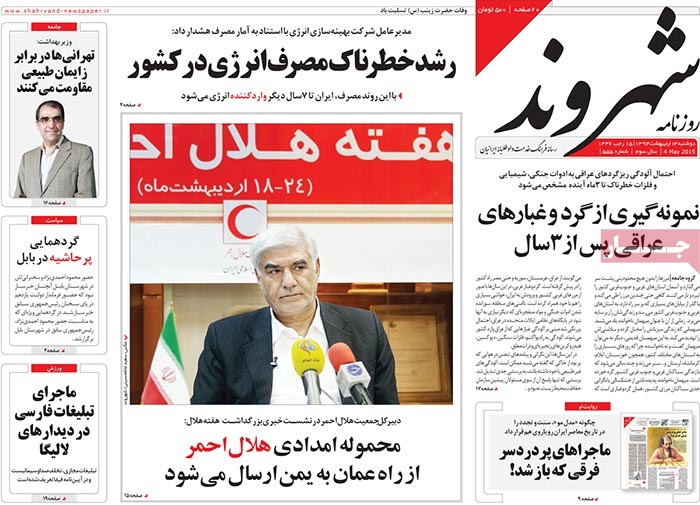
Shahrvand: Energy consumption has grown dangerously in the country.


A look at Iranian newspaper front pages on May 4


Process of drafting nuclear deal moving forward, Zarif says

zarif

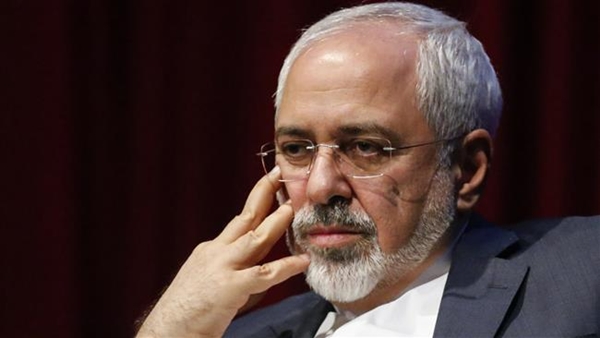
Iranian Foreign Minister Mohammad Javad Zarif says Iran and P5+1 are working on the draft of a final deal over Tehran’s nuclear work.

In a tweet on Monday, Zarif said that the process of drafting is “moving forward” as the two sides are “determined to end this manufactured crisis & open new horizons.”

The Iranian top diplomat, however, stressed that “many brackets” still remain which need to resolved by hard work.

Experts from Iran and the six global powers are currently in New York to try to reach a draft agreement over Tehran’s nuclear program.

An earlier tweet by senior Iranian negotiator Abbas Araghchi described the drafting process as “difficult,” noting that there are many bracketed points of disagreement in the text.

Araghchi has expressed hope that the first draft would come out within the next few days.

On Sunday, Hamid Baeedinejad, another member of Iran’s negotiating team, said that the two sides are taking all technical and legal aspects into regard during the drafting process and thus spend hours on every word, phrase and sentence of the proposed text.

“The issues that are not agreed upon following extensive discussions will be enclosed in brackets for further elaboration,” he added.

Reports said that the negotiations would continue over the next days in New York.

Iran and P5+1– the United States, France, Britain, Russia, China, and Germany – reached a mutual understanding on Tehran’s nuclear program in the Swiss city of Lausanne on April 2.

Iran and the six-party group have agreed to finalize a comprehensive deal by the end of June.