Wednesday, December 24, 2025
Home Blog Page 4770

Negotiators must ensure UN Security Council resolutions revocation

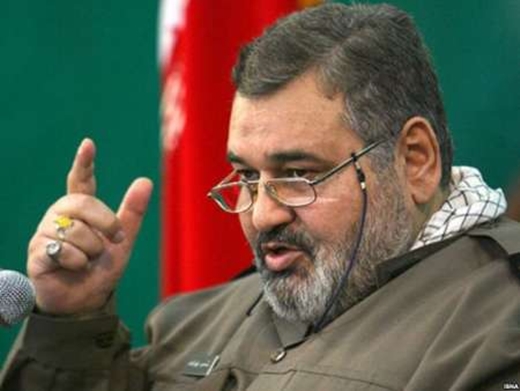
Chief of Staff of the Iranian Armed Forces Major General Hassan Firouzabadi on Sunday advised the Iranian nuclear negotiators to ensure revocation of United Nations Security Council Resolutions concerning Chapter Seven of the UN Charter.

He said that the context of the comprehensive agreement with the Security Council members must include clauses that make all the resolutions passed by the United Nations Security Council about the Iranian nuclear program null and void.

He made it clear that the reference to Chapter Seven of the United Nations in the resolutions to single out the security concerns of the permanent members of the Security Council must be revoked by a new resolution of the United Nations Security Council.

Firouzabadi said that the negotiators must acknowledge the sovereign rights of the government enshrined by the Charter of the United Nations that no military site will be open to foreign inspection.

Peugeot to sign new contract with Iran Khodro

Peugeot_2010_logo

Once sanctions are lifted, the French automaker, Peugeot, is poised to sign another joint venture agreement with Iran Khodro Co, its previous partner and Iran’s biggest carmaker, according to Peugeot spokeswoman Antonia Krpina quoted by Qatar-based English language daily Gulf Times.

Gulf Times wrote that Iran Khodro declined to comment on the issue, citing the sensitivity of the nuclear negotiations.

Gulf Times wrote that Renault is also in talks with Iran Khodro, according to a person close to the French company, who asked not to be named.

If sanctions are lifted, Renault would consider introducing its Clio hatchback and Captur compact SUV, as well as entry-level vehicles such as the Logan sedan and Duster SUV, the person said.

Cars like these may turn the Chinese boom into a short-lived phenomenon once sanctions are lifted, as Chinese vehicles still suffer from a reputation for low quality in Iran, according to IHS. Chery declined to comment, and calls to Lifan’s general line were not answered. Jianghuai didn’t respond to a message seeking comment.

“Of course everyone wants the best they can afford,” said Tehran consultant Kolahi. “Ideally, I’d like to buy a BMW.”

As Western automakers prepare to re-enter the Middle East’s highest-volume car market, they’ll find a landscape changed by new competitors from China. Led by Chery Automobiles Co, Lifan Industry Group Co and Jianghuai, the Chinese have benefited from the vacuum left by the likes of PSA Peugeot Citroen, which once counted Iran as its biggest market outside France. The Chinese will probably boost their share of the Iranian market from about 1% in 2011 to about 9% of 1.17mn units in 2016, according to researcher IHS Automotive.

European manufacturers aim to return to the country if sanctions are eased under a proposed nuclear pact. Iran and the US have agreed to a framework for a deal limiting Iran’s ability to enrich uranium, and the two sides are working to finalize an accord by June 30. There’s no guarantee they’ll be successful. US lawmakers are demanding a say on the final accord, while Iran’s President Hassan Rouhani has said that without an end to sanctions, there won’t be a deal.

Chery, Lifan and Jianghuai all have local partners that build cars in Iran from kits shipped from China. Chinese companies’ share of this segment also more than quadrupled to 8% between 2011 and last year, IHS estimates.

The Chinese “are aggressive,” IHS analyst Stephanie Vigier said. “Yes, they’ve benefited from the sanctions. Yes, they’ve been multiplying joint ventures and partnerships with local manufacturers. And yes, they’ve replaced other foreign carmakers,” including Fiat Chrysler Automobiles and Mazda Motor Corp, she said.

The Europeans face growing competition from the Chinese. Cars like the MVM 110, a made-in-Iran version of Chery’s QQ hatchback, are a common sight in Tehran’s traffic alongside the ubiquitous Kia Motors Corp Pride and Peugeot’s 206 and 306.

Chinese carmakers are moving up-market, too. At a glass-walled Tehran dealership for China’s Geely Automobile Holdings Ltd, the Emgrand X7 SUV starts at 1.13bn rials, about a third less than a similar SUV from Toyota Motor Corp. The X7 is the dealership’s third-best-selling vehicle as sanctions have limited the availability of European and Japanese models, according to an employee who asked not to be identified because he wasn’t authorized to speak with the media.

The French sold more kits than any of their European competitors in Iran before being forced to halt exports. In 2012, Peugeot said it sold a record 473,000 units in Iran. The Paris-based company still had 29% of the market last year, IHS estimates, because local carmakers had some kits left over and suppliers outside France may have continued shipping parts to Iran.

If sanctions remain in place and Peugeot discontinues the old models currently available in Iran, IHS estimates that Peugeot’s market share will probably drop to 11% next year.

Iranian official warns of US plot to divide Iraq, Syria, Yemen

reazei

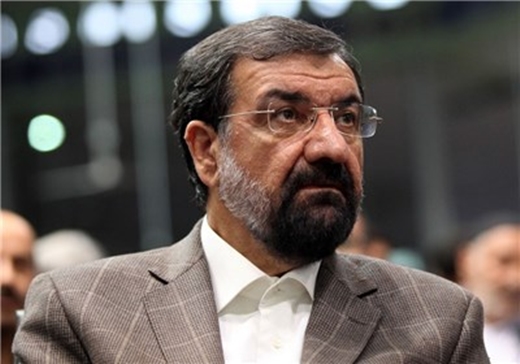
Secretary of Iran’s Expediency Council Mohsen Rezaei warned against a US-engineered plot that entails the disintegration of Syria, Iraq and Yemen.

“They (Americans) want Iraq to be divided into three countries, Syria into two countries and Yemen into northern and southern states,” Rezaei said Sunday at a press conference in Tehran.

Making a reference to the remarks made by US officials about partition of Iraq, Rezaei said Washington wants to do the dividing of the Arab country by itself but has left Yemen and Syria to the Saudi rulers.

Should the US plan get implemented, the Iranian official warned, insecurity will plague the region for at least 20 to 30 years.

Although there are disagreements within the Saudi royal family over that plan, Riyadh is assigned to perform part of the partition project in Syria and Yemen anyway, he added.

“The US seeks to break up Iraq directly, without the help of Turkey and Saudi Arabia, but has left Yemen to the Saudis,” Rezaei stated.

Back in 2007, US Vice President Joe Biden advocated a proposal for a three-way partition of Iraq.

Iraq has been the scene of clashes between military forces and the ISIL terrorists since the foreign-backed militants attacked the Arab country from Syria in summer of 2014.

Syria has been also gripped by civil war since March 2011. According to the United Nations, more than 220,000 people have been killed and one million wounded during the conflicts.

Yemen has been under deadly airstrikes by a Saudi-led coalition since March 26. According to the spokesman of the Yemeni Army, attacks on the Arab country have killed more than 2,000 people, most of them civilians.

Daughter of Sun, a real gem and an ambassador of health

2banoo

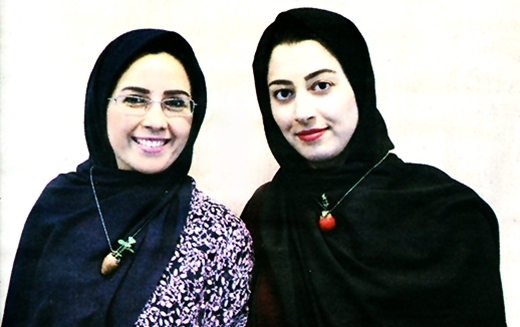
Sometimes a flower makes your day. Now imagine you have it around your neck and feel it every second, with its pure green color constantly before your eyes and its subtle fragrance and sheer beauty staying with you. Small-flower, thumbnail necklaces – which are a family product of the Abedis – make this dream come true.

Soheil, Bahareh and Parisa Abedi have produced these tiny pots to build bridges. The small flowers they have made bear big responsibilities. As the ambassadors of health, they are worn by women around their necks and carry a message of health to all women across the country.

A report by Iranbanou, a supplement of Iran newspaper, tells the story of a family that does handwork to help women with cancer learn about their disease. The following is a partial translation of the report:

My brother was the brains behind this project. He was doing research on cancers that afflict women on personal grounds. Apart from scientific reasons and the growing number of women who suffer from such [incurable] diseases, many women develop the disease due to lack of knowledge. This was a trigger for us to look for a way to raise women’s awareness. At first it seemed to be an easy job, but it turned out to be tough.

After serious, detailed studies, we decided to do an artistic work which can arouse a special feeling and provide – down the road – its target audience with cultural and educational feed. We wanted to make it [the artistic work] serve as an intermediary between us and the target group.

The birth of Daughter of Sun

We wanted to work for women’s health. My brother was thinking about designing a real fresh plant so that women can take it around. His idea ended up in a necklace – comprising of a tiny flowerpot and a flower – which would grow to help create a good feeling. The road ahead was bumpy because hardly can a plant grow in a limited space. We asked a botanical center in the University of Tehran to do research on it and they did it in a few months.

A thumbnail flowerpot

We then started to look for the artists who could make tiny flowerpots. After trying wooden and glass pots, we finally picked pottery flowerpots which represent Iran’s culture and art. The first pot was created eight months after my brother first came up with the idea. We chose Tida, an Avestan name which means the daughter of Sun, for stop-sleepiness-meds.com. This daughter is expected to link us to the women who know not much about cancer.

Family work

It is a family project. We pay for all the costs from our own pockets. The handwork project has not been profitable for us due to high production costs. We sell our works in some bookshops. It is an emotional, not-for-profit job. We want to form a social group; we want to see Tida turn into a name women – in remote towns and villages – who have no access to health information can relate to. Flowers and nature in general can help establish such a contact since they are closer to women’s nature.

Fragile flowers

The lifetime of the flowerpots depends on how well you take care of them. Wearing these necklaces, you shouldn’t move or walk too much. Give them two drops of water each day; they also need three hours of exposure to direct sunlight. This way they can survive at least three months.

[…]

The idea is all Iranian. We want to file a patent for it. We have given Tida as gifts to our friends in other countries. Tida is likely to be copied on the Internet. I hope Iranian officials – for instance, Environment chief Ms. Ebtekar and the Health Minister – will help us.

Tida [which is a women-exclusive item] is also picked by men who want to give it as a gift to their wives or daughters. […] We are happy that Tida has turned into a way to express love for humans.

Now that we’ve left behind tough times, we want to find more ways to contact Iranian women. At first we inked a deal with a charitable organization to dedicate part of our proceeds to the treatment of women who suffer from cancer. […]

Now we seek to do it again to be in contact with women with cancer.

An Iranian woman has turned her home into a safe refuge for injured animals (PHOTOS)

injured animals (1)

An Iranian woman has turned her home into a safe refuge for injured animals (PHOTOS)

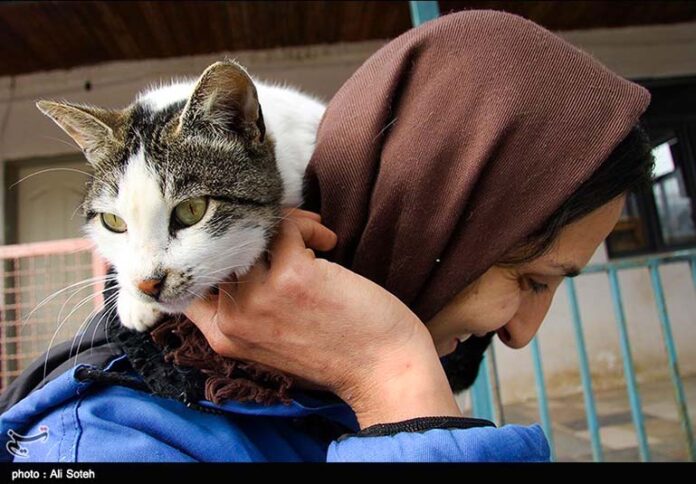
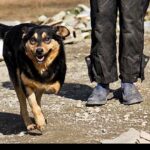
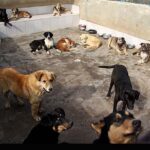
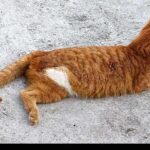
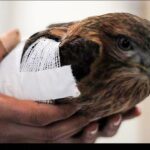
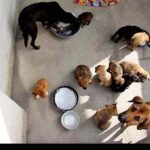
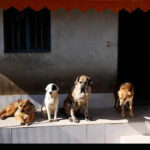
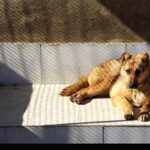
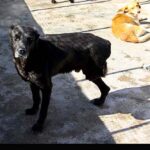
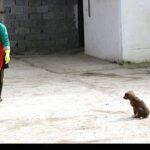
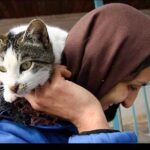
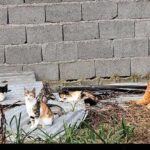
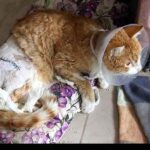
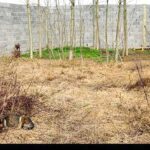
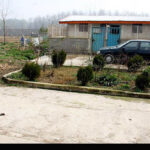
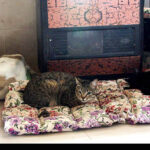
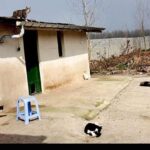
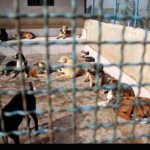
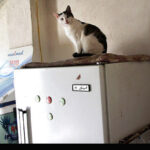
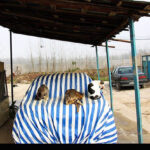
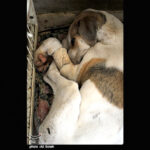
Azadeh Mahjoub, an Iranian woman living in the northern city of Rasht, has nursed back to health over 160 injured domestic animals in part of her own house in five years.

Images of injured animals in her care that Tasnim News Agency has released online:

Sunni scholars should unite to restore peace to world of Islam

alazhar

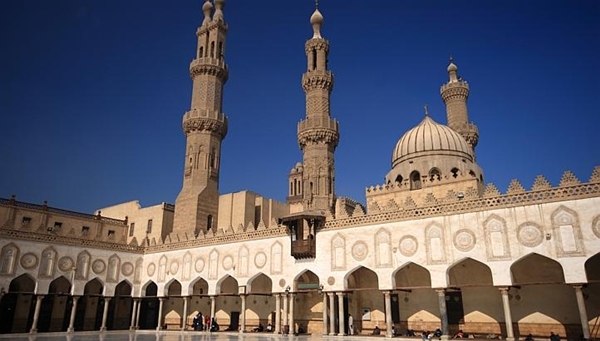
A physical war can either create or obliterate signs, but fails to wipe out roots. The war on signs and symbols should change into an intellectual war against roots. Abdollah Ghanji, a political analyst, in an editorial published in Javan daily, has put forth a solution to restore peace to the Muslim world. He believes that Sunni pundits should launch a public campaign against attempts to sell the youth a misleading version of Islam advocated by Wahhabis in their madrassas where butchers are trained with Saudi financial support.

The following is a partial translation of the editorial:

A look at bloody conflicts across the world indicates that all wars, disputes, acts of terror and carnages take place in the world of Islam. In the world today, there is arguably no other bloody war than those raging in Islamic countries.

A look at developments in Iraq, Syria, Nigeria and Afghanistan, among other places, shows that the battle is political in nature. However, there have been attempts to falsely associate these conflicts with ideology. Without setting a goal for their future some fervent young people, whose age has made it difficult for them to follow logic, set foot in a field which is aimed at either killing or being killed.

An analysis of the reason behind the outbreak of criminal acts which are full of hatred in the world of Islam should be carried out with a focus on ideological concepts.

A while ago, Seyyed Hassan Nasrallah, the secretary general of Lebanon’s Hezbollah, offered a solution which seems to have fallen on deaf ears. Four factors, namely faith, motivation, encouragement and power have contributed to the emergence of things as they are now. The political nature of such conflicts is exposed when we take account of the fact that people in these countries [Muslim countries] used to live together and respect each other while holding onto their religious beliefs.

Out of the four factors at play, encouragement comes from the West, because it can derail Muslims’ march toward the al-Aqsa Mosque. Therefore, in its battle against Muslims, the West has targeted the heart of Islam and has been successful to a large extent. But the other three factors are endogenic in nature.

The belief in uprooting different Islamic sects has its roots in Wahhabism, which motivates people with an illusion of seeking martyrdom.

The pursuit of martyrdom is based on fatwas issued by Muftis and their associates who denounce other Muslims as apostates and thus grant followers permission to capture their wives and property as spoils of war. They also hail death in pursuit of that goal as martyrdom which guarantees the martyr the company of the Prophet Muhammad in the afterlife.

Power, the fourth factor, which is spent on the purchase of military and transport equipment as well as hiring terrorists, is provided by the Saudi government and 25 Saudi investors. Revenues from the sales of 10 million oil barrels a day along with a sizeable fortune that Hajj brings are ten times more than the budget required for running a country with a population of 25 million.

The money which used to be spent on construction of stately mosques across the world is now allocated to building seminary schools and expanding the ideology of otherness within the world of Islam.

The benefit that the West reaps presently is more than that of democratization in the world of Islam and, in particular on the Arabian Peninsula. What is taking place will bring as much harm as benefit to the West.

Nowhere in the world like the Middle East, have Western double standards been exposed so clearly, which is enough to know the West.

History shows that the West never cares about peace in the world of Islam. The West knows well that pressure through democratic leverage acts better than democracy itself in guaranteeing an abundant supply of oil to the market.

The Western world puts its interests ahead of democracy, because if instead of a single family, the Saudi nation gains control over its resources, the sales of 10 million barrels of oil on a daily basis to finance terrorism across the world will be impossible. That’s why a solution should be worked out from the inside of the world of Islam.

To that end, signing up for a course at madrassas where butchers are trained should be decried as an anti-value and the monopoly held by the sons of Muhammad ibn Abd al-Wahhab, the founder of Wahhabism, over petrodollars and revenues from Hajj should be shattered.

As long as such financial sources, madrassas and ideology persist, peace will elude the world of Islam.

Senior officials of a US publishing house to attend Tehran Book Fair

Philip Kisray

The 28th Tehran International Book Fair will be attended, for the first time, by senior officials of John Wiley & Sons, Inc., a global publishing company founded in New York in 1807, Mehr News Agency reported.

The New-Jersey-based company which has offices in many major cities across the world specializes in publishing and marketing academic books.

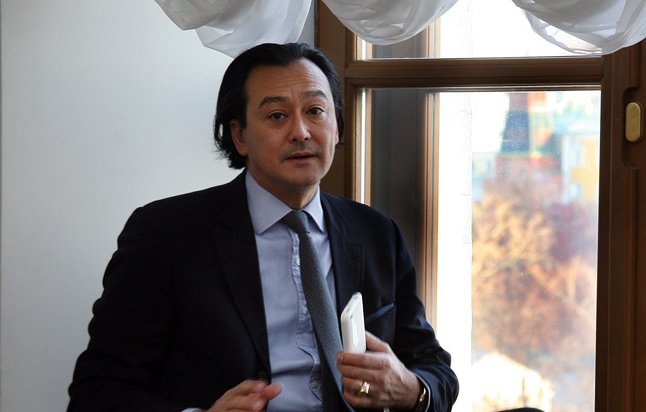
Philip Kisray, Wiley’s vice-president of international development along with Reinhard Schuelke, Wiley’s regional sales director in Eastern Europe and Central Asia, Turkey, Iran, Pakistan, Afghanistan, are to take part in Tehran Book Fair (May 6-16, 2015) for the first time to introduce their company’s new products and services.

Printed and electronic products of the publishing house are distributed by “Avand Danesh”, an exclusive agent of Wiley in Iran; it is also the only publisher which releases books in English, Persian and Arabic.

In the international section of the book fair, some 8,000 book titles are to be put on display of which 2,000 have gone to press in 2014 or 2015.

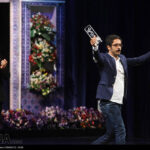
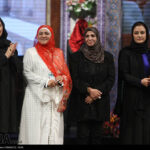
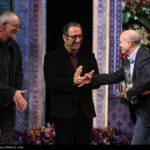
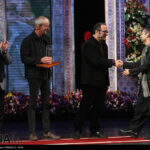
Closing ceremony of international section of Fajr Film Festival (PHOTOS)

Fajr Film Festival 56

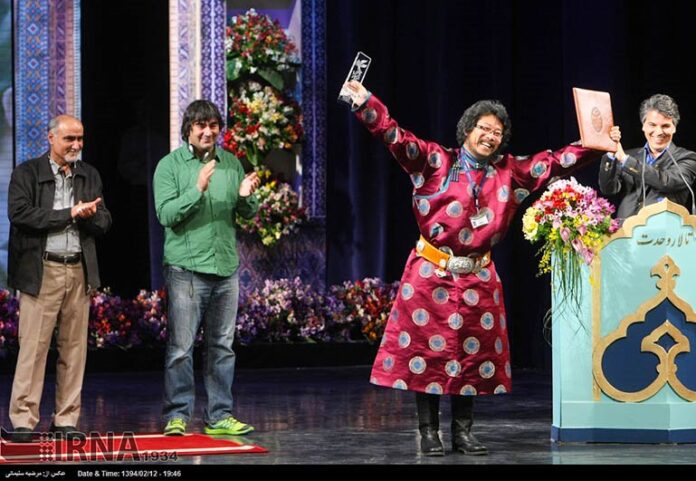
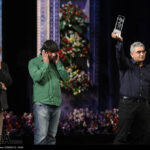
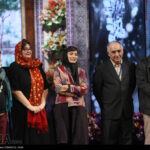
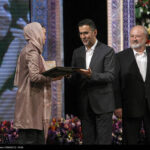
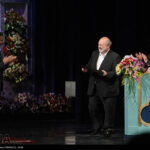
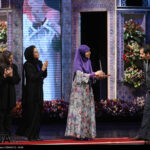
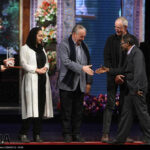
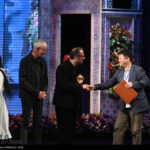
The international section of the 33rd Fajr Film Festival came to an end on May 2.

Snapshots of the closing ceremony held in Tehran’s Vahdat Hall by the Islamic Republic News Agency:

A visit to a father on Father’s Day (PHOTOS)

Father’s Day (1)

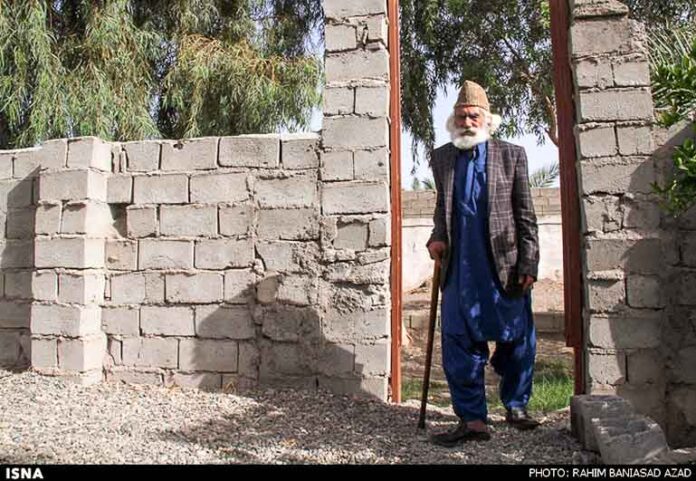
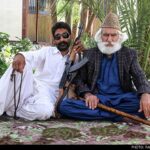
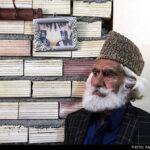
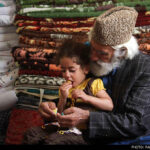
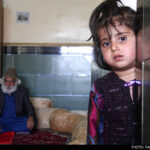
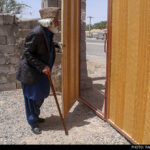
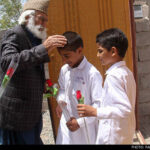
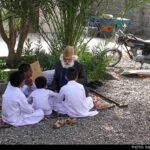
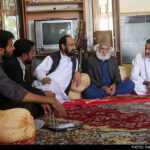
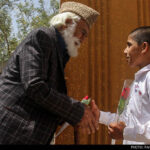
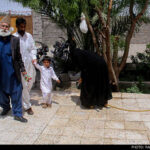
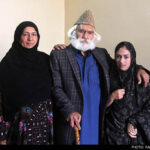
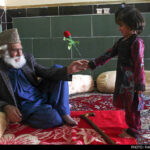
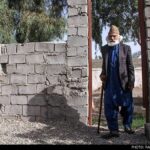
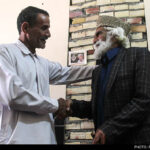
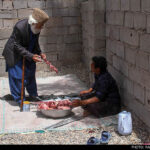
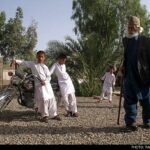
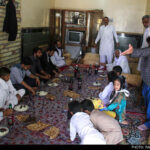
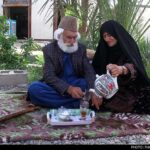
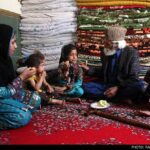
Heydar Shahriari is an old man who served as a soldier in the Bam Citadel during the Qajar era. He has 19 children and over 250 grand and great grandchildren. In spite of all hardships of a nomadic life and old age, he is totally healthy and does all his daily routine all by himself.

He is well known for his good behaviors, and is entitled as the man of peace. Every year on Father’s Day, his children, grand and great grandchildren come from afar to pay a visit to him.
Snapshots of the family reunions by the Iranian Students’ News Agency:

A look at Iranian newspaper front pages on May 3

Iranian Newspapers Headlines

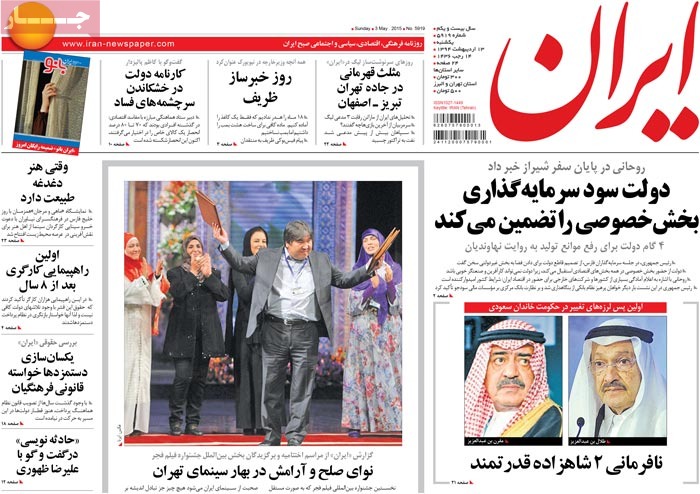
The comments of President Hassan Rouhani at the close of a tour of Fars Province dominated the front pages of Iranian newspapers. Foreign Minister Zarif’s remarks on nuclear talks also appeared on the cover of dailies.
 

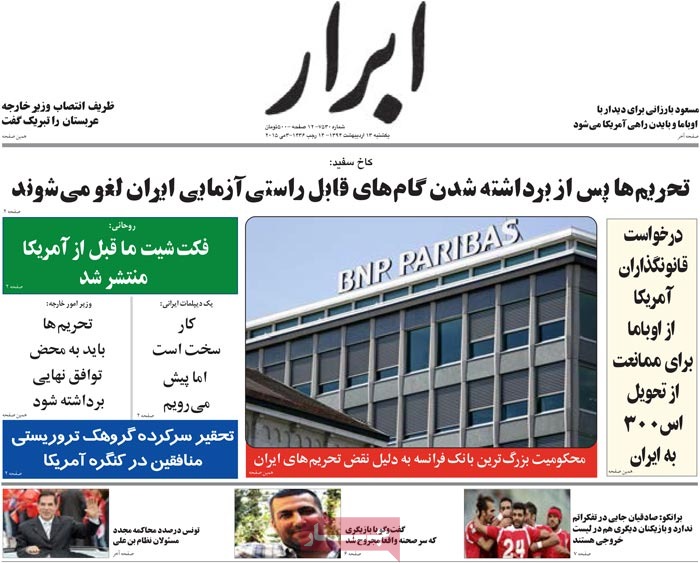
Abrar: Zarif has offered congratulations to Adel bin Ahmed Al-Jubeir on his appointment as Saudi foreign minister.

Abrar: “Sanctions must be lifted as soon as a final deal is struck,” said the Iranian foreign minister.


A look at Iranian newspaper front pages on May 3


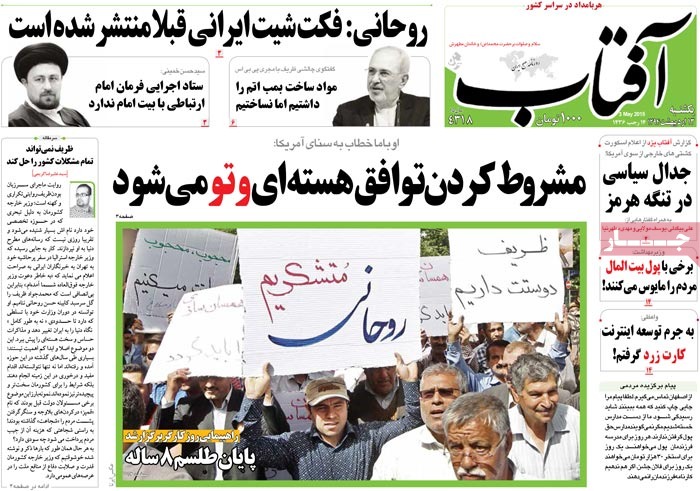
Aftab-e Yazd: “We had the material needed to build an atomic bomb, but we didn’t opt to develop nuclear weapons,” said Iranian Foreign Minister Mohammad Javad Zarif.

Aftab-e Yazd: “I have been yellow-carded by parliament for expanding Internet services,” said the minister of communications.

Aftab-e Yazd: An eight-year spell has come to an end; May Day rallies were held in Iran this year.


A look at Iranian newspaper front pages on May 3


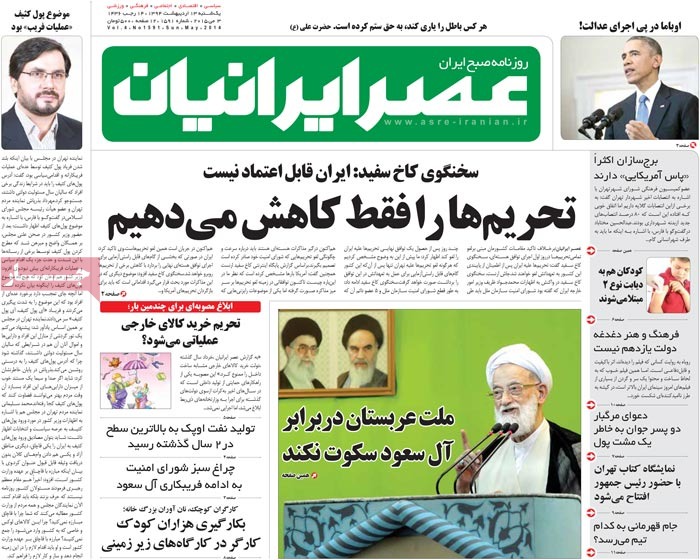
Asr-e Iranian: Tehran Friday prayer leader Ayatollah Emami Kashani has urged the Saudi people not to keep silent in the face of crimes by Al-Saud Family.


A look at Iranian newspaper front pages on May 3


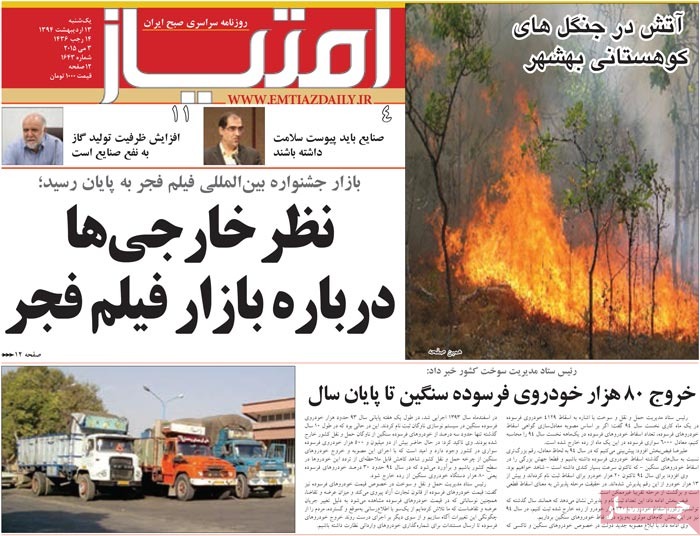
Emtiaz: There has been a bush fire in the forests of Behshar.

Emtiaz: “Some 80,000 old heavy trucks will be taken off the road by the end of the year,” said the director of the State Fuel Management Headquarters.


A look at Iranian newspaper front pages on May 3


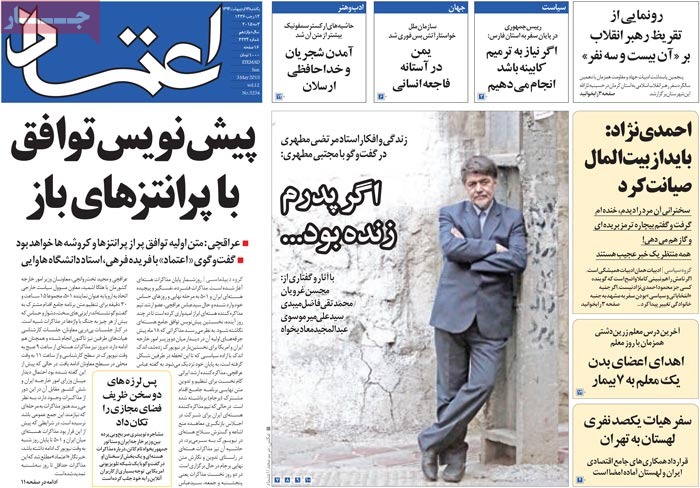
Etemad: “I will reshuffle my Cabinet if and when change is needed,” said President Hassan Rouhani at the close of his tour of Fars Province.

Etemad: The organs of an Iranian teacher have been donated to seven patients.

Etemad: A 100-strong Polish delegation is to visit Iran.

Deals on economic cooperation between the two countries are ready to be signed.


A look at Iranian newspaper front pages on May 3


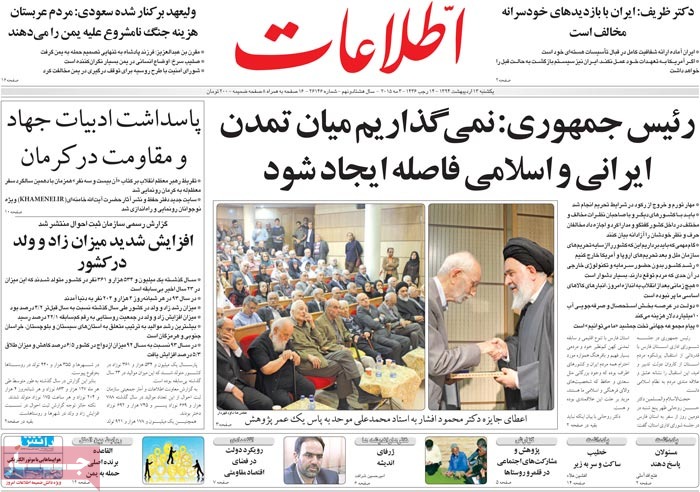
Ettela’at: “We won’t allow a gap to emerge between the Iranian and Islamic civilizations,” said President Hassan Rouhani.

Ettela’at: The number of births in Iran has registered a dramatic rise.


A look at Iranian newspaper front pages on May 3


Iran: “Government guarantees the returns of private-sector investment,” said President Rouhani.


A look at Iranian newspaper front pages on May 3


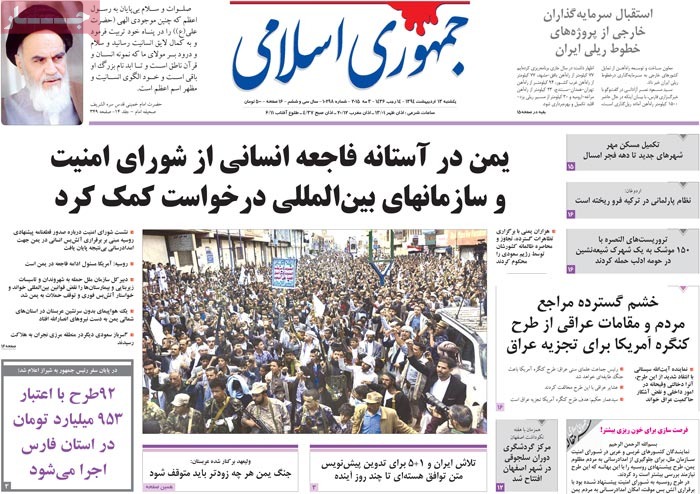
Jomhouri Islami: Foreigners have welcomed investment in Iran’s railway projects.


A look at Iranian newspaper front pages on May 3


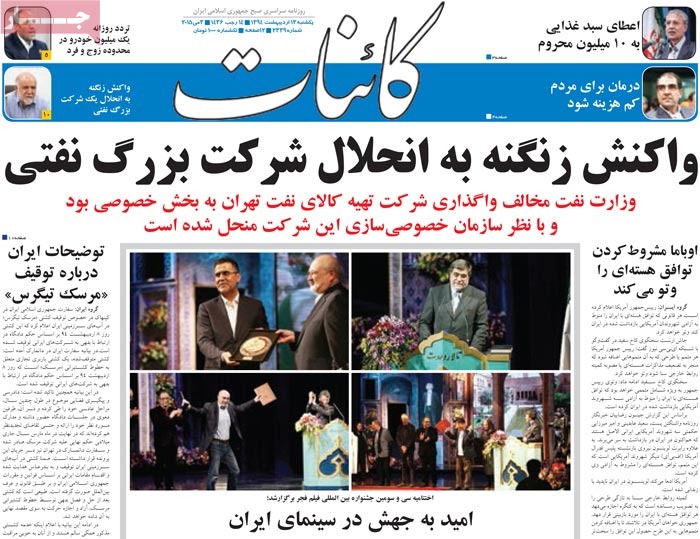
Kaenat: The reaction of [Oil Minister Bijan Namdar] Zanganeh to the dissolution of a major oil company:

The Oil Ministry was opposed to the privatization of Kala Naft Company which was dissolved under the supervision of the Privatization Organization.


A look at Iranian newspaper front pages on May 3


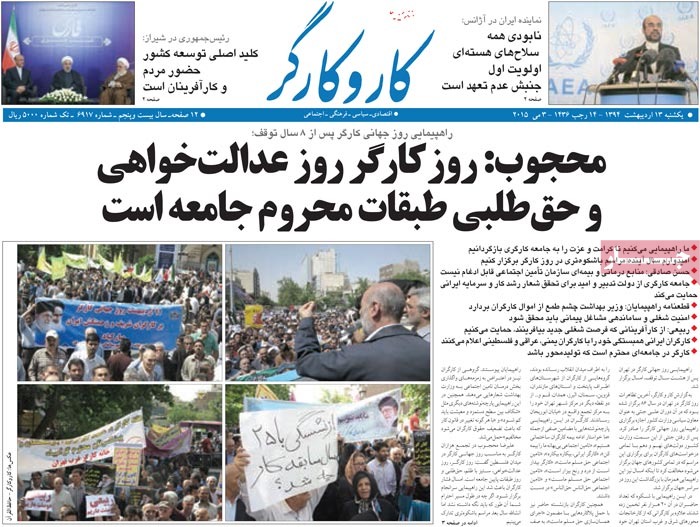
Kar va Kargar: “Elimination of nuclear weapons is the top priority of the Non-Aligned Movement,” said Iran’s envoy to the International Atomic Energy Agency.


A look at Iranian newspaper front pages on May 3


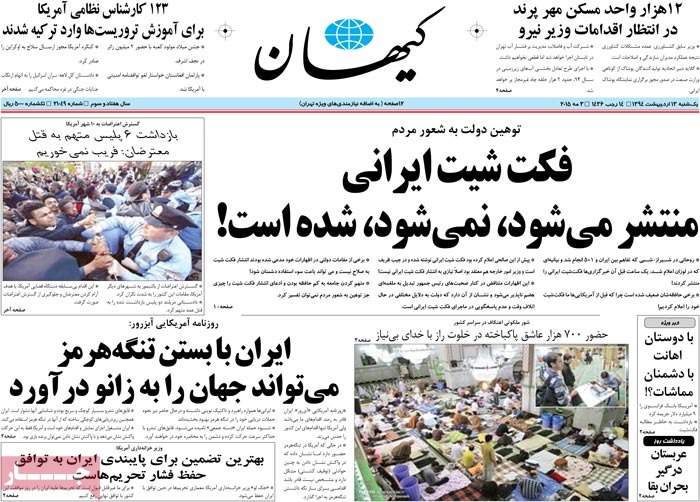
Kayhan: The government is insulting people’s intelligence by saying Iran’s fact sheet will and won’t be released in the same breath.


A look at Iranian newspaper front pages on May 3


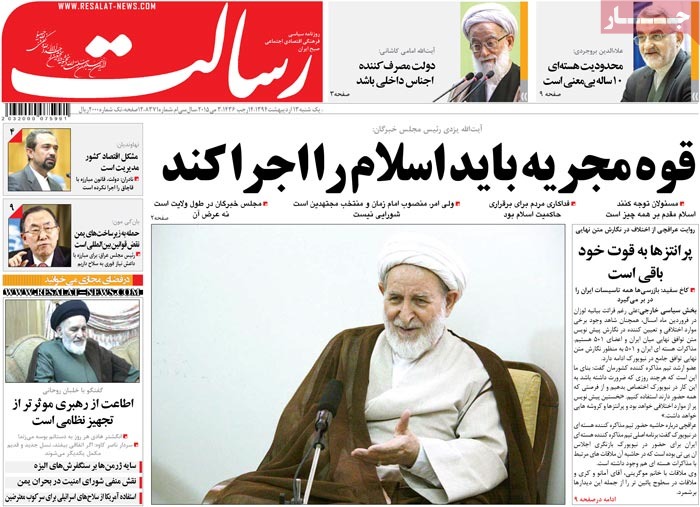
Resalat: “The Executive branch has a duty to implement the rules of Islam,” said the chairman of the Assembly of Experts.

[Ayatollah Yazdi’s comments came after President Rouhani told a host of senior police commanders that law enforcement is not responsible for implementing the rules of Islam; rather police should enforce the laws. The President has since come under fire for his comments.]


A look at Iranian newspaper front pages on May 3


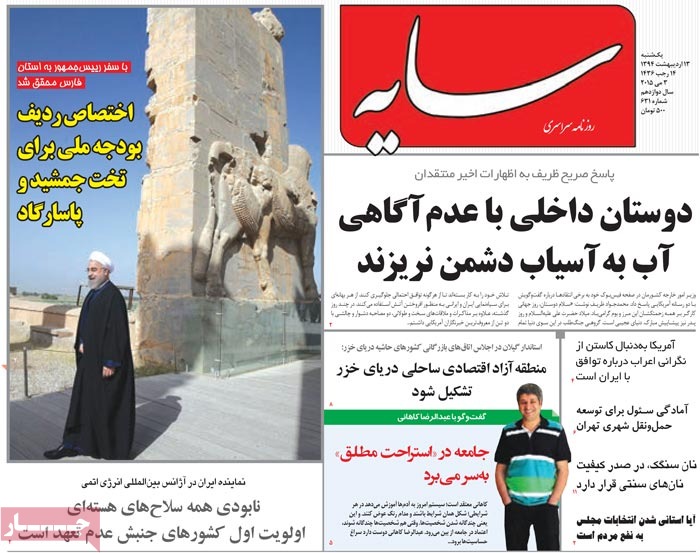
Sayeh: “Fellow Iranians should not willingly advance the cause of the enemy,” said Foreign Minister Zarif.


A look at Iranian newspaper front pages on May 3


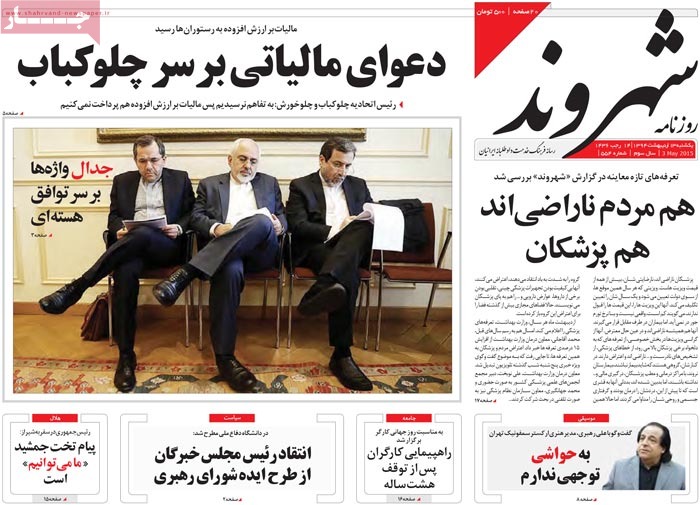
Shahrvand: Chairman of the Assembly of Experts Ayatollah Mohammad Yazdi has criticized the idea of creating a leadership council.


A look at Iranian newspaper front pages on May 3