Wednesday, December 31, 2025
Home Blog Page 4769

Araghchi: Model United Nations can promote better understanding of the organization

Araghchi

Deputy Foreign Minister for Legal and International Affairs Abbas Araghchi said that Model United Nations can promote better understanding of the organization.

Addressing a Model UN (MUN) Security Council to consider “the situation in Yemen”, organized jointly by International Studies Journal (ISJ) and United Nations Information Centre (UNIC) at the Tehran Peace Museum on Thursday (August 27), Araghchi said that there are significant misunderstandings about the functions and objectives of the United Nations and its Security Council.

According to a news report by the United Nations Information Center in Tehran, the diplomat said that “For this reason, initiatives such as holding Model United Nations can promote better understanding of the Organization and its Security Council”.

He also expressed hope that, next time, the story surrounding the UNSC Resolution on Iran’s nuclear deal will be examined.

He said that the question of Iran nuclear deal and UNSC Resolution 2231 is unique in the history of the UN.

“I believe there has been no other resolution which has been negotiated word-for-word by the target country, namely Iran,” added Araghchi, who led the Iranian negotiating team with five permanent members of the Security Council and Germany.

Some 53 participants – including university professors, students and researchers as well as seven interns from the UNIC Tehran participated in the one-day simulation on the question of Yemen.

Also addressing the MUN participants, UN Resident Coordinator and UNIC Director a.i. Mr. Gary Lewis said in today’s world many leaders in law, government, business and the arts have – in the past – participated in Model UN as students and this includes UN Secretary-General Ban Ki-moon himself.

Calling the question of Yemen as “challenging, complicated and important”, the UN official said the current state of affairs there – and its immediate impact on our region – is being actively discussed at many forums in the United Nations. So the exercise parallels reality.

He said all of us need to continue to try to find ways to help the people of Yemen. He concluded that the students engaged in the Model UN exercise will have developed skills in three ways.

“First you will have a better understanding of one of the main human security challenges facing our region; second, you will have come to learn more about the procedures and rules of the UN bodies as well as the values of the United Nations; and finally, you will have improved your skills in negotiation, communication and consensus-building,” he said, adding all three, especially the last, will be useful in your future careers, no matter where life leads you.”

Ambassador Bagher Asadi a former career Iranian diplomat and also a member of former UN Secretary-General Kofi Annan’s “Panel of Eminent Persons on Civil Society and UN Relationships,” was the President of the MUN Security Council Simulation on Yemen.

IAEA report confirms Iran’s peaceful program: Envoy

Najafi-IAEA

Iran’s representative to the International Atomic Energy Agency (IAEA) Reza Najafi said a recent IAEA report once again confirmed that Iran’s nuclear program is completely under the supervision of the UN nuclear watchdog and has had no divergence from its peaceful objectives.

On Friday, the IAEA verified that Iran has fulfilled all its commitments regarding its nuclear program.

In the updated report on Iran’s nuclear program, the UN nuclear agency reiterated that Tehran has maintained its level of uranium enrichment, nuclear research and development and other activities in line with its declarations to the UN nuclear watchdog.

The report also covered Iran’s activities before the country reached a comprehensive agreement in nuclear talks with P5+1 in Vienna on July 14.

Under the agreement, Iran has agreed to some restrictions in its nuclear program primarily in return for the removal of sanctions.

The updated IAEA report said, however, that the IAEA has still some reservations about Parchin, a military site located to the southeast of Tehran.

“Since (our) previous report (in May), at a particular location at the Parchin site, the agency has continued to observe, through satellite imagery, the presence of vehicles, equipment, and probable construction materials. In addition, a small extension to an existing building appears to have been constructed,” the report said.

But Iran has repeatedly denied any nuclear activity at Parchin, noting that ‘road construction’ activities have been done at the site.

The IAEA report covers Iran’s nuclear program in the leadup to the historic deal on July 14 and its first steps toward implementing the agreement.

[…]

Iran’s capital market is to absorb more foreign investment

Capital market

Iran Investment Institutions Association (IIIA) on Tuesday (August 25) held a 23rd capital market working breakfast which focused on “Potential and opportunities of the Joint Comprehensive Plan of Action (JCPOA) for the capital market”.

Speakers took the podium in the meeting to talk, among other things, about economic and non-economic sanctions imposed by Western countries on Iran for its nuclear program; the timetable of lifting sanctions after the conclusion of the nuclear deal; the need for changing the contracts of the country’s financial market in keeping with international rules and regulations; and closer attention by the players on the capital market to a series of reforms to attract foreign investors after the termination of sanctions in the final quarter of the current Iranian year [December 22, 2015 – March 19, 2016].

Donya-e Eqtesad, an Iranian daily, on August 26 published a report on foreign investment in Iran’s capital market and speeches by three officials at this working breakfast. The following is the translation of part of what each speaker said in the meeting:


Sirous Naseri, a former Iranian nuclear negotiator

Sirous Naseri
Sirous Naseri

From the start, nuclear talks between Iran and the West focused on one core issue: writing the text of the Joint Comprehensive Plan of Action (JCPOA) to render it workable for a long period of time. In doing so, the Iranian negotiating team had a bumpy road ahead. From the very beginning of the talks, we knew that the US president lacked the powers to remove all sanctions and that the US Congress held partial sway over this matter. […]

All in all, what has been included in JCPOA sufficiently tells about the establishment of normal ties between Iran and Europe and paves the way for legal and real institutions [on both sides] to work together.

[…]

All legal institutes in Iran should watch for the provisions of their contracts [with their foreign counterparts], and they are expected to consult with Foreign Ministry officials – if need arises – so that the ministry can ease things through regulations.

The overall prospect is promising. Things will change rapidly. I hope we can see the inflow of capital so that the country can come out of recession, and efforts to boost economic growth and development can be given momentum.


Mohammad Saeedi, a member of the Board of Directors at the Social Security Investment Company (SSIC) and managing director of the Islamic Republic of Iran Shipping Lines (IRISL Group)

Mohammad Saeedi
Mohammad Saeedi

Under the Joint Comprehensive Plan of Action, Iran’s ties with the West will normalize, but there is one problem here: the pace of the private and public sectors in adapting themselves to the new conditions is slow and their knowledge of all aspects of the sanctions is limited.

[…]

The point is that as an investing institution we [at the Social Security Investment Company (SSIC)] are not ready to tap into the opportunities which will open up after the removal of sanctions. We are not ready for post-sanctions era which will start in February or March [next year].

[…]

Unpreparedness to draw up [new] investment contracts is now a downside as far as absorption of foreign investment goes. Productive talks have been launched. Over time, ties between Iran and Western countries will change. We need to get prepared for such days down the line. […]

A number of contracts which entail the financial and insurance rights [of the two sides] should be drawn up in line with new conditions in the world. These contracts can be used for partnerships with foreign investors.


Kourosh Taherfar, an advisor to director of the Organization for Investment Economic and Technical Assistance of Iran (OIETAI)

Kourosh Taherfar
Kourosh Taherfar

Currently, foreigners have invested $0.5b in the Securities and Exchange Organization of Iran (SEO) which adds up to about 0.5 percent of the overall capital at the SEO. Based on national rules, this number can rise to up to 20 percent.

A working group has been formed to spur foreign investment. It is expected to remove obstacles standing in the way of foreign investment, both direct and indirect.

We need to examine the country’s investment strategy to determine whether the void created stems from legal obstacles or from adoption of different tactics by [different governments] in the past. When these ambiguities are removed, we can establish a strong bond between the [capital] market and foreign investment.

We cannot pursue the previous trends and enter talks with financing banks. Things have changed and we will witness remarkable progress on the economic front in the next two years. Besides a strong will, we need new methods to attract foreign investors and properly exploit the current opportunities.

The way companies release their financial statements should undergo change. Foreign investors cannot come to terms with the ways our companies release their financial reports. In order to make the stock exchange attractive to foreign investors, we need to take some measures, the minimum of which are: launching the English version of company websites, establishing bilingual CODAL financial reporting [Comprehensive Database Of All Listed Companies, a system to put corporal reports out], offering English analysis of bourse activities and setting up overseas branches for investing and financial institutions and companies.

Windmill: Original Iranian Experience of Industrial Structure

Iran Windmills

Modern architecture has a dynamic approach to renewable energies which are drawing much attention in our country of late. Natural potential which was tapped by our ancestors in the past can prove practical today too.

The following is the translation of an excerpt of a report filed by Saramad Magazine on the history of windmills in Iran:

Historical accounts suggest that windmills first emerged in Iran in the 7th century AD. Historians believe that windmills were the first machines in history. Unlike other sources used by mankind which were subject to constraint, wind offered a noticeable amount of power wherever it blew.

That wind power was not monopolized by only a privileged class or feudal lords and there was no need for the construction of specific channels to harness and transfer its energy rendered the wind energy affordable.

The production capacity of windmills was many times more than that of regular mills. Above all, the widespread availability of wind made it possible for all to use windmills.


Sistan and Baluchestan Province, Birthplace of Windmill

Windmills played a special role in Iran, particularly in Sistan and Baluchestan Province, which was called the country’s granary in different eras.

Iranian and Arab historians in the 9th and 10th centuries have all presented different stories about wind-run structures in what is now Sistan and Baluchestan. Even Western and contemporary historians unanimously believe that the first windmills of the world were constructed in this region.

In fact the technical and architectural properties of these structures were not the only noteworthy thing about them. They paved the way for the emergence of sustainable societies nearby. Zaranj, a city in southwestern Afghanistan, and Zahedan, the provincial capital of Sistan and Baluchestan, both home to windmills according to historic accounts, replaced the Burnt City to become key civilization hubs in the Iranian Plateau.

Highlights of Ettela’at newspaper on August 29

Ettelaat29

 “We need to root out monopoly,” said the chief of staff of President Rouhani.

Mohammad Nahavandian further said in the post-sanctions era, government will build on interaction to forge ahead in style with the policy of cutting the country’s dependence on oil revenues.

 The Iranian oil minister has said that Iran will reclaim its position as the second largest producer of OPEC.

Bijan Namdar Zanganeh further said all oil fields will return to the production cycle once the sanctions are lifted.

 The United Nations has called for the formation of a fact-finding mission on Saudi war crimes in Yemen.

UNICEF has said that three children are killed and five others are wounded in Yemen on a daily basis.

 “Ill-thought-out comments against nuclear talks deal a blow to the establishment,” said Grand Ayatollah Hossein Mazaheri, a source of emulation.

He further said the patience and tolerance of the negotiating team burnished the Iranian image [on the international stage].

 The International Atomic Energy Agency has said that Iran has remained committed to the provisions of the Geneva Deal.

Iran’s ambassador to the UN nuclear agency said the IAEA report suggests there is no diversion in Iran’s peaceful nuclear activities.

♦ “The world needs to respect the literature of the Persian language,” the Friday prayer leader of Ardebil told a closing session of an international conference to promote Farsi.

The culture minister told the same gathering that Farsi is full of terms and delicate figures of speech compatible with human knowledge.

 The grandson of the late Imam Khomeini has dismissed as wrong some individuals’ failure to shoulder responsibilities.

Seyyed Hassan Khomeini further said one of the most momentous achievements of the current government is [the creation of] hope which was touched upon by the Supreme Leader in his recent comments.

Film director arrested in all-star match (PHOTO)

Ali Molla-Gholipour

Ali Molla-Gholipour, a young Iranian director, took his protest at the screening of his film – Dowry’s Sugar Bowl – to a charity soccer match between the Iranian big names and the World Stars.

Ali, the son of famous Iranian director Rasoul Molla-Gholipour, ran onto the pitch Friday and was arrested by police. He was protesting against the screening of a movie in theaters previously designated to screen his.

He was later released thanks to the mediation efforts of Hojjatollah Ayyoubi, the head of Iran’s Cinema Organization.


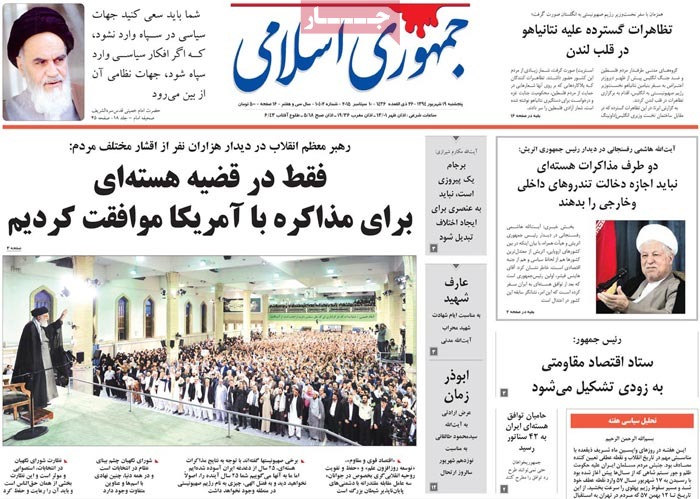
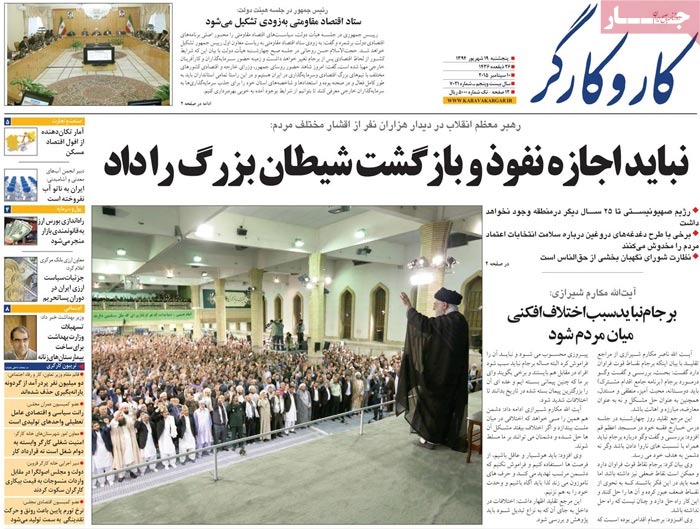
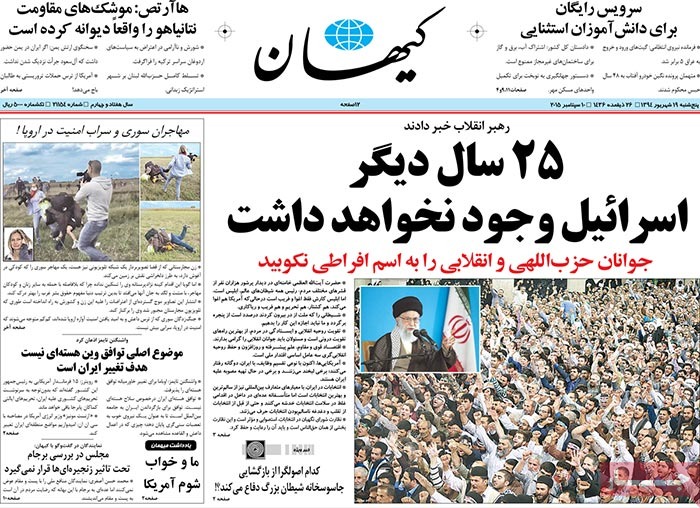
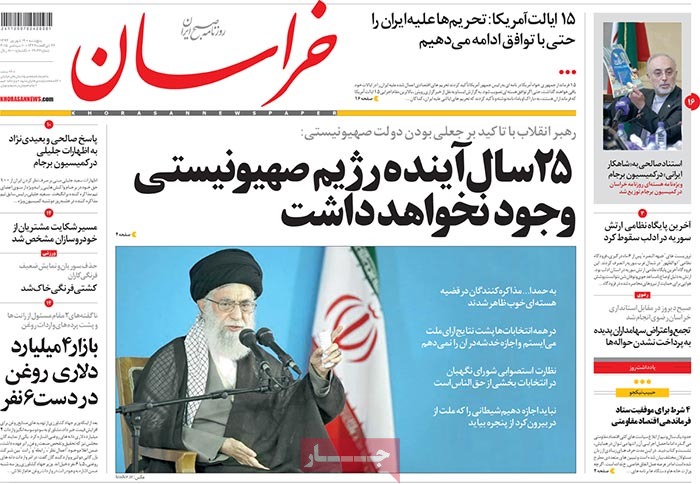
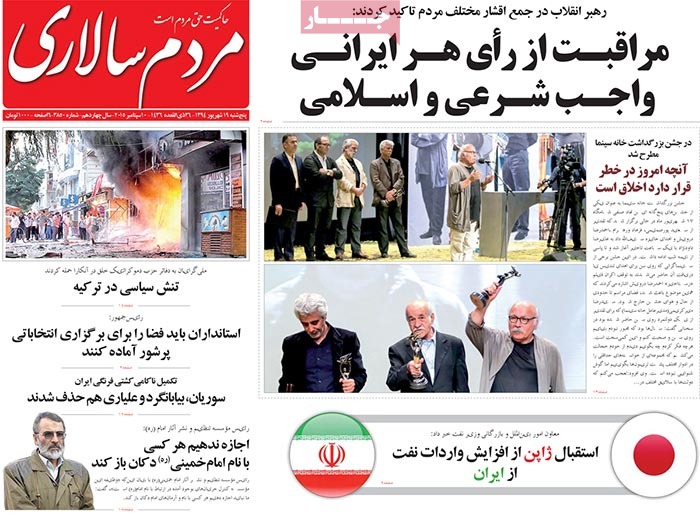
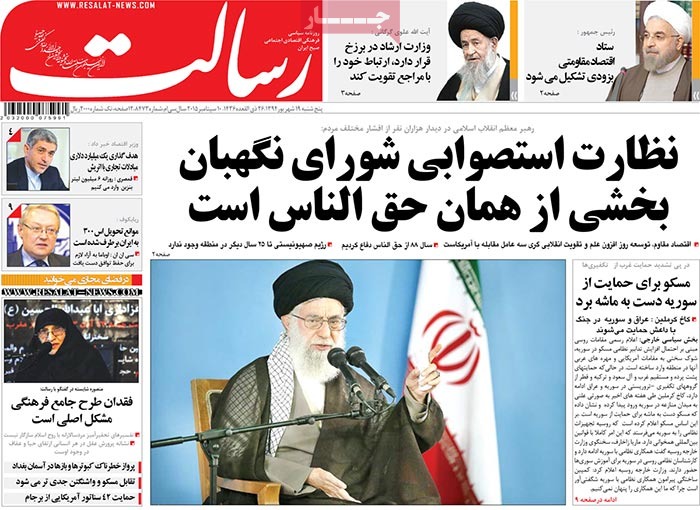
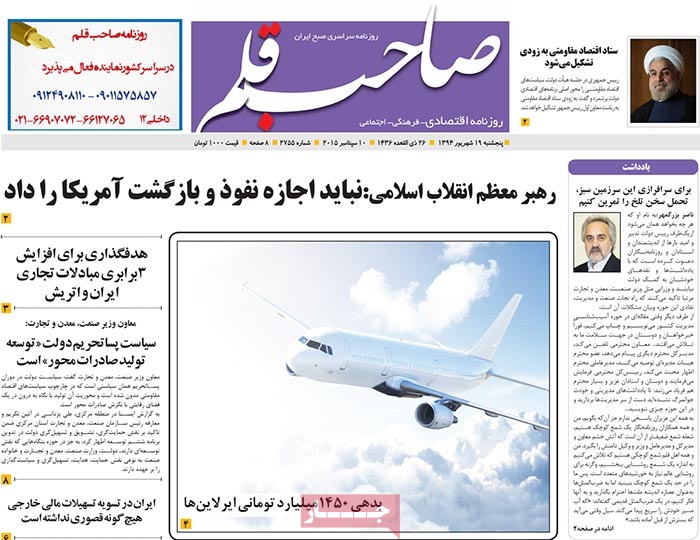
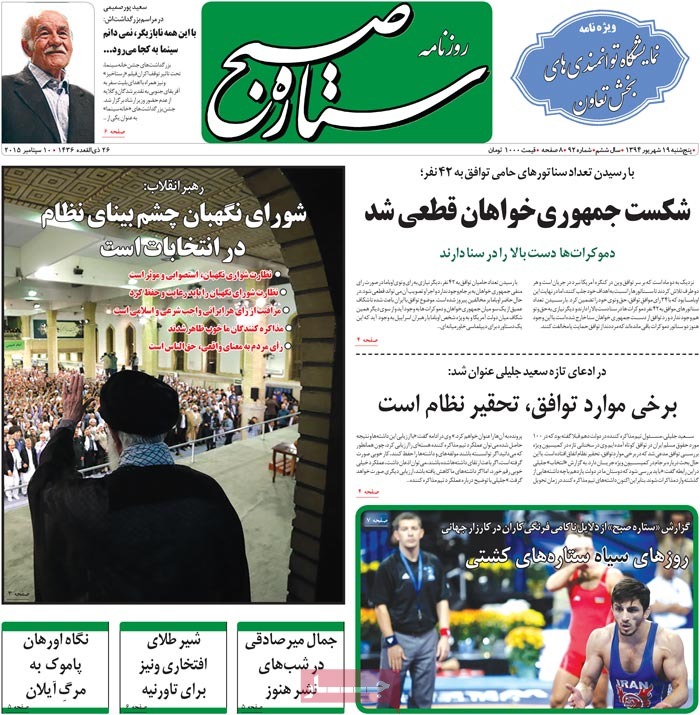
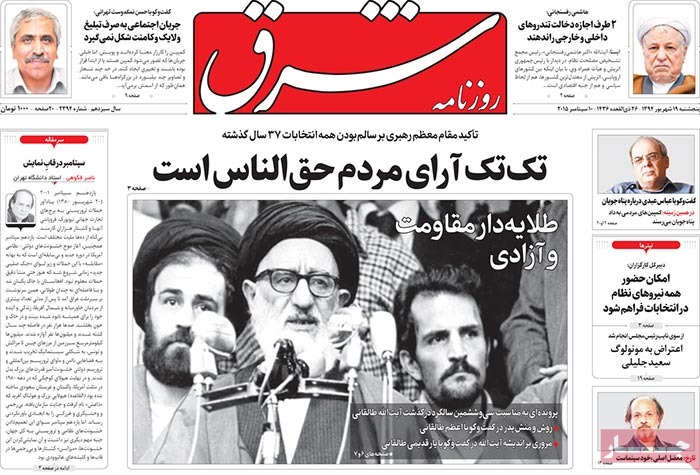
A look at Iranian newspaper front pages on August 29

Iranian Newspapers Headlines

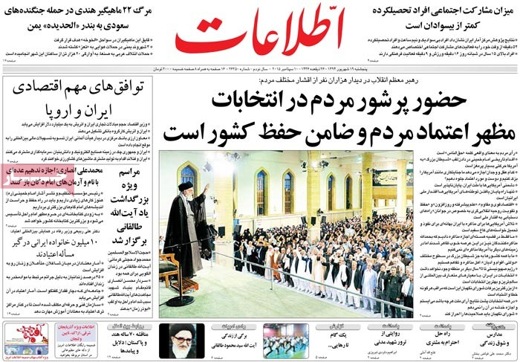
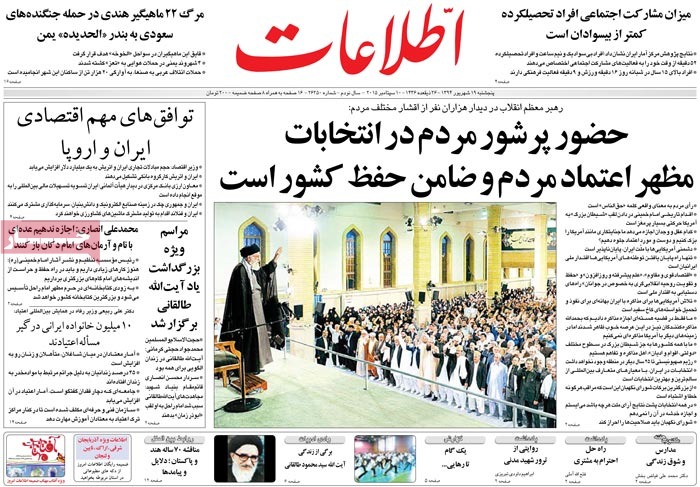
Ettela’at: “We need to root out monopoly,” said the chief of staff of President Rouhani.

Mohammad Nahavandian further said in the post-sanctions era, government will build on interaction to forge ahead in style with the policy of cutting the country’s dependence on oil revenues.


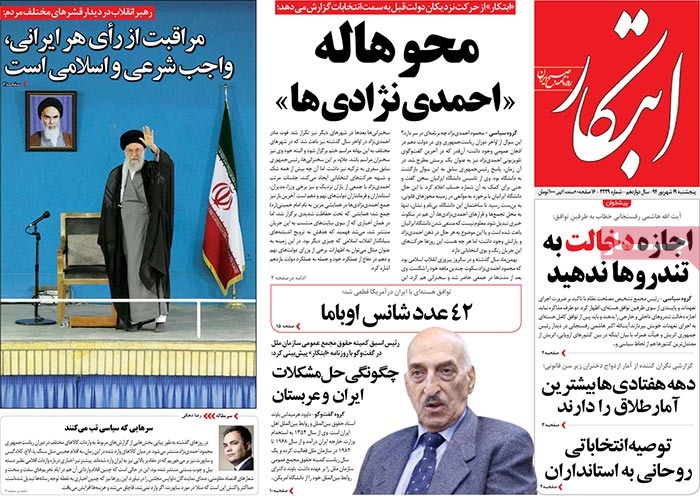
Abrar: Deadly gas leak in Mahshahr Petrochemical Complex

One person was killed and another badly poisoned in the incident at Arvand Petrochemical Company.


A look at Iranian newspaper front pages on August 29


Afarinesh: The director of the Atomic Energy Organization has said that Iran and China will cooperate in construction of 100 MW power plants.


A look at Iranian newspaper front pages on August 29


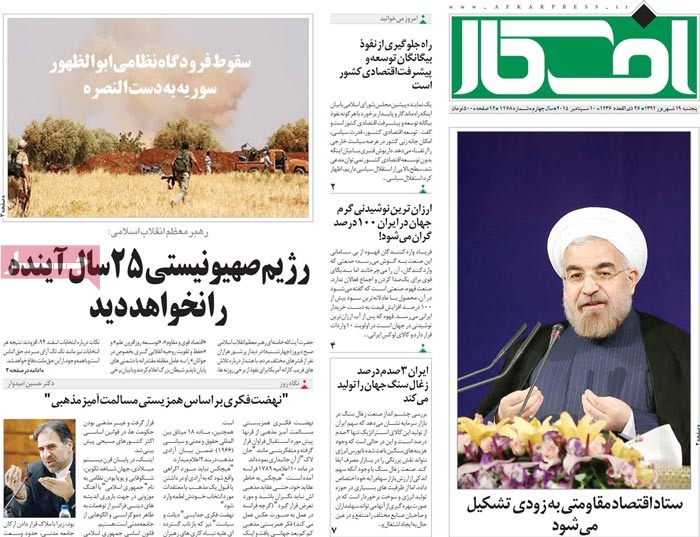
Afkar: “Iranian people are allergic to threats,” said Foreign Minister Mohammad Javad Zarif.


A look at Iranian newspaper front pages on August 29


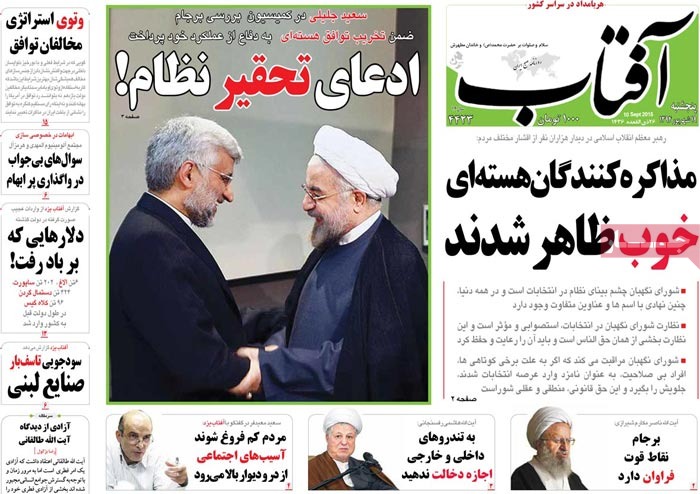
Aftab-e Yazd: “Inflation will slip into single digits within two years,” said the government spokesman.

Aftab-e Yazd:Iran and the United States have similar views on Parchin.

The likelihood of the US Congress rejecting the deal has become more remote.


A look at Iranian newspaper front pages on August 29


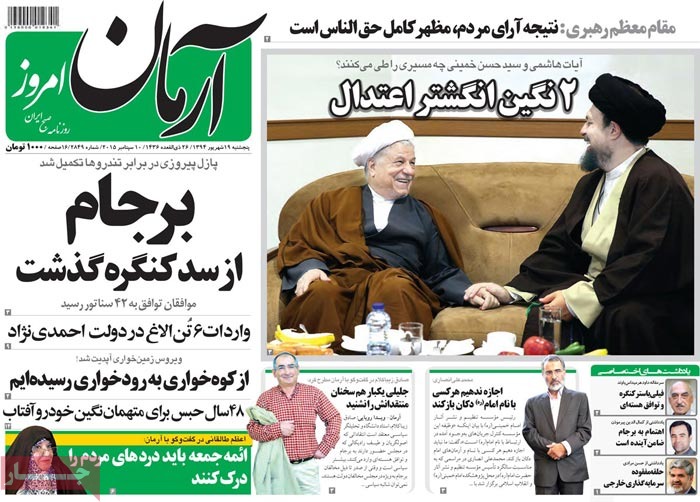
Arman-e Emrooz: The Central Council of NEDA [Farsi initials for a Second Generation of Reformism] Party has not accepted the resignation of Sadegh Kharrazi.


A look at Iranian newspaper front pages on August 29


Asr-e Azadi: “The Joint Comprehensive Plan of Action removes the obstacles standing in the way of making resistance-based economy a reality,” said Foreign Minister Zarif.


A look at Iranian newspaper front pages on August 29


Asrar: World Stars have beaten Iran’s all-star team (3-0) in a charity matchup at Azadi Stadium.


A look at Iranian newspaper front pages on August 29


Esfahan Emrooz: Foreign Minister Zarif was on hand for the experimental run of Isfahan Subway.


A look at Iranian newspaper front pages on August 29


Iran: Iran is ready to waive visa requirements for visitors from 28 countries if the move is reciprocated by those countries.

The move is part of efforts to increase the number of foreign tourists arriving in the country to 20 million.

Iran: “Stoking pessimism runs counter to the country’s national interests,” said the chief of staff of President Rouhani.


A look at Iranian newspaper front pages on August 29


Jomhouri Islami: Swiss firms are willing to invest in Iran.


A look at Iranian newspaper front pages on August 29


Kayhan: [Iran is in a] hurry to implement its commitments even before the Joint Comprehensive Plan of Action is approved.

Foreign Minister Zarif has said that implementation of the commitments will get underway on September 23.


A look at Iranian newspaper front pages on August 29


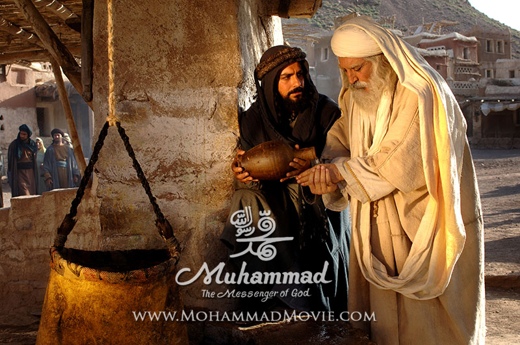
Qods: The pride of Iran’s film industry [Muhammad] hits the big screen.


A look at Iranian newspaper front pages on August 29


Resalat: Tehran police chief has said that 20 drug trafficking rings have been busted.


A look at Iranian newspaper front pages on August 29


Shahrvand: The bodies of 71 Syrian refugees have been found on board a truck in Austria.


A look at Iranian newspaper front pages on August 29


Only nations can solve Syria, Yemen crises: Iran

Larijani

Iran’s parliament speaker has said the crises in Syria and Yemen can be resolved only if the wishes of the two nations are taken into account.

“Some powerful countries proposed plans to resolve the crises in Yemen and Syria. We believe that such proposals would not work, since they do not address the wills of the nations,” Ali Larijani told reporters early on Saturday before leaving Tehran to attend the fourth World Conference of the Speakers of Parliaments in New York.

He stated that Tehran is going to offer new plans for the fight against terrorism and promotion of peace at the upcoming conference.

“There is a great gap between words and deeds. We see wars in the battlefields and in conferences, everyone talks about democracy,” Larijani noted, adding that during his speech at the conference he will try to define how democracy can realistically and practically promote peace in the region and the world.

He also pointed to the deadly military aggression against the Yemeni people, saying political dialogue is the only way out of the crisis in the impoverished Arab country. “Some countries suppose that they can solve problems through pressure and militarism, but the age of such theories is long over.”

Some 180 parliamentary leaders from 140 countries will take part in the New York conference, (August 31 to September 2) which will focus on tackling the challenges to peace and democracy.

Iran ready to offer reciprocal visa-free travel: Zarif

Zarif-Metro

Iranian Foreign Minister Mohammad Javad Zarif has said the country is ready to offer visa-free travel to citizens of the countries that are willing to engage in reciprocal visa waiver mechanisms with the Islamic Republic.

Citizens of the countries which are ready to waive visa requirements for Iranian nationals will also receive visa waivers from the Islamic Republic in a reciprocal move, Zarif said Friday on a visit to Isfahan, a major tourist hub in central Iran.

The top diplomat said Iran has held negotiations with many countries on the issue of visa requirements, saying the diplomacy apparatus is prepared to provide anything needed to facilitate the growth of Iran’s tourism sector.

Iran has dropped visa requirements for nationals of seven countries as part of its plans to boost the country’s tourism. Citizens of Turkey, Lebanon, Azerbaijan, Georgia, Bolivia, Egypt and Syria can travel to Iran and stay in the country without visa from 15 to 90 days.

Intelligence officials in Iran have also approved a plan to expand the list to include 12 more countries, but sources in Iran’s tourism sector say the Foreign Ministry opposes the move, arguing visa-free travel is basically a reciprocal mechanism.

According to the Visa Restrictions Index, holders of an Iranian passport can visit 40 countries visa-free or with visa on arrival.

Many observers say the July 14 nuclear agreement between Iran and P5+1 – Russia, China, France, Britain, the US and Germany – will significantly boost the Islamic Republic’s tourism sector and increase demands for Iranian visas.

Iran denounces British FM Hammond’s ‘unconstructive’ remarks

Marzieh Afkham

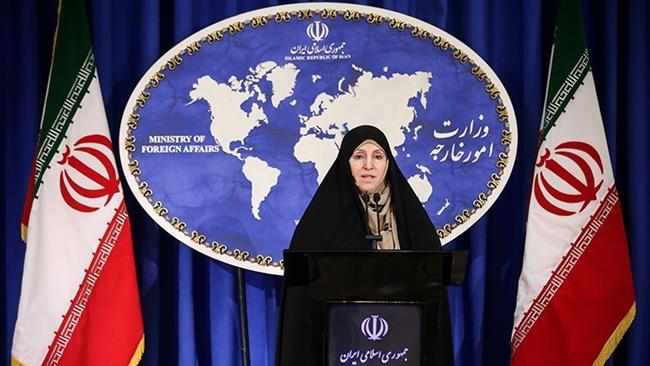
Iranian Foreign Ministry Spokeswoman Marzieh Afkham dismissed the recent remarks by British Foreign Secretary Philip Hammond as “unconstructive”, saying that such comments are part of continued moves to cast doubt on Iran’s relations with its neighbors.

Speaking to Tasnim News Agency on Friday, Afkham lashed out at Hammond for his recent remarks in a joint press conference with his Saudi counterpart, emphasizing that such statements are divisive.

“The Islamic Republic of Iran’s policy toward its neighbors is based on ensuring collective interests, strengthening friendship and peaceful coexistence with an emphasis on religious commonalities,” she said.

Countries outside the region had better avoid raising false and divisive issues through their words and deeds, she added.

Afkham also made it clear that the opening of the Iranian and British embassies in London and Tehran does not mean Iran will not oppose Britain’s regional policies.

In a joint press conference with Saudi Foreign Minister Adel al-Jubeir in London on Wednesday, Hammond said he had reassured al-Jubeir that the reopening of British embassy in Iran does not imply London will relax pressure on Tehran to stop what he called interfering in other Middle Eastern countries’ affairs.

Hammond was in Tehran on August 23 to reopen the British embassy in the Iranian capital after a 4-year closure.

Simultaneously, Iran’s embassy in London resumed its diplomatic activities.