Tuesday, December 30, 2025
Home Blog Page 4752

Islamic Movement Leader Describes Boko Haram as Failed Plot of Spy Agencies

Sheikh Ibraheem Zakzaky

“Boko Haram doesn’t exist and it can merely be seen in the media and we just see some aimless attacks and blasts against people in the markets, mosques, churches and streets,” Zakzaky told FNA on Wednesday.

Dismissing the Nigerian government’s claims that Boko Haram seeks to overthrow the regime, he asked, “Then what could justify their killing of ordinary people and not the statesmen.”

Zakzaky challenged the existence of Boko Haram, and said, “If there is any such group which has carried out these (terrorist) operations, then where is it? They are all affiliated to the government and no one has seen them.”

Noting that no journalist has ever seen a member of Boko Haram, he stressed that they don’t exist and it is merely the Nigerian police and law enforcement officials who blame Boko Haram for the terrorist acts.

Boko Haram militants, who have recently pledged allegiance to ISIL Takfiris, have killed about 15,000 people since they launched their militancy in 2009. Some 1.5 million people have also been displaced as a result of the violence.

Soldiers from Nigeria, Chad, Cameroon and Niger have been battling Boko Haram terrorists in recent months.

Since his inauguration in May, Nigeria’s President Muhammadu Buhari Buhari moved Nigeria’s defense command center to Maiduguri, the birthplace of the terrorist group, and is setting up the headquarters for a multi-national joint taskforce in Chad’s capital N’Djamena.

He also sacked his army, navy, air force and defense chiefs in July in a bid to launch a major military assault on Boko Haram terrorists.

The outgoing officials were Chief of Defence Staff, Air Marshall Alex Badeh; the Chief of Army Staff, Major General Kenneth Minimah; the Chief of Naval Staff, Rear Admiral Usman Jibrin and the Chief of Air Staff, Air Vice Marshall Adesola Amosu.

Buhari also lashed out at the United States for refusing to provide his soldiers with weapons in their fight against Boko Haram militants.

He said that Washington “aided and abetted” the Takfiri militants in his country by refusing to arm the Nigerian forces over human rights concerns.


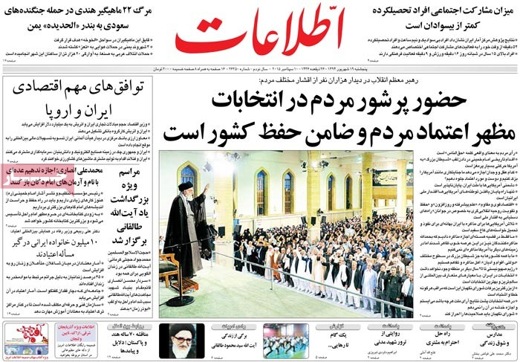
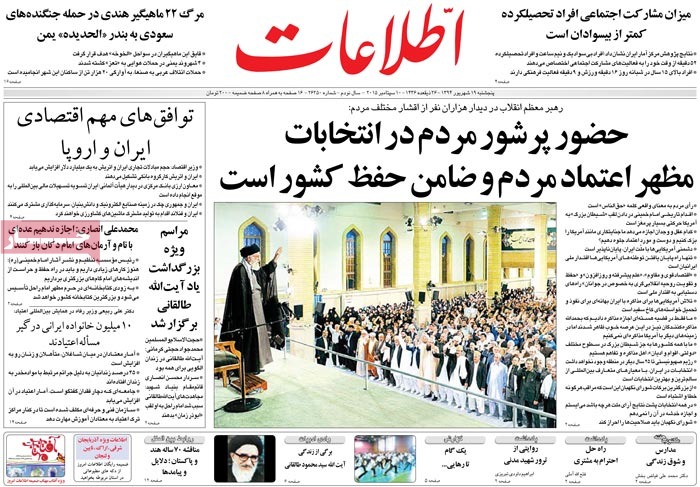
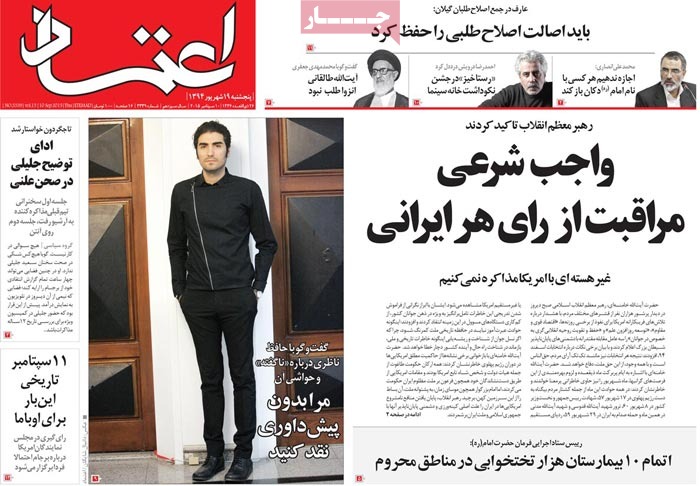
Highlights of Ettela’at newspaper on September 10

Ettelaat-Sep-10

 “The massive turnout of people for elections will symbolize public trust and guarantee the country’s future,” the Supreme Leader said at a meeting with people from all walks of life.

Ayatollah Khamenei further said that American hostility toward Iranians is endless.

 The extent of social participation of the educated people is less than the illiterate.

Studies by the Statistical Center of Iran suggest that illiterate and educated individuals are engaged in social activity 90 and 52 minutes respectively.

 A Saudi airstrike on the Yemeni port city of Al-Hudaydah has left 22 Indian fishermen dead.

Attacks by the Saudi-led coalition on Sana’a have displaced 20,000 residents of the city.

 Important economic deals between Iran and Europe

The minister of economy and financial affairs has said that the volume of trade between Iran and Austria will reach $1 billion.

 A ceremony has been held in memory of Ayatollah Mahmoud Taleghani, a prominent Muslim thinker and philosopher who passed away in the late 1970s.

 “We should not allow certain individuals to hide behind the late Imam to advance their own agenda,” said Mohammad Ali Ansari, the head of the Institute for Compilation and Publication of the Works of Imam Khomeini.

He further said that the country’s largest library will soon be launched at the mausoleum of the late Imam.

 “Some 10 million Iranian families deal with the negative impacts of addiction, one way or another,” said the welfare minister.

He further said that 45 percent of inmates are behind bars for offenses that have to do with illicit drugs.


A look at Iranian newspaper front pages on September 10

Iranian Newspapers Headlines

The important comments of the Supreme Leader on elections, nuclear talks and negotiations with the United States dominated the front pages of Iranians newspapers on Thursday.


Ettela’at: “The massive turnout of people for elections will symbolize public trust and guarantee the country’s future,” the Supreme Leader said at a meeting with people from all walks of life.

Ayatollah Khamenei further said that American hostility toward Iranians is endless.


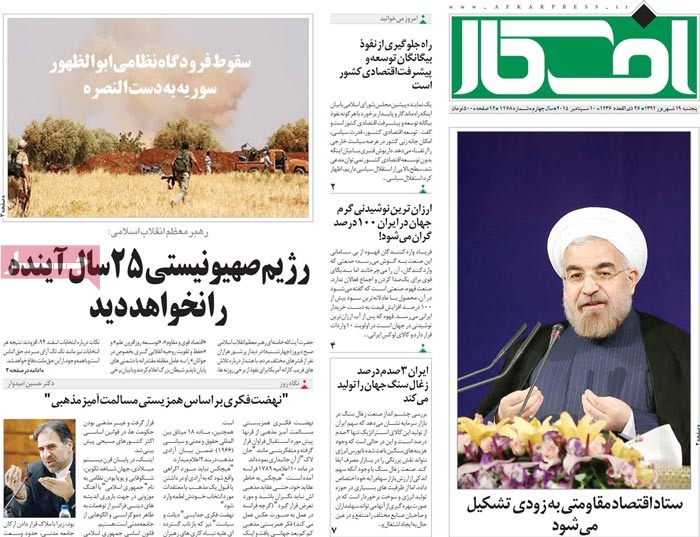
Afkar: The president has said that a resistance-based economy headquarters will soon be established.


A look at Iranian newspaper front pages on September 10


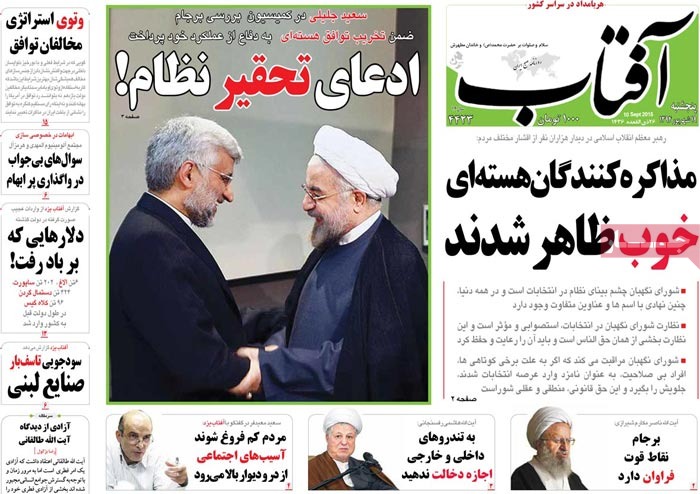
Aftab-e Yazd: The Supreme Leader has hailed the performance of Iranian nuclear negotiators as “good”.

Aftab-e Yazd: The chairman of the Expediency Council has said in a meeting with the Austrian president that the two sides [Iran and P5+1] should not allow local and foreign hardliners to sabotage the Vienna nuclear accord.    


A look at Iranian newspaper front pages on September 10


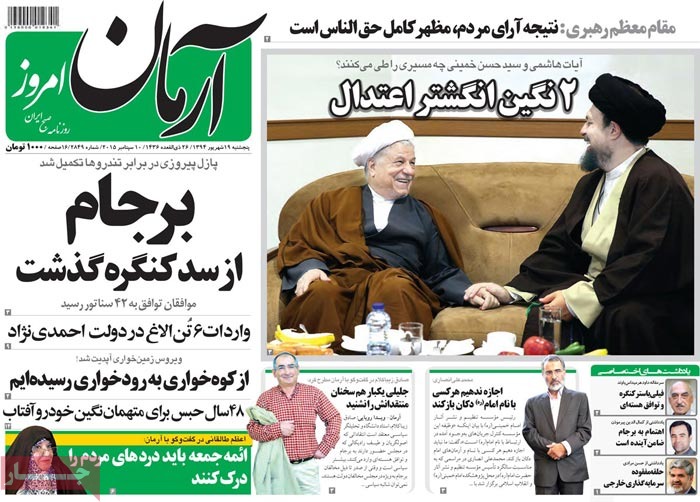
Arman-e Emrooz: The Joint Comprehensive Plan of Action has cleared the hurdle of Congress.

The number of US Senators supporting the Vienna nuclear accord now stands at 42.


A look at Iranian newspaper front pages on September 10


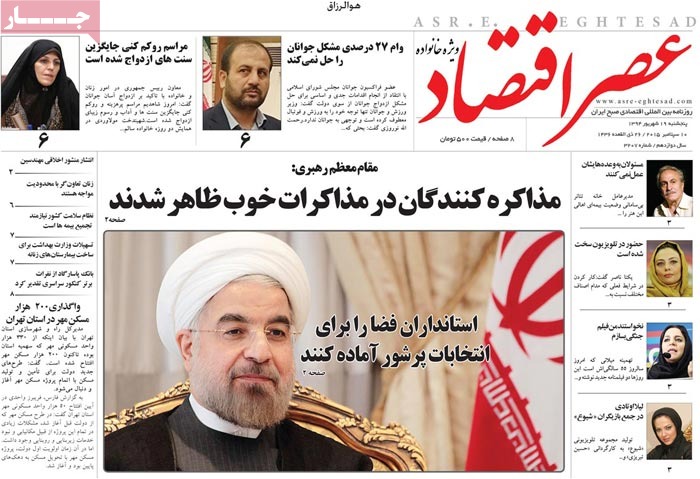
Asr-e Eghtesad: The president has urged governors general across the country to set the stage for lively elections in 2016.


A look at Iranian newspaper front pages on September 10


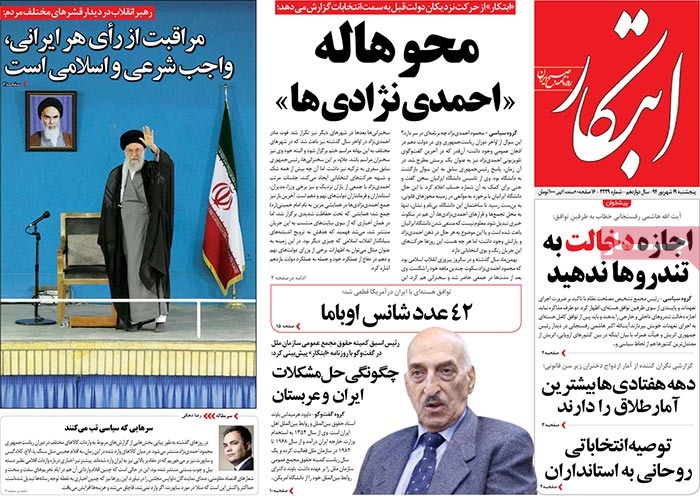
Ebtekar: The Supreme Leader has said, “Protecting the vote of every Iranian is an Islamic obligation.”


A look at Iranian newspaper front pages on September 10


Etemad: The Supreme Leader has said that Iran won’t hold talks with the US on issues other than the nuclear dossier.


A look at Iranian newspaper front pages on September 10


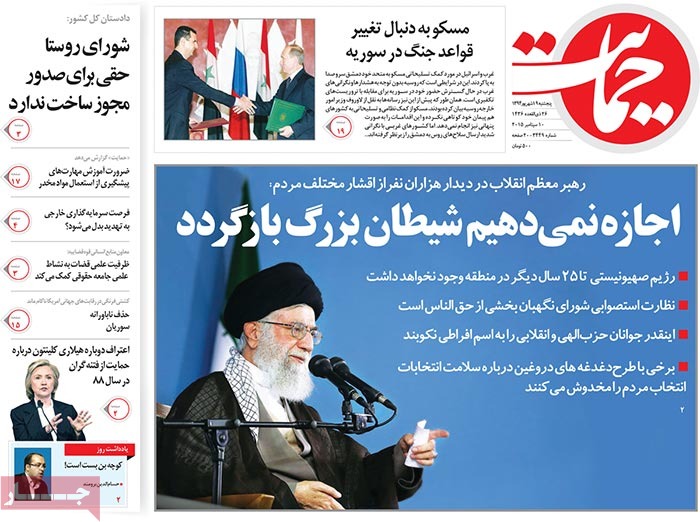
Hemayat: “We won’t allow the Great Satan to make a comeback to Iran,” said the Supreme Leader.


A look at Iranian newspaper front pages on September 10


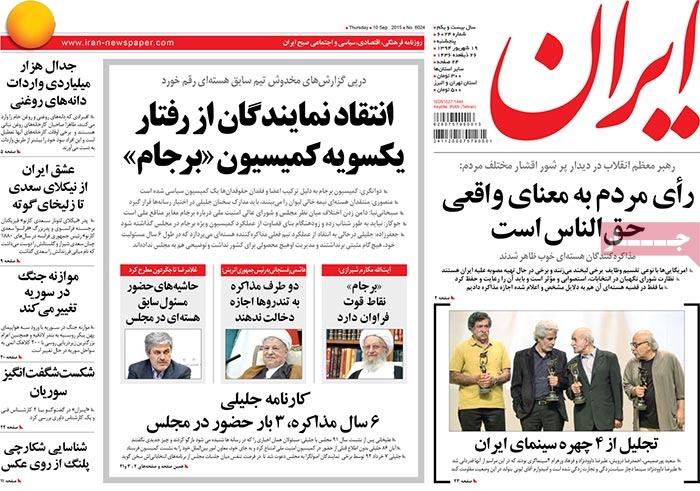
Iran: “The Joint Comprehensive Plan of Action has several strong points,” said Ayatollah Nasser Makarem Shirazi, a prominent cleric and source of emulation.

Iran: A man who had illegally hunted a leopard and posted a photo of himself holding the dead big cat has been arrested in the north.


A look at Iranian newspaper front pages on September 10


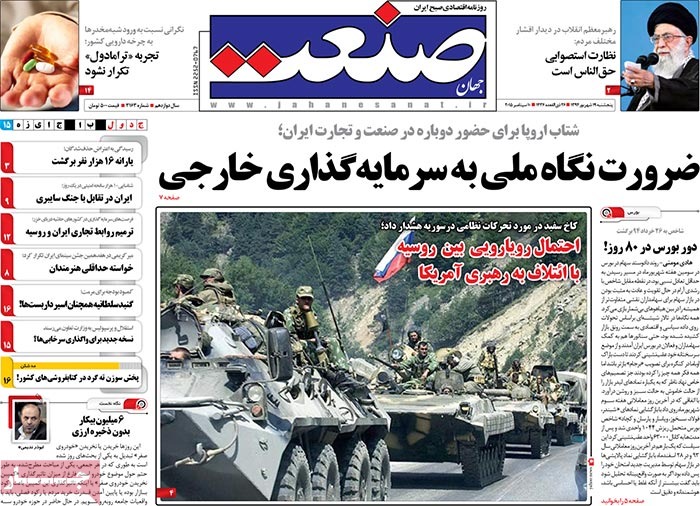
Jahan-e Sanat: Likelihood of a showdown between Russia and the US-led coalition in Syria


A look at Iranian newspaper front pages on September 10


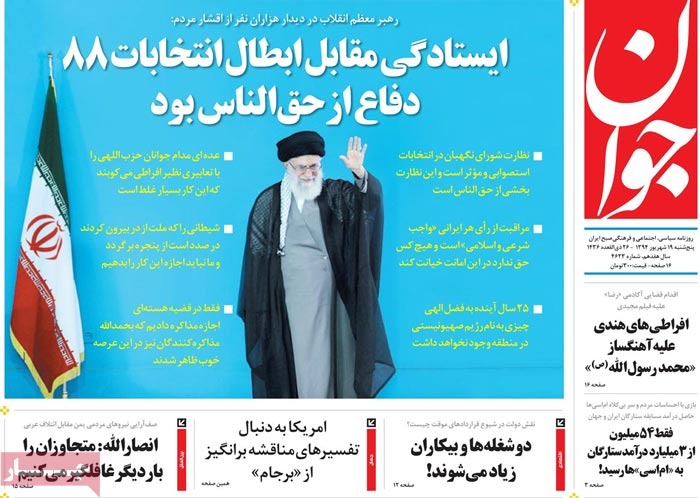
Javan: Yemen’s Houthis have said that they would once again take the aggressors by surprise.


A look at Iranian newspaper front pages on September 10


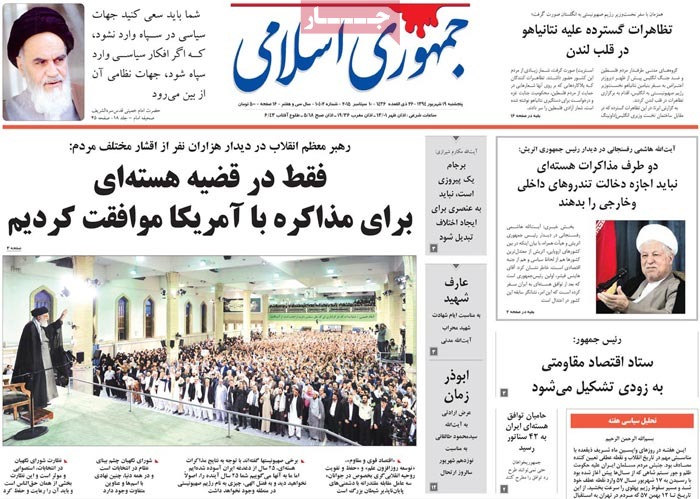
Jomhouri Islami: There has been a massive anti-Netanyahu rally in London.


A look at Iranian newspaper front pages on September 10


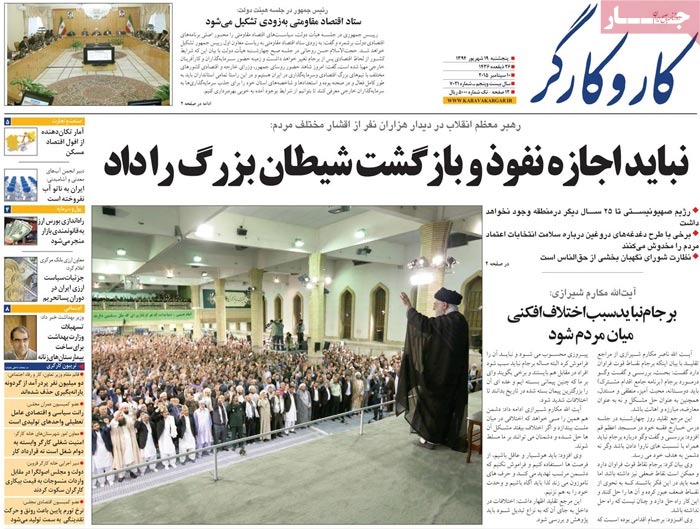
Kar va Kargar: “The Joint Comprehensive Plan of Action should not divide the Iranian public,” said Ayatollah Nasser Makarem Shirazi.


A look at Iranian newspaper front pages on September 10


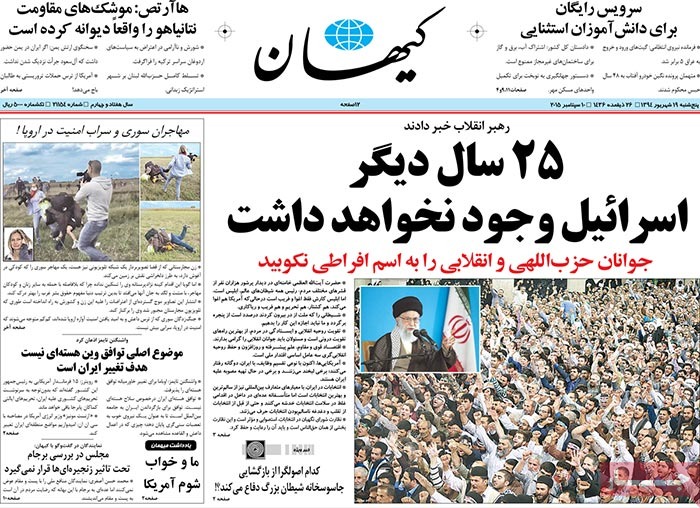
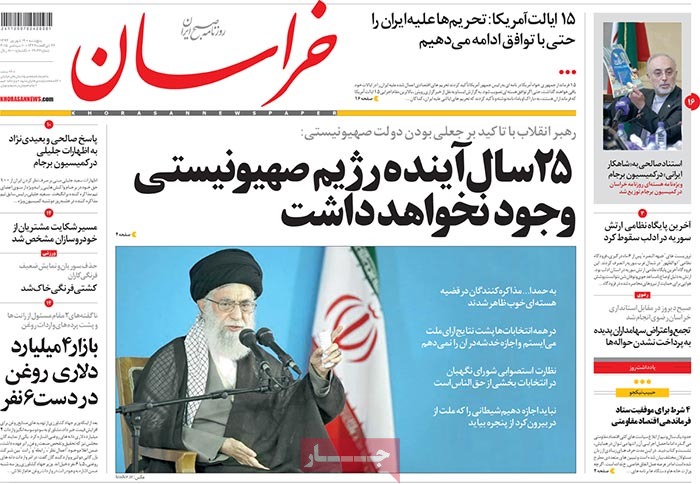
Kayhan: “The Zionist regime will not exist in the next 25 years,” said the Supreme Leader of the Islamic Revolution.

Kayhan: A number of MPs have said that in reviewing the Joint Comprehensive Plan of Action they would not be intimidated by the chain newspapers [a reference to reformist and moderate dailies].


A look at Iranian newspaper front pages on September 10


Khorasan: Fifteen US states are trying to keep sanctions against Iran in place even if the Iran nuclear deal is finalized.


A look at Iranian newspaper front pages on September 10


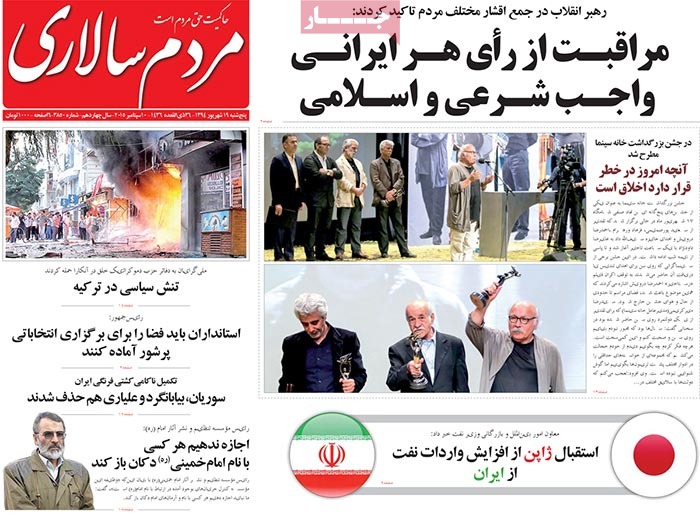
Mardomsalari: Japan has welcomed an increase in its oil imports from Iran.


A look at Iranian newspaper front pages on September 10


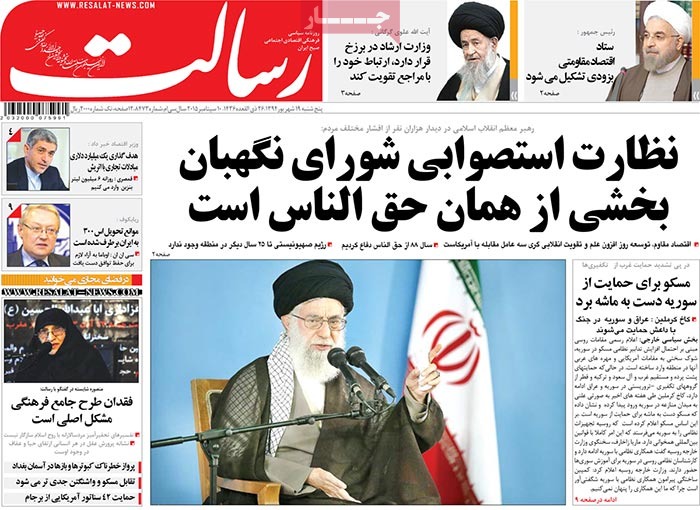
Resalat: “Discretionary supervision of the Guardian Council is part of public entitlements,” said the Supreme Leader.


A look at Iranian newspaper front pages on September 10


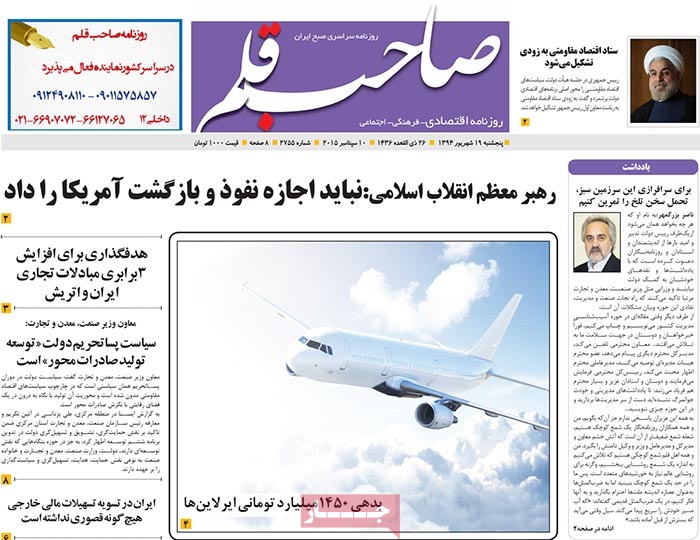
Saheb Ghalam: The industry minister has said that the government’s post-sanctions policy will focus on development of export-oriented production.


A look at Iranian newspaper front pages on September 10


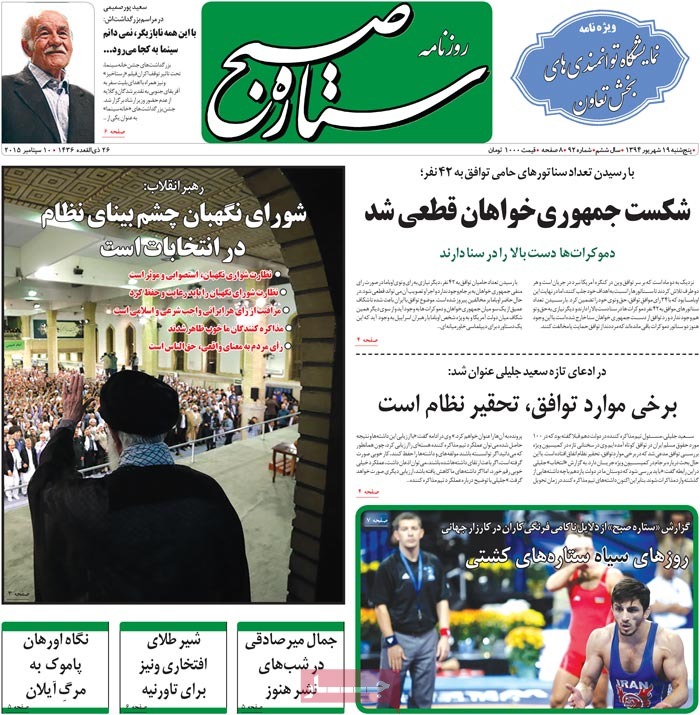
Setareh Sobh: “Some points in the agreement amount to humiliation for the establishment,” former chief nuclear negotiator Saeed Jalili has claimed.


A look at Iranian newspaper front pages on September 10


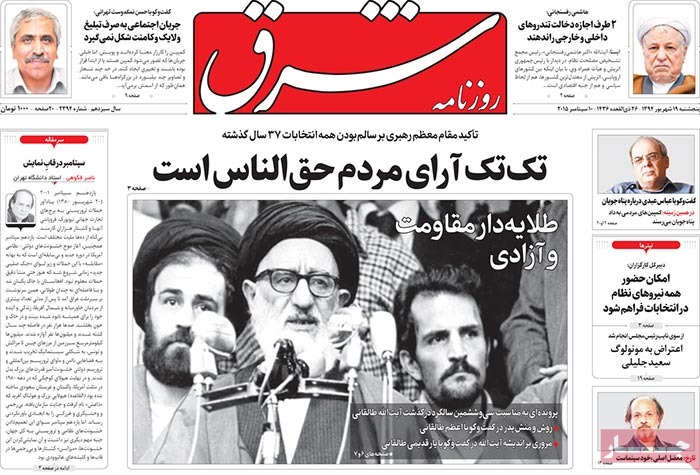
Sharq: The vice-speaker of parliament has objected to Saeed Jalili’s monologue [in which the former top nuclear negotiator took another swipe at the Vienna nuclear accord] in the chamber.


A look at Iranian newspaper front pages on September 10


Residents of Russia’s historic town of Derbent think of themselves as Iranians

Russia Darband

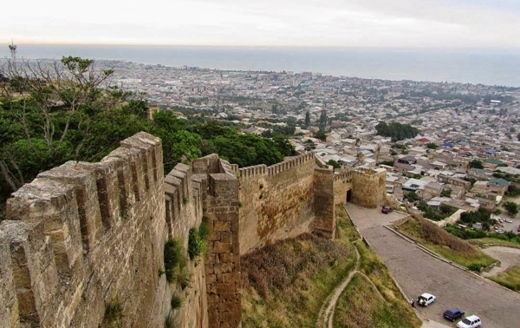
In spite of annexation to Russia many years ago, residents of Derbent, a town in the Russian Republic of Dagestan, think of themselves more as Iranian than Russian and such assumption can be easily spotted in the town’s inscriptions.

Derbent was built by Khosrow I, a Sassanid king, when his father Kavadh I (488–531) was on the throne, said Morteza Rezvanfar, a linguist and a member of the Research Center of Iran’s Cultural Heritage, Handicrafts and Tourism Organization.

The following is the translation of an excerpt of his remarks about the ancient town richt.ir has published:

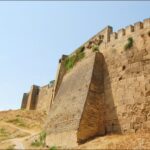
Khosrow I decided to found the town in a bid to fend off attacks by violent tribes and accommodate Iranians in the region. He ordered the construction of a 40-km wall, 20 m in height and 2.5 to 4 m in width. About 12.5 m of the wall still stand today.

The town has a fortress and seven neighborhoods all encircled by a wall which stretches from the fort into the sea where the two ends of the wall meet.

Thirty-two inscriptions in Pahlavi [a middle Iranian language which had currency between 3rd century BC and 10th century AD] edged on the walls of the fortress show its construction time and historical value.

In two villages which are 18 and 40 km away from the town people still speak Pahlavi; of course their language has been affected by Russian and Azeri over the years.

Dari Persian inscriptions which date back to the Safavid and Qajar eras are among tourist attractions of the city.

Each of the seven neighborhoods of this predominantly Shiite Russian town has a mosque with Persian inscriptions.

Unfortunately, the inscriptions have yet to be documented and deciphered by Iranian researchers. Some of the inscriptions have been studied by Russian and Azeri researchers.

The town’s Sassanid fortress and its historical structure were registered as a UNESCO World Heritage Site in 2006. The town is a symbol of the Sassanid civilization; its wall has protected Derbent for 1,500 years.

Because of security concerns, the city is not visited by tourists these days, but throughout history different ethnic groups have always paid attention to Derbent given its strategic position. That’s why Jewish, Christian and Muslim researchers have done a lot of research in this region.

Throughout history, different ethnic groups have invaded the town. For the very reason, there are a lot of villages in the vicinity of the town. They are home to different ethnic groups who speak 30 different languages.

Celebrations to mark the 2000th anniversary of Derbent are to be held in cooperation with eight countries.

Despite the Iranian characteristics of the town, Iran has not been invited to the ceremony and the Iranian cultural attaché in Russia is trying to pave the way for the presence of Iranian representatives in the event.

On my visit to Derbent, I saw gravestones dating back to 2012 and 2013 on which the national emblem of the Islamic Republic of Iran was engraved, a sign which shows that the people of Derbent think of themselves as Iranians.

In my conversations with people of Derbent during my several visits to the town, I realized that they think of Iran as their homeland and yearn for the days when the town was still part of Iran. Even poems on gravestones reflect that profound nostalgia.


Muhammad, in the eyes of two world-famous cinema figures

muhammad Movie

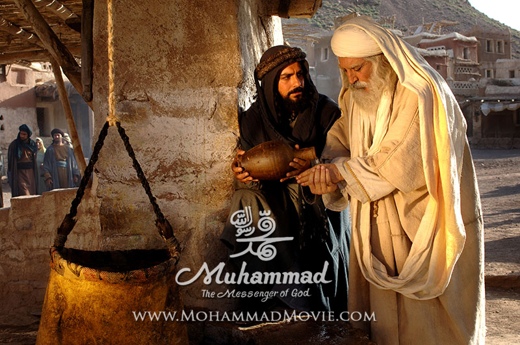
Muhammad, the Messenger of God, a film directed by Iran’s renowned director Majid Majidi, has been given extensive coverage for its screenings at private and public circles and these days at the Montreal World Film Festival (MWFF).

Previously Color of Paradise and Children of Heaven, also directed by Majidi, drew a lot of attention in big international film festivals.

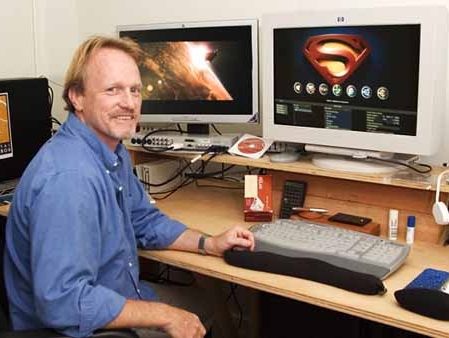
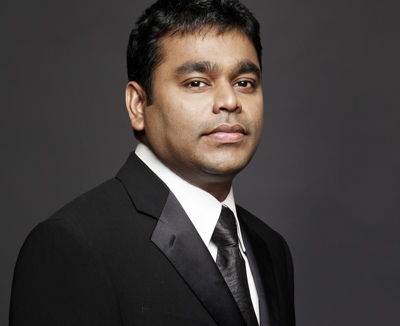
Mizan Online News Agency on September 9 published images of people in Canada standing in line to watch Muhammad, the Messenger of God together with comments by some cultural and cinematic figures, including two non-Iranian crew members of Majidi’s latest film. The following is a brief translation of comments by Scott E. Anderson, an Academy Award winning visual effects artist and filmmaker who supervised Muhammad’s visual effects, and A. R. Rahman, the Indian musician who has composed the score of Majidi’s film:

Scott E. Anderson: Muhammad, the Messenger of God brings together people from around the world 

Scott E. Anderson
Scott E. Anderson

In a piece for The Prophet of Compassion, a book which solely focuses on Muhammad, the Messenger of God, Scott Anderson wrote: “I have worked with great film directors such as Peter Jackson, Steven Spielberg, Paul Verhoeven, Roman Polanski, Michael Apted, Curtis Hanson, James Cameron, etc. Now I would like to add Majid Majidi to my list of big directors.”

The great Hollywood filmmaker who worked with Majidi in pre- and post-production phases of Muhammad for four years, further wrote, “I view Muhammad as one of the most important films on my record, not only for its outstanding visual effects or its matchless production, but as a film which I think has the ability to bring together people from around the world and open dialogue among them. From the start, Majidi said that he aimed to make a film about mutual understanding and peace. Now I can better understand what he was saying.”

Oscar winning musician: The score of Muhammad, the Messenger of God is one of my boldest works

A.R.Rahman
A.R.Rahman

A. R. Rahman talked about his experience in Majidi’s film in an interview with an Indian news website. He said, “The production of this film lasted six or seven years. I know well that how much attention the director has paid to the details. We are all lucky and [at the same time] happy that the film has been met with positive reactions. This is in fact a response to all hard work put in for the movie.”

The big name of the Indian cinema went on to talk about his experience with Majidi, “I learned a lot of things as we were working on the film project. We composed Muhammad’s score in Iran, Germany, France and Egypt with as many as 200 musicians cooperating in the project. Then we mixed it in Chennai, India. This is one of my boldest musical works”.

Rahman also said, “Ideas, language and even the term “each other” are void of any concept. Beyond such terms as Shiite and Sunni there is one sole thing and it is unity. I will watch this film with such an intention. I will watch Muhammad as an orphan who is loved by all”.

Violation of states’ sovereignty worsens Mideast crises: Iran

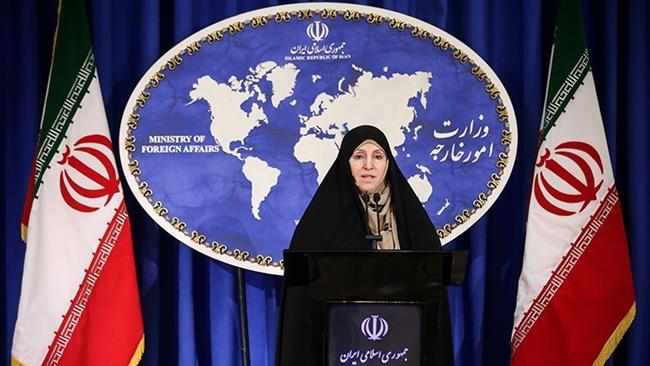
Marzieh Afkham

Iran has warned that any violation of other countries’ sovereignty will worsen the chaotic situation in the Middle East following the deployment of Turkish armed forces on Iraqi soil to hunt down Kurdish militants.

Iran “believes that any measure undermining the territorial integrity and sovereignty of countries further complicates the critical situation of the region and provides a justification for the intervention of foreign countries in the region,” Iranian Foreign Ministry Spokeswoman Marzieh Afkham said on Wednesday.

She made the remarks a day after a Turkish government source said two units of Turkish Special Forces had crossed the border into northern Iraq in “hot pursuit” of militants from the Kurdistan Workers’ Party (PKK).

Ankara’s decision came after at least 14 Turkish police officers were killed in a roadside bomb attack in eastern Turkey’s Igdir Province early Tuesday.

Afkham also condemned the deaths of civilians and security forces in the recent wave of terror attacks in Turkey.

The Iranian official expressed concern over the renewed clashes between Turkey and the PKK, expressing hope that the two sides would resume their peace

The PKK has been fighting for an autonomous Kurdish region in southeastern Turkey since 1984. The conflict has left tens of thousands of people dead.


Iran, Austria to triple volume of bilateral trade: Iran min.

Tayebnia-Austria

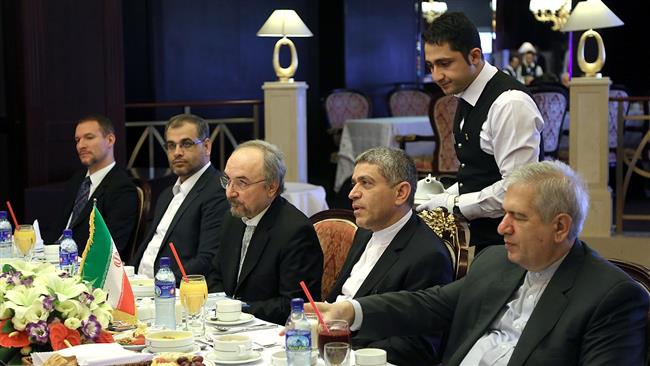
Iran’s minister of economic affairs and finance has said that Tehran and Vienna are planning to triple the volume of their bilateral trade in the near future.

Ali Tayyebnia made the remarks on the sidelines of a meeting with the visiting Austrian Vice Chancellor and Minister of the Economy Reinhold Mitterlehner in Tehran on Tuesday.

“At present, the volume of trade between Iran and Austria stands at $300 million and the two sides decided during this meeting to increase the figure to $1 billion,” Tayybnia added.

The Iranian minister expressed hope that in view of the available grounds for cooperation between the two countries, the goal would be realized in the near future.

According to Tayyebnia, the two sides also discussed the issue of delayed payments between the two countries’ banks, adding, “One of the issues we discussed during this meeting was how to settle these delayed payments, which are mostly due to conditions brought about by anti-Iran sanctions.”

The Iranian minister stated that the meeting can be a turning point for further expansion of economic and trade cooperation between Iran and Austria.

He also expressed hope that with the removal of sanction following the recent nuclear agreement between Iran and P5+1, existing restrictions against Iran’s foreign trade would be lifted and the country would see a sharp increase in its trade exchanges with the rest of the world.

Tayyebnia said Iran has offered diverse investment projects to the Austrian side, some of which have been accepted and negotiations are underway on their implementation.

The Austrian minister, for his part, said his country is willing to see sanctions imposed on Iran removed in the shortest possible time in order for the two countries to implement projects on which they have agreed.

Mitterlehner added that Austria enjoys vast potential in transportation and steel production and can invest in these fields in Iran.

“We believe that the two sides have serious determination to bolster their ties. Relations with a country like Iran are of high importance to us and the only problem that exists has to with the difficulties associated with monetary exchanges and banking cooperation,” he added.

The Austrian official expressed hope that removal of sanctions would enable the two countries to solve the current monetary and banking problems in the near future.


Rafsanjani: US should compensate past mistakes prior to thaw in ties

Rafsanjani-Austria

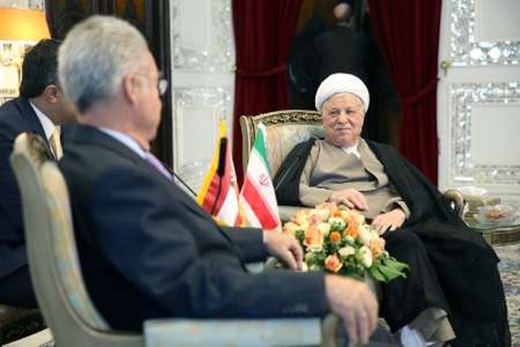
Chairman of the Expediency Council Ayatollah Akbar Hashemi Rafsanjani said on Wednesday that the US pursued hostility toward Iran and should compensate for its past prior to a thaw in ties.

Rafsanjani made the remarks in a meeting with visiting Austrian President Heinz Fischer and accompanying delegation.

Rafsanjani said that Austria is moderate and independent European government in terms of politics and economy.

Referring to Iran’s peaceful and principled policy at different historical junctures mainly after the Iraqi-imposed war (1980-1988), the top councilor said that during the critical period the world governments changed their policy and sided towards Iran and left Iraq alone and the then United Nations secretary-general identified the Iraqi dictator Saddam Hussein as aggressor.

Iraq attacked Kuwaiti to plunder Kuwaiti oil wealth and again repeated its mistakes which led to Saddam’s ouster, he said.

World public opinion indicates they are happy with the nuclear deal between Iran and G5+1 and called both sides to remain committed to implementing the text of the deal, Rafsanjani said.

Both sides should prevent domestic and foreign hardliners from meddling in the deal and should remain committed to their pledges, Rafsanjani said.

On the future of relations between Iran and the US, Rafsanjani said the US administration should adopt a fair policy based on mutual respect and admit to its mistakes in the past and compensate for them.

The Islamic Republic of Iran is ready to broaden cooperation and relations with all the countries mainly with Europe, he said.

Given the deplorable conditions of people in Syria, Libya, Palestine, Yemen, Iraq and other countries involved in the campaign against terrorism, he said stopping the deterioration of the humanitarian crisis requires collective cooperation of all countries away from regional prejudice, Rafsanjani said.

The root cause of all insecurities and terrors in the world is despotism and colonialism, he said.
Expressing regret over the support lent by some countries to terrorists, he said they should not assume that through backing terrorists they can attain their goals, these countries only make a big hurdle for the region and they should be assured that they will pay for their measures because terrorists recruit from among angry and disgruntled youth around the world.

Referring to the failed experience of occupation of Afghanistan by NATO under the pretext to the fight against terrorism and eradication of drug narcotics, Rafsanjani said they failed to attain their goals, but the volume of drug narcotics increased ten-fold and the Taliban gained more power.

Europe for many years made use of cheap human resources and their huge natural resources of under-developed countries and now it is their turn to compensate, he said.

The Austrian president, for his part, expressed pleasure with nuclear deal struck in Vienna on July 14 and said the Austrian government attaches importance to such deal and believes that the deal prepared the ground for expansion of all-out cooperation on various fields as well as fight against international terrorism.

Austria gives priority to expansion of cooperation based on mutual respect with others such as the Islamic Republic of Iran, the Austrian president said.

European countries have reached the conclusion that world’s problems should be resolved through dialogue and there is no room for military action, he said.

Expressing satisfaction over his visit to Iran and meeting with the chairman of the Expediency Council, the Austrian president described negotiations with Iranian officials as fruitful.

Iran won’t negotiate with US on matters other than nuclear issue: Leader

Supreme Leader

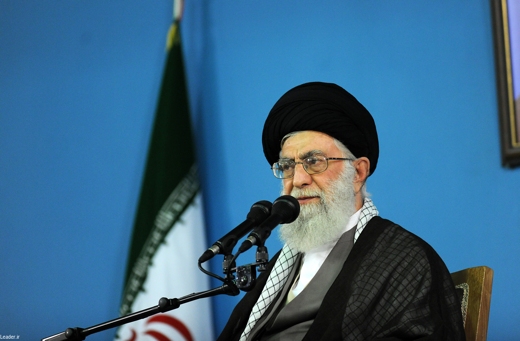
The Supreme Leader of the Islamic Revolution says the Islamic Republic “did not and will not hold talks with US on issues other than nuclear negotiations.”

Addressing people from different walks of life on Wednesday, the Leader said, “We agreed to hold talks with the Americans only on the nuclear issue and for particular reasons, and thank God, our negotiators did a good job.”

Ayatollah Khamenei stated that in other areas, “I have not authorized negotiations and [we] will not hold talks with them,” Ayatollah Khamenei noted.

The Leader noted that the United States does not conceal its animosity toward Iran, adding, “One [US official] smiles, while another draws up a bill against Iran.”

Ayatollah Khamenei emphasized that US officials seek to hold negotiations with Iran because they seek negotiations as a means of influencing the Islamic Republic and imposing their demands on Iran.

Referring to comments by the Tel Aviv regime after the conclusion of the Iran-P5+1 nuclear talks that Israel will have no more concerns about Iran for the coming 25 years as a result of the nuclear agreement, the Leader said, “First of all you will not [survive enough to] see the next 25 years, and God willing, no such thing as ‘the Zionist regime’ will exist in the next 25 years.”

“Secondly, during this period, the combatant, and epic, and jihadi spirit will never leave Zionists alone for a single moment.”

Noting that the late Imam Khomeini has described the United States as “the Great Satan,” the Leader said, “Some people insist on disguising this Great Satan as the savior angel. [However,] the Iranian nation expelled this Satan [from the country]; we must not allow that when we expelled it through the door, it could return and gain influence [again] through the window.”

Emphasizing the importance of having strong and resistance-based economy, advanced science, and a revolutionary spirit as three factors that strengthen the Iranian nation in the face of enemies, Ayatollah Khamenei, added that state officials should respect revolutionary youths, while advising “certain” speakers and writers not to verbally attack faithful and revolutionary youth by labeling them as extremist.

Referring to the importance of elections in Iran, the Leader took to task “certain people” who raise doubt about wholesomeness of elections, stressing that the Guardian Council is the “watching eye” of the Iranian nation and government in any elections.

Bad news coming out of Syria for the US and its Arab allies

atvan

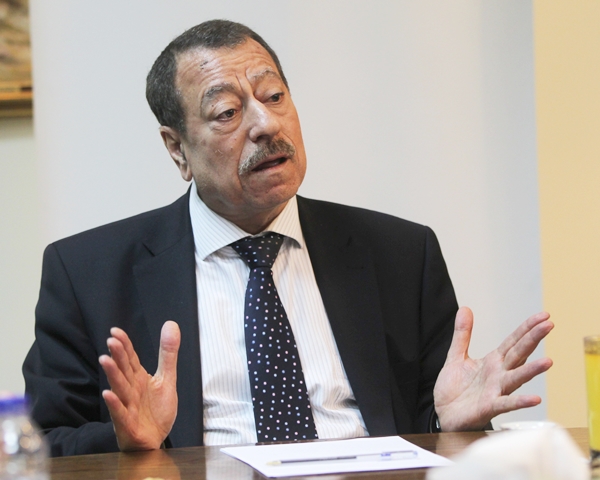
An Arab journalist has said that reports that Russia is sending military aid to Syria and its forces are active in combat zones in that country are sad news for the United States and its Arab allies which are the enemy of Syria and its government.

Abdel Bari Atwan, the editor-in-chief of Rai al-Youm, a digital newspaper, wrote this in an editorial and added that it is not surprising that the US and its Arab allies express concern over reports on developments in Syria because news coming from Lattakia and Idlib suggests that the Russian forces and armored vehicles are fighting along with the Syrian Army against the opposition. This indicates that the Russian leaders have decided to show in practice that they are against the ouster of Bashar Assad.

The Islamic Republic News Agency on September 7 published the Farsi version of the Arab journalist’s editorial on the Syrian crisis and the US concern over Russia’s enhanced military build-up in Syria. The following is the translation of the report:

US Secretary of State John Kerry expressed concern – in a telephone call with his Russian counterpart on Saturday (September 5) – over reports of Russian movements in Syria and asked Sergei Lavrov whether Russia is sending military hardware to Syria.

The New York Times published a report in its Friday issue saying that Russia has sent a military unit complete with weapons and ammunition to Syria. The Daily Telegraph wrote that the Syrian state TV reportedly broadcast footage of Russian soldiers and armored vehicle fighting alongside pro-Assad troops in Lattakia, adding “it is reportedly possible to hear Russian being spoken by the troops in the footage. [In further indications of Russian “mission creep” in Syria], a Twitter account linked to Jabhat al-Nusra, al-Qaeda’s Syrian branch, published images of what appeared to be Russian planes and drones flying over Idlib.”

On the sidelines of an Eastern Economic Forum in Vladivostok, President Vladimir Putin confirmed Moscow’s military aid and said, “[…] But we are already providing Syria with quite strong support in terms of equipment, training of military servicemen and weapons”.  He also said that it is premature to say Moscow is ready to participate in the anti-ISIL operations, adding that involvement in such military operations is different from supporting the Syrian regime.

The Russian president’s remarks which were reflected in the Syrian media carry a message for different sides: Moscow will not drop support for its ally, Bashar Assad; as the Syrian opposition forces are marching toward the Syrian coasts getting prepared for a massive onslaught, Russia does not allow the enemies of the Syrian regime to get to Lattakia and other coastal areas in Syria.

This message carries weight given its timing: it has come following insistence by the Saudi foreign minister – in different circles – on the overthrow of Bashar Assad, either militarily or diplomatically, saying that Assad is part of the Syrian problem, not its solution.

Perhaps Putin’s remarks that “The Syrian president agrees with that, all the way down to holding early elections, let’s say, parliamentary ones, [establishing contacts with the so-called healthy opposition, bringing them into governing]” reflects Moscow’s views on the diplomatic settlement of the Syrian crisis: necessary political reforms in Syria with Bashar Assad remaining atop the pyramid of power.

In his remarks, Putin did not talk about the political framework which is to be established in the post-elections era. In other words, he did not discuss whether a transition period should be in place in Syria, or a new constitution – which underlines a multi-party system in the Arab country – will be adopted in post-elections Syria. He also did not say anything about the powers of such an elected parliament.

Presently there are no answers to these questions, but Putin’s words can indicate that Russia is likely to get involved in a direct war to keep Bashar Assad in power. The US is well aware of this; that’s why Washington has focused on the elimination of ISIL, not the ouster of the Syrian regime, [in its involvement in Syria].

Comments by General David Petraeus, the retired American military officer and the former CIA director, on the formation of new forces with the moderate fighters (terrorists) of Nusra Front lying at the core [that he supports using “so-called moderate members of al Qaeda’s Nusra Front to fight ISIS in Syria.”] sends an important signal because he is the mastermind of the Awakening Councils in Iraq which fought against Alqaeda in 2007-8 and diminished its influence.

Also interesting are remarks by US President Barack Obama in a meeting with Saudi King Salman on Friday. Obama did not raise the issue of Bashar Assad leaving office and the US secretary of state too fell short of mentioning Assad’s departure as a prerequisite when he was talking about a diplomatic solution to the Syrian crisis.

If reports on the Russian military presence in Syria are sound – which seem to be correct – this means that the Syrian crisis has entered an international phase, militarily. This is a very important development which can have something to do with the Syrian refugee crisis.

In the midst of the crisis, Turkey is piling pressure on the West to help resolve the Syrian crisis the way Ankara seeks: establishment of a buffer zone at the border to accommodate the Syrian refugees. There are also reports which say Turkey has directly or indirectly forced the Syrian refugees to head for Europe, because it will not continue settling them if the current trend persists.

The new developments which are rapidly unfolding in Syria have concerned and depressed many sides, especially the Saudi-Turkey-Qatar coalition which has always called for the Syrian government to be toppled and Bashar Assed to be forced out of office. But the fact is that they need to know that the entry of big military powers into the Syrian question will tip the balance [in this country].

The coming weeks and months in Syria will be pregnant with unexpected events. What the future holds for this country remains to be seen.