Monday, December 29, 2025
Home Blog Page 4747

Iranian President Rouhani wishes Jews happy Rosh Hashana

Rouhani

Iranian President Hassan Rouhani has wished a happy new year for the Jewish community all over the world.

On Sunday, President Rouhani congratulated Jews, voicing hope that common “Abrahamic roots” will pave the way for the creation of more “respect” and “understanding” between Muslims and Jews.

“May our shared Abrahamic roots deepen respect & bring peace & mutual understanding,” the Iranian president said in a tweet, ending his message with the Hebrew phrase “L’Shanah Tovah,” meaning “May it be a good year.”

Below the message was a photo of Iranian Jews praying in a synagogue in Yousefabad Synagogue in Tehran.

About 9,000 Jews currently live in Iran, mostly in the cities of Tehran, Isfahan, and Shiraz.  Under the Iranian constitution, the country’s Jews are represented in parliament.

Iran keen to expand ties with Latin America: President Rouhani

Rouhani-Brazil

President Rouhani Sunday expressed Iran’s willingness to reinforce its relations with all Latin American countries, particularly Brazil.

Iran has always welcomed the development and deepening of its cooperation and good relations with Latin American countries, Rouhani said in a meeting with visiting Brazilian Foreign Minister Mauro Vieira in Tehran.

Iran attaches special significance to the promotion of its amicable ties with Brazil as an effective country in South America with a progressive economy, he said, highlighting the important role Brazil has in maintaining stability and security in Latin America.

The president referred to various advancements both countries have achieved in the fields of industry, technology, and science, calling for all potential for closer interaction between Tehran and Brasilia to be tapped.

Rouhani pointed to the new opportunities created in Iran after the conclusion of the nuclear deal, saying, “Brazilian investors can take advantage of this opportunity and have a stronger presence in Iran and participate in major projects.”

Vieira, for his part, said his country is determined to have closer and stronger relations with Iran in economic and political fields, adding that the two sides have the potential to play complementary roles for each other’s economy.

He hailed Iran’s effective role in creating balance and stability in the region, saying Brasilia has always supported and acknowledged Tehran’s positive and historical engagement in regional and international developments.

Vieira also delivered a letter of invitation by Brazil’s President Dilma Rousseff for President Rouhani to pay an official visit to the South American country.

Bahrain government should settle internal crisis rather than blame others

Afkham

Foreign Ministry Spokeswoman Marzieh Afkham said on Sunday that the Bahraini government had better settle its internal crisis through national reconciliation instead of putting the blame on others and making baseless allegations.

She rejected claims by the Bahraini foreign minister in an interview with Al-Sharq Al-Awsat newspaper.

Afkham recommended the Bahraini government set aside security and policing methods and solve national grievances through reconciliation.

The Bahraini government has gotten used to making unfounded allegations and putting the blame on others to cover up its internal problems, she said.

Restored Golden Palm unveiled in Tehran park

Golden Palm00

Tehran’s Mellat Park has hosted a ceremony during which a restored Golden Palm, a statue sculpted by Finnish artist Eila Hiltunen 40 years ago, has been unveiled.

The event was organized in cooperation with the Iran-Finland Friendship Association and Tehran’s Municipality District Three. Finnish Ambassador to Iran Harri Kamarainen, Deputy Foreign Minister Abbas Araghchi and a number of other Iranian and Finnish officials were on hand for the ceremony.

At the start of the event, the head of the Iran-Finland Friendship Association said that the artwork by the Finnish sculptor was put up in the park when it was newly opened and added, “Golden Palm is a messenger of Finnish art and culture in Iran and represents cultural ties between Tehran and Helsinki. This can also help the two countries have closer relations.”

On the 90th anniversary of Iran-Finland ties, Araghchi said, “There is hope that the unveiling of the artwork under new circumstances created by the nuclear deal between Iran and P5+1, can prompt a huge leap in economic and cultural relations between the two nations.”

He added, “We hope that close relations between the two countries which lost momentum as a result of sanctions can be restored.”

Images of the ceremony released online by different news websites:

Iranian, Brazilian top diplomats meet (PHOTOS)

Brazilian top diplomats1830865__38G8971

Brazilian Foreign Minister Mauro Vieira, who is in Tehran on an official visit, met with his Iranian counterpart Mohammad Javad Zarif on Sunday.

The following images of the meeting have been released by Mehr News Agency:

Iran’s Zarif: JCPOA victory of diplomacy over force

Iran-Brazil

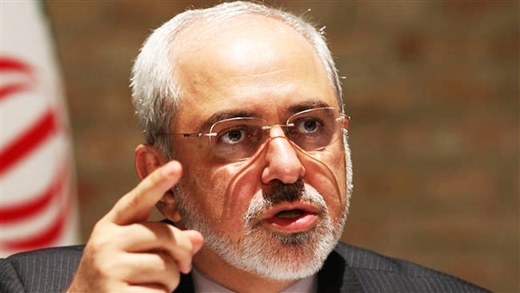
Foreign Minister Mohammad Javad Zarif has said the July 14 nuclear agreement between Iran and P5+1 was the victory of diplomacy over force.

At a joint press conference with Brazilian Foreign Minister Mauro Vieira in Tehran on Sunday, Zarif said the nuclear agreement, known as the Joint Comprehensive Plan of Action (JCPOA), was also the victory of rights over baseless claims.

He said that Iran and Brazil are two developing countries which have made great attempts in areas such as peaceful nuclear energy and added Brazil has played a “very active” role regarding the Iranian nuclear issue.

[…]

The Iranian foreign minister said Tehran and Brasilia have lots of commonalities, adding that Iran and Brazil are working to expand cooperation in various fields.

“Grounds are prepared for boosting bilateral ties given commonalities between the two countries,” Zarif said, adding that the two sides intend to exchange trade and economic delegations.

The Brazilian foreign minister, for his part, said Brazil and Iran established diplomatic relations more than a century ago and are “very good” partners.

“We have had very important bilateral relations ever since their establishment and we came here with a very specific goal to enhance and deepen our bilateral relations and to bring them to even higher levels,” Vieira added.

He expressed his country’s willingness to improve cooperation with Iran through visits by the two countries’ ministers.

“The exchange of high-level ministerial visits is a very clear evidence of the importance that the two countries attach to each other and to the bilateral relations,” the Brazilian minister noted.

He praised the Vienna nuclear agreement between Iran and P5+1 as “historic and landmark,” emphasizing that JCPOA represents the victory of diplomacy and political dialog.

No justification for JCPOA violation

In response to a question about a future decision that the US Congress and Senate are to make on JCPOA, Zarif said there is no justification for the violation of the agreement.

“We had announced since the very beginning that we hold the government of the Unites States of America responsible for the implementation of JCPOA and any move by [US] Congress in contradiction to JCPOA should be stopped by US government. Otherwise, it will be a breach of JCPOA,” the foreign minister said.

Zionists and certain warmongers in the US have been against any agreement between Iran and P5+1, Zarif said, adding that they have failed to reach their objective of blocking an agreement.

The Iranian top diplomat emphasized that the next US administrations are also duty-bound to implement the Vienna agreement.

The foreign minister said Tehran is ready to take part in all international efforts to fight terrorism in the region, calling for the international community to play a more effective role in this regard.

Zarif said double-standard policies have unfortunately barred the international community from playing its part in tackling the issue of terrorism.

The Brazilian minister also said his country has always supported measures taken to fight terrorism, adding that military approaches would fail to solve regional crises.

He added that Brazil believes diplomacy is the key to resolving regional problems.

Iran slams continuation of Saudi military aggression against Yemen

amir-abdolahian1

A senior Iranian diplomat has slammed continuation of the Saudi war on Yemen during the Hajj pilgrimage, saying the military aggression defies constructive diplomacy and peace.

“Yemen will have no military winner,” Iran’s Deputy Foreign Minister for Arab and African Affairs Hossein Amir-Abdollahian said on Sunday, adding that Iran has presented an appropriate political solution to help Riyadh get out of the ongoing crisis in Yemen.

“Tehran supports national dialog among all Yemeni sides,” the Iranian diplomat said.

In a letter to UN Secretary General Ban Ki-moon in April, Iran’s Foreign Minister Mohammad Javad Zarif submitted a four-point peace plan on Yemen in an attempt to end the bloodshed in the Arab country.

The proposal stresses the delivery of humanitarian aid to the Yemenis as well as dialog among various groups in the country.

Amir-Abdollahian said UN efforts to dispatch humanitarian aid to Yemen, lift the Saudi blockade on the country, and put an end to war and bloodshed have failed due to the lack of cooperation on the part of Saudi Arabia and the questionable silence of some Arab and Western countries.

In a bid to undermine the Houthi Ansarullah movement and bring back to power Riyadh’s staunch ally and fugitive former Yemeni president, Abd Rabbuh Mansour Hadi, Saudi Arabia started its military aggression against its southern neighbor onMarch 26 without a UN mandate.

According to the UN, the conflict has so far left about 4,500 people dead and thousands of others wounded. Local Yemeni sources, however, say the fatality figure is much higher.

Why is ground subsiding at Persepolis?

Persepolis

The Geological Survey of Iran (GSI) has been conducting an investigation into the exact cause(s) of land subsidence and fissures on the premises of Takht-e Jamshid [Persepolis] and Naqsh-e Rustam in southern Iran.

The head of the Geology Management and Mining Exploration in South (Shiraz) made the remark on Sunday in an interview with the Islamic Republic News Agency (IRNA) and blamed the sinking of the Earth’s surface on unrestrained exploitation of groundwater in the region. The following is the translation of Tahmoures Yousefi’s remarks in the interview followed by experts’ views:

Tahmoures Yousefi said that the current cracks come after similar cracks developed ten years ago in the eastern wing of the Rahmat Mountain where Persepolis is located, blaming the land-surface movement and the cracks on runaway water withdrawal in the area.

The Geological Survey of Iran has put on its agenda a study into the causes of this geological phenomenon and has installed and activated navigation systems such as GPS devices and stations in the historic area, he added.

Yousefi went on to say that the land subsidence and cracks are being studied in these stations and the earth’s frequencies are being monitored there. He also said that the subsidence and cracks in the areas surrounding Takht-e Jamshid are alarming, adding this historic building is in danger [of being destroyed] and we need to work out solutions to tackle the problem.

Experts say that it takes national determination to counter land subsidence around Takht-e Jamshid which is a World Heritage Site. Officials in Fars Province blame unrestrained withdrawal of groundwater for a looming crisis in the province and say that it could cause irreparable losses to people’s lives there.

Land subsidence and sinkholes are natural phenomena which happen gradually and pose a major threat to nature in the long run. The plain surrounding Takht-e Jamshid has developed cracks and sinkholes thanks to the drought which has affected the region and unchecked withdrawal of groundwater.

Prolonged dry spells in Fars Province have greatly concerned officials, people and those interested in cultural heritage. According to Persepolis.ir, land subsidence in Takht-e Jamshid has raised red flags and those in charge should take serious measures to minimize the natural hazards of the geological phenomenon.

[Persepolis was founded by Darius of Achaemenid in 521 BC, and was the dynasty’s political and religious capital until the decline of the empire in 331 BC. UNESCO declared the ruins of Persepolis a World Heritage Site in 1979.]

Saudi Arabia and the UAE; disputed territories and geographical maps

Persian Gulf

Abu Dhabi has released [new] official topographic maps which display part of Saudi territory as an annexation to the United Arab Emirates.

The Islamic Republic News Agency (IRNA) on September 12 published a report on a border dispute between Saudi Arabia and the UAE quoting the Arabic-language Alwaie News Agency as saying that informed sources in the Persian Gulf have suggested that a crisis is brewing between Riyadh and Abu Dhabi behind the scenes. The following is the translation of the report:

Informed sources in the Persian Gulf, who asked not to be named, further said that Saudi Arabia is insisting on keeping its border dispute with its neighbor unrevealed at a time when the Yemeni question has cast a shadow on the Persian Gulf region. That’s why Riyadh has officially asked Abu Dhabi to explain its annexation of Saudi land without going so far as to lodge a protest.

The rulers in Saudi Arabia have expressed discontent with the UAE’s move at the current juncture, fearing that Abu Dhabi may seek to capitalize on the Saudi embarrassment and its insistence on not provoking any crisis with fellow Arab countries in the Persian Gulf, the same sources added.

Thanks to ongoing military action in Yemen and the possibility that Arabs may put boots on the ground in Yemen, Saudi Arabia is reportedly building on calm, wisdom and prudence to deal with the territorial dispute with its [southeastern] neighbor.

Following the death of Sheikh Zayed bin Sultan Al Nahyan, [the founder of the UAE], Abu Dhabi made its border dispute with Saudi Arabia public, calling for the annexation of part of the border with Saudi Arabia, the sources went on to say.

In response, Saudi officials said that the border dispute has been settled based on an agreement signed between Riyadh and Abu Dhabi in August 1974 [known as the Treaty of Jeddah]. Under the Jeddah agreement, the UAE would keep six villages in the area of Al Buraimi, and Saudi Arabia – in return – would have control over Khawr al Udayd, which spans a 25km expanse of coastal land. This area is home to 80 percent of oil wells in the Shaybah-Zarrarazone which has huge energy reserves: around 15 billion barrels of oil and 650 million cubic meters of gas.

In 1971, Saudi Arabia welcomed the departure of the British forces from the Persian Gulf region, but refused to recognize the United Arab Emirates. Riyadh said it would recognize the UAE if Abu Dhabi accepted to settle its border dispute with Riyadh. Back then, the UAE could do nothing but give up to the demands of the Saudi regime.

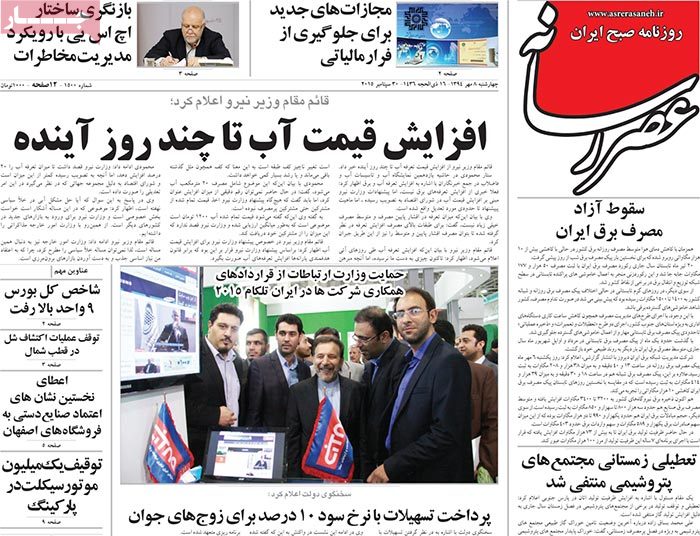
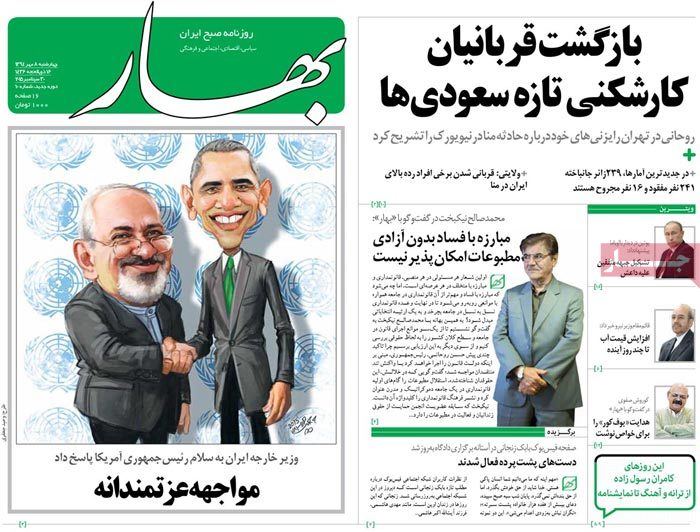
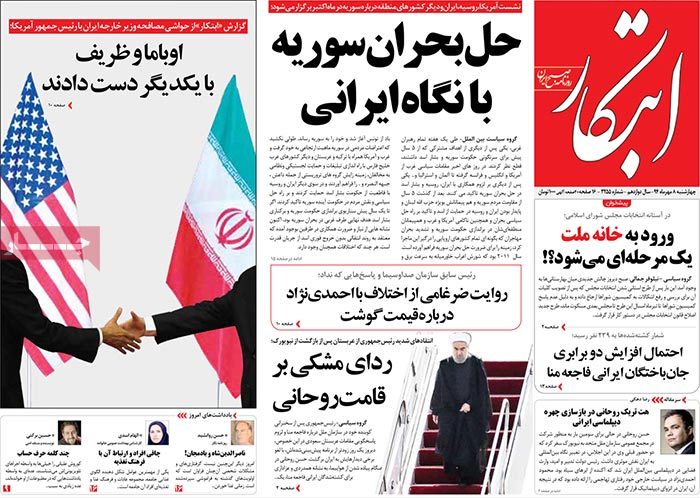
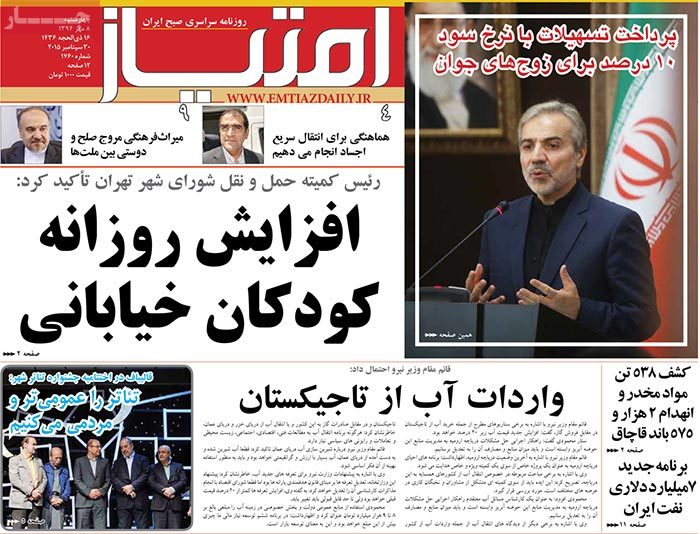
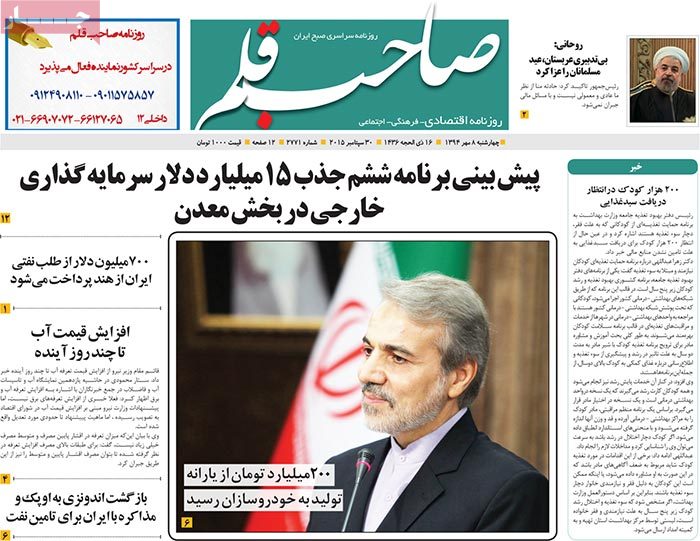
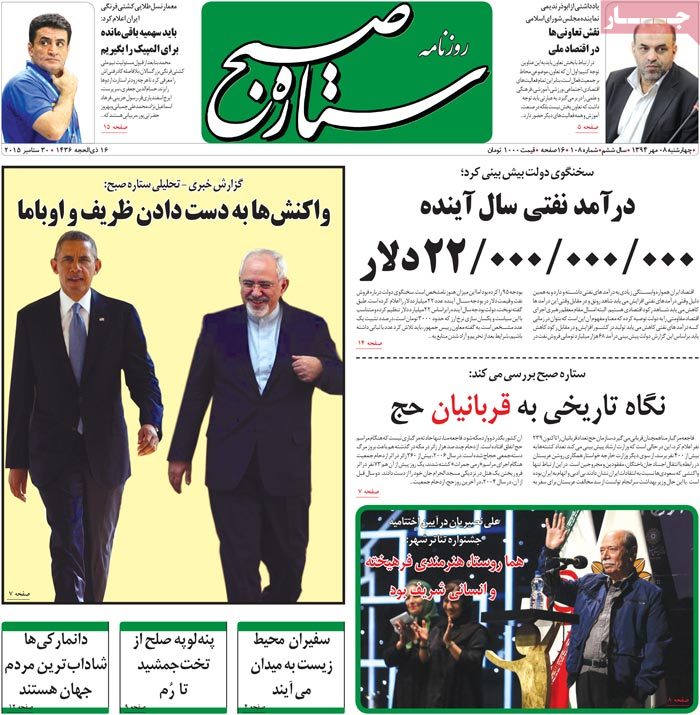
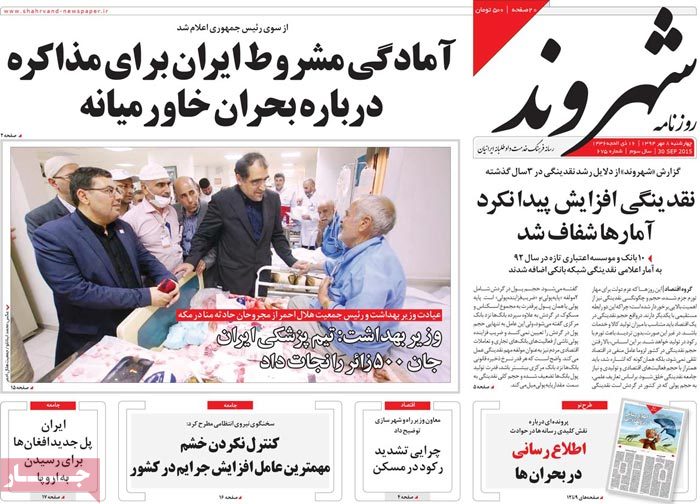
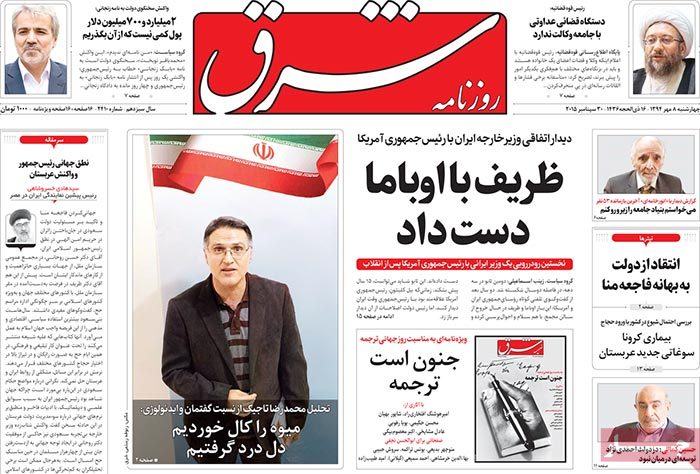
A look at Iranian newspaper front pages on September 13

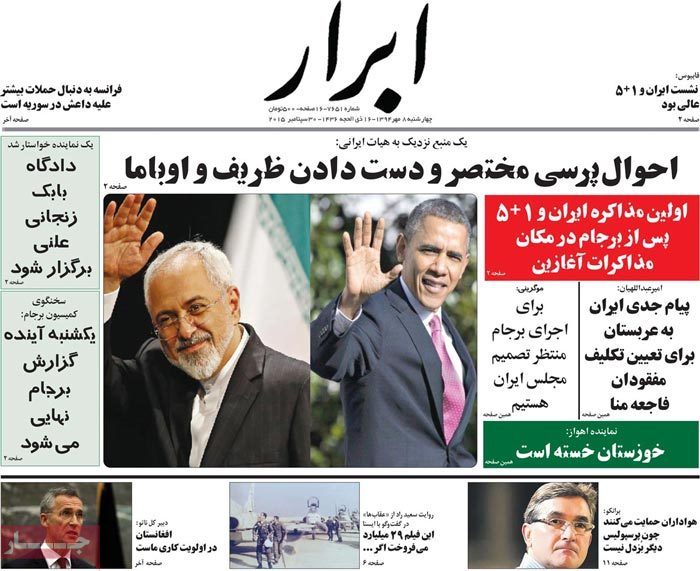
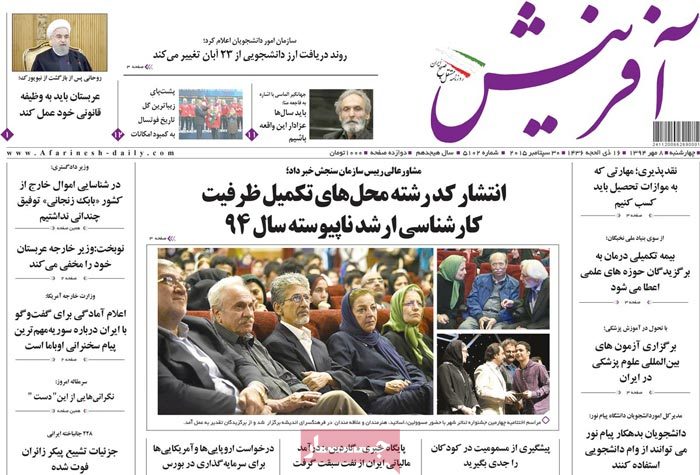
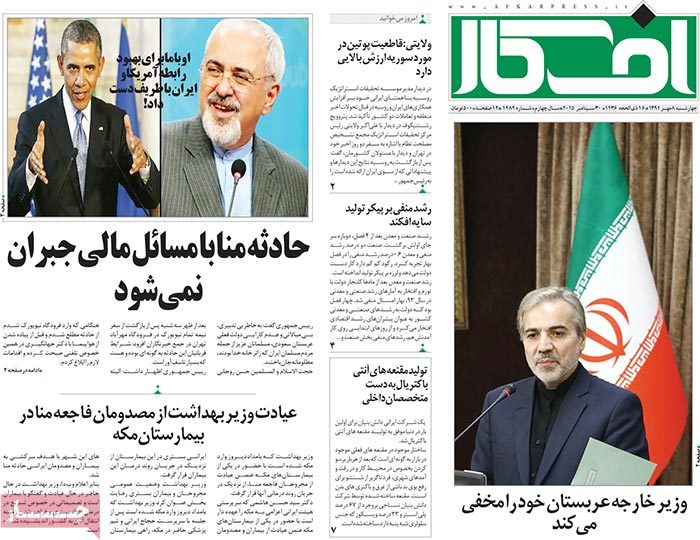
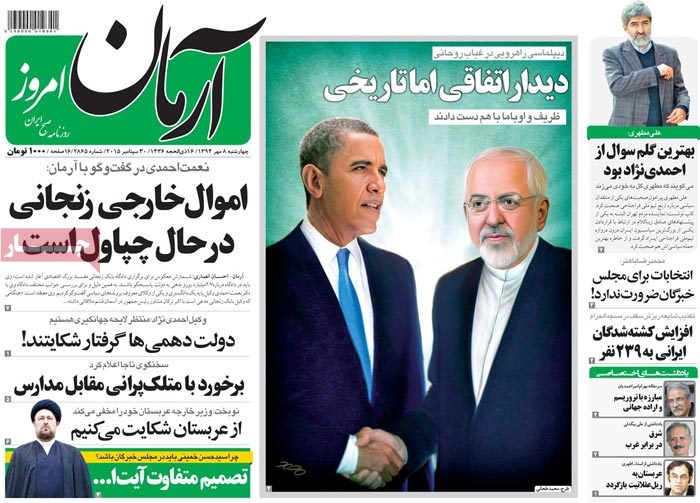
Iranian Newspapers Headlines

The president’s comment that he would not “allow hardliners to deal a blow to the aspirations of the nation” dominated the front pages of Iranian newspapers on Sunday.


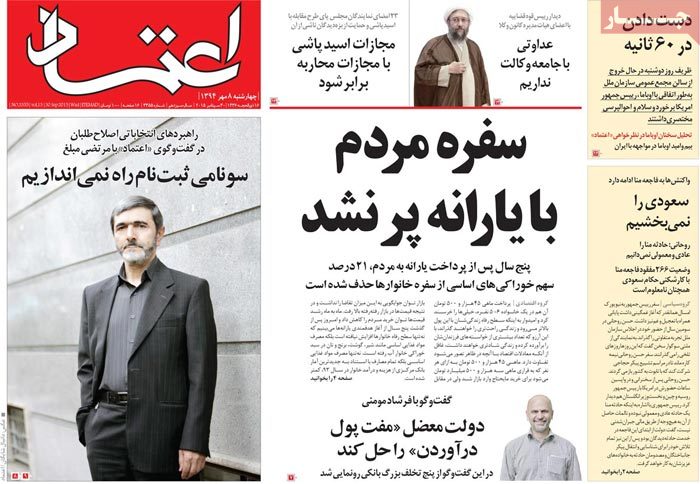
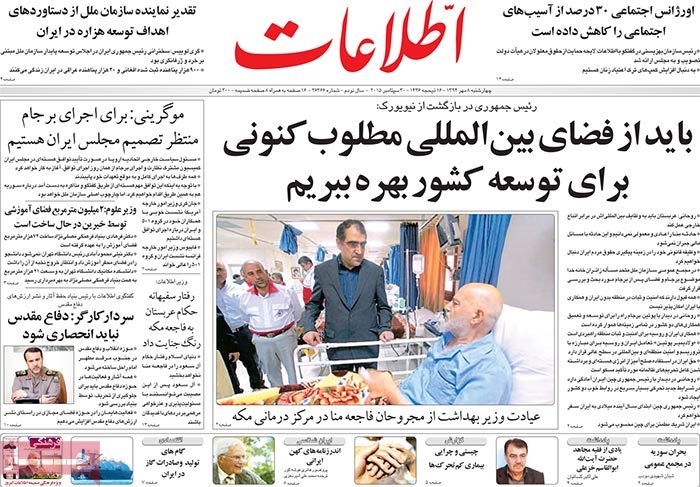
Ettela’at: “I won’t allow hardliners to deal a blow to the aspirations of the nation,” President Rouhani said.

The president further said that the Joint Comprehensive Plan of Action will see the collapse of all links in the chain of sanctions.


Abrar: The Brazilian foreign minister has arrived in Tehran for talks with Iranian officials.


A look at Iranian newspaper front pages on September 13


Afarinesh: The Traditional Medicine Department of Tehran University of Medical Sciences has signed an MOU with Austria’s academy of traditional medicine.


A look at Iranian newspaper front pages on September 13


Aftab-e Yazd: A corruption case involving $220 million

The daily features a report on corruption in the Iran-Turkmenistan railway project dating back to the tenure of the previous government.


A look at Iranian newspaper front pages on September 13


Arman-e Emrooz: Revelation of a $700 million fraud in a project

A new scandal involving the government of Ahmadinejad


A look at Iranian newspaper front pages on September 13


Asrar: The Health Ministry has confirmed reports that there are traces of meth in tobacco used in hookah.


A look at Iranian newspaper front pages on September 13


Ebtekar: “Reformists support the candidacy of Seyyed Hassan Khomeini in upcoming elections for the Assembly of Experts,” said Ayatollah Mousavi Bojnurdi.


A look at Iranian newspaper front pages on September 13


Hamshahri: Police have arrested armed robbers who made off with more than $160,000 worth of brand new cell phones.


A look at Iranian newspaper front pages on September 13


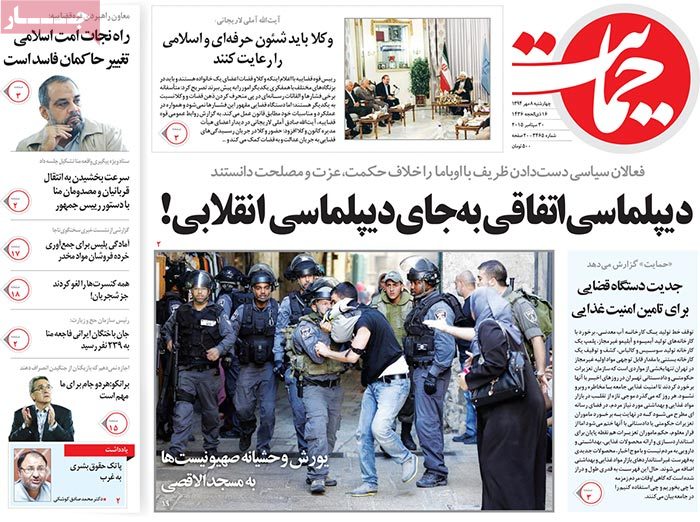
Hemayat: The secretary of the Human Rights Council has blamed the migration crisis in Europe on the policies of the West.


A look at Iranian newspaper front pages on September 13


Jahan-e Eghtesad: The private sector stands ready to complete unfinished government projects, said the chairman of Iran Chamber of Commerce.


A look at Iranian newspaper front pages on September 13


Javan: A British politician opposed to Iran sanctions has been elected leader of the Labour Party.


A look at Iranian newspaper front pages on September 13


Jomhouri Islami: The Expediency Council has voted for the Crime Prevention Bill.

Jomhouri Islami: The UN has warned about worsening humanitarian conditions in Yemen.


A look at Iranian newspaper front pages on September 13


Kaenat: The mayor of Tehran has said that the capital’s sewage system will be fully operational within five years.


A look at Iranian newspaper front pages on September 13


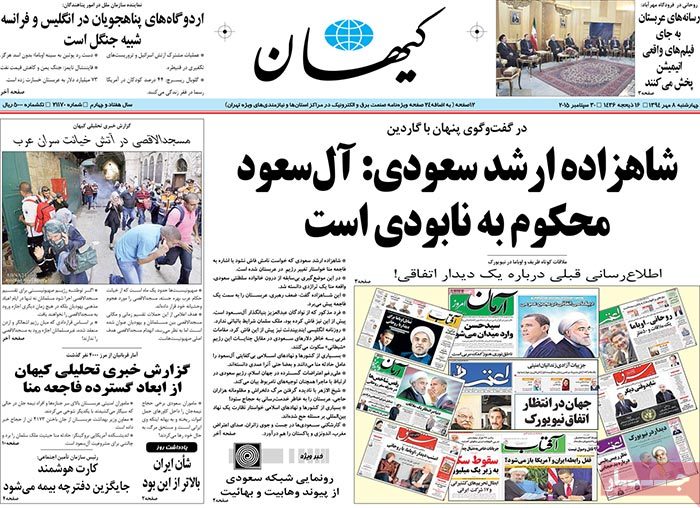
Kayhan: A number of MPs have said allegations that revolutionary youths are hardliners are part of the mission of the fifth column.


A look at Iranian newspaper front pages on September 13


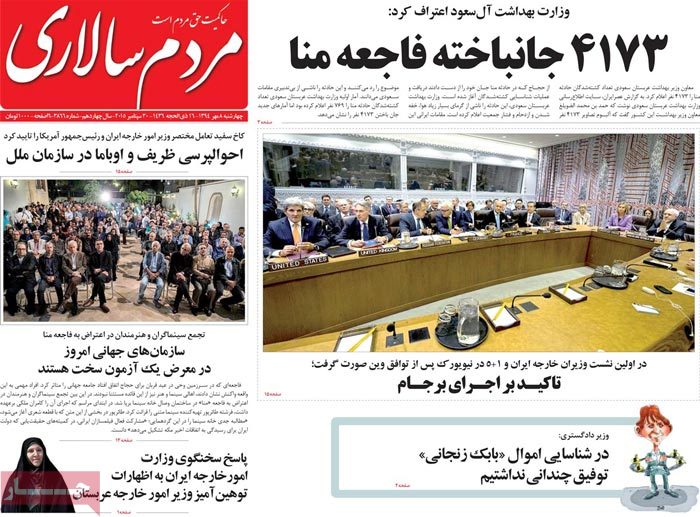
Mardomsalari: There were over 160,000 divorces across the country last year; women under 30 account for 60 percent of divorcees.


A look at Iranian newspaper front pages on September 13


Payam-e Zaman: “A factional attitude toward the Joint Comprehensive Plan of Action would harm national solidarity,” said the secretary of the Supreme National Security Council.
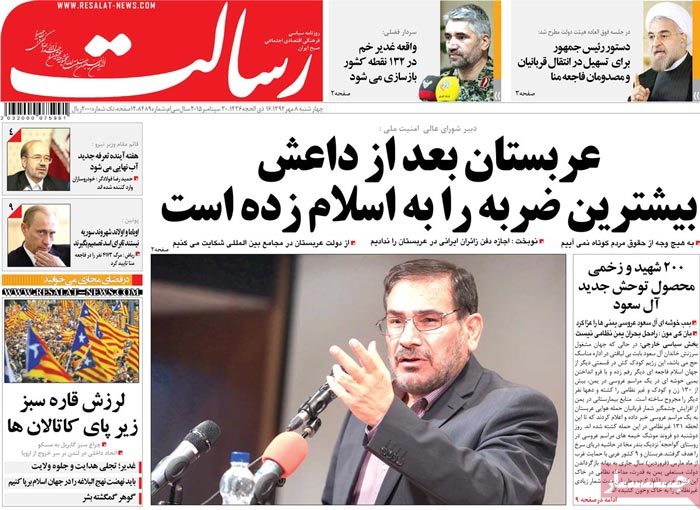
 

A look at Iranian newspaper front pages on September 13


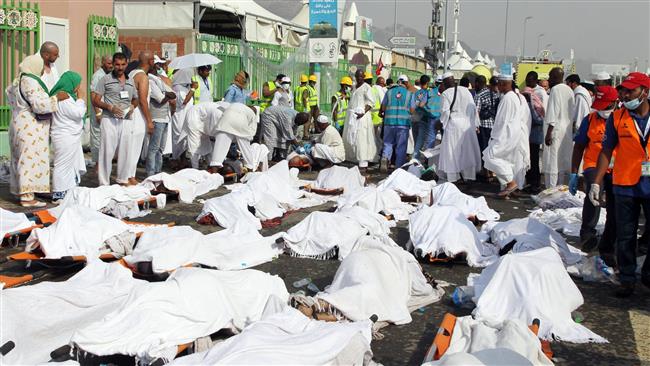
Resalat: Ayatollah Nasser Makarem Shirazi has criticized the injudiciousness of Saudi authorities [in the deadly crane collapse at the Grand Mosque] and said authorities should not have allowed multistory buildings to be erected near the holy site.


A look at Iranian newspaper front pages on September 13


Setareh Sobh: Akbar Torkan, a senior advisor to the president, has warned that the links of the corruption chain have yet to be fully identified.

He admitted that taking on middlemen is no mean feat.


A look at Iranian newspaper front pages on September 13