Tuesday, December 30, 2025
Home Blog Page 4728

What motivates an American woman to translate Iranian books on Sacred Defense?

13930717000298_PhotoL

Caroline Croskery, an orientalist and an American researcher at University of California at Los Angeles, has so far translated over 15 books by Iranian authors into English. Her latest translation is a collection of short stories on the Iran-Iraq War by Ahmad Dehghan.

The following are some of the books Croskery has translated: We Are All Sunflowers and A Heart Bigger Than the World by Erfan Nazarahari, Democracy or Demo-Crazy and In the Twinkling of an Eye by Seyyed Mehdi Shojaei, Red Fish by Katayoun Riahi, The Big Clay Jar and A Sweet Jam and one more title by Houshang Moradi Kermani and Stillness in a Storm by Saeed Ramezani. One book by Pejman Rahimzadeh and another by Afshin Yadollahi are also on the list of her translations.

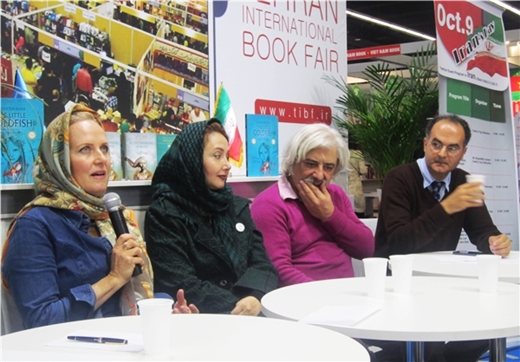
The American translator who was present in the 27th and 28th editions of Tehran International Book Fair is a Farsi interpreter for the Los Angeles County Superior Courts.

She has recently translated a collection of short stories about the Sacred Defense by Ahmad Dehghan entitled A Vital Killing which is to be unveiled at the 2015 Frankfurt Book Fair in October.

The following is the translation of an interview with Ms. Croskery Tasnim News Agency published on September 28:

Ms. Croskery, you have recently translated a book entitled A Vital Killing by Ahmad Dehghan which is a collection of short stories about the Iran-Iraq war. Based on the experience you acquired from such translation, to what extent do you think the concept of Sacred Defense and the Iran-Iraq war as reflected in the Persian literature is appealing to American readers?    

In the US where I live, whenever I talk with people about my translations from Farsi into English, they are amazed. A majority of them have a lot of questions about Iran and the Iranian people. They know that what Western media depict is not the whole truth and are eager to learn more about Iran.

That’s why I choose the books from a wide range of topics and titles by the best Iranian authors. My goal is to play an effective role in reintroducing Iran, its people and wonderful culture to the world.

What do you think about A Vital Killing?

I am extremely happy that I have translated a book by Ahmad Dehghan. I picked A Vital Killing for the title of the translated version; vital because it is necessary and at the same time life-saving. The collection of short stories paints a painful image of the disastrous impact of war on a country against the backdrop of the humanity of its people.

How must have found Iran’s war literature different and appealing to translate a book about it.

My personal intention of translating war books is to remind the world that Iran is a country with refined, noble and peace-loving people. The Iran-Iraq war was not merely a brief conflict between two unimportant countries; nor was it a product of Shiite-Sunni divisions. The public should bear in mind that it was an imposed war triggered by the interference in the internal affairs of a mighty country by major powers who sought to have a hold over the balance of power in the world. Such a policy still persists in the world and its wrongness is being proved.

The book by Ahmad Dehghan narrates stories that tell the truth about the Iranian people. Such stories show the power of people during war. The stories in the collection narrate human actions in a way which is comprehensible to everyone.

Do you adopt a special method in translating Iranian books into English? Given that your insight into the Iranian culture is gained through the books you translate, how do you translate?

I first read the book attentively, because I believe a translator should know the book inside out to be able to translate it. At times when it’s impossible to find an equivalent or there is no appropriate equivalent, I prefer to contact the author to appreciate the concept thoroughly. Then I add some explanations in the target language to convey the message.
Iran hits back: Senior Bahraini diplomat ordered to leave

fac5ef53-e9e2-4433-90a6-be47da3db30f

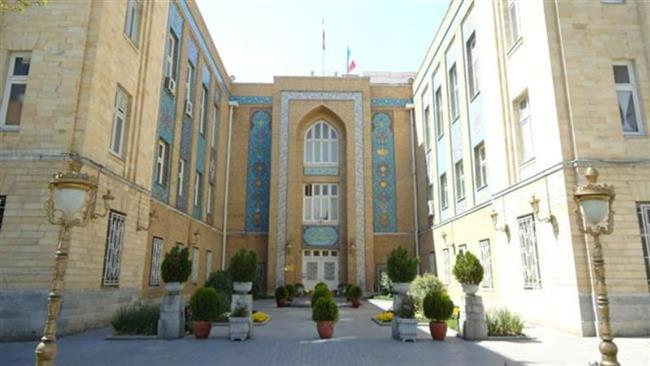
Iran has ordered a top Bahraini diplomat to leave the Islamic Republic after declaring him persona non grata, amid baseless allegations by the Manama regime against Tehran.

In a statement on Friday, Iran’s Foreign Ministry gave the second highest ranking diplomat at the Bahraini embassy in Tehran, Bassam Dalhan al-Dosari, 72 hours to leave Iran.

The Foreign Ministry dismissed Bahrain’s unfounded allegations that Tehran is interfering in the internal affairs of the kingdom of Bahrain.

Manama had accused Tehran of forming and arming groups opposed to the Al Khalifa regime.

In a statement on Thursday, the Bahraini Foreign Ministry recalled its ambassador to Iran and ordered the Islamic Republic’s charge d’affaires in Manama to leave the tiny Persian Gulf kingdom within 72 hours.

The Bahraini Foreign Ministry said it asked the ambassador, Rashid Saad al-Dosari, to return, and declared the Iranian diplomat, Mohammad Reza Babaei, persona non grata and ordered him to depart.

The decision was taken a day after Bahraini officials claimed that they had arrested a number of people over allegations that they had links with Iran and Iraq for ‘terrorist activities.’

A Bahraini Interior Ministry statement said the Al Khalifa regime forces had also uncovered a large stash of weapons at a house in the village of Nuwaidrat, located about 10 km (six miles) south of the capital, Manama.

The cache purportedly included a ton and a half of powerful explosive materials, automatic rifles, pistols and hand grenades.

This is not the first time the Al Khalifa regime has sought to implicate Iran over the ongoing instability in Bahrain.

Iran has repeatedly dismissed the accusations, saying the blame game Bahrain is playing is aimed at covering up the Arab country’s internal problems.

The Islamic Republic has urged the Bahraini government to stop pursuing a security approach toward the tensions in the country and solve its problems through dialogue.

[…]

Mina human crush culprits must face justice: Iran cleric

Movahedi-Kermani

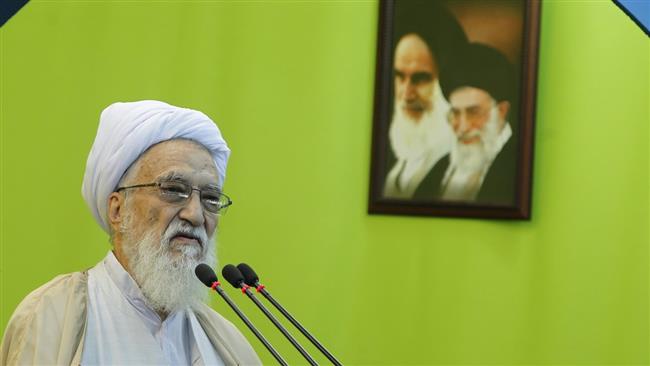
An Iranian cleric has said the main culprits of the September 24 tragedy in Mina, Saudi Arabia, must face justice for the human crush that killed hundreds of pilgrims during the Hajj rituals.

“The management of Hajj should undoubtedly change,” said Ayatollah Mohammad Ali Movahedi Kermani in an address to worshippers at Friday prayer in Tehran.

He added that the Mina tragedy has left a mark of disgrace on the Saudi regime which cannot be removed easily.

The cleric said the Saudi police are certainly responsible for the incident.

“Muslim countries must investigate [the incident] and a fact-finding mission must be set up and the reason behind the closure of the routes [leading to Mina] should be determined,” he said.

He added that many pilgrims died due to lack of water in the scorching heat.

Ayatollah Movahedi Kermani said the tragedy showed Saudi authorities’ lack of competence and their inability to manage the rituals.

He also called on the Saudi officials to consult with Muslim countries regarding the management of the pilgrimage.

[…]

Iran fights US appropriation of $1.7 billion

central-bank

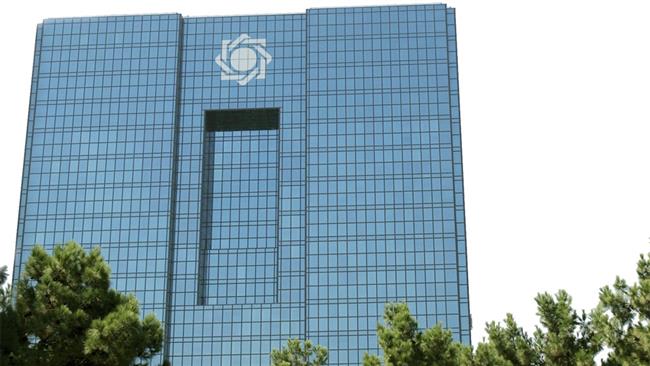
The Central Bank of Iran (CBI) has filed an appeal against a US court ruling to turn over Iranian funds worth $1.75 billion to alleged families of the victims of the 1983 bombing in Beirut.

The US Supreme Court has said that it has agreed to consider the appeal by the CBI which contends the ruling violates a 1955 US-Iran treaty.

The money, currently held in a trust account in New York, was ruled by the city’s court of appeals in 2014 to be handed over to the families of the victims. They accuse Iran of providing material support to carry out the attack which killed 241 US troops.

Iran has denied the accusations and said that the ruling violates a treaty between the US and Iran which bans expropriation of one country’s properties in the territory of the other.

The legal battle comes at a delicate time as Iran and the United States seek to implement an accord signed in July to put their nuclear differences to rest.

The Obama government has urged the high court not to take up the case.

The US Congress has waded into the dispute, passing a law in 2012 to implement the court ruling. The tribunal must now decide whether the chambers have violated the US Constitution by dictating the outcome of a court case.

Iran holding official welcoming ceremony for Mina stampede victims

13940711102537945_PhotoL

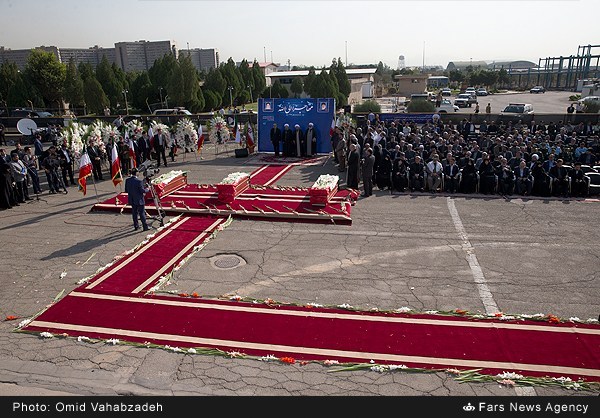
Iran is holding an official ceremony to welcome the bodies of 104 Iranian Hajj pilgrims who were killed in the recent crush in Mina, near the holy city of Mecca in Saudi Arabia.

President Rouhani is addressing the ceremony at Tehran Mehrabad Airport on Saturday.

Senior Iranian officials including Parliament Speaker Ali Larijani, Judiciary Chief Ayatollah Sadegh Amoli Larijani, Ayatollah Mohammad Mohammadi Golpayegani, the head of the office of Leader of the Islamic Revolution Ayatollah Seyyed Ali Khamenei, members of the Cabinet and a number of lawmakers are also present at the ceremony.

The flight carrying the bodies of 104 Iranian Hajj victims landed in Tehran early Saturday.

The crush occurred on September 24 after two large masses of pilgrims fused together.

Saudi Arabia claims nearly 770 people were killed in the calamity, but officials with Iran’s Hajj and Pilgrimage Organization say about 4,700 people, including 464 Iranians, lost their lives in the tragedy.

Iran rejects draft report by OIC Contact Group on Yemen

Araghchi

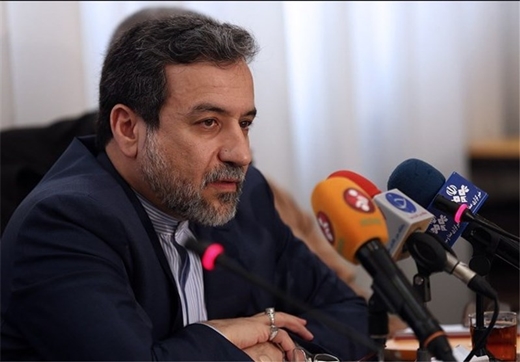
Deputy Foreign Minister Abbas Araghchi dismissed as “biased” a draft report prepared by the Organization of Islamic Cooperation (OIC) Contact Group on Yemen, saying Tehran disapproves of a document that has supported invasion of Yemen.

The OIC Contact Group on Yemen held its first meeting on the sidelines of the OIC Annual Coordination Meeting of Foreign Ministers at the UN Headquarters in New York on Thursday.

The group released a draft report that voiced continued support for Yemen’s former fugitive President Abdu Rabbo Mansour Hadi.

The report has also expressed the Contact Group’s support for Saudi-led “military action undertaken to defend Yemen, its people and its legitimate government on the invitation of President Hadi.”

OIC Secretary General Iyad Ameen Madani also delivered a speech to the meeting, voicing support for the so-called “coalition forces in their efforts to maintain the unity of Yemen’s people and territory”.

Mr. Araghchi, who represented Iran at the meeting, underscored in response that “unilateral approaches, supporting the invasion of Yemen and attacks on the civilians and Yemen’s infrastructures will not bring about peace and stability to that country.”

He said Iran has tried several times to help settle the crisis in Yemen and gather all Yemenis together for peace talks, but the efforts have failed because “one side has refrained” from resuming the political talks and the war on people of Yemen has gone on.

“For those reasons, the Islamic Republic of Iran will not approve of the report prepared by the secretariat, dubbed the Contact Group on Yemen’s report,” Araghchi said.

He also urged the OIC to adopt an evenhanded stance toward Yemen, saying that tensions in the Arab country have no military solution.

“All parties (in Yemen) should focus efforts on finding a peaceful solution,” the Iranian diplomat added.

[…]

Iran’s FM holds talks with Algerian, Syrian counterparts

zarif-20

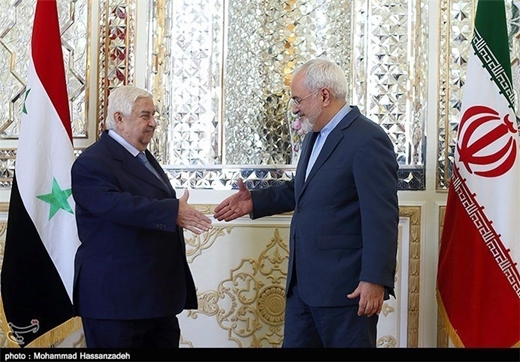
Iranian Foreign Minister Mohammad Javad Zarif discussed a broad range of issues with his counterparts from Algeria and Syria in New York.

At a meeting Thursday on the sidelines of the 70th annual session of the United Nations General Assembly in New York, Zarif and Algerian Foreign Minister Ramtane Lamamra held talks on bilateral ties, including cooperation in the energy market as part of efforts to stabilize oil prices.

They also talked about Tehran and Algiers’ support for each other in the international circles.

Efforts to end a drawn-out crisis in Syria and establish peace and stability in the Middle East and a tragic crush of Hajj pilgrims in Saudi Arabia’s Mina were among other subjects discussed at the meeting.

In a separate meeting, Zarif also met Syria’s top diplomat, Walid Muallem. They exchanged views on the latest developments in the Arab country with both emphasizing the need for continued fight against terrorism and extremism in the entire Middle East.

[…]

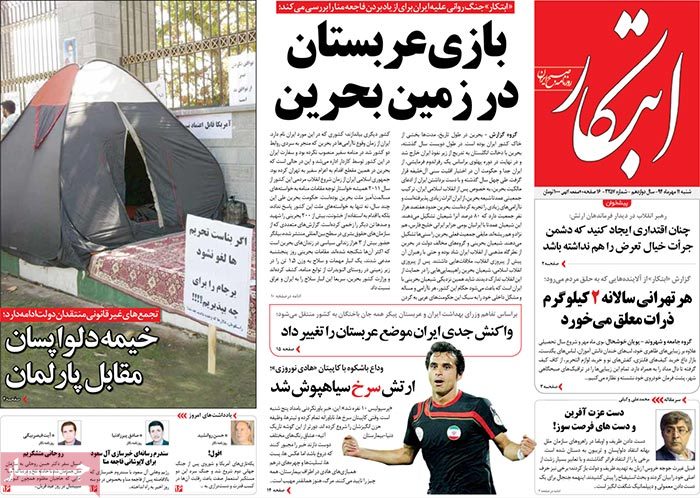
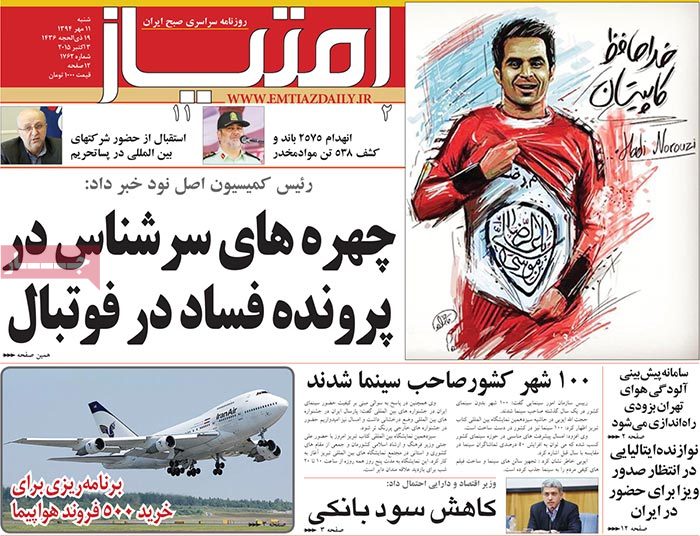
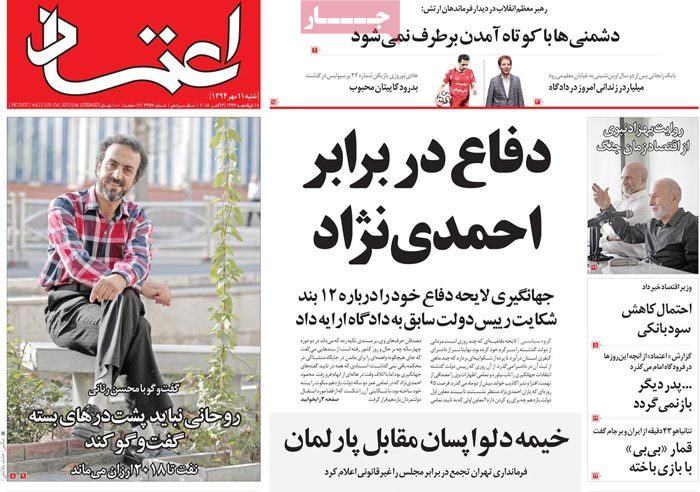
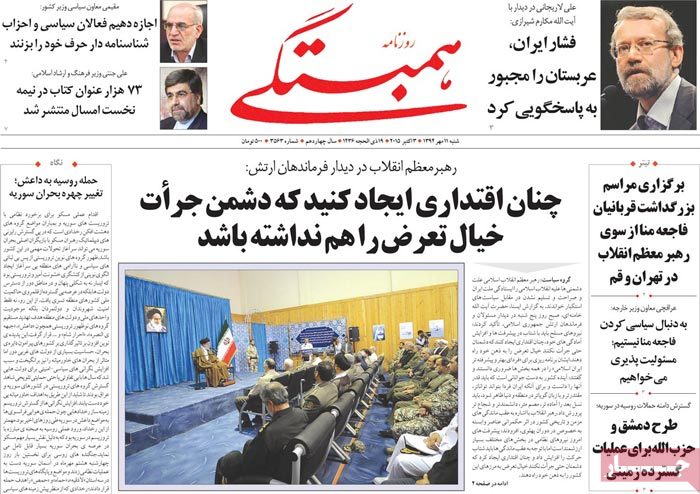
A look at Iranian newspaper front pages on October 3

Iranian Newspapers Headlines

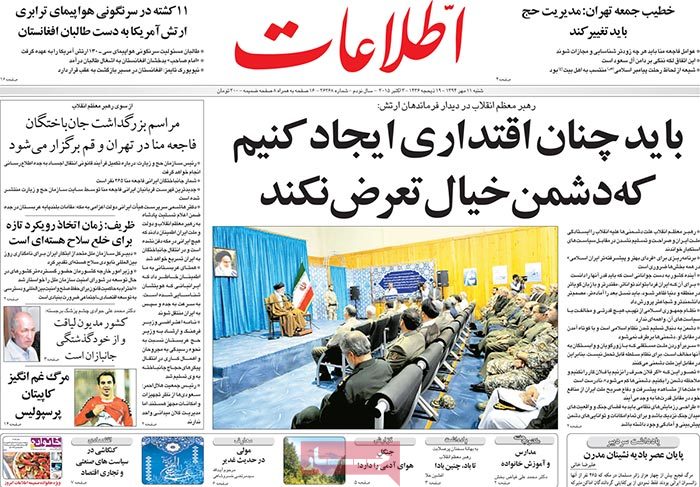
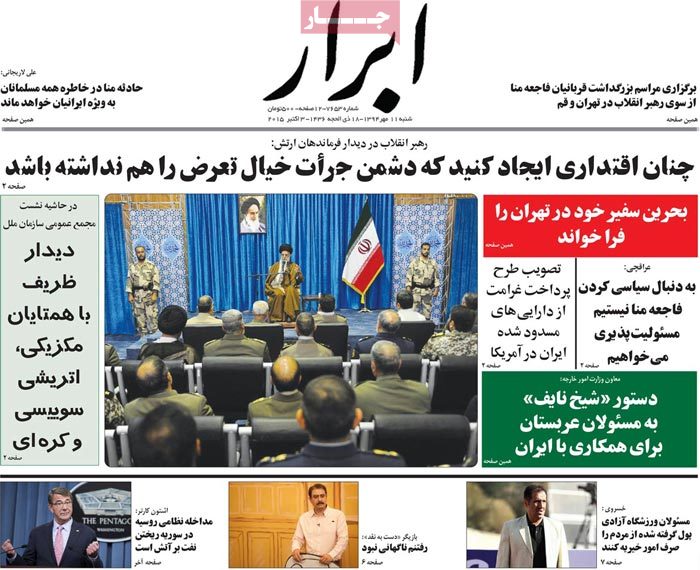
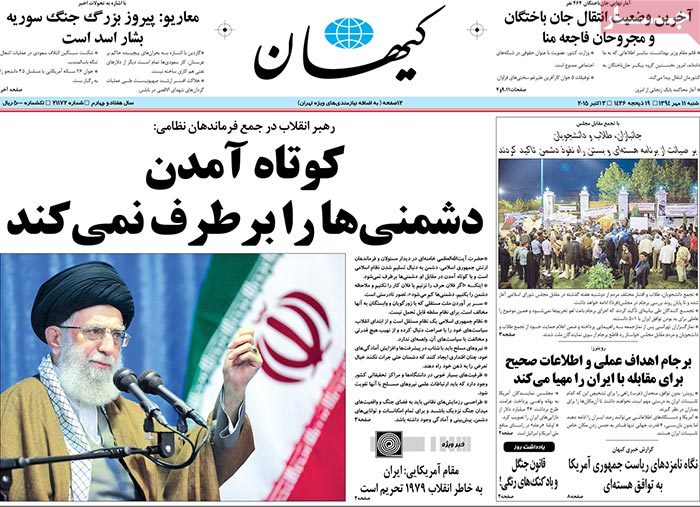
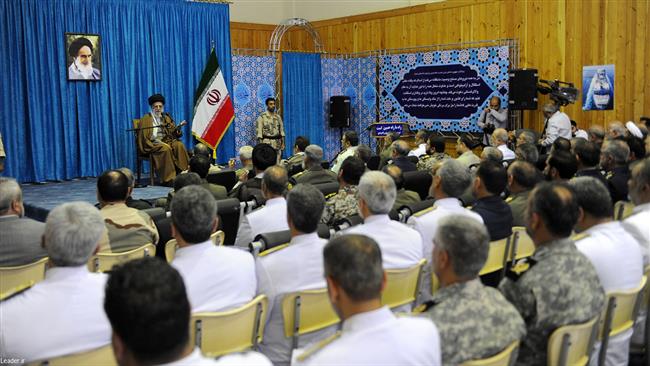
Remarks by the Supreme Leader in a meeting with army commanders that the hostilities of the enemies will not go away even if Iran backs down dominated the front pages of Iranian newspapers on Saturday.


Ettela’at: “You need to bolster the country’s power so that the enemy cannot even think of attacking Iran,” said the Supreme Leader in a meeting with Army commanders.

Ayatollah Khamenei further said that the enemy is seeking the surrender of the Islamic establishment, adding that hostilities will not become history even if Iran backs down.


Abrar: The Supreme Leader has told Army commanders that they should boost the country’s power so much so that the enemy does not dare to think of attacking Iran.


A look at Iranian newspaper front pages on October 3


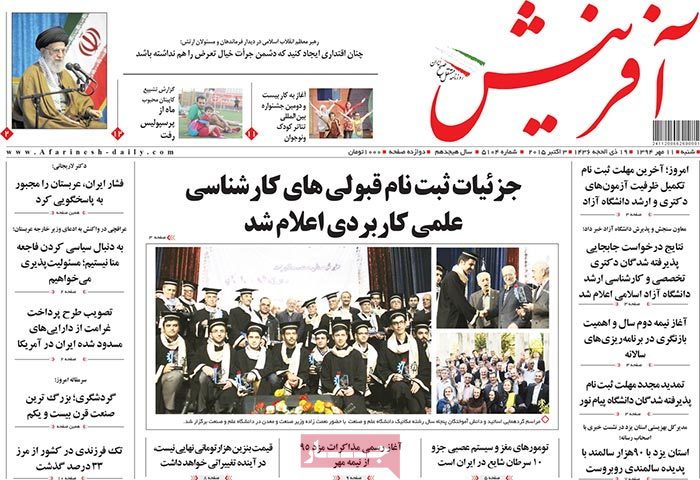
Afarinesh: A deputy foreign minister has said that Iran is not after politicizing the Mina tragedy.

Abbas Araghchi further said that Tehran is seeking accountability on the part of the Saudi government.


A look at Iranian newspaper front pages on October 3


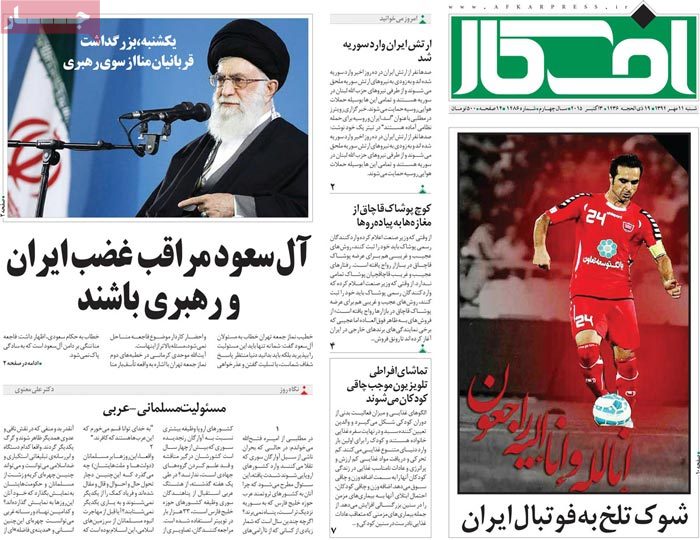
Afkar: A bitter shock for Iran’s football

The daily has taken a look at the untimely death of Hadi Norouzi, the captain of Tehran powerhouse Persepolis.


A look at Iranian newspaper front pages on October 3


Aftab-e Yazd: “If Zarif does not apologize [for his handshake with the US president], we will impeach him,” said a number of MPs.


A look at Iranian newspaper front pages on October 3


Arman-e Emrooz: New York diplomacy under the gun of Worriers [a reference to the supporters of former president who are critical of President Rouhani’s nuclear policies]

Efforts by Zarif in New York; mudslinging by the Worriers in Tehran

FM Zarif has been summoned to parliament’s National Security and Foreign Policy Committee.

Arman-e Emrooz: The Worriers are given the cold shoulder by people

Distribution of illegal placards in Friday prayers


A look at Iranian newspaper front pages on October 3


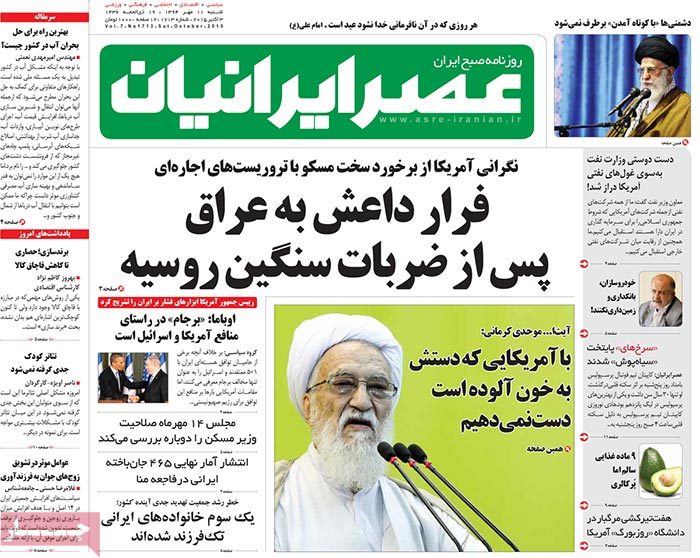
Asr-e Iranian: One-third of Iranian households have become one-child families.

The slow population growth, a serious threat to the country’s future


A look at Iranian newspaper front pages on October 3


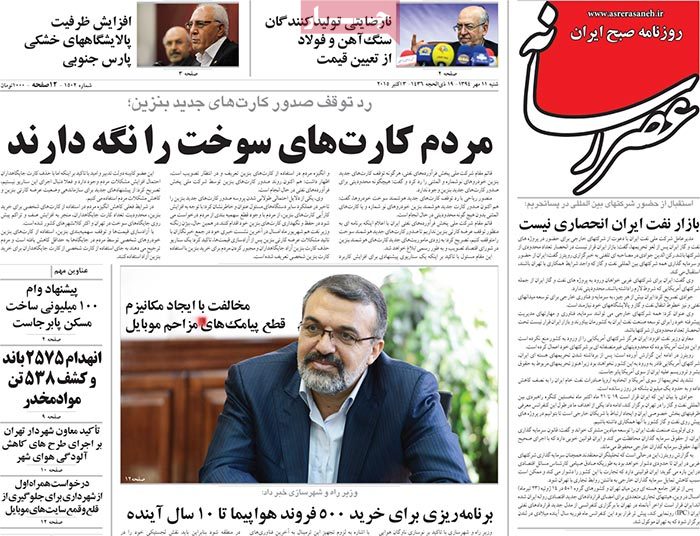
Asr-e Rasaneh: The minister of roads and urban development has said that Iran has plans to buy 500 planes in the next ten years.


A look at Iranian newspaper front pages on October 3


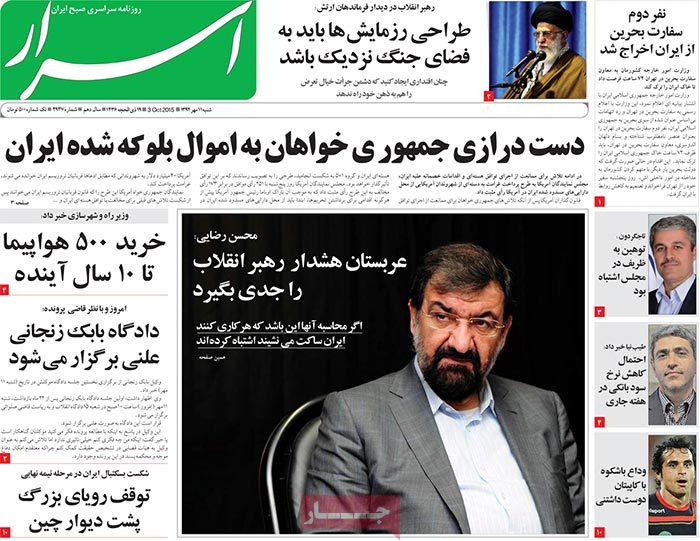
Asrar: The secretary of the Expediency Council has said that Saudi Arabia had better take the Supreme Leader’s warning seriously.


A look at Iranian newspaper front pages on October 3


Ebtekar: The tent of the Worriers outside parliament

The critics of the government are continuing their illegal gatherings.


A look at Iranian newspaper front pages on October 3


Emtiaz: A Tehran air pollution prediction system will be inaugurated in the capital soon.


A look at Iranian newspaper front pages on October 3


Etemad: Defense against Ahmadinejad

First Vice-President Eshagh Jahangiri has submitted to the court his defense motion against 12 parts of a complaint filed by the former president.


A look at Iranian newspaper front pages on October 3


Hambastegi: The speaker of the Islamic Consultative Assembly has said that Iran’s pressures have forced Saudi Arabia to act accountably.


A look at Iranian newspaper front pages on October 3


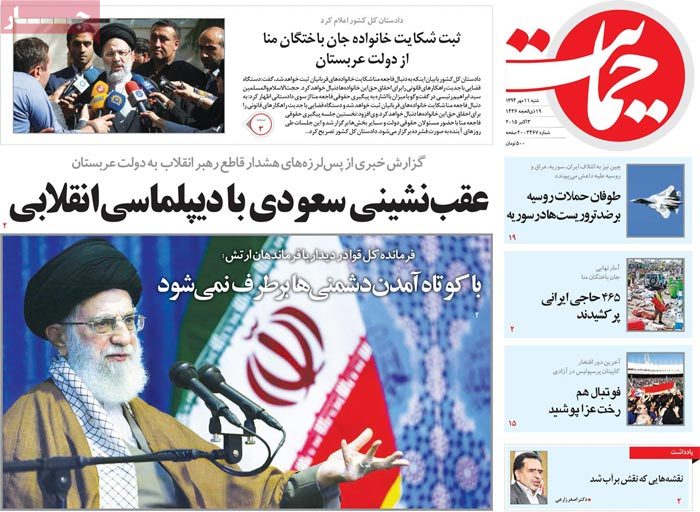
Hemayat: The Saudi withdrawal as a result of revolutionary diplomacy

The daily has taken a look at the aftershocks of the stern warning by the Supreme Leader to the Saudi government.


A look at Iranian newspaper front pages on October 3


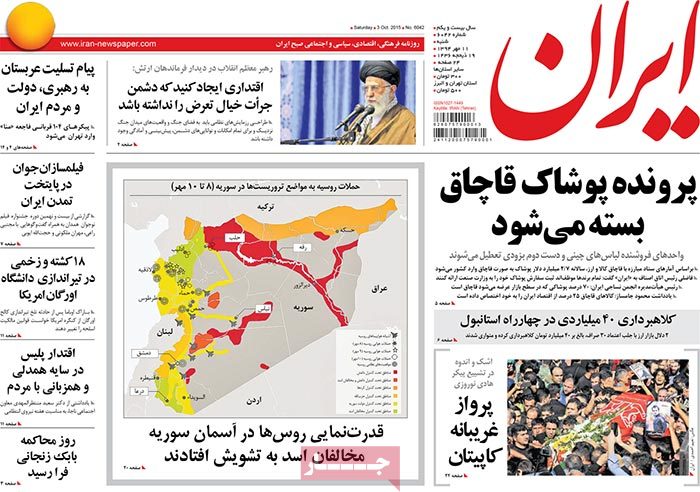
Iran: The Saudi message of condolences to the Supreme Leader, the Iranian people and government


A look at Iranian newspaper front pages on October 3


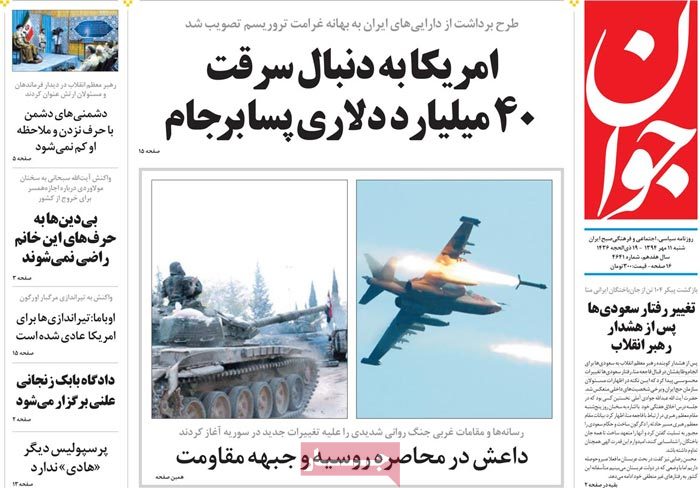
Javan: The trial of Babak Zanjani [a young billionaire who is to be tried for massive corruption and embezzlement] will be held open.


A look at Iranian newspaper front pages on October 3


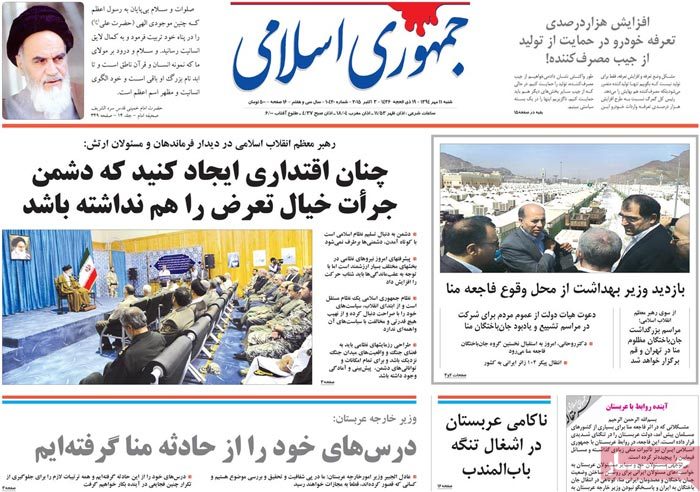
Jomhouri Islami: The health minister has paid a visit to the venue of the deadly stampede in Mina.


A look at Iranian newspaper front pages on October 3


Kayhan: “To concede does nothing to remove enmities,” said the Supreme Leader in a meeting with the country’s military commanders.


A look at Iranian newspaper front pages on October 3


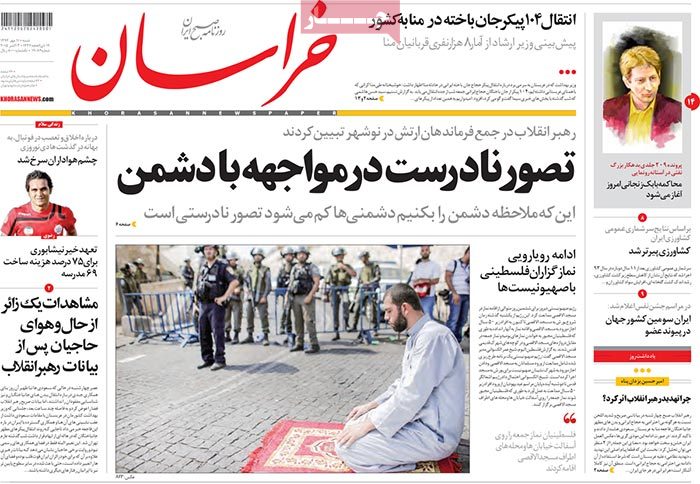
Khorasan: The transfer to Iran of the bodies of 104 Iranian pilgrims who were killed in the Mina stampede


A look at Iranian newspaper front pages on October 3


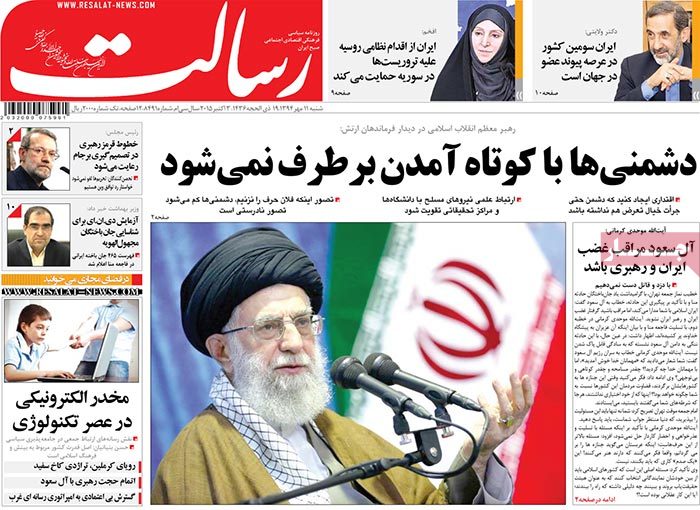
Resalat: “Iran ranks third in the world as far as organ transplant is concerned,” said Dr. Ali Akbar Velayati.

Resalat: “The [nuclear] red lines set by the Supreme Leader will be taken into account when [parliament] decides on the Joint Comprehensive Plan of Action,” said Parliament Speaker Ali Larijani.


A look at Iranian newspaper front pages on October 3


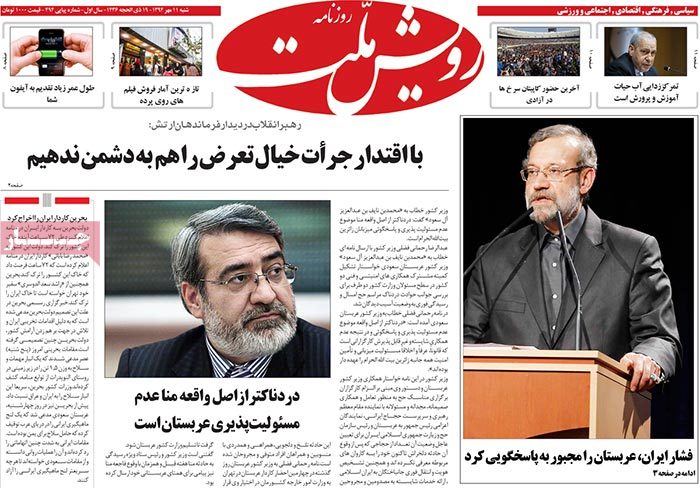
Rooyesh-e Mellat: The interior minister has said that Saudi Arabia’s failure to accept responsibility is more painful than the Mina tragedy itself.


A look at Iranian newspaper front pages on October 3


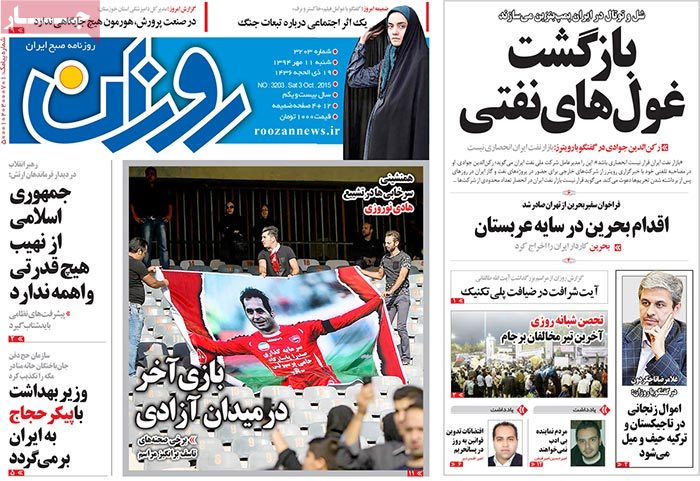
Roozan: The return of oil giants

Royal Dutch Shell and France’s Total are to build gas stations in Iran.


A look at Iranian newspaper front pages on October 3


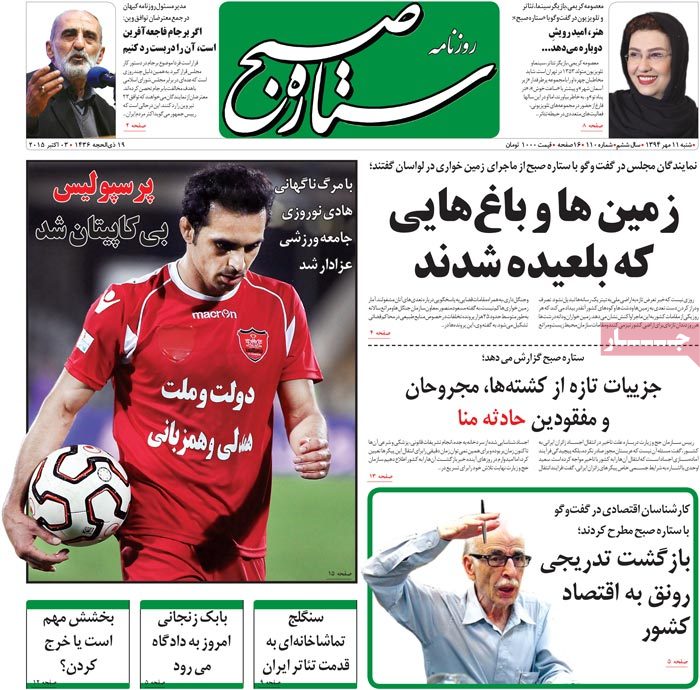
Setareh Sobh: Iran’s economy has started to experience a gradual boom.

The daily has conducted interviews with economic experts on the country’s economic situation.


A look at Iranian newspaper front pages on October 3


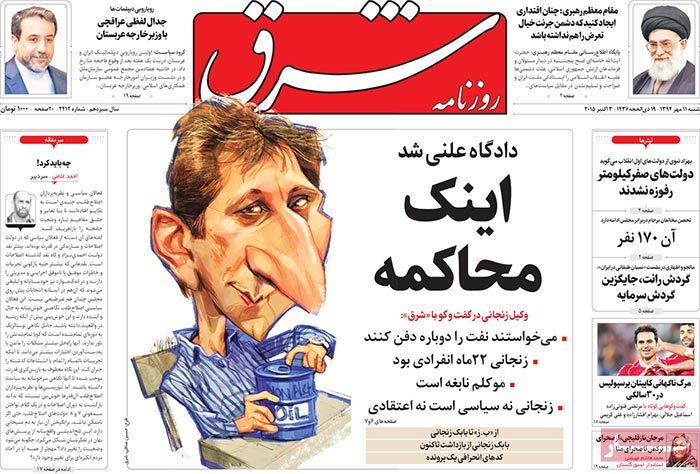
Sharq: Confrontation between diplomats

A verbal conflict between Araghchi and the Saudi foreign minister


A look at Iranian newspaper front pages on October 3


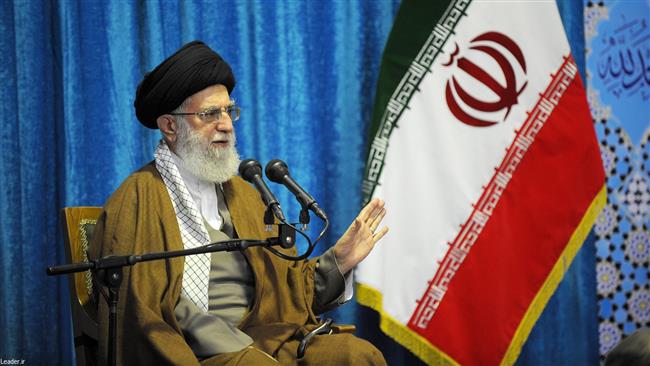
Enemies resent Iran independence: Leader

Leader

“The system of the Islamic Republic is an independent system; and has, since the [1979] Revolution, openly pursued its policies and does not fear the roar of any power or opposing any power’s policies,” the Leader said in a Thursday meeting with Iranian military officials and commanders.

“The emergence of an independent nation that is opposed to the bullies and their affiliates is not tolerable for the hegemonic system,” Ayatollah Khamenei pointed out.


Leader


‘Leniency won’t reduce enmity’

Ayatollah Khamenei also noted that the enemy seeks the surrender of the Islamic Republic.

“Enmities would not go away by backing down” in the face of the enemy, the Leader said, adding that it is wrong to think that if Iran practices leniency toward the enemy, the latter will reduce its enmity.

“Nations are delighted at seeing the Iranian nation progress and unequivocally defend its rights vis-à-vis powers,” Ayatollah Khamenei noted.

The Leader emphasized that, by accelerating their advances, the Iranian Armed Forces must gain such might that would have enemies not dare to even think of invading Iran.

“The advances of the military forces in different sectors today are very invaluable; but… the pace [of the progress] must be increased,” the Leader of the Islamic Revolution said.

A $700,000 dining table on display at Milad Tower

159692_302 (1)

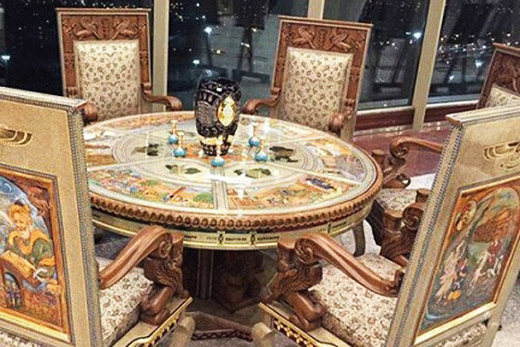
Magnificent works of art have been put on show at Tehran’s Milad Tower, among them a stately wooden table with a price tag of more than $700,000.

Poolnews.ir on September 29 published a report on the expensive table which is on show at Milad Tower and remarks by Mostafa Khoushabi, the head of an artisan cooperative. The following is the translation of part of that report:

A group of 86 artists have displayed 2,600 works – fine pieces of craftsmanship – at the capital’s tallest tower. A six-person dining table stands out among the craftworks there. Master Rasoul Motamedi, a student of Mahmoud Farshchian [the master of Persian painting and miniatures], has done the painting on the table and a pricing committee at the Trade Promotion Organization of Iran has valued the magnificent table at $700,000.

This dining table features Iran’s history from the Median period to the Pahlavi era in six parts and displays the expanse of Iran’s territory in different historical periods. Each painting has a special background: another painting on the costumes of different historical periods. The artist has spent nine months to conduct research into the costumes of those periods.

Khoushabi rejected rumors that Master Motamedi has crafted the table following an order placed by an American, saying this is a unique piece of art which will be put on show in Munich. He stressed that nobody has placed an order for this table.

He further said that Master Motamedi had earlier exhibited a set of furniture at Milad Tower which was worth over $150 million. The committee in charge of pricing the artifacts has priced the furniture: three dollars for each square centimeter of the work.

[…]