Tuesday, December 30, 2025
Home Blog Page 4712

A Saudi woman details life in Iran

Saudi woman Iran

The experiences of a Saudi woman who has lived in Iran for the past ten months were covered by observers.france24.com on October 15. One day later Jamejamonline, an Iranian website, released the Farsi translation of the report on Sara Masry and what she thinks about her 10-month-long stay in Iran. IFP found the original report on the website of the French international broadcaster. The following is the original report in its entirety:

With tensions between Iran and Saudi Arabia running feverishly high, this may seem like an odd time for a young Saudi woman to choose to study in Iran. Yet that’s exactly what our Observer is doing. She details her experiences on her blog, “Saudi in Iran”.

Iran and Saudi Arabia have never had very good relations. Iran is a Shiite theocracy, while Saudi Arabia is the home of Wahhabism, an ultra-conservative branch of Sunni Islam. And today, because of proxy wars between the two countries in Syria and Yemen, their relationship is more volatile than ever. Their latest feud is over the stampede that killed more than 1,600 people in Mecca: several hundred Iranians were among the pilgrims who perished, and were blamed by Saudi authorities for allegedly starting the stampede. Tehran, meanwhile, placed the blame for the tragedy squarely on the Saudi authorities.

After the Mecca stampede, Iranians demonstrated in front of the Saudi embassy in Tehran and the Saudi consulate in Mashhad. In Saudi Arabia, some imams declared that killing Shiites was ‘halal’, or allowed.

In this context, Saudi blogger Sara Masry, who has lived and studied in Tehran for the past ten months, chooses to focus in her blog on her day-to-day life there, avoiding all politics. She did, however, make a small exception to address the Mecca tragedy: “This event is now polarizing the two populations even further … while pushing the possibility of mutual understanding and empathy back another few decades”.

“Iranians are very hospitable, and are able to separate between politics and people in a way that I think is really unique to the Middle East”

Sara Masry grew up in Saudi Arabia before attending university in London. She is now following a course on Iranian studies in Tehran.

“I have always been interested in Iran, its culture, and its history, and was able to study it in depth in London. But one day, I decided studying from afar was not enough: I wanted to see the reality of this country myself.

When I told my Saudi friends and family about my plan, some of them were very worried and tried to dissuade me. In part, this was because I had a good job opportunity in London, but it was also because there’s not a lot of positive news about Iran in the media!

However, living here, I have found vast majority of Iranians are very hospitable, and are able to separate between politics and people in a way that I think is really unique to the Middle East. Not one person I have come across has cared that I’m Saudi, and not one has cared that I’m Sunni. When I meet new people, many think that I’m Indian because of my accent in Persian. When they learn I’m Saudi, the questions begin: Why are you here? Do you like our country? Are you having a good experience in Iran?

I honestly can’t tell you of a single bad experience. I know, of course, that racism and chauvinism exist here, like in many countries, but fortunately in ten months, I have not experienced it.

“I want to create a bridge between people in both nations”

A few months ago, I lost my wallet. In it, there was a lot of money, since I had just changed some British pounds to Toman. There was also my Saudi identity card. A few days later, a woman called me and said she had my wallet. She was the wife of the taxi driver who had found my wallet, and she had been searching for me for days!

After the Hajj stampede, I was paying for lunch at the cafeteria and one of my friends came up and made a joke to the cashier: ‘Don’t sell her anything, she’s Saudi!’ and ran off. A woman who had heard this came up to me and for five minutes apologized to me for her countryman’s behavior. Even after I told her it was just a joke, she said there was no place for such jokes here!

Most of the time, I blog about social and cultural experiences, and about my travels throughout the country. My goal is to create a bridge between people in both nations, to dispel myths and stereotypes. Right now, I write in English, but I plan to translate it into Arabic… Next step, Persian!

Discovery of 30 dead sharks on board boat (PHOTOS)

sharks-7

Wildlife rangers off the coast of Sistan and Baluchestan in southeastern Iran have uncovered the chopped bodies of 30 baby sharks hidden on board a boat.

The owner of the launch, which is now impounded, will have to pay almost $10,000 for each one of the sharks it was smuggling.

An increase in the number of poached sharks which are used in restaurants and for industrial and treatment purposes has seen their ranks shrink in recent years.
The following images have been released by www.iew.ir:


Caspian seals rescued from the trawl (PHOTOS)

Caspian seals0

In Golestan Province two Caspian seals caught in a trawl of local fishermen were handed over to rangers who in turn rushed them to a wildlife center in Ashuradeh before releasing them back into the sea.

Before the breakup of the Soviet Union the number of seals in the landlocked sea stood at approximately one million; their ranks shrank to 100,000 in 2008 when the most recent statistics were released.

Russia allows as many as 10,000 seals to be hunted on a yearly basis. The following images have been released by www.iew.ir:
 

Who replaces FM spokeswoman who will soon become ambassador to Malaysia?

Marzieh Afkham

Mohammad Hassan Sheikholeslami, Ph.D., who currently serves as president of the Foreign Ministry’s School for International Relations, will soon be named Iranian Foreign Ministry spokesman, replacing Marzieh Afkham who will move in Malaysia to become the Islamic Republic’s first female ambassador.

Mohammad Hassan SheikholeslamiOn October18, Entekhab.ir, a news website quoted Diplomat monthly as reporting that Sheikholeslami is a veteran public and media diplomacy expert with a Ph.D. in international relations from the University of Tehran.

Dr. Sheikholeslami has penned a number of articles on public and media diplomacy as well as on the foreign policy of the Islamic Republic of Iran.

The outgoing spokesperson – Marzieh Afkham – has been in the post since the rise to power of the Rouhani administration in 2013.

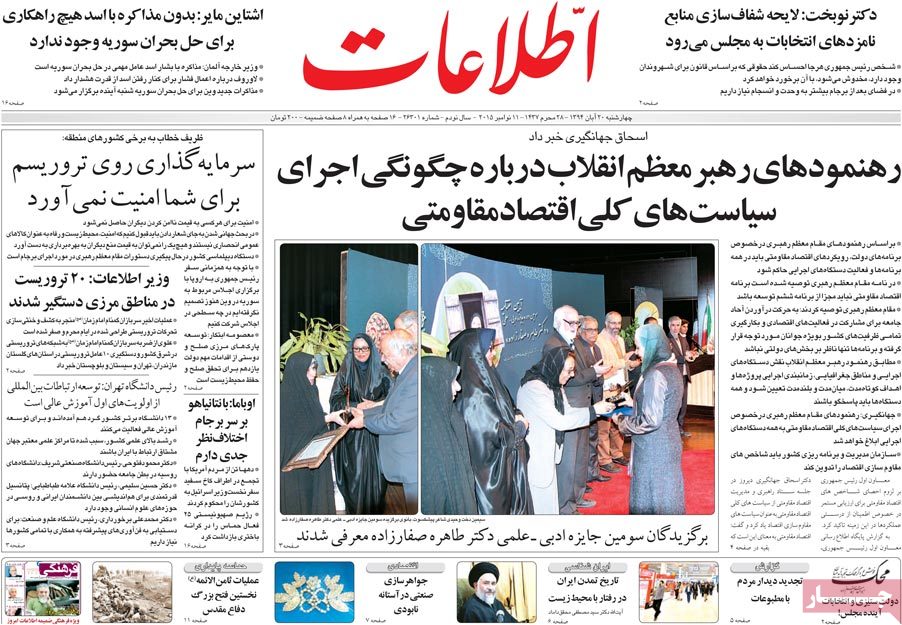
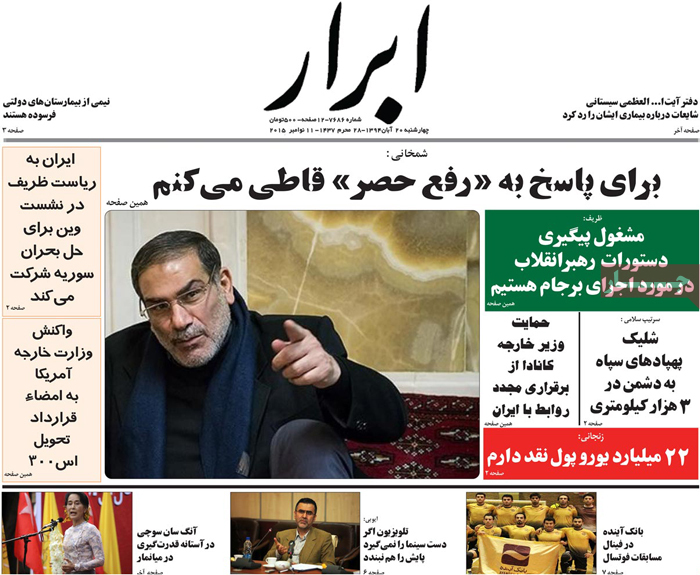
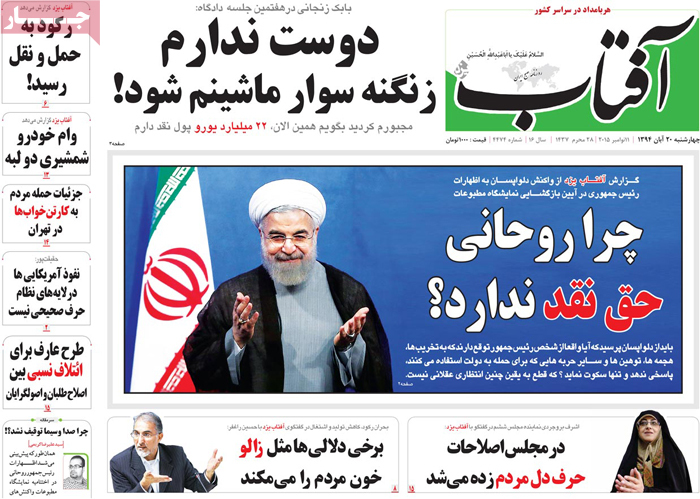
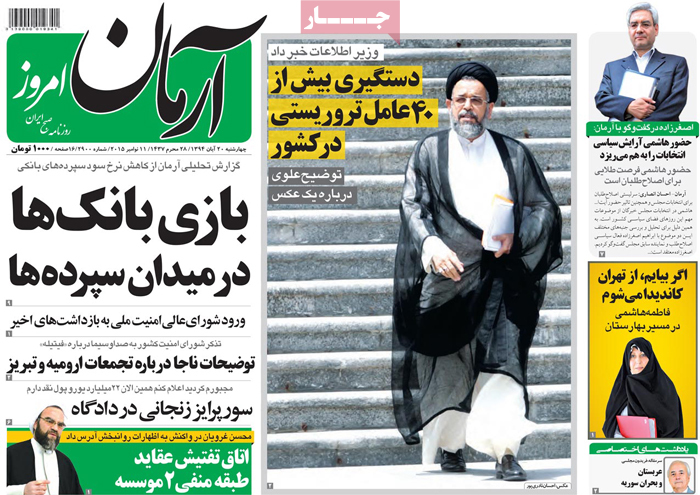
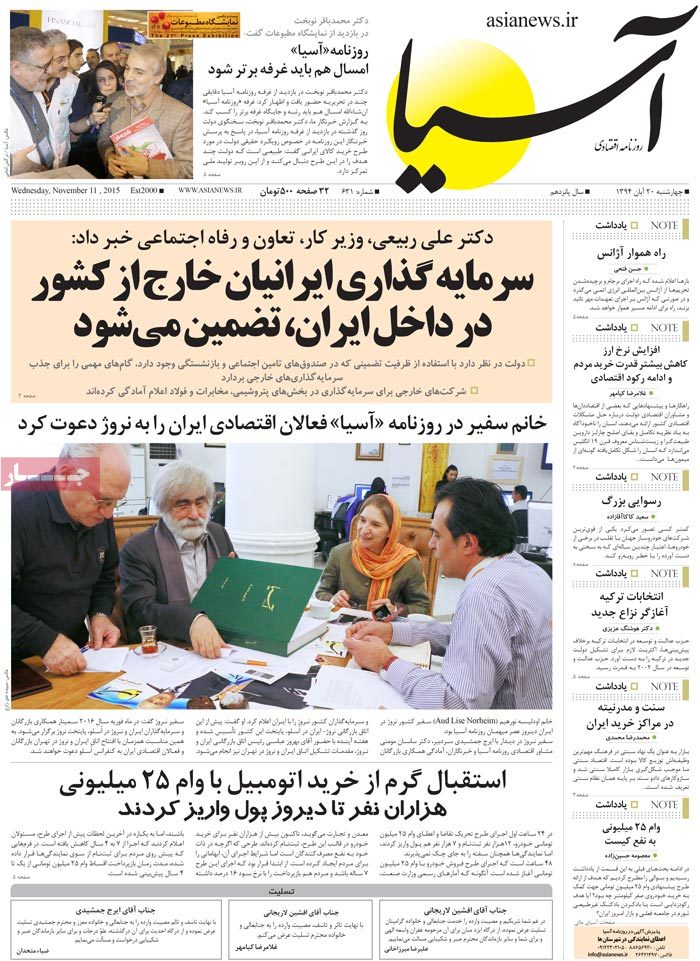
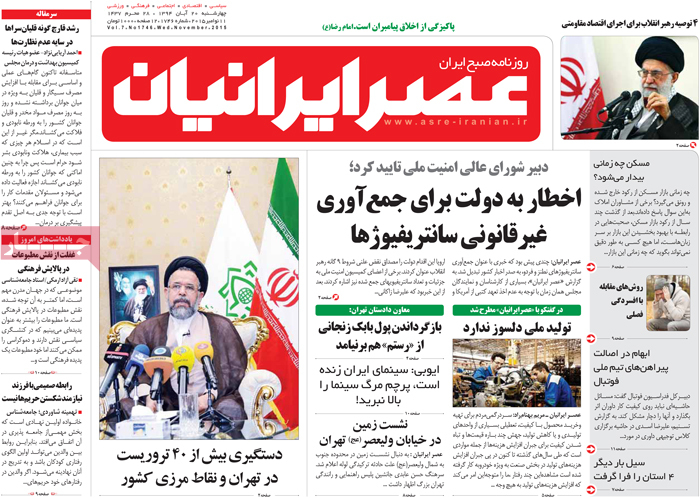
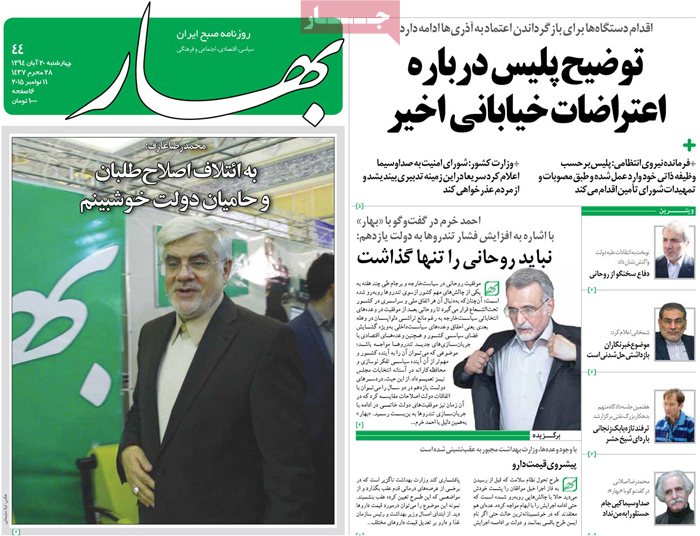
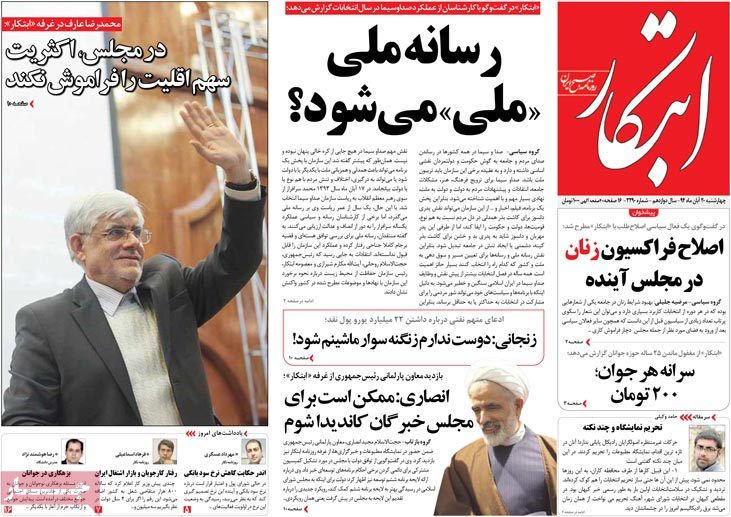
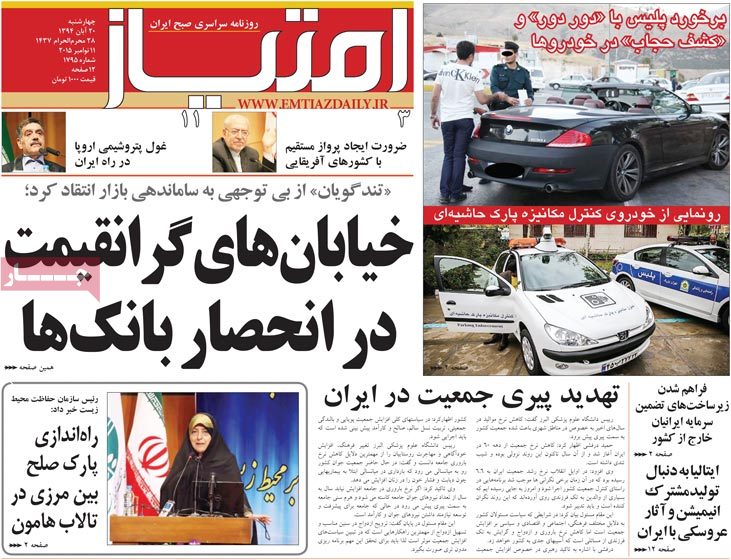
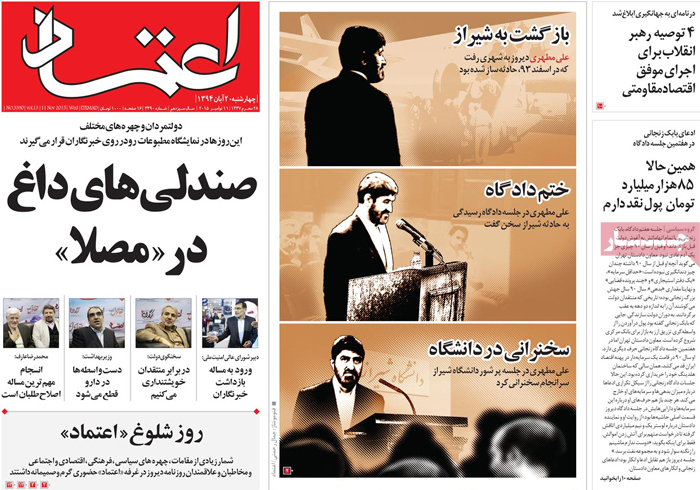
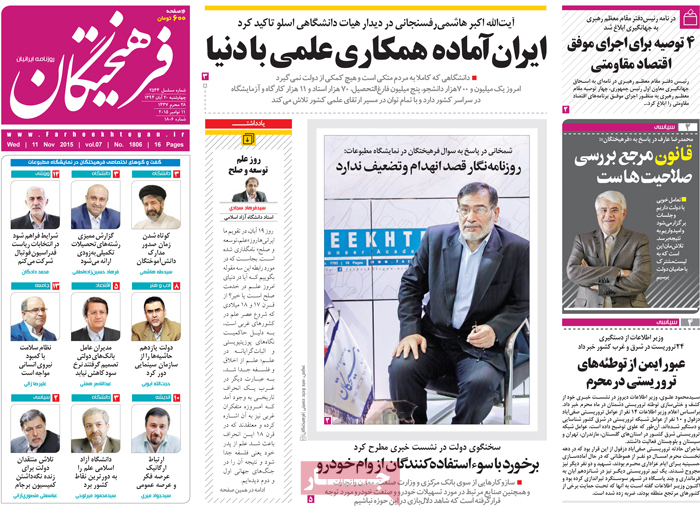
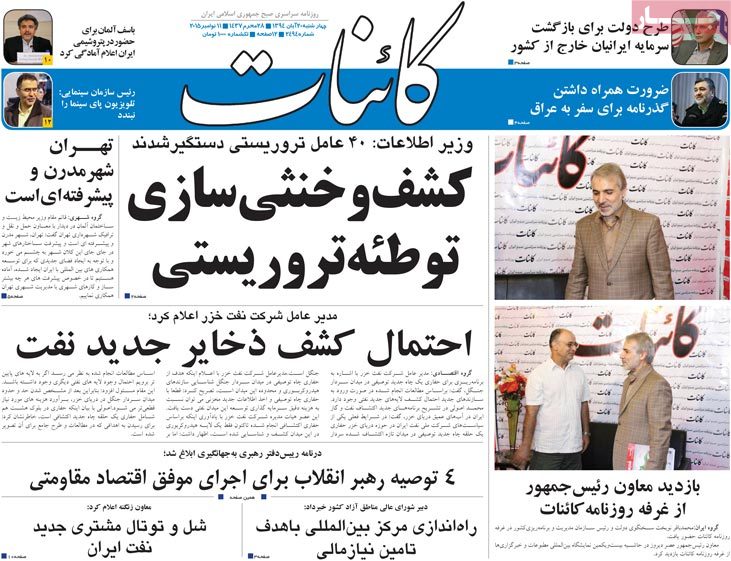
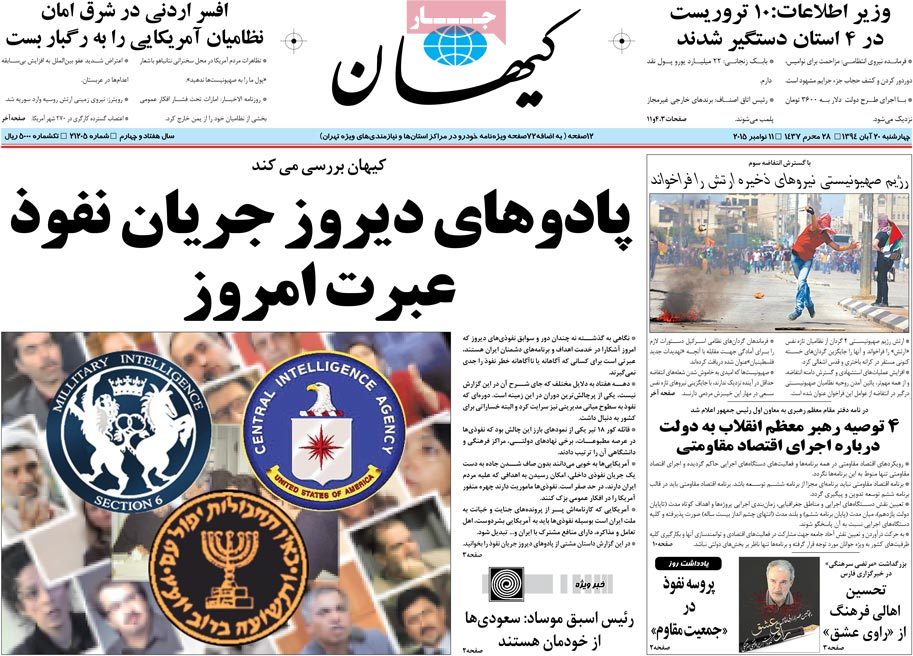
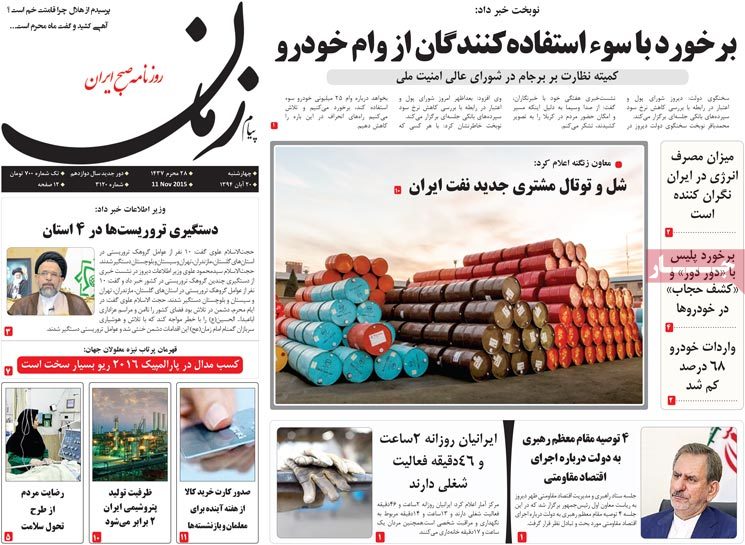
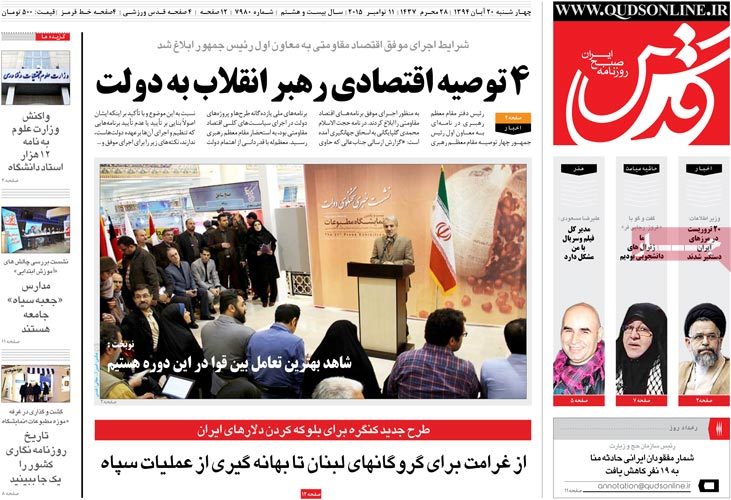
A look at Iranian newspaper front pages on Oct. 19

Iranian Newspapers Headlines

Developments related to the launch of a process to implement the Joint Comprehensive Plan of Action dominated the front pages of Iranian newspapers on Monday.


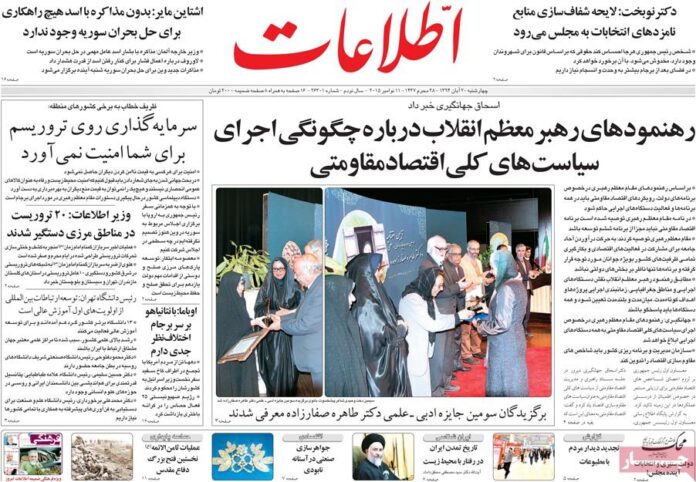
Ettela’at: President Rouhani has said that the revolutionary culture does not prescribe harsh rhetoric and sloganeering.

Speaking at a gathering on knowledge-based economy, the president said that the post-deal era would be ideal for research, elites and knowledge-based companies.

Ettela’at: The Supreme Leader has paid a visit to the residence of Brigadier General Hossein Hamedani [who was recently martyred near Aleppo, Syria] to meet with his family.

Ettela’at: As many as 300 terrorists have been killed in a Syrian Army offensive on the outskirts of Lattakia.

Meanwhile, the Russian Defense Ministry said that more than 50 IS positions have been demolished in Syria over the past two days.

Ettela’at: President Obama has ordered the Iran sanctions lifted; it came as the European Union terminated all sanctions against Iran.

Ettela’at: Foreign Minister Zarif and EU foreign policy chief Federica Mogherini have issued a joint statement on the implementation of the Joint Comprehensive Plan of Action.

A joint Iran-P5+1 commission will convene on Monday to take all the measures necessary to implement the Joint Comprehensive Plan of Action.

Ettela’at: The Iranian Army holds a two-day rapid response maneuver involving the most advanced weaponry in the west and northwest of the country starting Monday.


A look at Iranian newspaper front pages on Oct. 19


Abrar: “I have had no role in reviewing the nuclear case which is the Supreme Leader’s,” said Parliament Speaker Ali Larijani.


A look at Iranian newspaper front pages on Oct. 19


Abrar-e Eghtesadi: Fifteen aircraft will join the Iranian fleet by the end of 2015.


A look at Iranian newspaper front pages on Oct. 19


Afkar: The Guardian Council has given its blessing to the electronic equipment to be used in upcoming elections.


A look at Iranian newspaper front pages on Oct. 19


Aftab-e Yazd: “The Americans are unlikely to breach the nuclear deal,” said the chairman of parliament’s National Security and Foreign Policy Committee.


A look at Iranian newspaper front pages on Oct. 19


Arman-e Emrooz: Germans are to secure an investment foothold in Iran.


A look at Iranian newspaper front pages on Oct. 19


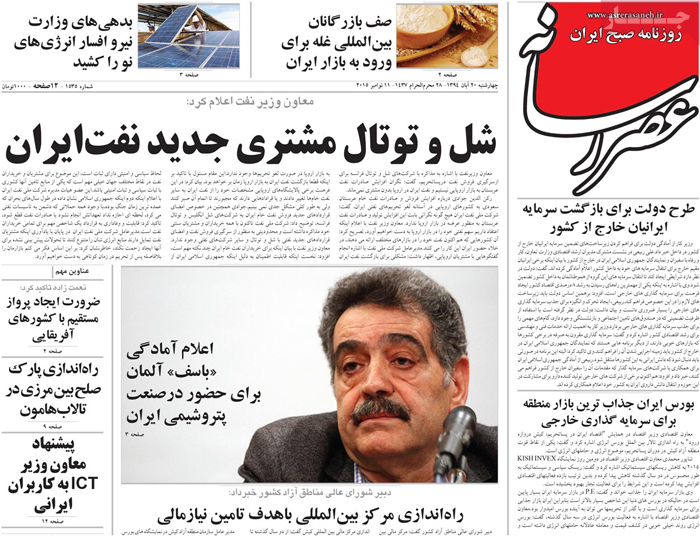
Asr-e Rasaneh: Germany has expressed readiness to launch joint ventures in Iran.


A look at Iranian newspaper front pages on Oct. 19


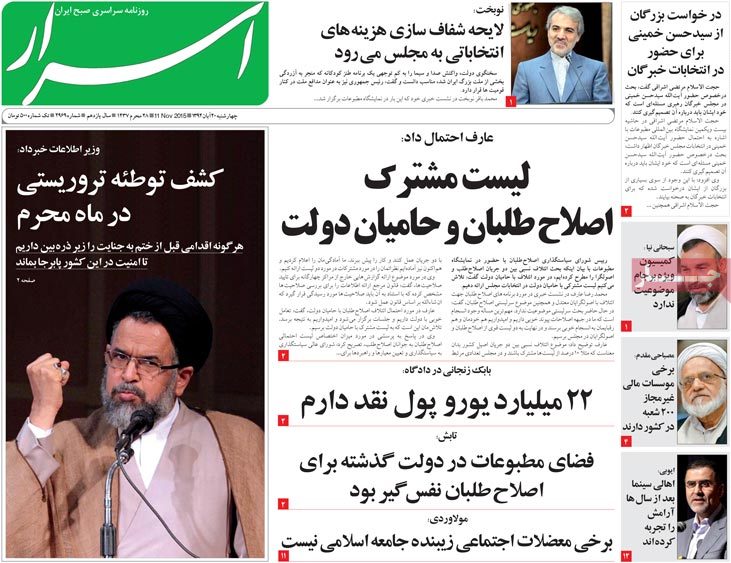
Asrar: Managers of eight Russian oil giants will accompany the Russian energy minister on a visit to Iran later this week.

Asrar: Iran’s nuclear measures will start as of next week, said the director of the Atomic Energy Organization.

Asrar: The Iranian oil minister has said that leaders of the Gas Exporting Countries Forum will converge on Tehran in December.


A look at Iranian newspaper front pages on Oct. 19


Ebtekar: The German foreign minister has hailed [Chairman of the Expediency Council Ayatollah Akbar] Hashemi Rafsanjani as instrumental in boosting ties between Iran and the rest of the world.


A look at Iranian newspaper front pages on Oct. 19


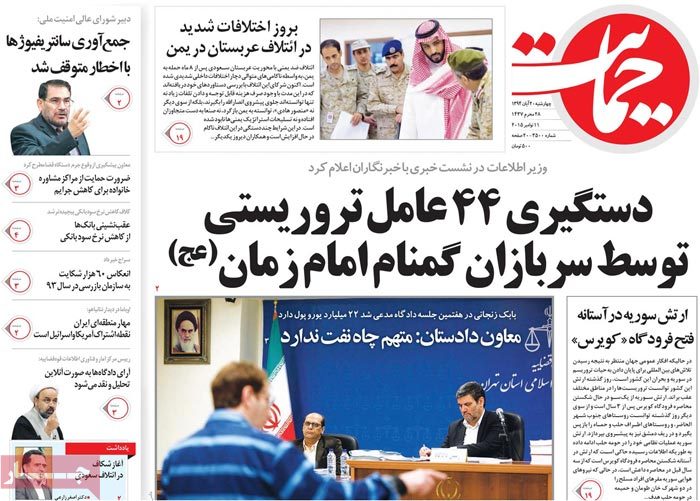
Etemad: The National Iranian Oil Company has said the defense attorneys of Babak Zanjani [a billionaire on trial for corruption] have yet to pay back any of their client’s debts.


A look at Iranian newspaper front pages on Oct. 19


Hemayat: The director of the Legal Medicine Organization has said that forensic experts will be sent to Saudi Arabia to examine the information [provided by Saudi authorities] on the Iranian pilgrims killed in the Mina stampede.


A look at Iranian newspaper front pages on Oct. 19


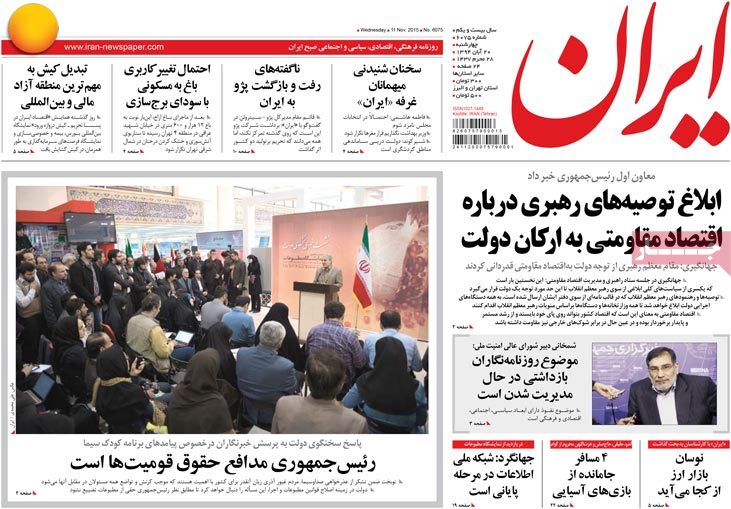
Iran: A poll by the Islamic Republic News Agency shows that the Rouhani administration’s approval rating has increased.


A look at Iranian newspaper front pages on Oct. 19


Jamejam: A road accident involving a truck and a minibus has left as many as 20 killed.


A look at Iranian newspaper front pages on Oct. 19


Javan: Termination of sanctions on the paper for now

Practical measures by Iran and notes by the West marked the implementation of the Joint Comprehensive Plan of Action.


A look at Iranian newspaper front pages on Oct. 19


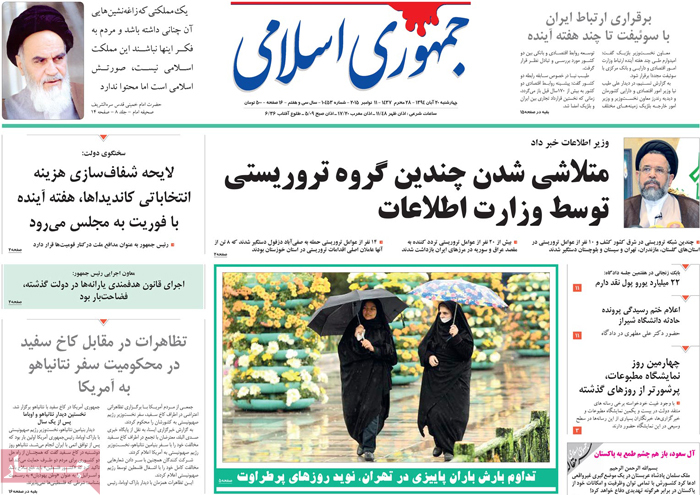
Jomhouri Islami: “The fight against terrorism requires global determination,” said Chairman of the Expediency Council Ayatollah Akbar Hashemi Rafsanjani in a meeting with visiting German foreign minister.


A look at Iranian newspaper front pages on Oct. 19


Kayhan: Kayhan takes a look at the rival camp in the run-up to the implementation of the Joint Comprehensive Plan of Action.


A look at Iranian newspaper front pages on Oct. 19


Payam-e Zaman: Seventy hackers have been identified and arrested by the Iranian cyber police.

Payam-e Zaman: Iran is the leading generator of electricity in the Middle East.


A look at Iranian newspaper front pages on Oct. 19


Qods: Coordination on the Joint Comprehensive Plan of Action was conducted at the highest levels of the establishment, said Speaker Ali Larijani.


A look at Iranian newspaper front pages on Oct. 19


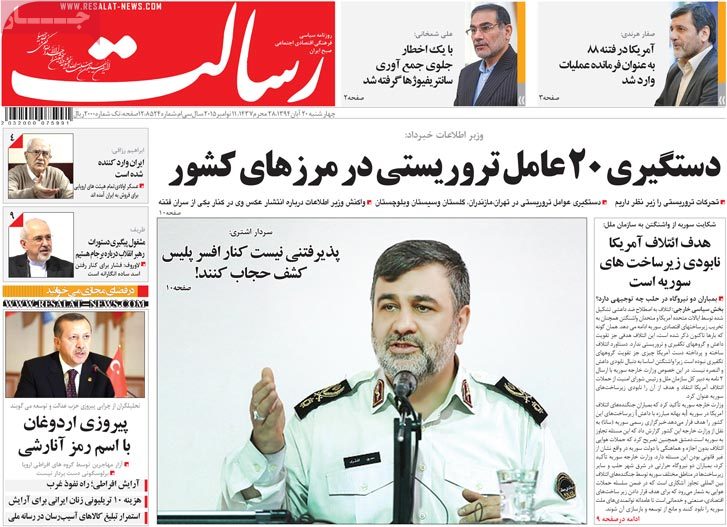
Resalat: The deputy foreign minister has said that Iran will ramp up its advisory role in Syria.


A look at Iranian newspaper front pages on Oct. 19


Saheb Ghalam: Iran is to invest in Afghan mines.


A look at Iranian newspaper front pages on Oct. 19


Top MP outlines parliamentary review of JCPOA

larijani

Speaker of the Islamic Consultative Assembly Ali Larijani says that parliament took into account different aspects of the nuclear case when it reviewed the bill on the Joint Comprehensive Plan of Action (JCPOA).

Larijani made the remark in a gathering on the Promotion of Virtue and Prevention of Vice in Tehran on Sunday and added that he had no personal interest in the nuclear case and did what he did based on the responsibilities he had undertaken.

The Islamic Republic News Agency (IRNA) on Sunday covered the speaker’s remarks which mainly focused on the passage in parliament of JCPOA and the critical comments on its approval. After his speech a woman approached the top MP and criticized what she called the ceremonial passage of JCPOA in the chamber. The following is the translation of part of his remarks in response to that woman’s criticism:

[Addressing the woman] I appreciate your critical comment. This amounts to promotion of virtue and prevention of vice. But why did you use the word “ceremonial”? In promoting virtue, a soft tone should be adopted.

Nuclear talks lasted almost three years. One year during the previous government’s tenure and two years in the current government’s; Iran pursued the talks and moved forward with eyes wide open. The Supreme National Security Council and other councils were involved in the [process of concluding the] Iran nuclear deal and provided parliament with explanations. Finally we reached the final stage and an agreement was concluded which came with certain frameworks.

Some said that JCPOA is to the detriment of the country and should be shelved. In case of rejection, what would have been the consequences? Others said that it is a good document and should be fully implemented, but there was a third view in between suggesting that the document should be controlled within the framework of certain conditions. The last view sounded more sensible.

We did not want to disapprove JCPOA, nor did we want to implement a US version of the deal. That’s why debates got more heated in the Supreme National Security Council with some wondering what should be done and others insisting that we should reject JCPOA. But we said that it could be implemented with some strings attached.

In the end, the Supreme Leader asked for the review of JCPOA in an open parliament session. We did not want to limit a parliamentary decision to a report released by one of its committees. To that end, we tried to pass a law so that parliament does not have to play an inactive role.

[…]

Parliament debated the JCPOA implementation bill after listening to the JCPOA Review Committee’s report. The chamber voted for the bill’s general outlines after a four-hour-long debate. That day some came and asked for the rejection of JCPOA and others came and said that the bill on JCPOA should be shelved in parliament. You may not believe your ears if I reveal the names of these people. They were saying that parliament does not need to decide on the bill, but we said that we need to make a law because the Supreme Leader has stressed that JCPOA should be reviewed in parliament. […]

In light of a threat that the Western side wants to implement the Joint Comprehensive Plan of Action in a different fashion, we passed the JCPOA implementation bill to prevent it from happening. According to one article of the bill, JCPOA should be brought to a halt if sanctions are not terminated or the other side fails to remove them on any grounds.

[…]

German FM Frank-Walter Steinmiere’s second day in Tehran (PHOTOS)

Frank-Walter Steinmiere's2

On Sunday, the second day of a state visit by Frank-Walter Steinmiere to Tehran, the German foreign minister met with Chairman of the Expediency Council Ayatollah Akbar Hashemi Rafsanjani.

After the meeting, the German top diplomat visited different parts of the Expediency Council building and was impressed by the delicate Khatam (inlaid designs set into the walls of the building).

He also delivered a speech at the University of Tehran on the role of education in sustainable development. In the speech, he praised the steadfastness of Iranian students and called for more grants and scholarships to Iranian students, especially those majoring in architecture, and cultural and scientific programs.

At the close of the ceremony he was given a present by the university officials in praise of his appearance in the oldest modern university in Iran.

The following images of the German FM’s day in Tehran have been released by Fararu.com and ana.ir:

Historical cemetery of Armenians in Tehran

cemetery00

The historical cemetery of Armenians in Tehran was registered on the list of national monuments in 2000. Its largest section, a plot 47,000 square meters in area, is dedicated to Christians of Armenian origin. Catholic, Orthodox, Assyrian and Chaldean Christians have the largest share of the remainder of the cemetery space.

All but half of the Catholic section of the cemetery belongs to the Poles and the rest is the ultimate resting place of Christians of French, Italian, British, German origin and other foreign nationals.

The graveyard dates back to the Zand era when a number of Armenian stonecutters took up residence in Tehran.

Interesting images and specially-designed stones, including a pilot’s gravestone which looks like a propeller or terraced graves of a young girl and boy which lead underground catch every visitor’s eye.

The following are photos of the historical cemetery different websites have released:

Iran welcomes German investment in industry sector

Nematzadeh

The minister of industries, mines and trade has said that Tehran supports long-term investment by German firms in different industrial sectors in Iran.

Mohammad Reza Nematzadeh made the comment in a meeting with visiting German Foreign Minister Frank-Walter Steinmeier on Sunday and added that to ride out the current trying times Iran needs to enter into partnership with German firms. The following is the translation of what else Nematzadeh said in the meeting:

Nematzadeh said that sanctions have downgraded trade and industrial ties between Iran and Germany, adding that after the termination of sanctions the stage will be set for Iran and Germany to have joint investment in the industry sector.

He further said that the German government largely helped solve questions surrounding the nuclear case, adding that Tehran hopes the results of the nuclear deal Iran and P5+1 inked can create better opportunities for the two sides.

Germany is one of Iran’s largest trade partners in Europe, he said, adding that German firms used to meet 50 percent of Iran’s industrial needs because Iranian companies attached great significance to the quality of industrial products, even if they carried a heavier price tag.

The Iranian minister went on to say that Iran is holding talks with a number of [foreign] companies so that it can start to carry out joint investment projects in the long run once the sanctions are lifted.

It is of great significance for Tehran and Berlin to have a joint market, Nematzadeh said, arguing that it can help educated Iranian youth exploit the experience of German firms and boost the synergy between Iran and Germany.

“Iran attaches great importance to development of trade and industrial ties with German companies. Iran’s trade and industrial ties have been reduced over the past few years, but I think we can make up for it [what we lost] in the new era,” said the minister.

Nematzadeh said that he had productive talks with his Afghan counterpart and added that Iran, Afghanistan and Germany can make profitable investment in different mining and industrial sectors.

Termination of sanctions has opened up big opportunities to work with different nations on technical and industrial fronts, he said, adding that Iran is interested in developing cooperation with small-, medium- and large-sized German firms in different areas.

Iran has entered into talks with German companies on economic issues, home appliances and medical devices, Nematzadeh said, hoping that talks with Volkswagen Group (VW) will bear fruit soon and the two sides can start to work together.

“Sanctions threw a big obstacle in the way of the two countries’ banking cooperation. Unjust sanctions prevented Iran from using the money it had in the German banks,” Nematzadeh said and added that he is sure all problems will soon become history after the Iran trip of the German foreign minister.

Flooding sweeps through northern provinces (PHOTOS)

Flooding0

Pouring rain on Saturday inundated streets in different cities across the Caspian provinces of Gilan and Mazandaran, disrupting the daily commute.

Fararu.com, a news website, has released online photos of flooded streets in northern Iran: