Tuesday, December 23, 2025
Home Blog Page 4709

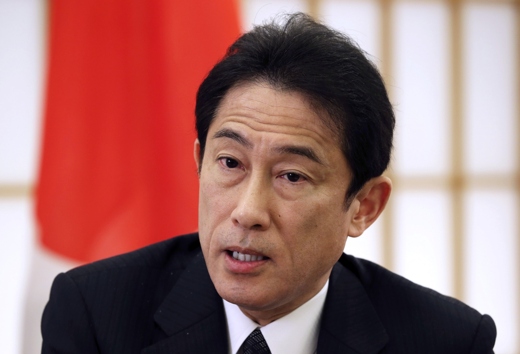
I’m coming to jumpstart Tokyo-Tehran relations: Japan FM

Fumio Kishida

In the wake of the Iran nuclear deal, a number of senior officials from powerful countries have arrived in Tehran to talk business. Japanese Foreign Minister Fumio Kishida is the latest such official to visit Iran. The Japanese media have said that Foreign Minister Kishida follows two priorities in his visit: planning for Iran-Japan economic ties in the post-sanctions era and reviewing the latest developments of the nuclear deal between Iran and world powers.

The Japanese media have also reported that Japan and Iran are on course to inking a bilateral investment treaty under which the Japanese companies will develop Iran’s oil fields and other commercial activities.

Iran Newspaper on October 12 published an interview with the Japanese top diplomat on the objectives of his Tehran visit. Minister Kishida said in the interview conducted prior to his arrival in Tehran that Tokyo has adopted a new approach toward trade exchanges with Iran which is a regional heavyweight. He also said that Japan no longer views Iran simply as an oil supplier; rather, Tokyo is seeking to develop ties with Iran on other fronts such as science, art and culture.

Since November 2013, this is Minister Kishida’s second trip to Iran. He said he is happy to visit Iran and is eagerly waiting for a meeting with his Iranian counterpart Mohammad Javad Zarif. The Japanese foreign policy chief also pointed to a friendly match between Japan and Iran scheduled for Tuesday (October 13) in Tehran’s Azadi Stadium and said the two countries are great soccer rivals, hoping the two countries can compete on different fronts and boost their progress and development.

The following is the translation of part of what the Japanese top diplomat said on different topics in the interview:

Nuclear deal, trust building, Iran’s international image

The international community, including Japan, welcomes with open arms the Iran nuclear deal which came on the back of efforts to tap diplomacy. Conclusion of the final nuclear deal through dialogue is a good example of an Iranian proverbial expression which says ‘When you can untie a knot with your fingers, why use the teeth?’ Issues can be settled on the world stage through dialogue.

Iran is a big country in the Middle East. The international community, including Japan, has high expectations of Iran as a responsible, big country. We expect Iran to help establish security and peace in the region and the entire world. Japan too is willing to have a share of efforts to establish security and peace in the region and the wider world.

FM Zarif and his performance  

I highly appreciate the efficiency of Dr. Zarif’s approach in nuclear talks and the endeavors of all members of the negotiating team who brought the nuclear issue which dragged on for more than ten years to an end. The Japanese are widely known for their perseverance and I [as a Japanese] praise the patience Mr. Zarif displayed during the long-running negotiations.

I think that conclusion of the deal and now its implementation are highly significant. The Iranian government proved steadfast in working out the nuclear deal, and I hope the Iran nuclear deal will be implemented consistently. Japan will cooperate [with Iran] in implementing the nuclear deal.

Post-nuclear deal Iran and foreign investment

Iran is a big country home to around 80 million people. Iran, which is rich in gas, oil and natural resources, has huge potential. Iran is particularly attractive not only for Japan but also for many companies in the world. It has enormous capabilities as far as economic exchanges with other countries and foreign investment are concerned.

I welcome remarks by Dr. Rouhani on absorption of foreign investment. [Following the Iran nuclear deal, President Rouhani announced that Iran is at the ready to have economic exchanges with other nations and attract foreign investment.] Japan voiced its readiness to cooperate with Iran and help it grow economically.

What matters here is that the Joint Comprehensive Plan of Action (JCPOA) is implemented consistently and – as a result – Iran and the international community can proceed with their trust-building measures. In that case, the Japanese companies will develop their activities in Iran, and Tokyo will support what the Japanese companies do in Iran.

To advance Japan-Iran talks on consultation services and investment, I would welcome any deal which supports the presence of Japanese firms in Iran. Japanese corporate figures will come with me to Iran in the hope of improving mutual economic relations.

To date, ties between Japan and Iran have been focused on energy which continues to be a key part in the two countries’ economic relations.

Nonetheless, I do not see Iran simply as a crude oil supplier. As two Asian countries, Japan and Iran have rich cultures and a long history. They can hold cooperation in a wide range of issues among them: the environment, medicine, culture, education, tourism, transportation, art, sports, etc. During my trip, I intend to bring up such cooperation in talks with Mr. Zarif.
A look at Iranian newspaper front pages on Oct. 12

Iranian Newspapers Headlines

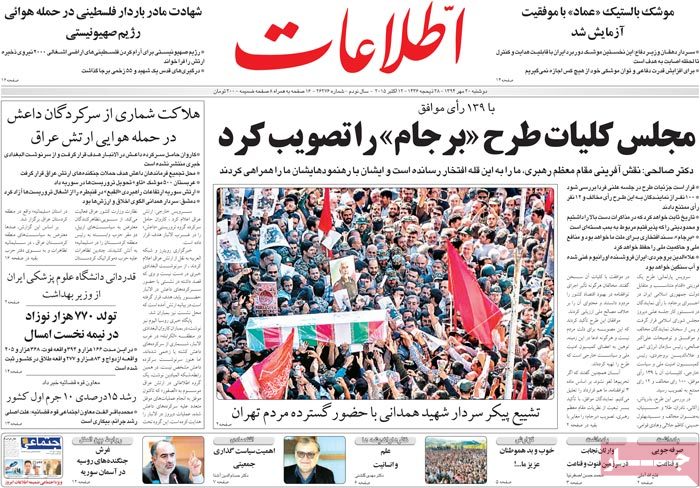
The approval in a noisy session of the Islamic Consultative Assembly of a bill on the implementation of the Joint Comprehensive Plan of Action dominated the front pages of Iranian newspapers on Monday.


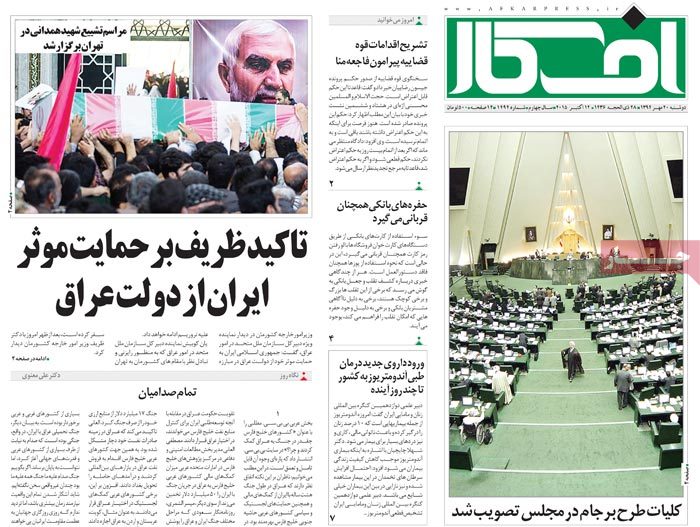
Ettela’at: Parliament has passed the general outlines of a bill on the implementation of the Joint Comprehensive Plan of Action.

The details of the bill are expected to be discussed in an open session of the Islamic Consultative Assembly on Tuesday.


Afkar: Foreign Minister Zarif has pledged Iran’s effective support for the Iraqi government.


A look at Iranian newspaper front pages on Oct. 12


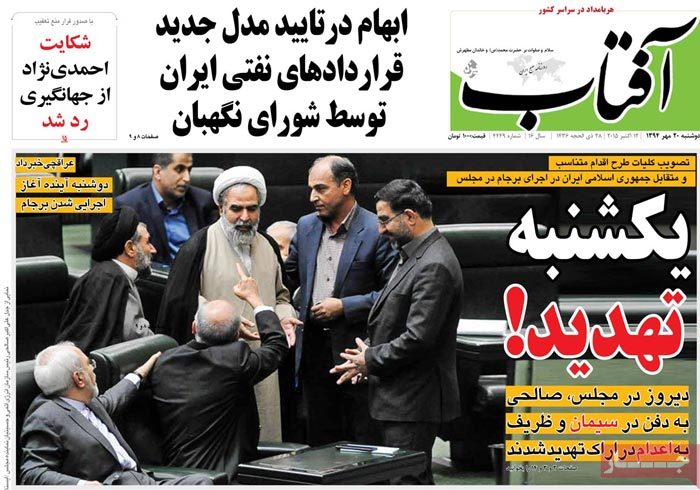
Aftab-e Yazd:Sunday of threats in parliament

An MP threatened to bury nuclear chief Ali Akbar Salehi under cement and lynch Foreign Minister Zarif in Arak.

Aftab-e Yazd:The deputy foreign minister has said that the Joint Comprehensive Plan of Action will be implemented as of next Monday.

Aftab-e Yazd: The judiciary has thrown out the complaint former President Mahmoud Ahmadinejad filed against First Vice-President Eshagh Jahangiri.


A look at Iranian newspaper front pages on Oct. 12


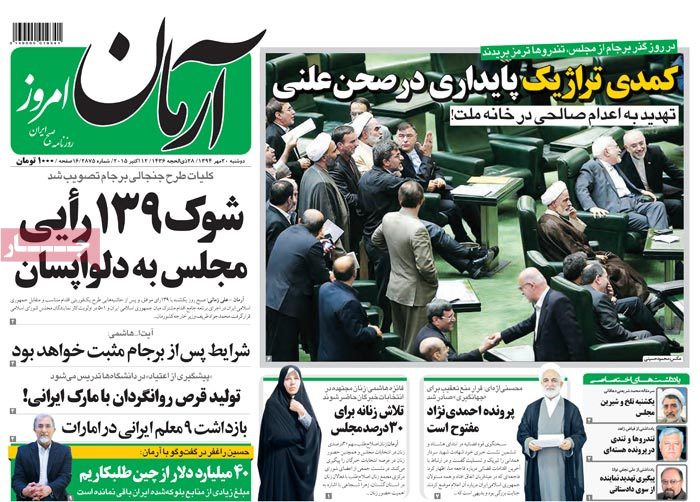
Arman-e Emrooz: The tragic comedy of the Stability Front on parliament floor

Director of the Atomic Energy Organization was threatened with lynching in parliament.

Arman-e Emrooz: The case involving former President Mahmoud Ahmadinejad remains open, said the deputy judiciary chief.

Arman-e Emrooz: “The post-JCPOA [Iran nuclear deal] conditions will be positive,” said the chairman of the Expediency Council.


A look at Iranian newspaper front pages on Oct. 12


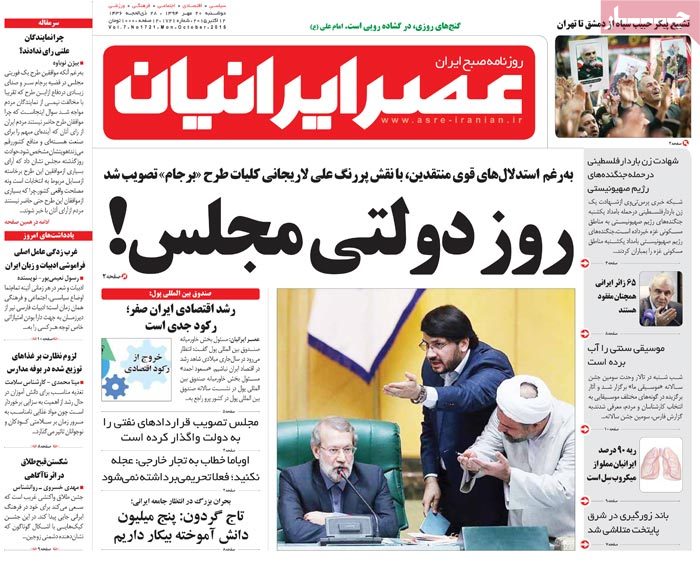
Asr-e Iranian: Despite well-founded reasoning by the opponents of the nuclear deal, Ali Larijani played a prominent role in helping parliament approve the Joint Comprehensive Plan of Action.


A look at Iranian newspaper front pages on Oct. 12


Ebtekar: “Europe should not view the influx of war refugees as a crisis,” said the chairman of the Expediency Council.

Ayatollah Hashemi Rafsanjani made the comment at a meeting with the marshal of the Polish Senate.


A look at Iranian newspaper front pages on Oct. 12


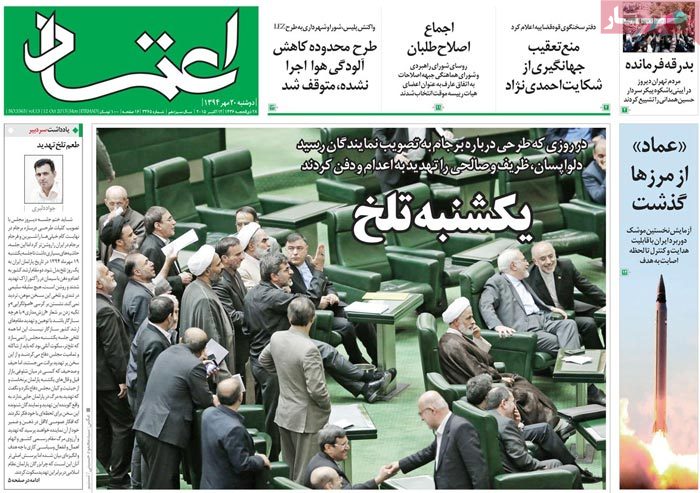
Etemad: The black Sunday

On the same day MPs voted for the Joint Comprehensive Plan of Action, the Worriers [opponents of the Rouhani administration] threatened FM Zarif and Salehi with lynching and burial beneath cement.


A look at Iranian newspaper front pages on Oct. 12


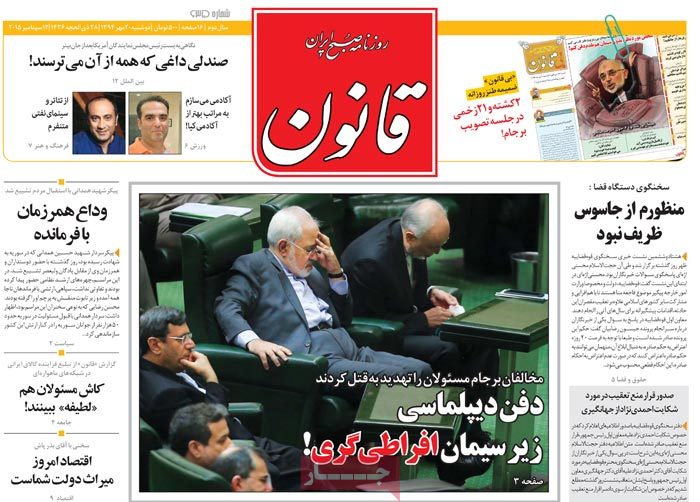
Ghanoon: The judiciary spokesman has said that his earlier remarks about spies were not targeted at Foreign Minister Zarif.


A look at Iranian newspaper front pages on Oct. 12


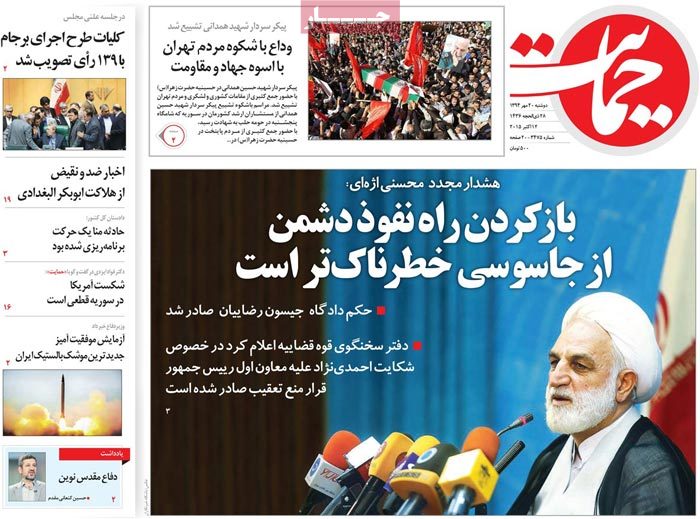
Hemayat: “Setting the stage for enemy infiltration is more dangerous than espionage,” the judiciary spokesman warned again.


A look at Iranian newspaper front pages on Oct. 12


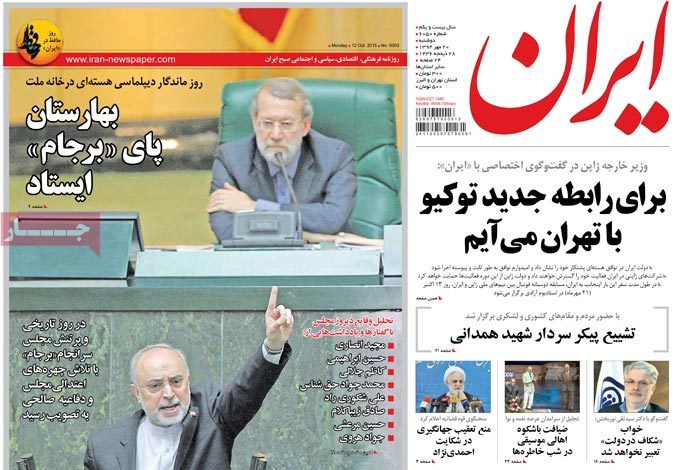
Iran: “I’m coming to Tehran to jumpstart Tokyo-Tehran relations,” said the Japanese foreign minister ahead of a state visit to Iran.

“The Iranian government proved steadfast in working out the nuclear deal,” Fumio Kishida said.


A look at Iranian newspaper front pages on Oct. 12


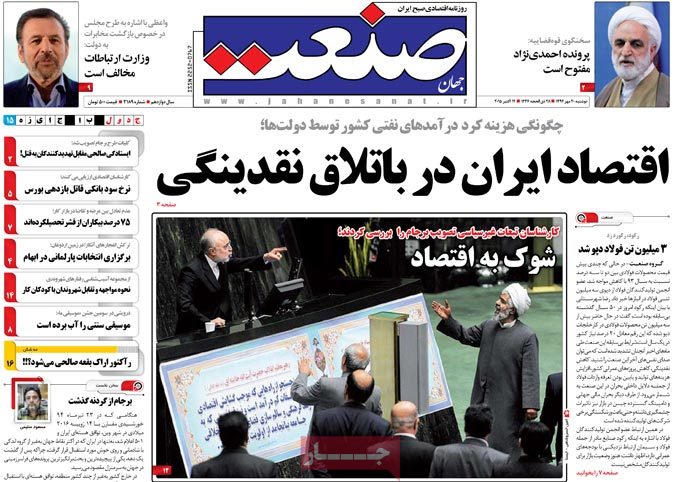
Jahan-e Sanat: The Iranian economy is bogged down in the quagmire of liquidity.


A look at Iranian newspaper front pages on Oct. 12


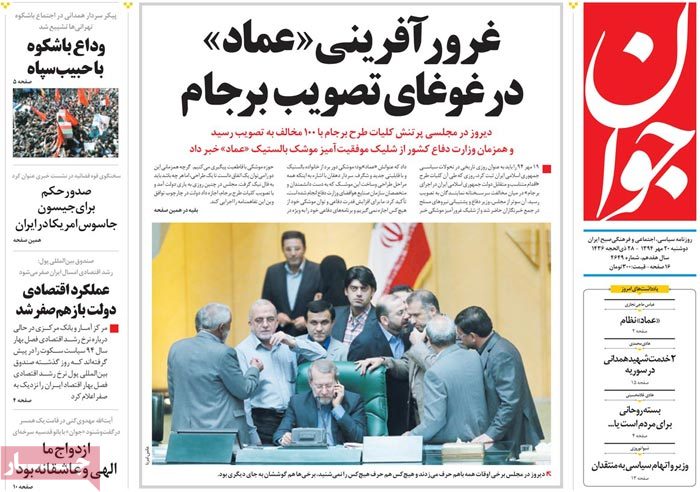
Javan: On a day when there was noise in parliament over the Joint Comprehensive Plan of Action, Emad [the long-range ballistic missile Iran successfully test-fired Sunday] roared gloriously in the sky.


A look at Iranian newspaper front pages on Oct. 12


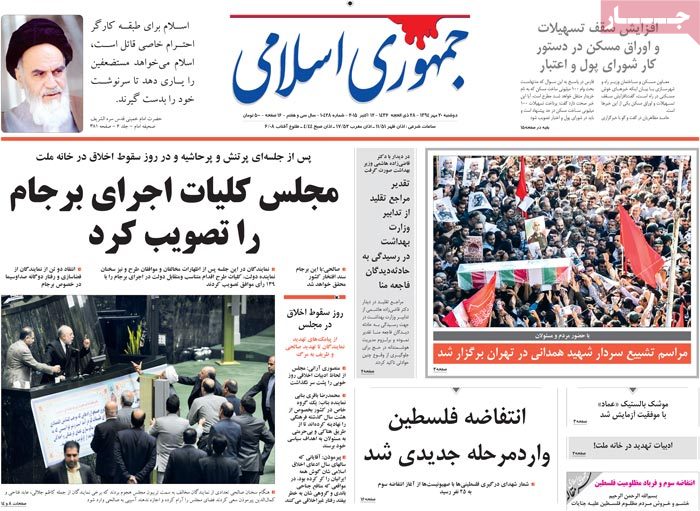
Jomhouri Islami: Parliament approved the outlines of a bill on the implementation of JCPOA on a day ethics tumbled in the chamber.


A look at Iranian newspaper front pages on Oct. 12


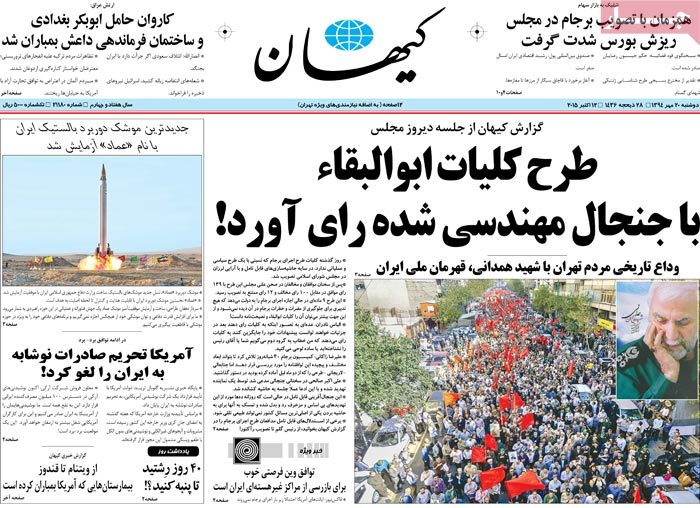
Kayhan: The downward trend of the stock exchange gathered momentum as parliament approved the Joint Comprehensive Plan of Action.


A look at Iranian newspaper front pages on Oct. 12


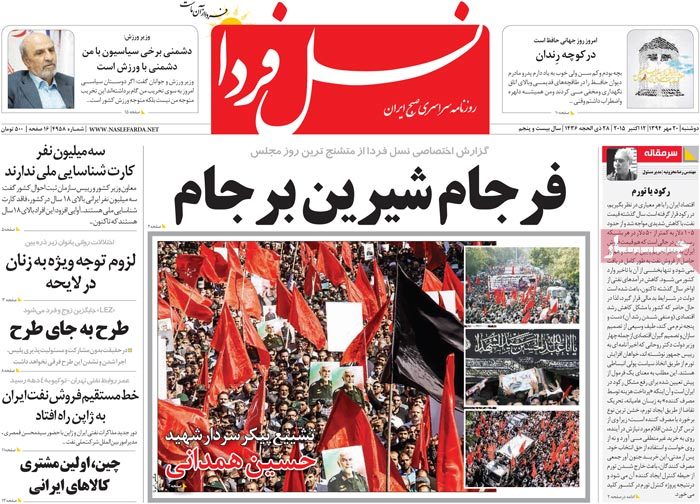
Nasl-e Farda: A direct line to sell Iranian oil to Japan has been launched.


A look at Iranian newspaper front pages on Oct. 12


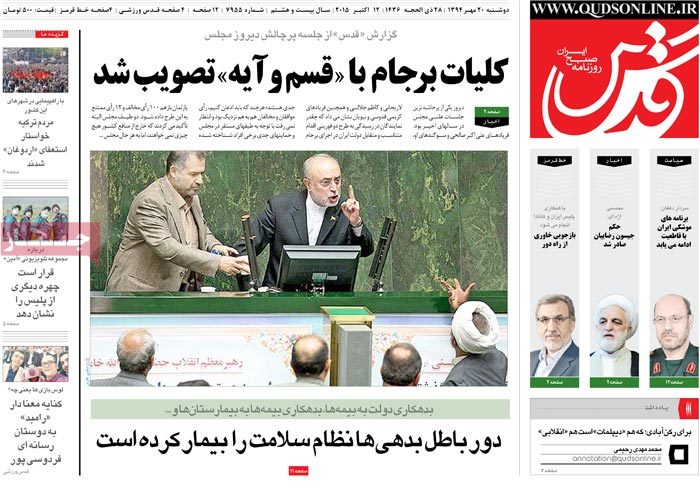
Qods: Mahmoud Khavari [a former managing director of Bank Melli who has fled to Canada] will be questioned from afar as a result of cooperation between Iranian and Canadian police.


A look at Iranian newspaper front pages on Oct. 12


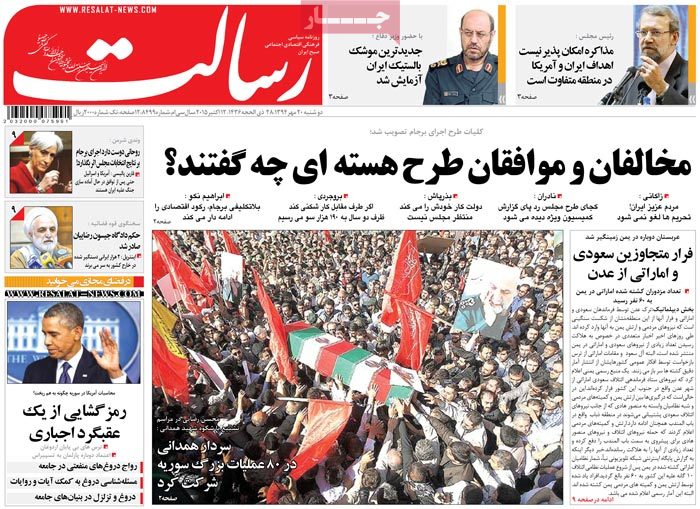
Resalat: “Talks are not possible, because Iran and the US pursue different goals in the region,” said Parliament Speaker Ali Larijani.


A look at Iranian newspaper front pages on Oct. 12


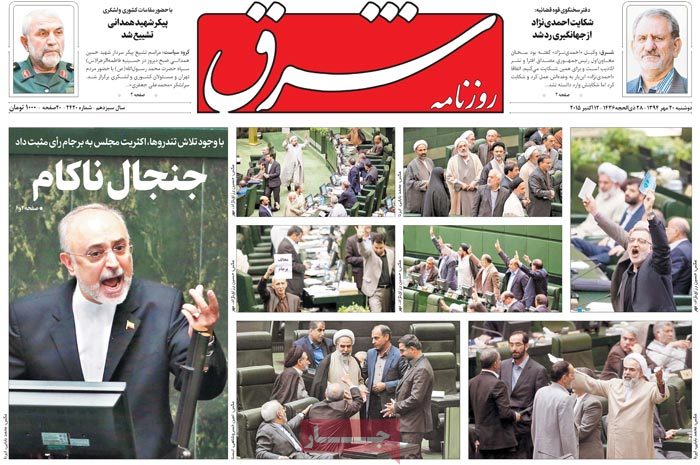
Sharq: Vain fuss-making

Despite efforts by hardliners, a majority of MPs voted for the Joint Comprehensive Plan of Action.


A look at Iranian newspaper front pages on Oct. 12


IRGC: Syria to achieve big victories in coming days

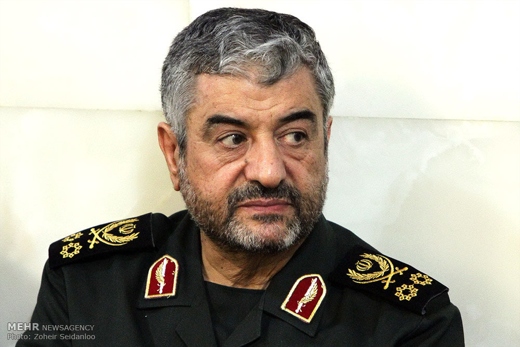
General Jafari

The commander of the Islamic Revolution Guards Corps (IRGC) has said that big victories are in the card for Syria in coming days, adding that martyr Hossein Hamedani lost his life for achieving such victories.

Major General Mohammad Ali Jafari, who was speaking in a ceremony to honor the memory of the fellow Revolution Guards general, further said that Syria is the supporter of the Islamic resistance against colonial powers and the Zionist regime, adding that the security of West Asia, including Iran, is tied to Syria and the axis of resistance.

The general went on to say that hegemonic powers are seeking to topple the Syrian government so that they can spread their influence in Islamic nations, adding that General Hamedani, who had sensed this threat, had an active presence in Syria to defend the resistance movement.

Legal action on Mina tragedy under consideration: Deputy FM

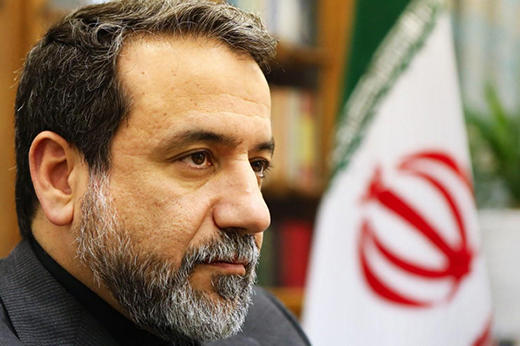
araghchi

Deputy Foreign Minister for Legal and International Affairs Abbas Araghchi said Iran is studying the tragic stampede in Saudi Arabia in which thousands of Hajj pilgrims, including hundreds of Iranians, were killed and wounded.

“The legal team of the Foreign Ministry as well as the Presidential Office’s Legal Department, representatives of the Hajj and Pilgrimage Organization and related bodies are carrying out an investigation,” he told a gathering on Sunday.

“Possible legal action is under review so that the best legal and diplomatic procedure will be taken in order to secure the rights of the victims and prevent the repeat of similar incidents,” Araghchi added.

He said there is still no news about the fate of Iran’s former ambassador to Lebanon Ghazanfar Roknabadi who was in Mecca and has gone missing since the fatal incident.

“We hope that during the investigation and with the identification of new bodies, his fate will also be cleared. But there is no news yet,” Araghchi said.

The nuclear negotiator also welcomed ratification of a bill by Parliament to implement the Joint Comprehensive Plan of Action struck by Iran and world powers in July.

The deputy foreign minister also briefed the meeting in detail on the next steps to be taken for implementation of nuclear deal by the parties involved.

Iran summons UAE charge d’affaires over detained teachers

Iran Officially Announces Termination of UN Arms Embargo

Iranian Foreign Ministry has summoned the United Arab Emirates’ charge d’affaires in Tehran over the detention of Iranian teachers in the Persian Gulf country.

The charge d’affaires, called upon in the absence of the UAE’s ambassador to Iran on Sunday, was asked to swiftly secure the release of a group of Iranian Ministry of Education teachers who were detained despite their years of lawful service in an Iranian school there.

The UAE diplomat stressed that he would promptly bring up the subject of their release with his country’s relative authorities.

Emirati officials have announced the teachers’ work permits were issued for employment in Dubai and as of yet permits for employment in Abu Dhabi have not been issued.

Iran slams spike in Israeli violence towards Palestinians

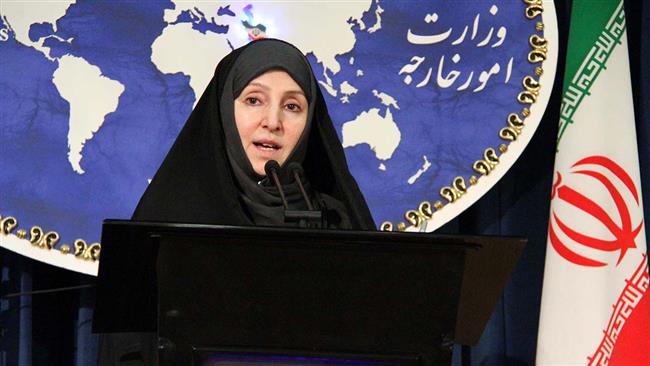
Afkham

Iran has condemned a recent escalation of Israeli attacks which have resulted in the deaths of several Palestinian youths in the Gaza Strip and the occupied West Bank.

“The recent measures are being carried out in addition to daily pressure and threats against the Palestinians, such as power cuts, economic blockade by land and sea along with the Zionist military attacks on people and raids and destruction of Palestinian homes,” Foreign Ministry Spokeswoman Marzieh Afkham said Sunday.           

She also called on Muslim countries and governments to react swiftly and seriously towards Israel’s atrocities, especially its policies based on Judaization of al-Quds (Jerusalem) and Islamic sites in the city including the al-Aqsa Mosque.

“The Zionist regime, by no means, has the right to occupy and divide the al-Aqsa Mosque,” she noted.

Tensions have been running high between Palestinian protesters and Israeli troops since August 26, when the Tel Aviv regime imposed sweeping restrictions on visits to the compound of the al-Aqsa Mosque.

Earlier, Israeli forces gunned down a 13-year-old boy during clashes south of the city of al-Bireh as clashes continued between Palestinian demonstrators and Israeli troops in West Bank.

At least 20 Palestinian students were also injured, eight by live ammunition, near the Khaddoury College in the West Bank city of Tulkarem.

A pregnant Palestinian woman and her child were also killed as Israeli warplanes carried out multiple strikes on the Gaza Strip.

Iran supports Iraq solidarity, sovereignty: Senior MP

Broujerdi-UN

Head of parliament’s National Security and Foreign Policy Committee has said that Iran is committed to assisting Iraq, supports the territorial integrity of its western neighbor, and opposes its disintegration.

Alaeddin Borujerdi made the comments in a meeting Sunday with the visiting UN Secretary General’s Special Envoy for Iraq Yan Kubish during which the Iranian lawmaker called for solidarity of all political, ethnic, and religious groups to restore tranquility and security to Iraq.

Borujerdi criticized the lack of determination on the side of the US and its European and regional allies to fight terrorism and extremism and said, “Classifying terrorists as good and bad, tactical exploitation of terrorists and giving them financial and armed assistance are the strategic mistakes of the US in Syria and the main reason behind the current situation.”

Kubish hailed Iran’s contribution to the reconstruction of Iraq and establishment of peace and security in the Arab country.

“Political and economic reforms are underway in Iraq and Iran’s continued support for Iraq, especially in the field of economy and transfer of political experience is of considerable significance,” he added.

Stressing the positive role of Iran in Iraq, the UN envoy said, “Iran’s continued support for Iraq has an influential role in the establishment of tranquility and security in Iraq.”

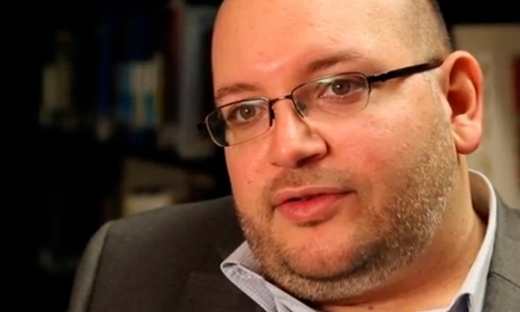
Iranian court issues verdict for Washington Post reporter Rezaian

Jason Rezaian

Iranian Judiciary Spokesman Gholamhossein Mohseni Ejei announced that a court in Tehran has handed down a verdict in the case of Washington Post reporter Jason Rezaian, who has been charged with espionage in the Islamic Republic.

“The verdict on the case has been issued,” Mohseni Ejei told reporters at a press conference in Tehran on Sunday.

He emphasized that the defendants have 20 days to appeal the ruling in a higher court, adding that if they do not do so, the ruling, of which he gave no details, will be final.

Rezaian, a 39-year-old correspondent with dual Iran-US citizenships, along with his wife Yeganeh Salehi, was arrested in Tehran on July 22, 2014 on espionage charges.

Two other American citizens who work as freelance photojournalists were also detained along with them at the time. Yeganeh Salehi was released on bail in October 2014.

An indictment later issued by Tehran’s prosecutor general said Rezaian is charged with “espionage by collecting the country’s decisions on internal and foreign policy issue, and cooperation with hostile governments.”

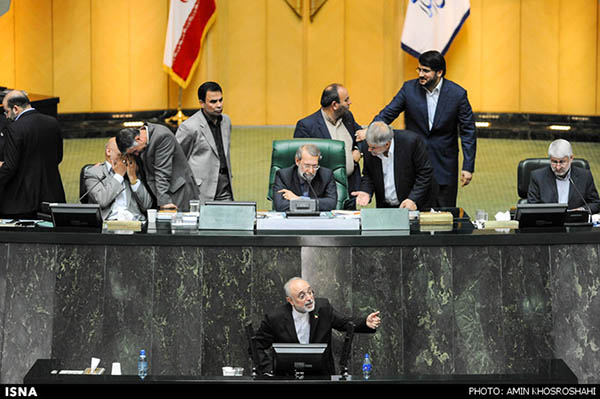
JCPOA clears hurdle at a boisterous parliament

Parliament2

The Iranian parliament on Sunday passed the general outlines of the Government’s Reciprocal and Proportional Action Bill on the implementation of the Joint Comprehensive Plan of Action 139-100 on Sunday.

The parliamentary session got off to a normal start with Foreign Minister Mohammad Javad Zarif and his deputies Abbas Araghchi and Majid Takht-e Ravanchi present there to defend JCPOA.

Minutes later, the session turned tense after MP Javad Karimi Ghodoosi started to shout at FM Zarif and blast JCPOA. Speaker Ali Larijani stepped in to bring calm to the session, asking Ghodoosi to stop shouting.

Afterward Hamid Rasaei, a [hardline principlist] MP, called for a bill on JCPOA to be submitted to parliament.

Entekhab.ir published a report on what happened in parliament on Sunday and what the proponents and opponents of the bill said in the chamber. The following is a brief translation of that report which included comments by pro- and anti-bill MPs:

Ruhollah Hosseinian, principlist Tehran MP

[…] Why should parliament get engaged in [discussing] a bill which is basically against the Constitution? Why do they want to make parliament deal with a done deal?  […]

Why does parliament want to pass a bill blindfolded with its hands tied? I think something is happening behind the scenes to make parliament get engaged in [discussing] a done deal. […]

Abbas Ghaedrahmat, Doroud and Azna MP

The bill comes with a number of necessities, among them: protection of the Iranian nation’s nuclear rights and achievements; observing religious and legal aspects defined by the Supreme Leader on talks with P5+1; and preventing infiltration and unilateral measures of the other side.

This bill allows the government to voluntarily implement JCPOA if it can abide by what has been envisioned in nine articles and two notes for the implementation process, including the Supreme Leader’s fatwa on the atomic weapons, WMDs and nuclear disarmament, and the need for Iran to clarify its stances.

Through this bill, the Iranian parliament will shed light on its stances: we need to remove all nuclear weapons in the world.

The rights of the Iranian nation should be respected and any pressure and threat [by the other side] will trigger a rethink of cooperation [with P5+1]. The government should carefully monitor failure by the other side to terminate sanctions or its imposition of [new] sanctions. If so, the Cabinet is expected to act in kind to reclaim the rights of the Iranian nation. Voluntary cooperation should be brought to a halt in case of the other side’s lack of cooperation.

The nuclear negotiating team managed to win some concessions in the talks. I call on fellow MPs to vote for the bill so that the fate of JCPOA can be fixed soon.

Alireza Zakani, Tehran MP    

He slammed Speaker Larijani and said, “You are defending JCPOA single-handedly. You said you gave the bill to the Supreme Leader but he did not speak his mind.”

In reaction, Larijani said, “I said I talked with him on JCPOA and that the Supreme Leader had no intention to get involved.”

Zakani also hit out at irrelevant disagreements and said, “The Joint Comprehensive Plan of Action is a national issue, but some make comments as if I reap profits out of it.”

Kazem Jalali, Shahrood MP

Kazem Jalali lashed out at opponents of the deal who keep quoting foreign officials as saying this and that. “To cite enemy officials simply to attack our own officials is not right. Wendy Sherman and Obama are no friends of ours. They will definitely use their comments to create tension in the country if they can.”

He further said that during the previous government Iran agreed to ship out its entire cache of fuel to import reactor fuel and the Ahmadinejad government agreed to the proposal. “The only one who objected was Mr. Larijani… Back then most principlist MPs kept silent. Why are you objecting now?”

In a jab at the chairman of the JCPOA Review Committee, Jalali said, “How is that the speaker who has been in direct contact with the Leader’s office for years and followed up the case does not understand the stance of the Leader? But some who are in contact [with the Leader’s office] through intermediaries do?”

He said the current director of the Atomic Energy Organization served as the foreign minister of Ahmadinejad. “If he wanted to act in line with personal priorities, he would have definitely acted differently. Individuals like Salehi are pious, sympathetic. They act above factional interests. Shouldn’t we fully trust their words?”

He said, “Critics wonder ‘What if the sanctions are not lifted?’ We have a bill that suggests in case sanctions are not terminated, we won’t implement JCPOA.”

In conclusion, he said parliament does not approve of the deal, it simply allows the government to implement it with certain strings attached.

Ali Akbar Salehi, Nuclear chief

Director of the Atomic Energy Organization of Iran (AEOI) Ali Akbar Salehi, who was in parliament to defend the nuclear deal, told the chamber, “We have not negotiated in the vacuum. We based our talks on principles.”

He went to say, “I have not determined the framework of the talks. If we talked, we did so within a certain framework.”

Salehi, who was at the receiving end of a shouting match, further said, “I have kept silent so far. A few days ago, They wished me death. The other day, a man appeared on TV and said, ‘The average life expectancy among Iranians is 77 years. Salehi will die in 10 years.’ What kind of language is this? Are you playing God?”

He went on to say, “Someone swore to God in parliament to bury me with cement. Is this how they should talk? Is this the way you talk to people who seek to serve?”

After the boisterous session of the chamber, Kamaleddin Pirmoazen, an MP, said, “Thank God, today hardliners failed in their efforts to leave a bad taste in the mouth of the nation. God willing, the approval of the details of JCPOA and its implementation will increase our national wealth and help realize a national epic.”

He went on to say, “Today, parliament proved that it puts national interests ahead of factional interests.”

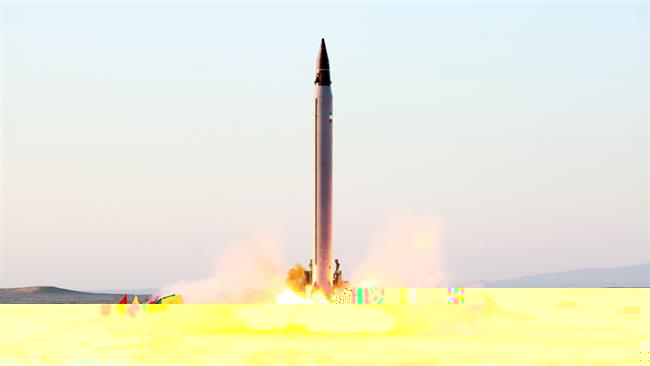
Iran successfully puts to test new long-range ballistic missile

c5ffb74f-5f8e-40b8-9b37-02270a3996cf

Iran’s Defense Minister Brigadier General Hossein Dehghan says the Islamic Republic has successfully test-fired a new long-range ballistic missile, dubbed Emad.

Speaking to reporters on Sunday, Dehghan said the surface-to-surface missile has been completely designed and manufactured by experts of Iran’s Aerospace Industries Organization affiliated with the Iranian Ministry of Defense.

Emad is Iran’s first long-range missile with guidance and control systems which can hit targets and completely destroy them with high precision, the Iranian minister added.

He also stated that the Defense Ministry pursues a strategy based on developing and increasing the missile capabilities of the Iranian Armed Forces and enhancing the Islamic Republic’s deterrent power.

“We do not ask for permission from anybody to increase our defense might and missile capability and are decisively following up our defense plans, particularly in the missile sector,” Dehghan said, emphasizing that the manufacturing of Emad is an apparent example of such a strategy.

The Iranian defense minister said Emad would be mass produced and delivered to missile units of the Iranian Armed Forces soon to significantly enhance their tactical and operational power.

The Islamic Republic has repeatedly said that its military might poses no threat to other countries, reiterating that its defense doctrine is merely based on deterrence.