Wednesday, December 24, 2025
Home Blog Page 4697

A woman shines in a male-dominated job

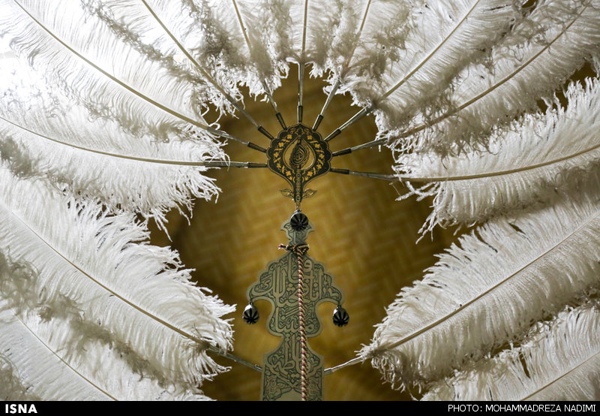
Alam

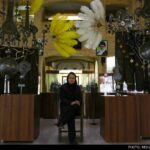
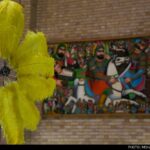
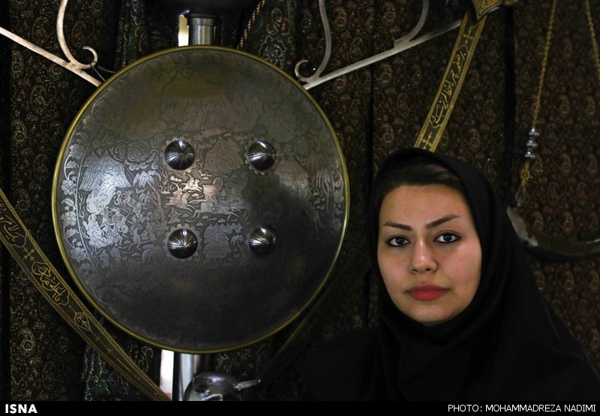
Fatemeh Eidiyoun is a 29-year-old Iranian woman who has followed in the footsteps of her father to make designs and engravings on alams (heavy metal installations covered with intricate figurines and engravings used in public Shiite mourning ceremonies).

In other words, she implements calligraphy and creates different images, including scenes of the epic battle of Karbala as well as flowers and birds on metal frameworks.

The Iranian Students’ News Agency has held an interview with her to find out why she has chosen a job which is typically male-dominated. The following is the translation of part of the report the news agency released:
Alam
Fatemeh Eidiyoun

As for how she does her job, Eidiyoun said, “After a metal framework is made, I engrave the designs on it before blanketing them with a combination of ink, lac and alcohol. After the ink goes dry, I immerse the framework in a mix of water and acid. Acid cannot penetrate the parts which are covered by lac and alcohol, but it does dissolve unprotected parts. As a result, the designs appear in relief when the frame goes dry.”

She said that the art is not well known, because it has not been registered yet, adding, “I can put it under the heading of metal arts, but I need to collect documents from old artists about the history of this art. I have put together some, including old photos from religious centers and museums.”

Eidiyoun said that she did not know the oldest artist who started this type of engraving, but it can be traced back to an artist based in the city of Isfahan who was involved in this profession about 80 years ago.

The artist added, “My father did the same job for about three decades before he passed away seven years ago. I was brought up a father heavily involved in this profession, that’s why I developed an interest in this.”

She went on to say that because it is a male-dominated job, her husband takes all the orders and delivers the final works.

The female artisan further said, “When my works are sent to experts for evaluation, they find it difficult to believe that such works have been created by a woman. No woman has done this job so far and because I inherited the art from my father, I am the only woman who does this.”

Eidiyoun has a Grade Three art certificate [presented by the Ministry of Culture and Islamic Guidance to artists] and can easily secure a Grade One certificate if she can have the art registered. She seeks to apply for the registration of the art to the Cultural Heritage, Handicrafts and Tourism Organization.


Environment-friendly distribution of votive food in northern Iran (PHOTOS)

food in northern Iran 0

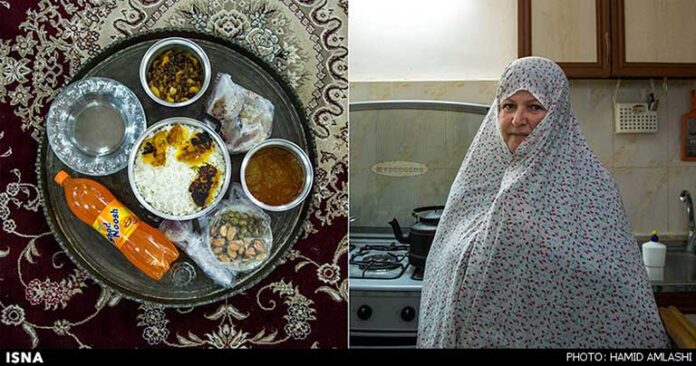
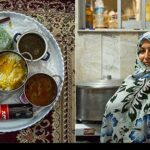
In a village near the northern town of Astaneh-ye Ashrafiyeh, Gilan Province, people avoid using disposable dishes in giving out votive food.

Presentation of votive food on trays during mourning ceremonies is an old-age tradition in the village.

The following images released by the Iranian Students’ News Agency show the meals handed out to mourners in the village:


A nice grandma and the story of her dolls

Grandma-Dolls

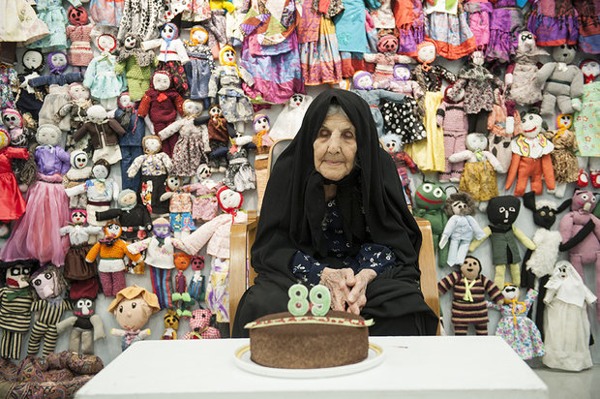
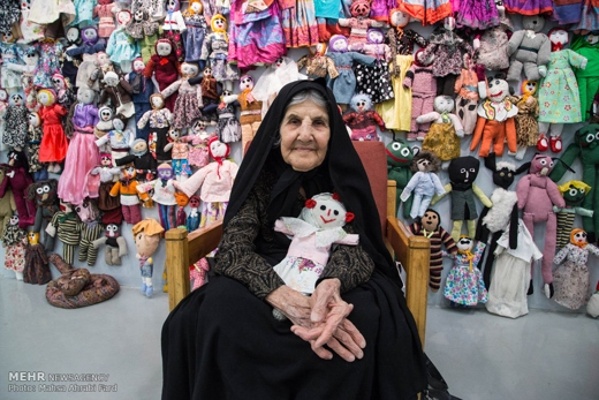
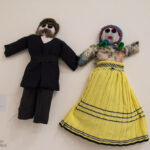
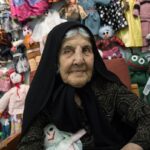
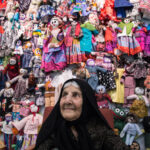
Bibi Hazer, a 90-year-old grandma who lives in Shiraz, has made many dolls, with her memory brimful of untold stories which date back to the years of yore.

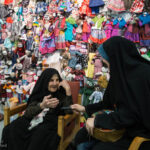
The wall behind her is spotted with dolls she has created in her loneliness to feel the void. The visitors take a walk around, look at Bibi and ask if she has made those dolls all by herself. In a nice Shirazi accent, Bibi says she’s done all that by herself. The visitors pose for a photo with Bibi before they leave.

Bibi Hazer and her dolls, that have been the guest of a gallery at the Iranian Artists Forum for a few days, impressed many people who were there to catch a glimpse of items of artistic value.

Earlier in October, Mehr News Agency published a report on the artistic works of the nonagenarian and a friendly chat with Bibi, who was accompanied by his grandson Bahman Abbaspour. The following is the translation of part of the report, including Bibi’s words:


Grandma-Dolls


Where did it begin?

“[…] It is now almost 20 years since I first began making dolls. I learned it from my mom, grandma and great grandma. I began to make dolls when my husband died. I had nothing else to do, so I took up doll making. Gradually I got used to it and now I do it on a daily basis. […]”

What is the story of the dolls?

Bibi’s dolls have names and stories. Her grandson says, “Grandma used to tell stories when we were kids and we have good memories of them. When she saw the dolls carried around by children in the family some 20 years ago, she started to make copies of those dolls. Everybody liked her dolls. She started to make the dolls of people who lived in the past.” […]


I like to make dolls all by myself

Bibi likes her dolls very much. When asked about the one whom she likes the most, she says she likes all of them because she’s put in a lot of efforts for each. […] Some dolls have woven clothes on. She says she has done it all by herself, adding that she makes two dolls every day. Her daughter-in-law and grandchild buy her the fabric and she takes care of the rest.

I’ll make dolls for children as long as I’m alive

A while ago, her grandson says, Bibi could not believe that anyone might like her dolls, wondering why no one would buy them. The family put the dolls on sale and people welcomed it. The family decided to halt the sale because the dolls were selling out.

There are reasons behind the decision not to sell. Bibi urges her family to keep selling, vowing she would keep making dolls as long as she is alive. But her grandson says that certain institutes have proposed to keep the dolls as part of a collection to protect them forever and let people watch them, arguing that when the dolls are sold, nobody knows what will become of them. […]

I like my dolls and wish to make more

With wrinkled hands, Bibi takes out a weaving hook and a woolen ball out of her bag and start weaving. “I don’t want to sit idly by when I am alone. I want to make dolls for as long as I can. I cannot do the house chores, but I make dolls for the love of it. […]

Bibi has made dolls of TV characters

Bibi is a regular TV viewer. You can see the traces of TV programs in her dolls. She has made two dolls of Bob Ross, the famous painter and host of Joy of Painting, a TV show. […]

Her grandson says Bibi constantly watches TV and when Catherine Ashton was replaced by Federica Mogherini during nuclear talks between Iran and P5+1, Bibi said that the lady is not Ashton and she has been replaced.

Bib’s stories, a source of inspiration   

[…] Her grandson says that he has memories of the stories Bibi told when he was a child. Bibi has four sons and one daughter. Her grandson, Bahman Abbaspour, has a degree in acting and is now a stage actor. He has helped the family hold an exhibition of Bibi’s dolls.

[…]


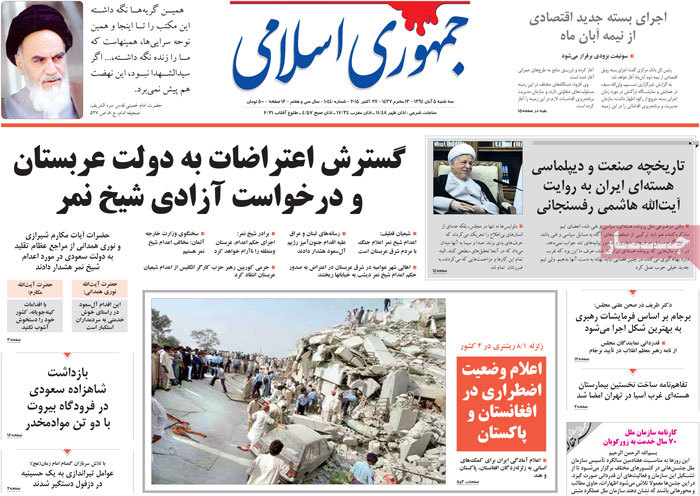
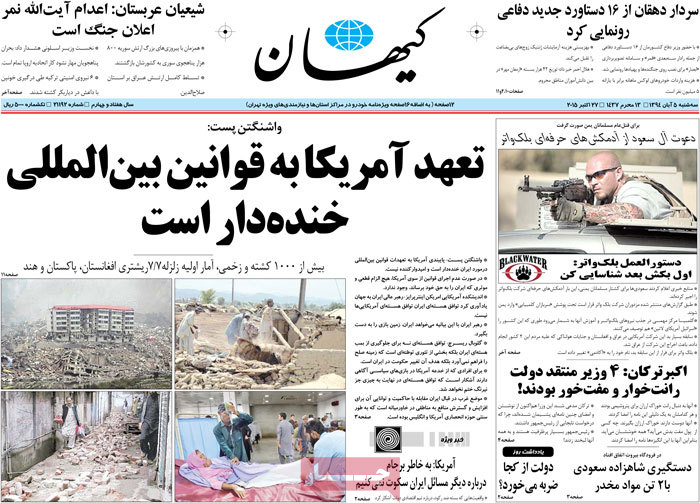
A look at Iranian newspaper front pages on Oct. 27

Iranian Newspapers Headlines

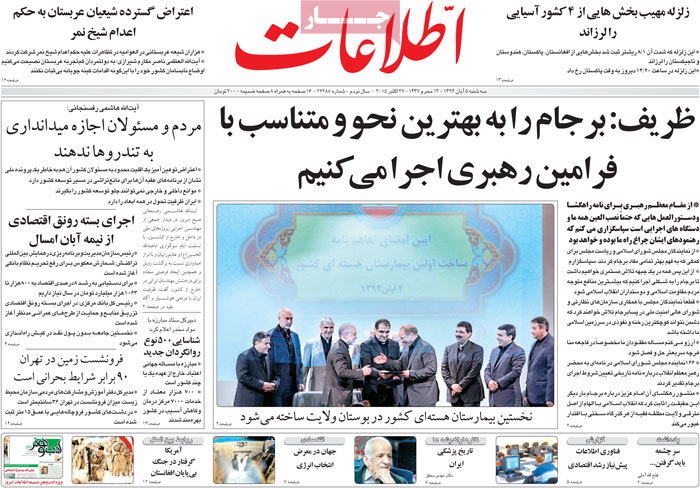
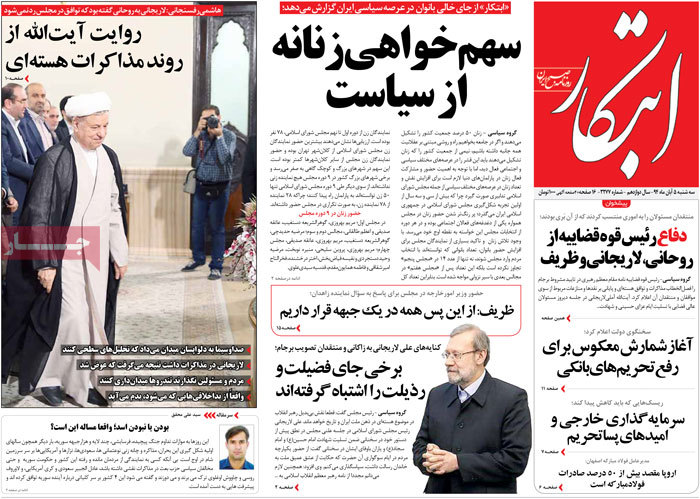
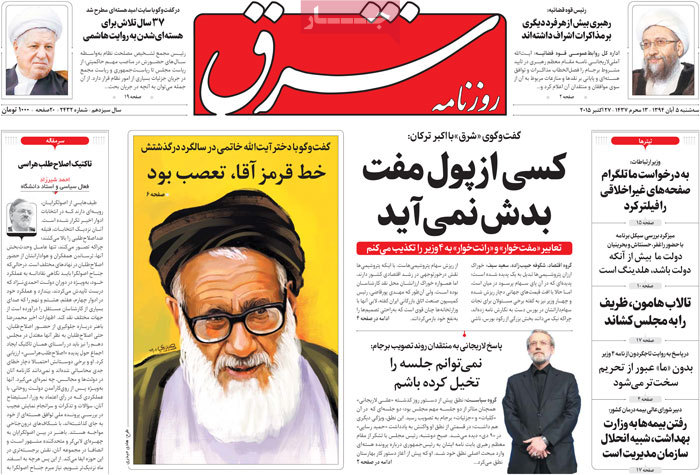
The comments of the judiciary chief in support of the nuclear negotiating team and the finality of the Joint Comprehensive Plan of Action were on the front pages of several Iranian newspapers Tuesday. On the front pages of reformist-leaning dailies were the untold stories of Iran’s nuclear program narrated by Ayatollah Akbar Hashemi Rafsanjani.


Ettela’at: “We will implement the Joint Comprehensive Plan of Action in the best way possible, in keeping with the instructions of the Leader,” Foreign Minister Zarif told the Islamic Consultative Assembly.

The top diplomat also thanked the Supreme Leader for his instructions and said they have been and will remain the guiding principle for the administration.

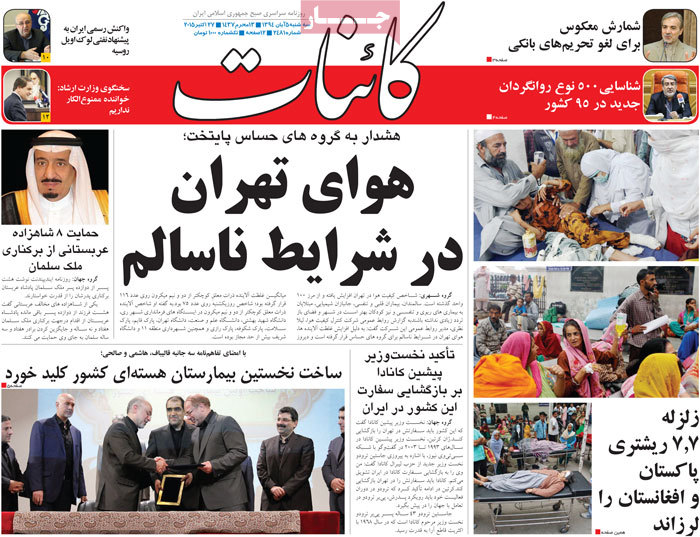
Ettela’at: A powerful earthquake has shaken four Asian countries.

Afghanistan, Pakistan, India and Tajikistan were affected by the quake.

Ettela’at: Saudi Shiites have widely protested an order to execute prominent Shiite cleric Ayatollah Nimr al-Nimr.

Iran’s Grand Ayatollah Nasser Makarem Shirazi has advised “the inexperienced Saudi statesmen” not to further destabilize – through vengeful measures – their country which is “already in disarray”.

Ettela’at: Chairman of the Expediency Council Ayatollah Akbar Hashemi Rafsanjani has urged members of the public and officials not to allow hardliners to lead the way.

Ettela’at: The economic boom package will be implemented in November.

The director of the Management and Planning Organization has said that the countdown is on for the termination of banking sanctions.

Ettela’at: The secretary-general of the Anti-Drugs Commission has said that 500 psychedelic drugs have been identified.

He said the global battle against narcotics cannot be fought by only a few countries.

Ettela’at: Ground subsidence in Tehran is 90 times worse than what is normally labeled as critical.

Ettela’at: The country’s first nuclear hospital will be built at Tehran’s Velayat Park.


A look at Iranian newspaper front pages on Oct. 27


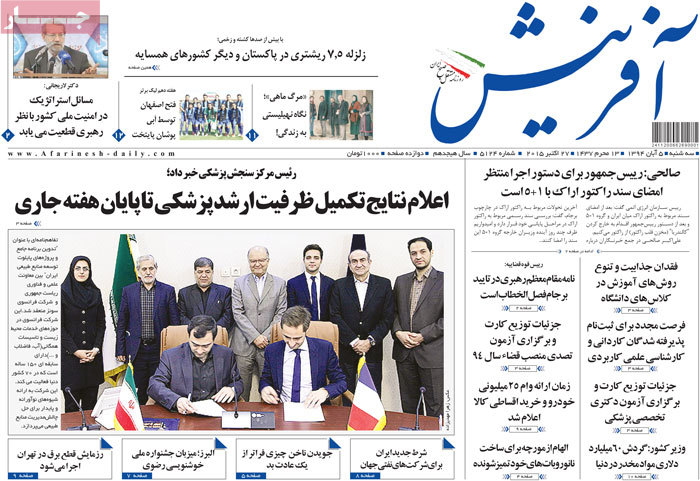
Afarinesh: “The president is waiting for the conclusion of a deal with P5+1 over Arak Reactor before issuing an implementation order,” said Director of the Atomic Energy Organization of Iran Ali Akbar Salehi.


A look at Iranian newspaper front pages on Oct. 27


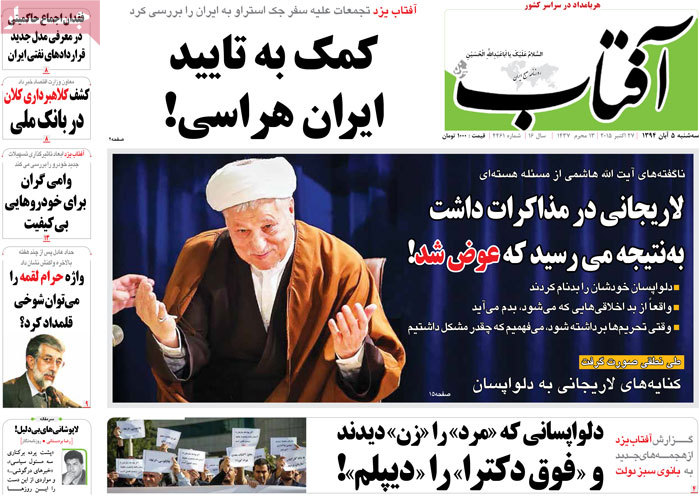
Aftab-e Yazd: Some at home are contributing to Iranophobia!

The daily has taken a close look at protests against the Iran visit of former British Foreign Secretary Jack Straw.

Aftab-e Yazd: “[Former chief nuclear negotiator Ali] Larijani was on the verge of reaching a deal in talks when he was replaced [by former President Mahmoud Ahmadinejad],” said Chairman of the Expediency Council Ayatollah Akbar Hashemi Rafsanjani.


A look at Iranian newspaper front pages on Oct. 27


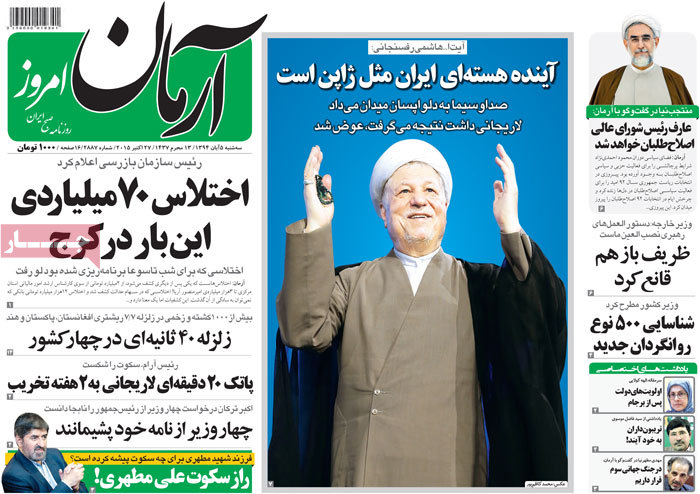
Arman-e Emrooz: The director of the State Inspectorate has revealed a $23 million embezzlement in Karaj.

Arman-e Emrooz: The four ministers who wrote a letter to the president to warn about the country’s economy regret their decision to do so, said Akbar Torkan, an advisor to the president.

Torkan also described the demands raised in the letter as inappropriate.


A look at Iranian newspaper front pages on Oct. 27


Ebtekar: The judiciary chief has defended the president, the parliament speaker and the foreign minister.

Some critics go too far in making allegations against senior state officials, said Ayatollah Sadegh Amoli Larijani.


A look at Iranian newspaper front pages on Oct. 27


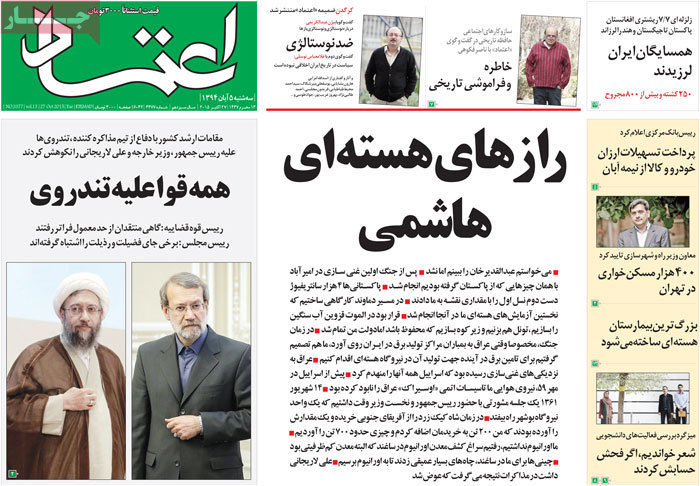
Etemad: All branches of government are making a stand against extremism.

Senior state officials have thrown their weight behind the nuclear negotiating team, criticizing hardline stances against the president, foreign minister and parliament speaker.

Etemad: Hashemi’s nuclear secrets:

I wanted to meet with Pakistan’s Abdul Qadeer Khan, but it never happened; the first post-war enrichment happened at Amirabad with the equipment we had purchased from Pakistan.


A look at Iranian newspaper front pages on Oct. 27


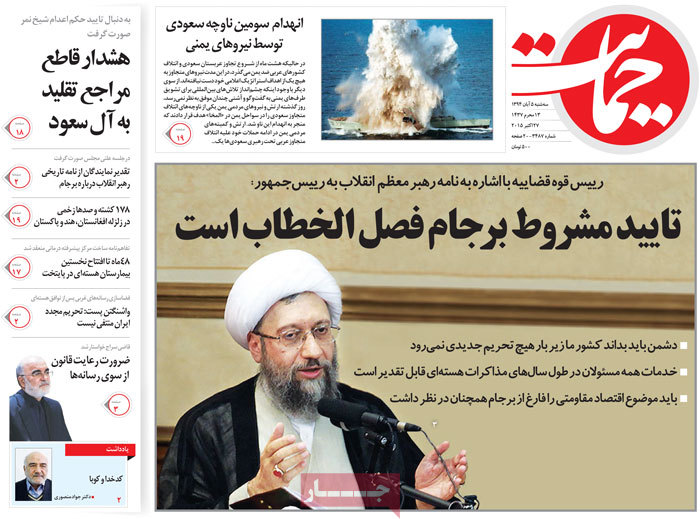
Hemayat: The judiciary chief has said that the tentative approval of the Joint Comprehensive Plan of Action is final.


A look at Iranian newspaper front pages on Oct. 27


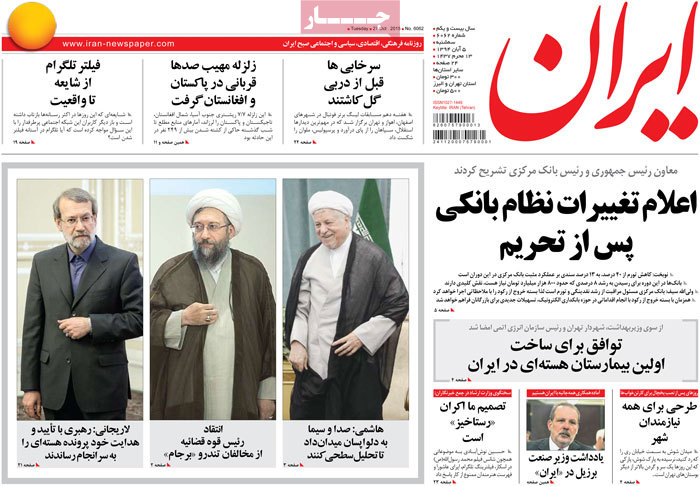
Iran: After the termination of sanctions, the banking system will undergo change.


A look at Iranian newspaper front pages on Oct. 27


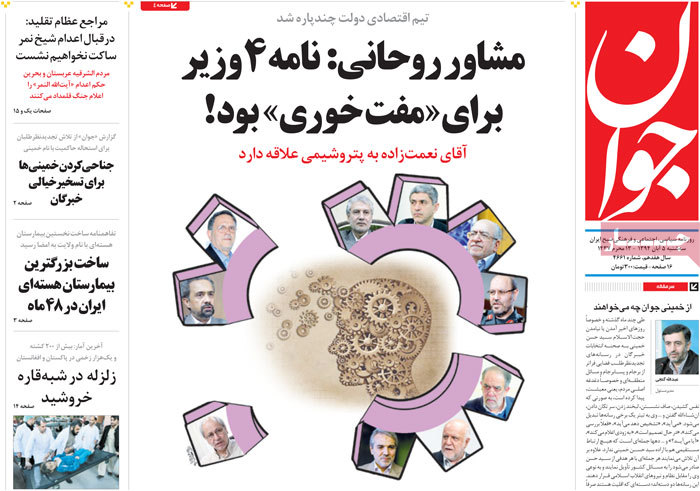
Javan: Iran’s Grand Ayatollahs have said they won’t remain silent over the [likely] execution of Ayatollah Nimr al-Nimr in Saudi Arabia.


A look at Iranian newspaper front pages on Oct. 27


Jomhouri Islami: An agreement on construction in Tehran of the first nuclear hospital in West Asia has been signed.


A look at Iranian newspaper front pages on Oct. 27


Kaenat: Former Canadian Prime Minister Jean Chretien has said that his country should reopen its Tehran embassy.

Kaenat: Eight Saudi princes support a plan to oust King Salman.


A look at Iranian newspaper front pages on Oct. 27


Kayhan: The defense minister has unveiled 16 new defense products.


A look at Iranian newspaper front pages on Oct. 27


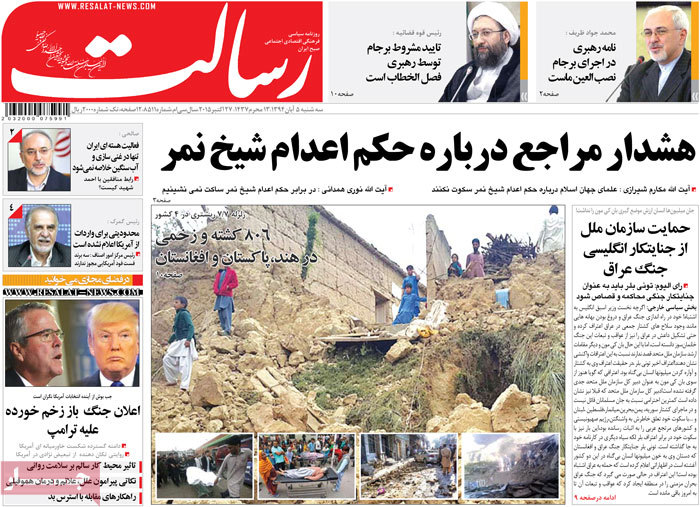
Resalat: “Iran’s nuclear activities are not limited to enrichment and heavy water,” said the country’s nuclear chief.


A look at Iranian newspaper front pages on Oct. 27


Sharq: “At our request Telegram [a messaging app which is very popular in Iran] blocked some immoral pages,” said the Iranian minister of communications.


A look at Iranian newspaper front pages on Oct. 27


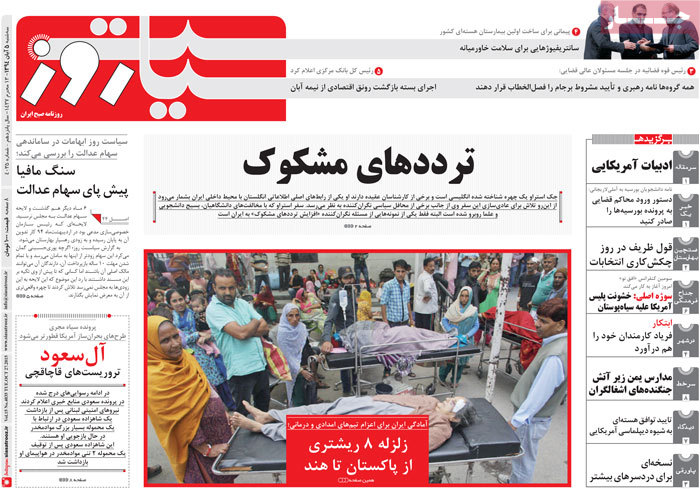
Siasat-e Rooz: Suspicious traffic!

Some experts believe Jack Straw serves as a link between British intelligence and some inside Iran.


A look at Iranian newspaper front pages on Oct. 27


Excavations uncover ancient gate in Persepolis

perspolis

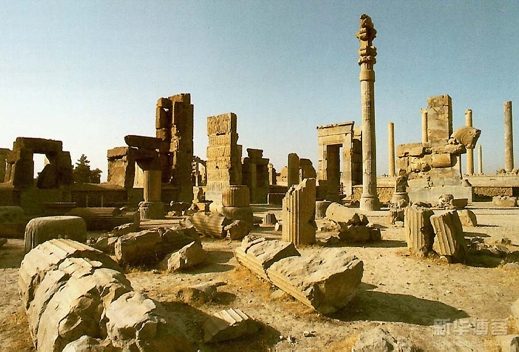
Excavations have uncovered a great ancient gate in Persepolis in a region called Tale-Ajori, the head of an Iranian excavation group has said.

Alireza Askari Chavardi said archeologists had been working to develop an insight into the functions of the ancient complex in Persepolis over the past century and to present a spatial analysis of coherence and conceptual links in the meaning of polis in the royal construction and the surrounding buildings.

As for the excavations, he said, “One of the most important sections of the region which directly leads to Persepolis is the northwestern part of the royal seat, also known as Firouzi Complex, on which the studies by archeological expeditions have been focused. It is also the place where the relics of a famous monument called Tale-Ajori lie.

“Any comprehensive study of Tale-Ajori, located 3km west of Persepolis, should be conducted in a broader framework of the past research in Parseh. Like past studies, we assume that the region in the vicinity of Firouzi Garden was part of a city relevant to the royal seat in Persepolis.”

He added, “The remains of Achemenid ascendancy near Firouzi Village has only gradually interested the archeologists who studied the areas surrounding the royal seat to locate the Royal Sacred Place in the broader limits of the city for nearly 100 years.”

He further said, “The most important findings of this season of the excavations are 30 glazed bricks adorned with images of winged animals which incorporate the mythic beasts of the Elamite and Achemenid eras in a tradition quite like those of Shusha and Mesopotamia in southwestern Iran. The exterior and the great hall of the gate of this section of Parseh are decorated with colorfully glazed bricks. The building was made of thousands of bricks. However, the majestic structure was reduced to a pile of dust, that’s why it is now called by locals Tale-Ajori.”

A joint Iranian-Italian team of archeologists explored Tale-Ajori for nearly 50 days in October and November 2013. Persepolis was founded by Darius of Achemenid in 521 BC and was the dynasty’s seat up to the decline of the empire in 331 BC.

The terrace where the royal houses were built envisages an urban landscape for Achemenid palaces with more than 100 ancient objects and great monumental works in the vicinity of the royal seat as well as the buildings scattered in an area of 600 hectares around Persepolis with gardens spread among these buildings.

The excavations were led by Dr. Chavardi from Shiraz University and Professor Pierre Francesco Caglieri from Italy’s University of Bologna and financed by Fars provincial Department of the Cultural Heritage, Handicrafts and Tourism Organization.
The season provided a reconstruction of the geomorphologic landscape of Persepolis and Parseh; 10 hectares of the areas near Tale-Ajori were documented through geo-electrical and geophysical instruments.

Iran will reveal its modern missile bases in due time

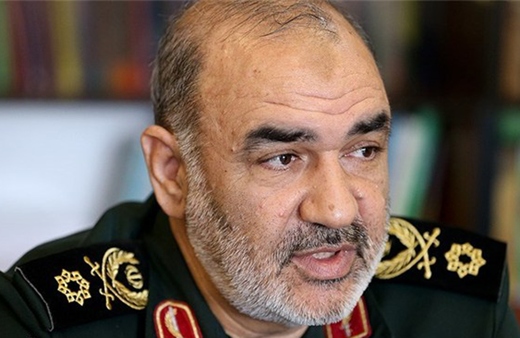
General Salami

A senior commander of the Islamic Revolution Guard Corps (IRGC) has said that the IRGC does not allow anyone to impose their wills on Iran.

Brigadier General Hossein Salami, the second-in-command of the IRGC, made the comment in an IRIB nightly news bulletin on Monday and added that today the Islamic Republic of Iran is the country which helps developments unfold in the region.

The following is the translation of highlights of the top commander’s remarks in the TV program as selected and released by entekhab.ir on October 27:

– If our forces do not engage [the enemy] in Syria today, we may have to engage them in other places.

– Iran’s presence in Syria has increased both qualitatively and quantitatively since a few months ago when Iran assumed an advisory role and got involved in rebuilding the Syrian army.

– We have to be present in Syria in order to adapt our experiences with new realities on the ground. Today Syria serves as a war university for us. Iranian forces are skillfully winning the hearts [and minds] of people in Syria.

– We have started to rebuild the Syrian army at a good pace.

– The Syrian army has launched a massive ground operation backed by the Russian air force. Already, this operation has largely tipped the balance on the battlefield, and crucial reports on this operation will be released in coming days.

– The transformation of the [Syrian] army backed by the presence of young forces has tipped the balance in Aleppo.

– Building on their new interpretation, the Russians have got engaged in Syria. They see Syria as part of their geopolitical position [in the region] and they need Syria for striking a balance over Ukraine.

– The Russians do not want to see their borders come under attack by Takfiris – the proxy infantry of the United States – from either Pakistan or Afghanistan or from the Syria-Turkey-Caucasus side.

– The Russians believe that forces from Asia and Chechnya account for 20 percent of the Takfiri commanders.

– The victories the al-Hashd al-Shaabi [the Popular Mobilization Forces in Iraq] have secured in Iraq indicate that positive changes are happening in Iraq, and triumphs in Fallujah and Baiji are further proof of such changes.

– The missiles Iran has developed have a zero margin of error.

– The underground missile base Iran showed the world [a while ago] was the country’s oldest base; we will show our modern bases in due time.

– The Supreme Leader of the Islamic Revolution, who is leading faithful forces, can manage any war in the world.

– The IRGC does not read the resolutions, because no one is allowed to dictate anything to us. Today the Islamic Republic is the one who dictates the developments.

Iran condoles with Afghanistan, Pakistan, India over quake deaths

afkham

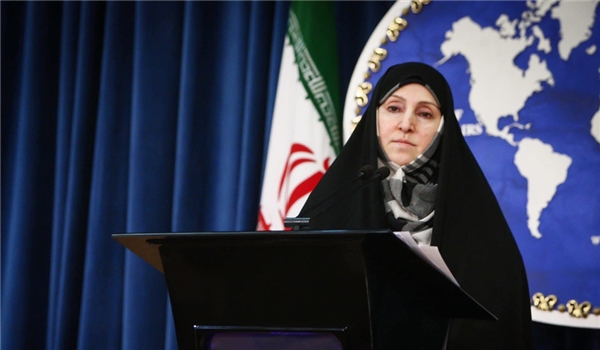
The Foreign Ministry spokeswoman Monday expressed Tehran’s deepest sympathy for Afghanistan, Pakistan and India over a powerful earthquake that left many people in these countries dead, voicing Iran’s readiness to help in relief and rescue operations in the quake-stricken areas.

Marzieh Afkham offered Iran’s condolences to the governments and nations of Afghanistan, Pakistan and India on the quake casualties.

Expressing hope that the death toll would remain at the lowest, Afkham said that Iran is ready to provide humanitarian and relief assistance for the quake-hit areas and wished those injured a swift recovery.

Over 180 people were killed in a 7.5-magnitude earthquake that struck northeastern Afghanistan and Pakistan earlier on Monday.

Tremors from the quake were also felt in northern India and Tajikistan.

The earthquake’s epicenter was in the mountainous Hindu Kush region, 76km (45 miles) south of Faizabad.

Iran arrests perpetrators of terrorist attack in Khuzestan

Iran’s Intelligence Ministry

Iranian security forces have arrested all perpetrators of a recent terrorist attack in the southern province of Khuzestan.

At least two people were killed and two others sustained injuries after masked assailants opened fire on a group of people who were holding a mourning ceremony for Imam Hussein, the third Shiite imam, in Safiabad, a town in Dezful county in Khuzestan Province, on October 16.

The terrorists intended to carry out acts of terror in four other areas but were arrested before carrying out their plans.

The provincial intelligence department said on Monday that the terrorist attack in Dezful had been organized and led by a foreign country.

Iran to invest in New Development Bank

Khazai

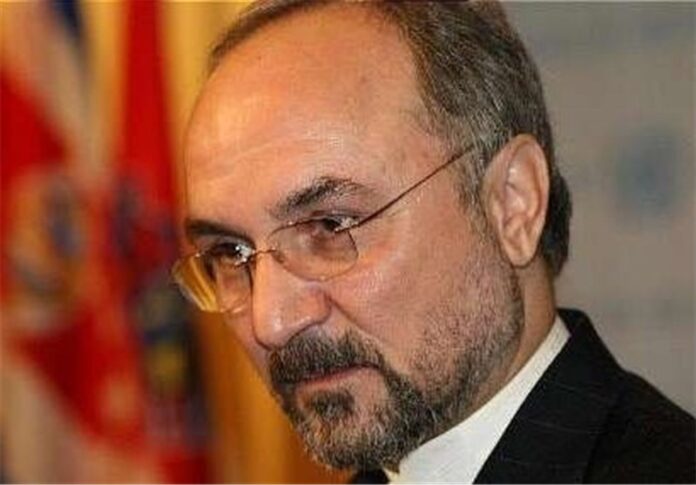
A deputy economy minister has said that Iran and Brazil have decided to develop their cooperation and to that end Iran will become a member of the New Development Bank (formerly known as BRICS Development Bank) whose capital stands at $100b.

Mohammad Khazaei, who is also the director of the Organization for Investment, Economic and Technical Assistance of Iran, made the remark in a meeting of Iran and Brazil Joint Economic Commission and added that Brazil is a member of BRICS [five major emerging national economies: Brazil, Russia, India, China and South Africa] that have established the bank. He expressed hope that Iran can get the bank’s membership to be able to enhance mutual cooperation.
The following is the translation of what else the Iranian official said as reported by Tasnim News Agency on October 26:

The deputy economy minister said that economic, industrial, banking and financial ties between Iran and Brazil are somewhere in the neighborhood of zero, adding that statistics released by the Customs Office showed that the volume of trade transactions between the two countries hit the $400m mark last year: Iran’s exports to Brazil amounted to around $100m, and the remaining $300 was Iran’s imports from that country.

The joint economic commission last met more than 20 years ago and the volume of bilateral economic cooperation has leveled off over the past two decades, he said.

Thanks to the talks between Tehran and Brasilia, efforts to develop Iran-Brazil ties gained momentum and this resulted in a trip by the Brazilian top diplomat to Iran a while ago and a meeting between the Iranian president and Brazil’s foreign minister at the UN, Khazaei added.

The Iranian official went on to say that he accompanied the economy minister in his recent trip to Brazil where they held four crucial meetings to chart the two countries’ economic roadmap.

Khazaei further said that Iran and Brazil have signed cooperation deals on customs affairs, removal of double taxation and joint ventures to upgrade their economic ties.

The two sides have plans to raise the volume of their trade to $5b, he said, adding that Iran and Brazil need to make joint investment if they seek to have persistent cooperation.
The New Development Bank (NDB), formerly referred to as the BRICS Development Bank, is a multilateral development bank operated by the BRICS states as an alternative to the existing American and European-dominated World Bank and International Monetary Fund.

Iran, Brazil firm to boost economic relations

Zarif-Brazilian

Foreign Minister Mohammad Javad Zarif has stressed the importance of improving relations with Brazil given the country’s special position in Latin America and in the BRICS group of major emerging economies.

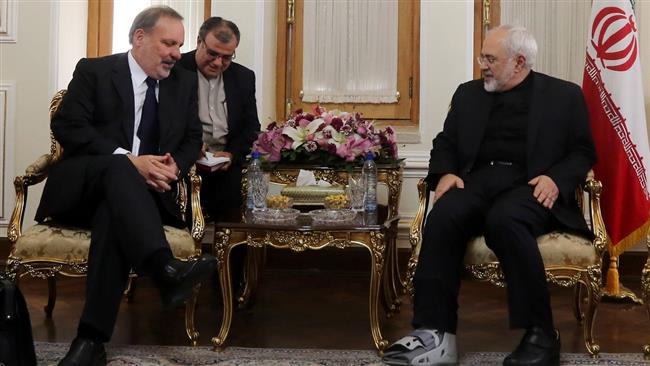
“This country (Brazil) has always been among the priorities of the Islamic Republic of Iran’s foreign policy,” Zarif said at a meeting with Brazilian Minister of Development, Industry and Trade Armando Monteiro in Tehran on Monday.

He added that Iran has great potential to open new markets and can help Brazil’s access to the Central Asian region.
Zarif said Tehran and Brasilia are seeking a new roadmap to develop common interests, adding that the two sides’ enterprises and banking and economic institutes can play an important role in this regard.

He added that Iran and Brazil enjoy great opportunities for strengthening cooperation in different fields such as technology, biotechnology, energy and gas.

Zarif expressed Iran’s readiness to remove obstacles in the way of banking cooperation with Brazil through constant consultation.
Brazil’s enhanced ties with Iran

Monteiro said Brazil has always attached special significance to cooperation with Iran and called for promotion of mutual relations.
The Brazilian minister arrived in Tehran Monday at the head of a 35-member economic delegation to explore ways of bolstering mutual economic relations.

Strengthening relations between Tehran and Brasilia in areas such as foreign trade, energy, banking, agriculture and investment has been mentioned as the main goal of Monteiro’s Tehran visit.

Brazil is currently the world’s seventh largest economy. It is also a member of the BRICS group of emerging powers that also includes Russia, India, China, and South Africa.

Brasilia is also Tehran’s most important economic partner in Latin America and the volume of bilateral trade amounts to about $1.6 billion a year.