Wednesday, December 24, 2025
Home Blog Page 4693

Iran felicitates Turkey on successful election

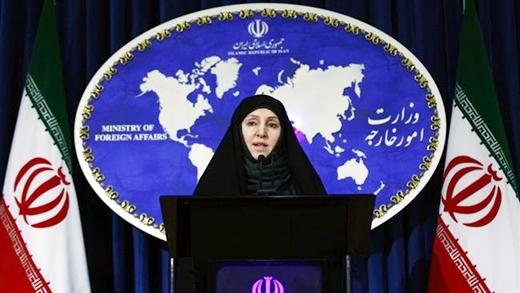
Afkham

Iran has offered congratulations to the Turkish government and nation on the recent successful parliamentary election marked by a massive turnout.

Foreign Ministry Spokeswoman Marzieh Afkham expressed hope on Monday that formation of a new government in Turkey would improve mutual relations in all fields.

Turkish President Recep Tayyip Erdogan’s Justice and Development Party (AKP) won the parliamentary election on Sunday and regained the parliamentary majority it had lost in a June election.

There are hopes that the election would put an end to months of tension and instability in Turkey, triggered by two deadly bomb blasts in the city of Suruc and Ankara over the past few months. Scores of people were killed in those explosions.

Foreign Ministry has won the hearts and minds of Iranians

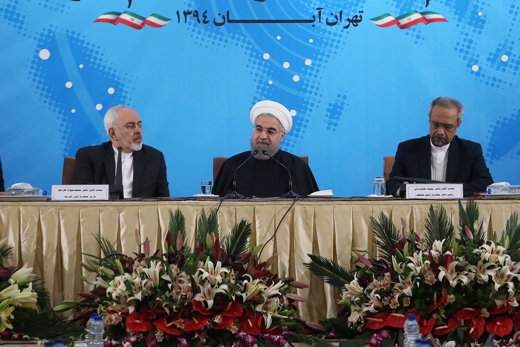
Rouhai

President Hassan Rouhani has said that backing down from principles has no place in Iran’s diplomacy machine, adding that the Joint Comprehensive Plan of Action (JCPOA) which is a big political victory for Iran serves as a global model to solve problems.

The president made the remarks in a meeting on Monday with foreign-based Iranian ambassadors and heads of Iran’s diplomatic missions across the world and added that the respect the world showed to Iranian diplomats was in fact a sign of respect for the greatness of the Iranian nation and that the Foreign Ministry today has found its way deep into the hearts of the Iranians.

Fararu.com on November 2 published President Rouhani’s remarks in the gathering and the following is the translation of part of the news website’s report:

[…]

We proved to the world that gone are the days of Iranophobia, and we practically supported our argument by presenting the World Against Violence And Extremism (WAVE) proposal which was unanimously adopted by the UN General Assembly.

[…]

According to the letter of the Constitution, being a revolutionary manifests itself in wishing prosperity for people all over the world, especially for Muslims or the great Islamic family and our neighbors.

We will implement JCPOA in line with the existing frameworks and the Supreme Leader’s instructions. We are making every effort to start the executive parts of the nuclear deal so that the cost people pay out of their pockets as a result of sanctions decreases.

[…]

The unfledged officials in a regional country without enough experience will reach nowhere by speaking harshly with the greats.

Iran has no doubt that the crises in Syria, Yemen and Bahrain can be solved diplomatically, and constructive interaction is needed to work out such diplomatic solutions.

If Saudi Arabia takes into account the realities on the ground when dealing with the region’s general questions and drops its policy of interference, a number of issues, including ties with Iran, can be settled in the new conditions. If Riyadh doubles back from the wrong path it had walked down, the way will be paved for cooperation.

[…]

In the modern world, no country can solve their problems and reach their objectives on their own. If we take the right path, we will reach a point where Iran’s isolation and imposition of sanctions will become impossible, because the government’s target is to cement efforts to promote deterrence in the face of isolation and sanctions.

The result of nuclear talks turned the Zionist regime into the most isolated regime in the world and today the world knows well that the settlement of a big number of regional problems hinges on Iran’s presence.

If we seek to compete with the world on the economic front, we have to find our way into international economic circles and be part of the process which makes decisions on tariffs levied by trade unions and other countries. This is one of the primary responsibilities of Iran’s ambassadors abroad.

The future of the Middle East, hopes and fears

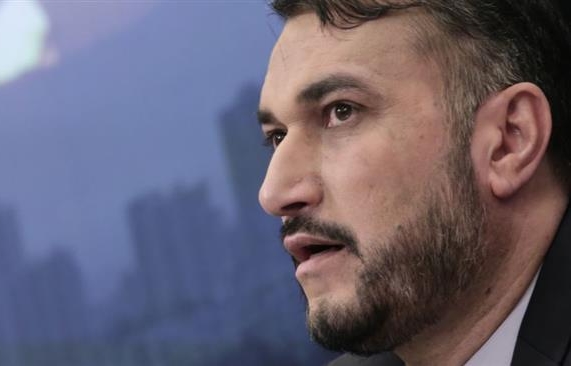
Amir-Abdoulahian

The deputy foreign minister for Arab and African affairs has said that different parties involved in the Vienna talks, including the EU and Oman, were insistently trying to convince the Islamic Republic of Iran to attend the talks on Syria.

Hossein Amir-Abdollahian made the comment in a nightly TV news program on Saturday and added that some were trying to misuse Iran’s expression of readiness to take part in the talks to suggest that Iran’s presence is indicative of a policy shift in Tehran and its go-ahead to measures to remove Assad from power.

He went on to say that Tehran attended the talks to announce that the Islamic Republic remains ready to take appropriate steps toward working out a political solution to the Syrian crisis.

The deputy foreign minister further said that in the Vienna talks Iran did not allow other countries to decide what the Syrian people are entitled to make decisions about.

The following is the translation of highlights of Amir-Abdollahian’s remarks on different questions in the news bulletin as reported by the national broadcaster’s news website (iribnews.ir) on November 1:

What happened in Vienna talks?

The other side [the West] was seeking to gain at the negotiating table what it had failed to achieve on military and security fronts – through its five-year support for the terrorists.

The Vienna talks were challenging, complex and tough. The other sides were seeking to seize the opportunity and decide the future of Syria, but they were denied such an opportunity.

Thanks to [Tehran’s] logic and reasoning, the US-proposed plan which was supposed to be put on the table was replaced by Iran’s political views in line with international law and defense of the Syrian people.

In the talks, all Western countries were not on the opposing side; the EU foreign policy representative, and the German and Italian foreign ministers were trying to strike a balance between the views; as a matter of course, France and Britain adopted the harshest stances among the Europeans.

The United States was struggling to tap into the opportunity to achieve its goals; [top] on the agenda was a political mechanism, so the logic and reasoning of the Islamic Republic of Iran was brought into focus and the other sides were denied the opportunity because they lacked any reasoning.

Certain countries, among them Saudi Arabia, were not advocating the right of the Syrian people to self-determination ….. They said that the Syrian people cannot decide their future, arguing that election is not a befitting mechanism to decide Syria’s political destiny and that the political future of the [Arab] country should be decided by them [those countries].

Where to take on terrorists?

For months, Iran was telling the Russians that they will have to take on terrorists in Moscow’s subway stations if they did not engage the terrorists in Syria, Iraq and Yemen.

If Iranian security agencies had not powerfully defended the country against the infiltration and emergence of terrorists, Iran would have been facing the terror groups in the alleys [and streets] of Tehran.

Two definitions of Syrian opposition

Iran supports those opposition members who believe in political solutions, whereas the West talks about the armed moderate opposition. Iran rejects the armed opposition as terrorists.

At the outset of the Syrian-Syrian talks, a dividing line should be clearly drawn between the pro-diplomacy opposition and those with ties to terrorists, and those groups which attend the national dialogue should have ability and competence, and represent a key part of Syrian society.

Ceasefire is achievable in Syria if …

If countries and security agencies which back terrorists cut off their support for the terrorists right now, establishment of ceasefire across Syria is sure to happen according to a timetable that runs a few months …. Ceasefire can be achieved in Syria, but it takes serious regional and international determination.

Yes to Iran’s oil and banking sanctions, no to sanctions on ISIS

For years, Iran has been hit by tough sanctions and had difficulty transferring even one dollar in the international banking system, but today ISIS sells part of Iraqi and Syrian oil to certain foreign firms. The revenues from oil sales are injected into the international banking system despite the fact that a number of resolutions have been issued against ISIS.

Who’s to blame for downing Russia’s passenger plane?

Based on Iran’s intelligence, the ISIS terror group lacks the capabilities to hit a passenger plane in high altitudes. If technical glitches are not to blame for the crash of the Russia plane, the reason should be looked for among countries which opposed Russia’s military action in Syria and in their security agencies and advanced military capabilities inside and outside the region.

No winner in Yemen crisis

The Saudis, Americans and other Western officials had said that they would settle the Yemeni question in less than three weeks. On different grounds, those three weeks lasted more than six months with Western support and the deafening silence of the West and even some regional Muslim nations.

Different Yemeni groups, nomads and people who care about their country’s unity and security did not let the Saudis settle the question by military means.

We hope the Saudis will walk down the path of wisdom this time around, make up for their past mistakes, pursue a diplomatic approach and let the Yemenis decide their own future.

I have no doubt that all Yemeni groups care about the security of the entire region, including Saudi Arabia, if they are given the chance to decide their own fate, but it needs insight on the part of the Saudis.

The third Intifada, reaction to Judaization of Beit-ul-Moqaddas

The current situation in occupied Palestine is the direct result of the Zionist regime’s wrong approaches and the mistake by certain Western countries in supporting the Zionist regime, its continued settlement activity and Judaization of Beit-ul-Moqaddas.

What we see in Palestine is a third Intifada which signals a powerful message for the Zionists. It also conveys a message of unity for the Palestinians and for resistance in the region.

Environment chief: Iran wins legal battle against US

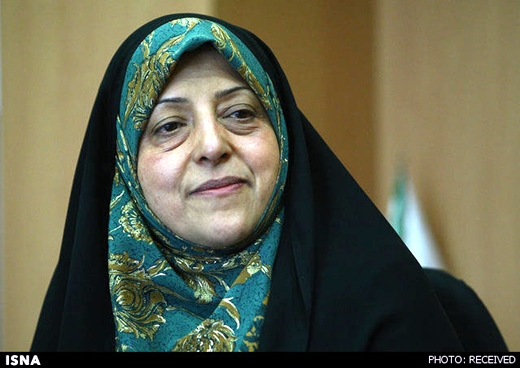
Masoumeh Ebtekar

Vice President and Director of the Environment Protection Organization Masoumeh Ebtekar said Sunday that Iran has emerged victorious in a decades-long legal dispute with the US over the return home in the near future of a number of Iranian fossils.

“A good piece of environmental news is that Maragheh Fossils belonging to various terrestrial eras, which are among the most precious of their kind in the world and were sent to the United States before the victory of the revolution for academic studies and kept at Harvard University return home,’ said the vice president.

Ebtekar told media editors and political science students said that the return of those precious fossils to Iran was held up for four decades due to certain problems.

“The long-running environmental (legal-archeological) dispute between Iran and the US on unearthing, collecting and coding the samples of Maragheh Fossil Site led to filing a complaint at the Hague Court of Justice and pursuing it in a very complicated, tough, legal process, which fortunately led to a happy ending,” said the environment chief.

Ebtekar said that his organization and Harvard University are arranging for a ceremony in the presence of Iranian and US researchers and scientists in which Maragheh Fossils will be unveiled before their return to Iran.

“A part of those fossils will return to Iran within weeks and will be delivered to the Museum of Natural History and a part of them to the Maragheh City Fossil Studies Center,” Ebtekar said.

Ebtekar said that in America the Iranian fossils were put on display in exhibitions, used in research works, and even numerous scientific articles about them were written in very reputable US and other foreign magazines.

“A part of the Iranian archeologists’ studies and surveys for the return of the Maragheh Fossils were based on those articles, images and research,” she added.

The environment chief said that the number of Maragheh Fossils is 3,000, of which 1,500 fossils were sent to US for research and the remaining 1,500 fossils are kept in the Iranian Natural History and Environmental Diversity Museum.

“Although Maragheh Site is one of the most precious fossil study and research sites in the world and the 8th government (of President Mohammad Khatami) made serious efforts to turn it into a modern research center, unfortunately due to many years of negligence the plan was halted,” she added.

Ebtekar also emphasized that Iran has very precious fossil sites, reiterating that those fossils can serve as the basis for joint research by Iran and the United States, or Iran and the rest of the international community.

A look at Iranian newspaper front pages on Nov. 2

Iranian Newspapers Headlines

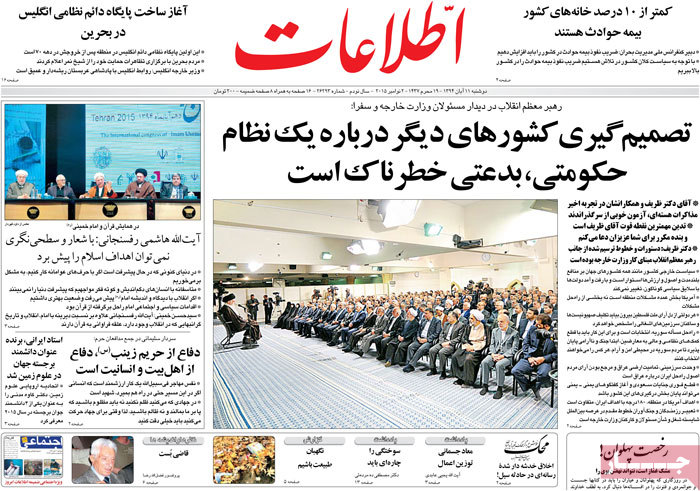
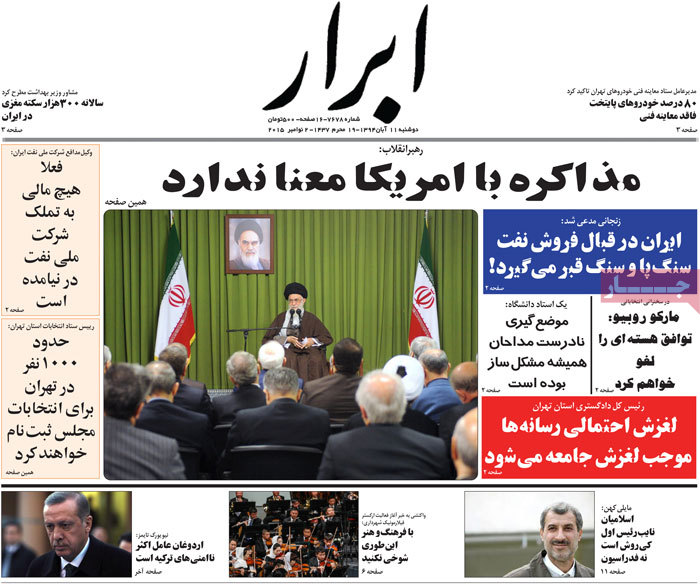
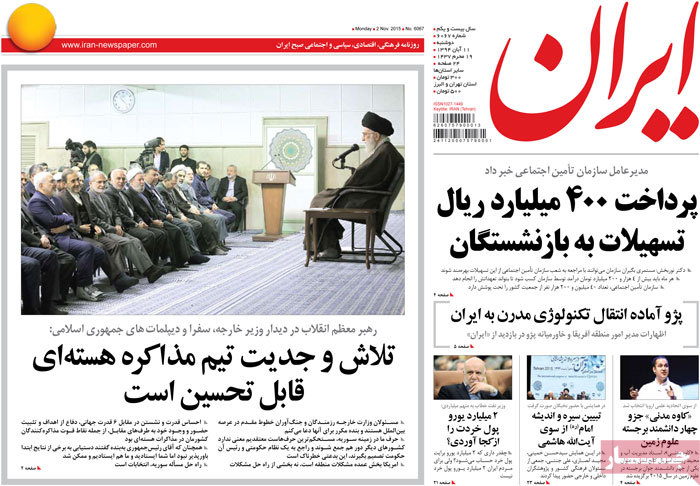
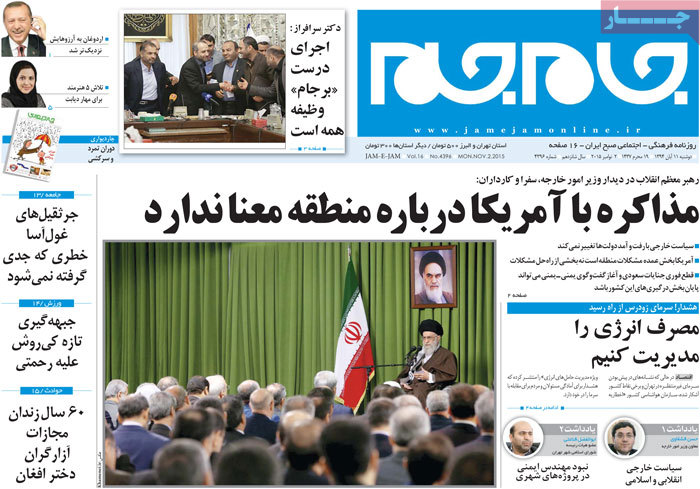
The Supreme Leader’s comments in a meeting with the foreign minister and overseas-based Iranian ambassadors that talks with the US over regional issues are pointless dominated the front pages of Iranian newspapers on Monday.


Ettela’at: Allowing others to decide about a country’s governing system sets a dangerous precedent, said the Supreme Leader at a meeting with Foreign Ministry officials and Iranian ambassadors overseas.

Ayatollah Khamenei further said Dr. Zarif and his colleagues passed the recent test of nuclear talks with flying colors.

At the same meeting, Foreign Minister Zarif said the instructions issued by the Supreme Leader have been the guiding principles of his ministry.

Ettela’at: Less than 10 percent of houses across the country have accident insurance.

The secretary of the National Conference on Crisis Management has said the rate of accident insurance in the country should increase.

Ettela’at: Construction of Britain’s permanent military base in Bahrain has got underway.

Ettela’at: With sloganeering and superficiality one cannot advance the goals of Islam, said Chairman of the Expediency Council Ayatollah Akbar Hashemi Rafsanjani.

Speaking in a conference on the Koran and Imam Khomeini, the former president said, “At a time when the modern world is making progress, demagoguery will land us in trouble.”

Ettela’at: An Iranian scientist has been awarded by the European Geosciences Union.

Dr. Kaveh Madani is one of the four scientists to have won the Arne Richter Award for Outstanding Young Scientists from the European Geosciences Union.

Ettela’at: The commander of the IRGC’s Quds Force has said that safeguarding the shrine of Hazrat Zeinab, [the granddaughter of Prophet Muhammad which is located in Syria], is like defending humanity.
 

A look at Iranian newspaper front pages on Nov. 2


Abrar: Each year nearly 300,000 Iranians suffer strokes, said an advisor to the health minister.
 

A look at Iranian newspaper front pages on Nov. 2


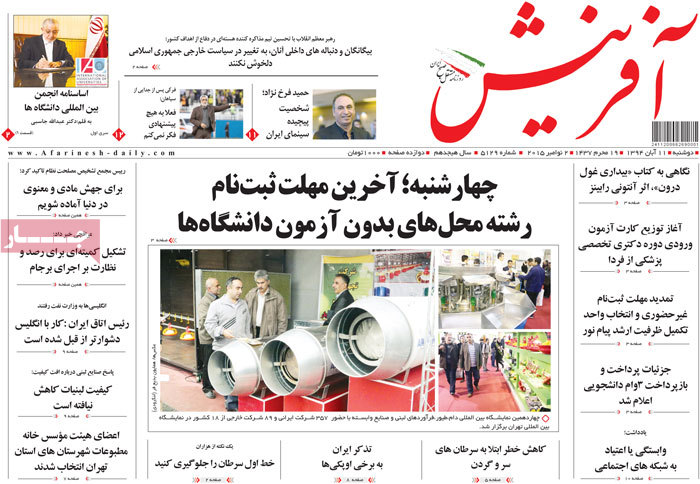
Afarinesh: The head of Iran Chamber of Commerce has said that working with the Brits is not more difficult than before.
 

A look at Iranian newspaper front pages on Nov. 2


Aftab-e Yazd: Some unauthorized financial institutes have folded, unofficially though.

Hamid Mir-Moini, an economist, says these institutes have heavily invested in property development. In light of the fact that the housing sector is in recession, these institutes are unable to cash their capital. Besides, the returns they expected on their investment have not materialized.
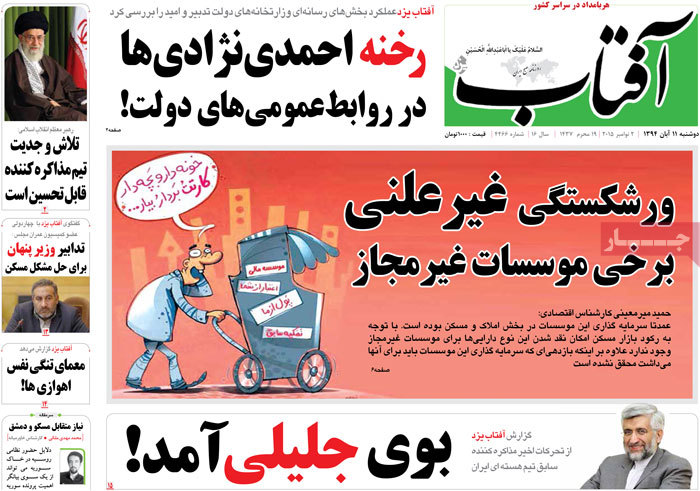
 

A look at Iranian newspaper front pages on Nov. 2


Akhbar Sanat: A deputy oil minister has said that new oil and gas fields have been discovered.
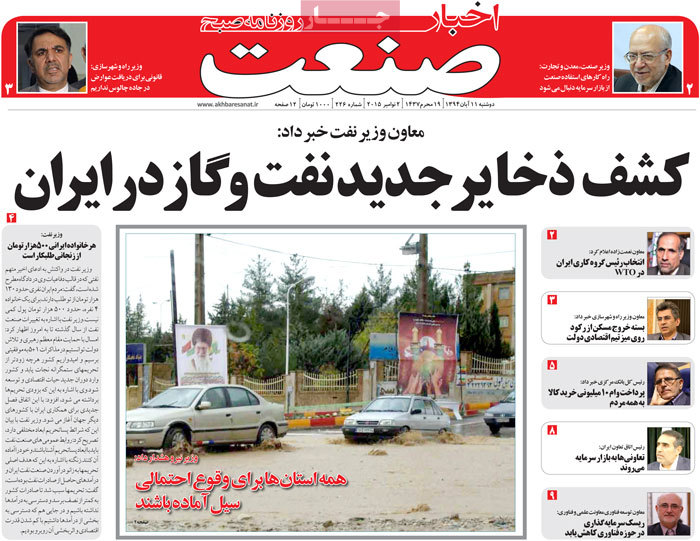
 

A look at Iranian newspaper front pages on Nov. 2


Arman-e Emrooz: “Where did you get your small change,” Oil Minister Zanganeh has asked Babak Zanjani who had told a fourth hearing in his corruption trial that “Two billion euros is nothing more than small change to me.”

The oil minister said Zanjani [who is on trial for corruption] owes each single Iranian $43.

Arman-e Emrooz: “Religiosity is Dr. Zarif’s strong suit,” the Supreme Leader said, adding, “Holding talks with the US on regional issues is pointless.”
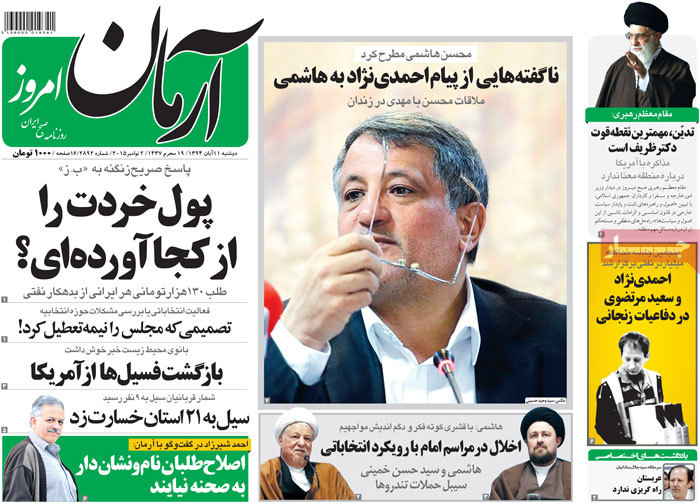
 

A look at Iranian newspaper front pages on Nov. 2


Asrar: The director of the Environment Protection Organization has said that Iran has emerged victorious in an environmental dispute with the US.
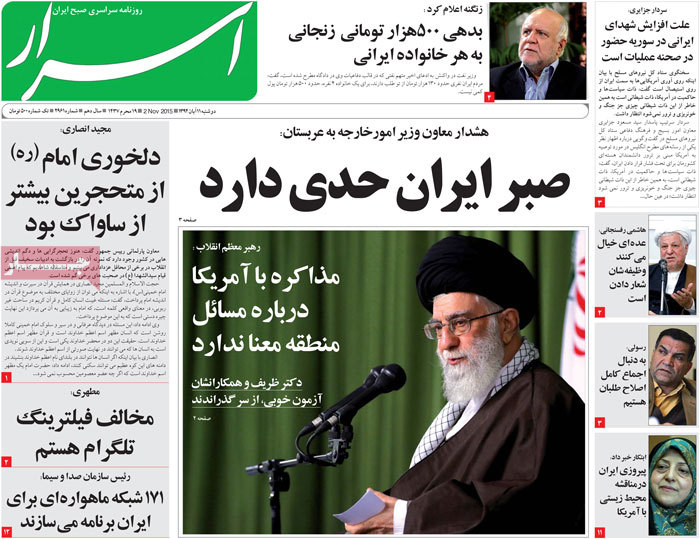
 

A look at Iranian newspaper front pages on Nov. 2


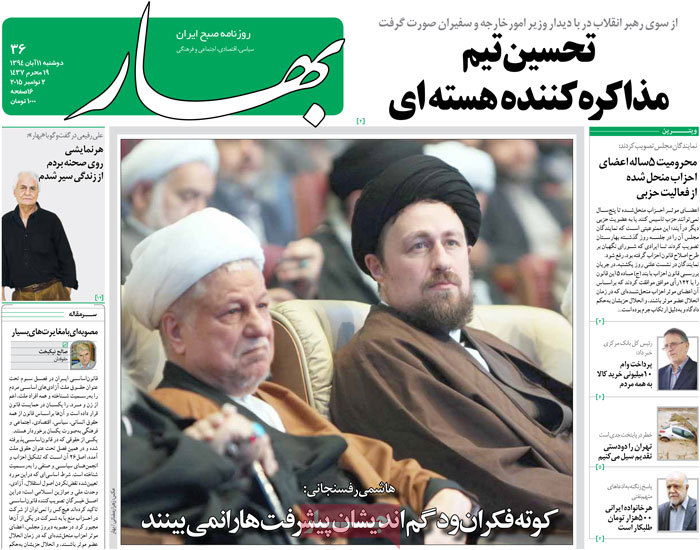
Bahar: Some narrow-minded, dogmatic individuals are closing their eyes to the progress [the country has made under President Rouhani], said the chairman of the Expediency Council.
 

A look at Iranian newspaper front pages on Nov. 2


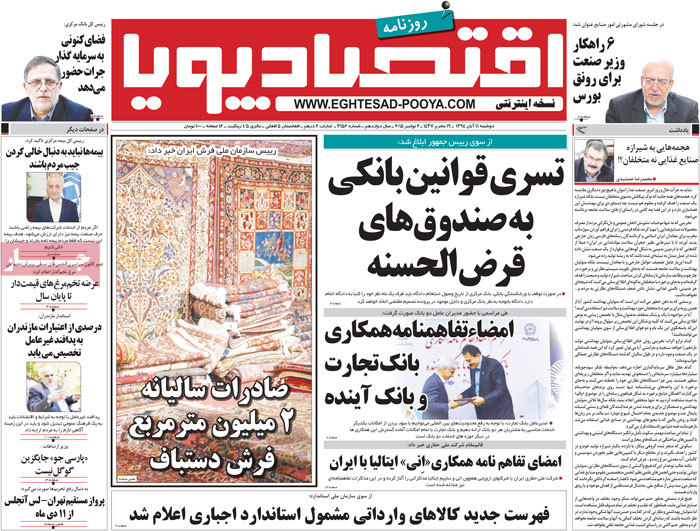
Eghtesad-e Pooya: Italy’s ENI has signed an MOU with Iran.
 

A look at Iranian newspaper front pages on Nov. 2


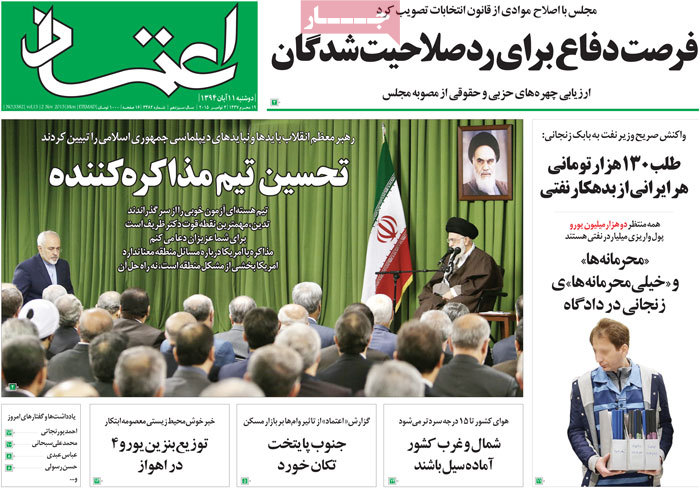
Etemad: Parliament has amended the Election Law, allowing disqualified candidates to defend their credentials.

Etemad: The meteorological organization has said that residents of northern and western Iran should brace for floods and that average temperatures are expected to drop by 15º C.
 

A look at Iranian newspaper front pages on Nov. 2


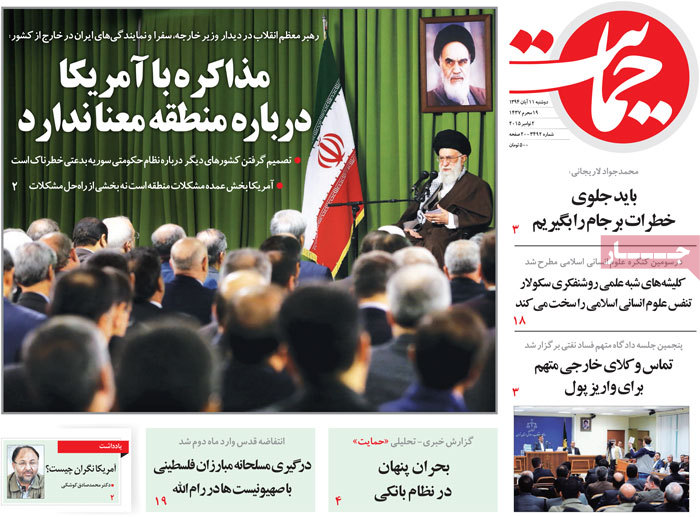
Hemayat: The head of the Judiciary’s Human Rights Commission has said that the dangers of the Joint Comprehensive Plan of Action should be averted.
 

A look at Iranian newspaper front pages on Nov. 2


Iran: France’s Peugeot has signaled readiness to transfer modern technology to Iran.
 

A look at Iranian newspaper front pages on Nov. 2


Jamejam: The president of IRIB has said that proper implementation of the Joint Comprehensive Plan of Action is the responsibility of everyone.

[Mohammad Sarafraz made the comment as he appeared before a parliamentary caucus to defend the performance of the national broadcaster after it came under fire for bias against the nuclear deal.]
 

A look at Iranian newspaper front pages on Nov. 2


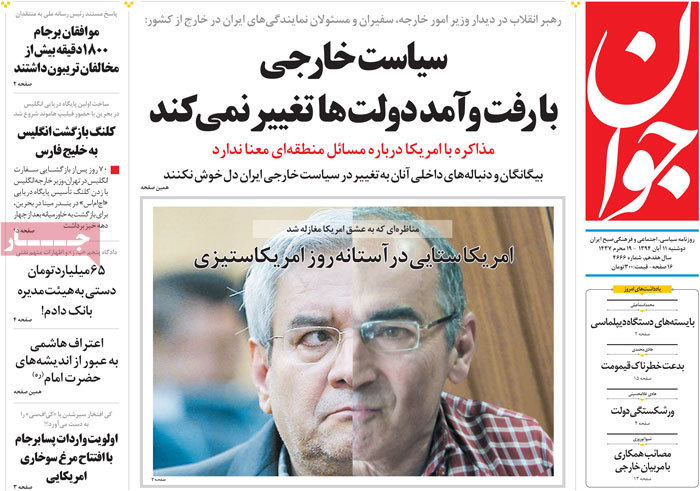
Javan: Proponents of the nuclear deal had 1,800 minutes more in airtime than its opponents, said the president of IRIB in reaction to critics of the performance of the national broadcaster.
 

A look at Iranian newspaper front pages on Nov. 2


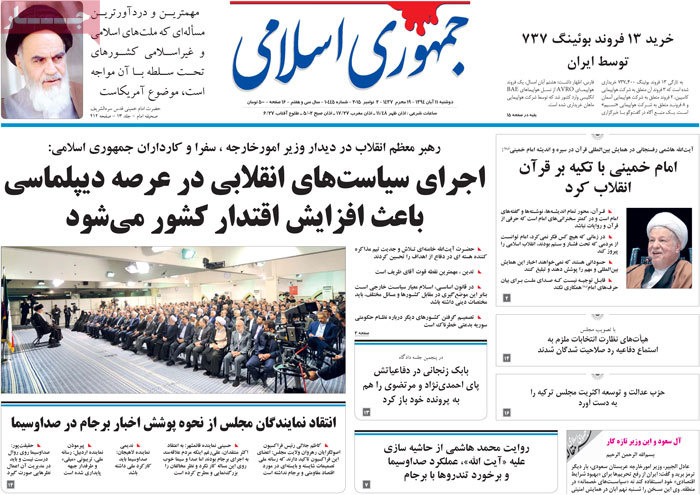
Jomhouri Islami: In comments made during a fourth hearing in his corruption trial, Babak Zanjani implicated Ahmadinejad and Saeed Mortazavi in the case.
 

A look at Iranian newspaper front pages on Nov. 2


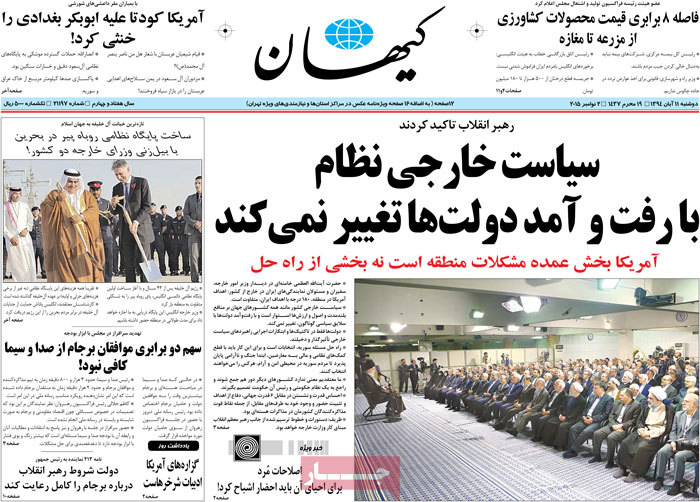
Kayhan: “Iran’s foreign policy does not change with the change of governments,” said the Supreme Leader.

Ayatollah Khamenei further said that the US is part of the regional problems, not solutions.
 

A look at Iranian newspaper front pages on Nov. 2


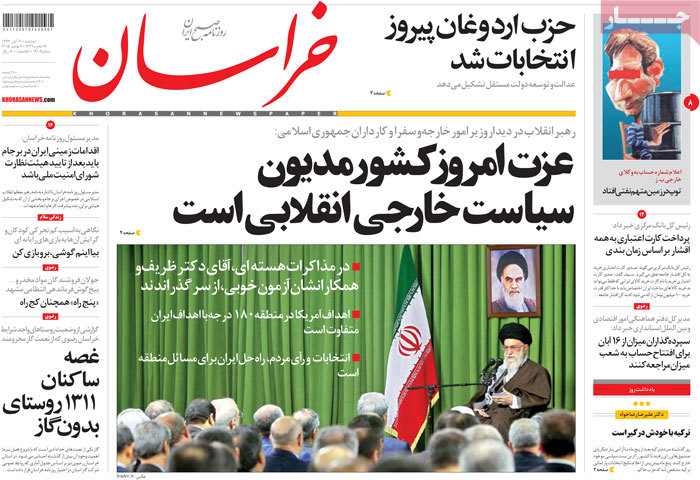
Khorasan: Erdogan’s AKP has emerged victorious in Turkey’s elections.
 

A look at Iranian newspaper front pages on Nov. 2


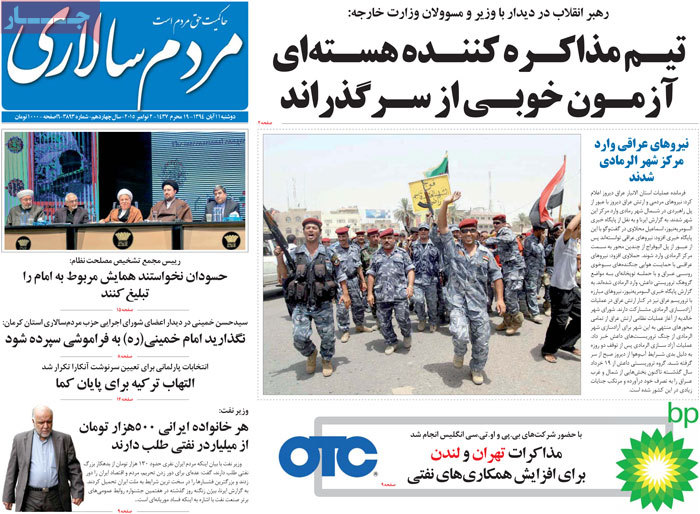
Mardomsalari: Iran and Britain have held talks to boost their oil cooperation.

The talks came during a Tehran visit by the representatives of BP and OTC.

Mardomsalari: Iraqi forces have advanced to the heart of Ramadi.
 

A look at Iranian newspaper front pages on Nov. 2


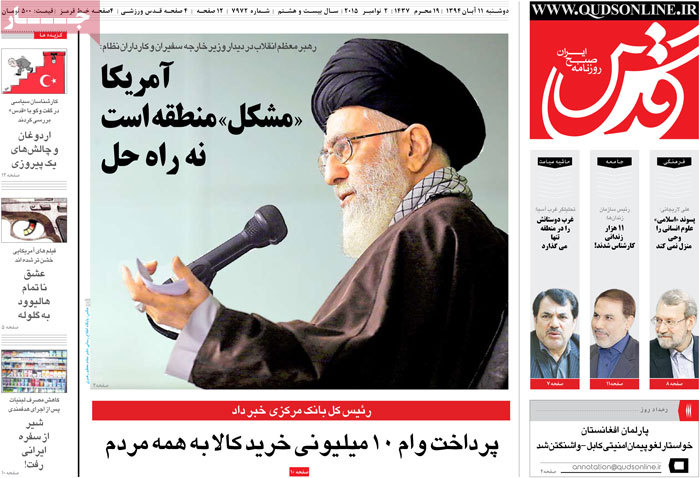
Qods: The governor of the Central Bank has said that everyone can apply for around $3,300 in loans for the purchase of appliances.
 

A look at Iranian newspaper front pages on Nov. 2


Resalat: The chairman of Tehran City Council has said that the capital is defenseless in the face of flooding.
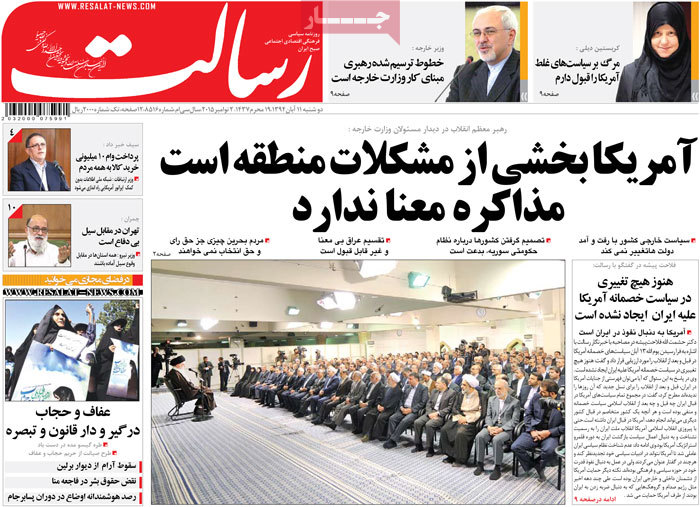
 

A look at Iranian newspaper front pages on Nov. 2


Rooyesh Mellat: The energy minister has warned all provinces to brace for probable flooding.
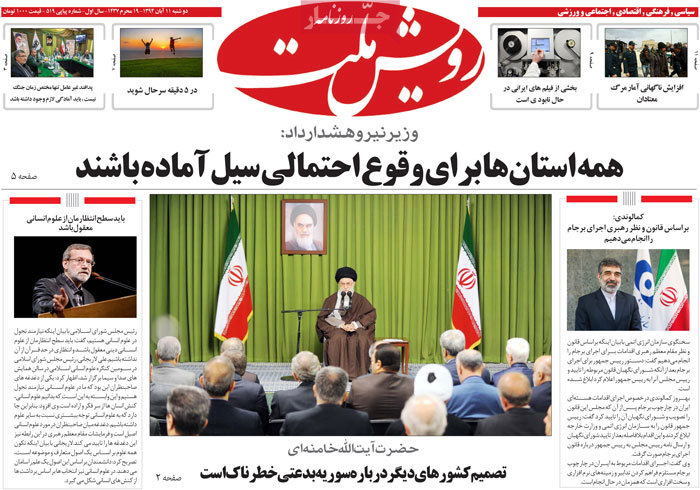
 

A look at Iranian newspaper front pages on Nov. 2


Shahrvand: A spokesman for Tehran City Council has said that those who cut trees in the capital can be fined somewhere between $170 and $45,000.
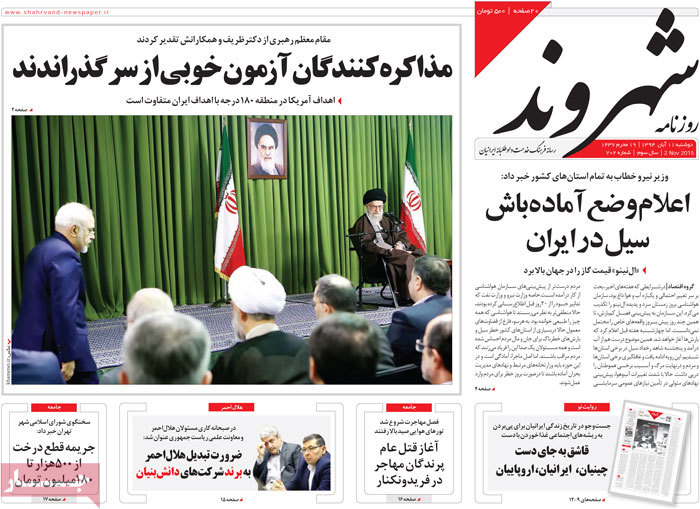

 

A look at Iranian newspaper front pages on Nov. 2


Zarif calls for fate of missing Hajj pilgrims to be determined

Zarif

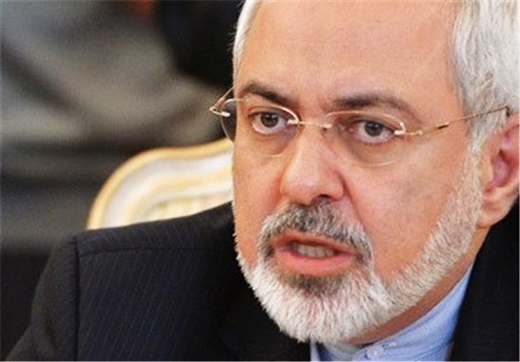
Foreign Minister Mohammad Javad Zarif has underlined that Saudi Arabia should determine the fate of individuals missing in the wake of the Mina tragic incident, and said that Iran is waiting for the return home of the missing former ambassador to Beirut Ghazanfar Roknabadi.

“The Foreign Ministry and the family of Mr. Roknabadi are waiting for his return and we hope his fate is determined,” Zarif said on Sunday, addressing a conference of ambassadors and heads of Iran’s diplomatic missions abroad.

The Iranian foreign minister condoled with the families of the victims of the Hajj tragedy, and said, “Our colleagues who died in the Hajj incident were among the most hardworking and industrious people in the Iranian Foreign Ministry and their goals will be pursued.”

Zarif said that the most important objective of Iran is for Iranian Hajj pilgrims who go on Hajj pilgrimage every year embark on the spiritual journey in tranquility.

JCPOA expected to be implemented in early January: Araghchi

araghchii

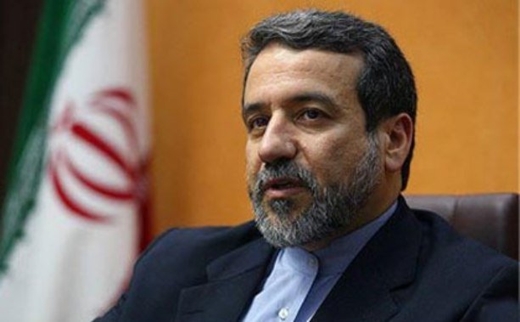
The nuclear agreement reached between Tehran and six world powers is expected to be implemented early in January, the spokesman of parliament’s National Security and Foreign Policy Committee quoted Deputy Foreign Minister Abbas Araghchi as saying.

According to Nozar Shafiee, Araghchi further said that except for two cases, all other parts of the roadmap between Iran and the International Atomic Energy Agency have been implemented and that the IAEA director general will present a report to IAEA Board of Governors in nearly a month.

The deputy foreign minister noted that the IAEA Board of Governors will convene on December 15 to present a resolution that will put an end to the so-called possible military dimensions (PMD) of Iran’s nuclear program.

The implementation of JCPOA and termination and suspension of sanction is expected to begin within next two months.

Iran warns Saudi FM: Don’t test our patience

Amir Abdoulahian

A senior Iranian official has dismissed as baseless the recent comments of the Saudi foreign minister against the Islamic Republic, warning that there is a limit to Tehran’s patience.

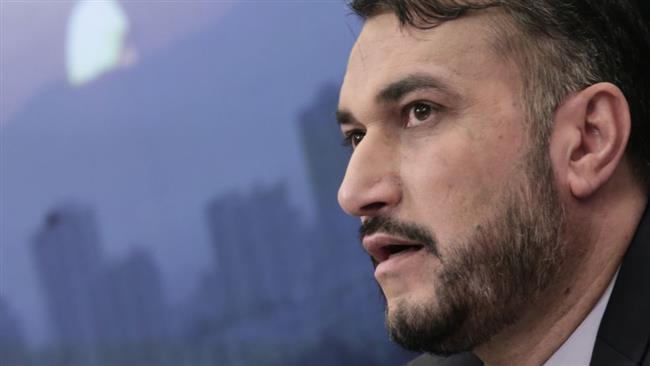
“We warn Adel al-Jubeir not to test the patience of the Islamic Republic of Iran,” Hossein Amir-Abdollahian, deputy foreign minister for Arab and African affairs, said on Sunday.

He was reacting to the Saudi top diplomat’s remarks on Saturday that Riyadh hoped Tehran would use additional earnings that it would make following the implementation of its July nuclear agreement with world powers, to develop its economy “rather than for aggressive policies.”

“Instead of accusation and shifting the blame [on others], the Saudi foreign minister should assume his country’s responsibility in the Mina disaster,” the Iranian official said.

On September 24, two large masses of Muslim pilgrims fused together in Mina outside the holy city of Mecca in Saudi Arabia, leading to a stampede, which, according to Iran’s Hajj and Pilgrimage Organization, killed around 4,700 people, including 464 Iranians.

Saudi Arabia, whose mismanagement prior to and in the aftermath of the incident has elicited widespread criticism, claims that nearly 770 people were killed in the disaster.

Amir-Abdollahian also advised Jubeir to “abandon his overt and covert support for terrorists in Yemen, Iraq, and Syria” and not make tiny states such as Bahrain the victim of Riyadh’s wrongful policies.

He, however, said, “Tehran has never ruled out normal relations with Saudi Arabia.” “Ever since the start of the administration of [President Hassan] Rouhani, the ball has been in their court, but it is not clear who the decision maker in Saudi Arabia is.”

Iranian nuclear chief arrives in Japan for nuclear safety talks

Salehi

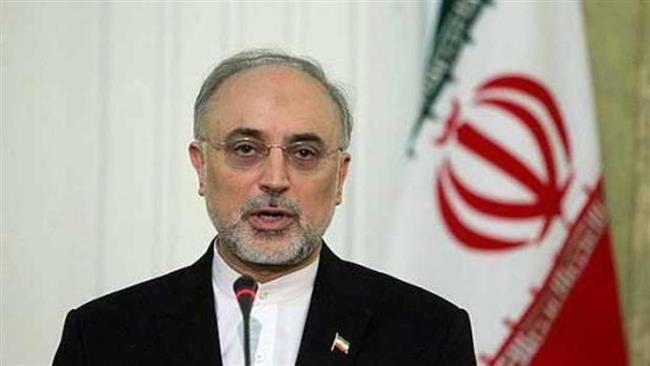
Head of the Atomic Energy Organization of Iran (AEOI) Ali Akbar Salehi has arrived in Japan to hold talks with the country’s officials about the expansion of nuclear cooperation, including in the field of safety.

Salehi’s Tokyo visit is meant to follow up negotiations about cooperation in nuclear safety.

During his four-day stay in Tokyo, the AEOI director is scheduled to hold talks with Japanese nuclear scientists and officials from Japan Nuclear Energy Safety Organization (JNES) and Nuclear Regulations Authority (NRA).

Salehi will also deliver speeches at the University of Tokyo and the Japan Institute of International Affairs (JIIA).

The Iranian nuclear chief and his accompanying delegation will also take part in the Pugwash international non-governmental conference on nuclear disarmament in the city of Nagasaki.

Iran’s Foreign Minister Mohammad Javad Zarif and his Japanese counterpart Fumio Kishida issued a joint statement in Tehran in October about nuclear safety cooperation and implementation of the International Atomic Energy Agency (IAEA) safeguards.

The Japanese foreign minister also agreed to help Iran implement the Joint Comprehensive Plan of Action (JCPOA) reached in Vienna on July 14.

Leader says US major part of regional problems, not solution

Leader-100

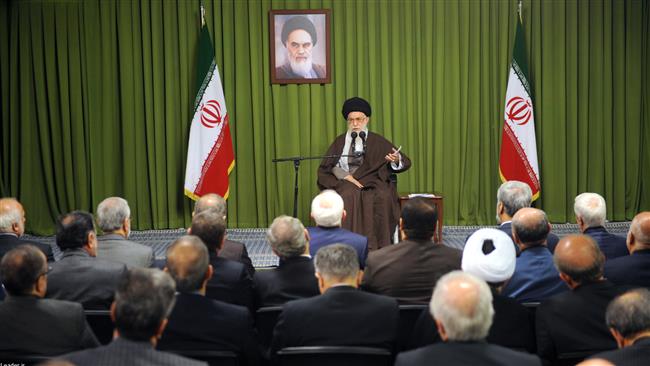
Supreme Leader of the Islamic Revolution Ayatollah Seyyed Ali Khamenei says the United States is behind a major part of the existing problems in the region, not a solution to them.

The Leader made the remarks in a meeting with Foreign Minister Mohammad Javad Zarif, along with Iran’s ambassadors and heads of diplomatic missions to other countries on Sunday.

Rejecting foreign propaganda about “compulsory or self-imposed” changes in Iran’s foreign policy, Ayatollah Khamenei said such an analysis on the part of the Western countries “stems from the pressure [exerted on them as a result] of this reality that the foreign policy of the Islamic Republic, at least at regional level, has prevented unrivaled jockeying of hegemonic powers, especially America like a strong barrier” and this is why they always aspire these policies to be changed.

The Leader added that Iran’s foreign policy, like all world countries, is predicated upon long-term interests, principles and values of the country and will not change with administrations holding different political views.

Ayatollah Khamenei said the impact of different administrations only goes as far as the tactics and executive initiatives of the country’s foreign policy strategies.

He emphasized that the US objectives in the Middle East are diametrically opposed to those of Iran.

The Supreme Leader further pointed to the four-year crisis in Syria and said that holding elections is the solution to the Arab country’s conflict.

Ayatollah Khamenei stressed that financial and military support for militants must first be terminated to end war and unrest in Syria so that the Syrian people would be able to elect who they wish in a secure and safe atmosphere.

The Leader also said the partitioning of Iraq into Shiite Arab, Sunni Arab and Kurdish regions is completely against its national interests and is an “impractical, meaningless and unacceptable” plan.