Wednesday, December 24, 2025
Home Blog Page 4692

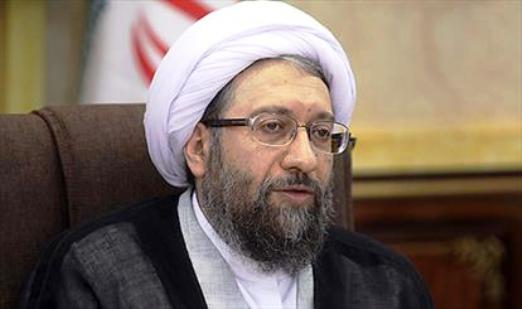
Judiciary chief calls on all Iranians to support JCPOA

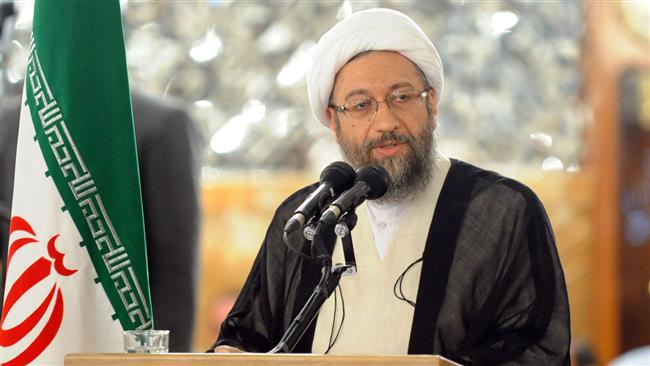
Amoli Larijani

Judiciary Chief Ayatollah Sadegh Amoli Larijani said that all Iranians should support the government and the team of negotiators for their strenuous efforts to implement the Joint Comprehensive Plan of Action (JCPOA).

Although some areas of JCPOA are far from perfect, exerting pressure on the government and the negotiators by some groups is quite unfair, Ayatollah Amoli Larijani said at a meeting of Mazandaran Provincial Administrative Council.

He said that the Judiciary has helped the government and there is good interaction between the two on this front.

“We have not given any guarantees to an institution or anyone for supporting them, but support for JCPOA is within the framework of the Islamic system and in line with the guidelines issued by the Supreme Leader,” he said.

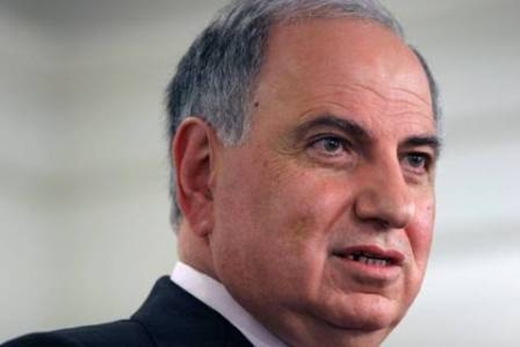
Iran delegation to attend funeral procession of Ahmad Chalabi

Chalabi

A parliamentary delegation from Iran is to participate in a funeral service in Baghdad for former Iraqi senior official Ahmad Chalabi who died of a heart attack on Tuesday, the Iraqi TV reported.

Chalabi was one of the founders of the new Iraqi government and regarded as a political and economic pillar in the country.

Chalabi who was a vocal opponent of former Iraqi dictator Saddam Hussein spent decades in the US and the United Kingdom in exile.

He returned to his country after Saddam’s downfall following the US invasion of Iraq in 2003.

He served as the interim oil minister and deputy prime minister in 2005 and 2006.

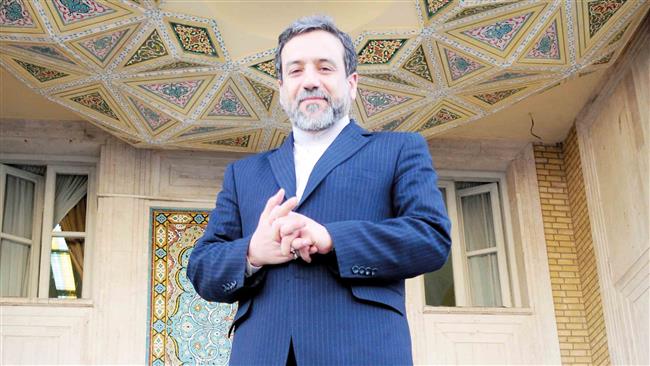
Iran faced off with Saudi Arabia in Syria talks: Abbas Araqchi

Araghchi-Abbas

The ministerial summit on Syria was held in Vienna on October 30. Apart from the Islamic Republic and Saudi Arabia, foreign ministers and representatives from the United States, Turkey, France, Germany, Egypt, Russia, Jordan, the UK, Qatar, the United Arab Emirates (UAE), Iraq, Lebanon, China and Oman also attended the talks.

Envoys from the United Nations (UN) and the European Union (EU) were also present at the talks.

“There was much give-and-take [during the talks]; and the conversations between us and Saudi Arabia were tense, and voices were raised,” said Abbas Araqchi, Iran’s deputy foreign minister for legal and international affairs, in an interview on Monday night.

“At one point” said Araqchi, “there was a quarrel between… Zarif and Adel al-Jubeir, the Saudi foreign minister.”

Referring to Zarif’s efforts to establish the Islamic Republic’s viewpoints in the final communiqué of the summit, Araqchi said, “Had the preliminary draft been published, one would have seen how different it was from the final text, where our principled demands can be seen.”

“The foreign minister of one of the countries even declared angrily that ‘It seems we are here to bring about the realization of Zarif’s demands,” Araqchi said. “Everyone admitted that Mr. Zarif’s demands were being met.”

‘Nothing will happen without Iran’

In a joint statement at the end of the Vienna talks, the participants called for a nation-wide truce in Syria. They said “substantial differences” remained but stressed the need to “accelerate all diplomatic efforts” to end the conflict in Syria.

In the statement, the participants called on the United Nations (UN) to bring together the representatives of the Syrian government and opposition to launch “a political process leading to credible, inclusive, non-sectarian governance, followed by a new constitution and elections.”

“The reality on the ground is that if Iran’s demands – which are rooted in the legitimate outlook of the Syrian people – are not met, nothing will happen” regarding the resolution of the Syrian crisis, Araqchi said.

Iran’s diplomatic scope and capabilities as well as the Islamic Republic’s confidence in that area following the conclusion of the agreement between the country and the P5+1 resulted in Iran being the main actor in the Syria talks, he added.

Araqchi made the remarks in an interview aired on the Islamic Republic of Iran Broadcasting (IRIB)’s Channel 2.

Previous talks on Syria, mediated by the UN and dubbed Geneva I and II, failed to find a solution to end the conflict in the Arab country. Iran had not been invited to any of the talks.

The foreign-sponsored conflict in Syria, which flared in March 2011, has claimed the lives of more than 250,000 people and left over one million injured, according to UN.

Saudi failure

Also on Monday, another Iranian deputy foreign minister, Hossein Amir-Abdollahian, who was present at the Vienna talks, said the Saudi foreign minister behaves in an “unbalanced” manner unworthy of a foreign minister.

Amir-Abdollahian told Alalam News Network on Monday that, during the one-day negotiations in the Austrian capital, Jubeir leveled unfounded accusations against Iran once he failed to reasonably argue over his own country’s demands but saw that the logical stances of the Islamic Republic were being addressed.

The Iranian official said that Jubeir received “a strong, unambiguous response” from Zarif.

Iran arrests US-Lebanese citizen on espionage charges

arrested

The IRIB news agency quoted informed sources on Tuesday as saying that Nazar Zaka had “deep ties” with the US military and intelligence services.

The report did not give any details on when or where the suspect had been arrested.

The report added that Zaka’s photographs show him in military uniform in a US base in the Riverside county, California.

Some sources label Zaka as “a hidden treasure trove” owing to his connections with intelligence and military bodies in the United States.

Detention of US, UK agents

Meanwhile, Iran’s Islamic Revolution Guards Corps (IRGC) has also detained members of “a network of infiltrators” affiliated with the US and British governments.

The IRGC intelligence branch has over the past week detained a number of people who had been operating in the cyberspace and Iran’s media for collaborating with hostile Western governments, the IRIB reported.

They were nabbed following months of close monitoring of their activities by the IRGC intelligence.

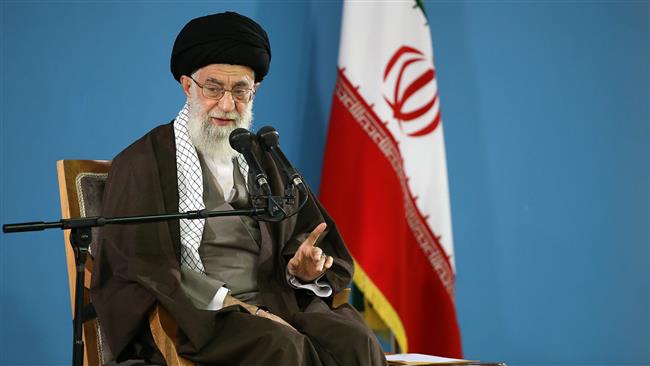
Leader: Death to US doesn’t mean death to Americans; it means death to US policies

Leader

The United States is the main enemy of Iran, Leader of the Islamic Revolution Ayatollah Seyyed Ali Khamenei said in a Tuesday meeting with Iranian students in Tehran.

The meeting came ahead of Aban 13 [November 4] which marks the day when Iranian students took over the US embassy dubbed the “den of espionage,” back in 1979. It has been named National Day of the Fight against Global Arrogance.

Ayatollah Khamenei recalled the 1953 coup d’état against former Iranian Prime Minister Mohammad Mosaddegh, and said the then-premier made a mistake by putting his trust in the US after the oil industry was nationalized.

The Leader said the US has in recent years been involved in having certain individuals conceal its hostile intentions against Iran; the objective is to hide the real intention of the enemy from Iran so foes can harm the country. “Some people do that with evil intentions, some others out of folly.”

Ayatollah Khamenei urged Iranian students to learn lessons from the US embassy takeover, noting that those students who seized the embassy found out that it was a “den of espionage.”

“This shows that the Americans, at the height of the [revolutionary] movement and the victory of the Revolution, were conspiring against the Islamic Republic; that is what America is,” the Leader said.

The Leader pointed to the nuclear negotiations between Iran and P5+1 and said it was the strength of the Iranian nation that forced the countries that claim a world power status to join hands to counter the Iranian nation and take the hostile measures that they took in the hope of bringing the Iranian nation to its knees. “That is the power of the Iranian nation,” Ayatollah Khamenei said.

[…]

Taking insignificant internal issues as pretexts, some people forget who the enemy is, the Leader said, adding, “Of course, society is free, and criticism leads to progress; however, you shouldn’t mistake the main enemy for secondary enemies or friends with whom one has disagreements.”

“The main enemy is the one who seeks to destroy the achievement of the Iranian nation,” the Leader of the Islamic Revolution said, adding, “In the negotiations, claiming that they opposed war, the Americans even shed tears in front of cameras. This is the very person who doesn’t bother when Zionists cut to pieces hundreds of children in Gaza. Is crying in front of the camera a sincere act?”

Death to US policies

“The slogan ‘death to America’ is backed by reason and wisdom; and it goes without saying that the slogan does not mean death to the American nation; this slogan means death to US policies, death to arrogance,” the Leader said.

“Our universities were one day a bridge to the West; today, they are ladders to reach high goals; certain people want to destroy this ladder and replace it with that bridge to the West,” Ayatollah Khamenei said, urging alertness by the youth in the face of such attempts.

Peugeot says ready to transfer modern technology to Iran

peugeot

The executive vice-president and a member of PSA Peugeot Citroen Managing Board says that his company had repeatedly offered Iranian carmakers – prior to the imposition of sanctions – a proposal: transferring the technology of new cars to Iran to produce sleek automobiles.

Jean-Christophe Quemard, who is a household name in France’s automotive industry, made the comment in an interview with Iran newspaper and expressed regret over the production of old, low-quality cars in Iran.

The following is the translation of a report Iran daily published on November 2 on the remarks of the French man whose name has been often heard in Iran during talks between Iran Khodro, the leading Iranian vehicle manufacturer, and Peugeot:

Quemard, Peugeot’s executive vice-president for Middle East and Africa who has recently traveled to Iran, has grievances to air. These grievances caused him to break his silence after a long time and openly talk about cooperation with Iran and the prospect of relations between the two automotive companies.

He was complaining about what has been recently reflected in the Iranian media, saying that such reports are simply based on a false interview a French magazine has published. According to the French magazine, the managing director of PSA Peugeot Citroen has said that his company will officially announce conditions for talks with Iran Khodro to build up pressure on the Iranian side. The magazine has also said that by doing so, Peugeot wants to put an end to the provocative acts of Iran Khodro when it comes to re-entering into partnership with Peugeot.

Quemard explicitly said that these remarks are nothing but misinterpretations and that Peugeot’s managers have not and will not make any such comments on joint ventures. [He also said] If Peugeot had had such a view of Iran, it would have never come to the negotiating table.

Addressing Iranians, Quemard said that remarks which have been recently attributed to Peugeot on cooperation with Iranian carmakers are not true, adding that they are merely misconceptions. “Peugeot’s rivals were in fact trying to do something to deal a blow to Europe’s second largest car manufacturer and render it unable to develop its activities.”

The Peugeot manager – who has come to Iran, at least nine times, to sign contracts with Iran Khodro and Saipa – further said that talks with Iranian carmakers are making progress and Peugeot’s three updated products seem likely to be introduced to the Iranian market in the next 18 months.

He expressed regret that cars of poor quality are produced in Iran and said that during our cooperation with Iran before the sanctions Peugeot told its Iranian counterparts that they could bring modern technologies to Iran and produce better cars.

Iranians did not welcome Peugeot’s offer, he said, adding that’s why some of the cars made [in Iran] are 2001 models. “No doubt, such cars cannot meet public demands now. There is no reason for not bringing modern cars to Iran.”

During the interview, Quemard repeatedly said he does not want to return to the past, adding “We need to build the future and make thoughtful planning for it. Before the sanctions, the two countries [Iran and France] benefited [from their cooperation] and they made losses when their cooperation was cut off. In fact, things are not always either black or white.”

He went on to say, “We are ready to cooperate with Iran in areas such as technology transfer, fuel consumption reduction, after-sale services and upgrading car safety. Asked if Iran Khodro has demanded compensations from Peugeot, he just said, “The one who has done something wrong should pay compensations.”

He added, “PSA Peugeot Citroen entered into an alliance with General Motors due to financial problems, so we had to comply with international rules and regulations. This caused Peugeot to leave Iran.”

The French manager also said that a car manufacturing company which was cooperating with Iran had to pay $9 billion in fines, adding that Peugeot, which is an economic institution, could not take such a risk.

A look at Iranian newspaper front pages on Nov. 3

Iranian Newspapers Headlines

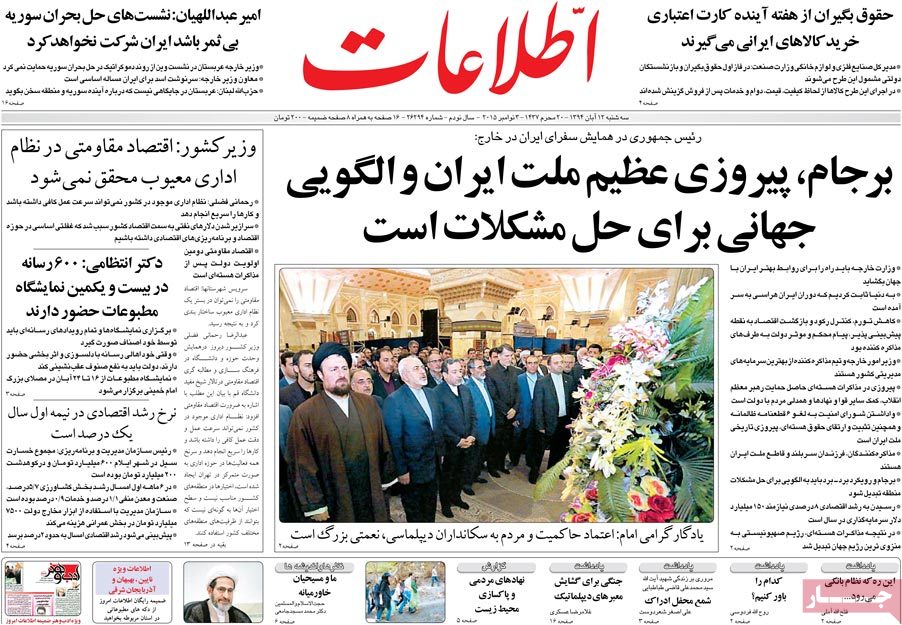
The comments of the president and the judiciary chief at an annual gathering of Iranian ambassadors and heads of diplomatic missions overseas on a wide range of issues including the nuclear deal and human rights dominated the front pages of Iranian newspapers Tuesday.


Ettela’at: “The Joint Comprehensive Plan of Action is a glorious victory for the Iranian nation and a model to settle global problems,” President Rouhani told a gathering of Iranian ambassadors in Tehran.

The president further said the Foreign Ministry should pave the way for better relations between Iran and the rest of the world.

Ettela’at: The grandson of the late Imam Khomeini has described the trust of the establishment and members of the public in the diplomacy machine as a great blessing.

Ettela’at: As of next week, Iranians on government payroll will receive credit cards to purchase Iranian-made products.

Quality, affordability, durability and after-sales services have been the criteria used in picking out the items which can be purchased with these cards.

Ettela’at: The deputy foreign minister has said Iranians will stay away from the talks on the Syrian crisis if they turn out to be useless.

Hossein Amir-Abdollahian further said that in the Vienna talks the Saudi foreign minister failed to support the diplomatic process in settling the Syrian crisis.

Ettela’at: The interior minister has said that implementation of the resistance-based economy in a faulty administrative system would be impossible.

Abdolreza Rahmani Fazli further said that institutionalization of a resistance-based economy is the government’s second priority after the nuclear issue.

Ettela’at: The deputy minister of culture and Islamic guidance has said that some 600 media outlets will take part in the 21st edition of the Media Exhibition.

The event opens at Imam Khomeini Prayer Ground in Tehran on November 7.

Ettela’at: Iran’s economic growth in the six months to September 23 stood at one percent.

The growth figure for the entire year [ends on March 20, 2016] is projected to be two percent.
 

A look at Iranian newspaper front pages on Nov. 3


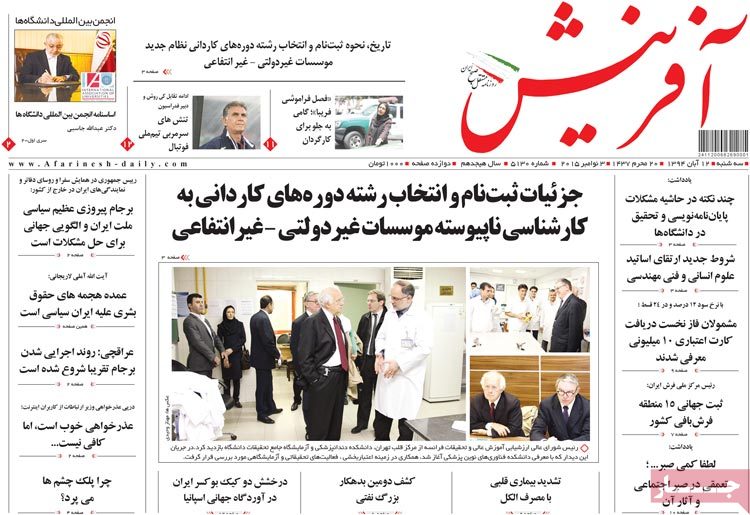
Afarinesh: Two Iranian kick-boxers had a stellar performance in the 2015 World Kickboxing Federation (WKF) Championships in Spain.
 

A look at Iranian newspaper front pages on Nov. 3


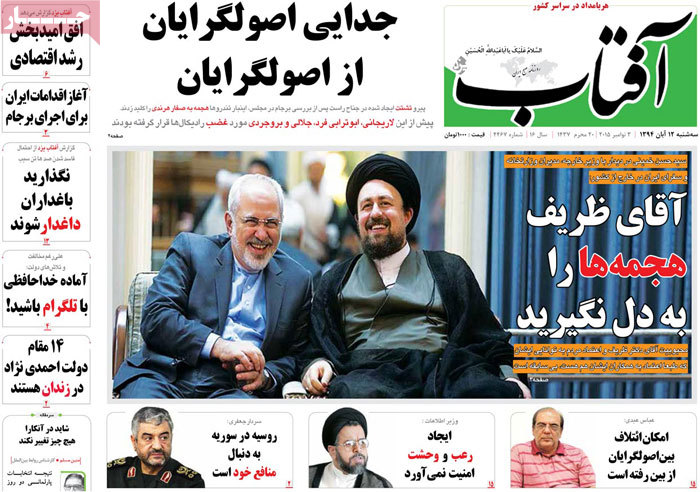
Aftab-e Yazd: Get ready to bid farewell to Telegram!

The daily says government efforts to stop the messaging app from being blocked are unlikely to produce the intended result.

Aftab-e Yazd: “Russia is after its own interests in Syria,” said the commander of the Islamic Revolution Guard Corps Major General Jafari.
 

A look at Iranian newspaper front pages on Nov. 3


Arman-e Emrooz: “There are difficulties associated with great jobs. Don’t take accusations seriously,” the grandson of the late Imam Khomeini told the foreign minister.

Seyyed Hassan Khomeini further said that the popularity of Foreign Minister Zarif is unprecedented.

Arman-e Emrooz: A member of parliament’s Followers of the Leader Caucus has said that 14 officials of the Ahmadinejad administration are in prison.
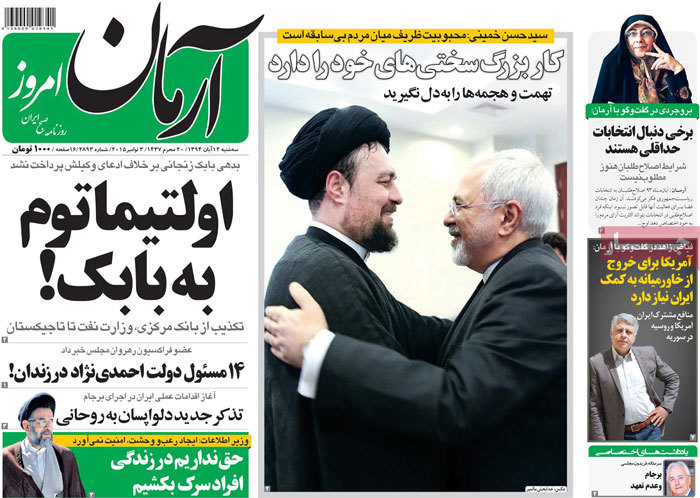
 

A look at Iranian newspaper front pages on Nov. 3


Asr-e Rasaneh: The ban on bird hunting in 10 provinces remains in place.
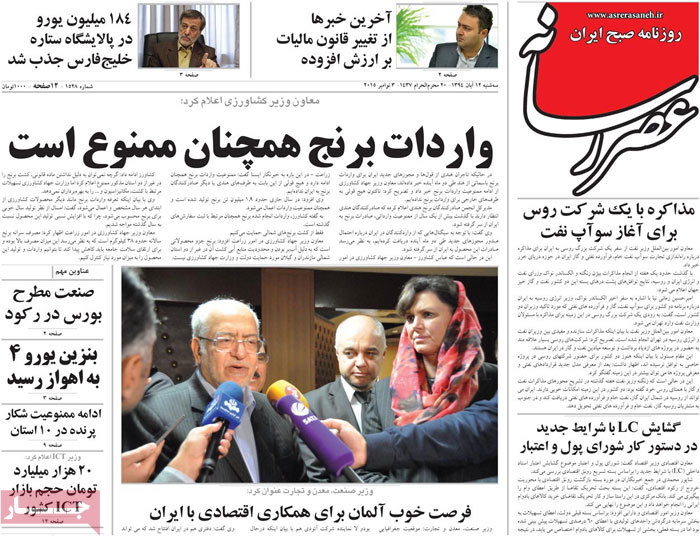
 

A look at Iranian newspaper front pages on Nov. 3


Asrar: “We are not authorized to hold talks with the US over Syria,” said the deputy foreign minister for Arab and African affairs.
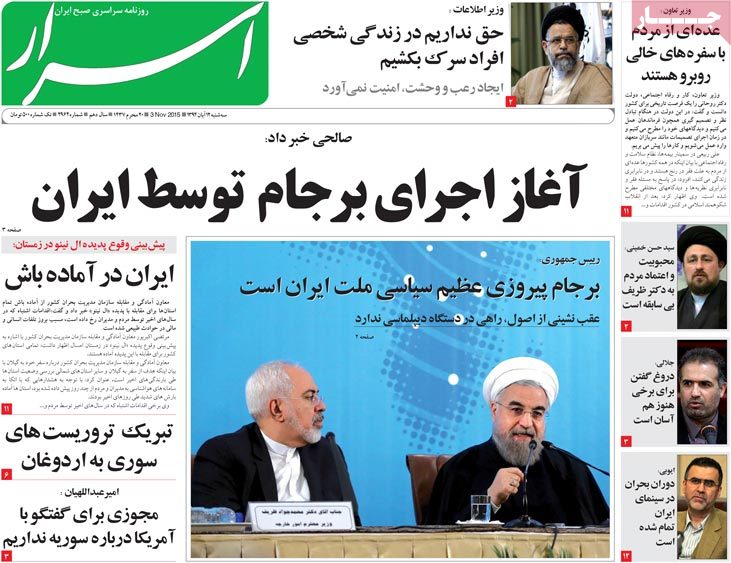
 

A look at Iranian newspaper front pages on Nov. 3


Bahar: President Rouhani has urged Riyadh to opt for interaction with Iran.

“Saudi Arabia’s doubling back on the wrong path [it has chosen] would pave the way for cooperation,” said the Iranian president.
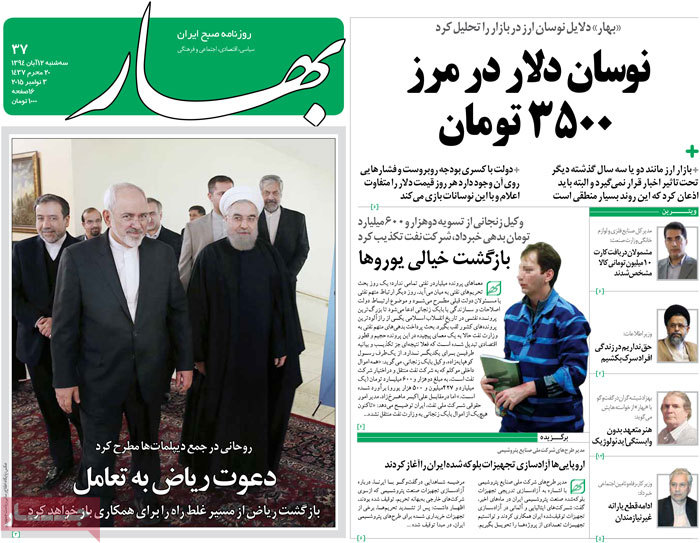
 

A look at Iranian newspaper front pages on Nov. 3


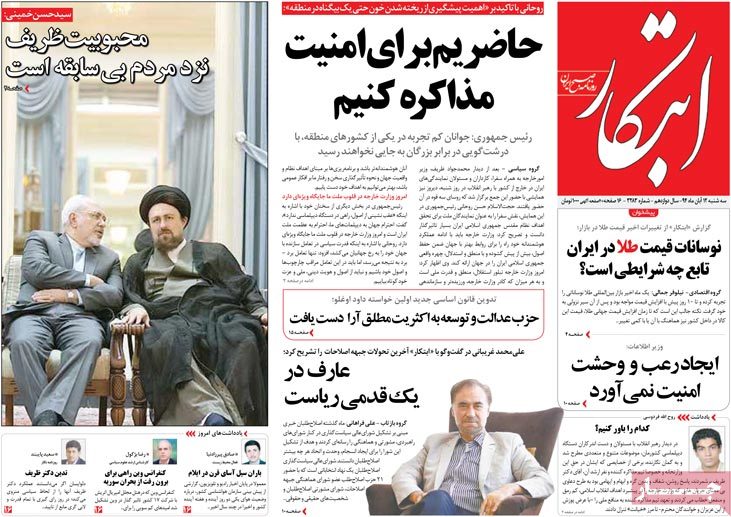
Ebtekar: “Intimidation does not bring about security,” said the minister of intelligence.
 

A look at Iranian newspaper front pages on Nov. 3


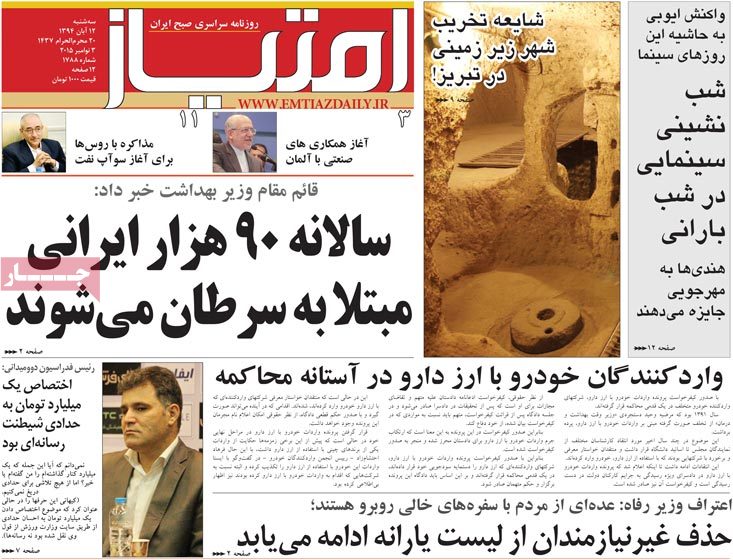
Emtiaz: A deputy health minister has said each year some 90,000 Iranians develop cancer.
 

A look at Iranian newspaper front pages on Nov. 3


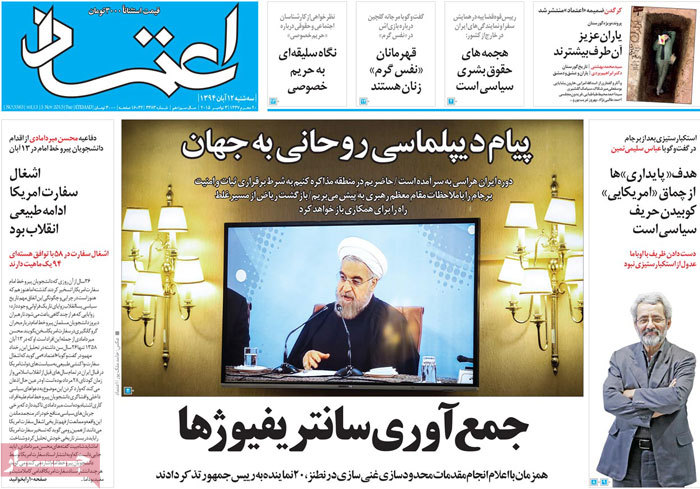
Etemad: Removal of centrifuges

As the government said it is taking preparatory measures to limit enrichment in the Natanz facility, 20 MPs issued a warning to the president.
 

A look at Iranian newspaper front pages on Nov. 3


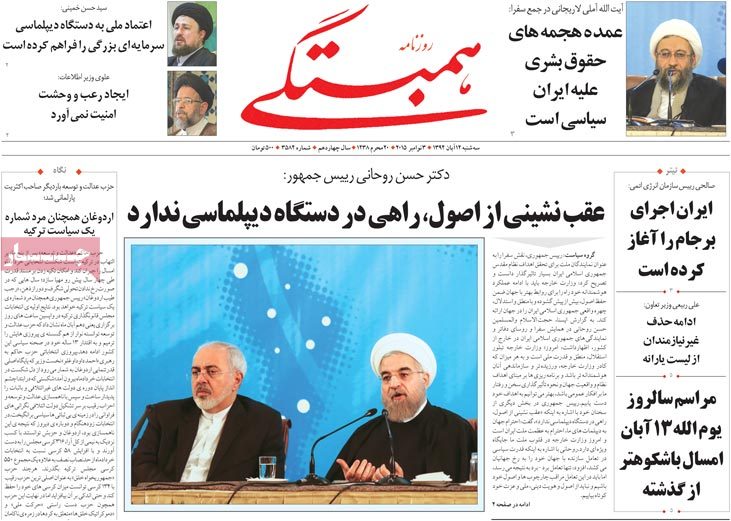
Hambastegi: “Most of human rights allegations against Iran are politically motivated,” said Judiciary Chief Ayatollah Sadegh Amoli Larijani.
 

A look at Iranian newspaper front pages on Nov. 3


Hemayat: “Infiltration is part of the fourth sedition,” said the commander of the Islamic Revolution Guard Corps.

Hemayat: The top judge has said that the Judiciary takes pride in implementing Islamic human rights.

Hemayat: The chairman of the Prisons Organization has said that in Iran 70 percent of inmates are behind bars for drug-related offenses.
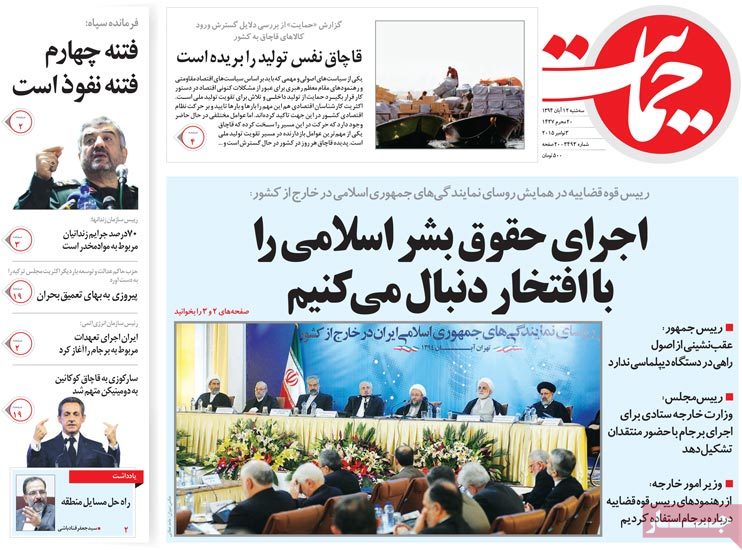
 

A look at Iranian newspaper front pages on Nov. 3


Iran: Autumnal snow and rain in 16 provinces

Iran: The British minister of state for trade and investment has said in an interview with the daily that Britain seeks partnership with the Iranian private sector.

Iran: The head of the Civil Aviation Organization has said airlines have been given the go-ahead to purchase new aircraft.
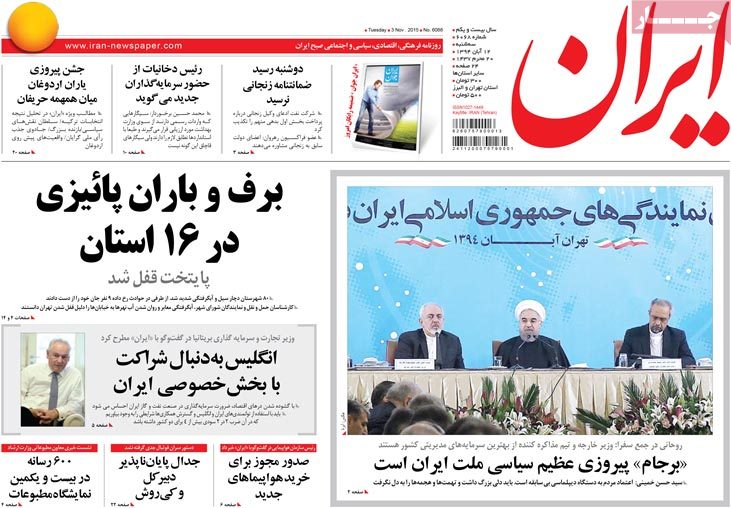
 

A look at Iranian newspaper front pages on Nov. 3


Javan: Those who took over the den of espionage [a reference to the US embassy in Tehran] are defending their action.
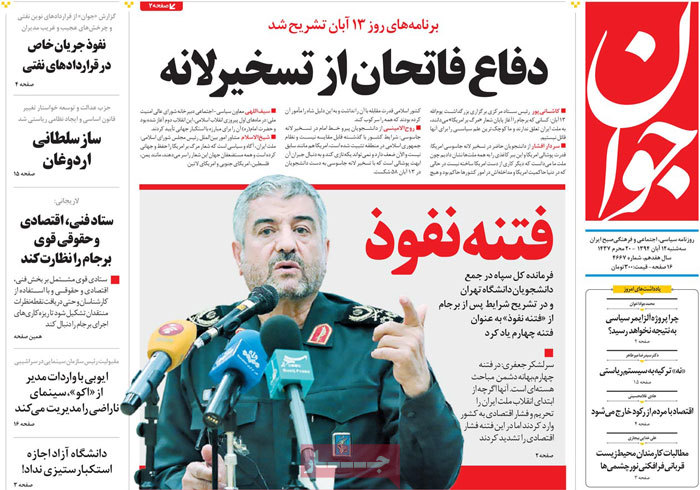
 

A look at Iranian newspaper front pages on Nov. 3


Jomhouri Islami: The policy of intimidation and insecurity in Turkey led to the victory of Erdogan’s AKP party in elections.
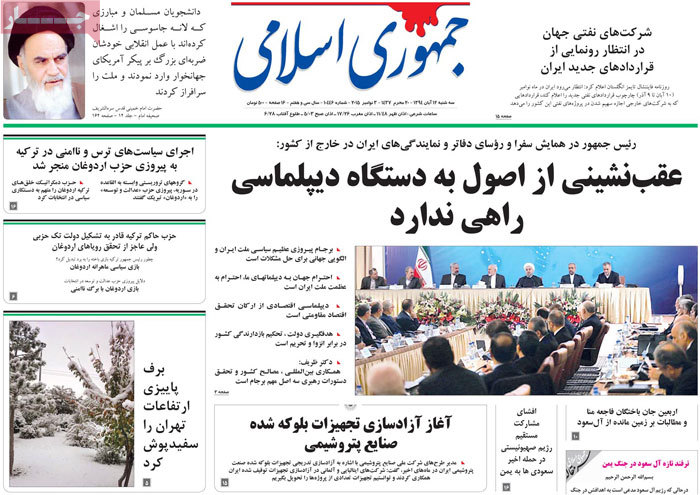
 

A look at Iranian newspaper front pages on Nov. 3


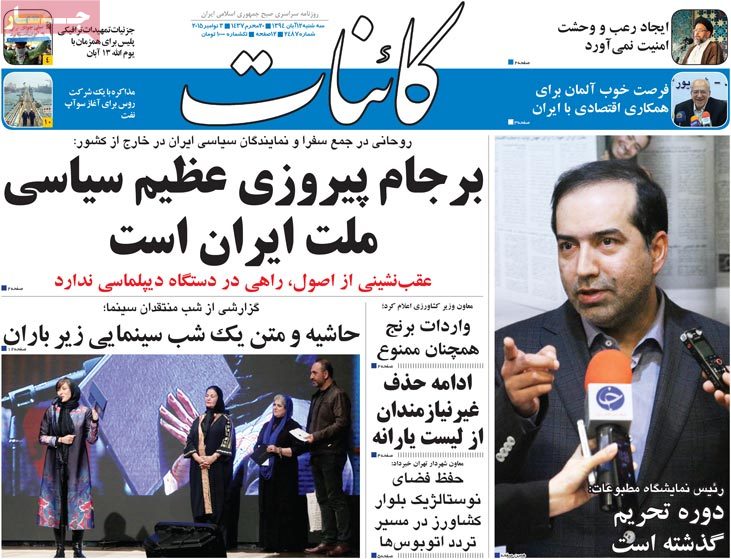
Kaenat: Imports of rice are still banned.
 

A look at Iranian newspaper front pages on Nov. 3


Kayhan: Implementation of the Joint Comprehensive Plan of Action! Where are the written guarantees?


A look at Iranian newspaper front pages on Nov. 3


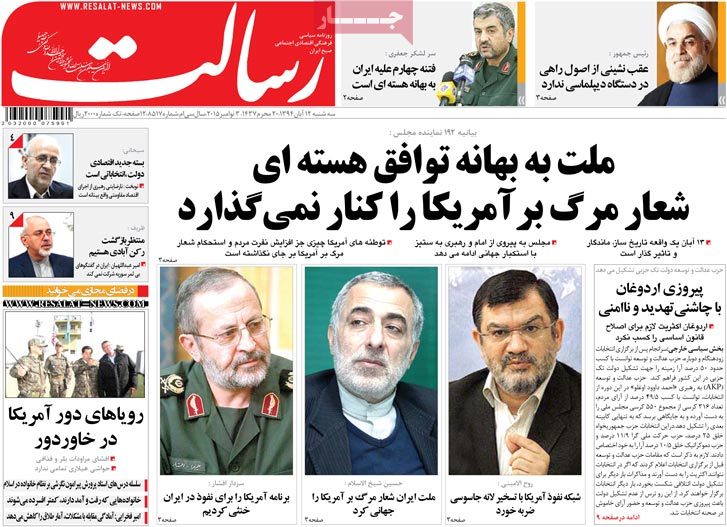
Resalat: “The nation won’t dump its slogan of ‘Down with the US’ simply because of the nuclear deal,” read a statement signed by 192 Iranian MPs.
 

A look at Iranian newspaper front pages on Nov. 3


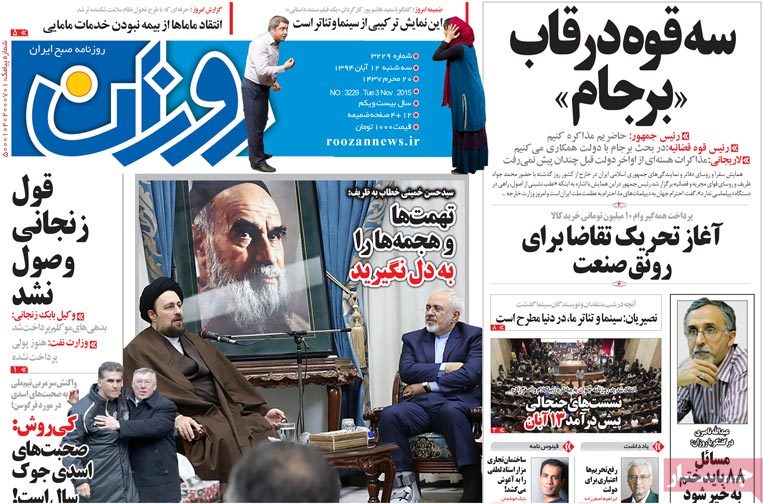
Roozan: Babak Zanjani [a young billionaire on trial for corruption] has not made good on his promise.

His lawyer says he has paid back his debts to the Oil Ministry.

The Oil Ministry says it has received no payment.
 

A look at Iranian newspaper front pages on Nov. 3


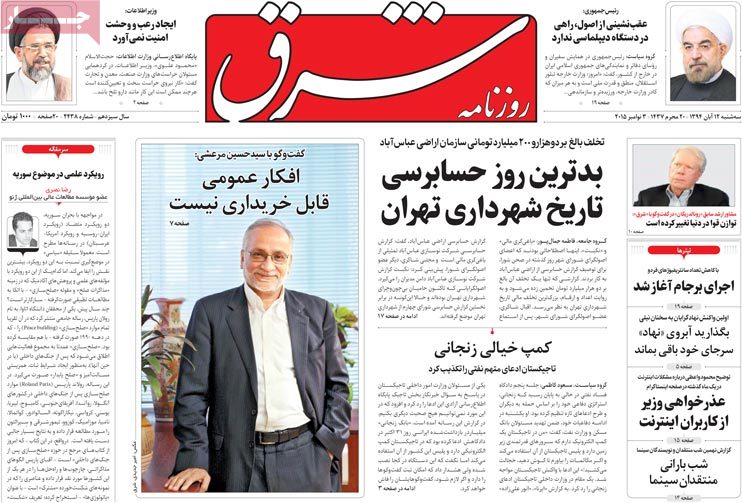
Sharq: “Withdrawal from principles has no place in Iran’s diplomacy apparatus,” said the president.

Sharq: The minister of communications has apologized to Internet users for disruptions to the Instagram service over the past month.

 

A look at Iranian newspaper front pages on Nov. 3


West’s anti-Iran human rights campaign biased: Judiciary chief

Larijani-Judiciary

Iran’s Judiciary Chief Ayatollah Sadegh Amoli Larijani has criticized the West’s human rights campaign against the Islamic Republic as biased, spiteful and politically-motivated.

Larijani said on Monday that not only have the Western countries turned a blind eye to the deadly Saudi aggression against Yemen and brutal killing of civilians in the impoverished country, but also defended the bloody campaign.

[…]

While Saudi Arabia continues to support terrorist groups such as IS and al-Qaeda in the region, the West accuses Iran of human right violations, the Iranian judiciary chief said.

He, however, emphasized that Iran would pursue human rights principles based on Islamic values and will never “submit to the human rights that the Westerners set for us (Iran).”

The judiciary chief further pointed to Saudi Arabia’s death sentence against prominent Shiite cleric Nimr al-Nimr and said Riyadh insists on the execution of an outspoken clergyman while nobody voices any opposition.

Sheikh Nimr was attacked and arrested in Qatif in July 2012, and was charged with undermining the kingdom’s security, making anti-government speeches, and defending political prisoners. He has denied the accusations.

On October 25, the Saudi Supreme Court upheld a death sentence issued against the cleric last year. The execution warrant will be sent to Saudi King Salman bin Abdulaziz Al Saud to be approved and then carried out. The execution of the Shiite cleric can be carried out by the Interior Ministry without any prior warning if the Saudi king signs the order.

Iran’s advisory help for Yemen to continue: IRGC chief

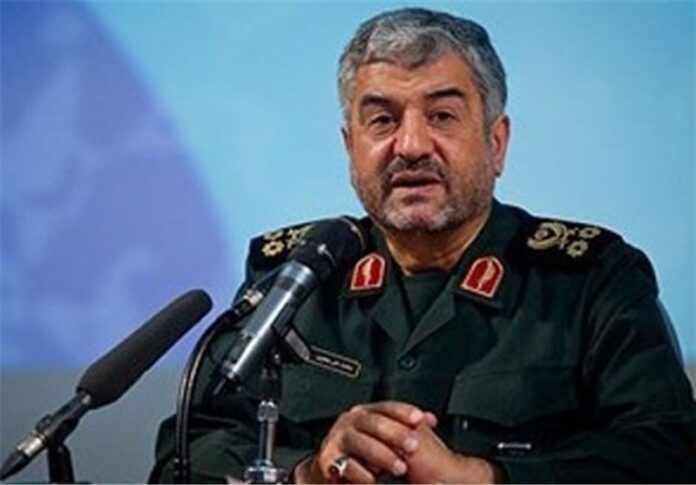
General Jafari

Commander of the Islamic Revolution Guard Corps (IRGC) Major General Mohammad Ali Jafari affirmed that Iran will keep providing Yemen’s Ansarullah movement with whatever advisory assistance it may need in the face of the Saudi-led aggression.

In an address to the University of Tehran’s students on Monday, the top general said Iran has offered the necessary help for Yemen so far, and will continue to “do whatever it can in the advisory dimension”, because “the Ansarullah (movement) has gained a firm position in Yemen.”

His comments came against the backdrop of more than seven months of airstrikes against Yemen by a Saudi-led military coalition. The Saudis and their Arab allies have been targeting the Houthi Ansarullah movement in an attempt to restore power to the fugitive former Yemeni President Abd Rabbuh Mansour Hadi, a close ally of Riyadh.

Major General Jafari reaffirmed Iran’s commitment to offering advisory assistance to the Syrian government and nation.

The general said Iran will keep backing Syrian President Bashar al-Assad, who has stood against Israel.

Lauding the Syrian president’s significant role in the axis of anti-Israeli resistance, the IRGC commander said Iran will agree to Assad’s stepping down “only if the Syrian people choose it in elections.”

Supreme Leader of the Islamic Revolution Ayatollah Seyyed Ali Khamenei on Sunday described the only way out of crisis in Syria as elections.

“The solution to the Syria issue is elections and to that effect, war and unrest should first end with a halt to military and financial aid to the opposition, so that the Syrian people would elect anyone they want in a safe and calm atmosphere,” Ayatollah Khamenei said.

Iran calls for dialogue of religions, civilizations, cultures

Janati

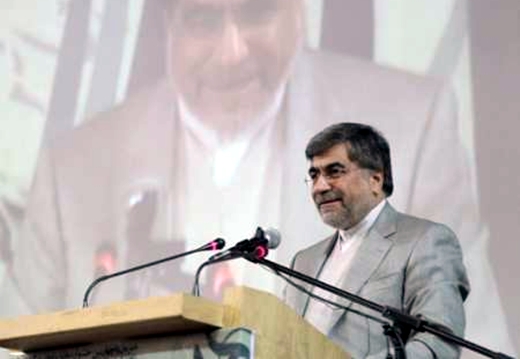
Minister of Culture and Islamic Guidance Ali Jannati said on Monday that Iran calls for proximity of religions and dialogue of civilizations and cultures as well as an international campaign against terrorism and violence.

Jannati made the remarks in a 9th conference of the ministers of culture from Islamic countries in Muscat, Oman.

The Islamic Republic of Iran has spared no effort to fight violence, terrorism and Takfiri terrorists, he said.

Referring to Palestine and the holy Quds, he said Iran has made great strides to support the Palestinians and defend the identity of the holy Quds though publication and promotion of the teachings of the holy Koran.

The Islamic Republic of Iran has always supported the cause of Palestine and liberation of the holy Quds, underlined the minister.

The enemies of Islam seek to sow discord, and promote superstition, backwardness of nations and blind ethnical disputes, he said.

Cooperation among Islamic states at this very sensitive juncture is not merely an option, it is an obligation, he said.

Unfortunately, during this year’s Hajj pilgrimage there were two very painful incidents claiming the lives of thousands of pilgrims which require sound management, Jannati said.

Jannati also welcomed a decision by the Islamic Educational, Scientific and Cultural Organization (ISESCO) to designate the city of Mashhad in northeastern Iran as the cultural capital of Muslim World in 2017.

“I would like to seize the opportunity and invite ministers of Islamic countries and all Muslims to visit the holy city,” he said.