Wednesday, December 24, 2025
Home Blog Page 4694

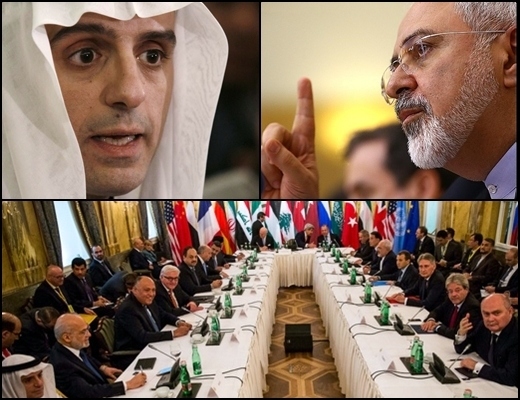
What led to argument between Zarif and Al-Jubeir at the Vienna conference?

Zarif-saudi-fm

Although the Iranian delegation in Vienna tried not to be dragged into a verbal confrontation with the Saudis, the baseless, offensive remarks of Saudi Foreign Minister Adel Al-Jubeir drew an open and sharp reaction from Foreign Minister Zarif, an Iranian deputy foreign minister said in a TV interview Saturday.

The following is the translation of a report Entekhab.ir published on November 1on what else Deputy Foreign Minister for Arab and African Affairs Hossein Amir Abdollahian said:

The deputy foreign minister said, “Throughout the gathering, Mr. Al-Jubeir tried to set a timetable for President Bashar al-Assad’s departure. He wouldn’t care about the Syrian people’s right to self-determination at all, and made baseless comments.

At one point when the conference was in session and other ministers were in attendance, Dr. Zarif responded to those remarks nonchalantly, and, at another, he openly rejected each of his comments.”

Abdollahian further said, “Iran’s presence [in the conference] helped the objectives envisioned in Tehran’s Syria strategy be taken into account. After seven hours of bargaining, we succeeded in reaching agreement over holding talks about key questions, including the need for simultaneous attention to the fight against terrorism and the election process based on international standards and not foreign interference in Syria as well as attention to refugee and humanitarian problems along with respect for Syria’s independence, sovereignty and territorial integrity.”

Iran not to implement JCPOA until sanctions repealed: MPs

Iranian lawmakers have urged the administration to withhold the fulfillment of its commitments under a nuclear agreement reached with P5+1 until US and EU sanctions against Tehran are declared null and void.

In a letter to President Rouhani on Sunday, 213 lawmakers said no practical measure should be taken with regard to the implementation of the Joint Comprehensive Plan of Action (JCPOA) before US President Barack Obama and the European Union officially declare the lifting of all financial and economic sanctions against Tehran.

They called on the government to set up a “powerful, informed and astute” committee to supervise the implementation of JCPOA.

It is expected that the government fully observe the directives issued by Leader of the Islamic Revolution Ayatollah Seyyed Ali Khamenei on the implementation of JCPOA to safeguard the interests of the Iranian nation, the letter read.

In a letter to President Rouhani on October 21, the Leader enumerated certain points on the implementation of JCPOA and issued directives to be heeded in this regard.

The Iranian president, in a letter addressed to the Leader on October 22, expressed gratitude to the Leader for his guidelines and support regarding the nuclear agreement and reiterated that Ayatollah Khamenei’s instructions will be fully taken into account.

[…]

Hardliners at home have dealt a blow to the country

Nategh Nouri

A member of the Expediency Council has taken a swipe at those who claim Iran’s negotiating team has not respected the red lines set by the Supreme Leader, saying what the country needs more than anything else at this juncture is unity.

Ali Akbar Nategh Nouri made the comments on Saturday and questioned the remarks some hardliners attribute to the Supreme Leader on the nuclear issue and Iran’s negotiating team. Ettela’at Newspaper published his remarks on November 1 and the following is the translation of part of what the former parliament speaker said:

The Expediency Council member said, “The Supreme Leader set the red lines and said that the nuclear negotiating team respected those red lines. But a number of hardliners claim – based on no solid evidence – that red lines have not been respected and the Leader’s remarks have been ignored and that these people [Iran’s nuclear negotiators] should be put on trial.

“What is this nonsense? The country has an establishment and a brave, vigilant leader. We are pursuing such [divisive] things instead of promoting unity in society and boosting like-mindedness at this [critical] juncture in the region.”

[…]

Nategh Nouri, who is currently the head of the Inspection Office of the Supreme Leader, went on to say, “The Leader has said time and again ‘Nobody should speak on my behalf. Nobody should quote me as saying this and that. I will speak my mind if have something to say. I am alive [and can speak for myself].’

“But there are some who are, as they say, more Catholic than Pope; they call themselves the followers of Velayat-e Faqih [Guardianship of the Islamic Jurist], but they create tension in society. They say the Leader meant this or the Leader said that. The Supreme Leader’s Office has on occasion denied such remarks [they attribute to Ayatollah Khamenei].

“The Leader has explicitly said that he will express his views, but some in certain newspapers and websites make these remarks [claiming that they are the Leader’s views]”.

He then touched upon the nuclear issue and said, “The Supreme Leader has repeatedly said that he approves of the country’s nuclear negotiating team whose members are religiously devoted and that the foreign minister and his companions are fighting a battle on the political front. […]”

[…]

Nategh Nouri also said that we will be blessed with divine power if we stand united and follow in the footsteps of the Supreme Leader, adding that Velayat [guardianship] is a blessing for the country. “Why can’t other countries get united? Because they lack such a blessing.

“We should know that Shiites are polite. They do not use foul language. They are not foul-mouthed and do not resort to offensive language. […]”

A look at Iranian newspaper front pages on Nov. 1

Iranian Newspapers Headlines

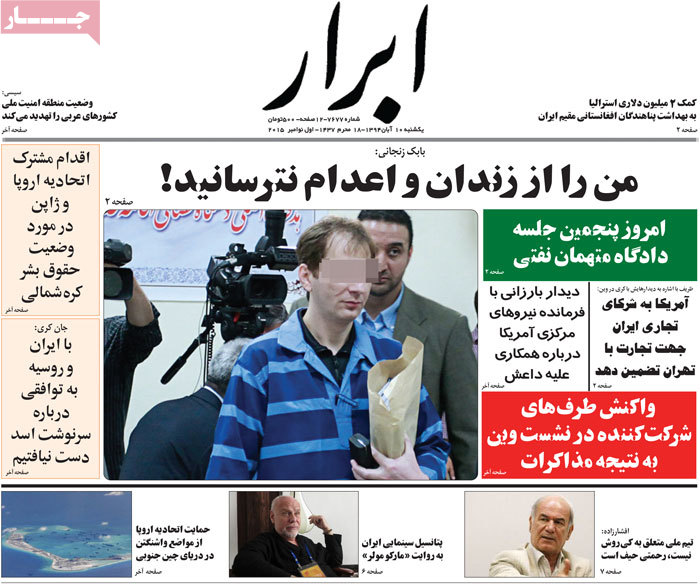
A fourth hearing in the corruption trial of Babak Zanjani and his brazen claims on repayment of the money he’s been accused of siphoning off dominated the front pages of Iranian newspapers on Sunday. Also in the news were comments by a former parliament speaker who lashed out at hardliners for claiming that the country’s nuclear negotiators have violated the red lines set by the Supreme Leader.   


Ettela’at: “Mudslinging is the country’s most serious abnormal behavior,” said a deputy Judiciary chief.

Mohammad Bagher Olfat further said that no country treats its greats the way Iran does.

He also said that we need to close the loopholes that might be used by those who seek to make a career out of conditions that arise in the post-sanctions era.

Ettela’at: The first vice-president has said that the government has made extensive planning for the post-sanctions era.  

Ettela’at: Iran is to draw up a document on the global fight against particles, said Masoumeh Ebtekar, the director of the Environment Protection Organization.

She also blamed negligence [by the previous government] over the years for the [formation of polluting] particles centers inside Iran.

Ettela’at: UN chief Ban Ki-moon has said that only the Syrian people should decide on the future of Assad.

The United Nations has announced that the Damascus government and the Syrian opposition will also attend the next rounds of talks over Syria.

Ettela’at: Hardliners and extremists inside Iran have dealt a blow to the country, said Ali Akbar Nategh Nouri [a former parliament speaker].

“The Supreme Leader set the red lines and said that the nuclear negotiating team respected those red lines. But a number of hardliners claim – based on no solid evidence – that red lines have not been respected and the Leader’s remarks have been ignored and that these people [Iran’s nuclear negotiators] should be put on trial,” he further said.

Ettela’at: Head of the Cancer Research Center of Shahid Beheshti University of Medical Sciences Mohammad Esmail Akbari has said that sausage and lunch meat are the primary cancer risk factor in the country.

He also said that [satellite] jamming signals are very dangerous.

Ettela’at: ISIS claims it has brought down a Russian passenger plane in Sinai, Egypt.

ISIS terrorists in Egypt have said that the Russian plane was targeted in response to airstrikes by Russian fighter jets on Syria.

All 224 people on board the plane have been killed.


A look at Iranian newspaper front pages on Nov. 1


Abrar: The US is expected to give guarantees to Iran’s trading partners for doing business with Tehran, said Foreign Minister Mohammad Javad Zarif referring to his meetings with US Secretary of State John Kerry in Vienna.
 

A look at Iranian newspaper front pages on Nov. 1


Afkar: The president of the European Parliament is to arrive in Iran on November 7.
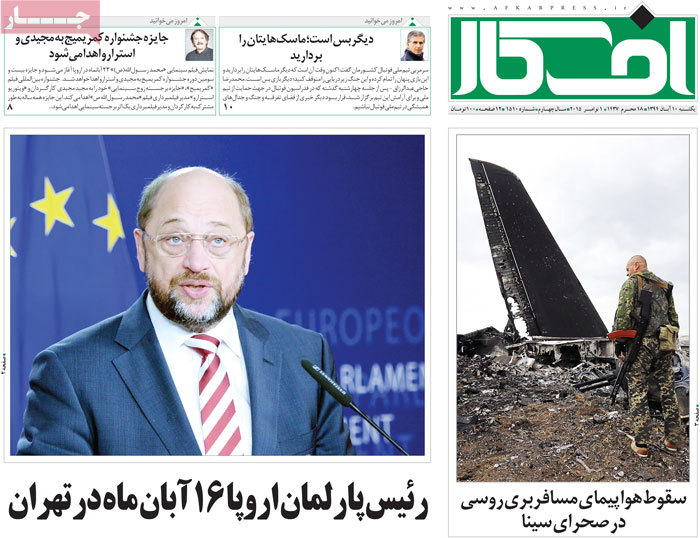
 

A look at Iranian newspaper front pages on Nov. 1


Aftab-e Yazd: Ballyhoo against HIV-positive students

Aftab-e Yazd: Hardliners are seeking to put on trial the country’s nuclear negotiating team, said former parliament speaker Ali Akbar Nategh Nouri.
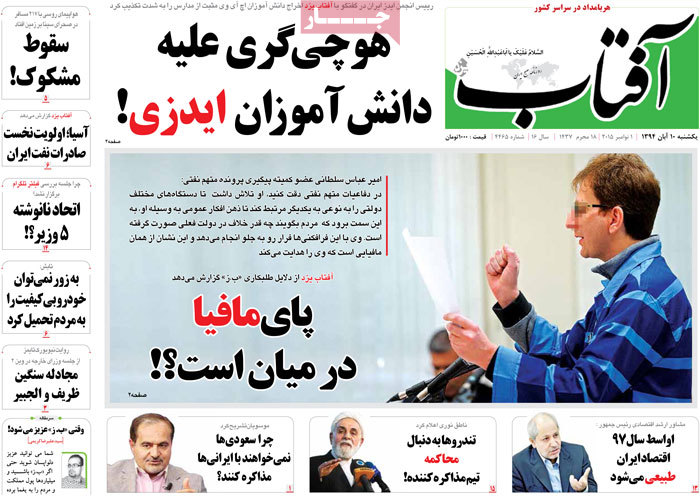
 

A look at Iranian newspaper front pages on Nov. 1


Arman-e Emrooz: Ali Motahari is following in the footsteps of his father

Motahari: The [political] atmosphere has become highly charged since 2009 [following the presidential elections in which former president Ahmadinejad was reelected].

The Tehran MP has also said that a large number of reformists are more religiously devoted than principlists.

Arman-e Emrooz: Iran should create competition among its foreign partners, said Saeed Laylaz, an economist, in an interview with the daily.
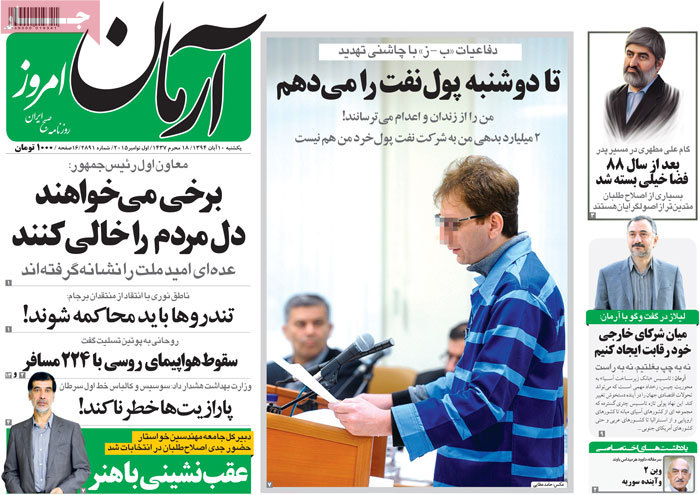
 

A look at Iranian newspaper front pages on Nov. 1


Asr-e Iranian: IRIB remained impartial in the review of the Joint Comprehensive Plan of Action, said Bijan Nobaveh, [a principlist MP and a former manager at IRIB], in reaction to attacks against the national broadcaster.
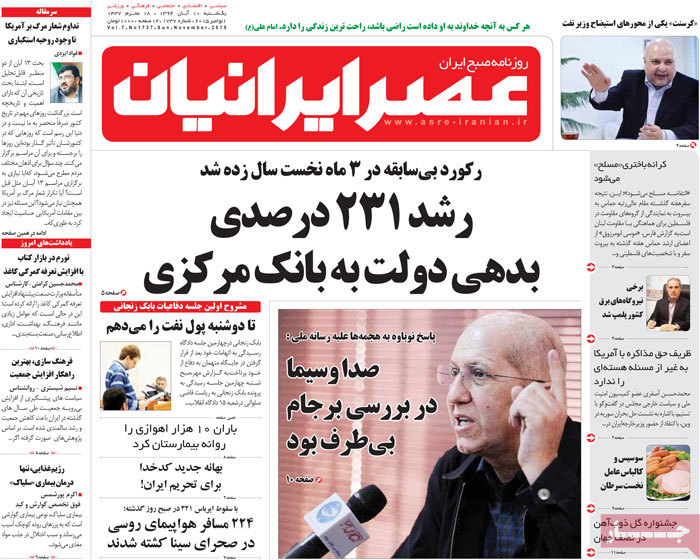
 

A look at Iranian newspaper front pages on Nov. 1


Asrar: Al Saud is the vicious regime in the region, said Speaker of the Islamic Consultative Assembly Ali Larijani.

Asrar: Those who allege that red lines have not been respected [in the Iran nuclear deal] should be put on trial, said Ali Akbar Nategh Nouri.
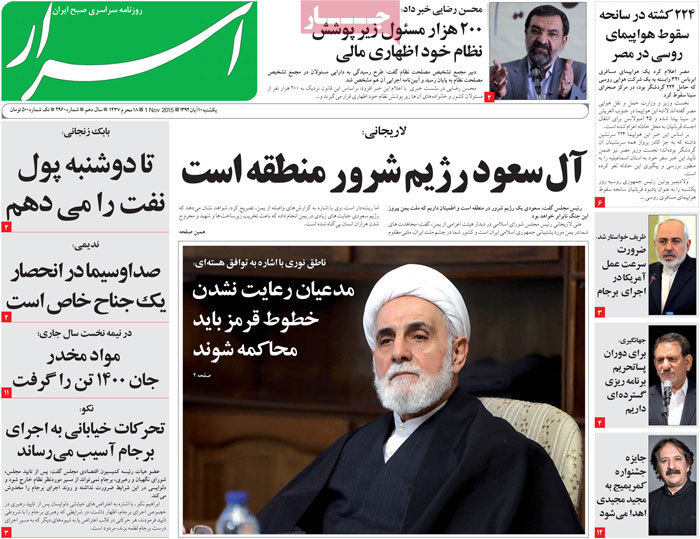
 

A look at Iranian newspaper front pages on Nov. 1


Bahar: Time has come for us to focus on domestic policy, said Ali Motahari, stressing the need for settling the lingering questions surrounding the 2009 presidential elections.
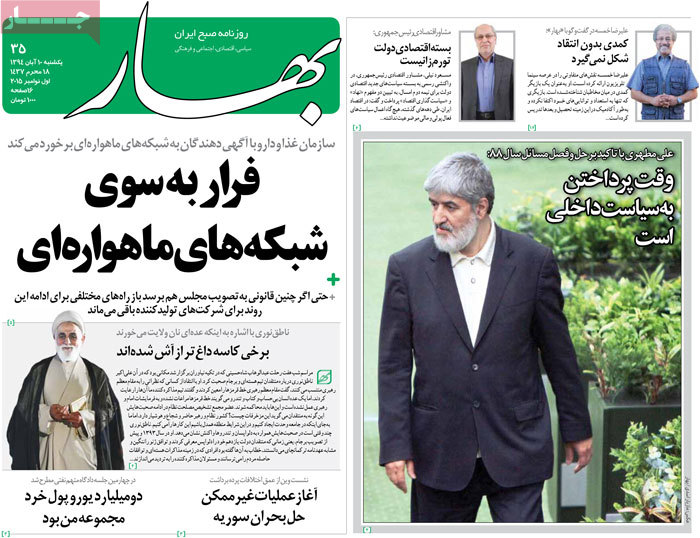
 

A look at Iranian newspaper front pages on Nov. 1


Ebtekar: “I will pay back the oil money by Monday,” said Babak Zanjani, the so-called oil billionaire who is on trial for massive corruption and embezzlement, in the fourth hearing of his trial.

“Do not threaten me with execution!”

“Two billion euros is nothing more than small change to me,” he said.
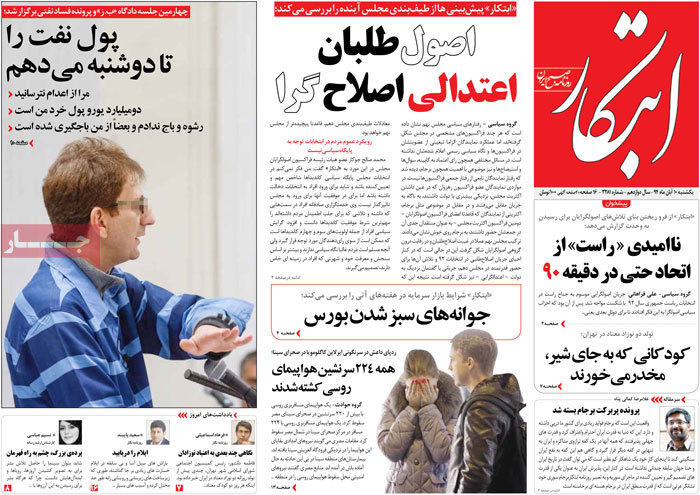
 

A look at Iranian newspaper front pages on Nov. 1 


Etemad: The accused points an accusing finger

The daily has taken a closer look at the fourth hearing of Babak Zanjani, the oil defendant, who accused the government, oil minister, the Judiciary and some other institutions of treating him improperly.  

Etemad: We should not go on the defensive [in dealing with those who] simply make critical comments, said Ali Motahari in the University of Tehran.
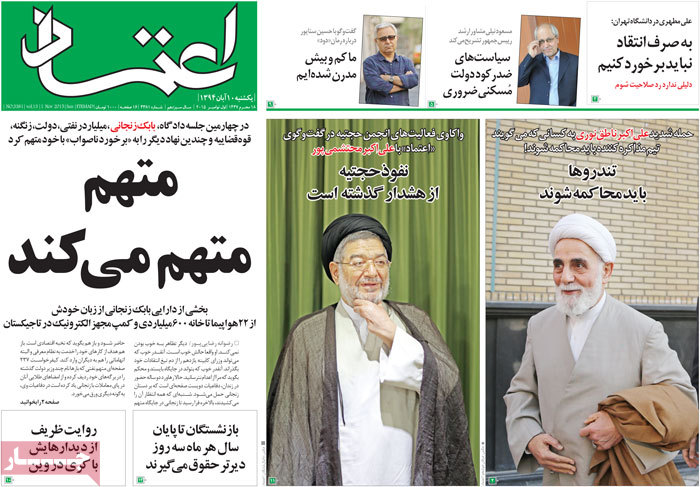
 

A look at Iranian newspaper front pages on Nov. 1


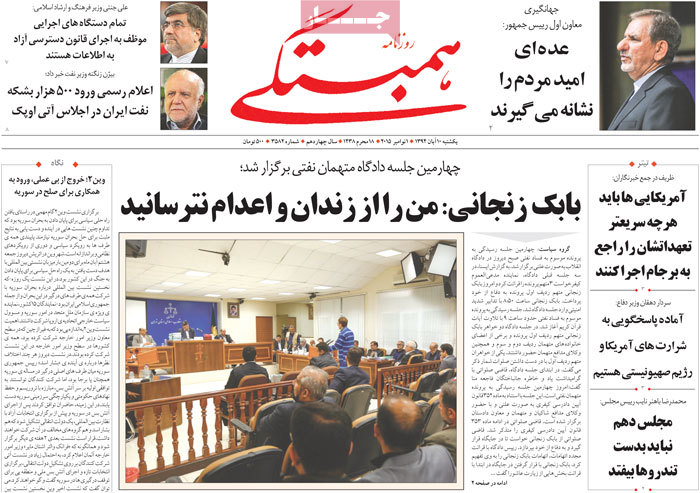
Hambastegi: The minister of culture and Islamic guidance has said that all executive bodies are obliged to implement the Law on the [Publication and] Free Access to Information.
 

A look at Iranian newspaper front pages on Nov. 1


Hemayat: A countdown to ending the war

Saudi Arabia will return from Yemen empty-handed.


A look at Iranian newspaper front pages on Nov. 1


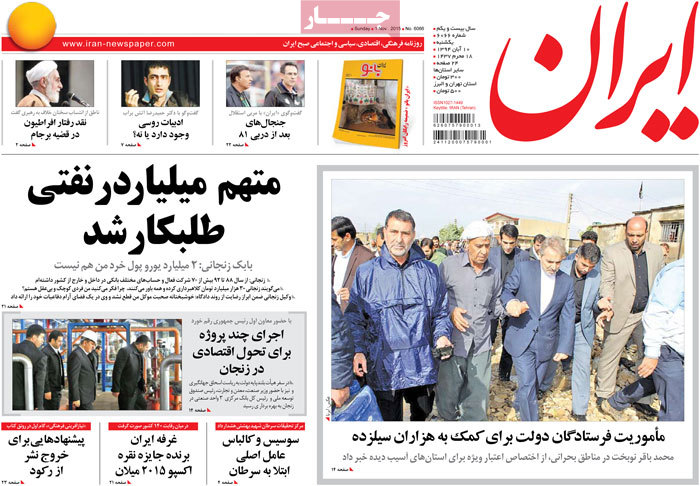
Iran: Iran’s pavilion has won the silver prize of the Expo Milano 2015.
 

A look at Iranian newspaper front pages on Nov. 1 


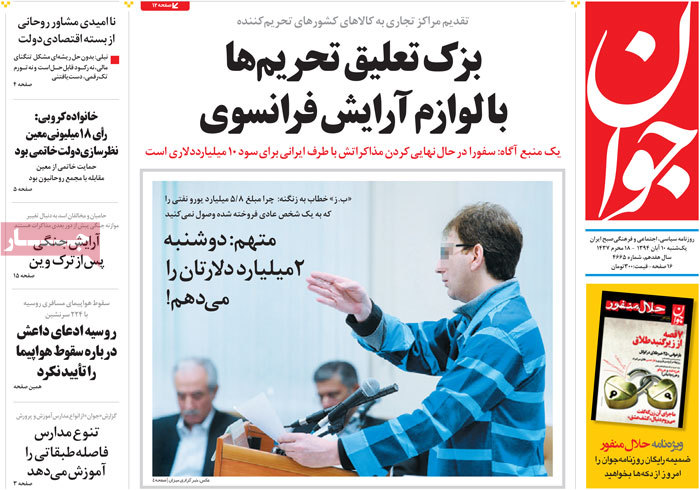
Javan: French cosmetics to make up the suspension of sanctions
 

A look at Iranian newspaper front pages on Nov. 1


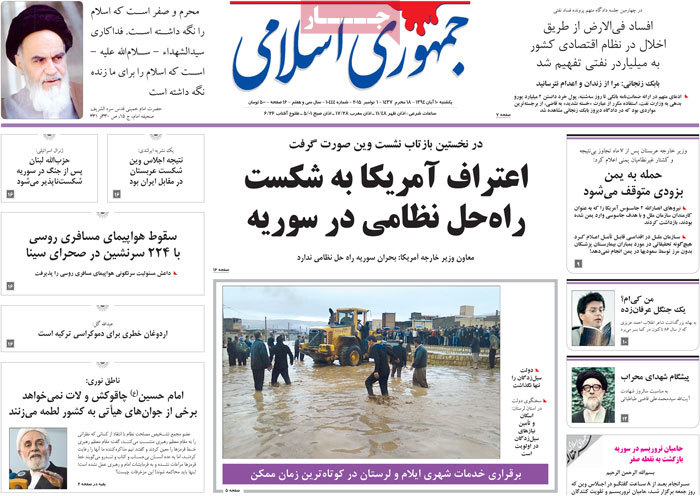
Jomhouri Islami: Imam Hussein does not need knife-wielding thugs, said Nategh Nouri.

Jomhouri Islami: Former Turkish President Abdullah Gul has implied that his successor Recep Tayyip Erdogan has risked damaging Turkish democracy.
 

A look at Iranian newspaper front pages on Nov. 1


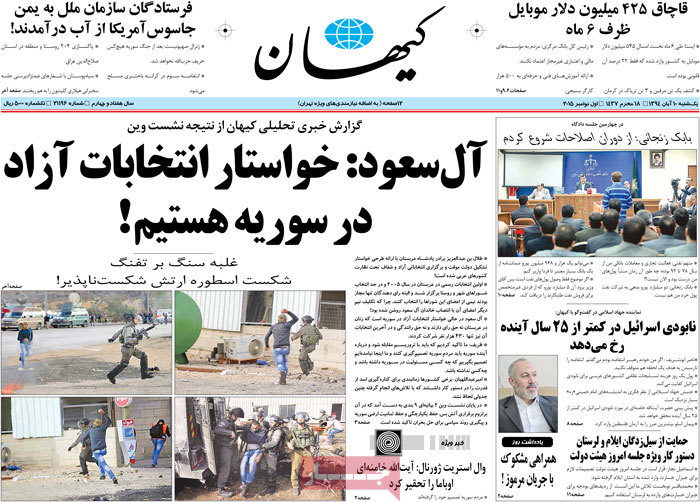
Kayhan: The daily has taken an analytical look at the result of the Vienna talks on Syria

Al Saud: We are seeking to have free elections in Syria!
 

A look at Iranian newspaper front pages on Nov. 1


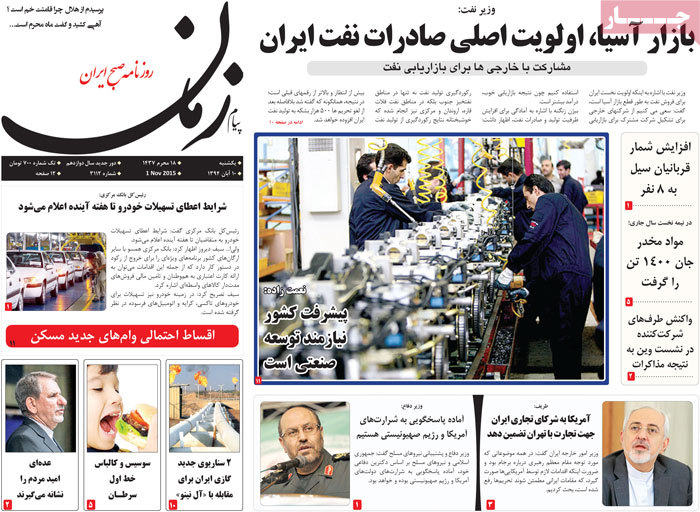
Payam-e Zaman: The Asian market is the top priority of Iran’s oil exports, said the oil minister.
 

A look at Iranian newspaper front pages on Nov. 1


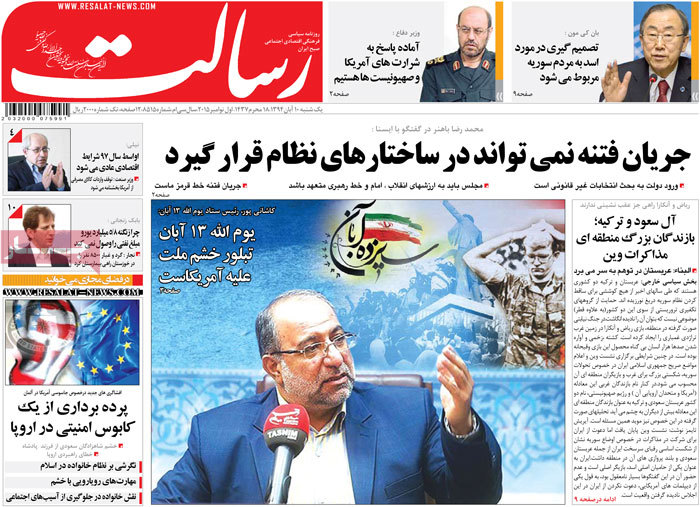
Resalat: The seditionists cannot be included in the establishment’s structures, said Mohammad Reza Bahonar.

Resalat: Iran’s economic conditions will return to normal in late 2018, said Masoud Nili, President Rouhani’s advisor for the economic affairs.
 

A look at Iranian newspaper front pages on Nov. 1


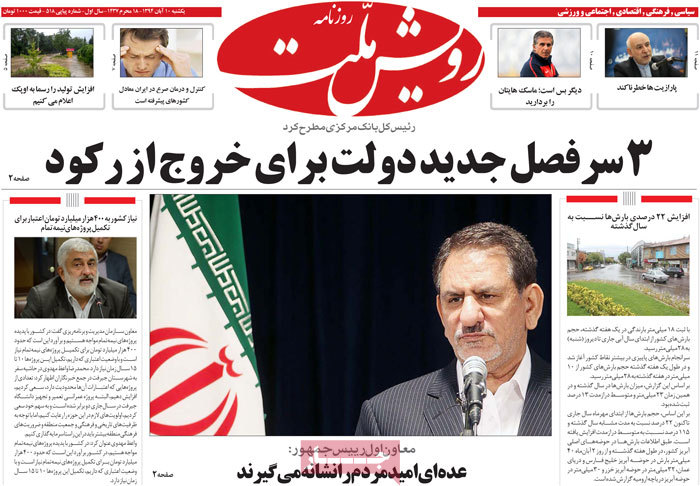
Rooyesh Mellat: There are some who have taken aim at people’s hope, said First Vice-President Eshagh Jahangiri.
 

A look at Iranian newspaper front pages on Nov. 1


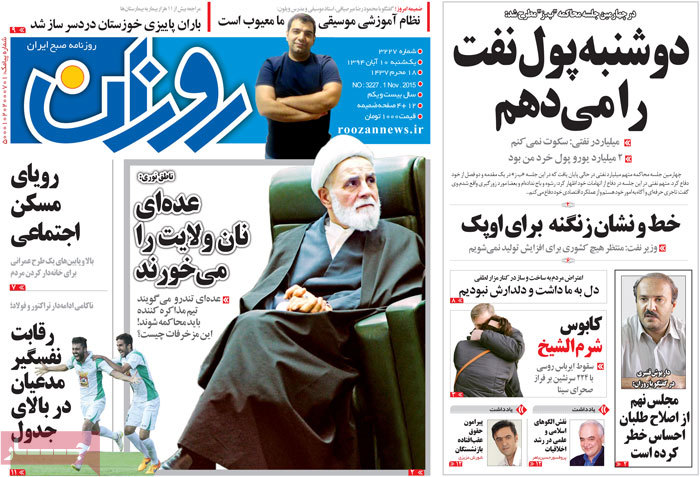
Roozan: Oil Minister Zanganeh threatens OPEC

Iran waits for no country to raise its oil production, said the minister.
 

A look at Iranian newspaper front pages on Nov. 1


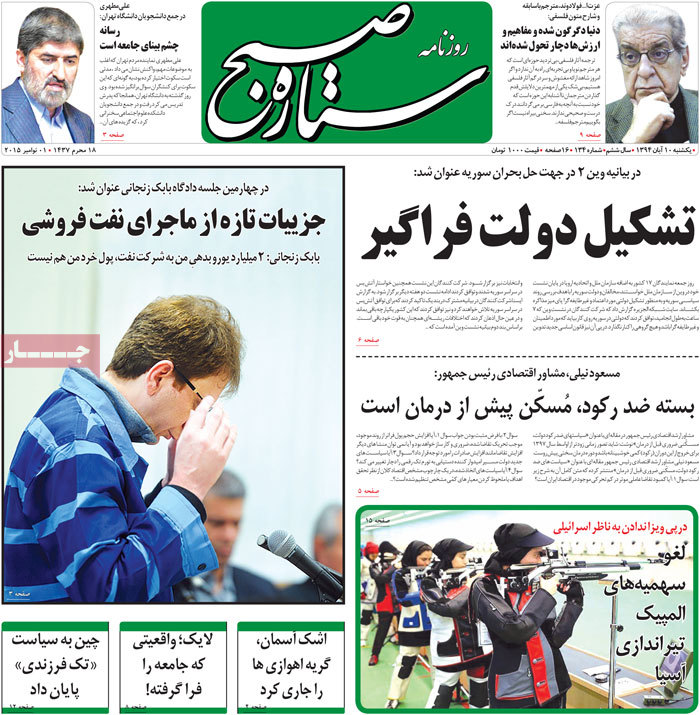
Setareh Sobh: Media are the discerning eye of society, Ali Motahari told students in the University of Tehran.
 

A look at Iranian newspaper front pages on Nov. 1


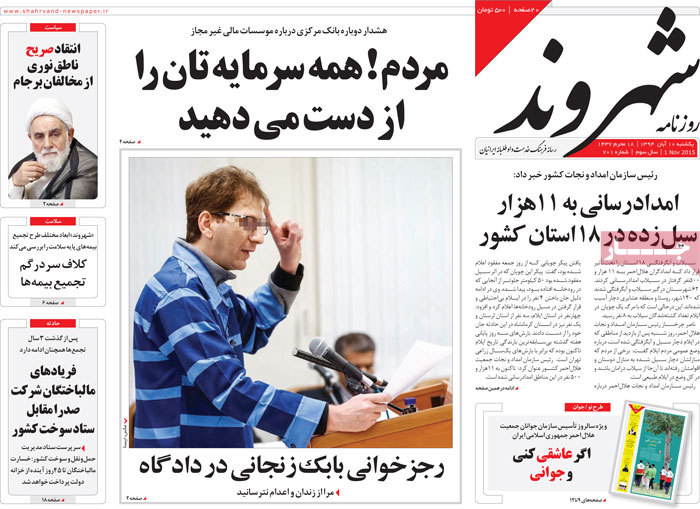
Shahrvand: The director of the Relief and Rescue Organization has said that 11,000 flood-stricken people in 18 provinces have received assistance.
 

A look at Iranian newspaper front pages on Nov. 1


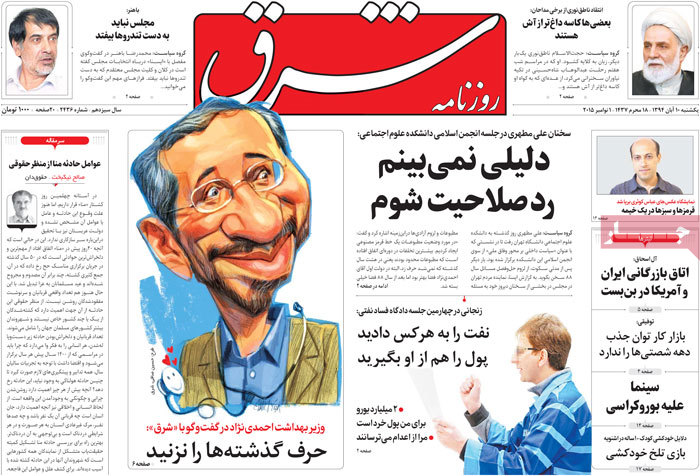
Sharq: “I see no reason to be disqualified [for the upcoming parliamentary elections],” said Tehran MP Ali Motahari.

Sharq: “Do not talk about the past,” said Ahmadinejad’s health minister in an interview with the daily.   
 

A look at Iranian newspaper front pages on Nov. 1


Why bridging the Iran-Saudi divide is vital for peace in Syria and the region

Mousavian

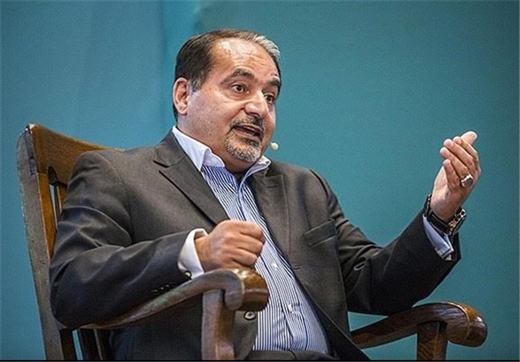
Hossein Mousavian, a former Iranian nuclear negotiator, says a thaw in relations between Iran and Saudi Arabia is crucial to regional peace and stability.

The following is the opinion piece the former Iranian diplomat published on Huffingtonpost.com on October 30:

Archrivals Saudi Arabia and Iran are experiencing their first regional talks in Vienna on the Syrian conflict. Since assuming office in August 2013, Iranian President Hassan Rouhani has initiated several overtures to Saudi Arabia, attempting to mend what has steadily devolved into a dangerously adversarial relationship in the years since the 2003 overthrow of Saddam Hussein.

Rouhani, who called for better ties with Saudi Arabia shortly after his inauguration, made his first diplomatic outreach to Saudi Arabia at a critical juncture. He dispatched his foreign minister, Mohammad Javad Zarif, to visit several of the Arab Persian Gulf states shortly after the November 2013 interim nuclear deal was reached between Iran and the P5+1 group of nations.

“I believe that our relations with Saudi Arabia should expand as we consider Saudi Arabia as an extremely important country in the region and the Islamic world,” Zarif said at the time. “We believe that Iran and Saudi Arabia should work together in order to promote peace and stability in the region.”

Zarif was in effect signaling that Iran was willing to take proactive steps to ease any concerns its southern neighbors had about a post-nuclear deal regional environment.

Rouhani followed this move with numerous other attempts at détente: Iranian Deputy Foreign Minister Hossein Amir Abdollahian visited Riyadh in August 2014, Zarif met with his Saudi counterpart during the 2014 United National General Assembly, and Zarif went to Saudi Arabia to attend the funeral of the late Saudi King Abdullah bin Abdulaziz in January 2015.

After the new Saudi king, Salman bin Abdulaziz, appointed U.S. Ambassador Adel al-Jubeir as foreign minister earlier this year, Zarif also congratulated him and announced that he hoped “relations between the Islamic Republic of Iran and the Saudi monarchy will develop.”

Zarif reached out to al-Jubeir to meet during this year’s UNGA, but was shunned. Nonetheless, at a recent press conference with Arab reporters in Tehran, Zarif reiterated that Iran and Saudi Arabia “have the same interests” and should “work together.”

By opting to increase rather than ameliorate tensions with Iran, Saudi Arabia has brought itself and the rest of the region to a dangerous precipice.

For its part, Saudi Arabia has rebuffed all of Iran’s attempts at engagement. To be sure, the Saudi government has not shied from making faux offers of cooperation, predicated on senseless preconditions like Iran ending its “interference” in Arab countries. The unfortunate reality is that Saudi Arabia, doubly so since the ascension of King Salman, has overtly opted for a more confrontational approach towards Iran. As the Brookings Institution’s Suzanne Maloney has said: “Saudi leaders have adopted a more aggressive diplomatic, economic and military campaign aimed both at marginalizing Iran and reasserting its own ambitions for regional dominance.”

There are multiple reasons why Saudi Arabia is not ready for serious negotiations with Iran at present. For one thing, the hothead son of the King Salman, Mohammed bin Salman, is battling for power and to move up in the succession line. The Saudi war in Yemen is largely his design, and the sensational extent to which supposed Iranian intervention in Yemen has been hyped up has helped bin Salman consolidate power, much to the derision of other members of the royal family.

Furthermore, as one member of the House of Saud told me in New York City during this year’s UNGA, the Saudis do not want come to the table with Iran because they believe Iran has the upper hand in the region. They feel that if they did engage Iran, it would be tantamount to accepting Iran’s position in the region. However, if this is indeed the case, the Saudis have fundamentally misread Iranian strategic thinking in this regard. Iran’s history since the revolution demonstrates that whenever it feels it is in a position of strength, it becomes more flexible, and whenever it comes under increased pressure, it becomes obstinate and acts in ways to increase the cost of pressuring it.

By opting to increase rather than ameliorate tensions with Iran, Saudi Arabia has brought itself and the rest of the region to a dangerous precipice. Dialogue and broad cooperation between Saudi Arabia and Iran is the only way forward and imperative if the various crises in the region, whether in Syria, Iraq, Lebanon, Yemen or elsewhere, are to be resolved. Saudi Arabia and Iran can either jumpstart negotiations or continue down the path of escalation, practically ensuring a devastating war becomes an inevitability.

There are three paths Saudi Arabia and Iran can take to bridge their differences. The first is formal, official high-level talks between foreign ministers and other senior representatives of the respective governments. Unfortunately, the Saudi government does not appear receptive of this option at this stage. Another alternative is for the two countries to engage in track one-and a-half or track-two diplomacy — contacts between former officials and prominent non-government figures and experts — to discuss a package to build trust and move towards official dialogue. There have been some efforts made on that front, but it is crucial that they be significantly expanded.

It is crucial that diplomacy efforts between Iran and Saudi Arabia be significantly expanded.

One other way of escaping the pressures of public negotiations is for Saudi Arabia and Iran to confidentially exchange special envoys. These meetings would be strictly off the record and allow for the two sides to engage in high-level talks and more effectively hash out their differences. During the mid-1990s, I engaged in precisely this type of diplomacy with Saudi Arabia in my capacity as a senior diplomat and advisor to then-president Ali Akbar Hashemi Rafsanjani. Back then, Saudi Arabia and Iran both sought to take steps to reconcile with one another after more than a decade of hostilities. I negotiated and agreed on a “peace package” with then-Crown Prince Abdullah bin Abdulaziz, during that time. After four nights of intense negotiations, we reached agreements which paved the road for amicable relations between our countries that would last until the mid-2000s.

Rather than trying to constrain Iran and isolate it in its own region, the leaders of Saudi Arabia should acknowledge that Iran is their neighbor and that they can and should live in peace with each other. Negotiations should be done without preconditions and both sides should act to understand and address one another’s concerns. Cooperation between Saudi Arabia, Iran and the other Persian Gulf states is vital and will fill the vacuum causing much of the conflicts raging in the region today. Détente between Iran and Saudi Arabia can indeed be the first step in creating a formal regional cooperation system that makes this goal a reality and helps stabilize the region.

Major Bavaria trade team visiting Iran

Germany

A major delegation comprising 130 businessmen from Germany’s Bavaria State has arrived in Tehran for talks on ways to promote mutual trade in the post-sanctions era.

The delegation comprises representatives from across a wide range of industrial enterprises mostly those active in the area of the automobile industry and electrical devices. Major brands that are visiting Tehran include BMW, Siemens and Audi.

The German businessmen led by Bavaria’s Minister for Economic Affairs Ilse Aigner will stay in Iran for five days to meet their Iranian peers.

They will also participate in a ceremony to inaugurate an office in Tehran dedicated for the expansion of trade with Germany’s Bavaria State.

Aigner in a statement that was released before arriving in Tehran announced that the removal of sanctions against Iran can be the beginning of a new era in trade ties between Iran and Bavaria.

She described Iran as “a very attractive and profitable market” for European enterprises, adding that trade ties between Bavaria and Iran can increase at least four-fold.

The value of Iran-Bavaria trade in 2014 stood at about €220 million, down at least 50 percent over 2009.

Many Bavarian companies – specifically those active in areas such as the auto industry, heavy machinery and infrastructure services – hope to seal deals with Iran.

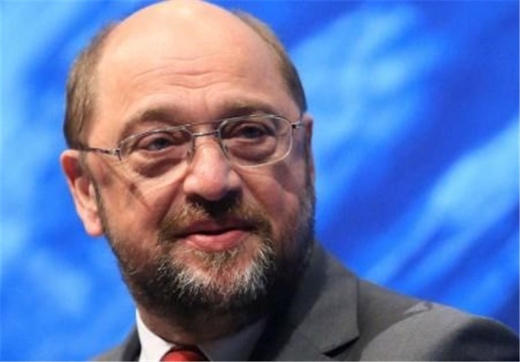
EP President Schulz due in Iran next week

EP President Schulz

President of the European Parliament Martin Schulz will pay an official visit to Tehran next Saturday at the head of a parliamentary delegation.

Schulz will arrive in Tehran on November 7 and hold talks with several high-ranking Iranian officials on his day-long visit.

President Rouhani, Parliament Speaker Ali Larijani, Foreign Minister Mohammad Javad Zarif, and Interior Minister Abdolreza Rahmani Fazli are among the top officials Schulz is scheduled to meet.

He will also hold talks with Kazem Jalali, the head of parliament’s research center, and Mohammad Javad Larijani, the head of judiciary’s human rights committee.

The German EP president had been scheduled to visit Tehran on October 12, but his trip was postponed.

The European Parliament (EP) is the directly elected parliamentary institution of the European Union (EU). Together with the Council of the European Union and the European Commission, it exercises the legislative function of the EU.

The EP is composed of 751 (previously 766) members, who represent the second largest democratic electorate in the world (after the Parliament of India) and the largest trans-national democratic electorate in the world (375 million eligible voters in 2009).

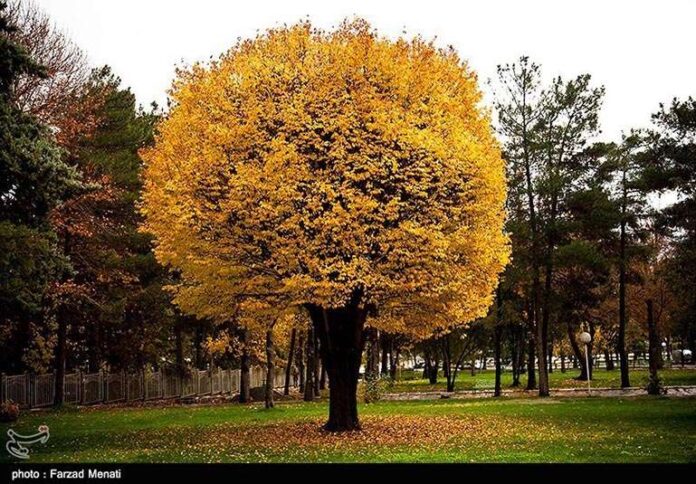
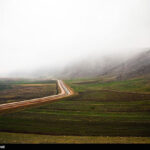
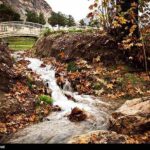
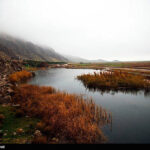
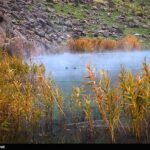
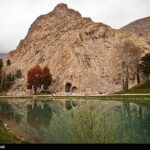
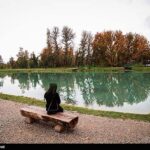
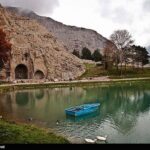
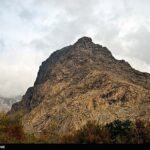
Fall in western Iran (PHOTOS)

Fall0

Nature has put on display different colors in autumn.

Tasnim News Agency has posted amazing pictures of Mother Nature in the capital of Kermanshah Province.

Rouhani offers condolences to Putin over plane crash

Rouhani-message

President Rouhani has extended condolences to his Russian counterpart Vladimir Putin over a deadly plane crash that killed over 200 people.

In a message to Putin on Saturday, President Rouhani expressed his sympathy with the Russian government and nation as well as the bereaved families of the victims.

Foreign Ministry Spokeswoman Marzieh Afkham also offered her condolences to the Russian government and people over the tragic incident.

The Russian passenger aircraft crashed in Egypt’s Sinai Peninsula with Egyptian officials and the Russian Embassy in Cairo confirming that all 224 people on board the flight have been killed.

The Airbus A-321 chartered by Russian airline Kogalymavia was carrying 217 passengers, including seven children, and seven crew members.

Russia’s Ria Novosti news agency has reported that the bodies of 100 passengers, including five children, together with one of the aircraft’s flight recorders had been found.

[…]

Saudi Arabia committing unprecedented crimes in Yemen: Larijani

Larijani-Yemen

Parliament Speaker Ali Larijani has said Saudi Arabia has committed “unprecedented” crimes in Yemen during its seven-month war on the country, stressing that Riyadh is a “wicked regime” in the Middle East.

In a meeting with the deputy head of the Yemeni Supreme Revolutionary Council, Naef Ahmad al-Qanis, in Tehran on Saturday, Larijani said the Yemeni people would undoubtedly emerge victorious in the “unequal war” against their country.

“Yemen and the Yemeni people are very important to us and the country’s issues constitute a constant concern for the Islamic Republic of Iran,” the top MP said.

He added that the Saudi regime has committed “numerous crimes” in Yemen which have led to the destruction of the impoverished country’s infrastructure and the deaths and injuries of thousands of civilians.

Larijani emphasized that the settlement of the Yemeni crisis is a main political priority for Iran, saying resistance of the Yemeni people can teach a lesson to all aggressive countries.

Qanis, for his part, said Iran is a close country to Yemen, urging the Islamic Republic to prepare the ground for the transfer of the injured Yemenis to Tehran given the lack of medical facilities in the war-hit country.

Riyadh seeks to dominate Yemen, but the Yemeni people will turn the country into a grave for Saudis through the support of friendly countries, he said.

[…]