Monday, December 22, 2025
Home Blog Page 4679

Highlights of Ettela’at newspaper on August 9

Ettelaat

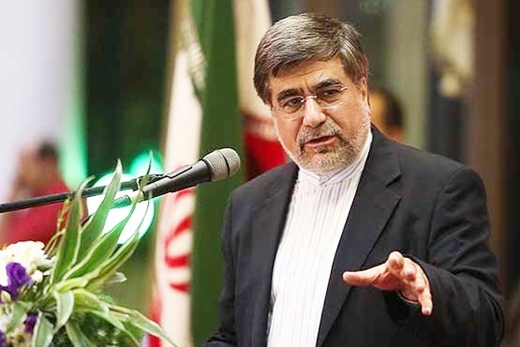
 “In the absence of lively media, societies drift toward dictatorship,” the minister of culture and Islamic guidance told a ceremony marking Reporter’s Day.

Ali Jannati further said that government intervention in media outlets runs counter to national security.

The police chief, meanwhile, said reporters play a very important role in promoting a sense of security in society.

 The first vice-president has said that a workgroup has been formed to look into offenses committed in executive bodies.

Eshagh Jahangiri further said that government has worked out plans for the post-sanctions era.

 In Iraq Grand Ayatollah Al-Sistani has called for a serious fight against corruption.

Following the appeal by the senior Shiite cleric, the Iraqi prime minister said he would comply with instructions issued by the sources of emulation.

 “Iran’s scientific ranking has improved,” said the minister of science, research and technology.

Iran’s share of science production has risen from 0.8 percent in 2010 to 1.63 percent in 2015, he said.

 The US has officially admitted that its plan to train Syrian opposition terrorists has failed.

The White House press secretary has said the US spent $42 million on training 60 Syrian opposition fighters, but the plan failed.

 The New York Times has reported that the US and its allies have lost the nuclear war to Iran.

The daily has said the Vienna accord slows down Iran’s nuclear program, but does not end it.


Iran loses to Japan in Asian Volleyball Championship final

13940510135554645793294

Iran lost to Japan 3-1 (17–25, 22–25, 25–18, 22–25) in the 18th Asian Senior Men’s Volleyball Championship final matchon Saturday.

Iran took part in the competition with its second team as the main team is preparing for the 2015 FIVB Volleyball Men’s World Cup which will be held from September 8 to 23 in Japan.

“First of all, I congratulate Japan for the title. We are not here to win the title. We wanted to field our young players to gain experience for the upcoming events,” Iran coach Peyman Akbari said after the match.

“I am satisfied with our performance in the competition. It’s Iran’s third team and we had just 20 days to prepare the team,” he added.

China finished in third place after defeating Qatar 3-2 (25–23, 25–19, 21–25, 24–26, 15–9).

A total of 18 editions have already been held, Japan has won eight titles, followed respectively by Korea (4), China (3), Iran (2) and Australia (1).

Italy’s Fata inks $543 million Iran power deal

Engineering unit of Finmeccanica

According to a spokesman for the Italian defense group, the deal was signed during Italian Foreign Minister Paolo Gentiloni’s visit to Tehran earlier this week at the head of a delegation of government officials and business leaders.

During the visit, Italy agreed to provide funding and insurance coverage for industrial, construction and infrastructure projects worth at least 3 billion euros in Iran.

“By the next three years, a credit line of at least 3 billion euros will be opened for the implementation of important projects in Iran,” Italy’s Economic Development Minister Federica Guidi said in Tehran.

For the projects, Italy’s investment bank Mediobanca and its development ministry and export credit agency SACE signed an MoU with Iran’s economy ministry and central bank.

The memorandum will be executed upon the removal of the sanctions, with Mediobanca providing credit and SACE insurance for projects in Iran.

On Saturday, Eni Chief Executive Claudio Descalzi was quoted as saying that his company was looking to resuming oil sales from Iran.

“Iran’s oil is highly desirable for our refineries and Eni welcomes purchasing crude from Iran after the annulment of sanctions,” the Iranian Ministry of Petroleum’s Shana news outlet quoted him as saying in Tehran.

Descalzi accompanied FM Paolo Gentiloni and Italy’s Economic Development Minister Federica Guidi in the visit to Tehran.

Eni reportedly seeks to return to the Darkhovin oilfield which it left in 2010 to avoid US sanctions for business with Iran.

“We are currently examining the situation and awaiting the annulment of the sanctions. But it is still early to talk about which projects we want or which companies we want to cooperate with,” Shana quoted Descalzi as saying.

Different things led to conclusion of the deal: Diplomat (PART TWO)

farhangnews_136159-389575-1437800893

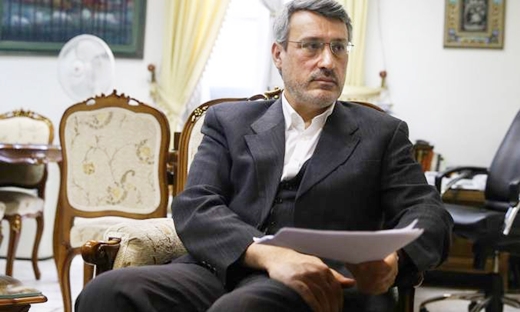
Iran and P5+1 know, beyond a shadow of a doubt, that nuclear talks, especially the home stretch of the talks over the past two years, are unprecedented in relations between Iran and world powers, Hamid Baidinejad, an Iranian diplomat who was part of the expert team representing Iran in grueling talks with P5+1 said.

He went on to say, “If someone other than President Rouhani had been in charge of the talks, we wouldn’t have been able to come this far.”

The following is the translation (PART TWO) of an excerpt of the comments made by this Iranian diplomat – who spent the two months leading to the July 14 deal away from Iran – in an interview with the Iranian Students’ News Agency (ISNA). The original story was headlined “It was only Rouhani who could lead the talks this way.”

– The ten-year period was important to us. We wanted to know from the very beginning when Iran’s nuclear case will be taken off the agenda of the UN Security Council. We are happy to see that the period is close to what we wanted; it was not an easy job, though. They [P5+1] insisted on a 20-year period, putting forward a 20+10-year-period proposal: 20 years for the agreement and 10 years for transparency measures. In all, that would have added up to 30 years.

We wanted a single-digit figure [for this period]. Logically, we thought we needed such a period to get prepared for going through the industrial phase. We saw nothing wrong in the inspections [regime] and the timeframe for taking transparency measures, because in the Additional Protocol too inspections have no time limits. As long as you are a member of the Safeguards and the Protocol, you have to accept inspections. What mattered for us was a limited time for enrichment restrictions.

– The fact is that the nuclear industry has undergone enormous change over the past 10 to 15 years with many nuclear states changing their policies. Russia has turned into a powerhouse in production of reactors, making many nuclear reactors, including for European countries. Conversely, a number of European countries, France included, are dumping the production of reactors and investing in other areas instead. Some European countries such as Germany, Switzerland and Austria have adopted policies to get rid of nuclear energy.

Cooperation on the nuclear front is tough because of restrictions [in ties] between Iran and the US. Iran-US nuclear cooperation seems likely within the framework of Iran-P5+1 relations, because of [severed] diplomatic ties between the two countries.

– Iran has proposed that it discuss the settlement of the so-called PMD [possible military dimensions] with the IAEA outside the Joint Comprehensive Plan of Action (JCPOA) but in close consultation with P5+1 members, because it is an issue between Iran and the UN nuclear agency.

There is a reference to November 2011 [IAEA] report in JCPOA, something which has been raised in the agency’s reports over the past few years. Iran has never accepted the IAEA’s claims [in this regard], but the agency is now ready to put an end to this question and have an eye to the future.

To settle this question, we follow the model set in Resolution 2231. Iran and the IAEA have agreed to continue cooperation; the agency’s director general reports the result of cooperation to the Board of Governors which will issue a resolution to close the chapter on the issue by the end of 2015.

What Iran has agreed to as far as the question of Parchin goes has been under the direct supervision of the Supreme National Security Council whose decisions will be ultimately communicated to relevant institutions. As high-ranking Iranian officials have put it, Iran will not agree to inspection of its military sites; the arrangements made to solve the past and present [outstanding] issues do not constitute a go-ahead for inspections in Parchin.

– Based on the available information, chances are not high for rejection of the deal in the US Congress at this stage, because Congress needs a two-thirds majority of the votes if it seeks to override Obama’s veto. This seems unlikely thanks to the current political makeup on Capitol Hill. If this [an override of the president’s veto] happened, we need to wait and see how other members of the UN Security Council and P5+1 would react. The US administration has shown that it believes in and supports the Iran deal. If it fails to form the consensus it needs at home, we should wait and see what approach it will adopt [down the road].

The Europeans always said they would not follow the decisions of the US Congress if it tried to undermine such a consensus. How the Europeans will react to the US failure to build a consensus remains to be seen. Iran’s stance will be tied to such parameters and we cannot talk about it now. What matters is the fact that all political and legal tools are available for Iran to show the proper reaction.

– The Americans used to say that Iran should not expect them to lift the sanctions on airplane purchases, which is a non-nuclear sanction. European companies too were not allowed to sell planes to Iran because the plane engines were made in the US. The Iranian negotiating team took this issue [plane purchase] into account from the beginning of the talks and dedicated a space to it in the Geneva agreement. During the talks, Mr. Kerry promised to raise this issue with his respective government and solve it. The question was solved due to Iran’s serious efforts.

– The US team was the strictest member of P5+1 [in nuclear talks]. The Americans had become familiar with Iran’s stances following different rounds of lengthy talks and had learned about Iran’s red lines.

They repeatedly tested Iran’s stance. As a result, the talks were extended several times and dragged out, with the Americans hoping that Iran would budge at the eleventh hour. But they realized that we remained steadfast in our stances and this helped them develop a more tangible understanding of Iran’s stances. All things considered, I should say that professional negotiators were on nuclear teams from different [P5+1] countries who were trying to push the agenda of their respective countries.

France pursued its national principles and stances as far as certain questions were concerned. In some cases, they would strongly defend their positions and this caused delays [in the conclusion of a deal], but it is far from real if we assume that France derailed the Geneva agreement, for example. France was acting within the framework of P5+1 and the European Union. By and large, a collective mindset prevailed in P5+1.

– It was around 23:00 p.m. on Monday (July 13) that almost all main parts of the deal had been decided upon, but there were still some details which had to be included in the text. There were discussions between the two sides on the very details and this placed added strain [on the parties to the talks]. An arms embargo was the question which had been finally decided on [with the negotiators] agreeing to turn the embargo into five-year restriction. It was also decided that the Security Council give the green light for [Iran’s] arms purchases if needed. With this formula and a few basic questions at hand, everything was almost done for reaching an agreement.

Other issues together with piecing together a joint statement of Iran and P5+1 were left to be dealt with the following day, and finally at 10:00 a.m. [local time] on Tuesday (July 14) the participating teams headed for the European headquarters of the UN in Vienna for the announcement of the result of nuclear talks [the Iran nuclear deal].

Speaker wants JCPOA be presented to parliament in the form of a bill

Zarif-parliament

Two weeks ago the Iranian Foreign Ministry delivered the text of the nuclear deal Iran struck with P5+1 in Vienna on July 14 to the Islamic Consultative Assembly so that the Iranian parliament could launch its review of the deal which came on the back of the longest-running diplomatic negotiations of the century.

After the submission of the text, two outspoken Tehran MPs called on the executive branch to present a bill on the Joint Comprehensive Plan of Action (JCPOA) and insisted on the chamber’s right to put the deal to a vote.

Following the appeal of the pair, Government Spokesman Mohammad Bagher Nobakht said parliament is not supposed to vote on the deal. “All it needs to do is to receive reports on the agreement and signal its concerns – about national interests and the red lines set and instructions issued by the Supreme Leader – to the Supreme National Security Council which will review the deal.”

Later, Director of the Atomic Energy Organization Ali Akbar Salehi also said JCPOA does not need the blessing of the Islamic Consultative Assembly.

Alef.ir, a news website run by principlist Tehran MP Ahmad Tavakoli, quoted Mohammad Saghaei, a principlist member of parliament, as saying that Speaker Ali Larijani has underlined the need for the government to present a bill to parliament on JCPOA.

He said,” In light of the fact that JCPOA entails certain commitments for Iran, it should be viewed as an agreement. Under the Constitution, it needs the blessing of the Islamic Consultative Assembly. We don’t care what the document is called; what is important is its content. I believe it should be presented to parliament in the form of a bill to be voted on by the chamber.”

The MP further said the Speaker’s view that the deal be presented as a bill seems to be correct.

In conclusion, he said ordinary agreements with other countries, such as ordinary ones covering issues such as transportation cooperation, are all voted on in parliament and failure to send a bill to parliament on a deal between Iran and other governments is unprecedented.

Free flow of information renders fight against corruption genuine

8587626229052421220205168815

The minister of culture and Islamic guidance has said that free access to and circulation of information is needed to put up a real fight against corruption, especially on the financial front.

Ali Jannati made the comment in a message he released to mark National Reporters Day (August 8) and added that any Iranian can access all unclassified information. He also said that access to information is people’s right and the government’s duty, adding the eleventh government insists on implementing the Law [on the Free Access to Information].

The following is a translation of part of Jannati’s message to the first conference on reporters, professional needs and social issues as reported by the Islamic Republic News Agency (IRNA) on August 7:

Professional challenges

At times reporters have to cover overlapping social issues – including judicial and police-related questions as well as the environment, health, education, etc. – for which they need serious studies, information and expertise. These questions on the social front have become a specialized field and media have to come to terms with this field and make planning for it.

Professional ethics

Efforts are needed to boost the ethical code of conduct in the news business, meet the reporters’ professional needs and solve their social issues. Different types of social networking sites, weblogs, microblogs, podcasts, wikis [webopedia] and [online] content-related gatherings have caused rapid changes. Reporters and those involved in the news business can use these media – one way or another – to do a professional job.

Citizen journalists

Social media have enabled a wide range of citizens to collect, filter and circulate information. This means reporters and news media have no exclusive access to news anymore. These pieces of news originate from a community in which journalists and citizens trade information.

In the newly-emerged media community, non-journalists or citizen reporters act as new sources for news organizations. The pace of evolution is strikingly rapid, leaving not enough time [for those in charge] to define the related laws and their annexes, but the news corps can stick to professional ethics and control and regulate such an atmosphere [in which laws have yet to be drafted or enforced].

Professional problems

Print media suffer from job insecurity. As a result, their reporters and journalists face occupational instability as well as insurance and wage issues, and this shatters their calm. This comes as reporters have no support in tackling such problems, like other occupations which have a guild to support them. The Ministry of Cooperatives, Labor and Social Welfare can play a key role in easing their burden.

A look at Iranian newspaper front pages on August 8

Iranian Newspapers Headlines

The comments of President Rouhani on journalistic freedom and interaction with the rest of the world and those of Akbar Hashemi Rafsanjani on the nuclear deal dominated the front pages of Iranian newspapers on Saturday.


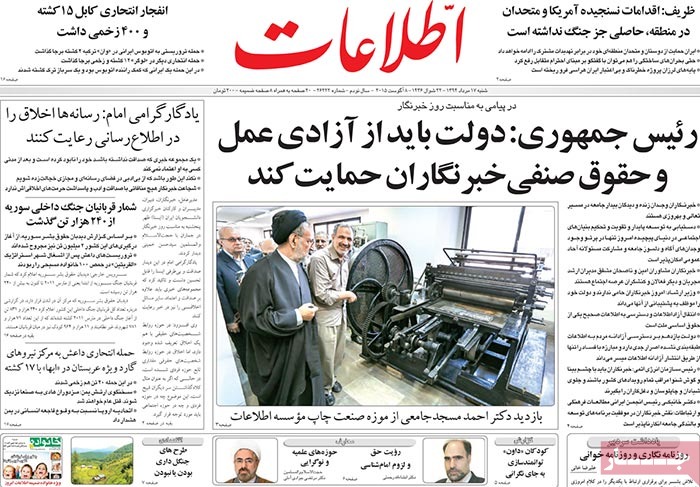
Ettela’at: “Government has a duty to safeguard journalistic freedom and reporter rights enshrined in the guild charter,” President Rouhani said.

“Reporters serve as the conscience of society as it walks down the path of prosperity and moral high ground,” the president further said in a statement to mark Reporters Day.


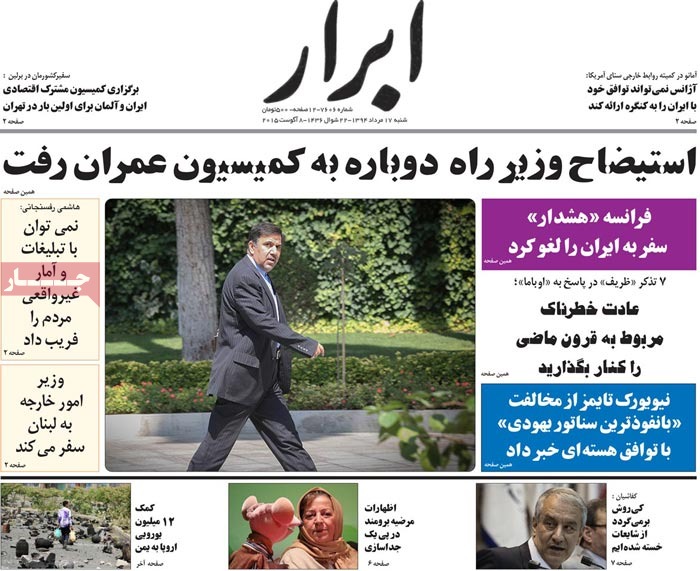
Abrar: “The Iran-Germany Joint Economic Commission meets in Tehran for the first time,” said the Iranian ambassador to Berlin.


A look at Iranian newspaper front pages on August 8


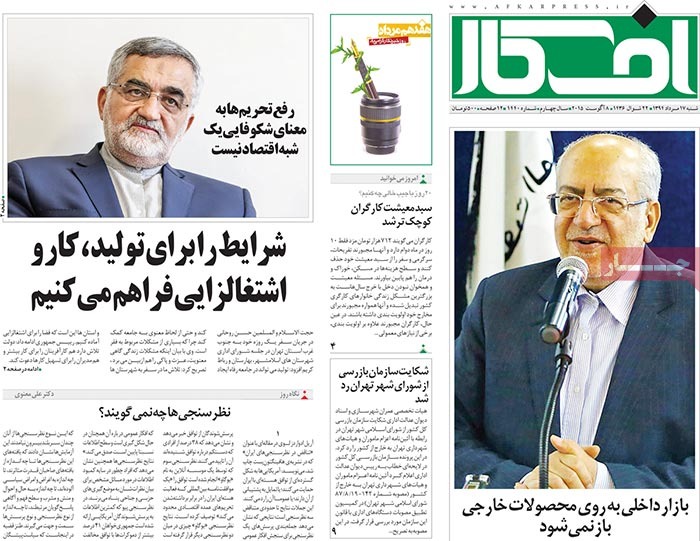
Afkar: “Termination of sanctions won’t translate into an overnight economic boom,” said the chairman of parliament’s National Security and Foreign Policy Committee.


A look at Iranian newspaper front pages on August 8


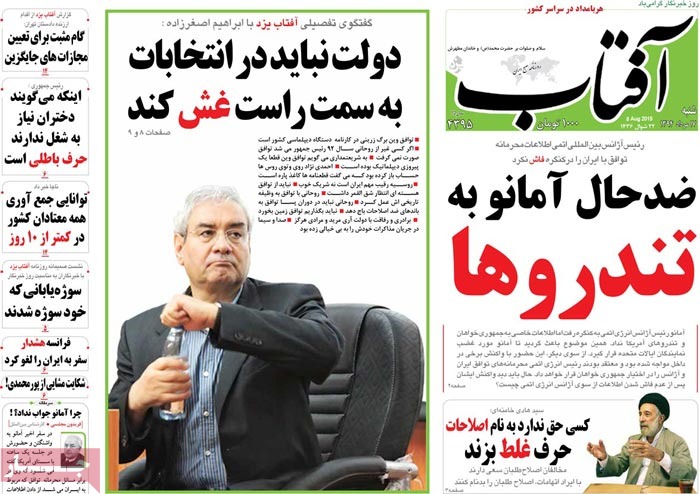
Aftab-e Yazd: Amano’s anticlimactic move

In the US Congress, the director general of the International Atomic Energy Agency would not reveal the details of the deal the UN nuclear watchdog has struck with Iran.


A look at Iranian newspaper front pages on August 8


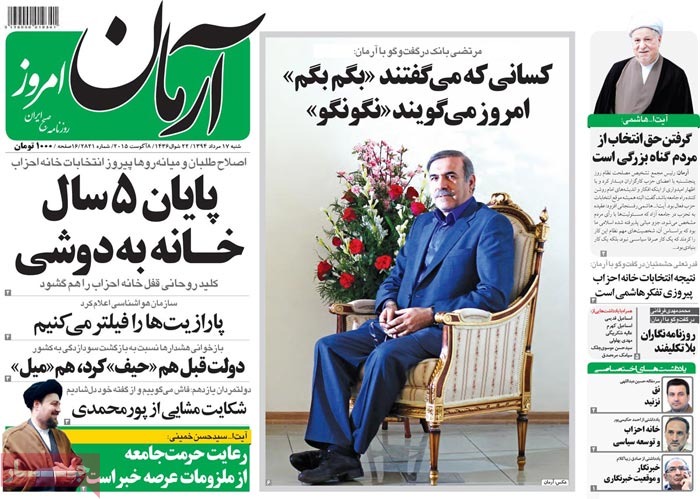
Arman-e Emrooz: Esfandiar Rahim Mashaei, a close aide to the former president, has filed a lawsuit against Justice Minister Mostafa Pourmohammadi.


A look at Iranian newspaper front pages on August 8


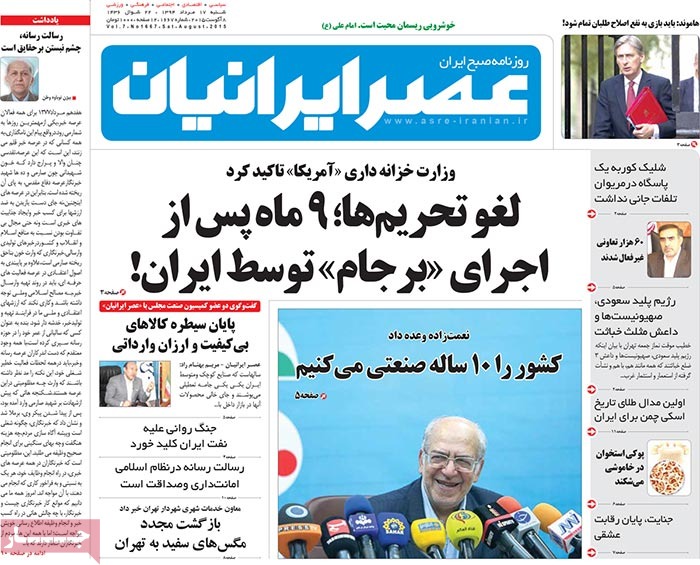
Asr-e Iranian: The industry minister has vowed to industrialize the country in a decade.


A look at Iranian newspaper front pages on August 8


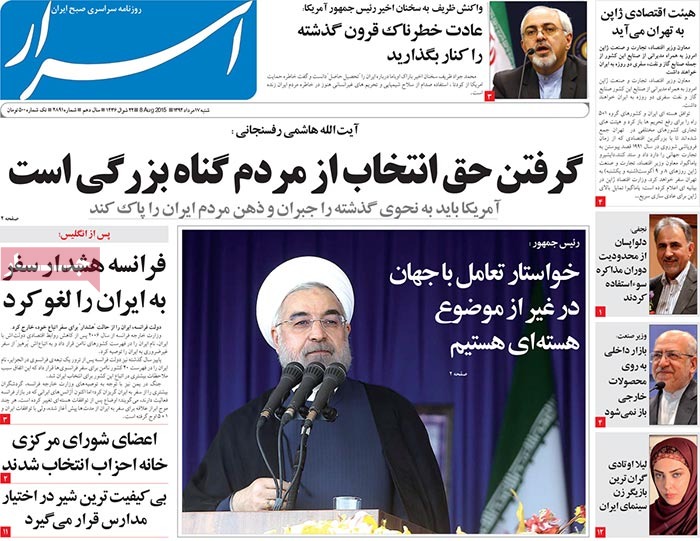
Asrar: A Japanese economic delegation visits Iran on Saturday.

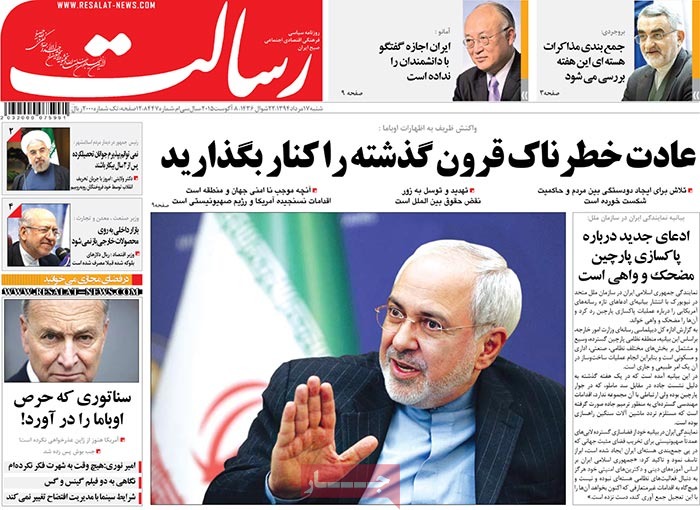
Asrar: Foreign Minister Zarif has urged the United States to drop “dangerous habits” of the past centuries.

Asrar: “Denying the public the right to choose is a cardinal sin,” said Chairman of the Expediency Council Ayatollah Akbar Hashemi Rafsanjani.

Asrar:  “We seek interaction with the rest of the world in areas other than the nuclear issue,” said Iranian President Hassan Rouhani.


A look at Iranian newspaper front pages on August 8


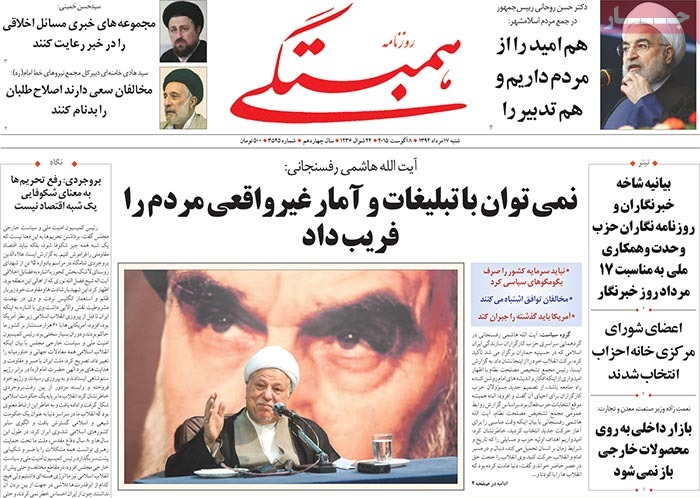
Hambastegi: “People won’t be duped by propaganda and unreal figures,” said Ayatollah Akbar Hashemi Rafsanjani.

The chairman of the Expediency Council further said that the national capital should not be wasted on political bickering.


A look at Iranian newspaper front pages on August 8


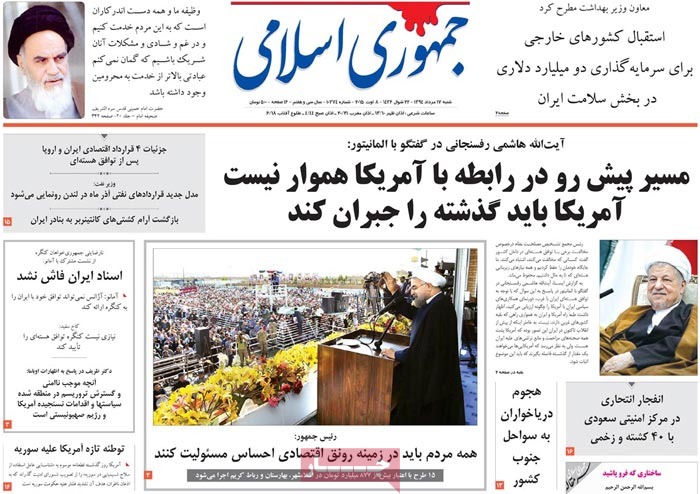
Jomhouri Islami: “Foreign countries have welcomed a $2 billion investment in Iran’s health sector,” Health Minister Hassan Hashemi said.


A look at Iranian newspaper front pages on August 8


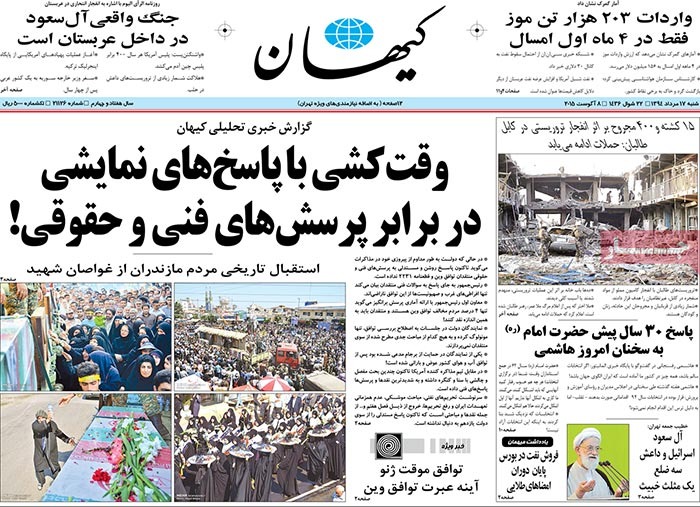
Kayhan: The government is killing time by providing theatrical answers to technical and legal questions.

[The daily has said that the Rouhani administration has failed to provide any definitive answer to questions of the critics of the nuclear deal.]

Kayhan: The people of Mazandaran have welcomed home the remains of the divers who were killed in the war with Iraq in the 80s.


A look at Iranian newspaper front pages on August 8


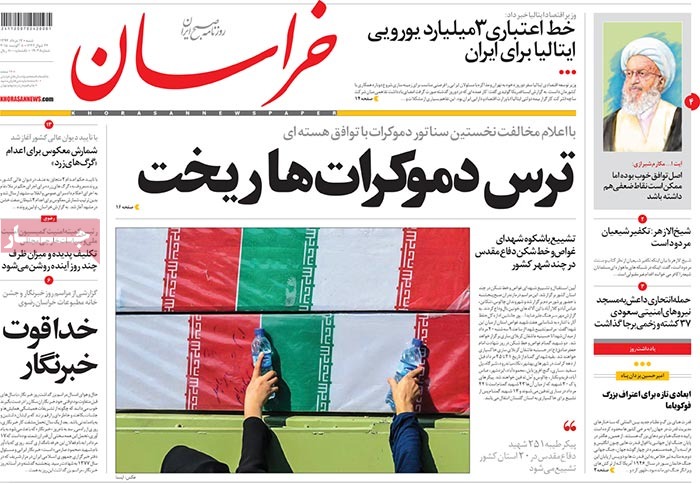
Khorasan: After the Supreme Court upheld a lower court verdict, the countdown to execution of the “Yellow Wolves” [two thugs who raped several women in Mashhad] has started.


A look at Iranian newspaper front pages on August 8


Resalat: “Parliament will review the Joint Comprehensive Plan of Action this week,” said Alaeddin Borujerdi, an MP.

Resalat: “The nuclear deal won’t open the floodgates of the Iranian market to foreign products,” vowed the Iranian trade minister.


A look at Iranian newspaper front pages on August 8


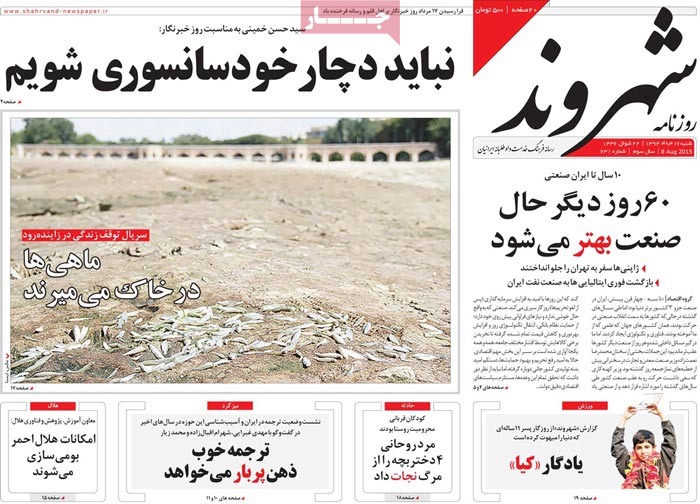
Shahrvand: “We shouldn’t allow self-censorship to get the better of us,” said the grandson of the founder of the Islamic Republic.


A look at Iranian newspaper front pages on August 8


Highlights of Ettela’at newspaper on August 8

Ettelaat

 “Government has a duty to safeguard journalistic freedom and reporter rights enshrined in the guild charter,” President Rouhani said.

“Reporters serve as the conscience of society as it walks down the path of prosperity and moral high ground,” the president further said in a statement to mark Reporters Day.

 Ahmad Masjed Jamei, a member of Tehran City Council, has visited the Press Museum of Ettela’at Institute.

 “The uncalculated measures of the US and its allies in the region have resulted in nothing but war,” said Foreign Minister Mohammad Javad Zarif.

The top diplomat further said that dialogue based on mutual respect can be used as a means to settle made-up crises.

 A suicide bombing in Kabul left 15 people dead and 400 others wounded.

In another terrorist attack, a bus carrying Iranian tourists came under fire in Turkey.

The Iranian conductor of the bus and a Turkish soldier were killed in the attack.

 “Media should uphold ethics in disseminating information,” said the grandson of the founding father of the Islamic Republic.

“The audacity of reporters should not come at the expense of honesty, civility and respect for ethics,” Seyyed Hassan Khomeini further said.

 The death toll from the civil war in Syria hit the 240,000 mark.

The war, which erupted in March 2011, has left an additional 2 million people injured.

 IS has mounted a suicide attack on the headquarters of the Saudi Special Forces in the border town of Abha, killing 17 and wounding 20 others.

Meanwhile a spokesman for the Yemeni army said that mercenaries of the former president would be massacred if they closed in on Sana’a.


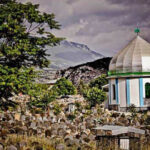
Mystery cemetery in northern Iran (PHOTOS)

Mystery cemetery 00

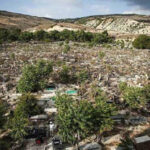
There is a famous village in the northernmost part of Iran which is known for its mystery cemetery.

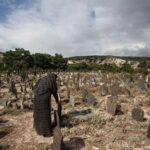
Sepid [White] Cemetery located in Galugah, a small town in Mazandaran Province, is said to be the first Muslim cemetery in Iran. Almost everyone in the village has heard mysteries about the graveyard.

Locals believe that the white soil of the cemetery does not let corpses decompose; they even believe that the sins of those buried in the graveyard are completely forgiven.

The wonders of the cemetery and beliefs of villagers in supernatural powers of the place have attracted many from far-off and nearby villages to vie for a grave in the cemetery for their deceased.

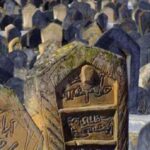
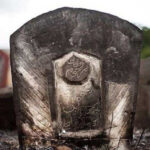
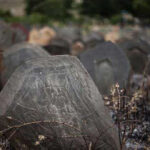
Another distinctive feature of the cemetery is its vertical grave stones which are engraved with images of the tools that the dead used in their professions when they were alive.

To let visitors know the gender of those buried, there are special symbols which add beauty to the look of the graveyard.

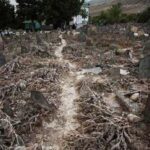
The famous cemetery is growing by the day, swallowing the nearby land to secure more space for the dead.

Snapshots of the cemetery posted online by the Young Journalists Club: 

Iran’s Tasisat Daryaei wins AFC Futsal Club Championship

139405162303215155831344

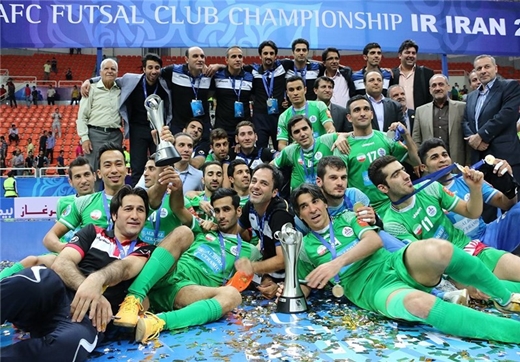
Tasisat Daryaei from Iran claimed the title of the 2015 AFC Futsal Club Championship on Friday.

Tasisat defeated Kuwait’s Qadsia 5-4 at the Nagshe Jahan Stadium in Isfahan to become the first Iranian club since 2012 to win the AFC Futsal Club Championship.

Asghar Hassanzadeh scored twice and there were single goals from Ghodrat Bahadori, Reza Sangsefidi and Vahid Shamsaee as the Iranian side claimed the title.

Hamad Hayat and Abdulrahman Alwadi, also with a brace, were on target for the Kuwaiti club while Abdulrahman Altawail’s late goal made for a nervous finish for the home team.