Friday, December 26, 2025
Home Blog Page 4675

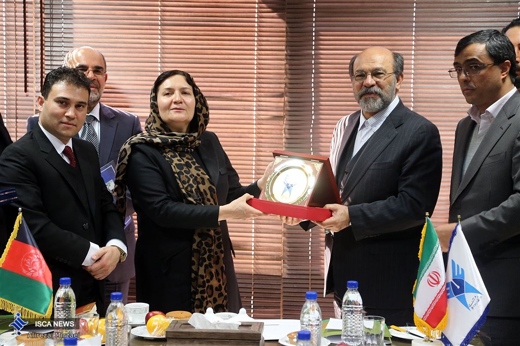
Islamic Azad University ready to offer scholarship to Afghan students

Mirzadeh-Afghanistan

The president of the Islamic Azad University has said that IAU is ready to open branches in Herat and Mazar-i-Sharif in Afghanistan and launch medical and engineering programs in its Kabul branch.

Dr. Hamid Mirzadeh made the comment in a meeting earlier this week with Farideh Momand, the Afghan minister of higher education, and added that IAU and the Afghan ministry need to revise the already inked agreements and sign new deals to meet the Afghan needs.

ISCAnews.ir, the website of Iran Student Correspondents Association, published a report on the meeting on Monday. The following is the translation of part of that report:

[…]

The IAU president said that the Iran-Afghanistan friendship can be boosted by establishing scientific ties, adding that his university stands ready to cooperate with the Afghan professors and tap into their knowledge and experience in its branches inside Iran.

He went on to say that Iran and Afghanistan can contribute to each other’s scientific development, adding that under a proposal by the Afghan minister the Islamic Azad University can grant scholarship to the Afghan students in different majors or help them get scholarship at a discount.

The visiting Afghan minister, for her part, said that the Islamic Azad University is one of the top, reliable universities in Iran and the world, adding that the two neighbors which share cultural, religious and linguistic traditions can cement their ties by cooperating on the academic front.

Ms. Farideh Momand then urged the IAU to cooperate with Afghan graduates in research projects, expressing hope that Iran’s Islamic Azad University can set the stage for students in her country to attend college on scholarships.

She also asked the Islamic Azad University to carry out a needs assessment before adding new majors to the list of university programs it offers in her country.

[…]

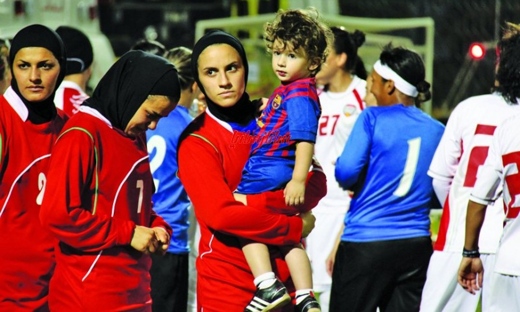
Iran’s female futsal player uses legal channels to defy travel ban

Niloufar Ardalan

Niloufar Ardalan, the captain of Iran’s national team who has stirred a controversy in recent months, has finally left Iran for Guatemala to take part in the 2015 Women’s Futsal World Tournament.

Ardalan, who had problems with her husband and as a result missed the final of the Asian Championship in Malaysia in September [in which Iran ended up winners], left the country without winning her husband’s consent. She left the country after she secured the approval of the Iranian Football Federation and a number of oversight bodies.

Mizan Online News Agency has released a report on the departure of the female Iranian futsal player, who is known locally as “Lady Goal”, for Guatemala despite her husband’s opposition. The following is the translation of the report:

The controversy broke out when the husband of Niloufar Ardalan, 30, refused to allow her to leave the country, citing her responsibility to take care of their only child.

In reaction, Ardalan turned to Football Federation officials and managed to accompany the country’s women squad on its trip to Guatemala where the 2015 Women’s Futsal World Tournament will be held on November 24-29.

While in Mexico in the national futsal team camp, Niloufar Ardalan said that she has left the country with the prosecutor’s permission.

“My presence in the national futsal team camp happened because of the prosecutor’s permission and I have a single exit permit” on my passport, Ardalan told http://90tv.ir/, adding that her departure [this time around] has nothing to do with her previous difficulties to leave Iran.

Ardalan then thanked the Football Federation, especially Messrs. Kafashian, Asadi and Eslamian as well as Ms. Arab Ameri and Mr. Sadeghi, a Tehran prosecutor.

[The 2015 Women’s Futsal World Tournament opened in Guatemala City, Guatemala, on November 24 and will conclude on November 29.

Iran has been drawn in Group A along with Brazil, Costa Rica and Portugal. Group B consists of Guatemala, Japan, Russia and Spain.]

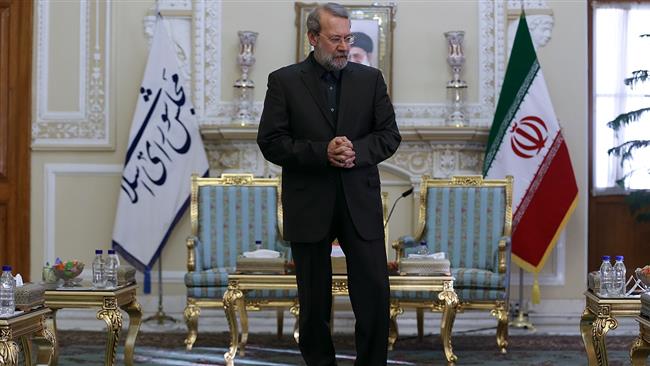
Turkey made big mistake downing Russian jet, US made bigger mistake backing it: Larijani

Larijani

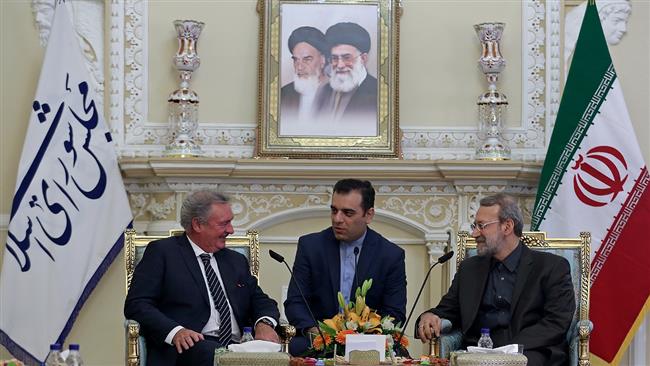
Iran’s Parliament Speaker Ali Larijani has said Turkey made a “big mistake” shooting down a Russian fighter jet near the Syrian border.

Larijani made the comment during a meeting with Luxembourg Foreign Minister Jean Asselborn in Tehran on Wednesday.

He also criticized the stance taken by US President Barack Obama and his administration, saying, “Obama’s support for this action is an even bigger mistake that further intensifies the conflicts in the region.”

On Tuesday, Obama expressed his country’s support for Turkey after it shot down a Russian Su-24M aircraft with two pilots aboard, claiming that the fighter jet had violated the Turkish airspace. “Turkey, like every country, has a right to defend its territory and its airspace,” Obama said.

Russia dismisses Ankara’s claims and says the fighter jet was downed in the Syrian airspace, where the Russian air force has been carrying out combat sorties against Takfiri terrorists since September 30 upon a request by the Syrian government.

Larijani said that some regional and Western countries support terrorist groups in the hope that they can use the conflict in the region to achieve their own objectives.

For his part, Asselborn said solving the crises in the Middle East is of utmost importance as insecurity in the region would endanger the security of European countries.

While in Tehran, Asselborn also met with his Iranian counterpart, Mohammad Javad Zarif, President Hassan Rouhani, and Ali Akbar Velayati, a senior adviser to Leader of the Islamic Revolution Ayatollah Seyyed Ali Khamenei.

Larijani-Luxembourg

Iran calls for global resolve in anti-terror fight

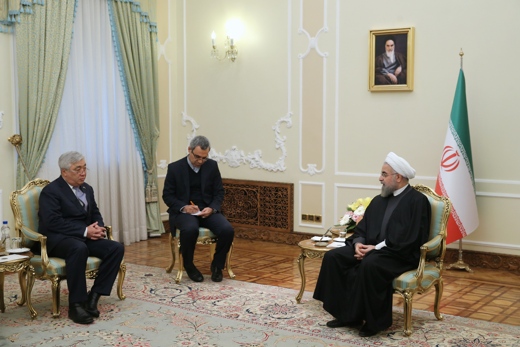
Rouhani-Kazakhstan

Iranian President Hassan Rouhani says an all-out fight against terrorism requires global resolve.

“The battle against terrorism needs the determination of all countries,” the Iranian president said in a meeting with Kazakhstan’s Foreign Minister Erlan Idrissov in Tehran Wednesday.

The international community must work to wipe out terrorism with attention to the roots of the phenomenon, Rouhani stated.

He further warned against ignoring terrorism as the “main threat” and said cooperation between countries is necessary in overcoming the problems in the region.

Idrissov, for his part, lauded the Islamic Republic’s “key role” in providing security in the region and resolving international issues.

The Kazak top diplomat said his country was willing to expand trade ties with Iran.

[…]


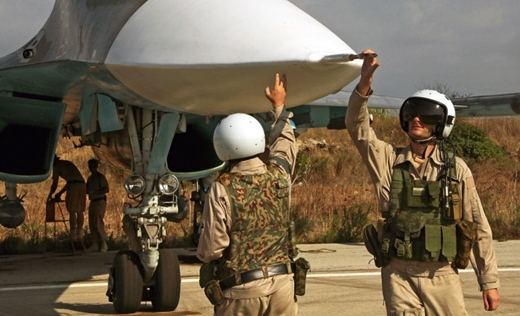
The rationale behind Russia’s intervention in Syria

Russia aire force

Hossein Alaei, who has the stewardship of the IRGC’s Navy under his belt, is a familiar face on Iran’s political scene. His strategic and independent political views have made his analytical articles, which are released in Iranian media every now and then, all the more read-worthy and contemplative.

Alaei delivered a speech at a scientific meeting on “The Russian presence in Syria and its impact on Iran’s national security and interests” which was recently held in Tehran in cooperation with the Iranian Political Sciences Association (IPSA) and the center for the Middle East Strategic Studies.

Tabnak.ir, a news website, on November 18 published the full text of his speech. IFP will release the translation of parts of Alaei’s remarks in two parts. Part one comes with the original headline “Why has Russia intervened in Syria?” and Part two is headlined “Why is Iran’s security tied to regional peace and security?” The following is PART ONE of the speech:

The speaker first reviewed the major developments in the Middle East which started with the invasion of Kuwait by Saddam Hussein followed by US military interference; and the fall of Saddam, the collapse of the Iraqi [political] structure and destruction of the Ba’ath regime’s Russian-made military hardware.

He then went through the Arab Spring (Awakening Movement of Muslims) in Arab countries which resulted in a mix of national frustration and failures in the Middle East thanks to meddling by the US and its regional allies such as Saudi Arabia. The trend [the speaker followed in his speech] eventually shifted to Syria where is now a hotbed of proxy wars.

All along the path from the occupation of Iraq to the Syrian crisis, Alaei argued, the Americans have always been trying to erase the footprints of their arch rival – Russia [the successor of the Soviet Union]. Now the covert war between the White House and the Kremlin has reached the final stage.

After his introduction, Hossein Alaei said, “[…] Following the popular uprisings in Arab nations, Russia was entangled in strategic passivity and inactivity. This passiveness caused Russia to lose – to a great extent – the bases it used over the course of history to infiltrate the Middle East.

“The policy Russia adopted during the Iraqi crisis and the disintegration of the Ba’ath Party practically cleared the way for the United States to take military action in Iraq. [Back then] The US appointed an American ruler in Iraq and governed the [war-hit] country with its own military before the formation of a new government in Iraq.

“In other words, the structure of the Iraqi government which had a leaning toward Russia since the Ba’ath Party came into office was put aside by the US. That was not all; the Americans – by taking military action – intentionally destroyed the remnants of the eastern structure of the Cold War era in Iraq and disbanded the Ba’ath army not to be worried about [the possibility of] the revival of the Russian structures in Iraq.

“Disbandment of the army in any given country marks the end of the influence of the government which has built up that army. If the US had not disbanded the Ba’ath army, [members of] the demobilized army would have likely turned to the country which had created it.

“The US acted on a pre-planned agenda and disbanded the Iraqi army, because it was the product of the Russians. Such an army had to be dissolved, and all its structure, personnel and equipment had to be destroyed.

“A similar theory was developed by a number of strategists following the NATO invasion of Libya [in 2011] suggesting that Washington would take advantage of the uprising by the Libyan people against [Colonel] Muammar Gaddafi to force Russia out of Libya. NATO air forces launched attacks on Libya’s military infrastructure and bombed all the Russian-made submarines – which had no role in cracking down on people – in the port city of Sirte. This way the US destroyed the Libyan navy and all the Russian structures which dominated the Libyan government and army.

“In the wake of these developments, the Russians felt that they had to pack their bags and leave the Middle East region, because they had nothing else to do. The Russians know that they are unpopular in the public opinion of many countries for holding Marxist views and nurturing dictators. To infiltrate the countries, the Russians can only establish military structures and create like-minded governments in other countries.

“They have no other way to make their presence felt in the political structures and power equations in the region. The Russians realized that if Syria shared the fate of Libya or Iraq, they would be confined to their territorial and geographical borders and the Americans would expand their actions against them.

“A look at developments in Georgia shows that the US is seeking to tighten the noose around Russia by changing the governments in the Commonwealth of Independent States (CIS) or welcoming regime change in the former Soviet republics.

“The last case in point was Ukraine. The Russians captured Crimea, but they lost their power in Ukraine to a great extent. In Ukraine, they lost [the support of] the government. They are becoming smaller [and smaller]. Given the fact that the Russians have gotten involved in other issues in their own region, they will definitely face a big challenge in the Caucasus in the future.

“It can be said that Russia’s military intervention in Syria seems justifiable as far as its national interests are concerned. If Russia had not intervened in Syria militarily, the US would have talked with the Russians solely over Ukraine. But, Russia’s military presence in Syria will see Moscow and Washington talk about larger issues and this will serve as a driving force behind efforts to shift the balance in the region.”

Accusing Basij of radicalism completes enemy’s infiltration project: Leader

8ce1e2ed-f9f3-4ee6-97ab-be8060bb215d

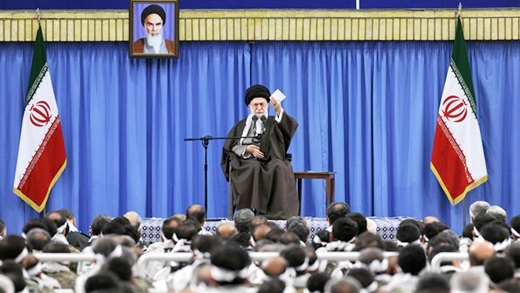
Leader of the Islamic Revolution Ayatollah Seyyed Ali Khamenei says those people who accuse Basij force of being radical are in fact completing the enemy’s infiltration project.

Ayatollah Khamenei made remarks in a meeting with thousands of Basij commanders from across the country in Tehran on Wednesday.

During the meeting, the Leader once again explained enemy efforts to infiltrate the country under various excuses, saying, “The [issue] of [enemy’s] infiltration is a very important issue.”

Ayatollah Khamenei said the fact that some people intend to take advantage of the issue of “influence” in favor of their own political faction, does not reduce the importance of this issue because the enemy is devising plots against the country.

“Today, infiltrating into [political] currents is more dangerous than influencing individuals,” the Leader noted, adding that infiltrating into a political current means to build a network within the nation by spending money and banking on sexual attractions in order to change the beliefs, ideals, views and lifestyle of the nation.

Praising Iran’s Basij force as an “unending treasure,” the Leader warned that those people who accuse Basij of being extremist and radical “are completing the enemy’s infiltration project.”

“Basij is among strong embankments [of the country], which should not be undermined,” Ayatollah Khamenei emphasized.

The Leader then turned to the Intifada (uprising) of the Palestinian people in the occupied territories, saying, “The Intifada of the Palestinian people in the West Bank has started and people are fighting [the Zionist regime].”

“About 60 years have passed since the occupation of Palestine and these people have changed for a number of generations, but the cause of Palestine still exists,” Ayatollah Khamenei said, noting that the enemy aims to eliminate this cause.

“We will defend the movement of the Palestinian people in any way that we can,” the Leader emphasized.

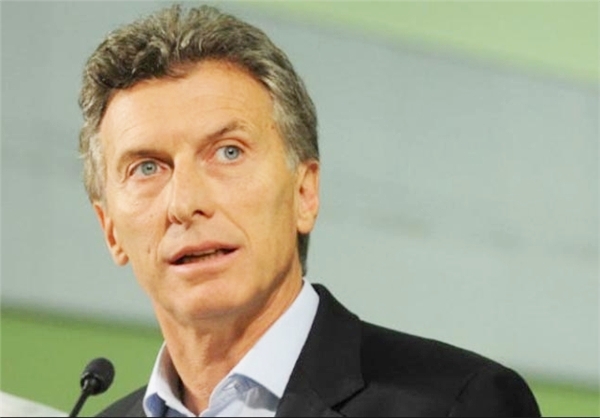
The new Argentine president plays the AMIA card

13940729000190_PhotoL

Daniel Scioli, the candidate endorsed by former President Cristina Fernandez de Kirchner in Argentina’s presidential election to replace her, was defeated in a runoff vote over the weekend.

The presidential terms of the Argentine president came to an end at a time when the judicial case involving the bombing of AMIA [Argentine Israelite Mutual Association in 1994] remained pretty much open. A case which put enormous pressure on the former president whose opponents used the bombing as leverage against her.

Many analysts believe that Argentina will pursue a new diplomatic line under the new president. Khabaronline’s Zohreh Noruzpour has interviewed one such expert: Hadi Alami Fariman. The following is the translation of part of the interview the news website released on Tuesday:

Q . What is your assessment of Daniel Scioli’s defeat? Does it mean that the Argentine government’s policies have failed?

A. The Argentine people were sick and tired of austerity measures, and of Cristina Kirchner’s confrontation with the International Monetary Fund and Washington lenders. The recent murder of the judge in the AMIA case was another factor that to some extent complicated things for the government and prolonged domestic tensions.

The theory of suicide and then murder of the judge and the overhaul of the intelligence agency had overshadowed Cristina Kirchner’s government and sometimes led her to the brink of frustration. Critics capitalized on this situation to announce that she was incompetent, in judicial matters in particular.

The pressure was obviously felt in her recent speeches at the UN where she lashed out at the current international order. Some interpreted it as a shot at blame game for the domestic problems she was facing. De Kirchner’s long rule had exhausted the Argentine people. The stage was set in Argentina for change. People were tired of sloganeering of Peronist Populists.

Q. What kind of changes can be expected in foreign policy?

A. The most significant strategic changes lie in this field. The president-elect has explicitly declared that he will distance Argentina from populist Venezuela and Iran, and will cement ties with the Pacific Alliance member countries including Peru, Mexico, Colombia and Chile, will reinforce ties with Washington, especially in combating drug smuggling, and above all, will establish strategic ties with Brazil. All of these changes, particularly the rethinking of ties with Venezuela, will leave serious impact on the region.

Q. What’s your prediction of the AMIA case and its settlement with the Islamic Republic of Iran?

A. With changes in foreign policy and more bonds between Macri and Washington, the AMIA case will most probably remain unchanged and will be used as leverage against Iran. Mrs. Kirchner made lots of efforts to settle the case, but those efforts had no effective results except for a memorandum of understanding and a number of diplomatic dialogues.

It is unlikely for the case to be closed under the new government. The settlement of the case could hinge on the change in situation after the implementation of the Joint Comprehensive Plan of Action as well as on ties between Iran and the Western countries, including the US.

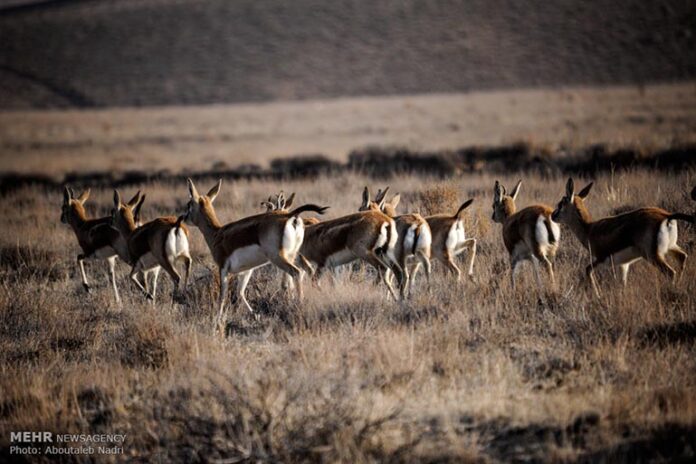
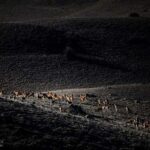
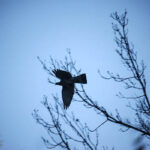
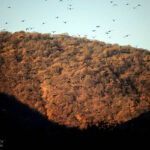
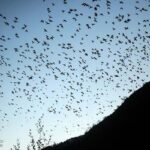
Wildlife Census in national park (PHOTOS)

Wildlife0

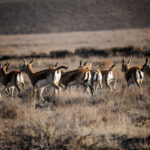
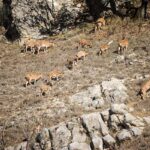
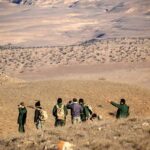
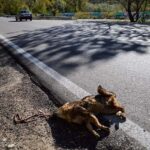
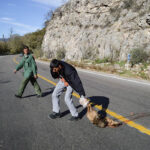
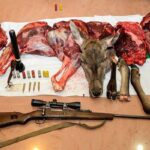
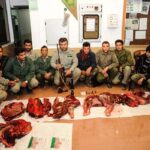
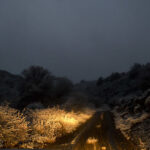
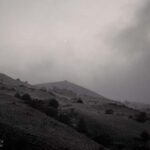
A wildlife census at Golestan National Park has come with the apprehension of a number of poachers.

The following images have been released by Mehr News Agency:

A look at Iranian newspaper front pages on Nov. 25

Iranian Newspapers Headlines

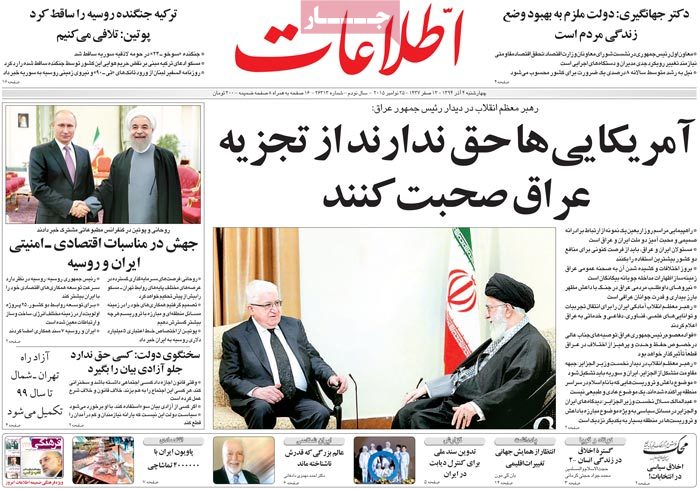
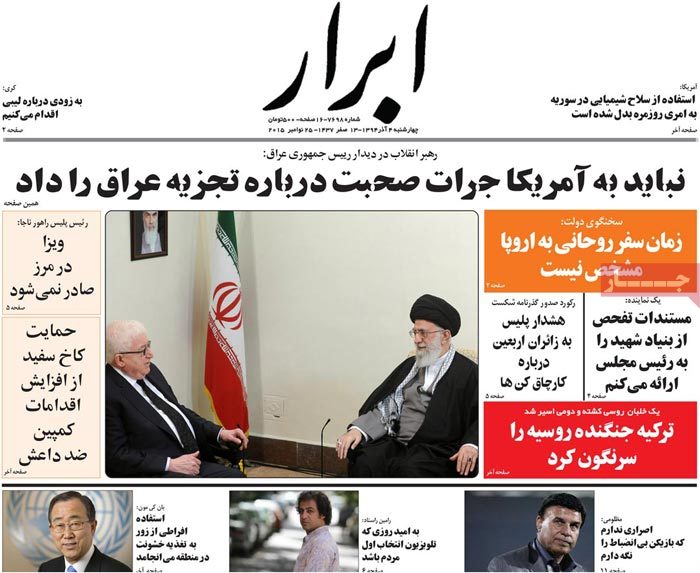
The Leader’s comments in three meetings with the heads of state and government in Tehran to attend a gas conference dominated the front pages of Iranian newspapers on Wednesday. Also on the cover of the dailies was the shoot-down of a Russian jet fighter by Turkey.


Ettela’at: The Americans have no right to talk about Iraq’s disintegration, said the Supreme Leader in a meeting with the Iraqi president.

Ayatollah Khamenei further said Iranian and Iraqi officials need to make the most of the existing opportunity to advance the interests of the two nations.


Abrar: The number of Iranians applying for passport [to take part in Arba’een ceremonies in Iraq] has hit an all-time high.
 

A look at Iranian newspaper front pages on Nov. 25


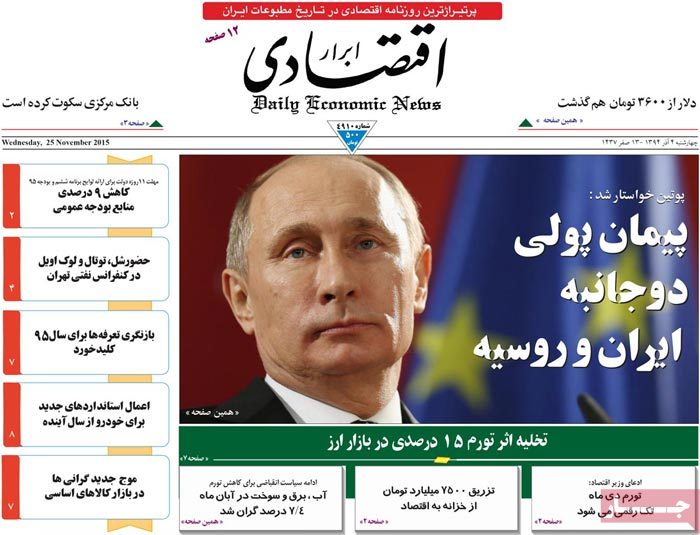
Abrar-e Eghtesadi: President Putin has called for a two-way monetary pact between Iran and Russia.
 

A look at Iranian newspaper front pages on Nov. 25


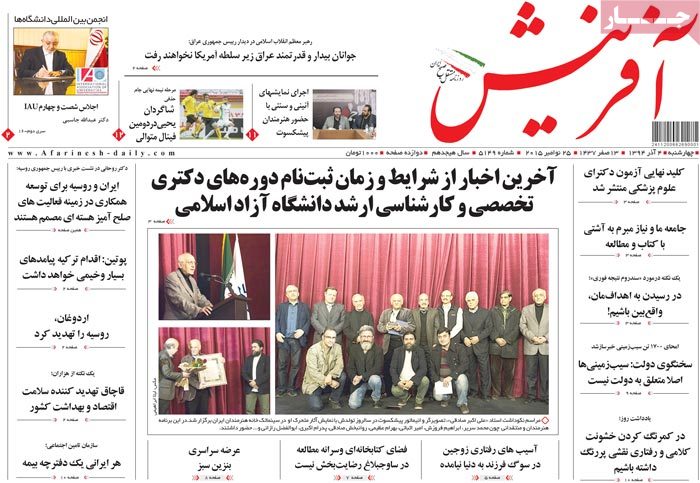
Afarinesh: The government spokesman: Those potatoes did not belong to any government institution.

[Earlier, reports that 1,700 tons of potatoes have been disposed of in a bid to keep prices up kicked up a stir in parliament.]
 

A look at Iranian newspaper front pages on Nov. 25


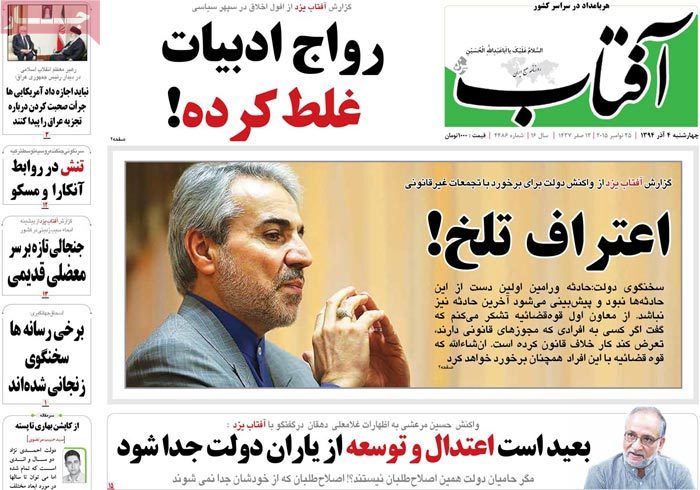
Aftab-e Yazd: A bitter admission!

What happened in Varamin [an attack on an authorized gathering of reformists] was not the first such incident and is unlikely to be the last, said the government spokesman.

Mohammad Bagher Nobakht further said he hopes the assailants are seriously dealt with by the Judiciary.
 

A look at Iranian newspaper front pages on Nov. 25


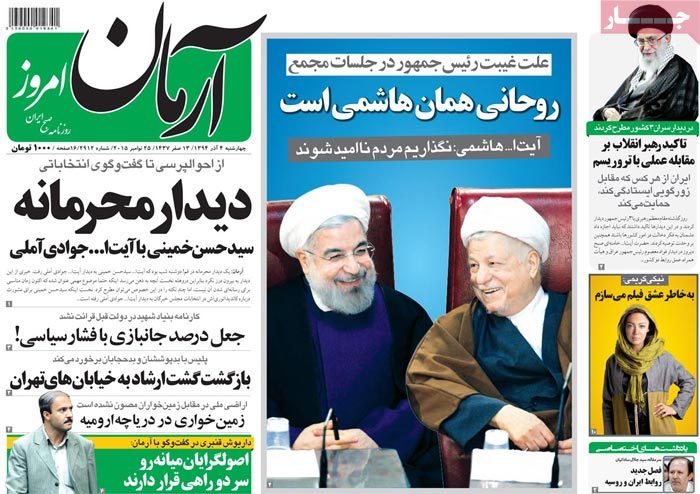
Arman-e Emrooz: Morality police have made a comeback to the streets of Tehran.

Those who flout the dress code will be dealt with.
 

A look at Iranian newspaper front pages on Nov. 25


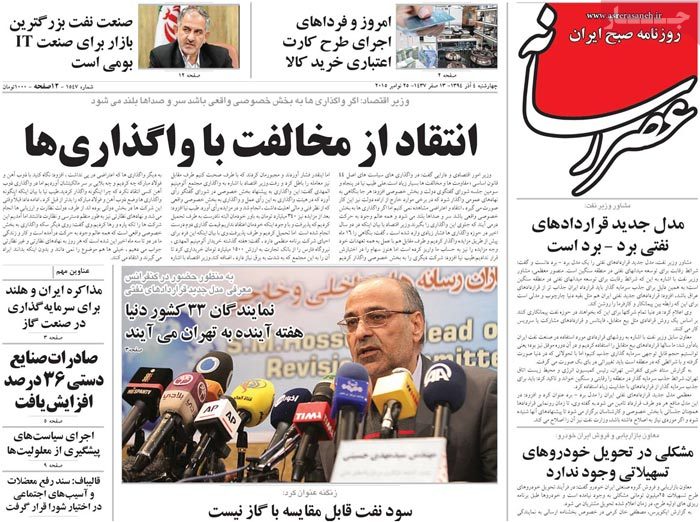
Asr-e Rasaneh: Representatives of 33 countries will arrive in Tehran next week to attend a conference on introduction of new oil contracts.

Asr-e Rasaneh: Exports of handicrafts have posted a 36 percent rise.
 

A look at Iranian newspaper front pages on Nov. 25


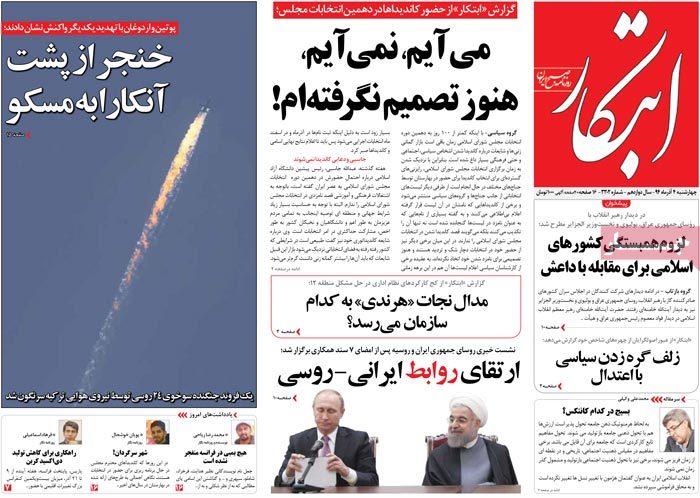
Ebtekar: Promotion of Iran-Russia ties

The two countries have signed seven cooperation agreements.
 

A look at Iranian newspaper front pages on Nov. 25


Emtiaz: The deputy secretary general of the Anti-Drugs Commission has said that 133 labs cooking synthetic drugs have been closed down.
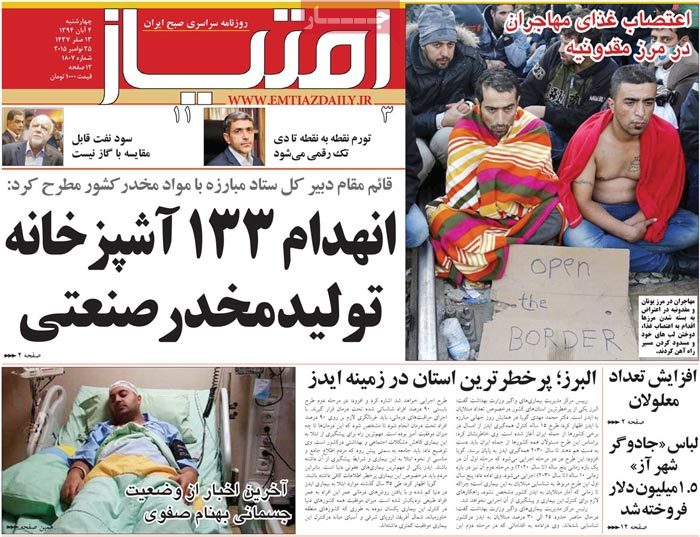
 

A look at Iranian newspaper front pages on Nov. 25


Etemad: A spokesman for the Islamic Revolution Guard Corps has denied Arab media reports that Major General Ghasem Soleimani has been injured.
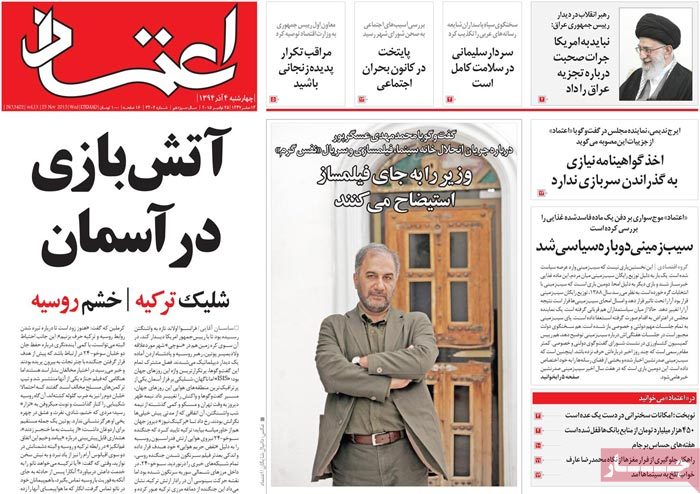
 

A look at Iranian newspaper front pages on Nov. 25


Hadaf va Eghtesad: Reports that the Cabinet will be reshuffled have been rejected.

The government spokesman has said there is no truth to rumors that the industry minister will be replaced.
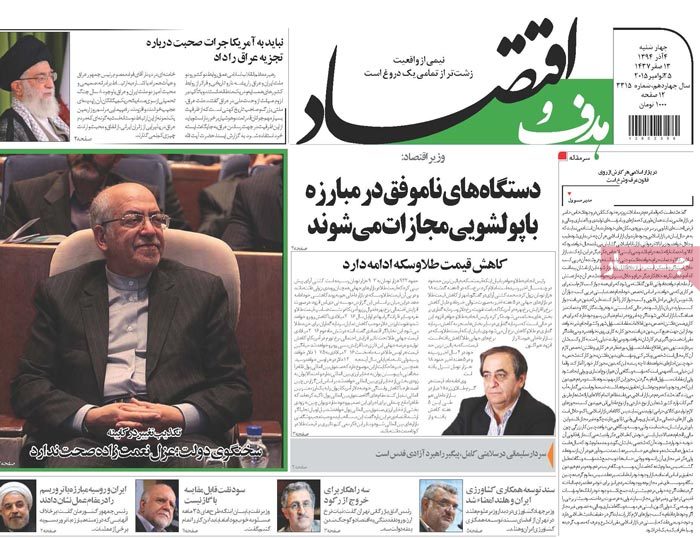
 

A look at Iranian newspaper front pages on Nov. 25


Hambastegi: Chairman of the Expediency Council Ayatollah Akbar Hashemi Rafsanjani has said, “Let’s take heed of what members of the public want and not allow them to get frustrated.”
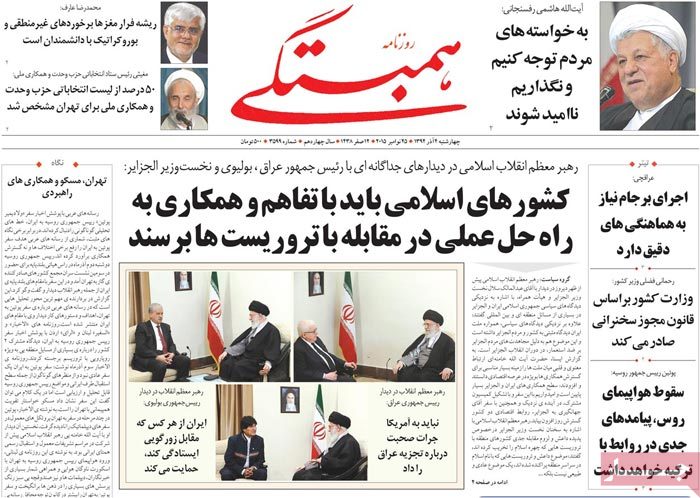
 

A look at Iranian newspaper front pages on Nov. 25


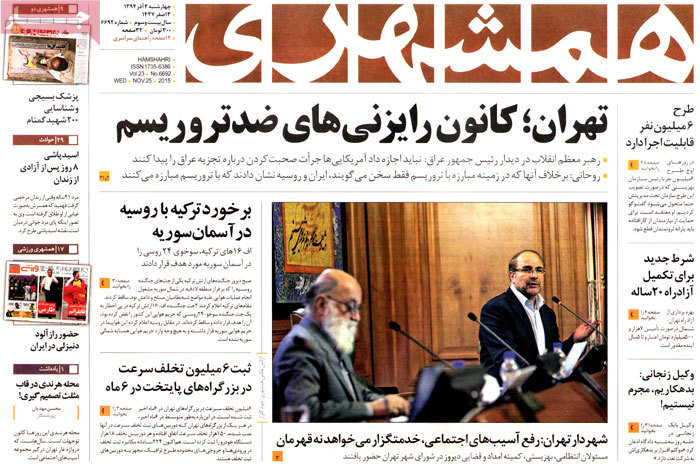
Hamshahri: Tehran turned into the hub of anti-terrorism consultations.
 

A look at Iranian newspaper front pages on Nov. 25


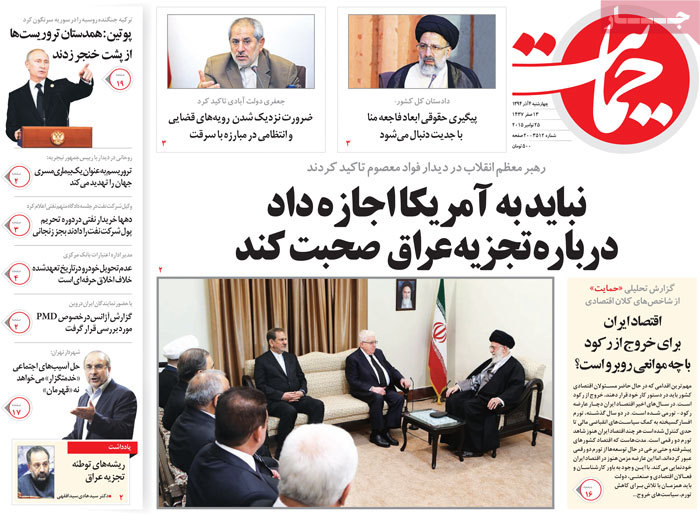
Hemayat: The attorney general has said that the legal aspect of the Mina tragedy will be seriously pursued.
 

A look at Iranian newspaper front pages on Nov. 25


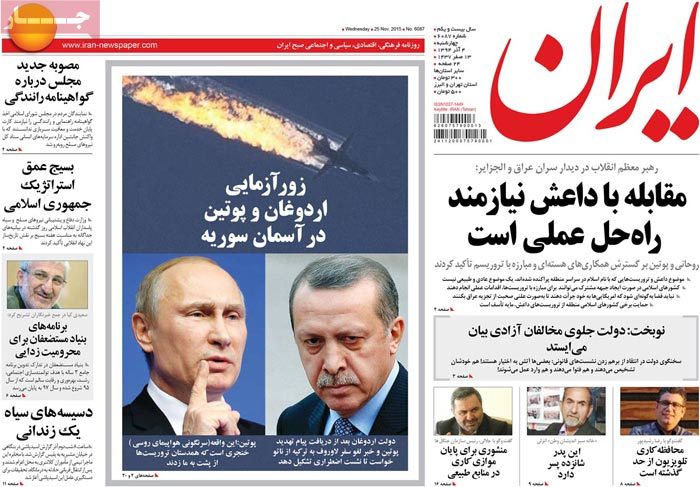
Iran: A new decision by parliament on requirements to get a driver’s license

Under the new decision, to get a license, male applicants do not need to produce evidence that that they have served out their military service or that they are exempt from the service.
 

A look at Iranian newspaper front pages on Nov. 25


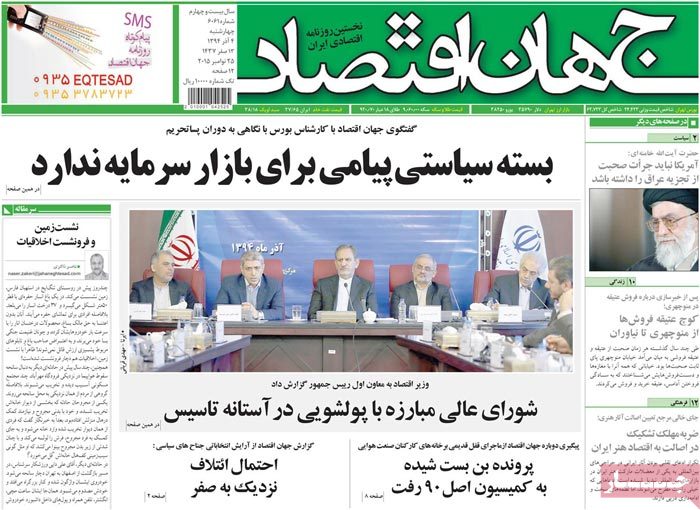
Jahan-e Eghtesad: The first vice-president has said that a Supreme Anti-Money Laundering Council will be set up soon.
 

A look at Iranian newspaper front pages on Nov. 25


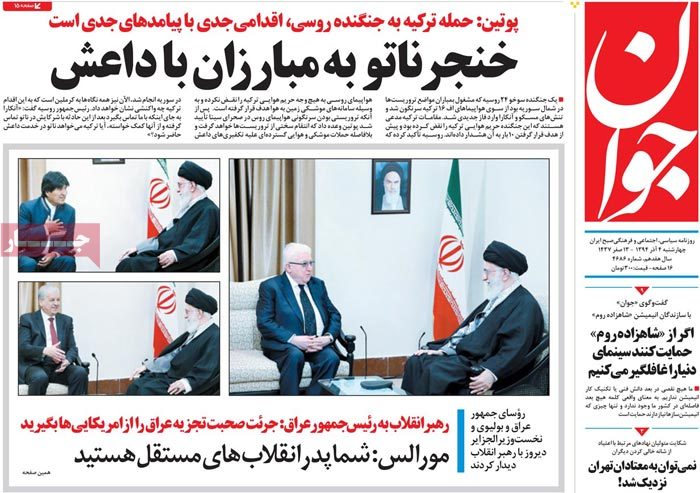
Javan: NATO has stabbed those who are taking on IS.

President Putin has described the downing of the Russian fighter jet as a serious act with serious ramifications.
 

A look at Iranian newspaper front pages on Nov. 25


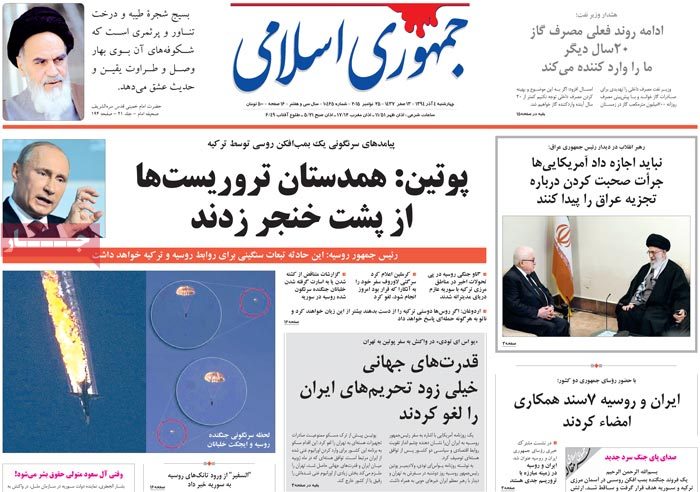
Jomhouri Islami: Putin has said that allies of the terrorists have stabbed us in the back.

The Russian president further said that the downing of a Russian fighter by Turkey will have a serious repercussion on relations between Moscow and Ankara.
 

A look at Iranian newspaper front pages on Nov. 25


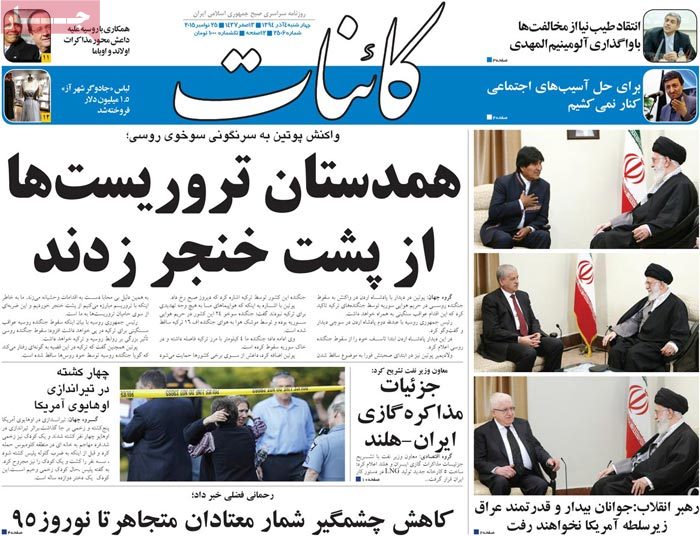
Kaenat: The number of homeless addicts who openly use drugs in public places will be down dramatically by the end of the year [March 21, 2016], the interior minister has predicted.
 

A look at Iranian newspaper front pages on Nov. 25


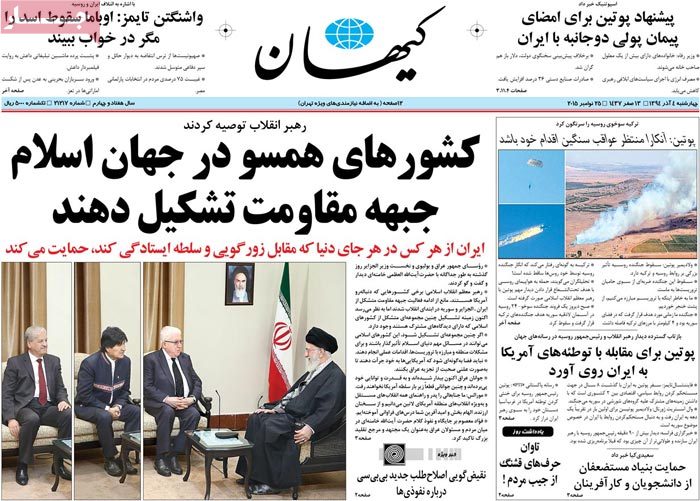
Kayhan: Like-minded countries in the world of Islam should form a resistance front, said the Supreme Leader.

Ayatollah Khamenei further said Iran supports anyone who stands up to hegemony and bullying anywhere in the world.
 

A look at Iranian newspaper front pages on Nov. 25


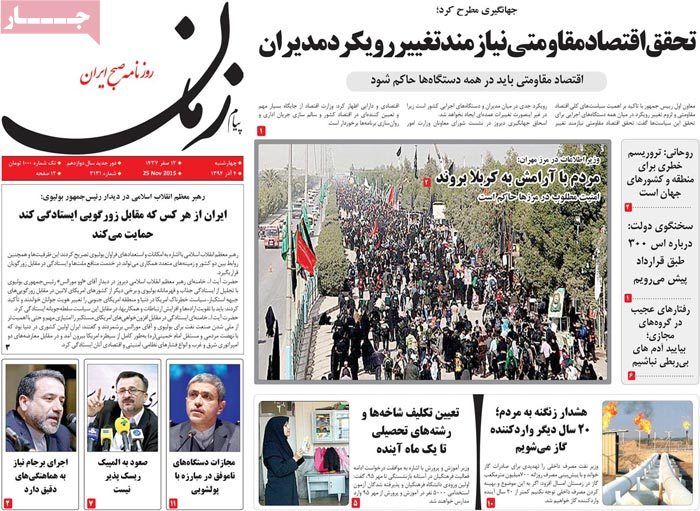
Payam-e Zaman: The oil minister has warned that continued consumption at the current level may turn Iran into an importer of natural gas in 20 years’ time.

Payam-e Zaman: The government spokesman has said that procurement of S300 missile defense system from Russia is going ahead according to what has been stipulated in the deal.
 

A look at Iranian newspaper front pages on Nov. 25


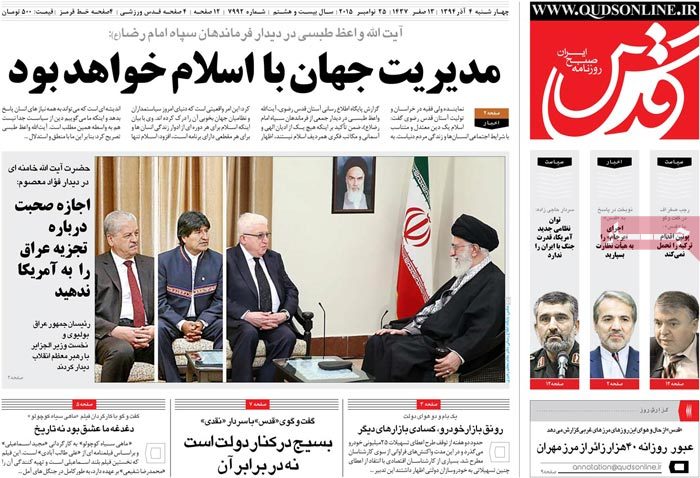
Qods: The commander of the Basij (Volunteer) Force has said that his men stand by the government, not against it.
 

A look at Iranian newspaper front pages on Nov. 25


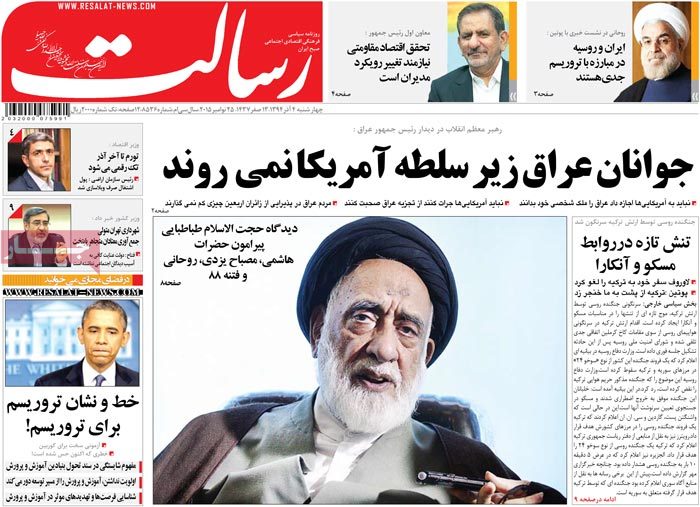
Resalat: Realization of resistance-based economy requires a change in the approaches employed by state managers, said First Vice-President Eshagh Jahangiri.
 

A look at Iranian newspaper front pages on Nov. 25


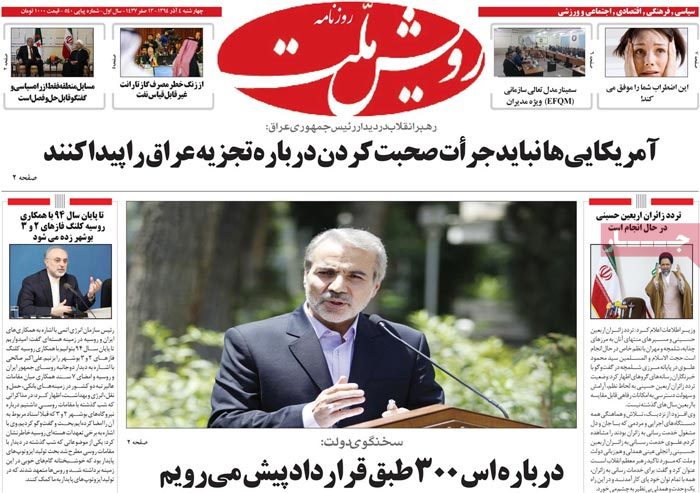
Rooyesh Mellat: In less than four months, ground will be broken on Phases 2 and 3 of Bushehr Power Plant in cooperation with the Russians, said the director of the Atomic Energy Organization of Iran.
 

A look at Iranian newspaper front pages on Nov. 25


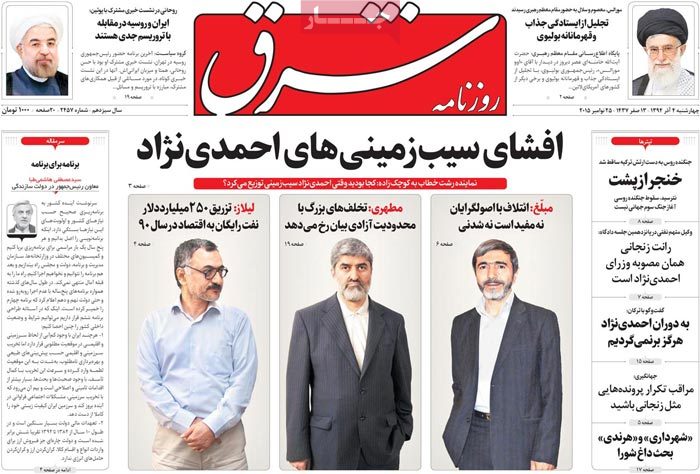
Sharq: Iran and Russia are resolute in countering terrorism, President Rouhani said at a joint press conference with his Russian counterpart.
 

A look at Iranian newspaper front pages on Nov. 25


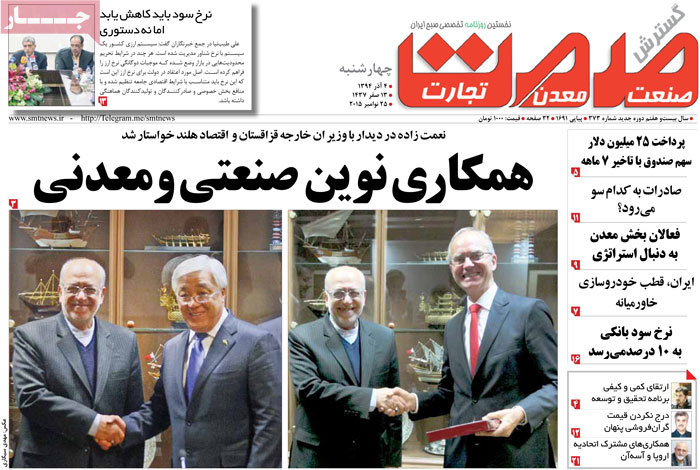
SMT: The industry minister has called for a new chapter in industrial and mining cooperation with Kazakhstan and the Netherlands.

The appeal came at separate meetings with the Kazakh and Dutch foreign ministers.
 

A look at Iranian newspaper front pages on Nov. 25


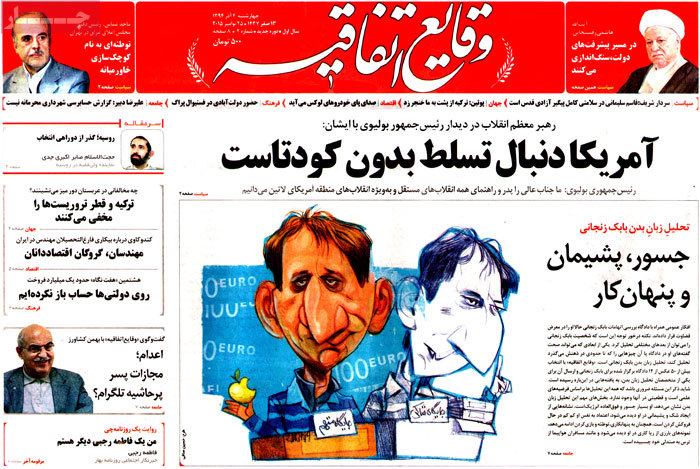
Vaghaye-e Etefaghiyeh: Some are interfering with government efforts to make progress, said the chairman of the Expediency Council.

 

A look at Iranian newspaper front pages on Nov. 25
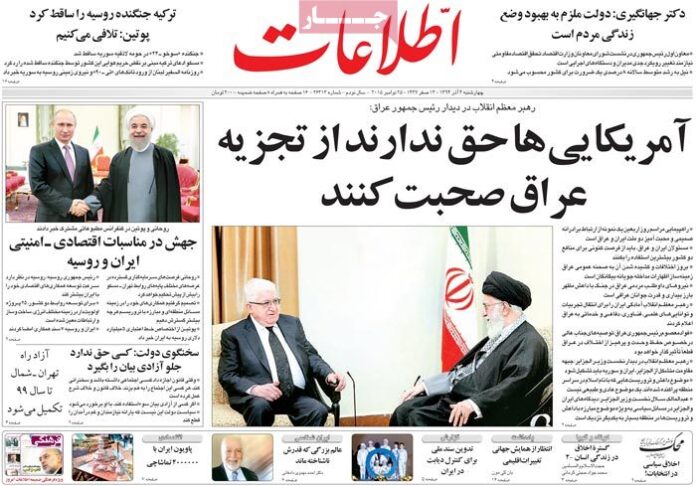


Highlights of Ettela’at newspaper on Nov. 25

Ettelaat25

 The Americans have no right to talk about Iraq’s disintegration, said the Supreme Leader in a meeting with the Iraqi president.

Ayatollah Khamenei further said Iranian and Iraqi officials need to make the most of the existing opportunity to advance the interests of the two nations.

 The first vice-president has said the government is duty-bound to improve the living conditions of citizens.

Eshagh Jahangiri further said that securing an average eight percent growth is a necessity for the country.

 Turkey has shot down a Russian fighter.

President Putin has said Moscow will retaliate.

 Presidents Rouhani and Putin have announced a leap in economic and security relations between Iran and Russia.

More investment opportunities in different areas can further cement relations between Tehran and Moscow, President Rouhani told a joint press conference.

 The highway linking Tehran to the Caspian coast will have been completed by 2020.

 The government spokesman has said that no one has the right to interfere with freedom of speech.

Mohammad Bagher Nobakht further said that those who disrupt authorized gatherings are acting against the law and Sharia.