Sunday, December 21, 2025
Home Blog Page 4661

A look at Iranian newspaper front pages on August 25

Iranian Newspapers Headlines

The comments of President Rouhani about republicanism as his Cabinet paid respect to the late Imam Khomeini in his mausoleum in southern Tehran, the meetings of the British foreign secretary with Iranian officials, and the remarks of the judiciary chief and the interior minister on the role of the Guardian Council in the electoral process dominated the front pages of Iranian newspapers on Tuesday.


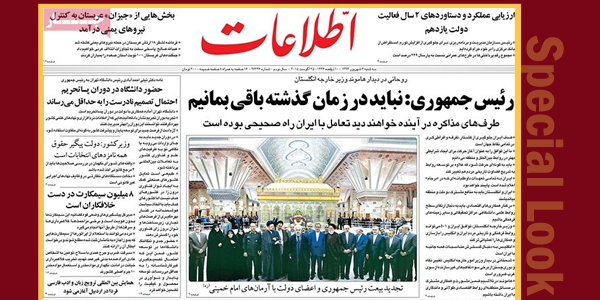
Ettela’at: “We should not remain stuck in the past,” said President Rouhani at a meeting with visiting British Foreign Secretary Philip Hammond.

The Iranian president further said those who sat at the negotiating table with us will realize in the future that interaction with Iran has been the right choice.
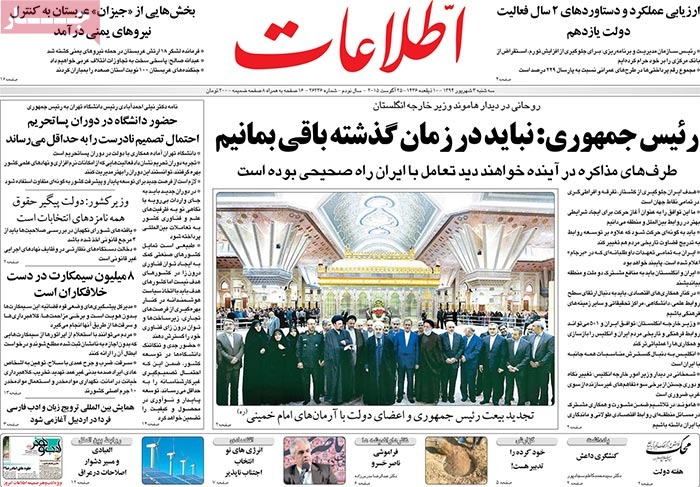


Aftab-e Yazd: “Those who went so far as to sanctify Ahmadinejad should now answer for their measures,” said Chairman of the Expediency Council Akbar Hashemi Rafsanjani.

Aftab-e Yazd: Chinese cars have landed on a list of items boycotted by people.

Aftab-e Yazd: The interior minister has said that his ministry seeks to hold talks with the Guardian Council on upcoming elections.
 

A look at Iranian newspaper front pages on August 25


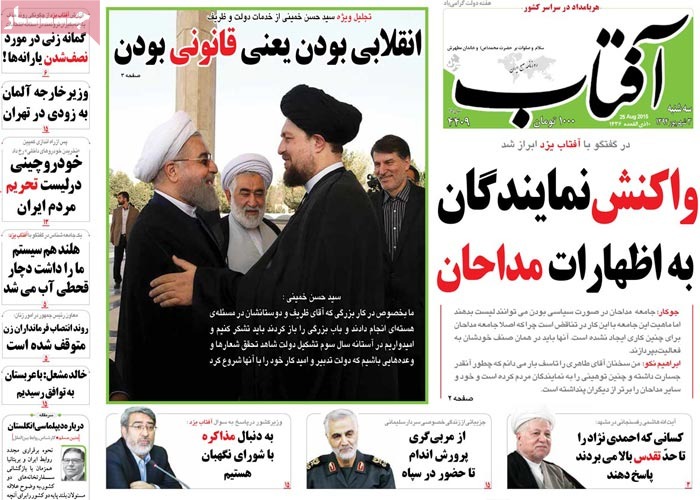
Arman-e Emrooz: The Interior Ministry has broken its silence.

“I received 10 calls a day from MPs as I was about to name a governor general,” the interior minister said.
 

A look at Iranian newspaper front pages on August 25


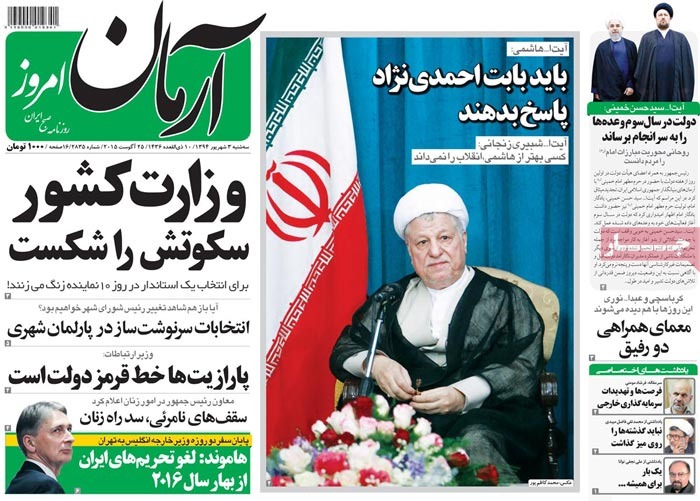
Asrar: “Talks with the Americans on other issues depends on their behavior,” said Iranian Foreign Minister Mohammad Javad Zarif.

Asrar: “Our revolution was not designed to make us sever our ties with the rest of the world,” said Tehran MP Ali Motahari.
 

A look at Iranian newspaper front pages on August 25


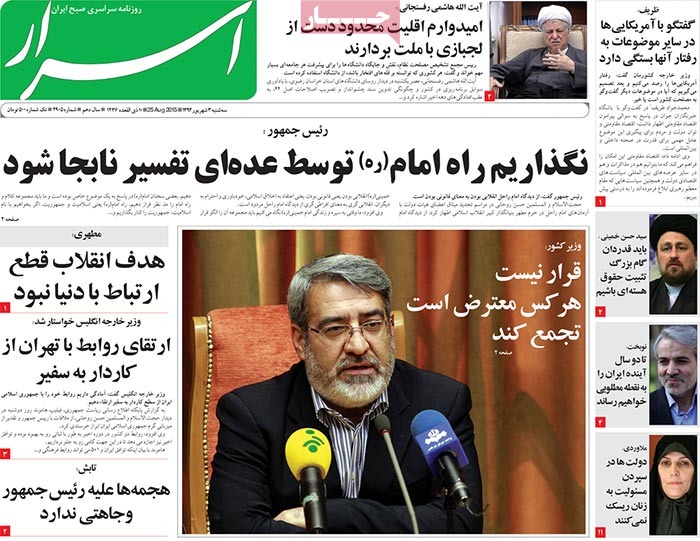
Ebtekar: The German foreign minister is due in Iran shortly.

He will be the third top diplomat of the P5+1 group to visit Iran in the wake of the Vienna accord.

Ebtekar: Rouhani has dismissed the notion that being a revolutionary is equal to holding extremist ideas.
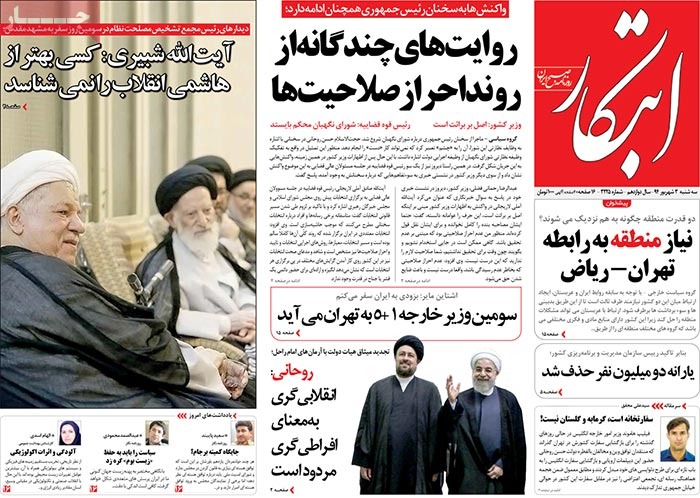
 

A look at Iranian newspaper front pages on August 25


Emtiaz: The petrochemical industry needs $8 billion in annual investment.
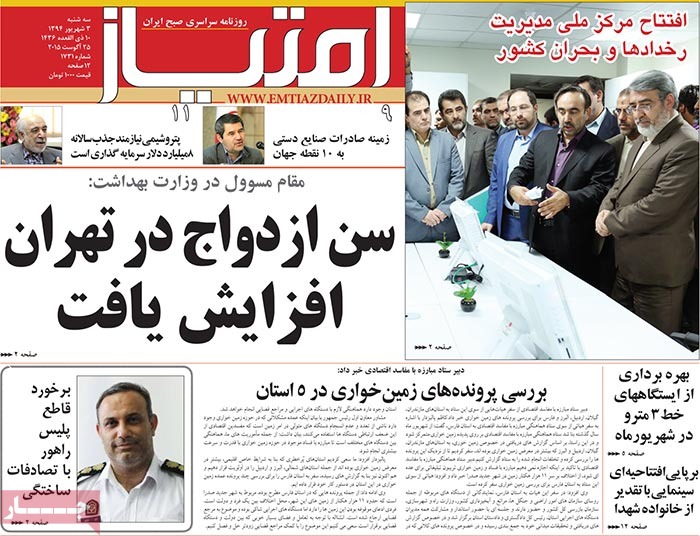
 

A look at Iranian newspaper front pages on August 25


Hemayat: “The seditionists [a reference to those who supported massive riots sparked when two candidates questioned the results of the 2009 presidential elections] seek to run for office in [upcoming] elections; the Guardian Council should stay its ground,” said the judiciary chief.
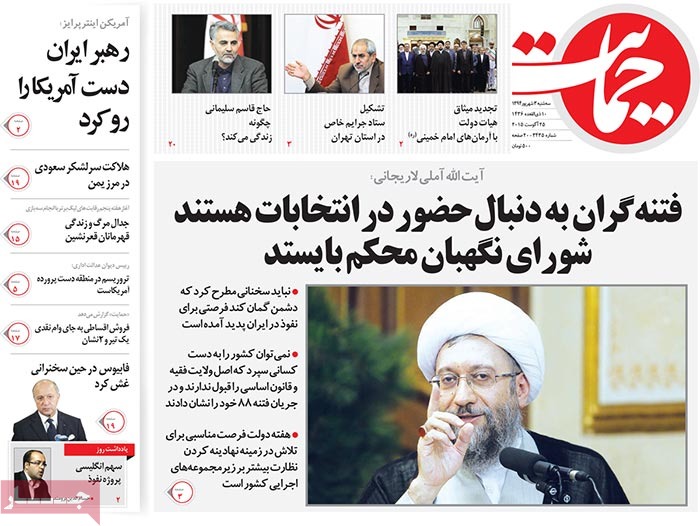
 

A look at Iranian newspaper front pages on August 25


Iran: The cash subsidies of some two million high-income individuals have been cut.

Iran: President Rouhani has said that officials should not allow the ideas of the late Imam Khomeini to be misinterpreted.
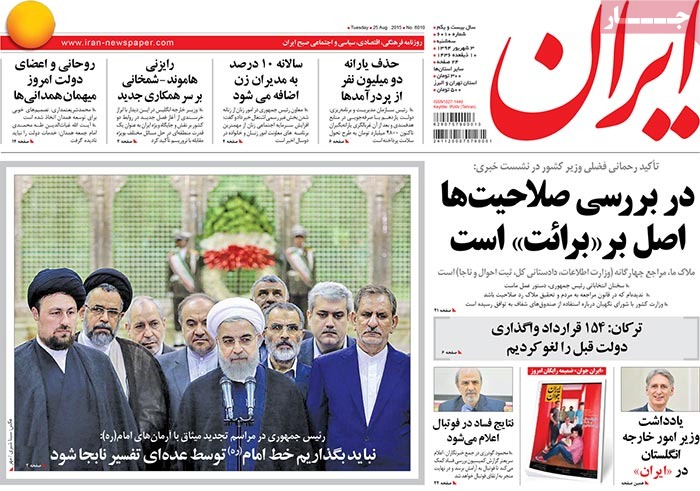
 

A look at Iranian newspaper front pages on August 25


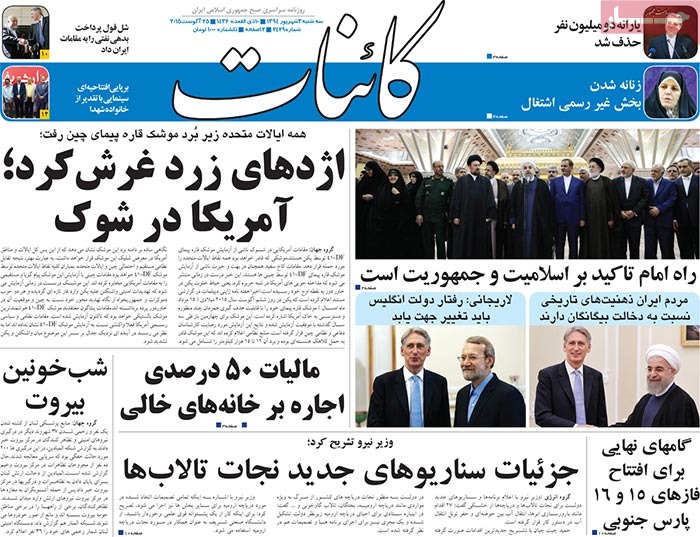
Kaenat: “The path the late Imam chose laid emphasis on Islam and Republicanism,” said president Rouhani.
 

A look at Iranian newspaper front pages on August 25


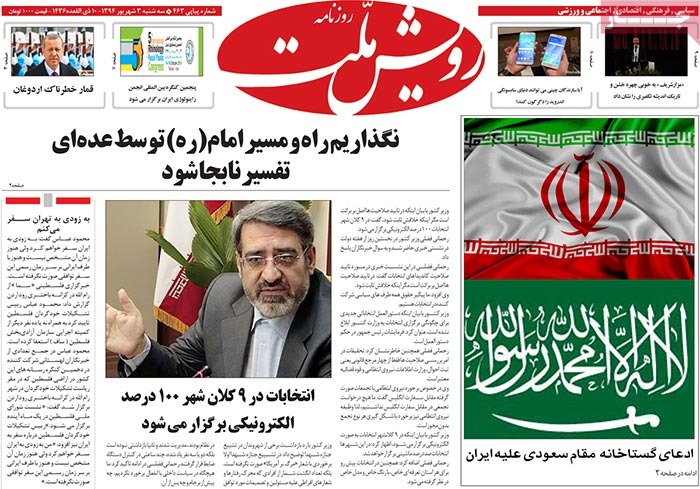
Rooyesh-e Mellat: “Elections in nine metropolises will be 100 percent electronic,” said the interior minister.
 

A look at Iranian newspaper front pages on August 25


Highlights of Ettela’at newspaper on August 25

Ettelaat Highlights-post

 “We should not remain stuck in the past,” said President Rouhani at a meeting with visiting British Foreign Secretary Philip Hammond.

The Iranian president further said those who sat at the negotiating table with us will realize in the future that interaction with Iran has been the right choice.

 The president and his Cabinet have paid a visit to the mausoleum of Imam Khomeini to reaffirm allegiance to the late founder of the Islamic Republic and his ideals.

The visit was timed to coincide with Government Week.

 Assessment of the performance of the 11th government two years after it took office

The director of the Management and Planning Organization said that government has banned itself from borrowing money from the Central Bank in a bid to prevent a hike in inflation.

 Parts of the Saudi town of Jizan have been captured by Yemeni forces.

[Former Yemeni President] Ali Abdullah Saleh has said that the Saudi-led coalition will pay a price for its aggressions.

 “The involvement of universities in post-sanctions decision-making minimizes the risk of wrong decisions,” said the president of the University of Tehran in a letter to President Rouhani.

In the letter, Dr. Nili Ahmadabadi signaled the readiness of Tehran University to cooperate with the government in the post-sanctions era.

 The interior minister has said government tries to protect the rights of all electoral candidates.

Abdolreza Rahmani-Fazli further said involvement of oversight bodies in the responsibilities of executive institutions is illegal.

 Criminals are in possession of eight million unregistered SIM cards.

A senior official with the judiciary has said that these unregistered SIM cards are being used, among other things, in scams and thefts.


Army commander warns enemies of Iran’s prompt response to threats

139405071632504015778094

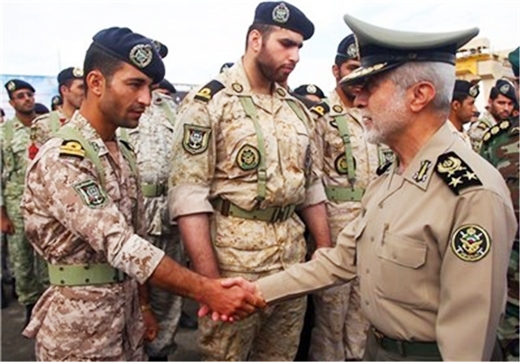
Iran’s Army Commander Major General Ataollah Salehi reiterated the country’s armed forces’ high preparedness to defend the country against possible hostile moves.

Addressing a group of Iranian Air Force cadets on Monday, Salehi pointed to the ongoing developments in the Middle East, and also anti-Iran rhetoric by “bullying countries”, and said the army is well prepared to defend the country.

“The mighty Army of the Islamic Iran has the ability and power to show prompt response to any kind of unwise movement in the region, especially against our dear country: Iran,” Salehi underscored.

In similar remarks earlier this month, Commander of the Islamic Revolution Guard Corps Major General Mohammad Ali Jafari said that his forces, who have advanced technologies in their possession, are prepared to counter any foreign threat.

“Today, the Islamic Revolution Guard Corps has immense power with reliance on people and faith (in God), and by possessing very advanced technologies, it is ready to counter any foreign threat,” the top general said in a cultural conference held in the northeastern city of Mashhad.

He asserted that “defending the Islamic Revolution” is the main mission of IRGC.

Britain should cease interventionist policy toward Iran: Larijani

Larijani-hommand

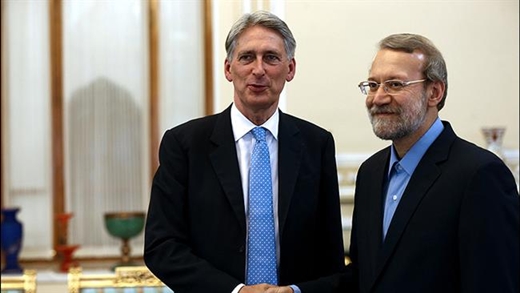
Iran’s Parliament Speaker Ali Larijani has called on the British government to drastically change its interventionist approach toward Iran’s domestic issues if it really seeks a new beginning in relations with Tehran.

“The British government’s behavior concerning on-off interference in Iran’s internal affairs in the past should change and Iranian people should not feel that Britain’s approach toward them is unfriendly and ambiguous” said Larijani in a meeting Monday with visiting British Foreign Secretary Philip Hammond in Tehran.

The top lawmaker further slammed certain Western governments for adopting double standards in dealing with important issues such as human rights and the fight against terrorism, narcotics, and foreign occupation, saying those who created Takfiri terrorism and provided arms and weapons to terror groups should now take responsibility for their wrong policies.

The British foreign secretary, for his part, admitted the fact that Britain has a negative record in the minds of Iranians, saying, however, that no one should be stalled in the past and there must be a move forward.

Hammond also hailed a July 14 nuclear agreement between Iran and six global powers, saying that the world has come to understand that Tehran is making strides to improve its relations with governments around the world.

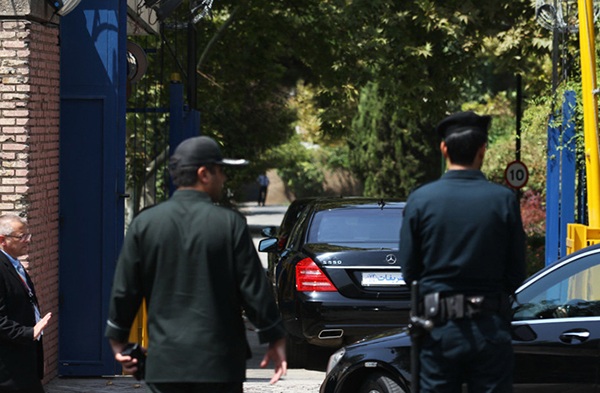
Hammond said the reopening of the British embassy in Tehran, which he supervised on Sunday, was a new step in opening up new horizons in relations between the two countries.

The top diplomat also urged more parliamentary cooperation and dialog between Iranian and British lawmakers in various fields, including the fight against IS and narcotics.

Hammond arrived in Tehran on Sunday in a first such visit by a British foreign secretary since 2003. In his two-day trip, he held meetings with President Rouhani, Secretary of the Supreme National Security Council (SNSC) Ali Shamkhani, Oil Minister Bijan Namdar Zanganeh and Foreign Minister Mohammad Javad Zarif.

Steinmeier to pay visit to Iran to boost bilateral ties: official

81732572-70116919

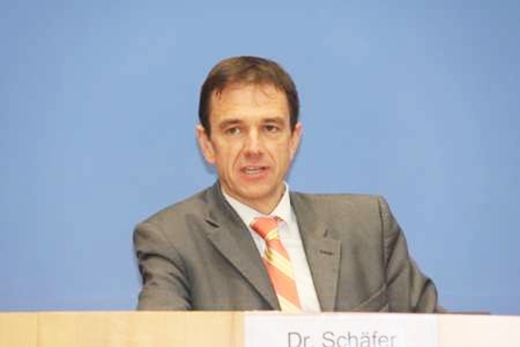
The upcoming Iran visit by German Foreign Minister Frank-Walter Steinmeier is geared to bolster bilateral ties on all fronts, said Foreign Ministry Spokesman Martin Schaefer in Berlin on Monday.

When asked by IRNA about the objective of Steinmeier’s October visit to Iran, Schaefer said the July 14 nuclear agreement – and thus the settlement of a major dispute in the Near and Middle East – is a good reason for establishing new bilateral relations.

The German diplomat recalled the fact that both countries enjoyed very close ties dating back several centuries.

Germany was Iran’s most important trading partner for a long time.

Both countries had deep political, economic and cultural ties which were beneficial to both sides and we seek to re-establish that era, said Schaefer.

This will not happen overnight. This needs time but what is most important is that a first step will be taken and we feel that the timing of it and the international as well as bilateral state of affairs is conducive to boosting Berlin-Tehran relations, he added.

Schaefer said bilateral talks on details of Steinmeier’s Iran visit will soon begin.

The German foreign minister is to visit the Islamic Republic at the invitation of his Iranian counterpart Mohammad Javad Zarif, Schaefer said.

Iran plans $50 billion energy investment

13b6456a-664a-4f32-bc6e-97378954659a

Iran is lining up water and electricity projects worth $50 billion for investment after the removal of sanctions, Energy Minister Hamid Chitchian said.

“About $50 billion worth of projects have been defined and sent to President Rouhani for presentation to domestic and foreign investors amid hopes they will generate good dynamism in this sector,” the minister said on Monday.

The Energy Ministry has drafted more than 800 national projects which are expected to take about 20 years to complete, Islamic Republic News Agency quoted Chitchian as saying.

“We are going to give a lot of the projects to the private sector in order to carry them out at a lower cost and in a shorter period of time,” he added.

Iran used to hand out heavy energy subsidies to its citizens but a half-hearted phasing out of those grants has left the water and power industry saddled with a massive debt.

Under the targeted subsidy program launched by former President Mahmoud Ahmadinejad, water and electricity prices were to be made “realistic” by March 2016 in order to encourage investments in the sector.

“A sharp decline in investments is the biggest loss and the energy industry is suffering from the improper implementation of the targeted subsidy law,” Chitchian said.

“Given that water and electricity prices are enormously lower than their real rates, the industry has built up a massive debt and lost its ability to clear its debts.”

Iran is faced with a serious drought which is straining the country’s water resources and power generation capacities.

Record temperatures have compounded the problem, causing electricity consumption to peak and putting the country on the brink of widespread blackouts and brownouts.

“Forecasts suggest we have put behind the peak electricity load for the year 1394” which ends on March 20, 2016, meaning there will be no widespread outages, Chitchian said.

Iran’s nominal power generation capacity stands at about 74,000 megawatts. The country will add another 2,000 megawatts to its national grid next year amid efforts to cope up with runaway demand, the minister said.

Gas-powered plants produce the bulk of the electricity which the country consumes in the face of declining hydropower capacities due to a lingering drought.

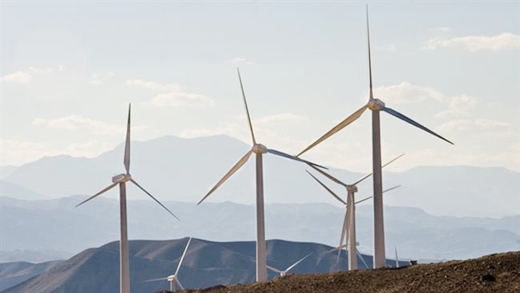
Iran, instead, plans to ramp up solar and wind energy production, with a vision to generate 5,000 megawatts by 2020.

As for water imports, negotiations have been held with some neighboring countries which “we hope to reach definite conclusions in the coming few months”, Chitchian said without naming them.

Shamkhani, Hammond call for boosting all out ties

Shamkhani-Hammond-680x360

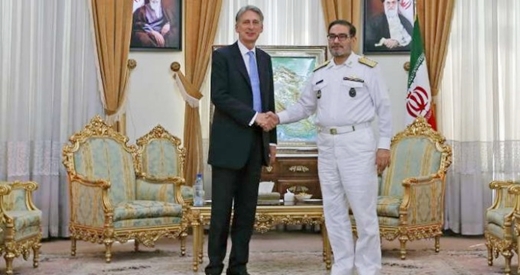
Secretary of the Supreme National Security Council Ali Shamkhani and visiting British Foreign Secretary Philip Hammond on Monday held talks on ways to boost all-out ties.

Shamkhani told Hammond that moving toward sustainable relations based on trust-building can secure the mutual interests of Iran and Britain.

The Iranian official said that Iran expects the British government to change its views toward Iran and keep away from non-constructive misunderstandings.

Shamkhani said that understanding the real source of Islamic Republic’s power by the British government can help boost ties between Tehran and London.

He said that the Islamic Republic of Iran’s power has its roots in the nation’s support and the Supreme Leader’s insight, adding that Iran adopted a balanced and stabilizing regional and international policies.

Shamkhani referred to Iran’s warnings about the spread of terrorism in the region, saying that the fight against terrorism and extremism needs respect for national sovereignty and independence of governments.

Iran and Britain have a similar stance toward the fight against ISIL, regional stability and closer economic cooperation, the official noted.

He said that supporting the nations which have been subjected to oppression by bullying powers to reclaim their legitimate rights is part of Iran’s foreign policy.

The British foreign secretary, for his part, stressed the important role of Iran in the settlement of regional problems, including terrorism.

London is keen on boosting sustainable ties with Iran in all fields, including economic and regional cooperation, he noted.

[…]

We buy what the worst enemies of Tehran tell us

Stephen Kinzer

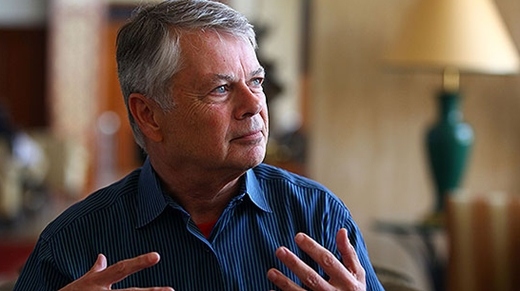
An American university professor says that Foreign Minister Zarif can be another Mossadegh or Amir Kabir for the Iranians capable of changing the country’s destiny in the future.

Stephen Kinzer, a lecturer at Watson Institute for International and Public Affairs in Brown University, has taken a look – in his book – at the August 18, 1953 coup in Iran [which toppled the government of Prime Minister Mohammad Mossadegh] and its impact on ties between the United States and the Islamic Republic of Iran.

All the Shah’s Men is a novel-like book which tells about the 1953 coup in Iran in a narrative form. Over the years, Kinzer covered news for The New York Times from 50 countries. He has written a number of books on the Middle East and Iran.

Tolou Sobh, an Iranian weekly, has in an interview asked about Kinzer’s take on the Iran nuclear deal. The following is the translation of the interview in its entirety:


One month ago, Iran and P5+1 reached an agreement after twelve years of talks. How do you assess the Iran nuclear deal? What do you think caused the parties to the talks to walk down that path [toward conclusion of a deal]?    

Iran, a Shiite power, is the enemy of radical Sunnis such as ISIL, Alqaeda, and the Taliban. If the US is really seeking to take on these [radical] movements, Iran would be a logical partner.

In the meantime, economic opportunities led Iran and the US to strike a deal. Iran is the world’s biggest untapped market with 80 million literate people who are interested in American products. Iran, which is rich in oil and gas reserves, can buy anything it seeks, so there are potentially big profits [for the US] in Iran.

Iran also influences other areas in the Middle East, among them Iraq, Syria and Yemen. President Obama says that he can solve regional disputes with Iran’s help.

What were the distinctive features of the Vienna talks that prompted foreign ministers of six world powers and that of Iran to have a three-week stay in the Austrian capital?

Zarif and Kerry were determined to conclude an agreement. Any breakdown could have been a very bad event. They both knew about this and together with their teams they made great endeavors to arrive at the best deal possible.

Following the announcement of the nuclear deal, loud voices were heard from the US Congress calling for the derailment of the deal. Given this, do you think the nuclear deal will be sustainable?  

Opposition to the deal in Washington has nothing to do with Iran’s behavior. The past measures, including the hostage-taking in the US embassy [in Iran], have made us blind to national interests. We buy what the worst enemies of Tehran tell us and view Iran as a country which has delivered the biggest blow to us, but we cannot see the blows we dealt to Iran and pay no attention to them.

I should say that Congress is likely to reject the Iran nuclear deal, but Obama will veto its decision and this will help implement the deal.

Now that a deal has been clinched, Mohammad Javad Zarif has become very popular with Iranians and many go so far as to describe him as Mossadegh or Amir Kabir of the time. Given that you have extensively studied Iranian history, what do you think?

Zarif deserves to take a lot of credit for the deal, so does John Kerry. Still the deal was one single incident. Amir Kabir and Mossadegh were national leaders who deeply influenced the destiny of Iran. Zarif may be able to do just that in the future. For now, however, he’s a successful negotiator and that is enough for the Iranians to take pride in him.

Just like opponents of the nuclear deal on Capitol Hill, in Iran some are very critical of the Vienna accord and describe it as a new Turkmenchay Treaty [by which Persia ceded to Russia control of several northern areas]. Do you basically see the Vienna accord as one such agreement for Iran, or the US for that matter?

Turkmenchay and the Vienna deal are polar opposites, because the latter has been based on mutual respect and serves the interests of both sides. It does not entail the surrender of sovereign rights, not does it constitute a blow to either party.

Some believe that the deal Iran and P5+1 have clinched can set the stage for improvement in relations between Iran and the United States, what’s your take on that?

Iran-US animosities on the international stage date back 36 years. Such poisoned ties are part of a structure which is extremely difficult to shatter. In fact, under the circumstances, Tehran and Washington are looking for new reasons to hate each other. They need to try to break out of the present conditions first.

Student Basij’s critical view of the British embassy reopening and JCPOA

Britain reopens its embassy222567_476

Four student Basij organizations have expressed their critical views of and concerns about the reopening of the British embassy in Tehran and the Joint Comprehensive Plan of Action (JCPOA), complaining about the government’s lack of transparency in handling the Tehran trip of the British foreign secretary. They have also said that their review of the text of JCPOA has resulted in 70 questions on the Iran nuclear deal.

The Iranian Students’ News Agency (ISNA) has published the remarks of the heads of the four student organizations in a press conference. The following is a brief translation of what they had to say:

Mehdi Ramezanzadeh, the head of a Tehran University student council:

It has now become obvious that nuclear talks are not the sole topic about which people have been kept out of the loop. The government continued its cloak-and-dagger measures in the run-up to the British embassy reopening too. Why should we first learn about the embassy reopening from a foreign news agency? Why should an Iranian Foreign Ministry official confirm the news later?

The Iranian nation has no favorable recollections of Britain and what is has done throughout history. The Britons have always been after looting, bullying and colonial moves.

We said nothing about the text of JCPOA over the past month. The great volume and the specialized content of JCPOA’s text are to blame for the student Basij’s delay in reviewing the text. We wanted to consult with the experts and scientifically review that text. Finally we came up with 70 questions on JCPOA. We will make these questions public in coming days.

Jalal Khaleghi, the head of Basij organization at School of Media Studies

Today we see that the government is more willing to share its secrets with foreigners than with the Iranian nation. […] The closure of the British embassy reduced London’s intelligence work. The reason why this embassy has been reopened is unclear. […]

We know nothing about the reason behind the government’s secrecy. Our concerns about the British embassy reopening are graver than worries stemming from the 1953 Anglo-American coup.

We call on students and media to join the two [students] campaigns which focus on the reopening of the British embassy and the government’s trust-building measures.

Hossein Oraki, the head of Basij organization at Tarbiat Modares University

Student Basij has complaints about the government’s performance. Why has the government pursued a secret plan? Why has the government not talked about such an issue with people? We are opposed to the British embassy reopening because of terrible memories the Iranians have of Britain’s measures in Iran. Nobody will forget the coup Britain plotted against Iran. Nobody will forget the eight-year Iraqi imposed war and the British support for this country. That’s why we are unhappy with the embassy reopening and the presence of a senior British official on Iranian soil.

We urge the government not to do something which may make the next generations feel shameful for this government’s improper measures. We hope the government takes heed of the country’s national interests.

Soheil Kiarash, the head of Basij organization at Shahed University

A month-long review by the Student Basij Organization of the Iran nuclear deal shows that the country’s national interests have not been maintained in the nuclear deal, not even minimally. We raised this issue with [senior nuclear negotiator] Mr. Araghchi who responded that the deal was the best they [the country’s negotiators] could clinch. This comes as Mr. Zarif said in parliament that maximum national interests have been taken into account in the nuclear deal.

Prior to the talks, the negotiating team stressed that they would respect the red lines and the nation’s interests in the talks. The question here is: Were you given any order to have talks and produce a result?

I do not buy what [Chief of Staff of the Iranian armed forces Major General] Firouzabadi has recently said about JCPOA. He has knowledge in military issues, [not in nuclear matters].

Iranian industry chief makes appealing offers to foreign investors at Expo Milano 2015

Nematzadeh-Expo

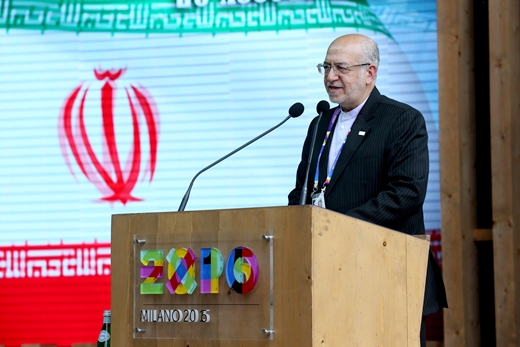
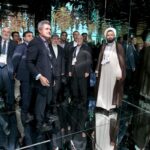
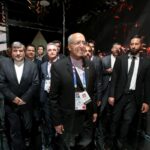
Foreign investors can secure 100 percent land ownership for production purposes in Iran and will have the government’s assistance, Iranian Minister of Industries, Mines and Trade Mohammad Reza Nematzadeh told an Iran Day ceremony in Expo Milano 2015 on Sunday.

The following is the translation of part of a report eghtesadnews.com has published on the industry minister’s comments and the ceremony at large:

At the ceremony also attended by Minister of Culture and Islamic Guidance Ali Jannati and a number of officials, both Iranian and Italian, the Iranian industry minister said countries attending the expo should take effective measures to promote healthy nutrition in the world.

“Of course industrial countries whose colonial practices in the past have interfered with the scientific, cultural and economic progress of African, Asian and Latin American nations should do more.

“Despite restrictions, Iran stands ready to help promote agricultural production in the world and invest in the agriculture and animal husbandry of countries which need help.”

He went on to say that Iranians have always been in favor of international development as well as global peace, cooperation and affinity.

Nematzadeh said, “At the close of the [Iran-Iraq] war [in 1988] it became clear that the neighboring country was the aggressor and that the Iranians had simply defended their land for eight years. The unjust economic sanctions too proved that Iran is committed to international regulations. We tapped into dialogue and patience to prove our truthfulness to the world and thus prevented another catastrophe in the Middle East.”

On economic cooperation with the rest of the world in the post-sanctions era, the Iranian industry chief said, “The West’s attitude toward Iran has changed. We are ready to allow foreigner access to our market for joint production. To that end, foreign investors face no restrictions and they can secure 100 percent land ownership for production purposes.”

In conclusion, he said Iran stands ready to establish cooperation with foreigners in the fields of tourism and large- or small-scale production.

Later in the day, Iran’s National Day stamp was unveiled in the exposition.

It is worth noting that the restaurant of the Iranian pavilion in the expo has proved very popular with visitors. For instance, the wife and daughter of the director of the expo and the wife of the Italian prime minister have praised the Iranian food. And staff members of the pavilions of Arab countries such as Qatar and the UAE regularly stop by the Iranian restaurant to grab a bite.

Renowned Iranian vocalist Salar Aghili performed at the event too.