Friday, December 26, 2025
Home Blog Page 4652

Inauguration of Iran’s largest five-star hotel (PHOTOS)

five-star hotel0

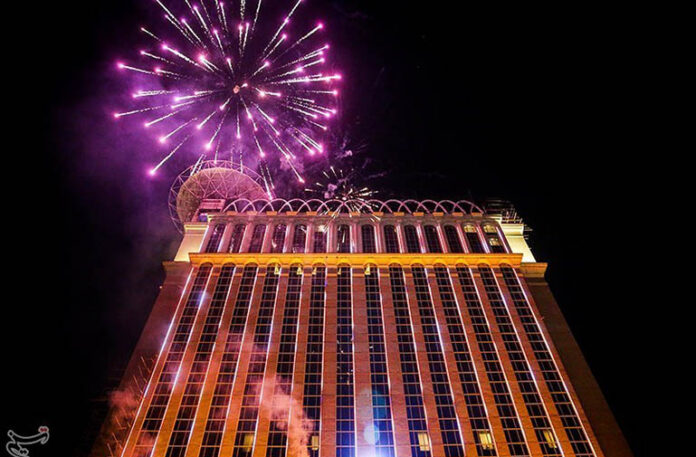
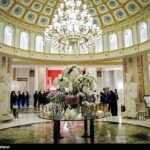
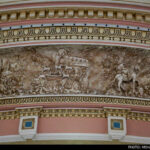
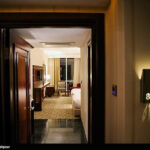
Iran’s largest five-star hotel was inaugurated Monday night in northwestern Tehran.

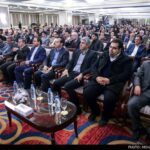
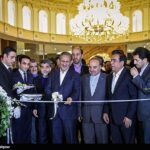
The first vice-president and the director of the tourism organization were on hand for the inaugural ceremony.

The facility that sits on an expanse of land 75 square km in area became operational, unofficially, when Tehran played host to a forum of gas-exporting countries.

The following images of the inauguration have been released by different news agencies:


Iran, India ink comprehensive deal on diverse economic areas

Tayebnia-India

High-ranking officials from Iran and India signed a “comprehensive” agreement on economic cooperation, as part of efforts to boost trade relations between the two Asian countries.

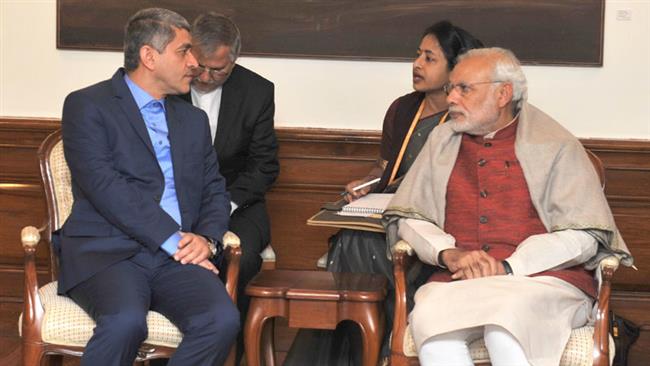
In a meeting in New Delhi, visiting Iranian Minister of Economic Affairs and Finance Ali Tayyebnia and Indian Foreign Minister Sushma Swaraj signed the agreement on cooperation in various fields, including energy, infrastructure, banking, consular affairs, trade and tourism.

Speaking after the signing of the 73-article deal, Tayyebnia said the agreement is a major stride in the promotion of economic relations between the two countries.

He further emphasized that the Indians are willing to cooperate with the Islamic Republic in the development of Chabahar port in southern Iran and the construction of a rail network to connect India to Central Asia.

Tayyebnia also said according to an article of the agreement, India will open a credit line for Iran to boost cooperation in various fields of energy, including petrochemicals, oil and steel industries.

In an earlier meeting in New Delhi attended by Tayyebnia and senior economic officials from India, a joint economic committee was inaugurated in a bid to stimulate bilateral trade and encourage the two countries’ merchants to make more investment.

Speaking in the ceremony, the Iranian minister said stronger trade ties between Tehran and New Delhi will contribute to their economic growth.

He further expressed the hope that termination of anti-Iran sanctions under a July nuclear deal between Tehran and six world powers would double the volume of trade between Iran and India.

Experts believe that Iran’s economic growth would rise remarkably after the nuclear deal takes effect.

Leader voices hope for establishment of new Islamic civilization

Leader

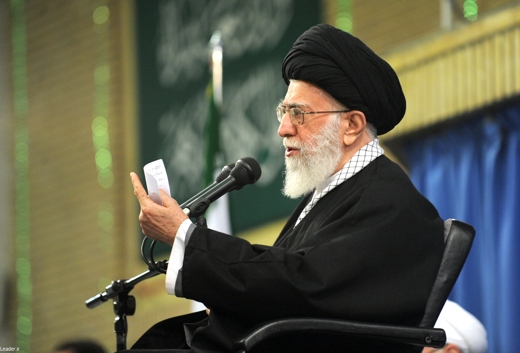
He made the remarks in his meeting with the Muslim scholars, thinkers and political figures attending the 29th International Islamic Unity Conference as well as the Islamic countries ambassadors in Tehran.

‘Today, enemies pursue civil wars between Muslims and unfortunately, to some extent, they have been successful in realization of this goal and have ruined the Islamic countries including Syria, Yemen and Libya,’ the Leader said.

He criticized pressures on Muslims in Bahrain and also arrest of Sheikh Ibrahim al-Zakzaky, the leader of the Shia Movement in Nigeria, saying that why Muslim Ummah is silent towards all these issues.

‘Western civilization has started to show its paradoxical nature and it is the turn of Islam to re-emerge,’ Ayatollah Khamenei added.

The Leader said that Muslims are duty bound to establish the new Islamic civilization.

‘I am disappointed with the Islamic World politicians, but I am hopeful about those Muslim religious scholars and intellectuals for whom the West has not become a mecca,’ he noted.

The Muslim scholars, thinkers and political figures attending the 29th International Islamic Unity Conference as well as Islamic countries ambassadors in Tehran met with the Supreme Leader of the Islamic Revolution on Tuesday.

Ayatollah Khamanei addressed them at Imam Khomeini (RA) Religious Center in Tehran on the occasion of the birthday anniversary of the Holy Prophet (PBUH) and the Unity Week.

The 29th International Islamic Unity Conference kicked off in Tehran on Sunday with the participation of hundreds of Shia and Sunni scholars and thinkers.

The current crises facing the Islamic world were the main subjects discussed in the international event, which will last until Tuesday afternoon.

The 17th day of the month of Rabi al-Awwal on the lunar Hijri calendar is believed by the Shia Muslims to mark the birth anniversaries of Prophet Mohammad (PBUH), while Sunni Muslims regard the 12th day of the month as the birthday of the last prophet.

The interval between the two dates is celebrated every year as the Islamic Unity Week.

Post-JCPOA Iran on course to winning WTO membership

wto

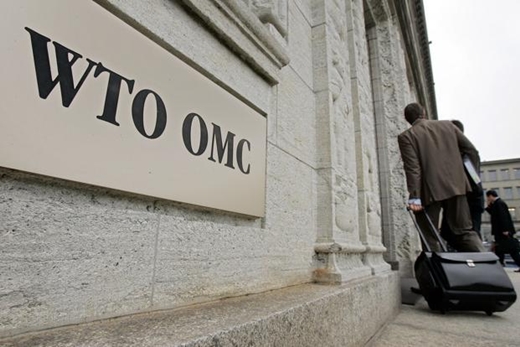
An official at the Trade Promotion Organization of Iran (TPO) says that steps will be taken in a few months to help Iran join the World Trade Organization (WTO).

Sadegh Ziaee BigdeliSadegh Ziaee Bigdeli, who is the deputy head of TPO, made the remark in an interview Khabaronline.ir released on December 28 and added that Iran will wait until the Joint Comprehensive Plan of Action is implemented [before it starts its accession talks].

The following is the translation of part of his comments in the interview:

What we learned from remarks by Kenyan Foreign Affairs Cabinet Secretary Amina Mohamed, who previously served as Chairman of Dispute Settlement Body at the WTO [in 2004], and consultations at the Tenth Session of the WTO Ministerial Conference held in Nairobi, Kenya is that the accession talks will get off to a normal start in a few months’ time.

We will wait until the Joint Comprehensive Plan of Action (JCPOA) is put into force; there are indications that Iran’s bid to become a member of the WTO will be positively affected following the implementation of the Iran nuclear deal.

To date, US opposition has been the only obstacle standing in the way of Iran’s membership, but Washington seems to take a more reasonable approach thanks to the pressures WTO members pile on the US in favor of Iran’s accession bid, and a new climate that has been created.

In the following stages, Iran is likely to face challenges and obstacles to its bid, for which the country is expected to work out solutions at the right time in the right place.

Absence from the World Trade Organization, which translates to self-imposed sanctions, will definitely cause Iran big damage. Non-membership of the trade organization will deny Iran trade transactions with a number of countries.

On the other hand, many countries such as neighboring Turkey act on their rules and regulations and treat WTO members differently and impose strict regulations on non-WTO members like Iran.

In bilateral talks [with such countries], Iran goes to great lengths to help ease these rules and regulations, but the fact remains that these countries resist our pressures arguing that they have made concessions for entering the WTO and that they have every right to go tough on those who have not made such concessions.

Non-membership of the World Trade Organization walls off the WTO members from non-members as far as tariff and non-tariff barriers to trade are concerned. These barriers will slap stringent restrictions on promotion of trade and investment as well as the country’s economic development.

Why are there 40 contenders for each parliamentary seat?

Election-Iran

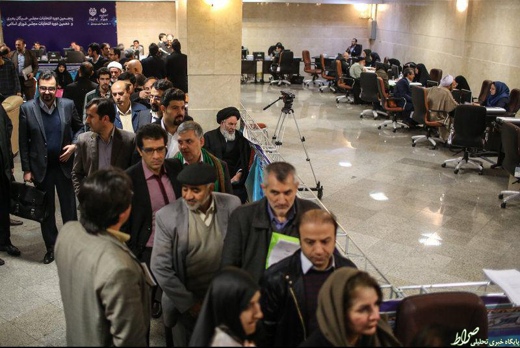
After registration of candidates for the upcoming parliamentary and Assembly of Experts elections came to a close, Interior Minister Abdolreza Rahmani Fazli said the number of hopefuls seeking to run for parliament is up 65 percent, while the ranks of those seeking a seat in the Assembly of Experts show a 62 percent growth.

That is how managing editor of Javanonline.ir Abdollah Ganji opens a piece in answering the question posed in the headline of this story. The following is the translation of the rest of his article which appeared online on December 26:

This registration is unprecedented, especially at a time when educational and scientific requirements for parliamentary and Assembly of Experts elections put a cap on the number of contenders.

Political reasons are not the only reason contributing to the outstanding hike in the number of candidates. Naturally, different political reasons play an important role in this, but they are not the only factor.

The reasons behind the spike in the number of individuals fielding their candidacy for the Assembly of Experts elections are a little bit different and cannot be expounded on in this article. Political motives which have become a factor for the first time, and the rise in the number of Mujtahids [people capable of independent reasoning] and seminaries are the main contributor to the increase in the number of Assembly of Experts candidates.

The following political and non-political factors seem to be the reasons behind the quantitative growth of parliamentary hopefuls:

1. The volume of registrations is indicative of the growth and development of the middle class in Iran. There is undoubtedly a meaningful relationship between the vast number of parliamentary candidates and the growth of the middle class. For example, the hopefuls need to have at least a master’s degree and the great volume of the registrations shows the level of higher education in the country which is one of the characteristics of the middle class.

2. With the elites making the rounds in different political periods, human development has gained traction and resulted in both experimental and scientific training of individuals. With their experimental and managerial experience, these people now have high levels of self-confidence and believe they can solve the country’s problems, legislative ones in particular.  That is why they have today thrown their hats in the ring.

3. The effectiveness of religious democracy is another motivational factor behind the candidacy of so many individuals. Indubitably, if the elites believed that parliament lacked real authority to make decisions, they would not enter the race because wading into an area which is ineffective  in nature runs counter to the principle of rationality. Hence, the effectiveness of parliament in the country’s political, social and economic equations is a significant factor in encouraging the hopefuls to register.

4. The fact that rivalry and competition are tough has brought all high- and mid-ranking members of different groupings into the race. In fact, the registration frenzy in one camp has resulted in the rush to registration in another.  In the parliamentary elections, registration is a competition in its own right ahead of the main competition in the balloting stations.

5. The fact that tickets have not been finalized and individuals remain hopeful to be placed on major tickets is another factor. Divisions in different groupings mean those who need to be screened are far from certain of being placed on tickets. So many jump in the race; it is more of a shot in the dark. As a result, many of those who fail to make the list of major parties, especially in big cities, are likely to withdraw from the race.

6. The factional breakdown of those who have signed up is not out yet. But some groups that vacillate on loyalty to the establishment believe a high level of registration would naturally increase the number of disqualified candidates. Consequently this can cause a human rights issue for the establishment and cast doubts on the democratic nature of the vote. When each faction’s share of candidates becomes known, judgment will be easier in this regard. The registration of people like Tabarzadi and Sholeh Saadi, etc.  reinforces this theory.

7. Some reformist leaders believe that candidates should enter the competition in layers (in force) so that even if a large number of hopefuls are declared disqualified, enough people remain in the race. This strategy can be implemented at the registration stage. The number of principlists in the constituencies is no fewer than the reformists though, their motive does not center on so-called layer unity. There are other regretful issues at play.

8. Motives such as finding an identity, upgrading one’s social dignity, psychological issues, as well as thirst for power have all played a role in the increase in the number of those who have registered. Of course, these motives cannot be attributed to renowned figures. They mostly apply to unknown or less-known individuals.

The Western media’s attitude toward groupings or candidates can be an index for better judgment of what was explained in items 6 and 7 above. BBC Persian has already launched an attack on Ayatollah Jannati and Mohammad Yazdi, and has started supporting reformists. To make a more definitive judgment more time is needed.

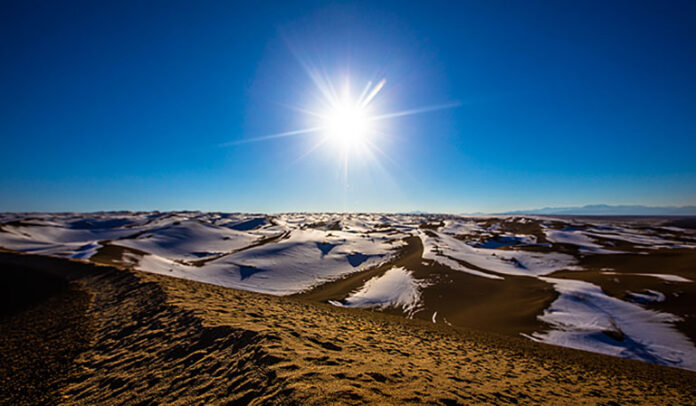
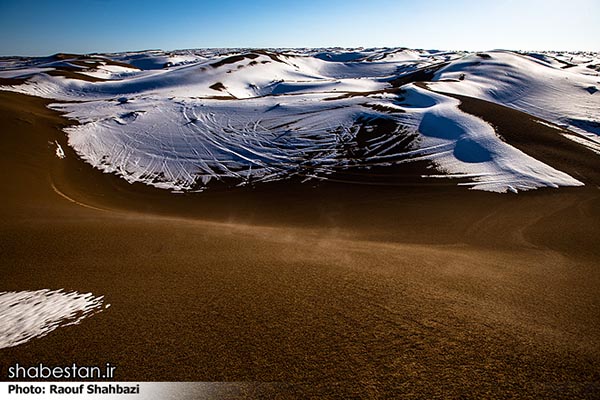
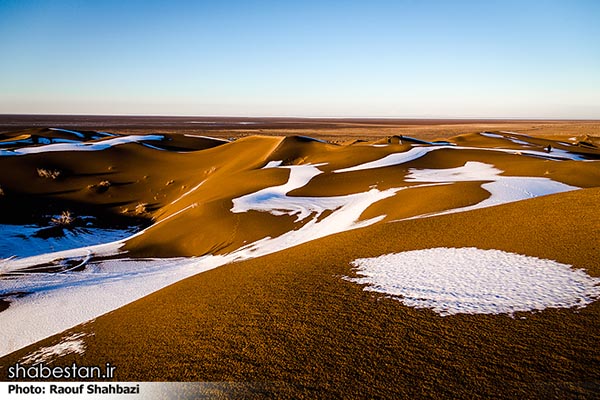
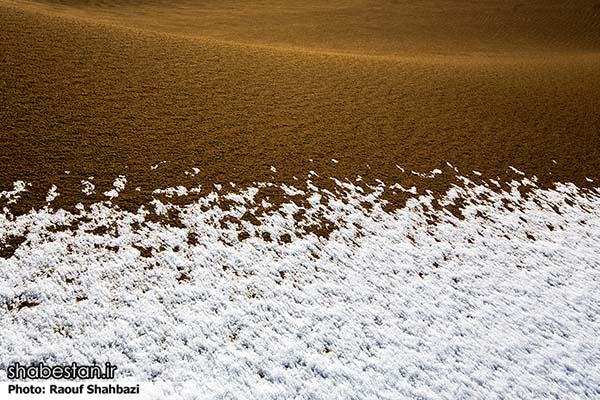
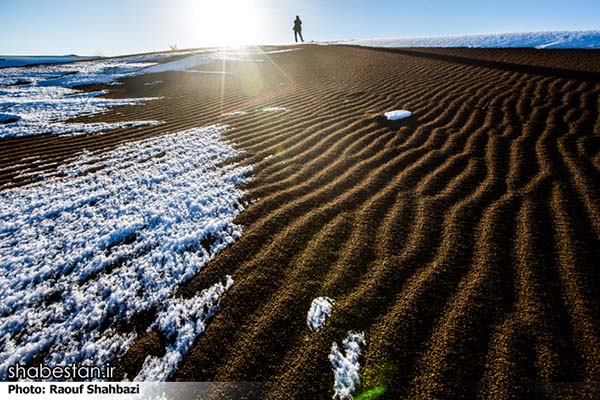
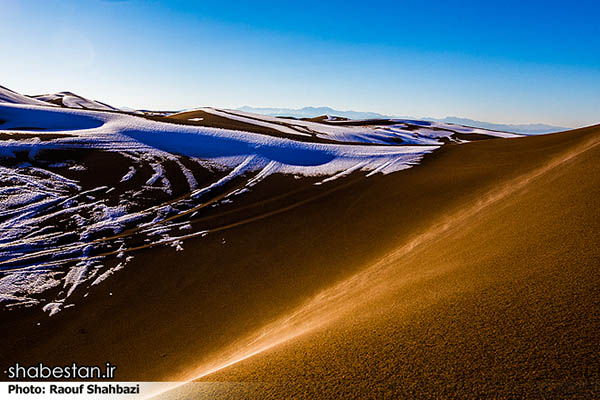
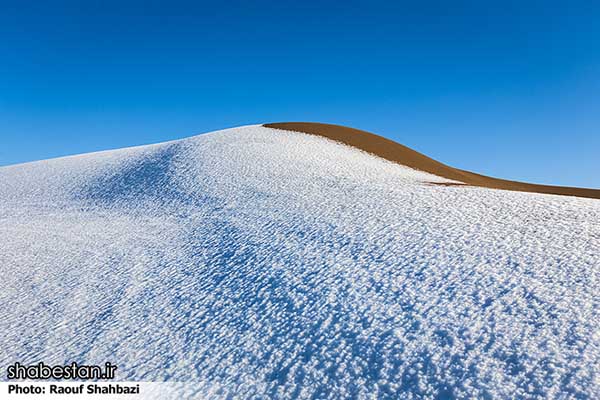
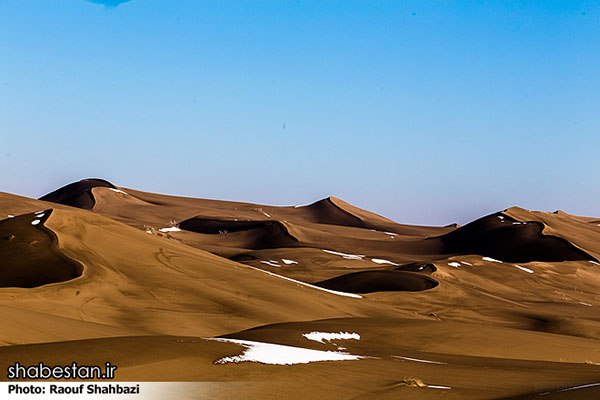
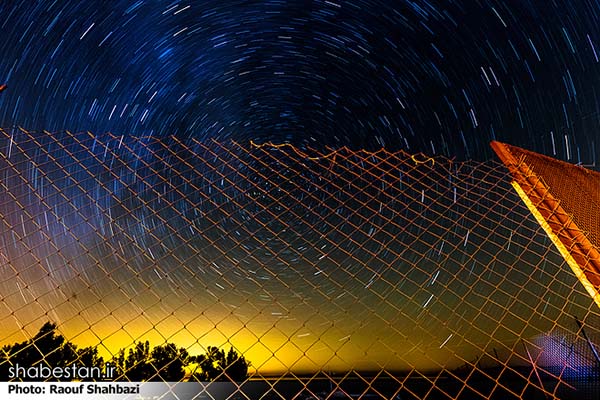
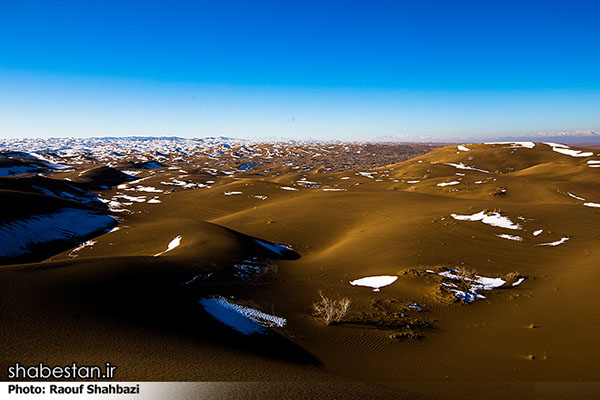
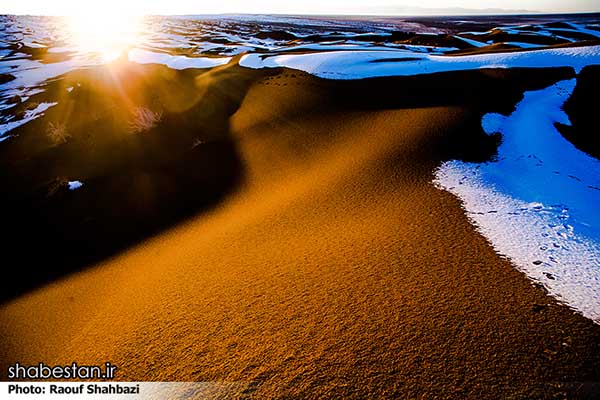
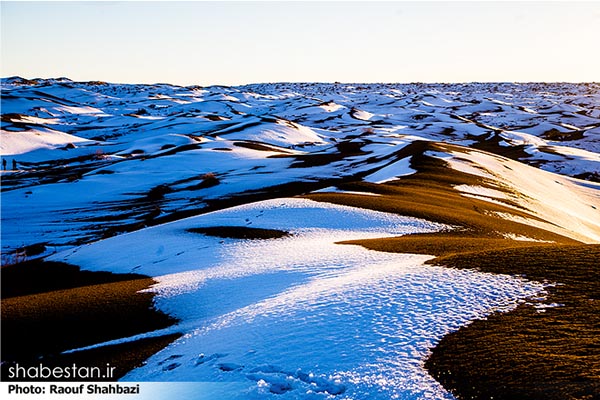
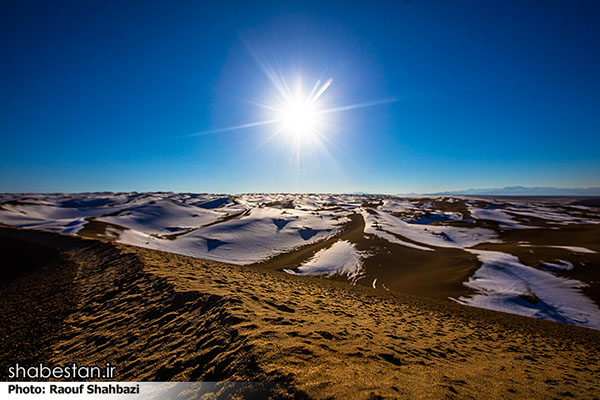
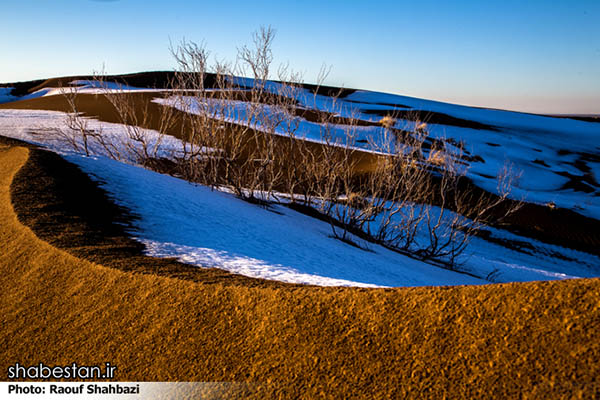
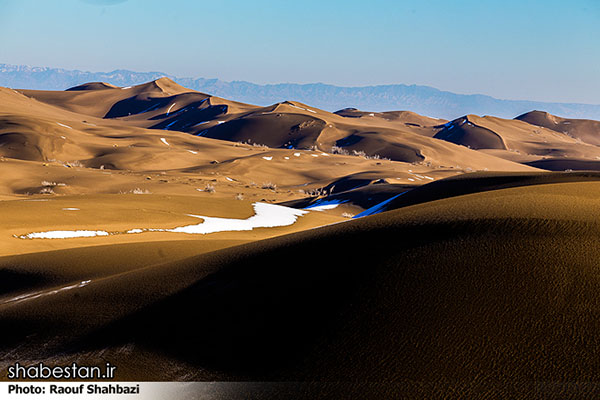
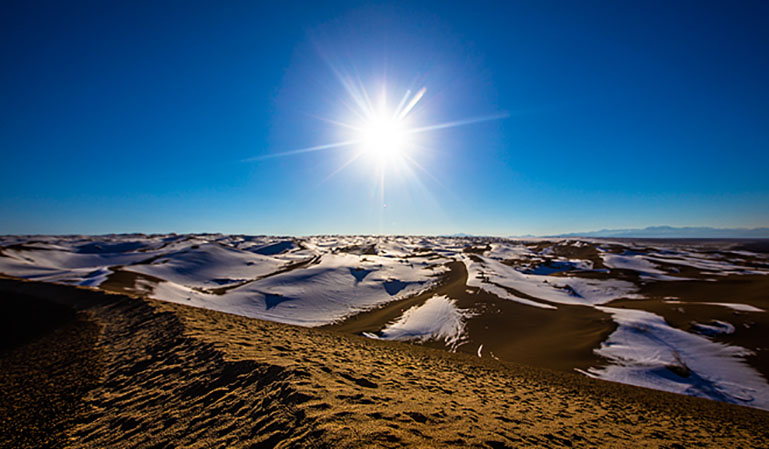
Maranjab Desert blanketed by snow (PHOTOS)

Maranjab Desert0

In the cold season, a snow-covered Maranjab Desert, which is located to the north of Aran and Bidgol in Isfahan Province, creates beautiful scenery.

The snow-coated desert draws local and foreign visitors in the winter.

The following images have been released by Shabestan News Agency:

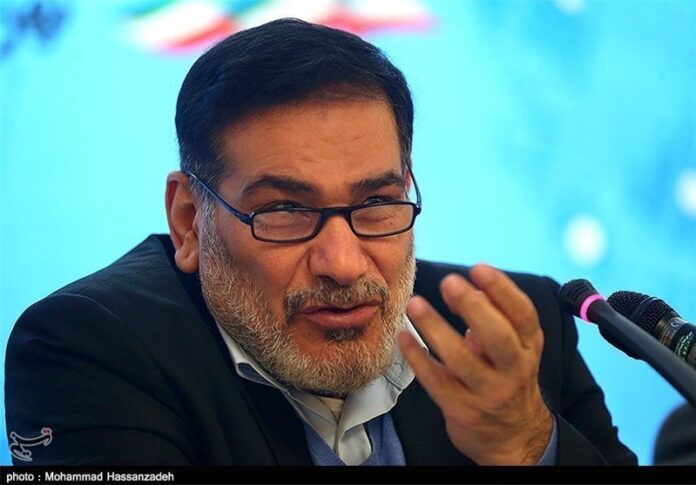
New US Visa Law contravenes JCPOA “good faith” provision: Shamkhani

Shamkhani

A restriction on visa-free travel to the US for travelers to Iran “clearly” runs counter to a provision in a July nuclear deal between Tehran and six world powers that commits the parties to implement the accord in good faith, a senior Iranian official said Monday.

Secretary of the Supreme National Security Council (SNSC) Ali Shamkhani said moves like the new US visa program only “deepen mistrust” and reveal the “explicit contradictions in the words and deeds of the US government officials” to the world public opinion.

He made the comments in a meeting with Head of the Supreme Islamic Council of Iraq Ammar Hakim, held in Tehran.

According to a bill, which was passed in the US House by 407 to 19 on December 8, visitors from the 38 “visa waiver” countries will need to obtain a visa to travel to the US if they have been to Syria, Iraq, Iran or Sudan in the past five years.

On December 18, US lawmakers sent Barack Obama a huge tax and spending package, which also included reforms of the US visa waiver program, and the president quickly signed it into law.

The controversy comes a few weeks before implementation of JCPOA, the final nuclear deal signed between Iran and P5+1 (Russia, China, the US, Britain, France and Germany) in July.

According to the 8th clause in the preamble and general provisions of JCPOA, “The E3/EU+3 and Iran commit to implement this JCPOA in good faith and in a constructive atmosphere, based on mutual respect, and to refrain from any action inconsistent with the letter, spirit and intent of this JCPOA that would undermine its successful implementation.”

Shamkhani also said that the US cannot talk about trust building and goodwill, and at the same time impose “hostile restrictions” on Iran or pass laws to “illegally steal the Iranian nation’s assets.”

His remarks were in reaction to reports that the US Supreme Court is considering a case to confiscate the Iranian Central Bank’s assets in the US to pay the American victims of attacks allegedly linked to the Iranian government.

The US House of Representatives is now weighing in on a pending case that accuses Iran of links with the 1983 bombing of the Marine barracks in Beirut and the 1996 bombing of the Khobar Towers in Saudi Arabia.

The US lawmakers are trying to force Iran’s Central Bank to pay damages to over 1,300 American plaintiffs. In 2008, the victims discovered that Iran’s Central Bank had almost $2 billion stored in Citibank accounts in New York.

The victims sued for that money, and the litigation has now reached the Supreme Court.

Iran to use all possible means to protect properties: Spokesman

Jaber Ansari

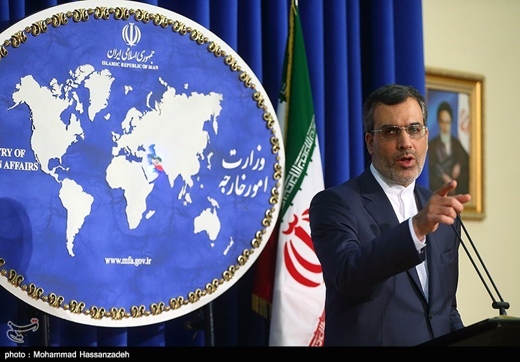
Foreign Ministry Spokesman Hossein Jaberi Ansari said on Monday that if assets belonging to Iran and Iranians are exposed to any kind of “robbery”, Iran will use every possible means to safeguard the rights of the nation.

Asked to comment on payment of compensation to US diplomats taken hostage in Tehran in 1979, the spokesman said that the so-called compensation is to be deducted from the fine paid by a French bank.

Jaberi Ansari ruled out the possibility of getting the compensation from the Iranian assets frozen by the US government and said it runs counter to the 1981 Algeria Claims Settlement Declaration.

In response to a question about the savings of the Central Bank of Iran (CBI), Jaberi Ansari said US courts have issued some verdicts since 2007 on taking from these savings which is illegal according to Algiers Declaration and the CBI has been following the case through legal procedures.

On Syria, he said Iran’s stands regarding regional developments and what is going on in Syria are crystal clear.

When asked to comment about recent allegations by Turkish President Recep Tayyep Erdogan against the Islamic Republic of Iran over Tehran’s policies in Syria, he said, “This is not the first time that we witness the adoption of such policies by Turkey.”

“Tehran believes that it is the Syrian people who have the final say and right to determine their own destiny,” said the spokesman.

He also voiced Tehran’s strong opposition to exploiting terrorism and extremism to reach political goals.

He also voiced Tehran’s readiness to help solve the critical situation of West Asia, saying the same resolve on the Saudi part could pave the way for more active efforts.

When asked to comment on a report carried by Lebanese newspaper As Safir about a meeting between Iranian Foreign Minister Mohammad Javad Zarif and his Saudi counterpart Adel al-Jubeir, the spokesman confirmed preliminary diplomatic contacts between Tehran and Riyadh on the sidelines of international meetings, but declined to further elaborate.

He expressed hope that the contacts between the two countries would pave the way for a way out of the current critical situation of the region.

Joint determination of two major West Asian countries to put an end to the current situation would raise hopes for solving regional crises so that lower costs will be inflicted on regional nations and governments, Jaber Ansari said.

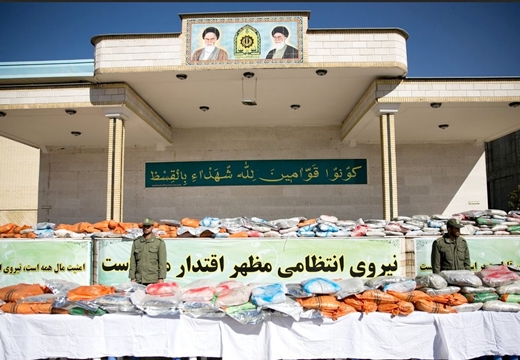
Iran seizes 422 tons of illicit drugs in eight months

drugs

In the eight months to December 22, Iranian police have seized more than 442 tons of illicit drugs from traffickers, a spokesman for the Anti-Drugs Commission said Sunday.

The following is the translation of what else Ettela’at daily quoted Parviz Afshar as telling a news conference:

The volume of illicit drugs seized has registered a 21 percent rise over corresponding period last year. In terms of quantity opium, hashish and heroin top the list of seized items.

The number of arrests and anti-drug sweeps during the eight-month period was up 19 percent, while the number of busts increased six percent.

The number of security forces fallen martyr in clashes with armed traffickers was down, so was the number of outlaws and traffickers killed in such operations.

The number of firearms and cars seized from traffickers was up four and 10 percent respectively.

Only 10-12 percent of the budget allocated to the insurance of addicts has been paid out.

During the same period 1,722 addicts (including 1,540 men and 189 women) have died of overdose).

The commission is bitterly opposed to proposed plans to vasectomize drug addicts that openly do drugs on the streets.

The lack of optional treatment and failure of insurance companies to cover the costs of rehabilitation are to blame for an increase in the numbers of homeless drug users.

The commission is not opposed to elimination of the death penalty from the list of punishments stipulated for drug traffickers. It believes small-time dealers should be spared, and death sentences should be handed down in cases involving ringleaders and those who get involved in armed clashes with security forces and commit kidnapping, murder and other serious crimes.

A look at Iranian newspaper front pages on Dec. 28

Iranian Newspapers Headlines

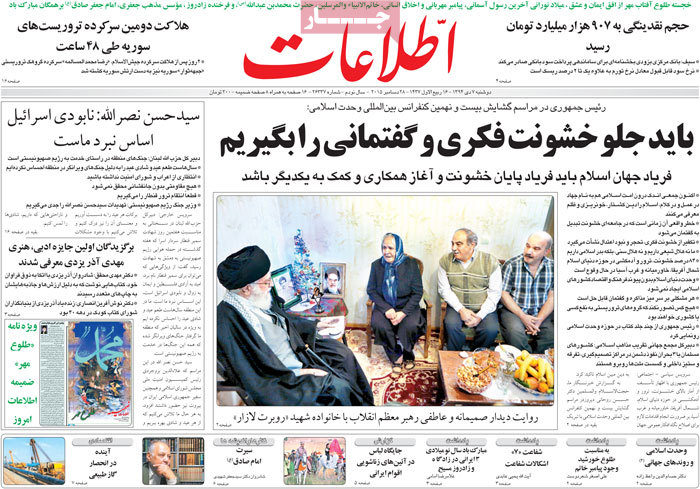
President Rouhani’s comments at an Islamic Unity Conference in Tehran dominated the front pages of Iranian newspapers on Monday.


Ettela’at: The president has called for measures to avert intellectual and conversational violence.

Speaking at a 29th International Islamic Unity Conference in Tehran, Hassan Rouhani said the world of Islam should call for an end to violence and a beginning of Muslim cooperation.

Ettela’at: The Supreme Leader has had a friendly meeting with the family of Martyr Robert Lazar.

Ettela’at: The volume of the country’s liquidity stands at around $300 billion.

The governor of the Central Bank has said that a new directive on interest rates will soon be issued.

Ettela’at: A second terrorist leader has been killed in Syria in 48 hours.

Ettela’at: The secretary general of the Lebanese Hezbollah has said that elimination of Israel is the ultimate goal of resistance.

Sayyed Hassan Nasrallah further said that regional conflicts are ignited to serve the interests of the Zionist regime.

Ettela’at: The winners of Mehdi Azar Yazdi Literary and Arts Award have been named.
 

A look at Iranian newspaper front pages on Dec. 28


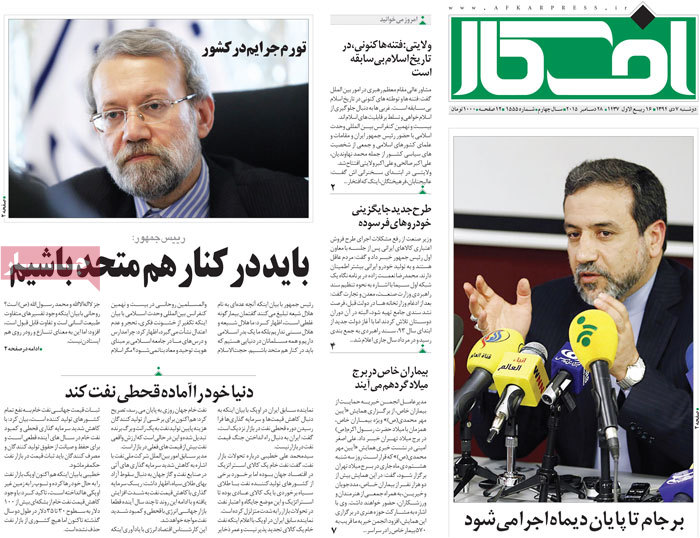
Afkar: The Joint Comprehensive Plan of Action will be implemented by January 20, said Deputy Foreign Minister Abbas Araghchi.
 

A look at Iranian newspaper front pages on Dec. 28


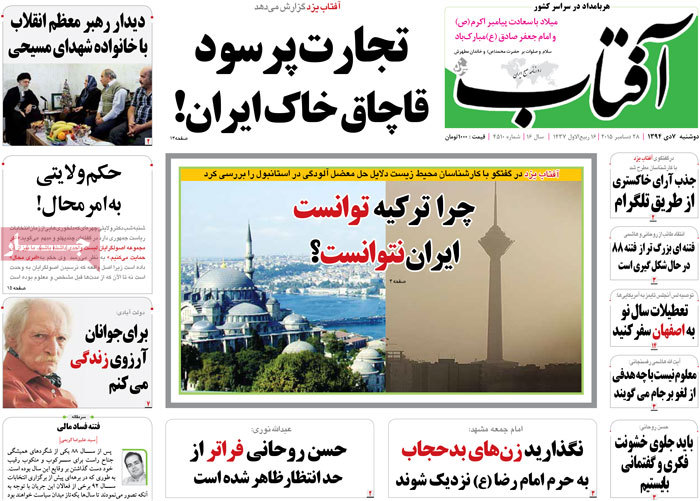
Aftab-e Yazd: How come Turkey managed to do it? But Iran can’t.

The daily has interviewed a number of experts on how Turkish officials managed to solve the problem of air pollution in Istanbul.
 

A look at Iranian newspaper front pages on Dec. 28


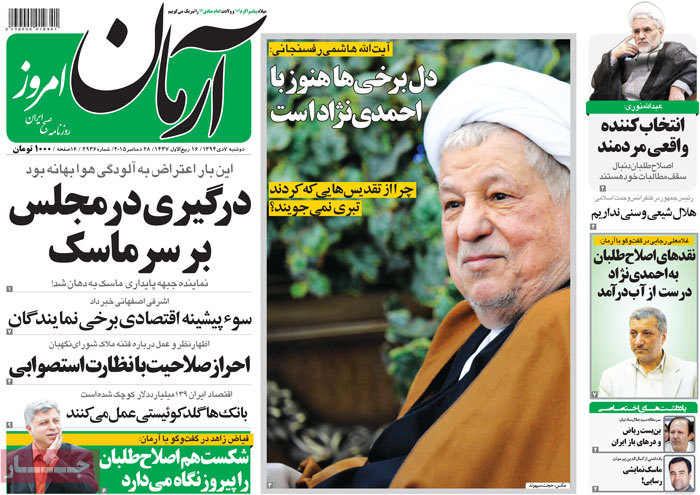
Arman-e Emrooz: There has been a wrangle over face masks in parliament.

A member of the Stability Front [staunch supporters of former President Ahmadinejad] showed up on the floor with a face mask on to protest air pollution.
 

A look at Iranian newspaper front pages on Dec. 28


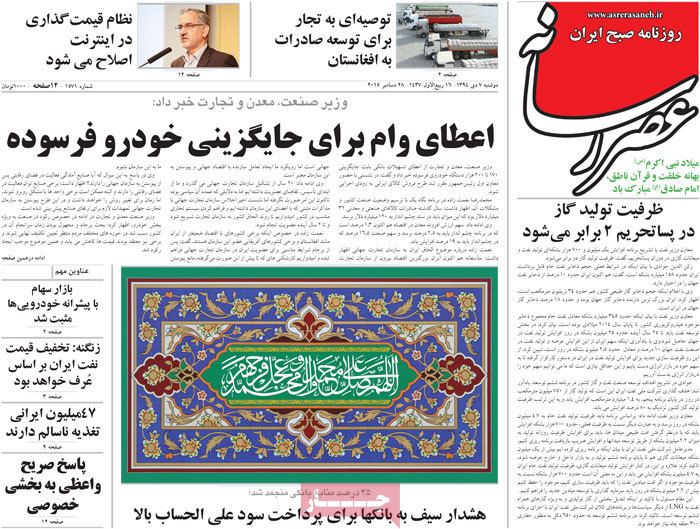
Asr-e Rasaneh: The capacity to produce natural gas in the post-sanctions era will double.
 

A look at Iranian newspaper front pages on Dec. 28


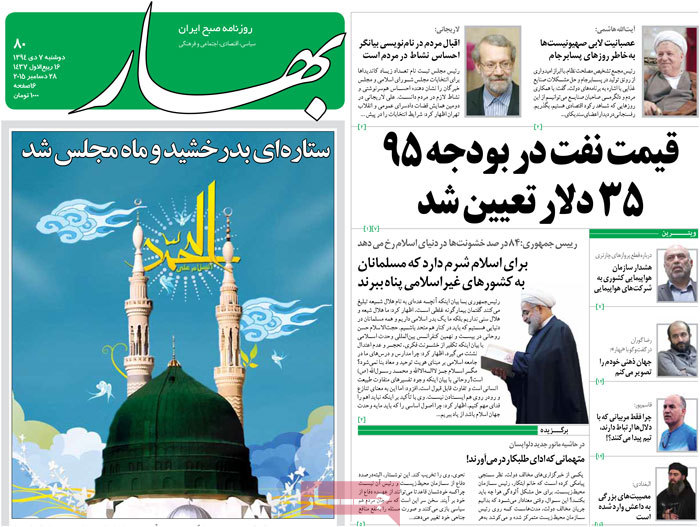
Bahar: The fact that a large number of people have registered to run in elections shows there is liveliness in society, said Parliament Speaker Ali Larijani.
 

A look at Iranian newspaper front pages on Dec. 28


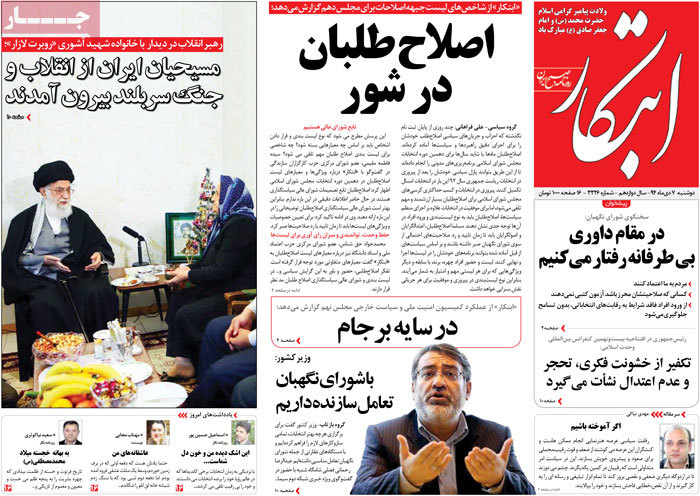
Ebtekar: The interior minister has said that his ministry has “constructive interaction” with the Guardian Council.

A spokesman for the Guardian Council [which vets candidates for elections] has said that the country will act impartially in screening the hopefuls.
 

A look at Iranian newspaper front pages on Dec. 28


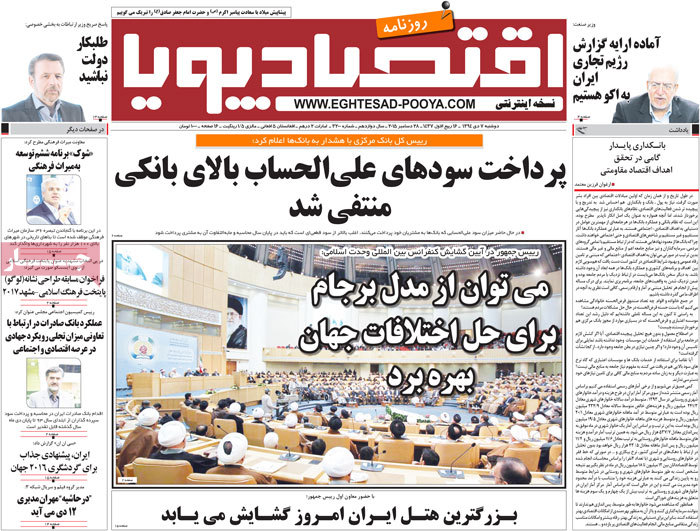
Eghtesad-e Pooya: Iran’s biggest hotel opens on Monday.

The first vice-president will be on hand for the inauguration.
 

A look at Iranian newspaper front pages on Dec. 28


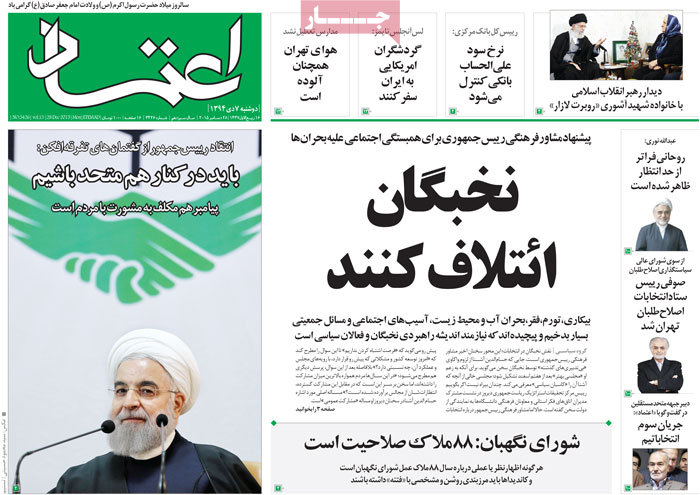
Etemad: The Guardian Council has said that 2009 is its criterion in qualifying the candidates.

Any comment on or practical measure in connection with the sedition of 2009 [widespread rioting sparked when two candidates doubted the results of the presidential elections] will be the council’s criteria in vetting the candidates who should have a clear stance on the sedition.
 

A look at Iranian newspaper front pages on Dec. 28


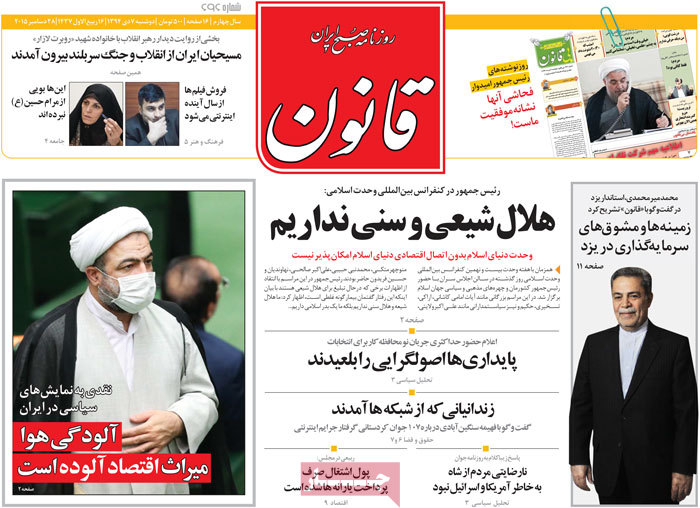
Ghanoon: The president has told an International Islamic Unity Conference that there are no Shiite or Sunni crescents.

He further said that in the absence of economic links between Muslim countries unity will remain elusive.
 

A look at Iranian newspaper front pages on Dec. 28


Hamdeli: The interior minister has said that he has reached a deal with the Guardian Council over candidates.
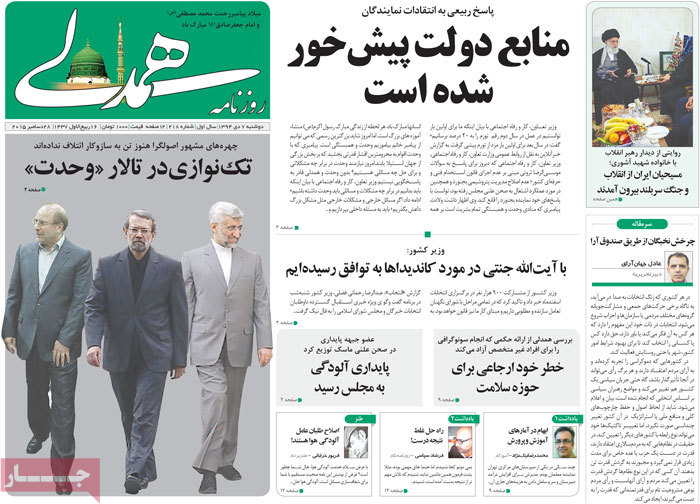
 

A look at Iranian newspaper front pages on Dec. 28


Hemayat: America’s measure to block Iranian assets amounts to robbery and bullying, Parliament Speaker Ali Larijani told a national gathering of public and revolutionary court judges.
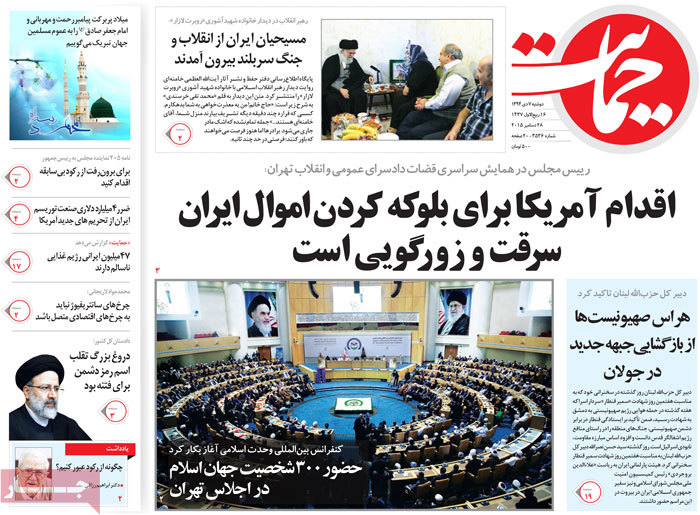
 

A look at Iranian newspaper front pages on Dec. 28


Iran: Molaverdi and Ebtekar [two female vice-presidents] are to file complaints against those who have resorted to libel and terms of abuse in criticizing them.
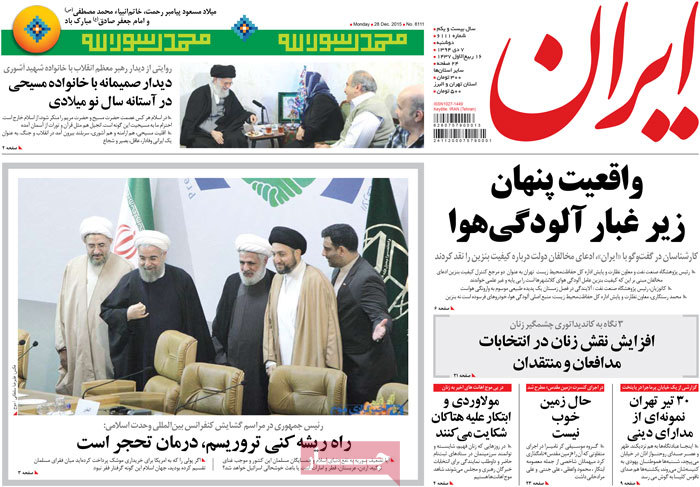
 

A look at Iranian newspaper front pages on Dec. 28


Javan: Iranian Christians had a proud performance during the revolution and the war, said the Supreme Leader as he met with the family of a Christian martyr.
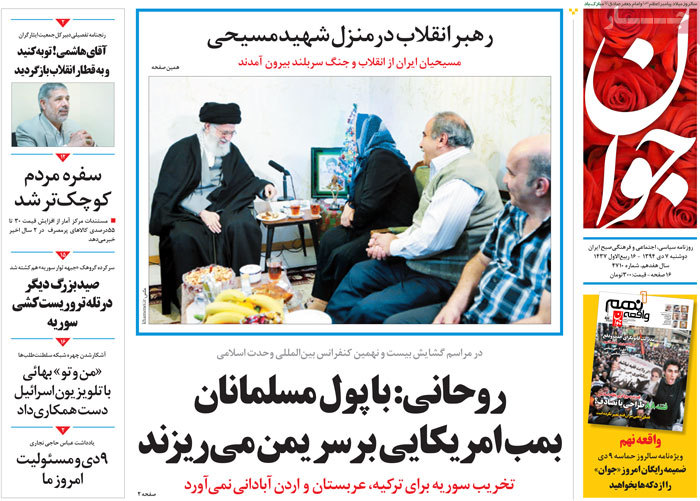
 

A look at Iranian newspaper front pages on Dec. 28


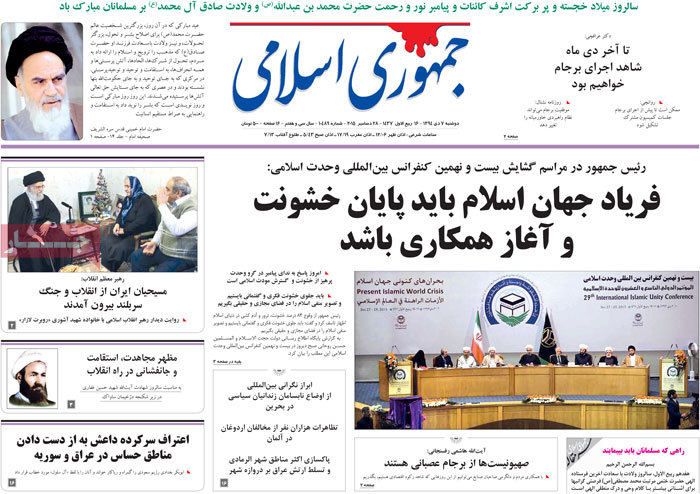
Jomhouri Islami: The Zionists are angry at the conclusion of the Iran nuclear deal, said Chairman of the Expediency Council Ayatollah Akbar Hashemi Rafsanjani.
 

A look at Iranian newspaper front pages on Dec. 28


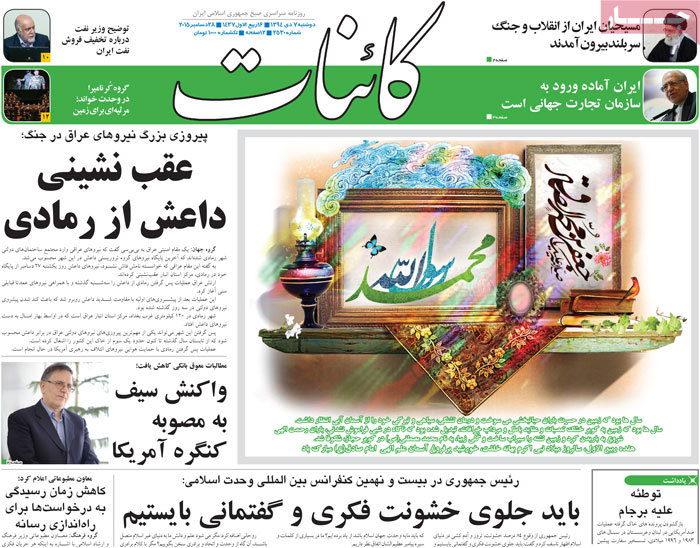
Kaenat: Iran is ready to be admitted to the World Trade Organization, said the ministry of industries, mines and trade.
 

A look at Iranian newspaper front pages on Dec. 28


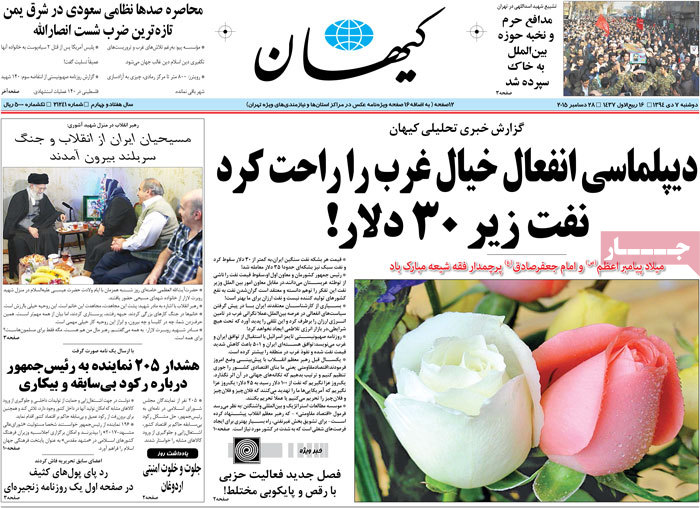
Kayhan: Some 205 MPs have sent a letter to President Rouhani warning about unprecedented recession and unemployment.
 

A look at Iranian newspaper front pages on Dec. 28


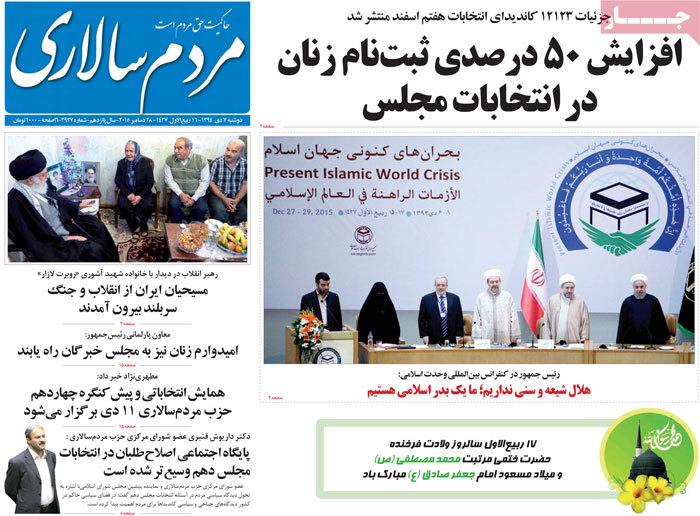
Mardomsalari: The number of women fielding their candidacy for parliamentary elections is up 50 percent.

Mardomsalari: The vice-president for parliamentary affairs says he hopes women too are elected to the Assembly of Experts.
 

A look at Iranian newspaper front pages on Dec. 28


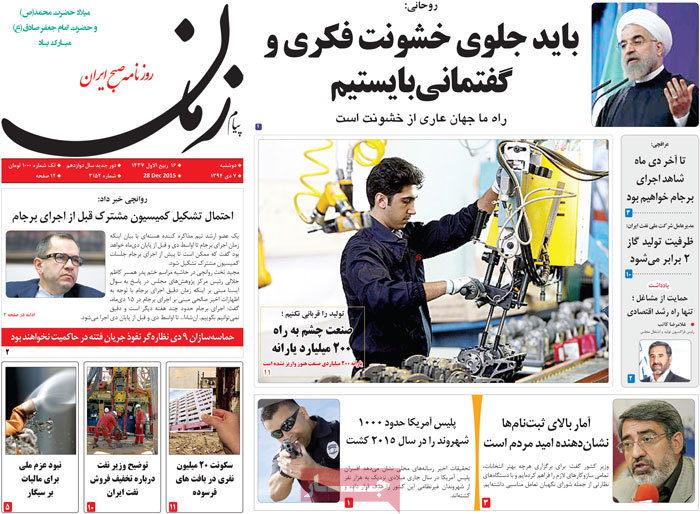
Payam-e Zaman: The deputy foreign minister has said that a Joint Commission is likely to be formed before the implementation of JCPOA.
 

A look at Iranian newspaper front pages on Dec. 28


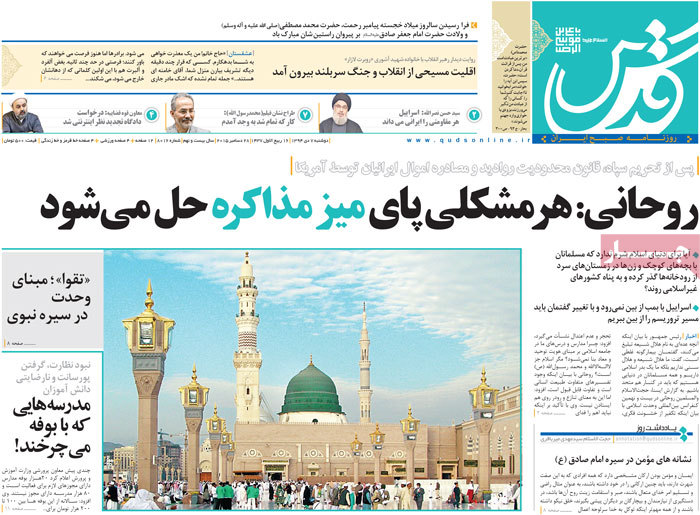
Qods: All problems can be settled at the negotiating table, said President Rouhani.
 

A look at Iranian newspaper front pages on Dec. 28


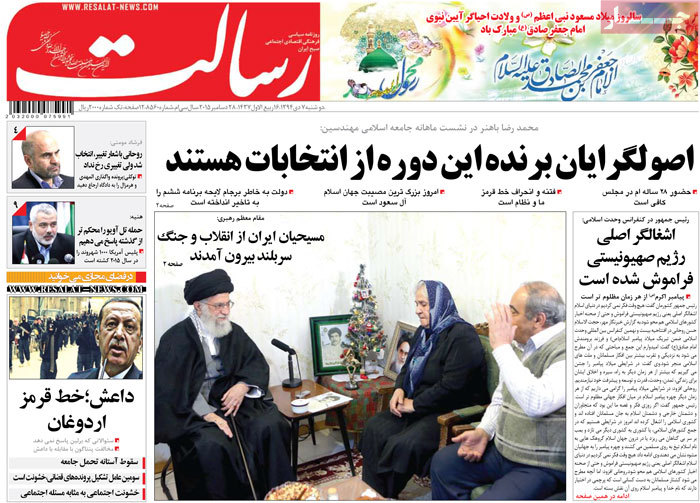
Resalat: Mohammad Reza Bahonar [a principlist vice-speaker of the Islamic Consultative Assembly who is not seeking reelection] has said that principlists will emerge victorious in the upcoming elections.

He blamed the nuclear deal for the delay in presentation by the government of a bill on the Sixth Development Plan to parliament.
 

A look at Iranian newspaper front pages on Dec. 28


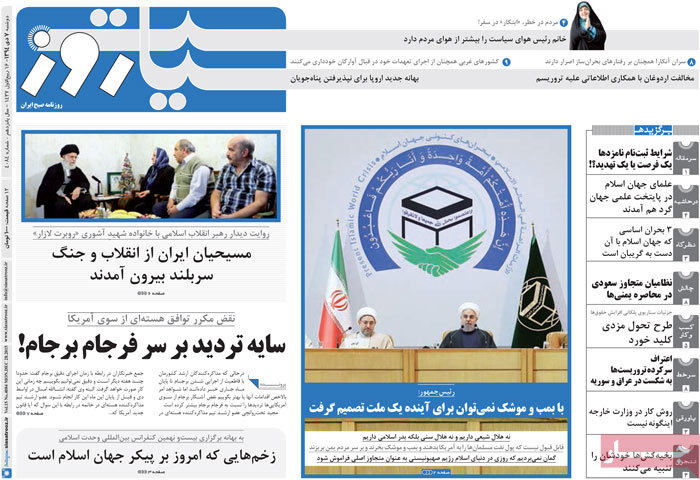
Siasat-e Rooz: America’s repeated violation of the deal has sent clouds of doubts hanging over the implementation of the nuclear deal.

Siasat-e Rooz: Bombs and missiles cannot be used to determine the future of a country, President Rouhani said.

 

A look at Iranian newspaper front pages on Dec. 28