Friday, December 26, 2025
Home Blog Page 4651

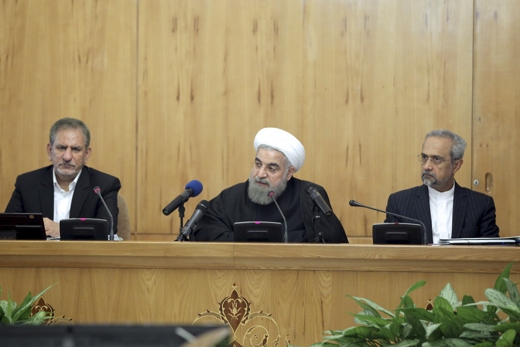
Iran taking urgent action on air pollution

Rouhani-Government

As cold season inversion has shrouded a number of Iranian cities in smog, President Hassan Rouhani unveiled plans on Wednesday

for “urgent, short-term” measures to tackle severe pollution.

Speaking at a weekly session of the Cabinet, President Rouhani said necessary decisions have been made to deal with the pressing problem of air pollution.

Public concern about the pollution is reasonable and just, the president contended, stressing the need for continuous efforts to allay concerns on the issue.

Although tackling the air pollution is not possible in a short-term period, the administration will make whatever decision necessary to combat the problem, Rouhani added.

In recent weeks, cold temperatures and stagnant air in a number of big Iranian cities, including capital Tehran, have put the air pollution index as much as 7 times the levels recommended by the World Health Organization.

Severe air pollution prompted authorities last week to shut down schools for three days in and around the megacity of Tehran, with an estimated population of 14 million people. It also canceled two Iran Pro League soccer matches on Sunday.

Residents, especially those with cardiac and respiratory problems and pregnant women, have been highly advised to remain indoors.

Eighty percent of Tehran’s pollution is blamed on exhaust fumes emitted from five million cars.


Iran condemns bomb attack in Pakistan

Jaber Ansari

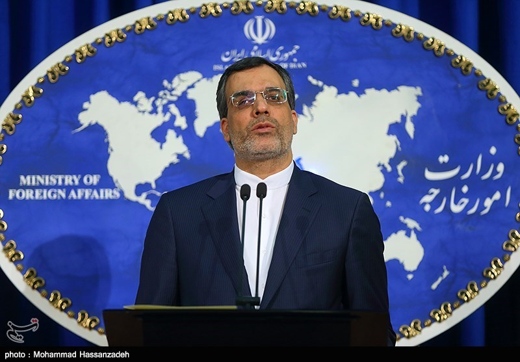
Iran has condemned a bomb attack in northwestern Pakistan, saying the act of terror was part of a ploy to serve the interests of the enemies of Islam.

“The Islamic Republic of Iran views such terrorist acts as being in line with the evil objectives of the enemies of the Pakistani nation and the Islamic world,” said Iranian Foreign Ministry Spokesman Hossein Jaberi Ansari on Wednesday.

On Tuesday, nearly two dozen people were killed in a bombing outside a government building in the town of Mardan, 50 km northwest of Peshawar, the capital of Khyber Pakhtunkhwa Province, near the country’s border with Afghanistan. Pakistani officials said some 70 others were wounded in the attack which targeted the regional office of the National Database and Registration Authority.

In his statement, Jaberi Ansari offered condolences to the bereaved and the government of the “friendly and brotherly nation” of Pakistan.

Shortly after the attack, a spokesman for the militant group Jamaat-ul-Ahrar, an offshoot of the Pakistani Taliban, claimed responsibility for the bombing, saying it was to “punish” government agencies over the support they provide to the security forces in the country.

The attack seemed to be a response to Pakistan’s ever-increasing crackdown on the militants which began in December 2014, when militants killed nearly 150 people, mainly children, in an attack on an army-run school in Peshawar.

Since then, the Pakistani military has been engaged in a wide-scale operation against the militants. Pakistan is known as an old backer of the Taliban militants in neighboring Afghanistan.


A look at Iranian newspaper front pages on Dec. 31

Iranian Newspapers Headlines

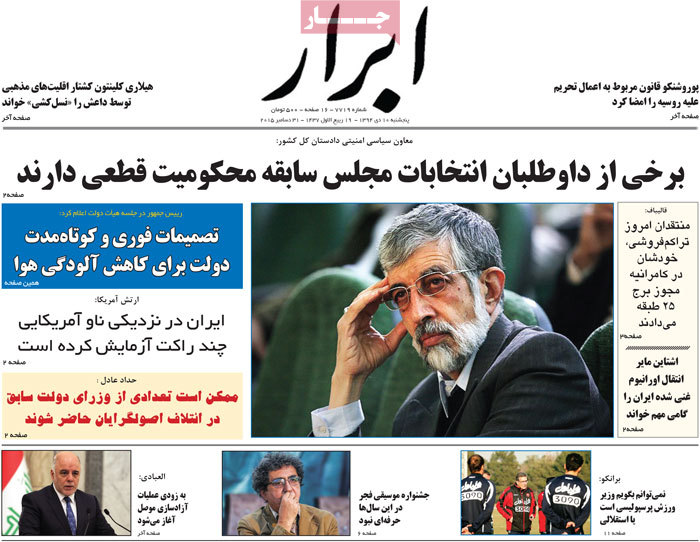
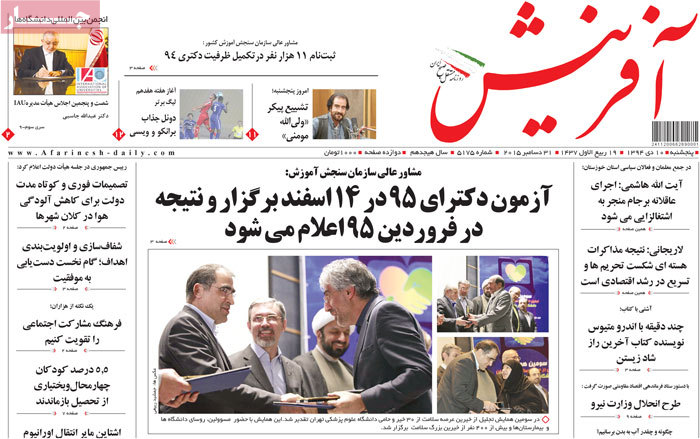
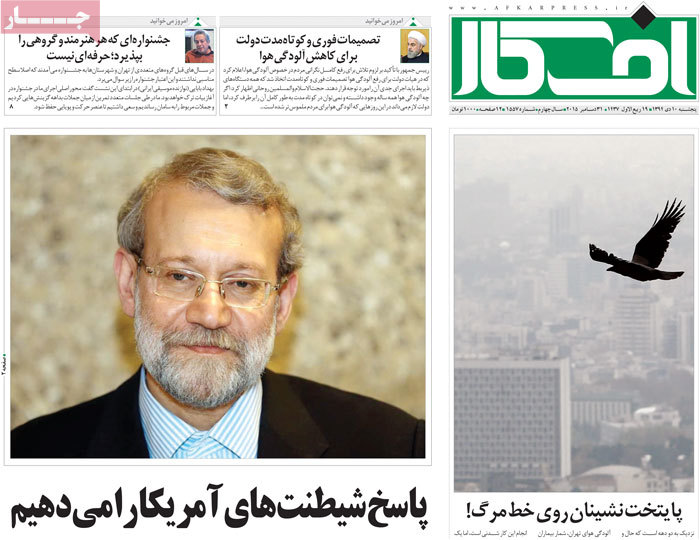
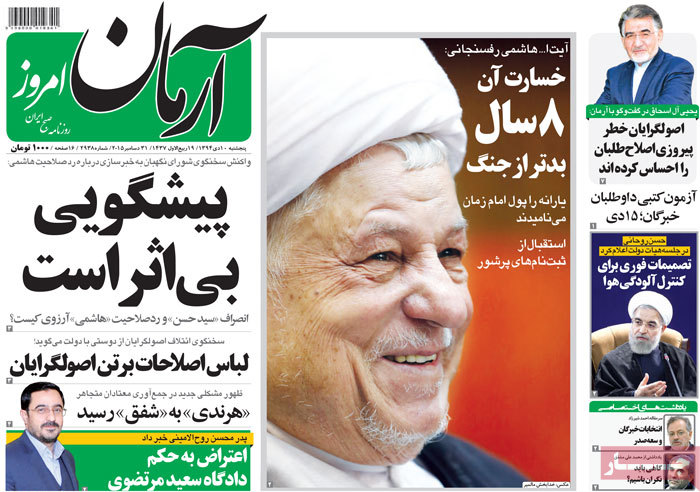
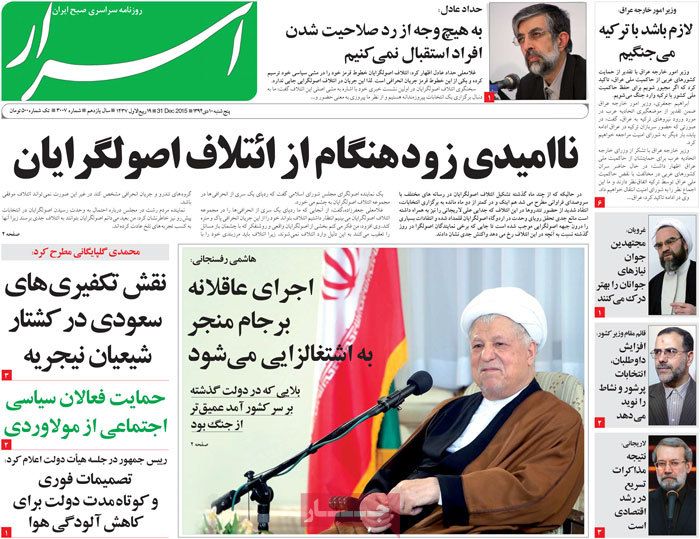
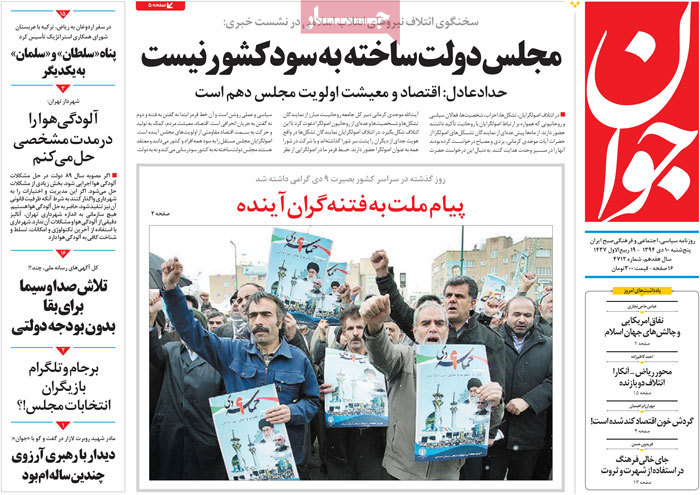
Air pollution in megacities and the decision of the Cabinet to take urgent measures to ease it dominated the front pages of Iranian newspapers on Thursday. Principlist dailies gave front-page coverage to the comments of the principlist coalition spokesman Haddad Adel, while reformist papers put on their covers the comments Akbar Hashemi Rafsanjani has made on the losses the country incurred when the previous government was in office.


A look at Iranian newspaper front pages on Dec. 31


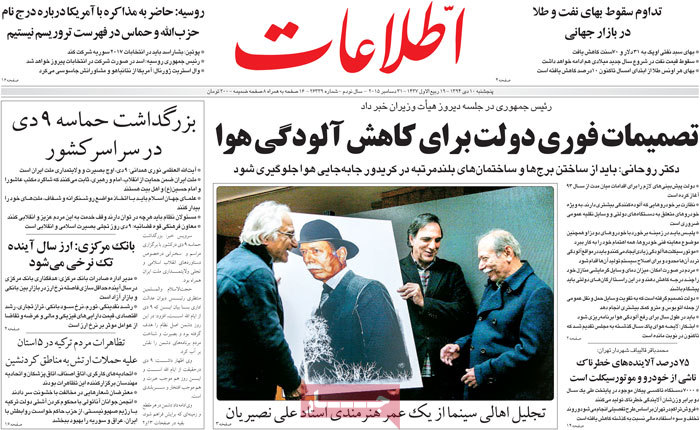
Ettela’at: President Rouhani has unveiled urgent decisions by his government to ease air pollution.

The president said construction of high-rise buildings in air corridors should stop.

Ettela’at: Tehran Mayor Mohammad Bagher Ghalibaf has blamed the gas emissions of cars and motorcycles for 75 percent of all toxic pollutants in the air.

Ettela’at: The lifetime achievements of prominent actor Ali Nasirian have been praised.

Ettela’at: Oil and gold prices on the world markets keep sliding.

The plunge in oil prices is projected to continue in 2016.

Ettela’at: Russia has said it won’t hold talks with the US over the designation of Hezbollah and Hamas as terrorist entities.

The Russian president said Assad should be part of the 2017 elections in Syria.

Ettela’at: Ceremonies have been held to commemorate the epic of December 30, 2009 [when people took to the street across the country to throw their weight behind the Supreme Leader and the establishment; those rallies spelled an end to the unrest that began to rage in the wake of the presidential elections earlier in the year.]

Ettela’at: The Central Bank of Iran has said a single foreign currency rate will be introduced next year [starts March 2016].

Ettela’at: People in five Turkish provinces have staged rallies to protest attacks by the army on Kurdish areas.


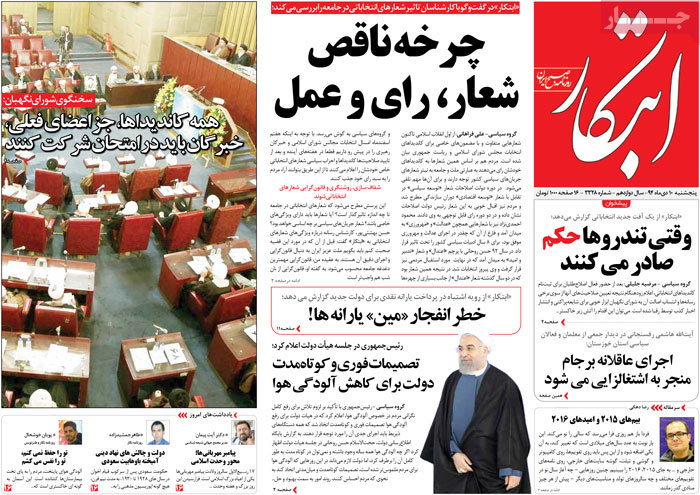
Abrar: Some of the individuals seeking to run for the Islamic Consultative Assembly are ex-convicts, said the deputy attorney general for political and security affairs.

Abrar: A number of ministers who served under the previous government [Ahmadinejad’s] are likely to be on the principlist ticket, said Gholamali Haddad Adel, the spokesman of the Principlist Coalition Council.


A look at Iranian newspaper front pages on Dec. 31


Afarinesh: Parliament Speaker Ali Larijani has said as a result of nuclear talks [which culminated in a deal between Iran and P5+1 in July] sanctions will be removed and economic growth will be expedited.


A look at Iranian newspaper front pages on Dec. 31


Afkar: America’s mischief won’t go unanswered, said Parliament Speaker Ali Larijani.


A look at Iranian newspaper front pages on Dec. 31


Aftab-e Yazd: Supporters of the sedition [a reference to widespread riots sparked when two presidential candidates doubted the results of the 2009 elections] won’t garner votes even if they are not disqualified, said Ayatollah Ahmad Khatami, a member of the Assembly of Experts.


A look at Iranian newspaper front pages on Dec. 31


Arman-e Emrooz: Predictions won’t be effective.

That is how the spokesman of the Guardian Council has reacted to rumors that Ayatollah Hashemi Rafsanjani is likely to be barred from running for the Assembly of Experts.


A look at Iranian newspaper front pages on Dec. 31


Asrar: We won’t welcome the disqualification of candidates,said Haddad Adel, the spokesman of the Principlist Coalition Council.

Asrar: Prudent implementation of the Joint Comprehensive Plan of Action will create jobs, said Chairman of the Expediency Council Ayatollah Akbar Hashemi Rafsanjani.

He further said the damage the country suffered under the previous government was worse than the losses inflicted during the war.


A look at Iranian newspaper front pages on Dec. 31


Ebtekar: A spokesman for the Guardian Council has said all candidates [for the Assembly of Experts] except the incumbents will have to take a test on Ijtihad [independent reasoning].


A look at Iranian newspaper front pages on Dec. 31


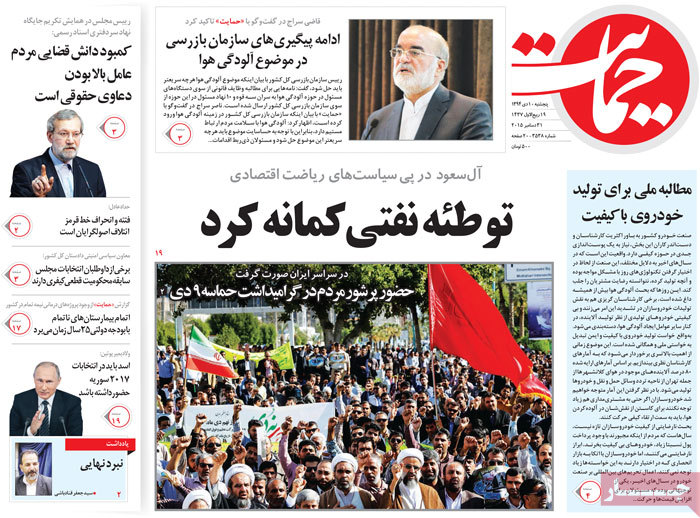
Hemayat: The oil plot backfired.

The Saudi government seeks to introduce austerity measures.


A look at Iranian newspaper front pages on Dec. 31


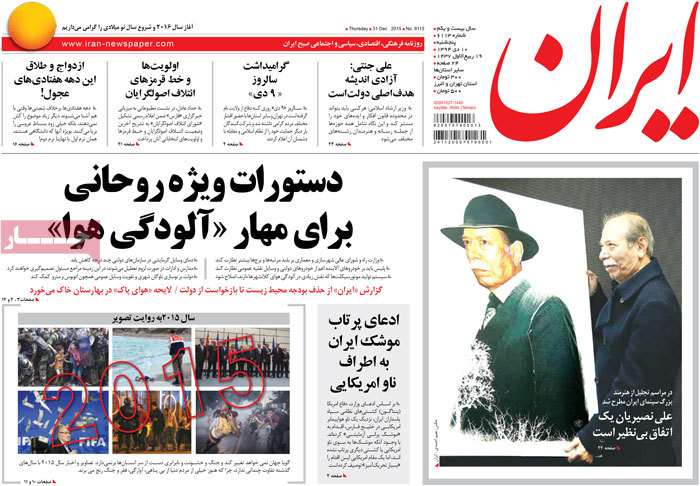
Iran: Minister of Culture and Islamic Guidance Ali Jannati has said upholding the freedom of thought is the main goal of the government.


A look at Iranian newspaper front pages on Dec. 31


Javan: A parliament whose makeup is influenced by the executive won’t serve the country’s interests, said the spokesman of the principlist coalition.

Haddad Adel further said economy and pocketbook issues will be the top priorities of the 10th parliament.


A look at Iranian newspaper front pages on Dec. 31


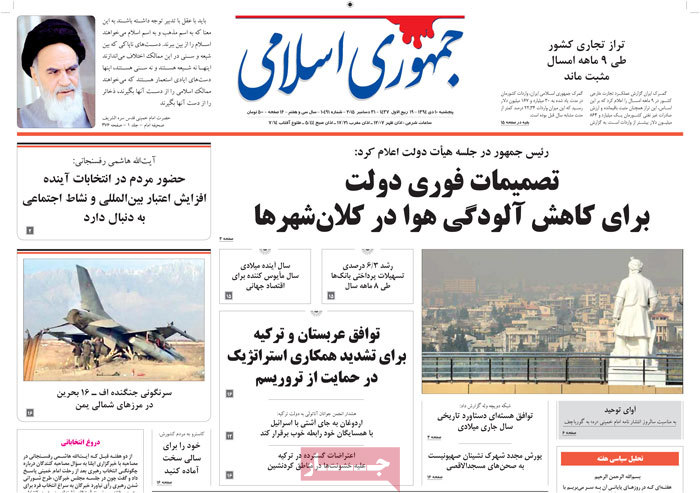
Jomhouri Islami: The country’s trade balance in the first nine months of the year was positive.

Jomhouri Islami: Ayatollah Rafsanjani has said participation of members of the public in the upcoming elections will promote the country’s international credibility as it creates social dynamism.


A look at Iranian newspaper front pages on Dec. 31


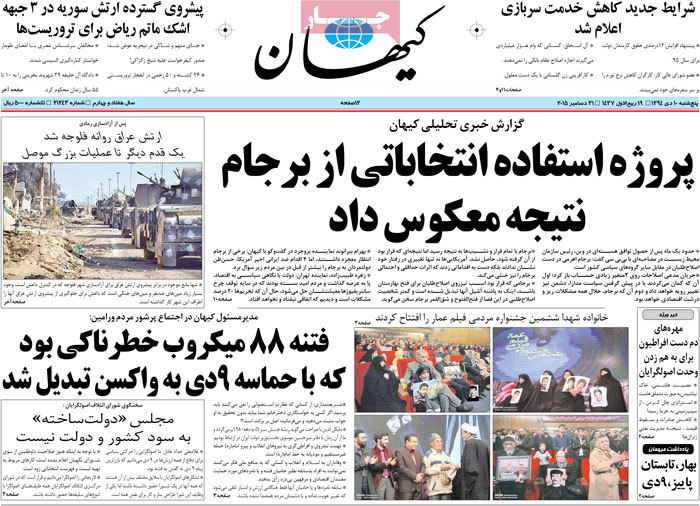
Kayhan: The Syrian army has made advances on three fronts; Riyadh is shedding tears for terrorists.


A look at Iranian newspaper front pages on Dec. 31


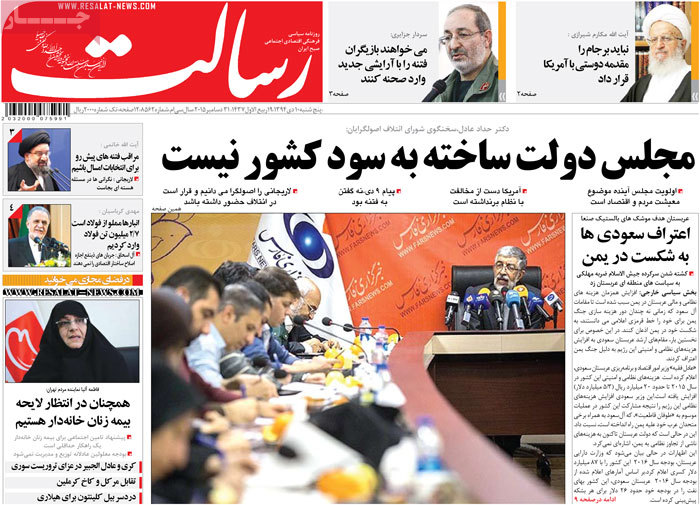
Resalat: At a time when storage facilities are full of steel, some 2.7 million tons of steel products has been imported from overseas, said Deputy Trade Minister Mehdi Karbasian.


A look at Iranian newspaper front pages on Dec. 31


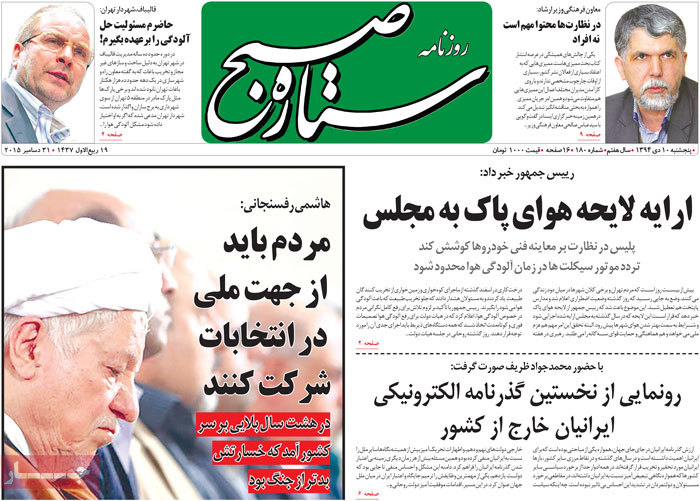
Setareh Sobh: Tehran Mayor Mohammad Bagher Ghalibaf has signaled his readiness to settle the problem of air pollution in the capital.

It came as the president said a clean air bill was presented to parliament [last year].

Setareh Sobh: At a ceremony attended by Foreign Minister Zarif, an electronic passport for Iranian expats has been unveiled.


A look at Iranian newspaper front pages on Dec. 31


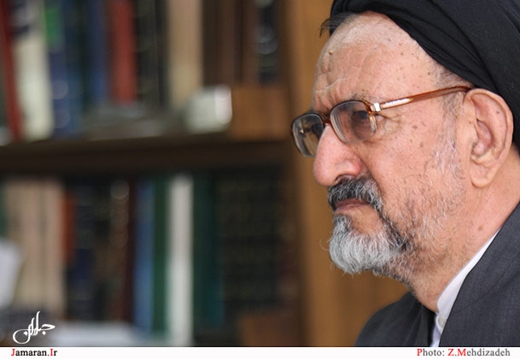
An ex-envoy expounds on his mission in Iraq

Doai

A former Iranian ambassador to Iraq has reacted to a claim that the late Imam Khomeini had insisted on war with Iraq despite advice by his inner circles to avoid such a conflict.

A memory from the days predating the Iran-Iraq war has changed hands on social networking sites despite the fact that Iran’s former ambassador to Iraq – Seyyed Mahmoud Doaei who was a main player in the memory – had already denied it outright.

Sharq daily’s Marjan Towhidi had a Q-and-A with Mr. Doaei about his time as Iran’s ambassador to Iraq, his contacts with Saddam and the controversial memory on the eruption of war. The following is the translation of the Second and Final Part of the interview ( Part One ):

Q: Did you have any meeting with Saddam Hussein during the time you were Iran’s ambassador to Iraq?

A: When I was appointed Iran’s ambassador to Iraq, there were two spectrums in that country: One spectrum was moderate and comprised of seasoned individuals, and the other included hardliners who barely tolerated each other.

I was assigned as Iran’s ambassador to Iraq during Hassan al-Bakr’s tenure [as Iraq’s president]. He welcomed the designation. He completely understood the late Imam Khomeini’s goodwill, and we had a very good meeting.

However, the hardliners – Saddam and his supporters – were opposed to my designation. They had hatched plans for Iran-Iraq relations and they were pursuing what they had planned since much earlier.

I arrived in Iraq on June 5, 1979 and I was called home in February 1980 which marked the end of my assignment in Iraq. During the eight months or so that I was in Iraq, I had several meetings, mainly with Iraqi Foreign Ministry officials. My first meeting was with Hassan al-Bakr. It was a positive meeting based on goodwill and lasted two hours.

But, Hassan al-Bakr was not tolerated in Iraq and was toppled in a coup after which Saddam Hussein took over. During Saddam’s tenure, I had two ceremonial meetings with him, but I never had any talks with Saddam.

Q: Would you please explain those two ceremonial meetings?

A: There were festive occasions for which presidents would usually hold ceremonies and receive foreign ambassadors. I was invited to one such ceremony as the ambassador of the Islamic Republic of Iran. I offered congratulations on the occasion in that meeting and since it was my first meeting with him (Saddam), I raised a request. My request revolved around the release of Iranians in Iraqi prisons to mark the auspicious occasion. Saddam had apparently ordered [the release] and a number of prisoners had been set free.

Except for that, I did not have any meeting with Saddam. Of course, on another occasion, when Saddam returned home from a trip overseas, the Iraqi Foreign Ministry invited me to be at the airport to welcome Saddam. It was customary to invite diplomatic delegations to welcome the president. I stood along with fellow political representatives. Saddam walked past us and shook everybody’s hand, including me. I did not have any other meetings with Saddam.

Q: After the coup when Saddam became president, did you – as the Iranian envoy to Iraq – convey any message to him? As part of diplomatic protocol, was any step taken on behalf of Iran?

A: It was not customary for ambassadors to convey any messages. If any message was to be conveyed, it would be conveyed through comments by high-ranking officials on different occasions. I was not at a level to carry any message.

Q: The meetings you had with Iraqi foreign ministers, both under Hassan al-Bakr and Saddam, seem to have been mostly critical ones during which the two sides slammed each other….

A: There were two kinds of meetings. In some meetings, they summoned the ambassador to hand in a message in protest at the remarks that had been made in Iran and I passed along those messages. If there were responses from Iran, I notified the Iraqi officials afterward.

Or I would contact Iraq’s Foreign Ministry to relay a message or a protest note to them.

They would usually protest against the comments our officials made in interviews published by newspapers and during official ceremonies, and our objections to them focused on stances they took in newspaper articles, and radio and television programs.

Q: Can you provide examples of Iran’s objections to Iraqi officials and vice-versa?

A: One example was the sermons by the Late [Ayatollah] Montazeri in Tehran Friday prayers in which he officially made remarks against the Ba’ath party and Iraqi officials. Subsequently, Iraqi officials called me in to signal their objection to those statements and called for compensation.

I had told them in previous meetings that after the revolution, freedom prevailed in Iran and that the media corps as well as politicians had their own words and what we attached significance to were the official comments aired by political and Foreign Ministry officials. What mattered were the comments made by the president or foreign minister, I said.

In response, they [Iraqi officials] said: “The most important body you have in your country is the Constituent Assembly which is headed by Mr. Montazeri [who has made such comments]. This means the most senior political official of your country has made such comments.” I was supposed to convey their protest to our officials.

Q: What was the response Iran produced when you handed in this protest message?

A: They said it is incumbent upon us and it is a religious duty [to shed light on what is going on in the region] and words like that.

Our objections to them focused on their stance against Iran. After coming into office, in his first speech Saddam made certain claims about three Persian Gulf Iranian islands and about our Arab-speaking compatriots. I handed over a note of protest to the Iraqi Foreign Ministry.

Q: Did they produce any remarkable response?

A: No, I made one objection and they would not respond.

The End

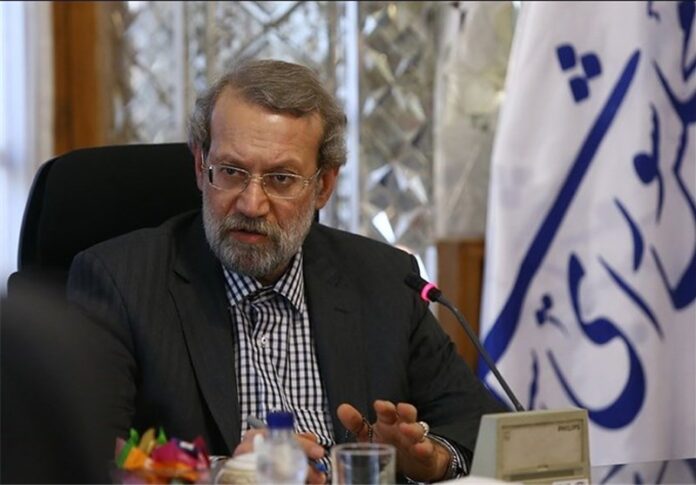
Speaker vows reaction to US moves against Iran

Ali Larijani

The US should not be surprised to get Iran’s retaliatory response to mischievous conduct when it comes to implementing a July nuclear deal on Tehran’s nuclear program, parliament Speaker Ali Larijani said.

The US should expect Iran’s reaction to every mischievous act and should know that Tehran is monitoring the developments, Larijani said at a conference in the city of Qom, 130 kilometers south of Tehran, on Tuesday night.

He reaffirmed that Iran honors its commitments under the Joint Comprehensive Plan of Action (JCPOA), and tries to make sure that the deal is carried out properly.

The JCPOA, a final nuclear deal between Iran and the Group 5+1 (Russia, China, the US, Britain, France and Germany) is going to take effect within the next few weeks.

On Monday, Larijani had slammed Washington’s possible decision to confiscate Iran’s assets in the US banks as “robbery”, saying the legislature is considering plans to react to any such move.

The warning came in reaction to reports that the US Supreme Court is considering a case to confiscate the Iranian Central Bank’s assets in the US to pay the American victims of terrorist attacks allegedly linked to the Iranian government.

The US House of Representatives is now weighing in on a pending case that accuses Iran of links with the 1983 bombing of the Marine barracks in Beirut and the 1996 bombing of the Khobar Towers in Saudi Arabia.

The US lawmakers are trying to force Iran’s Central Bank to pay damages to over 1,300 American plaintiffs. In 2008, the victims discovered that Iran’s Central Bank had almost $2 billion stored in Citibank accounts in New York. The victims sued for that money, and the litigation has now reached the Supreme Court.


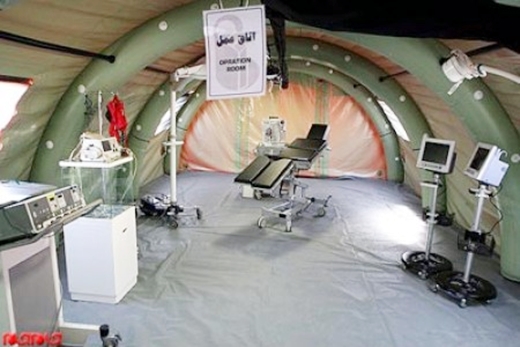
Surgical operations in field hospitals in predominantly Sunni areas to mark Unity Week

hospitals

The head of the Public Relations Office of the IRGC Ground Force’s Quds Base in charge of the southeast has said that as many as 2,709 surgical operations have been performed in four days in ten field hospitals in Sistan and Baluchestan Province to mark Unity Week.

Colonel Ghasem Hassanzadeh told the Islamic Republic News Agency on Monday that at least 255,000 patients have received medical services in these hospitals in the same period.

The following is the translation of what else he told IRNA:

In the first four days of Unity Week, four women had natural childbirths in the field hospitals stationed in the province.

The field hospitals – which have been stationed in districts close to a number of provincial towns such as Dalgan, Hirmand, Konarak, Saravan, Sarbaz, Zarabad, and Zehak – offered medical services and treatment to the needy in southeastern Iran.

By setting up field hospitals, the Islamic Revolution Guard Corps aims to improve the healthcare of patients, and offer medical and clinical services to people in impoverished and remote areas in the country.

Roughly 1,160 medics and paramedics from Tehran, Khorasan Razavi, Kurdistan, East Azerbaijan, Kermanshah and Sistan and Baluchestan provinces work in these hospitals which will run for a week and are equipped with specialty and subspecialty wards to help offer the best services to people in Sistan and Baluchestan and Kerman provinces.

Since 2009, the IRGC’s Ground Forces in charge of the south have launched 29 field hospitals in Sistan and Baluchestan, Kerman and Hormozgan provinces.

The IRGC Ground Force’s Quds Base, which is based in Sistan and Baluchestan Province, covers areas in the border province as well as parts of Kerman and Hormozgan Provinces.

A look at Iranian newspaper front pages on Dec. 30

Iranian Newspapers Headlines

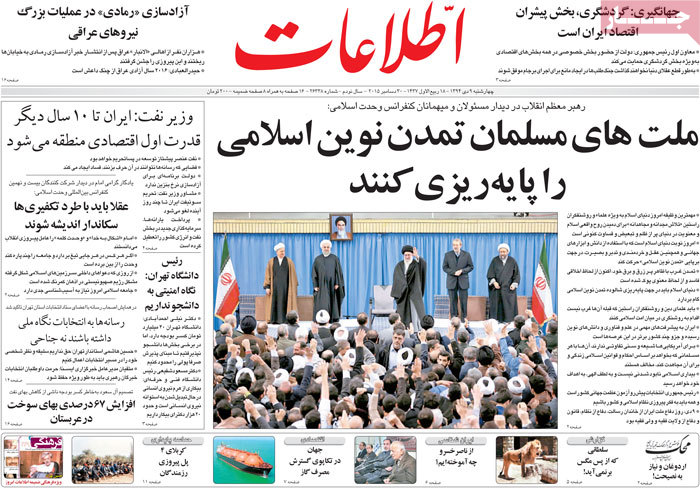
The comments of the Supreme Leader at a meeting with officials and foreign guests attending an Islamic Unity Conference dominated the front pages of Iranian newspapers on Wednesday.
 

A look at Iranian newspaper front pages on Dec. 30


Ettela’at: In a meeting with officials and foreign guests who were in Tehran to take part in an Islamic Unity Conference, the Supreme Leader urged Muslim nations to lay the foundation of a modern Islamic civilization.

Ayatollah Khamenei also urged scholars to enlighten the faithful.

Ettela’at: The first vice-president has hailed tourism as a pioneer of Iran’s economy.

Eshagh Jahangiri further said that government supports the private sector’s involvement in all economic areas, tourism in particular.

Ettela’at: Ramadi has been liberated in a major operation by Iraqi forces.

Prime Minister Haider al-Abadi has said that 2016 will be the year Iraq rids itself of the scourge of Daesh.

Ettela’at: The oil minister has said that Iran will be the regional economic heavyweight in a decade.

Bijan Namdar Zanganeh described oil as top component of development in the post-sanctions era.

Ettela’at: Sagacious individuals should push aside Takfiris to take the helm of schools of thought.

Ettela’at: The president of the University of Tehran has said that there is no security-centered attitude toward students in his university.

Ettela’at: Media should have a national, rather than factional, attitude toward elections.

The comment was made at a meeting between media and Tehran electoral commission officials.

Ettela’at: Fuel prices have risen by 67 percent in Saudi Arabia.

The decision by Saudi authorities to raise fuel prices was meant to offset a budget crunch sparked by the fall in oil prices.


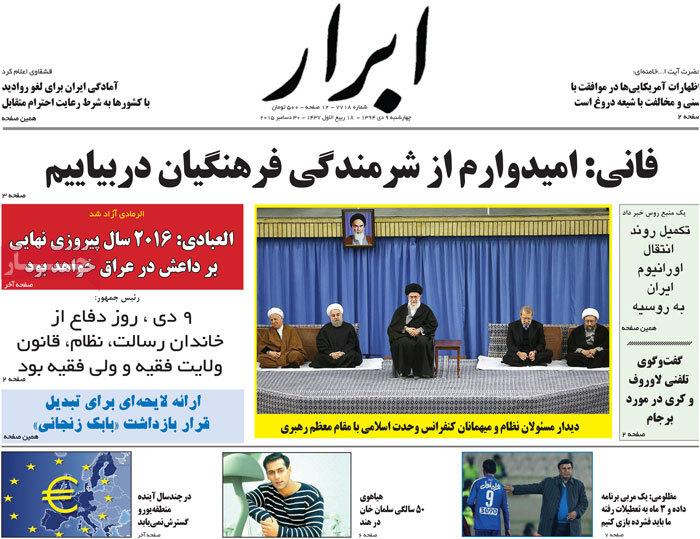
Abrar: The deputy foreign minister has signaled Iran’s readiness to waive visa for citizens of the countries which do the same thing for Iranian nationals.
 

A look at Iranian newspaper front pages on Dec. 30


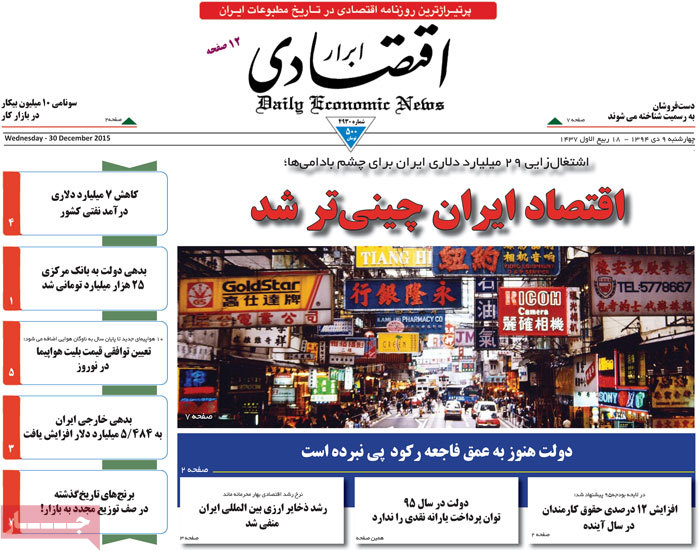
Abrar-e Eghtesadi: The country’s oil revenues are down by $7 billion.

Iran’s foreign debts have risen to $5.484 billion.

Government won’t be able to carry out with the payment of cash subsidies next year.
 

A look at Iranian newspaper front pages on Dec. 30


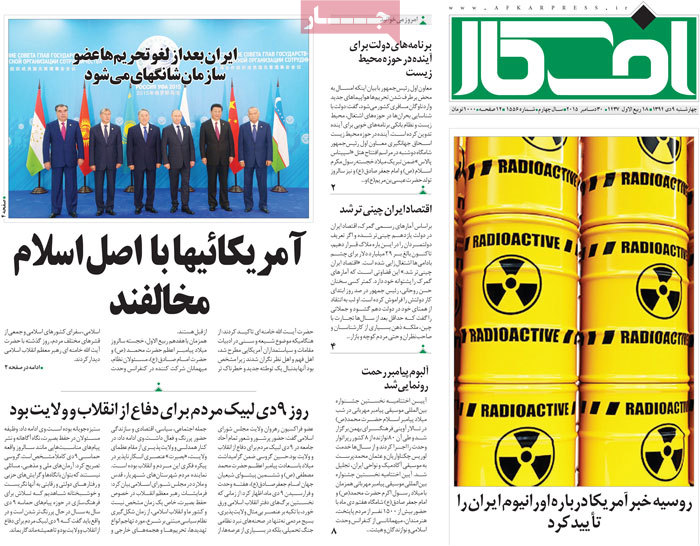
Afkar: Iran will become a member of the Shanghai Cooperation Organization after sanctions have been removed.
 

A look at Iranian newspaper front pages on Dec. 30


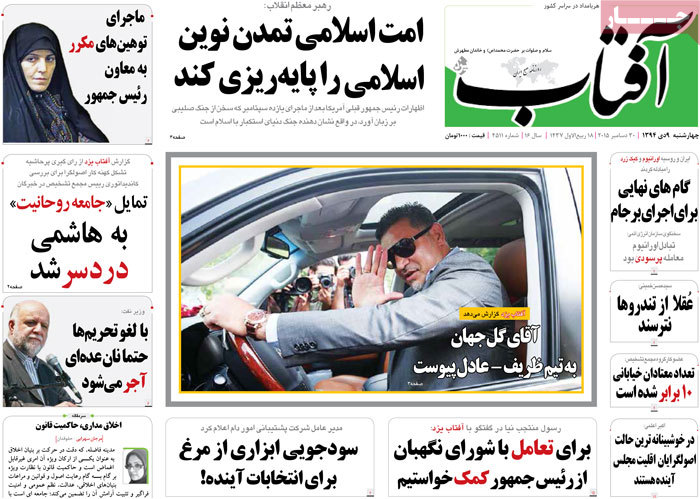
Aftab-e Yazd: The number of homeless drug addicts has increased 10-fold.

Aftab-e Yazd: Rasoul Montajabnia [a reformist leader] has said that reformists have reached out to the president in a bid to have interaction with the Guardian Council.
 

A look at Iranian newspaper front pages on Dec. 30


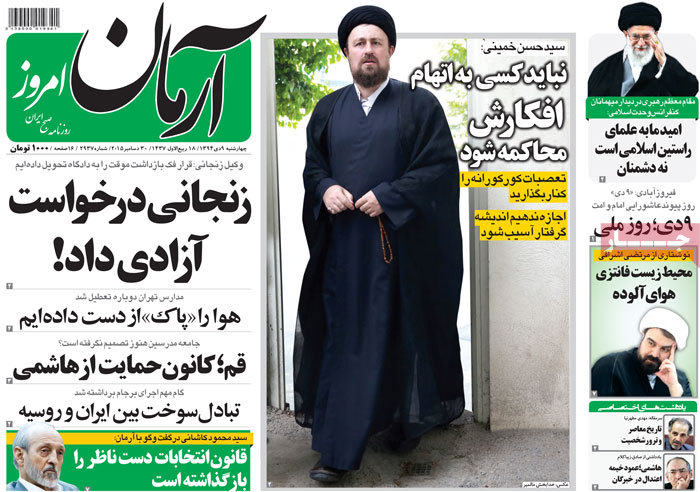
Arman-e Emrooz: In a motion, the lawyer representing Babak Zanjani [who is on trial for massive corruption] has called on the judge presiding over the trial to order his client freed!!

Arman-e Emrooz: Fuel exchange between Iran and Russia

A major step in line with the implementation of the Joint Comprehensive Plan of Action was taken.
 

A look at Iranian newspaper front pages on Dec. 30


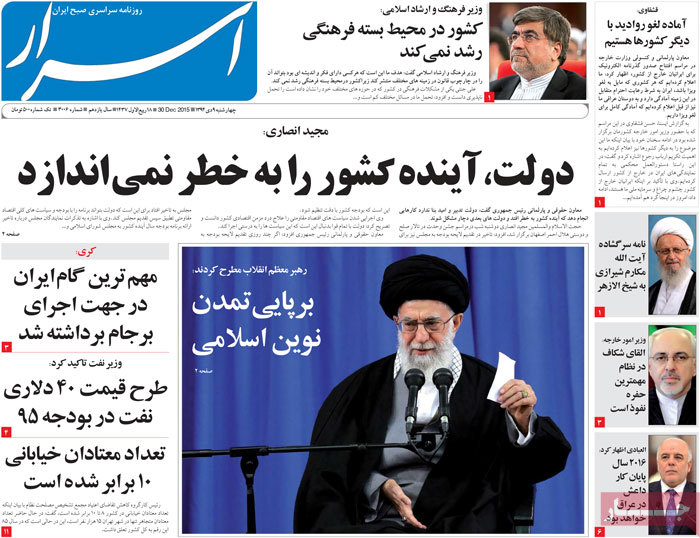
Asrar: In a culturally-closed environment growth would be elusive, said the minister of culture and Islamic guidance.

Asrar: Insinuations that there are rifts within the establishment pave the way for infiltration, said Foreign Minister Mohammad Javad Zarif.
 

A look at Iranian newspaper front pages on Dec. 30


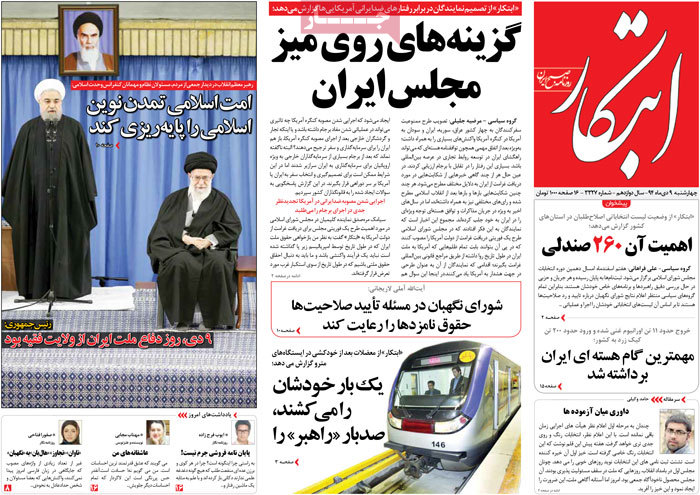
Ebtekar: Options on the table for the Iranian parliament

The daily takes a look at the decisions of Iranians MPs vis-à-vis the anti-Iranian attitude of the American politicians.
 

A look at Iranian newspaper front pages on Dec. 30


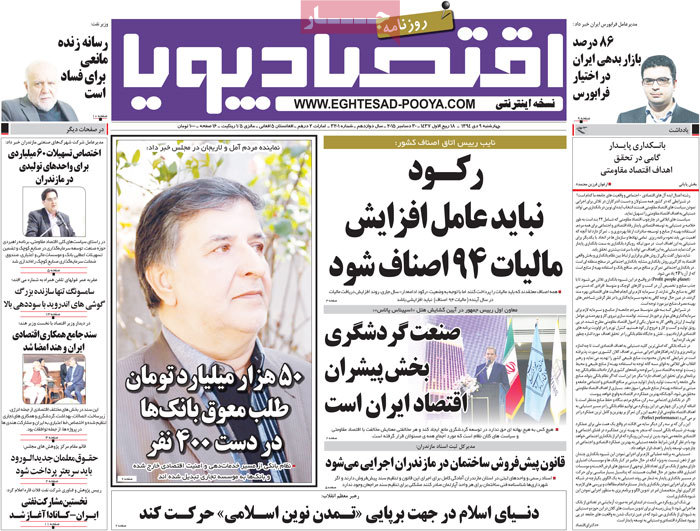
Eghtesad-e Pooya: An Iranian MP has said that 400 individuals owe some $17 billion in arrears to banks.
 

A look at Iranian newspaper front pages on Dec. 30


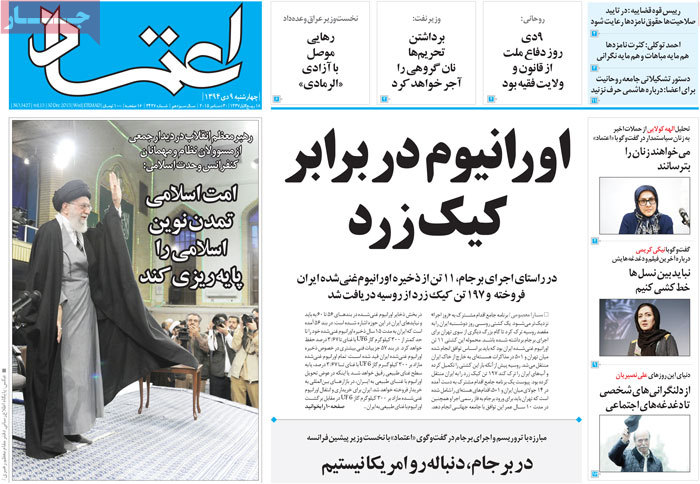
Etemad: In implementing the Joint Comprehensive Plan of Action, we won’t follow the US lead.

A former French prime minister talks about the war on terror and the Iran nuclear deal in an exclusive interview with the daily.
 

A look at Iranian newspaper front pages on Dec. 30


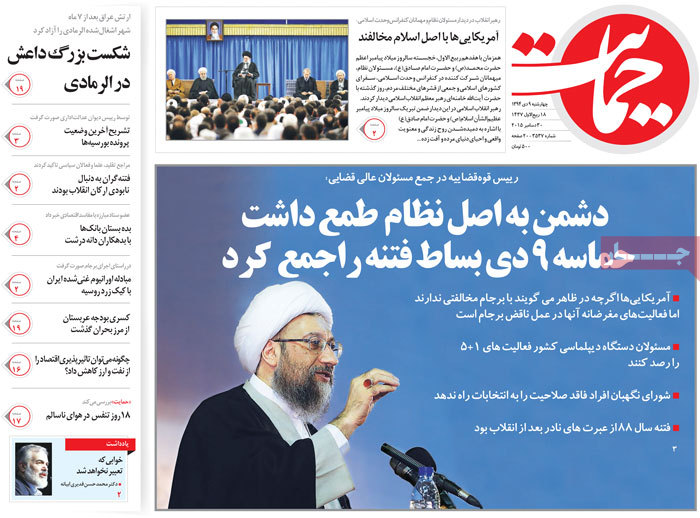
Hemayat: The enemies sought to topple the establishment; what happened on December 30, 2009 [the massive outpouring of support for the leader in nationwide rallies] finished off the sedition, said the Judiciary chief.

Although the Americans say they are not opposed to the nuclear deal, their hostile measures are a violation of the agreement, Ayatollah Sadegh Amoli Larijani said.
 

A look at Iranian newspaper front pages on Dec. 30


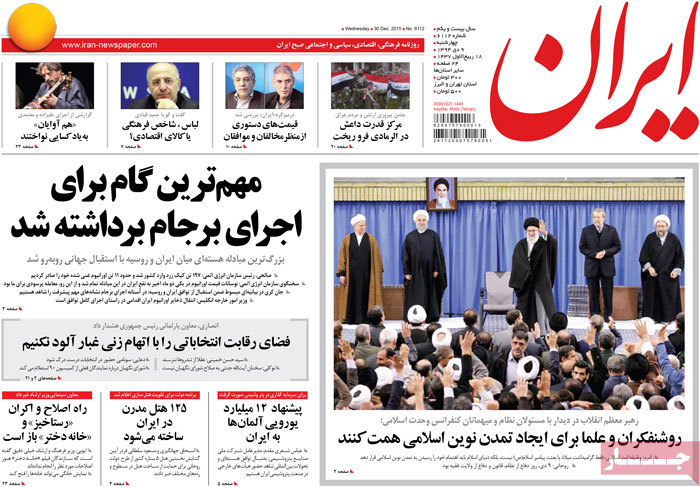
Iran: A hundred-twenty-five modern hotels will be built in Iran.

Iran: The vice-president for parliamentary affairs has said that the competitive electoral atmosphere should not be sullied by mudslinging.
 

A look at Iranian newspaper front pages on Dec. 30


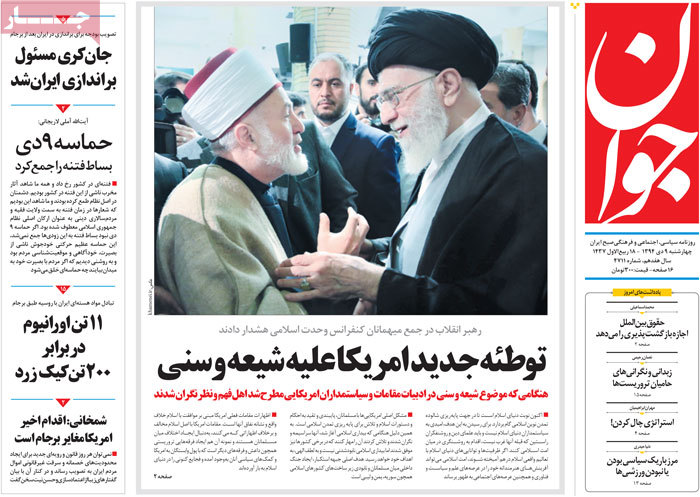
Javan: The secretary of the Supreme National Security Council has said that the recent measure the US has taken [a reference to changes to the Visa Waiver Program] amounts to breach of the nuclear deal.
 

A look at Iranian newspaper front pages on Dec. 30


Jomhouri Islami: The director of the Atomic Energy Organization of Iran has said that the fuel swap between Iran and Russia has been completed.

Jomhouri Islami: Ten of the aircraft Iran has purchased will arrive in Iran by the end of the year [March 21, 2016].
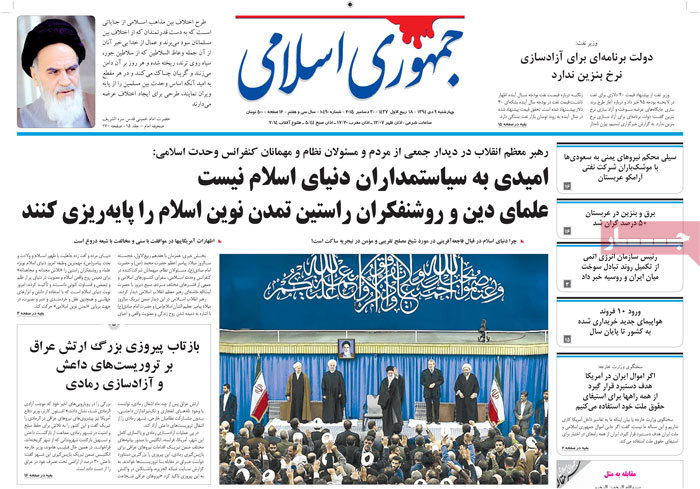
 

A look at Iranian newspaper front pages on Dec. 30


Kayhan: Despite US failure to keep its end of the bargain under the nuclear deal, 11 tons of enriched uranium was shipped out of the country.
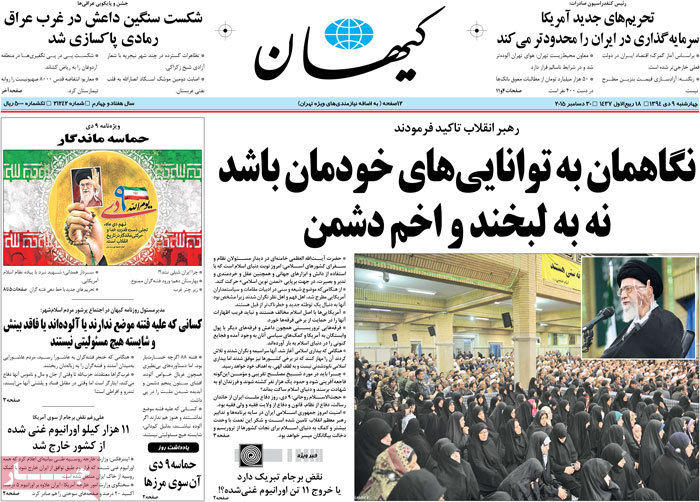
 

A look at Iranian newspaper front pages on Dec. 30


Resalat: December 30, 2009 was the day Iranians threw their weight behind the rule of law and rule of religious jurisprudent, said President Rouhani.
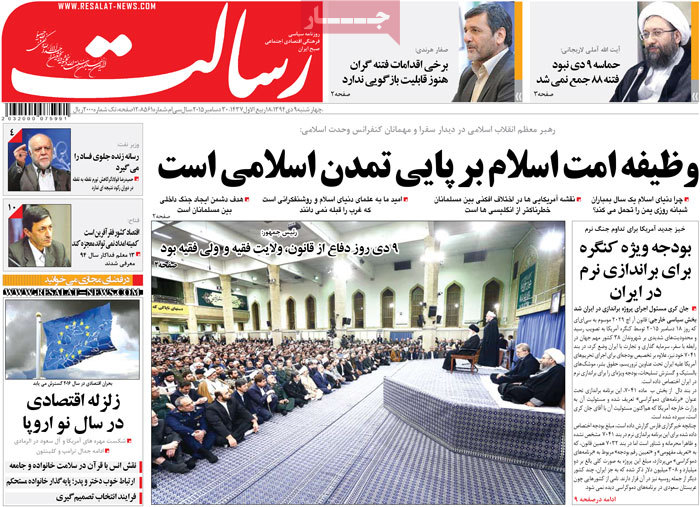
 

A look at Iranian newspaper front pages on Dec. 30


Roozan: The ministers of the Ahmadinejad administration are trying to enter parliament to tarnish the image of President Rouhani.
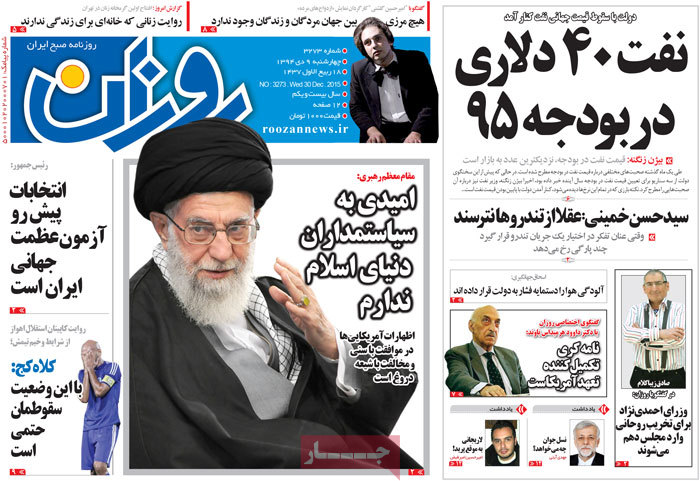
 

A look at Iranian newspaper front pages on Dec. 30


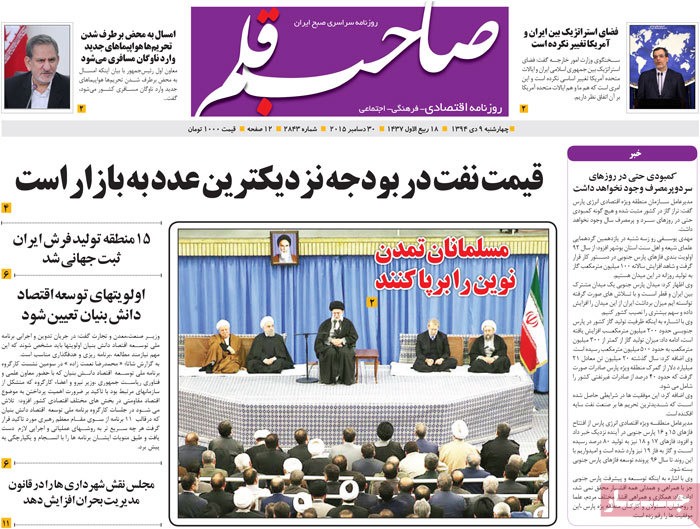
Saheb Ghalam: Fifteen Iranian carpet weaving areas have been registered globally.
 

A look at Iranian newspaper front pages on Dec. 30


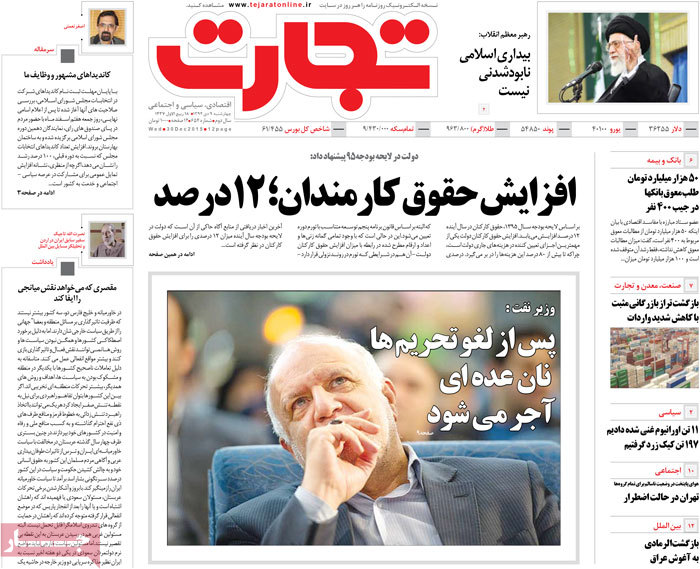
Tejarat: The government-proposed spending package calls for a 12 percent increase in the salary of civil servants next year.

Tejarat: With the termination of sanctions some will see their income shrink, said Oil Minister Bijan Namdar Zanganeh.
 

A look at Iranian newspaper front pages on Dec. 30


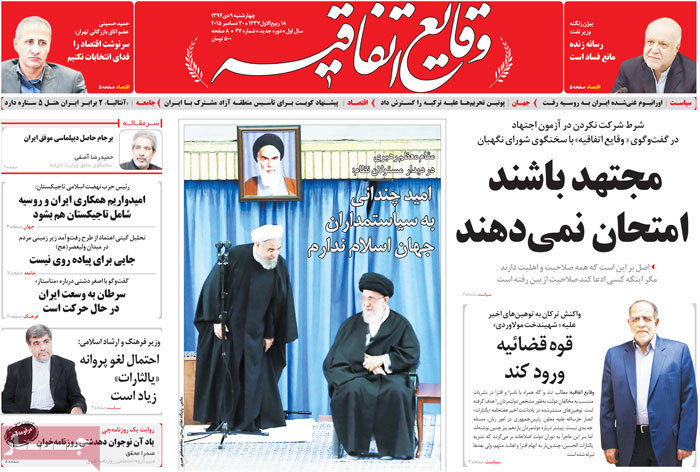
Vaghaye-e Etefaghiyeh: The editorial of the daily penned by the former Foreign Ministry Spokesman Hamid Reza Asefi hails the nuclear deal as a result of the country’s successful diplomacy.

 

A look at Iranian newspaper front pages on Dec. 30


Iranian MPs to propose motion to receive compensation from US

parliament

Iranian lawmakers plan to put forward a motion to call on the administration to restore the rights of the Iranian nation and receive compensation from the US administration for Washington’s crimes against the Islamic Republic.

Speaking to the Tasnim News Agency on Tuesday, Ebrahim Karkhanei, chairman of parliament’s Nuclear Committee, said the motion has been prepared by a group of parliamentarians and signed by 175 MPs up to now.

“According to the motion, the administration would be obliged to take all legal measures necessary to restore the Iranian nation’s rights and receive compensation from the US administration,” he said.

The lawmaker further emphasized that the motion will be submitted to the presiding board at the next open session of parliament which will be held in two weeks.

The cases for which the Iranian MPs have requested compensation from Washington range from the US-backed coup d’état in Iran, which overthrew the democratically elected Prime Minister Mohammad Mosaddegh in 1953, to US supports for the 1980-1988 Iraqi imposed war on Iran, which led to the deaths of more than 223,000 Iranians.

The lawmakers have also called for compensation for Iran’s loss of property and assets that have been blocked by the US government contrary to international conventions and regulations.


Iran says constructing 125 luxury hotels

Soltanifar-Hotels

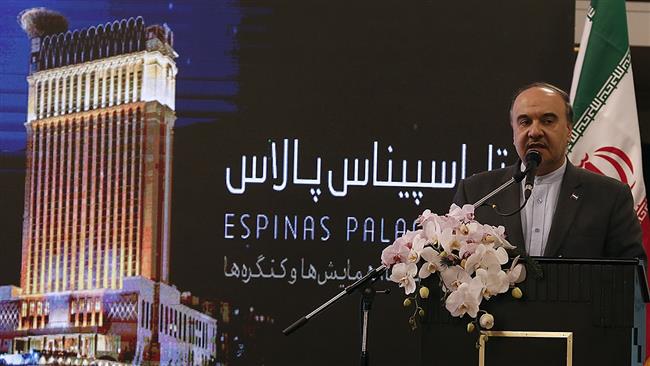
Iran’s top tourism official says the country is constructing 125 new four- and five-star hotels, stressing that the figure is a record in the Iranian hospitality industry.

Masoud Soltanifar, the head of Iran’s Cultural Heritage, Handicrafts and Tourism Organization, said the Rouhani administration has over the past two years constructed as many luxury hotels as the ones constructed in the country over the past century.

Speaking in a ceremony to inaugurate Spinas Palace Hotel in uptown Tehran, Soltanifar emphasized that some of the new hotels are ready to be opened provided that the required financial resources are provided to their contractors.

He further emphasized that the recent progress in Iran’s nuclear case and the prospects for the removal of sanctions against Iran have provided a bright outlook for the country’s tourism industry.

Soltanifar said that President Rouhani’s government has already devised serious plans to promote Iran’s tourism industry once the sanctions are lifted.

Iran has an ambitious target to increase annual visitor count by five-fold to 20 million by 2025 in order to generate $30 billion a year.

Reports emerged earlier that international hoteliers are heartened by the plan. Hotel groups in the Persian Gulf Arab states are specifically believed to have already drawn up plans to boost their portfolios in Iran as they see the country emerging as the most lucrative hospitality development market.

According to Iranian officials, hotel groups from Germany, Greece, South Korea and Singapore have recently traveled to Iran for talks.

Europe’s largest hotel group Accor has also constructed two four-star hotels at Imam Khomeini International Airport outside the Iranian capital. The UAE-based Rotana plans to open its five-star 600-room hotel in Tehran this year and another in the pilgrimage city of Mashhad.

Iran urges ‘smart’ approaches to Mideast crises

Amir Abdollahian-Qatar

A senior Iranian official says foreign powers seek to hatch plots to cause harm to Middle East countries, stressing that regional states must adopt “smart” approaches to thwart such schemes.

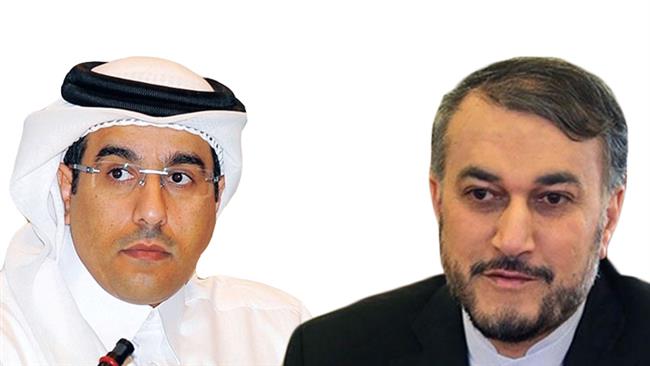
Deputy Foreign Minister for Arab and African Affairs Hossein Amir Abdollahian made the remarks in a meeting with the Chairman of Qatar National Human Rights Committee (NHRC), Ali bin Samikh Al Marri, in Tehran on Tuesday.

He added that the region is currently in a sensitive situation and emphasized that foreigners intend to cause much harm to Middle East nations, who have been coexisting in peace and security for centuries.

The senior Iranian diplomat noted that Iran’s policy is based on the expansion of relations with the Persian Gulf littoral states and called on Tehran and Doha to continue talks with aimed at improving ties.

“The Islamic Republic of Iran stresses the necessity for strengthening relations with its neighbors based on the principles of good neighborliness and adopting smart approaches in light of sensitive regional conditions,” Amir Abdollahian pointed out.

The Qatari human rights official, for his part, said Iran enjoys an important position in the region as well as great cultural, scientific and economic capabilities.

The NHRC chairman added that his country is determined to bolster relations with Iran.